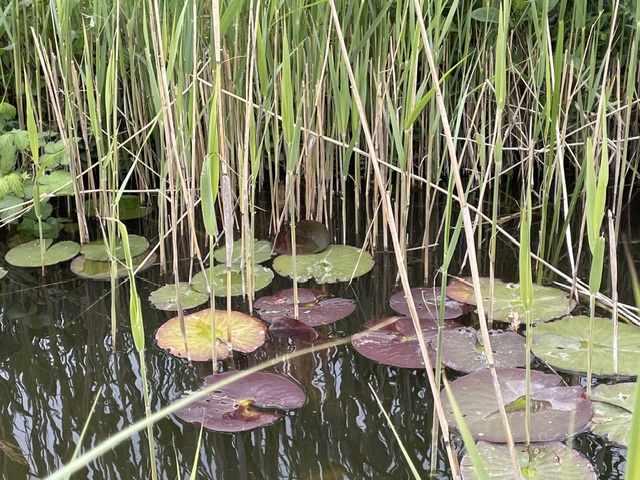
Lodes, Rodes and Sedge

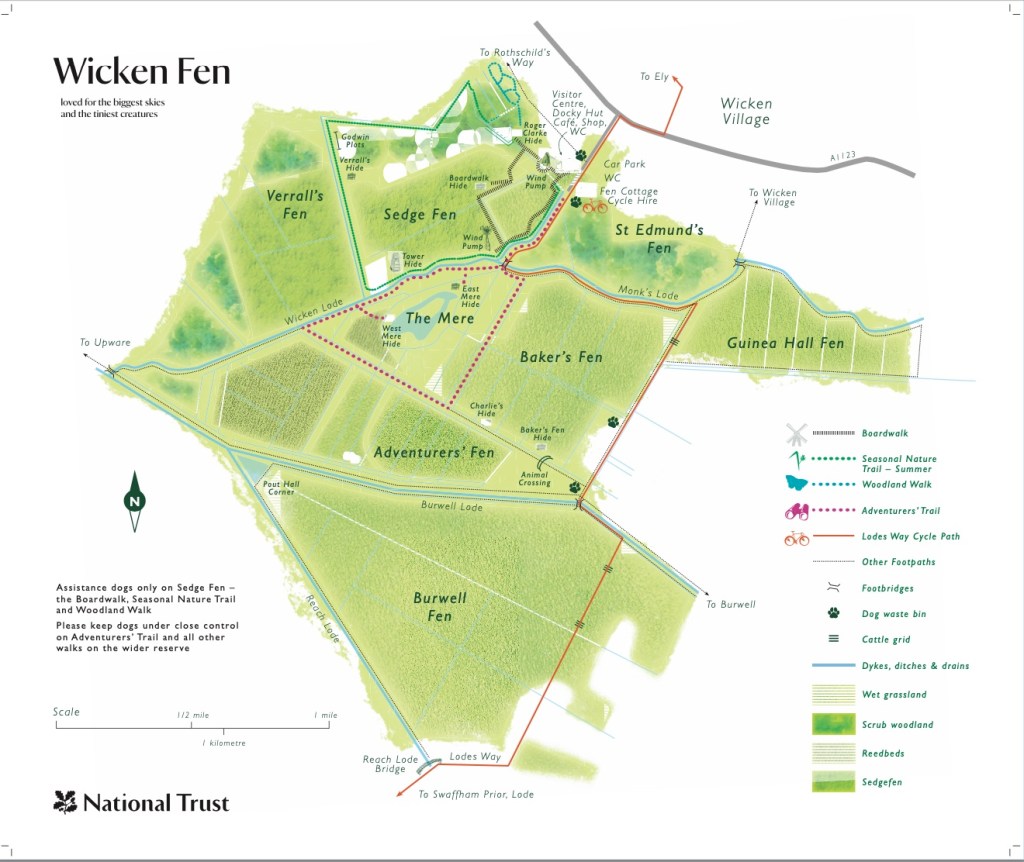
There’s some quiet magic at work when you enter the world of Wicken Fen. Coming from the England of stone walls, fast streams, lush valleys and high moors I’ve nursed a lifelong need to sample the exact opposite. Finally I got the chance to do just that, in this corner of Cambridgeshire, where  horizontal and vertical combine to define new perspectives and land and waterways interact on different levels under a carapace of yawning skies.

Wicken is a complex interrelated wetland that is England’s most species rich nature reserve, as well as being its most studied. This National Trust site welcomes some 70,000 visitors annually; not that it felt at all crowded on a midweek day in May. Quite the opposite!

Over 2,000 years Romans, Normans, Medieval monks, Stuart Merchant Adventurers, Victorian improvers, modern governments and agribusinesses have played their part in draining, containing and cultivating the great rural swathe of eastern England known as the Fens. The bulk of England’s grain, vegetable and fruit harvests are produced in the region as a result. The changes to the landscape have been profound and widespread. Less than 1% of that original wetland ecosystem remains, and nearly all of it is at Wickham.

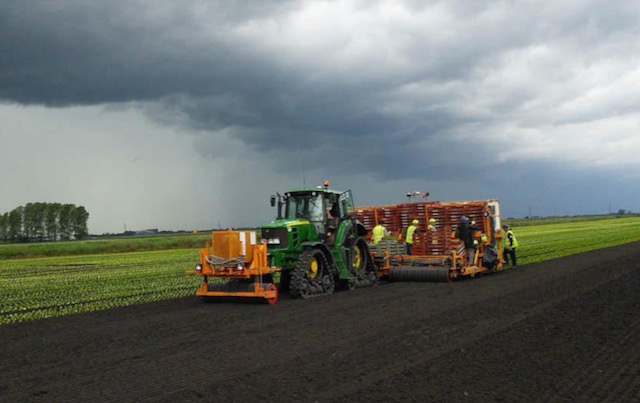
Planting Little Gem Lettuce in a Fenland Field: Credit NFU Online

So how come it’s still here? Partly because in 1637 an armed uprising by locals fearful of losing their livelihoods fishing, water fowling and sedge harvesting prevented the Anglo-Dutch drainage projects of the area’s aristocratic landowners from going ahead here, like they had elsewhere. By the end of the 19th century, naturalists, academics and enlightened landowners who prized this traditionally managed oasis for for its rare bird, moth and butterfly populations took action to preserve and extend it. In 1899 the newly formed National Trust bought two acres of Wicken Fen – the charity’s first ever nature reserve. Now acknowledged as’ the birth place of ecology’ it has grown to be a 629 nature acre (254 hectare) reserve of international importance featuring wet grassland, scrub woodland, reedbeds and sedge fen. More than 9,300 species have been recorded.

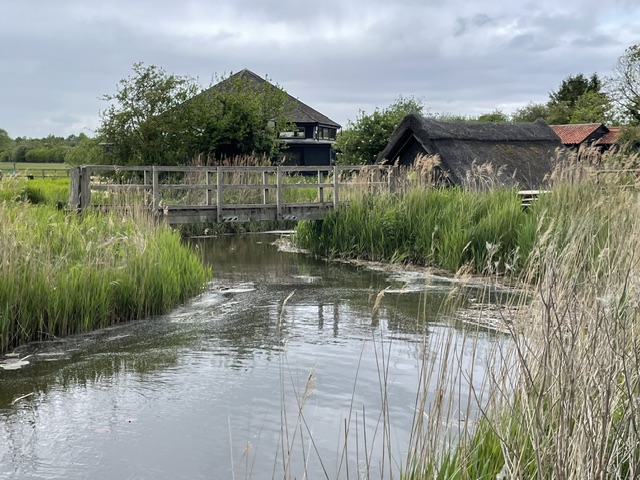
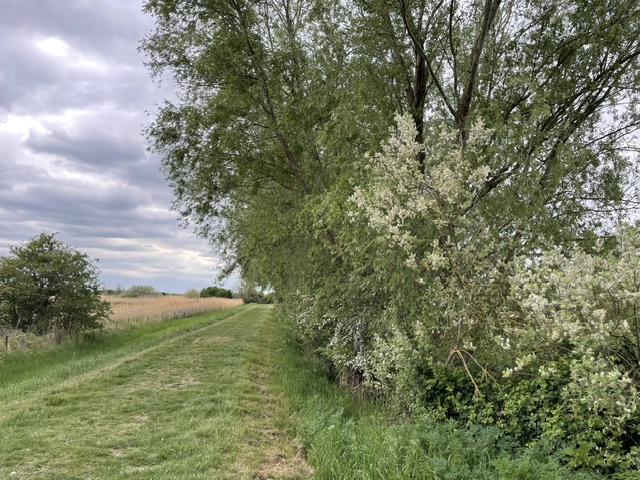
The reserve is connected by a network of boardwalks, paths, bridges and droves (grass roads) alongside ditches, dykes, meres, banks and lodes (canalised waterways). These waterways form part of the River Cam navigation and drainage catchment.
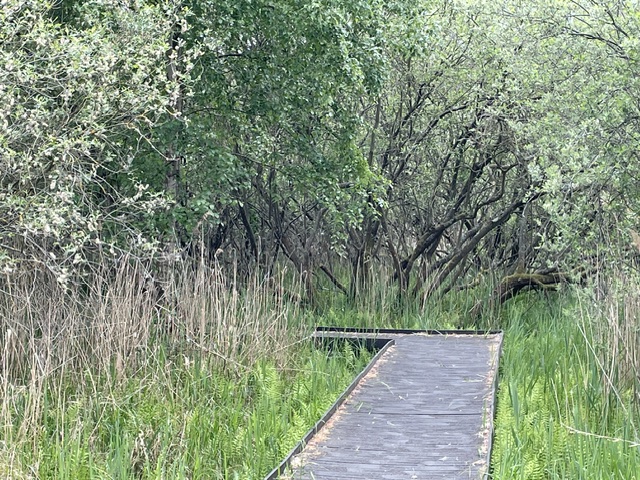
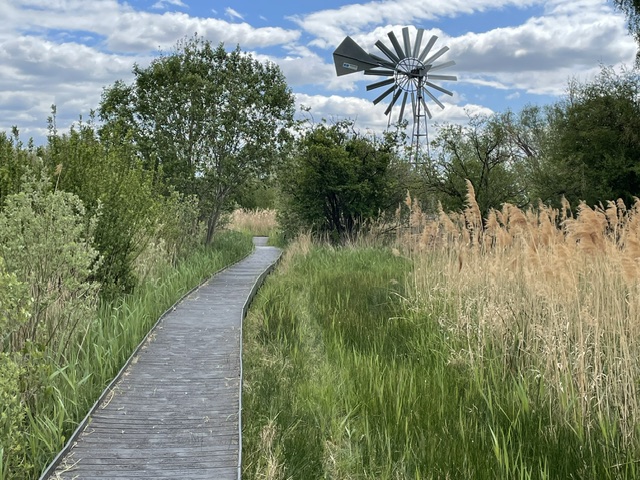
There’s only so much you can take in on one day at such a place. We set off from the Visitor Centre, with its chalk boards listing an array of daily bird sightings, to circumnavigate adjacent Sedge Fen. It proved a gentle introduction and easy perambulation, mainly on boardwalks fashioned from black recycled plastic.

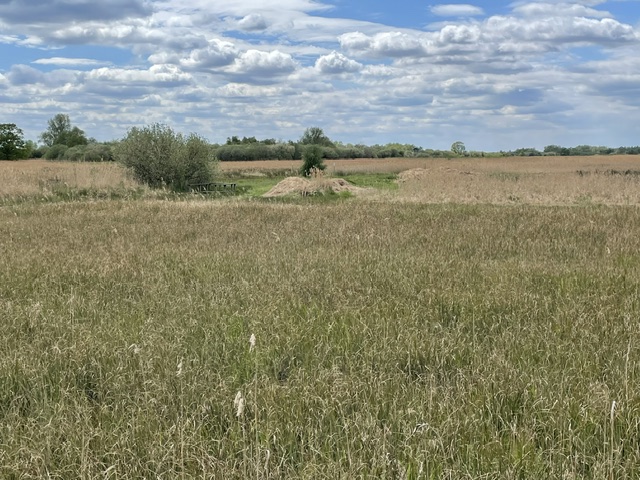
Passed the remains of old clay pits, now deep ponds with coots scuttling, used when this area was a brickworks. Passed through islands of willow and alder buckthorn carr (wet scrub) alive with reed warbler and other bird song. The neighbouring seasonally wet grasslands (above) were cordoned off, for conservation reasons they’re not open for visitors until the summer. Saw Chinese Water Deer, an invasive species, nibbling the turf.

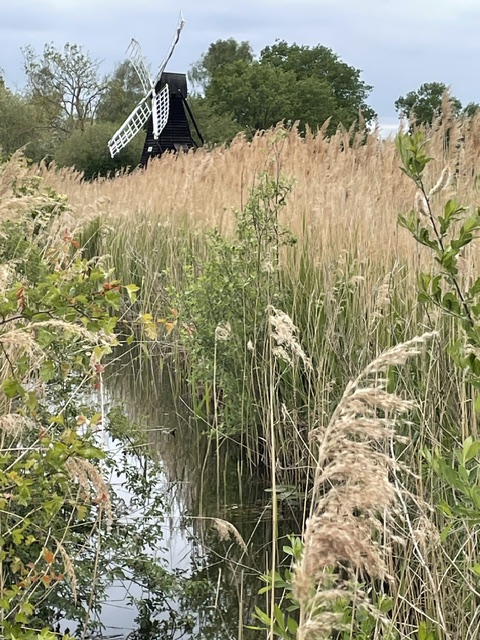
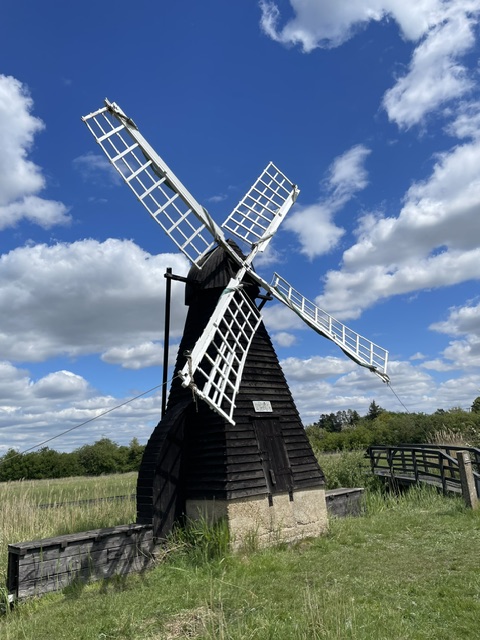
Vertical features have increased pull on the eye in such a landscape. The black wooden wind pump with its white sails is one such iconic marker. A relic of another former Fenland industry, peat digging.

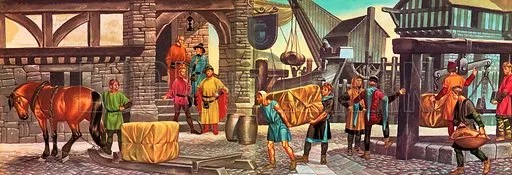
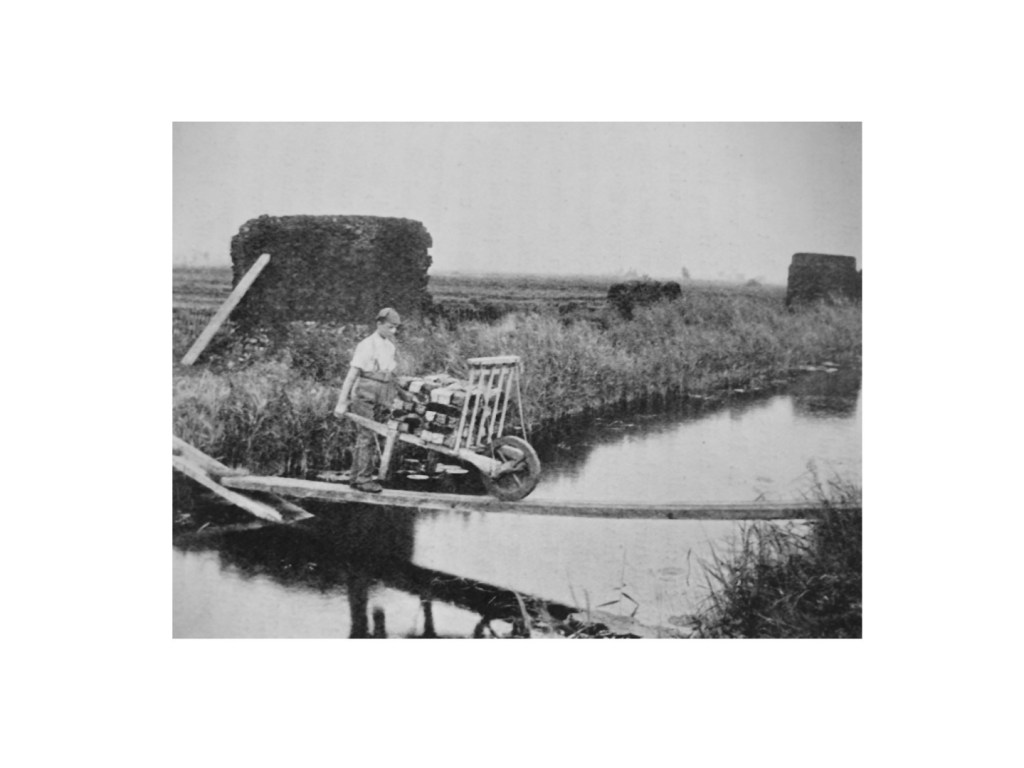
Pushing a barrow of peat turves across a Fenland waterway c.1900

Before steam and diesel, wind power did the draining of the turf pits (peat diggings) so these small mills were once a common sight.

The modern structure seen here is a new wind pump, funded by the Environment Agency in 2011 to draw alkaline ground water to Sedge Fen from nearby Monk’s Lode in the winter months, helping keep the peat soil from drying out, a very real threat as the climate changes.

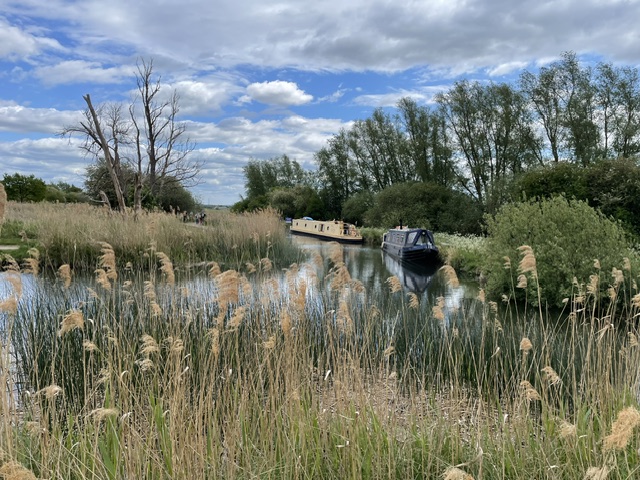
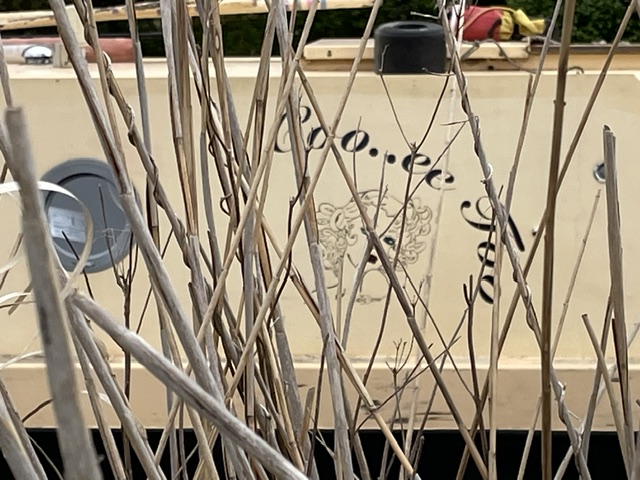
At this point, where Monk’s Lode meets Wicken Lode, is where we came across narrow boats moored. The name of one of them ‘Coo…ee Too’ a pun on a somewhat larger ocean going vessel!

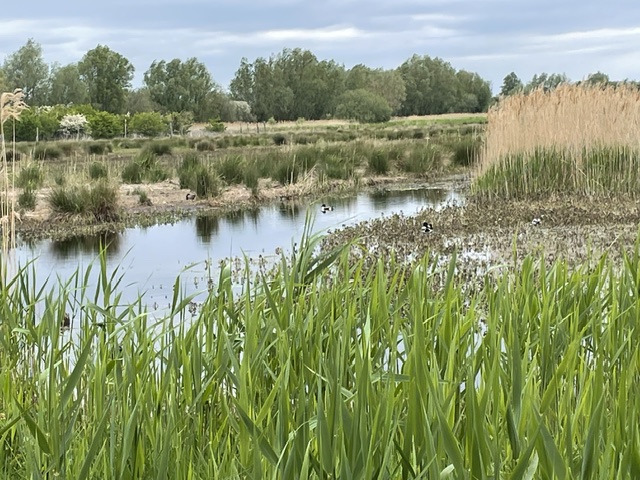
After a picnic lunch we followed paths that led in turn to the straight lines of droves dividing East and West Meres from Baker’s and Adventure’s Fens. And what a contrast. Here we looked down on to swathes of land drained for farming centuries back. An unforeseen consequence was the drying out and sinking of the land, leaving vast acreages below remaining water level. Reflooded by the Trust post WW2 the new bogland and pools in the peat created as a result now attract masses of wildfowl, especially in winter.

We lingered at one of the hides, hearing more birds than we saw. Later, some brave folk passed us on tandem bikes, hired at the visitor centre, bumping furiously along the deceptively uneven drove surface, laughing in mixed measures of anxiety and delight.

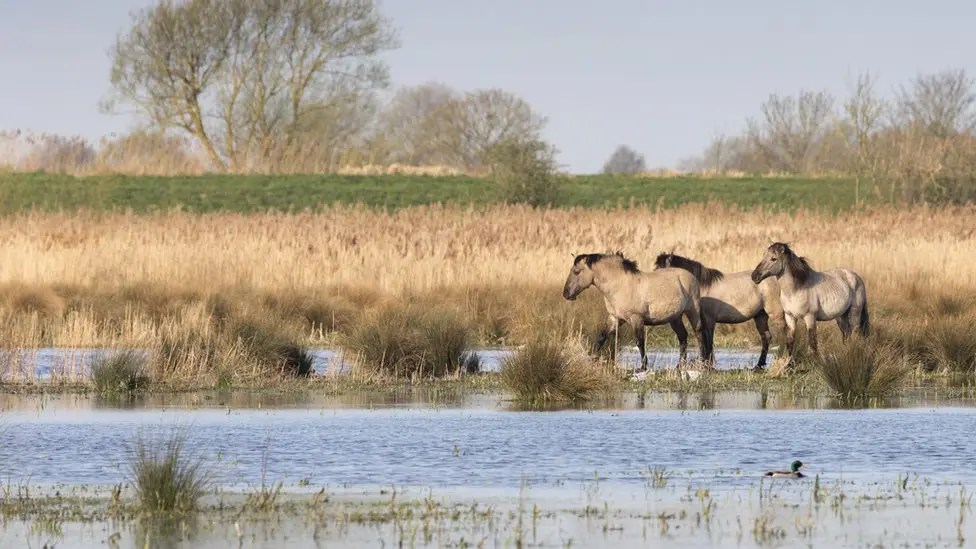
Image of Konik ponies at Wicken Fen: National Trust

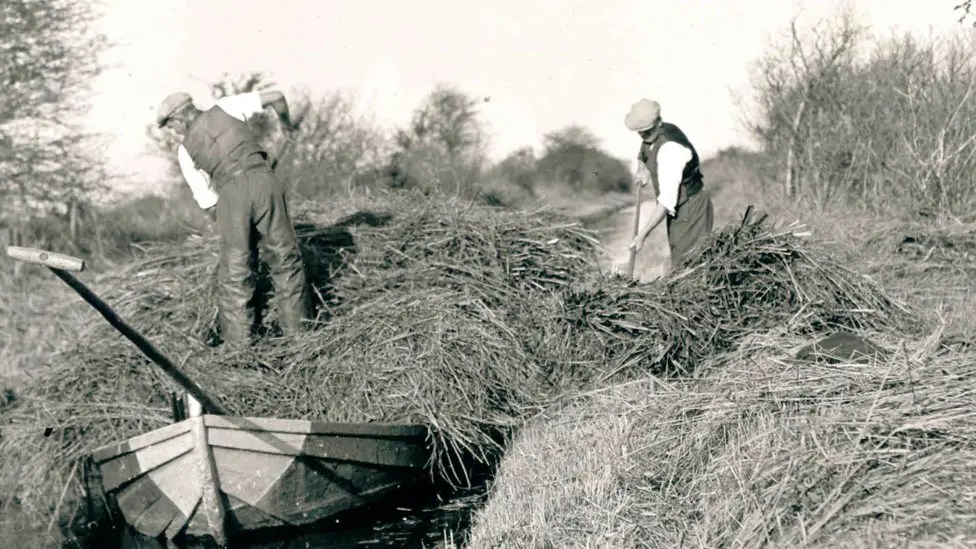
We glimpsed a distant group  of Konik ponies at pasture. Together with a herd of handsome highland cattle, these introduced conservation grazers free range the reserve. The animals contrasting complimentary grazing styles play a key role in managing wet grasslands, doing the job people once did, keeping the ever encroaching scrub at bay. They also distribute wild flower seed in their droppings! Sedge today is cut by machine where once the fenmen cut, stacked, stored and transported the material for a wide range of uses in the textile and building trades.

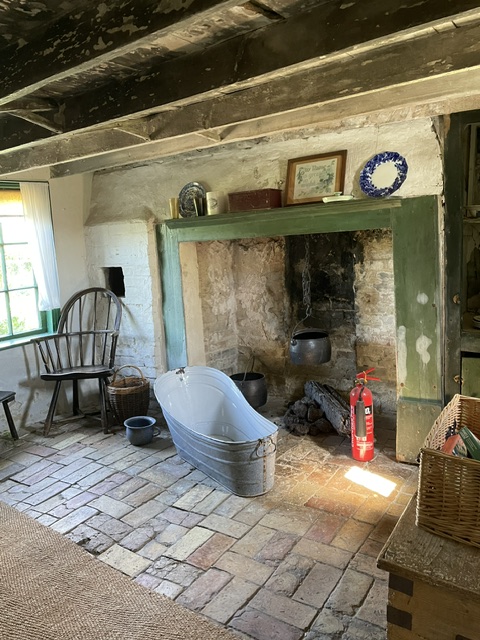
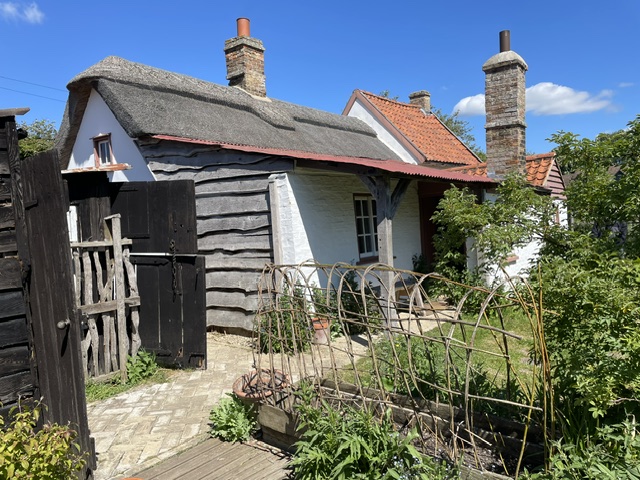
Opposite the visitor centre, off the narrow approach lane, is the pretty C18th Fenman’s Cottage, restored in 1990 and furnished as it might have been in the 1930’s. A must see that gives a fascinating insight into an age old relationship between people, buildings and place.

The cottage is vernacular architecture defined by the use of  locally sourced material; from dried peat  bricks to floor tiles and daub plaster of gault clay, thatching with reeds and sedge.  

Here, for many centuries, local families made a fiercely independent living from a raft of interrelated successional labours. Sedge, reed or willow harvesting, fishing, eel or mole catching, wildfowling, digging peat and clay, cutting litter (marsh hay) or transporting a wide range of goods in and out by water….all dictated by the seasons.

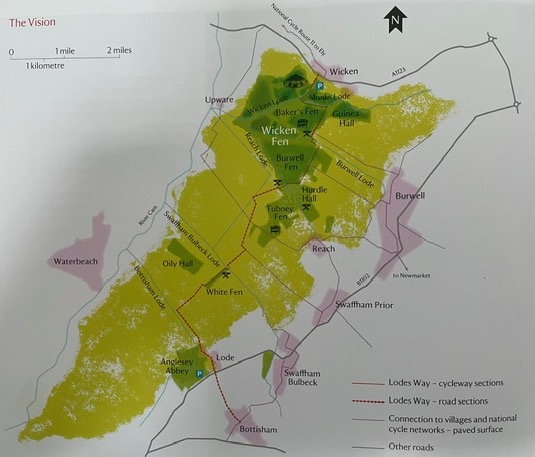
Under ambitious plans set out in the ‘Wicken Fen Vision’ the reserve is set to expand downstream, right to the outskirts of Cambridge. It’s the NT’s commitment to tackling climate change by re-establishing a lost landscape at scale, including nature friendly farm holdings on its edges acting as a buffer zone for the core fenland.

I wish them well in their mission. The Trust is protecting a treasure horde of vulnerable species and preserving precious peatlands, while still enabling  access for all  to enjoy this magnificent if fragile ecosystem. Balancing the need to increase self-sufficiency  and security of food production while including nature as a key to managing a healthy and sustainable countryside remains one of the most pressing challenges of our times.

Past Present

Its floors complain with every tread, soft echoes of its long since dead…A stubborn, time-worn, tender place.  (From a poem by Christopher Skaife)

Leaving Norwich we drove southwards into Suffolk. A winding country lane and the turn off we were looking out for. Down a rutted unmade sunken track, concrete ford over dried up stream, parking at lane’s end. All our stuff offloaded into two waiting wheelbarrows. Anticipation rising, we pushed on up the cracked earth path between swooping acres of barley and lush hedge of young elm, field maple and hawthorn. At the woodland ridge, we turned the corner and…there it was.

Looking like a film set, real yet unreal. No driveway, hedge, wall, garden, garage, aerial, telephone pole or other visual anchor of our times. Self-contained, giving off a curious sense of mirage, as if it could vanish at any moment, its plaster glowing in the late afternoon sun. A present from the past, waiting to be unlocked and occupied in the present.

Purton Green is the only surviving building of a lost medieval settlement, on an abandoned highway leading to the great abbey and pilgrimage shrine of England’s first patron saint, St Edmund the Martyr at Bury, a few miles north-east….We later enjoyed an afternoon exploring its extensive civic gardens where the abbey once stood. A modern bronze statue of the ninth century Saxon king of East Anglia, executed for his faith by marauding Danes, stands in the grounds there.

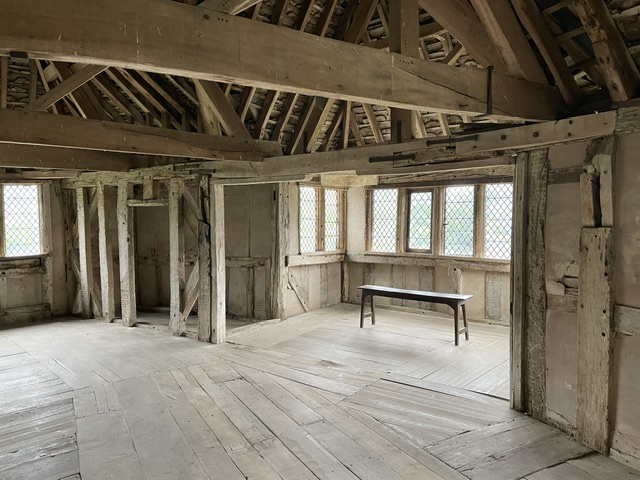
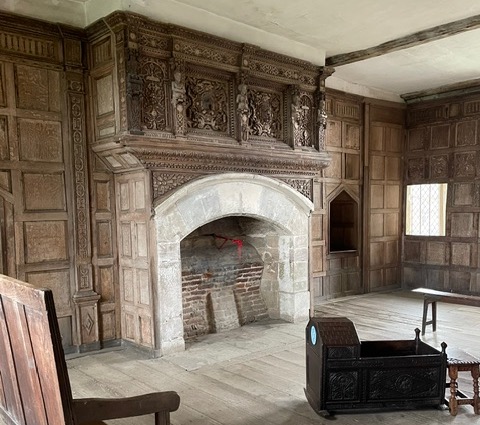
Built as a hall house sometime around 1270, probably by Walter de Priditon,  Steward to the Earl Marshal, a high ranking official of the royal court. It was remodelled in the 15th century and again, when by now a farmhouse, with internal alterations c.1600. Slowly declining in status and condition over time It was saved from total dereliction in 1970 by a nascent conservation charity.

Our medieval homestead was divided when built, as now, into three parts. The service end, where most of the daily work took place. Communal hall with central hearth, where the household met and dined in their social order. The Parlour, inhabited by the owner and his family, is now the cosy cottage like heated section that was our base for the week.

This extraordinary building is distinguished by its arcaded service area and cross frame scissor braces stretching to the open thatched roof. I love the way new replacement woodwork harmonises with the original timber structure.

Because East Anglia lacks natural stone a ready supply of timber from copious woodlands was the obvious building material. Cut ‘green’ and easily worked the individual components would have been assembled then slotted together and raised on site; its many posts, joints and braces secured with wood pegs. Walls made from a weave of hazel wands and daub (clay and straw) completed the construction…The original pre-fabricated building!

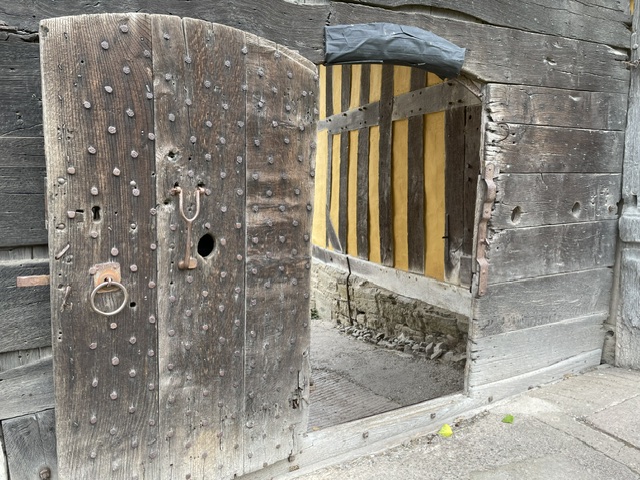
Building ‘green’ leaves properties to warp and shift  with age, a quaint feature we’re all familiar with in old timber frame buildings. This one in Norwich is a good example. Was also taken with the literal ‘door step’ here at Purton Green. A minor human inconvenience to secure a strong frame and keep out dust and mud.

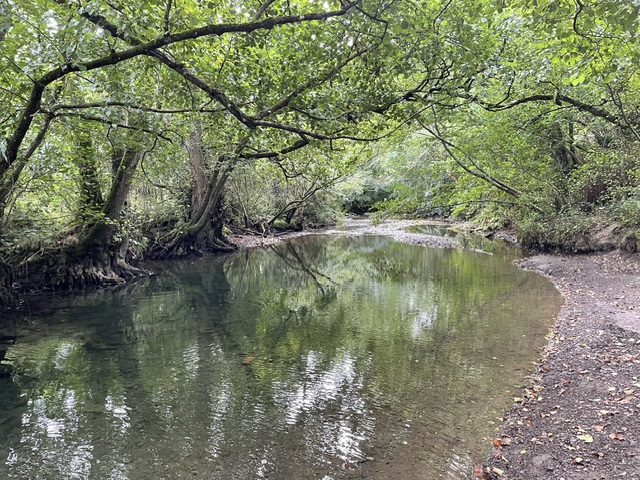
Exploring the immediate environment by public footpath I stumbled across a stretch of former moat under a dense canopy of foliage. (The OS map shows a remarkable number of moated properties in this area). The ground was bone dry and we didn’t see a soul all week. Hares were in evidence though, with birdsong aplenty. At one point a painted lady butterfly landed at my feet.
The only melancholy note of our stay was struck by the sad ash tree out front by the dried out shallow pond. A victim, like so many across the land, of ash dieback.

The most common native broadleaf tree in these parts has to be the horse chestnut. We admired several fine specimens in full flower, which reminded me of lines from Philip Larkin’s poem ‘The Trees’: Yet still the unresting castles thresh/ In fullgrown thickness every May./ Last year is dead, they seem to say,/ Begin afresh, afresh, afresh.

You can read about Purton Green and the charity that owns it here:

https://www.landmarktrust.org.uk/properties/purton-green

Star of the East

Country dwellers like us could take a shine to any city that presents like East Anglia’s regional centre. The centre of Norwich feels more like a town than a metropolis, retaining ancient street patterns while much new building complements the old. Following the trend of breaking  identity down into quarters also suits it well. We stayed two nights at the Maids Head, a venerable independent family hotel, right in the centre. The inhouse hire offer of Bentleys and bicycles must be unique.

From this base on Tombland (Old Norse for ‘open ground’) we took an evening stroll along the quayside that skirts the encircling River Wensum, from Fye bridge to Pull’s ferry. Thanks to the demolition of the former city gas works in recent times that stretch of riverside path is now continuous.

Curiosities here included seeing the remains of a sluice gate and swan pit. With their wings clipped the birds were once culled for feasts at the neighbouring Great Hospital. Formerly part of a monastery and still linked to the cathedral, it continues its caring role as a sheltered housing complex – minus the swan diet.

We watched a male bird waddling along the path while his mate sat on a nearby nest in the reedy corner of a fenced off pond.

Cow Tower (c.1398) is an early example of an elevated gun battery set on a bend in the river. Originally part of the medieval city wall, it  looms up as a flinty floorless finger against the tranquil watery scene below.

Later, in the castle, we’d see the work of Romantic era artists from East Anglia like John Sell Cotman and John Crome. Here’s Crome’s bucolic summer view of the riverside hereabouts in 1819.

Bishops Bridge is a striking original structure of stone and brick, dating from 1340. The oldest span over the Wensum and once a major portal in the settlement’s walled defences. Terraced housing and small houseboats moored on the opposite bank give a peaceful counterpoint to passing traffic. A reminder of navigation that brought boats back and forth to the city’s teeming quays, helping Norwich develop as a major population centre of medieval England. Home to a thriving nexus of craftsmen, artisans and merchants.

The stone used to build Norwich cathedral was imported  all the way from Caen in Normandy. To accommodate that final leg a short canal was dug here in the 1090’s, linking waterway to building site. Now long filled in we passed under the overarching ferryman’s house heading along the cut’s former course, now Ferry Lane, to the Cathedral close.

Next day found us digging further the city’s rich Norman legacy. From the newly refurbished castle to that imposing cathedral. The medieval splendour of the roof bosses in the cathedral is something to behold (preferably with binoculars!) Deeply impressed with the degree of visual narrative power so cleverly compressed in those vivid stone roundels.

The bosses were incorporated into the new stone roof of the late C15th. Yet for most of their existence they have been hidden from view, whitewashed over from the Reformation until late Victorian times. In 1932 they got repainted in their original bright colours.

An extraordinary achievement, 255 in total, looking down from on high above nave and choir, depicting biblical scenes and characters, from the Creation to the Last Judgement. I wondered if the much loved mystery plays performed by trades guilds through the streets of Norwich and other big towns had  inspired the stonemasons in their turn.  

One of the best meals of our holiday was had in this gracious medieval building, the Britons Arms.  In the early C15th this was a ‘Beguinage’, a community of lay single women who devoted themselves to a life of prayer and charitable work. Today its secular tenants create some great dishes cooked with care and skill in the most relaxed and ambient of settings.

Taking a break from matters medieval, we stumbled upon a hidden gem, the Plantation Garden, situated just outside the centre. It’s a redundant chalk pit lovingly fashioned in the second half of the C19th into a charming  green oasis by local businessman Henry Trevor, often re-using redundant building material in the process. The villa he had built as his family home overlooks the tree bordered steep sided three acre spread.

And finally…the steps of the C20th Art Deco City Hall not only give a fine view over the permanent market to the castle keep beyond but also yield overlooked sights of their own.

18 large round plaques grace the great bronze doors of the hall, chronicling Norwich’s history and its diverse businesses… I particularly liked this one of the former soda works.

We only saw a fraction of what Norwich has to offer and would gladly return to experience more. With a medieval church round every city centre corner, a maze of lanes and alleys, a wealth of business large and small, independents and chains, with its universities, museums and the wider cultural offer its civic star is rising. May its light continue to shine.

Castle Acre

Bare ruin’d choirs, where late the sweet birds sang. ( Shakespeare: Sonnet 73)

On the road to Norwich to start our East Anglian holiday we stopped off in north Norfolk to explore Castle Acre. It’s a quiet spot embedded into a rolling landscape of arable chalklands, woods and shallow valleys. But today the air was riven by the passing sorties of fighter planes. A reminder that American jets stationed at nearby RAF bases are actively involved in that country’s current conflict with Iran.

It was military conquest following the battle of Hastings that brought a veteran of that regime changing conflict, William de Warenne, to these parts in the 1080’s. He and his successors planned and built a whole new settlement consisting of priory, village, parish church and castle. Their main seat though remained at Lewes in Sussex.

Artist’s impression of Castle Acre priory as was

Today the impressive remains of priory (dissolved at the reformation in the 1530’s) and castle (abandoned by the 14th century) stand either side of a well to do pretty village complete with pub, teashop and convenience store.

Castle Acre castle site: Source – Wikipedia

Arriving in this region you notice just how much flint is in evidence as building material, alongside other local stone and timber frame. The historic remains are in the care of English Heritage while the estate lands that surround it remain with the Coke family, earls of Leicester, landowners since the mid 17th Century. We noticed they were following the national trend in rewilding parts of the land, especially around waterways and hedgerows.

The priory was a wonder to discover as the ruins are so extensive and allow you to build a coherent picture of it as the grand self-contained community it once was. On entering the grounds you’re immediately struck by the C.12th west front facade of the church and  tower. The adjacent west range was the guest house for important secular visitors. We then ascended stone stairs to the Prior’s chambers, which includes a well-lit hall and private chapel.

These sections of the priory  were always roofed, unlike the religious buildings which were ruthlessly stripped following dissolution for their valuable construction material. It became a farmhouse and stores with the former priory ruins and meadows grazed by stock or otherwise farmed. In the  C.18th and C.19th growing appreciation of the picturesque and further interpretation and recording by antiquarians and artists allowed the Castle Acre complex to be seen in a new light and by 1929 the government  Ministry of Works were allowing visitors regular public access to both priory and castle.

Of the ruined complex, largely stripped of dressed facing stone, the most evocative are the parts that betray human interaction, like the well-worn stairs that led up to the monks dormitory, where the brothers slept in their robes of black and white. The reredorter (literally, ‘at the back of the dormitory’) is a narrow two story building which was used on an industrial scale as a latrine block. Underneath is a watercourse designed to carry the waste away.

The castle footprint is huge, with steep embankments, ditches and motte. The De Warenne’s first buildings however were a relatively modest affair set within the outer defences.

It was only later, in the C13th civil wars that raged between nobles supporting the rival claims of Matilda and Stephen to the English throne that it was rapidly transformed from fortified house to full scale fortress, with barbican and inner bailey additions.

That protection stretched to an outer town wall and a bailey gate entrance, through whose narrow archway we carefully drove on entering and departing.

Norwich Castle Great Hall

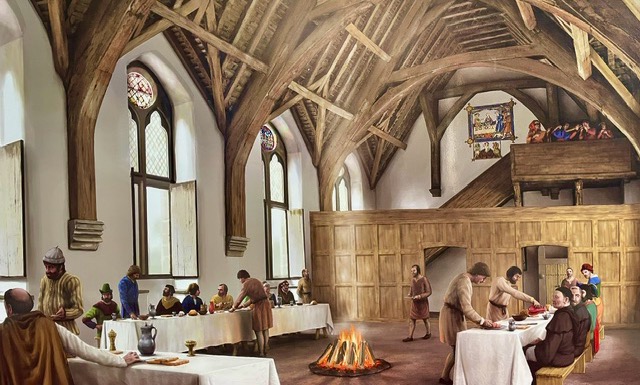
In Norwich we were impressed with the multi-million pound makeover of the great Norman castle (or rather the remaining keep) which has been five years in the making and feel it would make for a worthy winner of this year’s ‘Museum of the Year’ award. The great hall would have been similar to the De Warenne’s eventual fortress creation at Castle Acre.

Two exhibits displayed in the revamped medieval treasures display pertain to Castle Acre. This C15th parchment chant book, made and used by the Castle Acre monks, is  of vellum (calfskin) oak and leather and small enough to be held in the hand. It’s complete with instructions (in red) for use in services as the brethren processed through the priory on different feast days throughout the year. The Cluniac order, founded in the French town of Cluny in the  6th century, strictly followed  the rules set down by St Benedict, but was also renowned for a love of art and decoration, which would have resulted in the walls of their establishments being brightly coloured and expressive.

There’s a timeless quality to this simple board game of Nine Men’s Morris made of chalk with horse motif, found at the castle in Castle Acre. Two players try to place three of their counters in a row, allowing them to remove one of their opponent’s pieces. Whoever removes enough of their opponent’s counters to prevent them from moving is the winner.

Castle Acre is a fantastic place to get an idea of how the temporal and spiritual life of a rural medieval planned settlement would have appeared. Well worth a visit, especially at mid-week when we were only two of a handful of visitors at the priory. More at https://www.english-heritage.org.uk/visit/places/castle-acre-castle-acre-priory/

Hedges, Nests and Willow

Who doesn’t want to see the back of winter?  The trouble is winter doesn’t want to see the back of us just yet. Spring is a tad tardy in appearing here in the borderlands, arriving in fits and starts. But the longer days and gradual greening is cause for cheer; the soundtrack of curlew, skylark and lapwing balm for the ear.

Good progress on the mile of roadside hedging either side of our abode established by our friends and neighbours at Southridge. I continue the volunteer monitoring, rectifying fallen guards, replacing rotten or broken canes. Now hawthorn and hazel, blackthorn and run ahead roses are breaking cover, waving in the wind atop their protective plastic tubes.

Earlier this year, one misty day, we stopped to right a cast ewe in our neighbour’s field. The animal’s gravid barrel body and dense fleece had stopped it righting itself, so glad to lend a helping hand. The flock were taken off last week, back to the farm, and now the biggest and best pasture is filling with ewes and lambs.

Next to it our four acres of rough grazing is back to host the tups – Texels and the Border Leicester ram who has featured in this diary before. They loll about not doing much, like old fellas down the working mens club, while their offspring skip and leap about on the other side of the dry stone wall, oblivious of their presence.

Delighted to catch hares re-appearing in the garden at all hours, whether grazing or just passing through. With no dogs or cats on the premises they have no fear of being driven off. Am convinced these particular hares are the adult form of those last seen as leverets on summer evenings, gathered as a family group on the garden paths whilst their dam was out and about foraging.

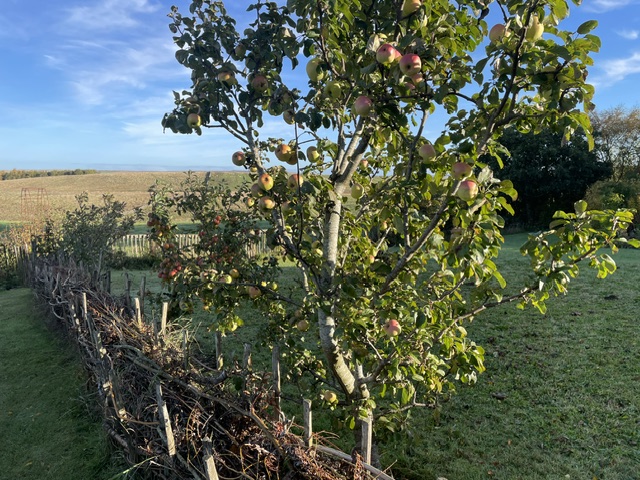
Earlier this year I decided to create a dead hedge in the garden. By recycling as vertical stakes the best preserved chestnut paling in the picket fence that separated kitchen garden from meadow we were able to establish the hedge’s breadth and length. Then built up horizontal layering and weave with pruned branches of old willow, alder and various woody bushes over following weeks. A remarkably satisfying transition, relatively easy to accomplish, in the rustic tradition!

We’re hoping this dead hedge will benefit resident wildlife, act as a windbreak, and add another blended structural feature to the garden. I’d been gradually repositioning the bigger species of daffodils along the former fence line over the years so pleased to see they sit equally well, framed by the new hedge.

I never knew there were so many varieties of willow. In the wake of my clearing old established ones  from the largest copse the serious family gardeners/ craftswomen planted these varieties in wet ground and large pots with an eye to harvesting for weaving into baskets and wreathes. I will chip  what they don’t use for mulching and adding to compost. The straight young wands go down the throat of my noisy little chipper a treat and cause it few digestion problems, unlike tough knotty stuff like hawthorn or blackthorn.

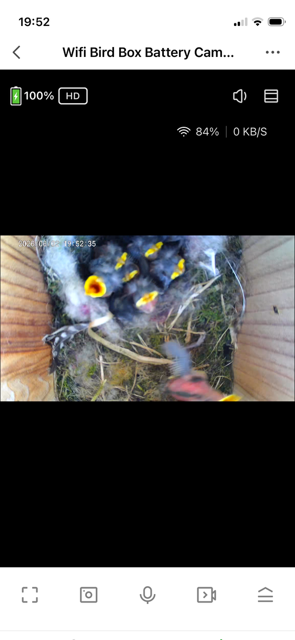
A lovely family Christmas present was a solar powered bird box with camera. Setting it up proved a tad tricky (It helps to read the instructions about operational range from router) but after a few false starts and final technical know how applied by the giver, we were finally set and ready to go.

Within hours the camera showed us a shake of moss on the box floor. I took that to be a down payment by a would be tenant and gradually more material appeared. At first I thought a wren might be the mystery depositor but soon we caught sight of the visitor. Rather unsurprisingly it turned out to be one of the blue tits that colonise the garden every year.

The bird’s hyperactive action in burrowing and fluffing the moss with its wings before stopping to view the result and flying off was a revelation. That led us to think it must be drying through aerating the fluffed up soft material. Constant re-arrangement takes place as a dense pile builds. Strands of dried grasses and cloudy swirls of sheep’s wool have been integrated into the uniform bed of green and we await full time occupation and laying of eggs.

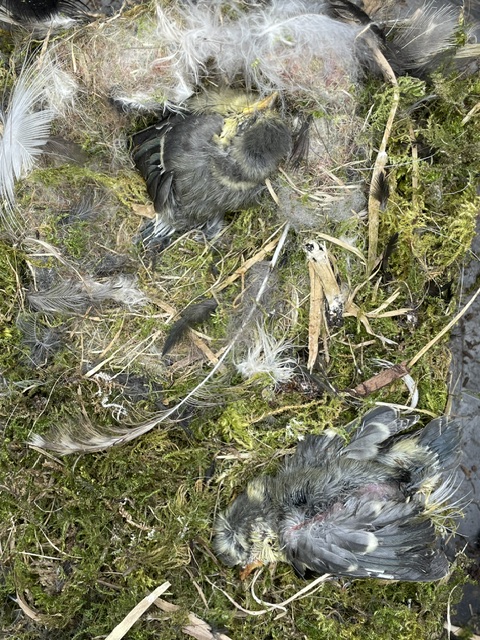
A few days ago we recorded this remarkable night time image. The adult bird has spent a lot of time preparing to roost by pulling out hundreds of its feathers to form a warm duvet to maintain life through the cold night. Early morning will be spent relaying them.

Meanwhile in the open gated garden shed we call the railway hut – the body of a former goods wagon – blackbirds have again taken up residence. In previous years they favoured a seed tray on a high shelf to support their intricate weaved abode. This year, oblivious of our entrances and exits inches from them, their nest sits exposed atop coat hook nails flush by the doorway. The hen, all head and tail, totally silent and still, keeps a sharp eye on our comings and goings.

Post publication update: Two new arrivals

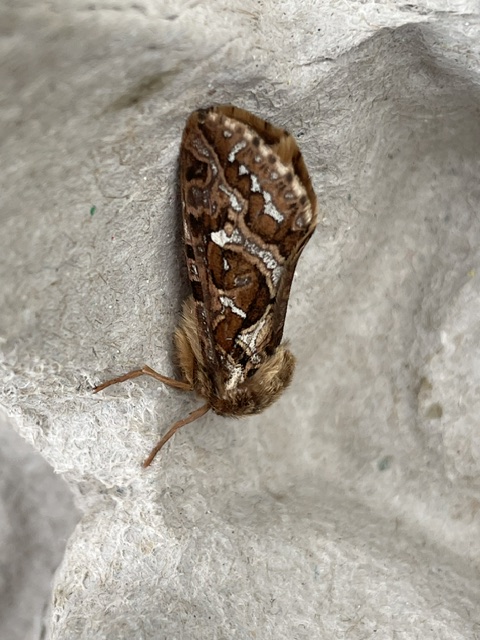
Starting to trap moths again. Amongst their number the usual early arrivals on the spring scene like Hebrew Character, Clouded Drab (pictured) and Common Quaker. Look forward to having more species visit as we warm and settle. That and following the progress of the nesting birds we know about while looking out for signs of where our other avian residents – wagtails, dunnocks, robins etc – will be bringing their broods into the world.

Sizergh The Day

I’ve visited a lot of National Trust properties during my adult life. In the 1980s & 1990’s it was as an actor/researcher with their young people’s theatre company, devising and staging immersive dramas. More recently I was a welcome host then garden volunteer at Cherryburn, the Tyne valley farm that was Thomas Bewick’s childhood home. But it’s as an ordinary member that I’d rate a day spent on the Sizergh Castle estate near Kendal in Westmorland as one of the most coherent and harmonious of visitor experiences.

This happy outcome was due to an ideal combination of activities. A fine walk with varied views, seasonal garden delights and characterful castle interiors, rounded off with sampling the scones offer in the café.

The Sizergh estate came to the National Trust in 1950 after centuries in the ownership of one family, the Stricklands, whose Anglo-Norman ancestors inherited it through marriage in 1239. The family still retain part of the house as their private home. The 1,600 acre (647 hectare) estate is commercially farmed by tenants while rangers develop and manage nature restoration and greater access projects in and around the agricultural framework.  

The well signposted Sizergh Fell trail provided lots of interest.  At the 400’ summit, overlooking Morecambe Bay to the south,  we came across remains of neolithic burial sites and traces of Romano-British settlements peeping through cropped turf and brambles at the edge of a huge swathe of tussocky anthills. Traditional British breeds of beef cattle are kept here, well adapted to this kind of upland grazing. Fittingly, the old English derivation of the name Strickland apparently means bullock pasture.

The track dips then rises to follow the limestone ridge, yielding fine views across the Lyth valley levels up into the mountainous heart of the Lake District. A brief ferocious hail storm cleared the grey clouds and let some sunshine in. Emerging from Brigsteer woods we  found ourselves at  Helsington Church, sheltered by its tree bordered burial ground now carpeted by daffodils and white starred wood anemones.

Inside the modest  light filled  interior the Georgian church’s distinctive decorative feature is wonderfully revealed…A whole wall depiction of supplicant female angels in a setting of Lakeland fells framing the altar below.

Dating from 1919, the painting commemorates those who gave their lives in the Great War.  Along with the altar paintings depicting flowers and other motifs, it was the work of a  female artist  who lodged at Sizergh Castle, Marion de Saumarez (1885-1978). Executed in oils on canvas the composition was stretched on battens and secured to the wall.
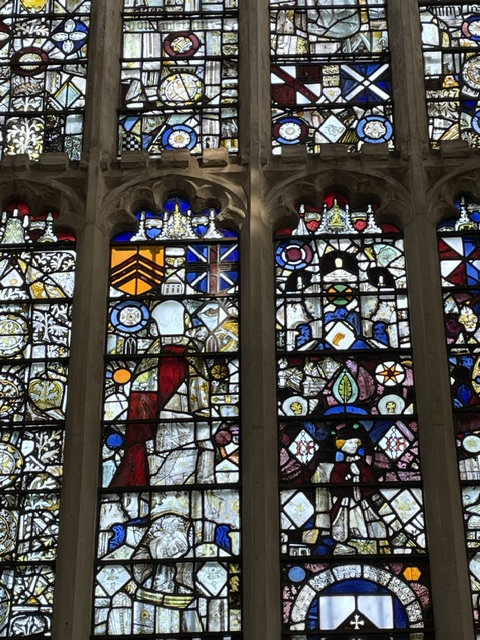
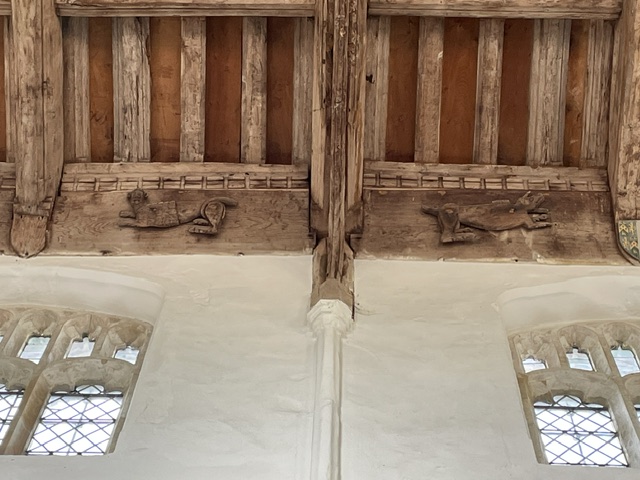
On our gradual descent back to the start we appreciated  the quality work put in by the rangers to make this circular trail so user friendly.

From  bespoke gate latches  to the  limestone dry stone walls strengthened by through ties of metal wire and wood block. This particularly thick wall also had extra stock proofing on the field side in the form of blackthorn hedging, which was just now coming into flower.

Down at Holeslack farm (now holiday accommodation) new laid hedges framed a damson orchard. In the old barn were bundles of hazel rods harvested from the neighbouring wood, no doubt to be used in hedge laying and other tasks about public parts of the estate.

The building is also playing host to a temporary exhibition celebrating the often undervalued and overlooked role of women in upland hill farming in the 21st century. Illustrated by great images of said women at work on their farms, their number including profiled chroniclers of rural life like Andrea Meanwell (Tebay) and Helen Rebanks (Matterdale).

A walk through Holeslack woods revealed the wide paths and smooth surface to allow buggies and wheelchairs easy access. Dogs Mercury – an indicator of ancient woodland – is here in abundance. A branching path led us to a platform overlooking a wildlife pond on the woodland’s lowest edge, framed by arches of live willow wands. A nice touch.

The gardens at Sizergh are a delight. Conversations with one of the gardeners about the narcissi as we strolled through gave extra pleasure to the discoveries.

The wide borders, cordons of pears against orchard walls, herb beds framed and sheltered by reflective slate; an extensive sunken limestone rockery with pools, shrubs, trees and alpines giving way to large formal ponds, steps and terraces that frame the castle’s impressive south elevation.

The castle core is the most impressive architectural feature to my eyes.. That’s the oldest section, the 60’ high C14th Pele or Solar tower. It also has the original spiral staircase which the little boy  inside me was quietly thrilled to descend at the end of our visit.

Inside the great square tower and its elegant Jacobean extension the takeaway impression is of dark oak floors and wall panels punctuated by huge sculpted fire surrounds within massively thick walls, enlightened and enriched by fine furniture and hangings. There are also generations of family portraits, alongside those of the Stuart monarchs many of them served. So close an association in fact that Thomas Strickland was forced into exile in France alongside fellow catholic James II after the Glorious revolution of 1688, never to return. His successors were fortunate to retrieve the family seat after protracted legal action.

In the 1890’s another dip in fortunes saw the selling off of the inlaid wainscoting that gave the Elizabethan bedroom at the top of great tower its name. A very rare survivor in a country house of oak panelling inlaid with pale poplar in floral and geometric patterns. London’s V&A museum had bought the panels from the family and displayed them throughout the 20th century. The story gets a happy ending when the NT and the V&A struck a deal, facilitating their refit in aitu in the 21st century.  We’d like to return too, to experience the garden in another season and explore those parts of the wider estate we’d not had time to discover this time around.

Footnote: returning home next day the weather turned  truly elemental in a way that only Cumbrian weather can. We spent a happy morning out of the biblical deluge, enchanted by the Windermere Jetty Museum in its impressive architect designed home on the lake at Bowness. It houses an extraordinary collection of craft associated with Lakeland waters and also offers – weather permitting – trips aboard steam powered vessels on Windermere.

What really made our day though was when we eventually got to Castlerigg. Situated on a shoulder of hillside, between Keswick and the town’s neighbouring mountains this impressive stone circle is estimated to be some 3,000 years old.

Rediscovered by romantic era influencers of the early C19th like Wordsworth and Burns this mysterious round of huge stones then stood marooned within a ploughed field. The most likely reason the circle’s single stone outlier was moved and repositioned in a corner of the field was to ease passage for the plough and team. The ghosted form of rigg and furrow (ridge & furrow) is still evident  in the flattened corrugated ground. A challenge to stay upright when fiercely buffeted by fierce wind and rain but the effect was extra spectacular and – more selfishly – the weather helped keep this spell binding picture free of fellow humans for a while!

Linhay Restored

In June 2022 I published a country diary titled ‘Linhay, Tallet and Barn.’ https://stephentomlin.co.uk/2022/06/27/linhay-tallet-and-barn/ Traditional west country farm buildings might be something of a minority interest but the spirit of my friend Tom’s writing style comes shining through and the story of their restoration updates my earlier blog.

Tom’s fields by Peter Tavy village, west Dartmoor

Linhays, Lintels and Lunkeys by Tom Roskilly, from The Peter Tavy Piper April 2023 (parish quarterly newsletter)

Anyone who casts their mind back to February 2022 will remember that ‘furious winter’s rages’ and in particular Storm Eunice which blew in with gusto on the morning of Friday 18th, leaving a trail of havoc in its wake. Out at Willsworthy brook bridge, a tree fell down and blocked the road, but thanks to the sterling efforts of Tim Dodd, who was working in the area, it was soon cleared for residents to go on with their busy lives.

At Lower Nutley, Janet heard an almighty bang whilst in the sheep shed, and looked out to find the roof of an old shed in the lower field completely gone and deposited in the field above the cottage. The shed, which we have always referred to as ‘The Abbot’s Linnie’, had been useful as a nursery for ewes with young lambs, but alas no more. Scrolling on to May, Steve Allen – an old Tavistock School friend – and his wife Kim were spending a short break in the vicinity and dropped in to see us. He is an actor by trade (AKA Stephen Tomlin), with an interest in all things local and historical and so we took them over the lane to see the old building in its damaged state.

Old Linhay before restoration

After doing a little research he told us that our building had most likely been an old Linhay, where cattle were sheltered and fed below a sort of loft where hay was stored. The loft area had long gone, and the gaps between the unique round pillars have been stoned in for ages, but nevertheless it has all the features of this type of farm building really only found here in the South West. Suffice it to say that, thanks to a local builder well-versed in the concept of restoration, the Linhay has now acquired a new roof, not only to protect its rather special architecture, but also to give it a new lease of life for sheep-husbandry.

Across the lane, Lower Nutley – aka Old Nutley – is very old as well, and whilst ‘our’ builder was about, he also replaced a couple of decaying Lintels above the front-facing windows. Now, whereas most people will know what a Lintel is, they might not know what a Lunkey is. To tell the truth, I only came across one when I listened to an episode of ‘The Archers’ some years ago, when a chap appeared on the scene at Ambridge to build it.

Lunkey – or hogg hole as this one would be known in the north – now blocked.

A Lunkey is essentially a dedicated passage through a stone wall or bank for animals to travel through. You see them around here in several hedge banks, often stock-wired up now because they’re no longer appropriate, much like the stone styles which post-boys used years ago to take the shortest route between distant houses in the parish.

Tom, Stephen & Janet

How does all this fit together? Well, Steve played the chap in the storyline who made a masterful job of constructing the Lunkey. Quite clever people, these actors! Oh, and by the way, in 1991 he ‘stormed’ through and won Mastermind with his knowledge of Sir Francis Drake and the Armada of 1588.From what I remember the Spaniards ran into a bit of bad weather as well when they were on the way home that April and it didn’t end well for them. So, notwithstanding climate change, one thing’s for sure: if you’re thinking about more sheep housing, or even crossing the Channel, you can’t go by the weather in the previous year….In contrast with the gales of last year we’ve just had the quietest February the Met Office could have ever recorded!

Physic Visit

A garden is a grand teacher. It teaches patience and careful watchfulness; it teaches industry and thrift; above all, it teaches entire trust. Gertrude Jekyll

Coat of Arms of the Worshipful Society of Apothecaries on the Water Gate at CPG. London’s oldest existing livery company, founded 1631.

There’s something of a thrill to be had in stepping out of a noisy London street into an old walled garden. And not just any green urban oasis but the Chelsea Physic Garden, the country’s second oldest, after Oxford’s Botanic Garden. In that time it’s been intensely studied, expertly curated and lovingly cared for by generations of gardeners and botanists. Always constant, always changing.

Plan of Chelsea Physic Garden in 1751 (Image: Wallace Collection)

Cultivating medicinal herbs and other useful plants from around the world, ensconced in its own microclimate, these precious four acres are bounded by busy thoroughfares, elegant Georgian terraces and lofty Edwardian apartments. The physic garden was established on the site of a market garden in the village of Chelsea  by the Worshipful Society of Apothecaries in 1673. It was meant as an outdoor classroom for apprentices to study medicinal plants and their uses. An independent charity since 1983, the hitherto private garden only opened its door in the wall to the public in 1987.

Dicotyledon Order beds

We had a relaxing lunch in the cafe before exploring. I ambled off to crop some pertinent facts while the head gardener took her own more knowledgeable and thoughtful turn around the grounds. Being early February we only expected to take in a  structural sense of the place, but its sheltered site and great variety of plants in different sections meant there was much to see and admire, and of course no crowds to navigate – unlike the major art exhibitions we’d visited.

The Water Gate

Up to mid Victorian times the site enjoyed a river frontage, with  plant bearing barges plying their way downstream to Apothecary Hall, Blackfriars, in the City of London. Construction of the Thames Embankment –  a huge undertaking carrying underground railway, sewage pipes, walkway and road – divorced garden from river highway. Now an elegant water gate marks the old entrance route and baffle boards by boundary railings soften the traffic noise.

The garden was once famous for its spectacular Cedar of Lebanon trees; being one of the first places in England where they were grown successfully from seed. Alterations to the water table caused by the embankment barrier saw those venerable trees wither and they had to be felled. A rare failure for an institution that started its international seed exchange programme as long ago as 1682.

Thinking fondly of  the horticultural businesses that flourish in the famous ‘Rhubarb Triangle’ of  West Yorkshire I learnt that the technique of forcing (light prevention) was accidentally discovered here back in 1817. Another claim to fame is the rockery round the central pond, originating from 1723,  credited with being the first of its kind in the world. In the same year the garden’s glasshouses, heated by stoves, produced pineapples and other tropical fruits, which says something about the status of the place at that time. Only the very wealthiest in Georgian Britain could afford heavily taxed glass for greenhouses and the staff necessary to produce such exotic produce on home ground.

Arrested by an entrancing aroma, my nose led me to a plant with yellow tufts of flowers called Edgeworthia Chrysantha, AKA the Paperbush shrub, which originated in China. The long inner bark of the plant, known in Japan as Mitsumata, was used for centuries to make bank notes there, so strong and tear proof is the natural fibre when pulped. A fascinating origin story, just one of many plant histories recounted here.

The section given over to poisonous plants is clearly a visitor favourite. A student nurse who completed her Apothecary training in 1917 and who lived nearby, between the wars, was Agatha Christie. She famously used that insider knowledge of deadly plants grown here – hemlock, belladonna, foxglove et al  – in the plots of her many murder mystery novels. 

Although you wouldn’t know it  at this time of year, the spiral eyecatcher of a contemporary sculpture, marking the garden’s 350th anniversary in 2023, also doubles as plant support in the summer months, which is pleasing.

Another impressive structure is the original Victorian cool fernery and adjoining glasshouse, comprehensively restored thanks to funding from the Heritage Lottery. These elements of the garden were particularly popular in the C19th century when Chelsea  further extended its reputation as the foremost collection of medical plants in the UK. 

As country dwellers we found this venerable cultivated corner of the capital a quietly engaging draw. Remarkable that it hosts as many as 80,000 visitors a year and that more than 4,500 species of edible, useful and medicinal plants from home and abroad have are on show here. Our quiet afternoon discovery allowed us to appreciate its semi-dormant state while imagining what it would be like in other seasons…Cue return visit!

More at: https://www.chelseaphysicgarden.co.uk/

Medieval Treasures

Where are the men who came before us/ Who led hounds and hawks to the hunt, / Who commanded fields and woods? / Where are the elegant ladies in their boudoirs / Who braided gold through their hair / And had such fair complexions?

Extract from an anonymous poem c. 1275, trans. Michael R Burch)

There are more than one and a quarter million objects on display in the Victoria & Albert Museum. Since 2009 the medieval and Renaissance treasures are displayed in five galleries in that vast C19th cultural complex. On our recent London visit we confined ourselves to just one gallery, and were not disappointed with what was discovered. Here’s a bit about a handful of treasures on display connected with the west and north of England.

The wealth and power of a medieval English king pales in comparison to the richest and most splendid of European courts upheld by the magnificent Dukes of Burgundy, centred on what is now roughly southern Holland and northern Belgium. These towns and cities were the nexus of the continent’s major  trading  centres in luxury goods and services. This huge Flemish tapestry dated 1425-30, completely covers the gallery end wall. Formerly lodged at Hardwick Hall Derbyshire it was accepted by HMG in lieu of death duties on the estate of the 10th Duke of Devonshire.

Conspicuous wealth is on show here, the tapestry’s narrative function as great as that of its role decorating and insulating a castle or household interior. Only Kings and aristocrats were allowed to hunt game, like the bears and boars depicted here, and participants attire is strictly status related, eschewing practical hunting clobber. The ladies fur for example is miniver, an expensive pelt from the bellies of hundreds of Baltic squirrels culled in winter.

Three unique half-life size oak figures stand out against a background of the  great tapestry. A knight, his squire and man-at-arms; three orders of society in a great feudal household. Dating from the early 1500’s, they’re believed to have supported heraldic devices, and were placed high in the great hall of Kirkoswald or Naworth castle in Cumberland, properties held by the powerful Dacre dynasty. The armed man’s helmet or sallet was an essential piece of soldering kit but it also limited the wearer’s vision and impaired his breathing. In 1461, during the battle of Towton, a helmetless Lord Dacre was killed by an arrow while taking  a desperately needed drink of water. A monument marks the fatal spot of that terrible battle in the Wars of the Roses. (We visited in 2025 https://stephentomlin.co.uk/2025/05/01/towton-field/

The tragic epic romance of Tristan and Isolde in Cornwall had huge appeal to the wealthy elites right across Europe and lots of art work reference it. This superb broadcloth bed covering, made in Florence for a rich merchant family between 1360-1400, really goes to town on the tale.

It’s a wonderful display of compressed narrative detail chronicling the epic story, with extra pieces attached at various times, fashioned from linen and cotton. Kim, who comes from a long line of quilters, was particularly impressed with the skill involved in its execution.  

Surviving examples of luxury medieval Islamic glassware are exceptionally rare so this pristine one from Syria or Egypt dated to c.1350 has special significance. A talisman of the Musgrave family at their seat of Hartley castle and later at Edenhall in Cumbria ‘The Luck of Eden Hall’ has been protected in part by the 15th century leather case and – if local legend is to be  believed – by fleeing fairies,  who left it in human hands with the warning ‘If this cup should break or fall / Farewell the luck of Eden Hall.’ Curiously, in northern farming circles it remains customary to gift ‘luck money’ to the buyer of one’s stock at market as a token of goodwill.

Finally…this small C14th alabaster fragment of a lost altarpiece from a Midlands church is a fine example of a deposition. The top figure’s steadying arm on the cross and Joseph of Aramathea’s handling of the slumped body of Christ help fix a moment of tender compassion. The odd missing head or hands of the other figures bear witness to the vagaries of time, or the action of iconoclasts. Along with the faded original bright colouring, this narrative scene exudes a sense of loss and sacrifice.

Light Over Jutland

The Old Window (detail) Oil painting by Anna Ancher

Maybe it’s from watching too much Danish television and cinema, but the northern region of Jutland lodges in my imagination as a cold windswept archipelago breeding outlaws, from Viking raiders to Scandi noir murderers. How refreshing then to set the record straight with a welcome immersion in the luminous world created by one of that country’s most celebrated artists, Anna Ancher.

Last week, on a rain soaked Tuesday morning, we slipped into the serene interior of the UK’s oldest public art collection, the Dulwich Picture Gallery in south London. We’ve previously caught some fine shows here but this one was different in that the artist was hitherto unknown to us.

Children on the beach at Skagen

Women artists of Anna’s day – she lived from 1859 to1935 – faced huge barriers in pursuing their careers. Her family, the Brondum’s, ran the only hotel in the remote town of Skagen (pronounced Skay-en) where she was born and spent most of her life. It became a lively centre of artistic activity from the 1870’s and still trades today in what has become an upmarket seasonal resort town of uniform bright walls and red tile roofs.

Emerging artists were drawn then to what was a near inaccessible spot at the very northern tip of Jutland, where the Skagerrak and the Kattegat seas meet. An exposed lone finger of land defined by sand dunes and continual beaches under vast open skies. One of those dynamic young  incomers, Michael Ancher, became Anna’s husband and collaborator.

Anna, central, and her circle at the Brondum’s Hotel / Art Museums of Skagen, historic photo collection.

At that time most of the indigenous inhabitants led a hard existence as farmers and fisherfolk and many, like Anna’s mother Ane, were devout protestants. Surprisingly perhaps, Ane supported her daughter by paying for private art lessons in Copenhagen. (Women were banned from the official schools) Later both Anna and Michael studied in France where the liberating influence of impressionism was key to further development.

Anna was not just confined to the traditional female realms of home and family for subject matter and she demonstrated her compositional skills in large scale works like this one from 1903. The Skagen mission church congregation her mother belonged to, seated in the dunes ,listening  to a sermon given by their local preacher.

Particularly liked this little picture of mothers bringing children to be vaccinated against smallpox. The practice had been compulsory in Denmark since 1810 but then, as now, it was a cause of controversy. With Michael modelling as the doctor, alongside local women and children, clearly shows which side of the argument the Anchers favoured.

Another eye catching small study in oils shows the Ancher’s daughter Helga, with Anna’s cousin Ane Torup, dressed in green, at home on the bench in a summer garden (c.1892).

Farmland had been painstakingly reclaimed from sandy heath and this vibrant close study of harvesters in the corn from 1905 both focuses and intensifies the colouration of the scene, where the sturdy workers set out to reap the rewards of their year’s labour.

One of the major oil paintings on display is a wonderful portrait from 1886 of a maid in the kitchen which demonstrates Ancher’s particular genius. A fascinating composition imbued with intimacy and stillness. Entrancing in its luminosity, with echoes for me of Vermeer.

Before the Hunt, Michael Ancher painted by Anna

Thank you Dulwich for bringing us this cultural gift from rural Denmark. I for one will – literally – see that land in a rather different light from now on. The exhibition continues to 8th March. https://www.dulwichpicturegallery.org.uk/whats-on/anna-ancher-painting-light/

Grenen nature reserve, beyond Skagen. Image: Christian Faber