Star of the East

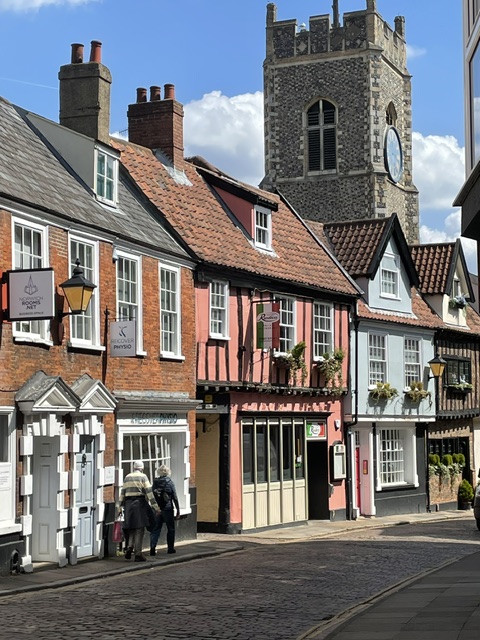
Country dwellers like us could take a shine to any city that presents like East Anglia’s regional centre. The centre of Norwich feels more like a town than a metropolis, retaining ancient street patterns while much new building complements the old. Following the trend of breaking  identity down into quarters also suits it well. We stayed two nights at the Maids Head, a venerable independent family hotel, right in the centre. The inhouse hire offer of Bentleys and bicycles must be unique.

From this base on Tombland (Old Norse for ‘open ground’) we took an evening stroll along the quayside that skirts the encircling River Wensum, from Fye bridge to Pull’s ferry. Thanks to the demolition of the former city gas works in recent times that stretch of riverside path is now continuous.

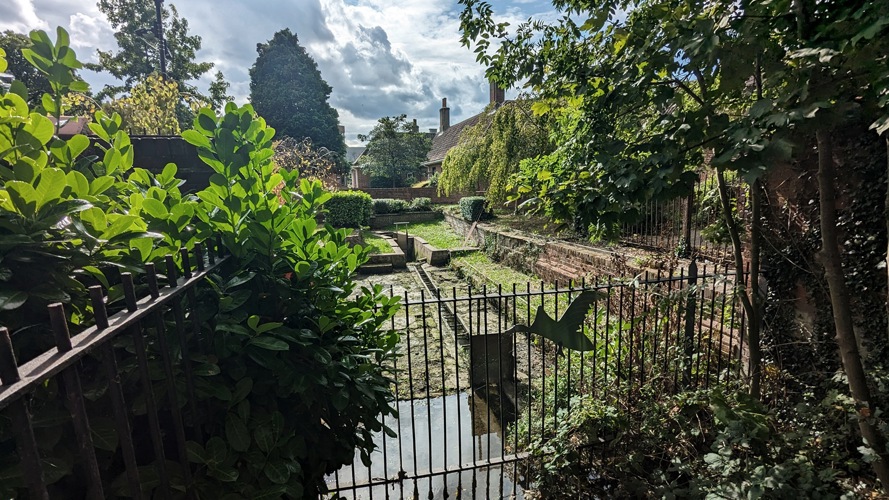
Curiosities here included seeing the remains of a sluice gate and swan pit. With their wings clipped the birds were once culled for feasts at the neighbouring Great Hospital. Formerly part of a monastery and still linked to the cathedral, it continues its caring role as a sheltered housing complex – minus the swan diet.

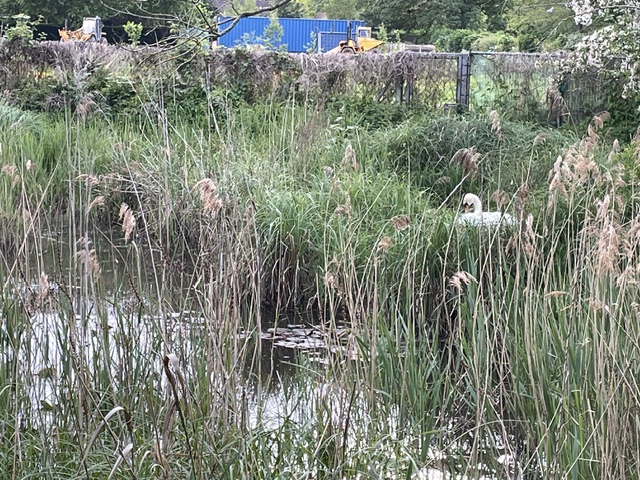
We watched a male bird waddling along the path while his mate sat on a nearby nest in the reedy corner of a fenced off pond.

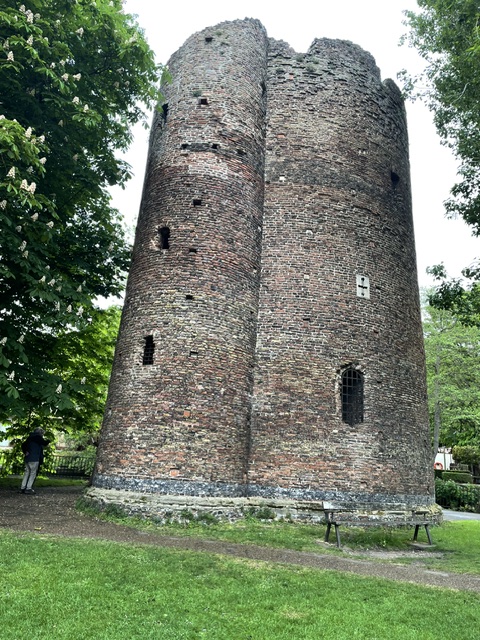
Cow Tower (c.1398) is an early example of an elevated gun battery set on a bend in the river. Originally part of the medieval city wall, it  looms up as a flinty floorless finger against the tranquil watery scene below.

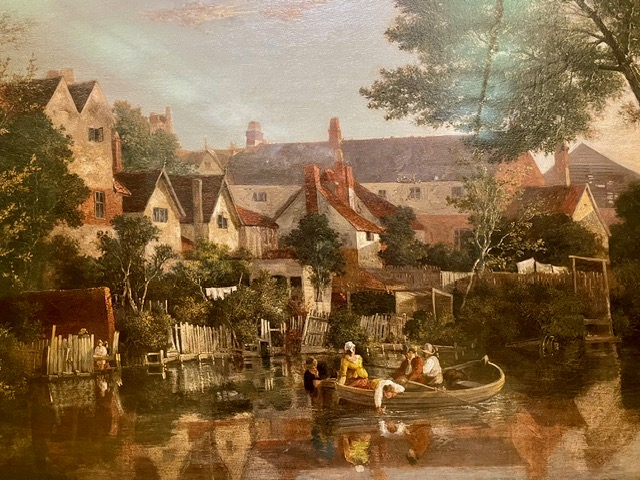
Later, in the castle, we’d see the work of Romantic era artists from East Anglia like John Sell Cotman and John Crome. Here’s Crome’s bucolic summer view of the riverside hereabouts in 1819.

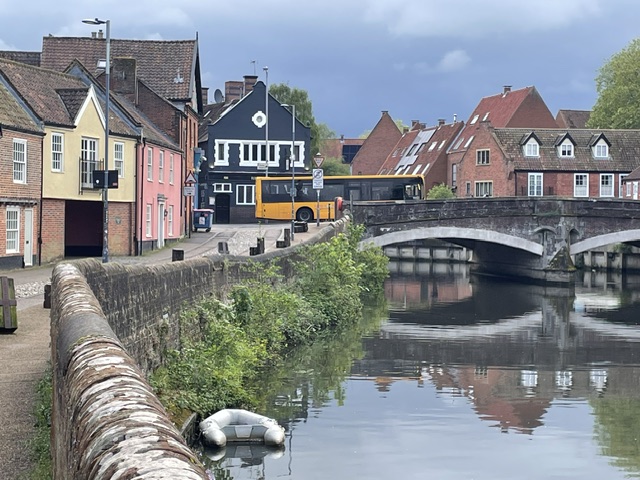
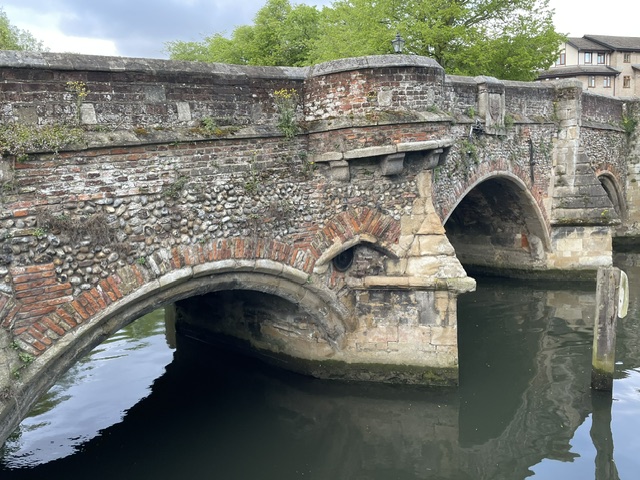
Bishops Bridge is a striking original structure of stone and brick, dating from 1340. The oldest span over the Wensum and once a major portal in the settlement’s walled defences. Terraced housing and small houseboats moored on the opposite bank give a peaceful counterpoint to passing traffic. A reminder of navigation that brought boats back and forth to the city’s teeming quays, helping Norwich develop as a major population centre of medieval England. Home to a thriving nexus of craftsmen, artisans and merchants.

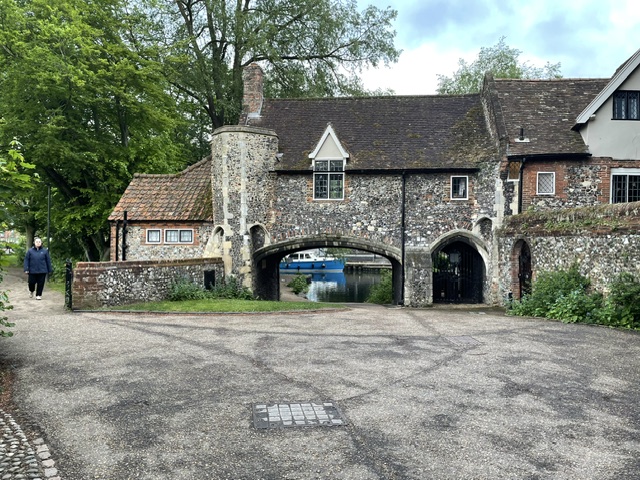
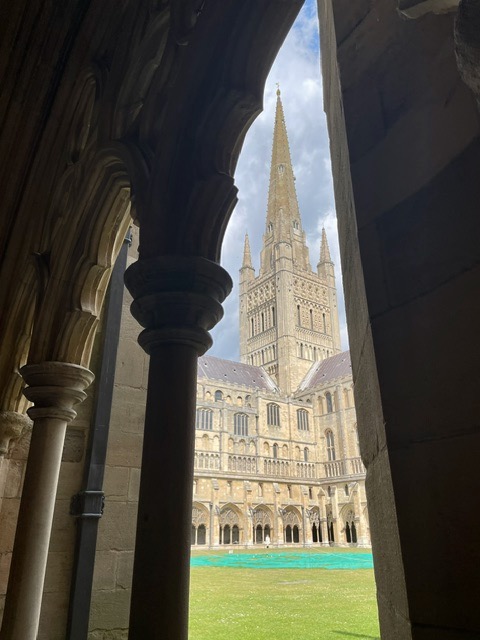
The stone used to build Norwich cathedral was imported  all the way from Caen in Normandy. To accommodate that final leg a short canal was dug here in the 1090’s, linking waterway to building site. Now long filled in we passed under the overarching ferryman’s house heading along the cut’s former course, now Ferry Lane, to the Cathedral close.

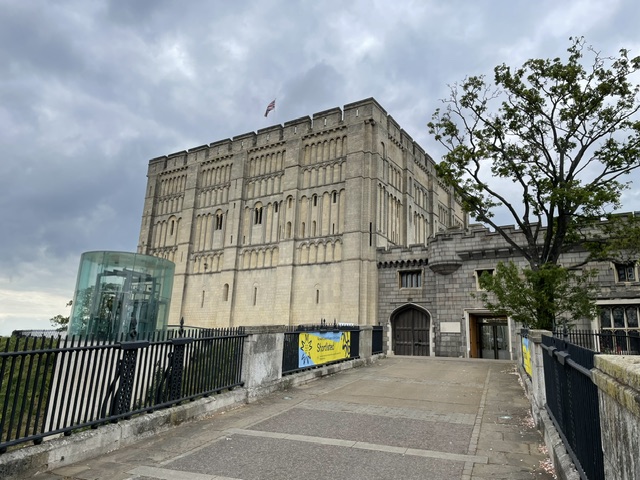
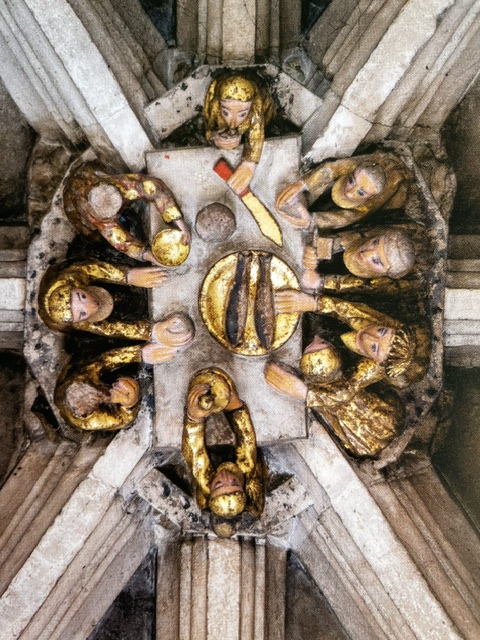
Next day found us digging further the city’s rich Norman legacy. From the newly refurbished castle to that imposing cathedral. The medieval splendour of the roof bosses in the cathedral is something to behold (preferably with binoculars!) Deeply impressed with the degree of visual narrative power so cleverly compressed in those vivid stone roundels.

The bosses were incorporated into the new stone roof of the late C15th. Yet for most of their existence they have been hidden from view, whitewashed over from the Reformation until late Victorian times. In 1932 they got repainted in their original bright colours.

An extraordinary achievement, 255 in total, looking down from on high above nave and choir, depicting biblical scenes and characters, from the Creation to the Last Judgement. I wondered if the much loved mystery plays performed by trades guilds through the streets of Norwich and other big towns had  inspired the stonemasons in their turn.  

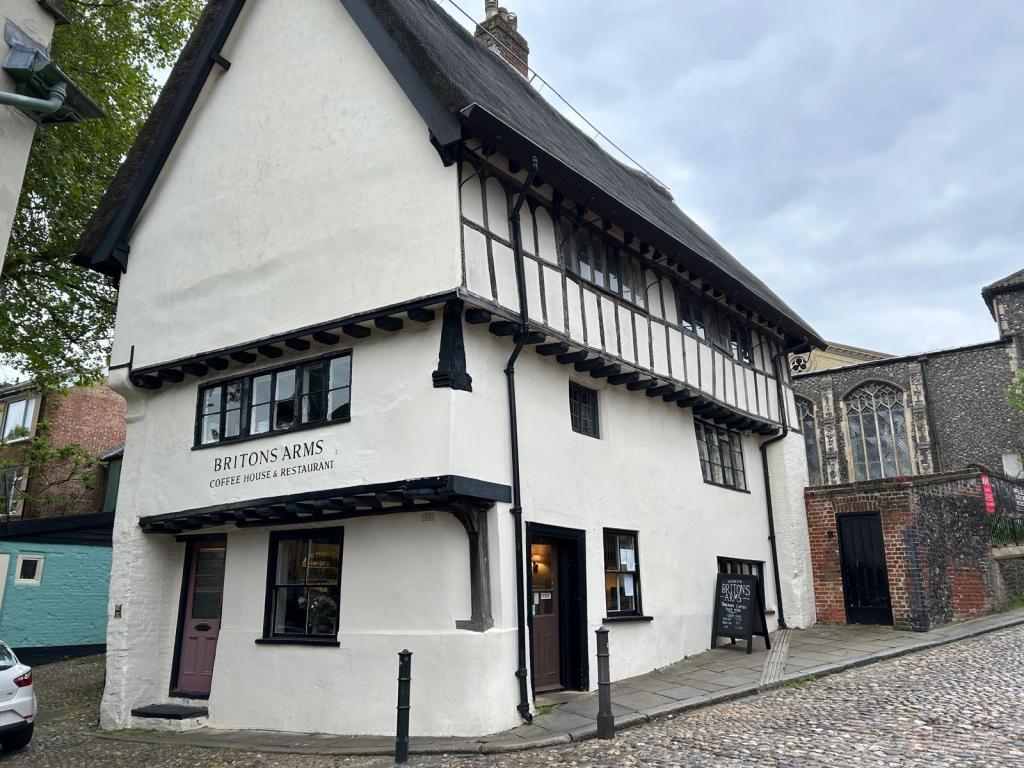
One of the best meals of our holiday was had in this gracious medieval building, the Britons Arms.  In the early C15th this was a ‘Beguinage’, a community of lay single women who devoted themselves to a life of prayer and charitable work. Today its secular tenants create some great dishes cooked with care and skill in the most relaxed and ambient of settings.

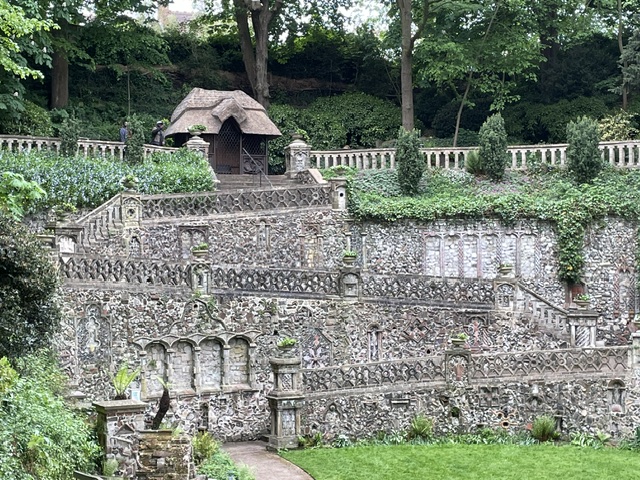
Taking a break from matters medieval, we stumbled upon a hidden gem, the Plantation Garden, situated just outside the centre. It’s a redundant chalk pit lovingly fashioned in the second half of the C19th into a charming  green oasis by local businessman Henry Trevor, often re-using redundant building material in the process. The villa he had built as his family home overlooks the tree bordered steep sided three acre spread.

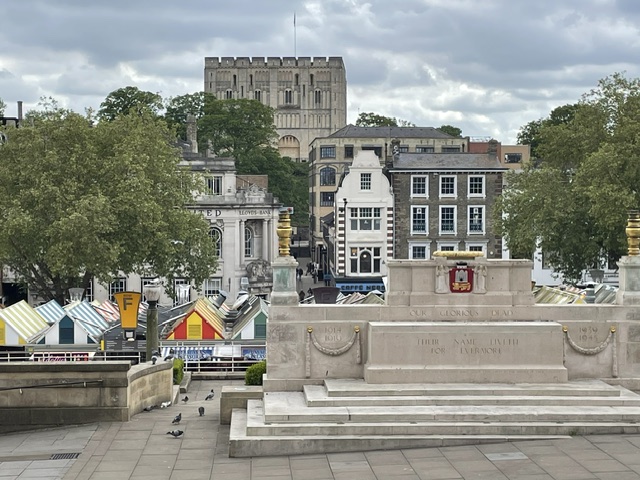
And finally…the steps of the C20th Art Deco City Hall not only give a fine view over the permanent market to the castle keep beyond but also yield overlooked sights of their own.

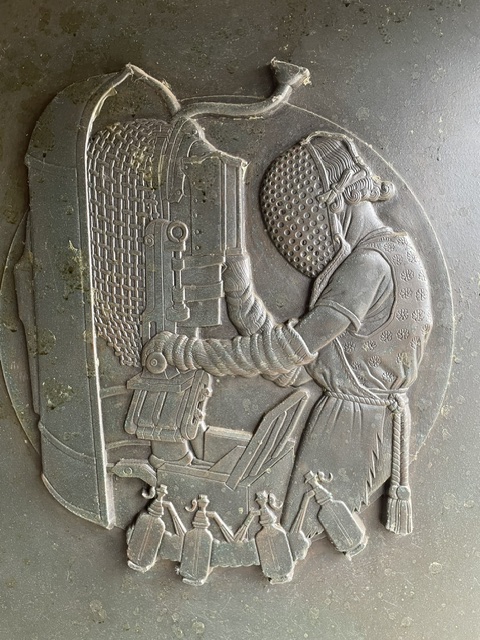
18 large round plaques grace the great bronze doors of the hall, chronicling Norwich’s history and its diverse businesses… I particularly liked this one of the former soda works.

We only saw a fraction of what Norwich has to offer and would gladly return to experience more. With a medieval church round every city centre corner, a maze of lanes and alleys, a wealth of business large and small, independents and chains, with its universities, museums and the wider cultural offer its civic star is rising. May its light continue to shine.

Castle Acre

Bare ruin’d choirs, where late the sweet birds sang. ( Shakespeare: Sonnet 73)

On the road to Norwich to start our East Anglian holiday we stopped off in north Norfolk to explore Castle Acre. It’s a quiet spot embedded into a rolling landscape of arable chalklands, woods and shallow valleys. But today the air was riven by the passing sorties of fighter planes. A reminder that American jets stationed at nearby RAF bases are actively involved in that country’s current conflict with Iran.

It was military conquest following the battle of Hastings that brought a veteran of that regime changing conflict, William de Warenne, to these parts in the 1080’s. He and his successors planned and built a whole new settlement consisting of priory, village, parish church and castle. Their main seat though remained at Lewes in Sussex.

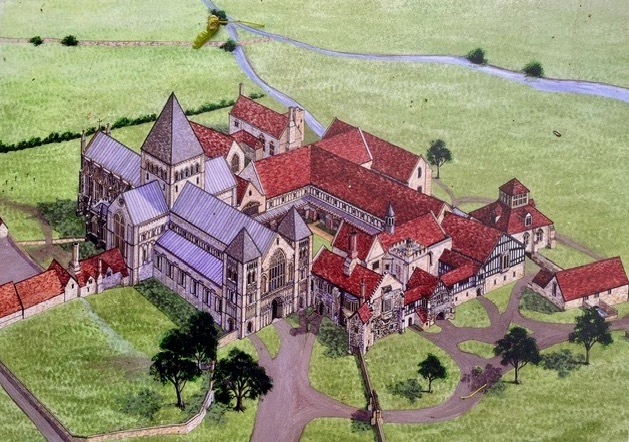
Artist’s impression of Castle Acre priory as was

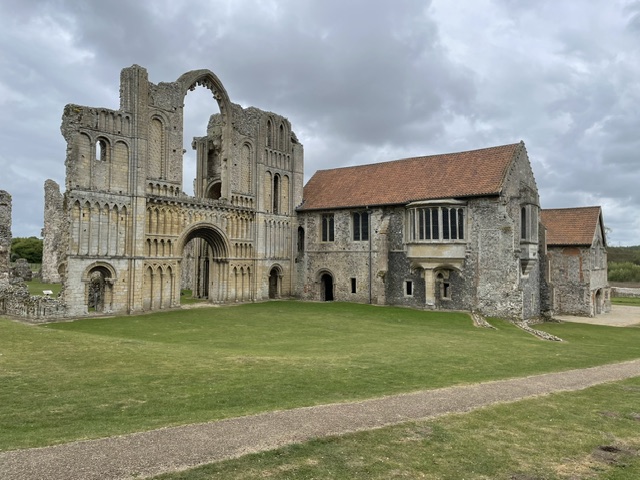
Today the impressive remains of priory (dissolved at the reformation in the 1530’s) and castle (abandoned by the 14th century) stand either side of a well to do pretty village complete with pub, teashop and convenience store.

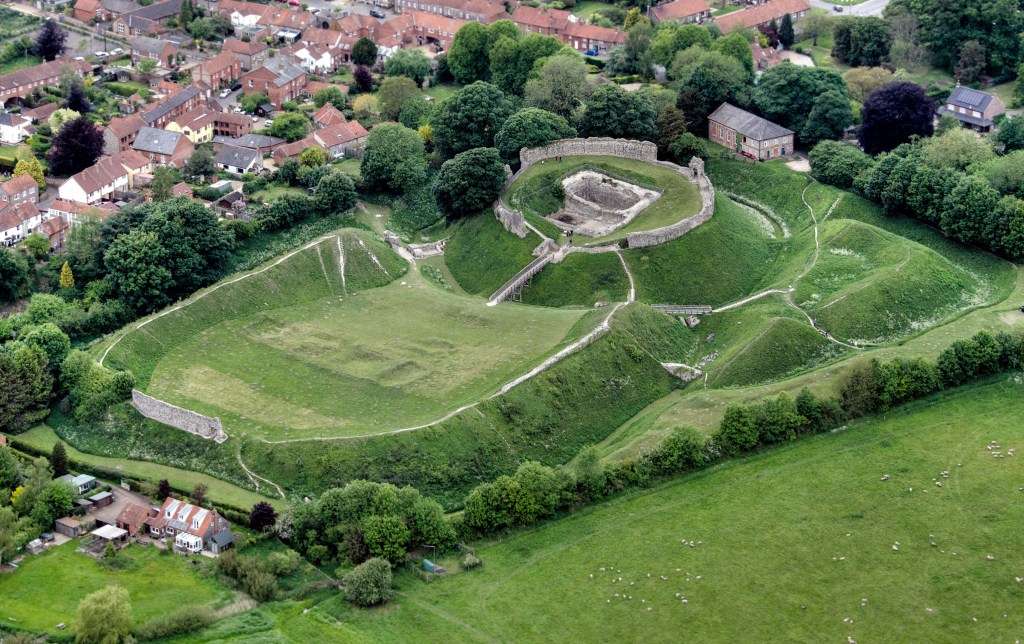
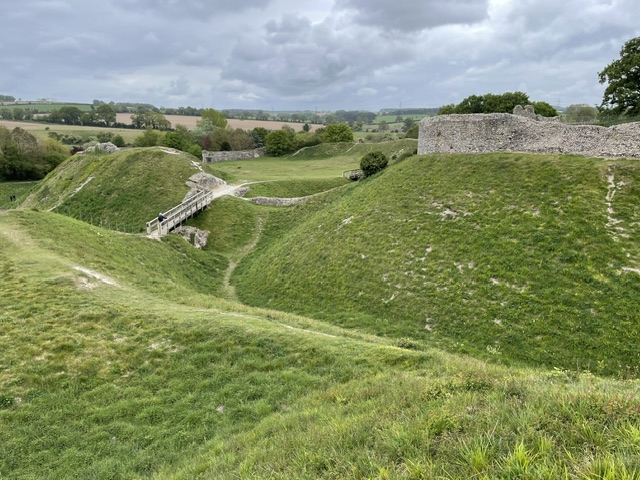
Castle Acre castle site: Source – Wikipedia

Arriving in this region you notice just how much flint is in evidence as building material, alongside other local stone and timber frame. The historic remains are in the care of English Heritage while the estate lands that surround it remain with the Coke family, earls of Leicester, landowners since the mid 17th Century. We noticed they were following the national trend in rewilding parts of the land, especially around waterways and hedgerows.

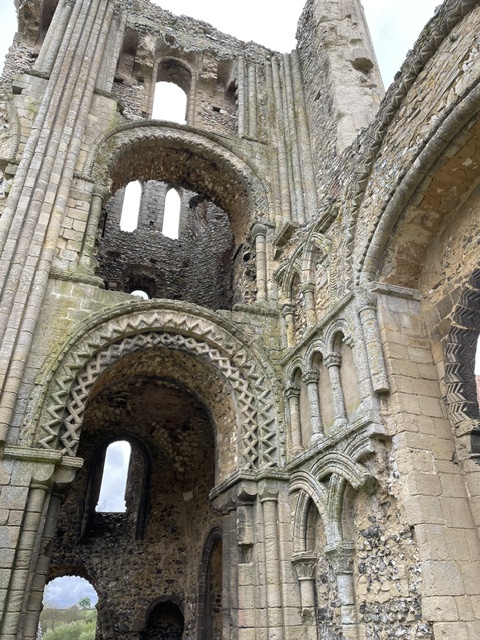
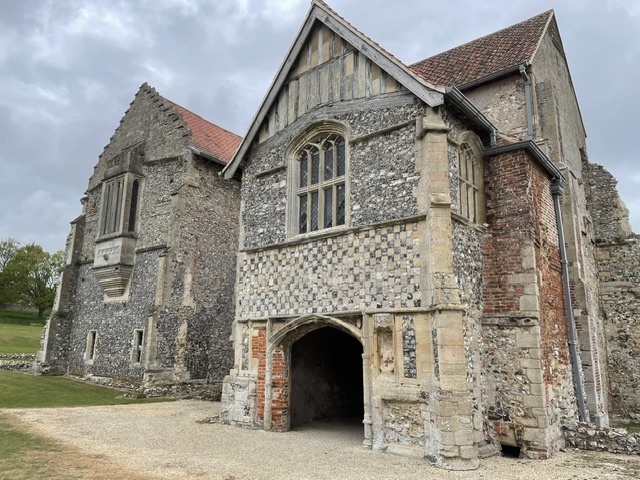
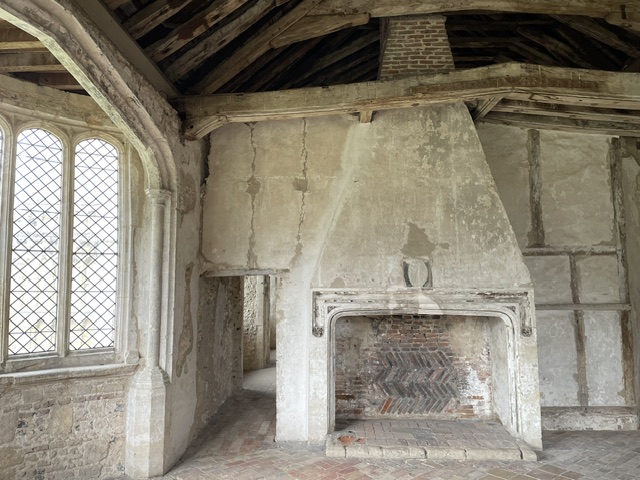
The priory was a wonder to discover as the ruins are so extensive and allow you to build a coherent picture of it as the grand self-contained community it once was. On entering the grounds you’re immediately struck by the C.12th west front facade of the church and  tower. The adjacent west range was the guest house for important secular visitors. We then ascended stone stairs to the Prior’s chambers, which includes a well-lit hall and private chapel.

These sections of the priory  were always roofed, unlike the religious buildings which were ruthlessly stripped following dissolution for their valuable construction material. It became a farmhouse and stores with the former priory ruins and meadows grazed by stock or otherwise farmed. In the  C.18th and C.19th growing appreciation of the picturesque and further interpretation and recording by antiquarians and artists allowed the Castle Acre complex to be seen in a new light and by 1929 the government  Ministry of Works were allowing visitors regular public access to both priory and castle.

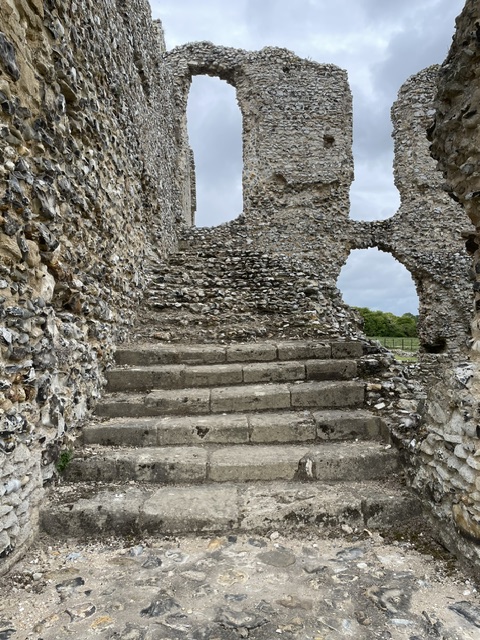
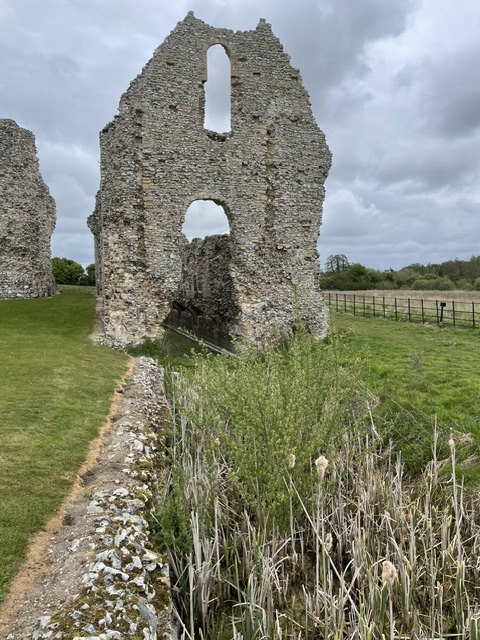
Of the ruined complex, largely stripped of dressed facing stone, the most evocative are the parts that betray human interaction, like the well-worn stairs that led up to the monks dormitory, where the brothers slept in their robes of black and white. The reredorter (literally, ‘at the back of the dormitory’) is a narrow two story building which was used on an industrial scale as a latrine block. Underneath is a watercourse designed to carry the waste away.

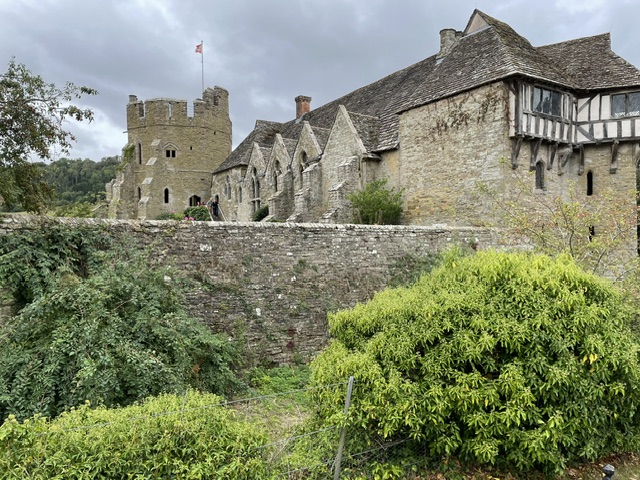
The castle footprint is huge, with steep embankments, ditches and motte. The De Warenne’s first buildings however were a relatively modest affair set within the outer defences.

It was only later, in the C13th civil wars that raged between nobles supporting the rival claims of Matilda and Stephen to the English throne that it was rapidly transformed from fortified house to full scale fortress, with barbican and inner bailey additions.

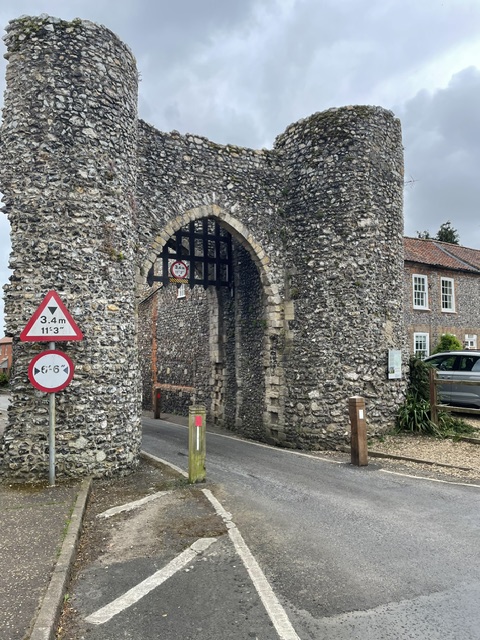
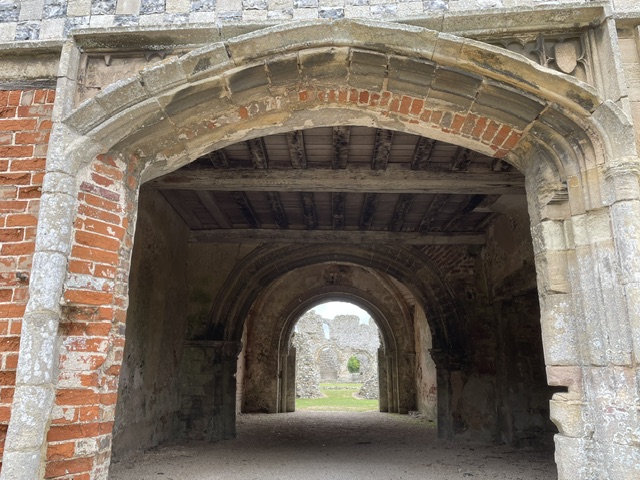
That protection stretched to an outer town wall and a bailey gate entrance, through whose narrow archway we carefully drove on entering and departing.

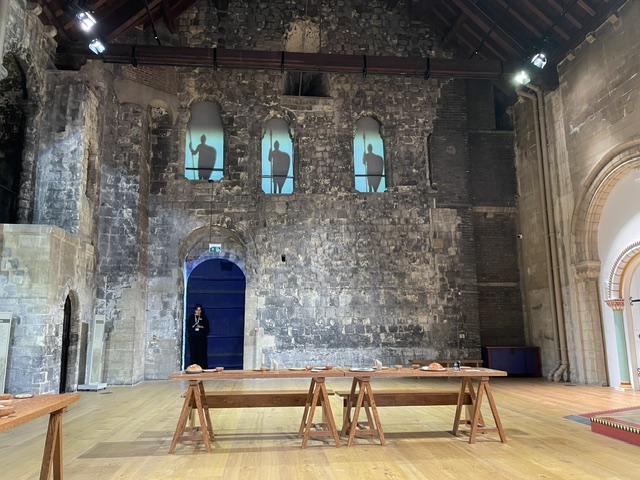
Norwich Castle Great Hall

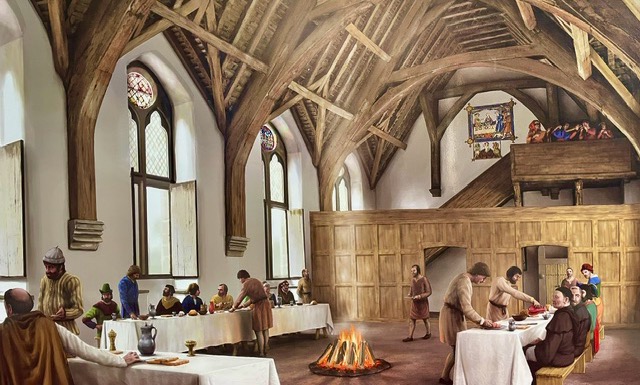
In Norwich we were impressed with the multi-million pound makeover of the great Norman castle (or rather the remaining keep) which has been five years in the making and feel it would make for a worthy winner of this year’s ‘Museum of the Year’ award. The great hall would have been similar to the De Warenne’s eventual fortress creation at Castle Acre.

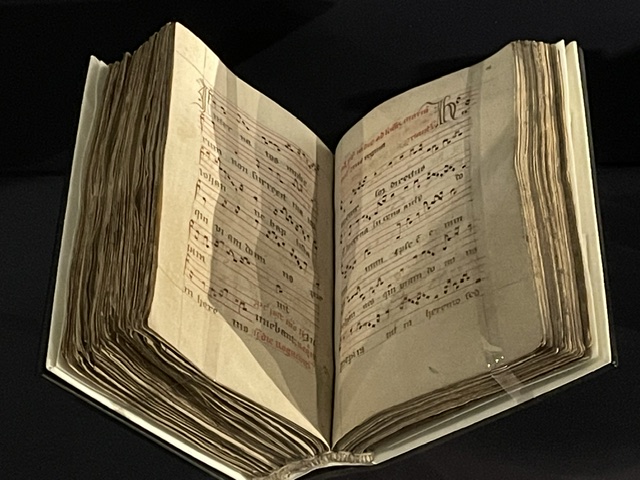
Two exhibits displayed in the revamped medieval treasures display pertain to Castle Acre. This C15th parchment chant book, made and used by the Castle Acre monks, is  of vellum (calfskin) oak and leather and small enough to be held in the hand. It’s complete with instructions (in red) for use in services as the brethren processed through the priory on different feast days throughout the year. The Cluniac order, founded in the French town of Cluny in the  6th century, strictly followed  the rules set down by St Benedict, but was also renowned for a love of art and decoration, which would have resulted in the walls of their establishments being brightly coloured and expressive.

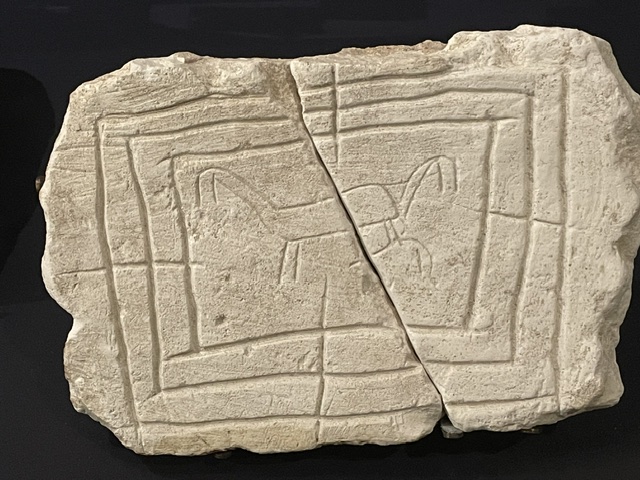
There’s a timeless quality to this simple board game of Nine Men’s Morris made of chalk with horse motif, found at the castle in Castle Acre. Two players try to place three of their counters in a row, allowing them to remove one of their opponent’s pieces. Whoever removes enough of their opponent’s counters to prevent them from moving is the winner.

Castle Acre is a fantastic place to get an idea of how the temporal and spiritual life of a rural medieval planned settlement would have appeared. Well worth a visit, especially at mid-week when we were only two of a handful of visitors at the priory. More at https://www.english-heritage.org.uk/visit/places/castle-acre-castle-acre-priory/
Physic Visit

A garden is a grand teacher. It teaches patience and careful watchfulness; it teaches industry and thrift; above all, it teaches entire trust. Gertrude Jekyll

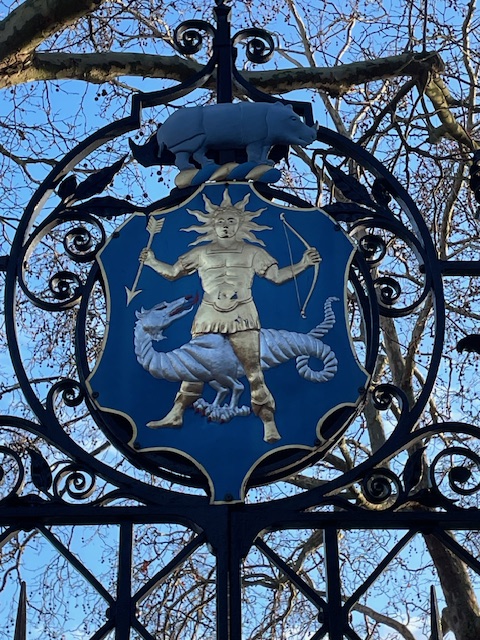
Coat of Arms of the Worshipful Society of Apothecaries on the Water Gate at CPG. London’s oldest existing livery company, founded 1631.

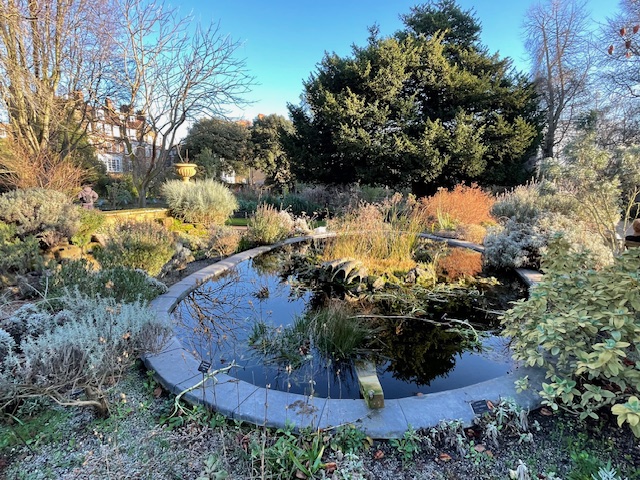
There’s something of a thrill to be had in stepping out of a noisy London street into an old walled garden. And not just any green urban oasis but the Chelsea Physic Garden, the country’s second oldest, after Oxford’s Botanic Garden. In that time it’s been intensely studied, expertly curated and lovingly cared for by generations of gardeners and botanists. Always constant, always changing.

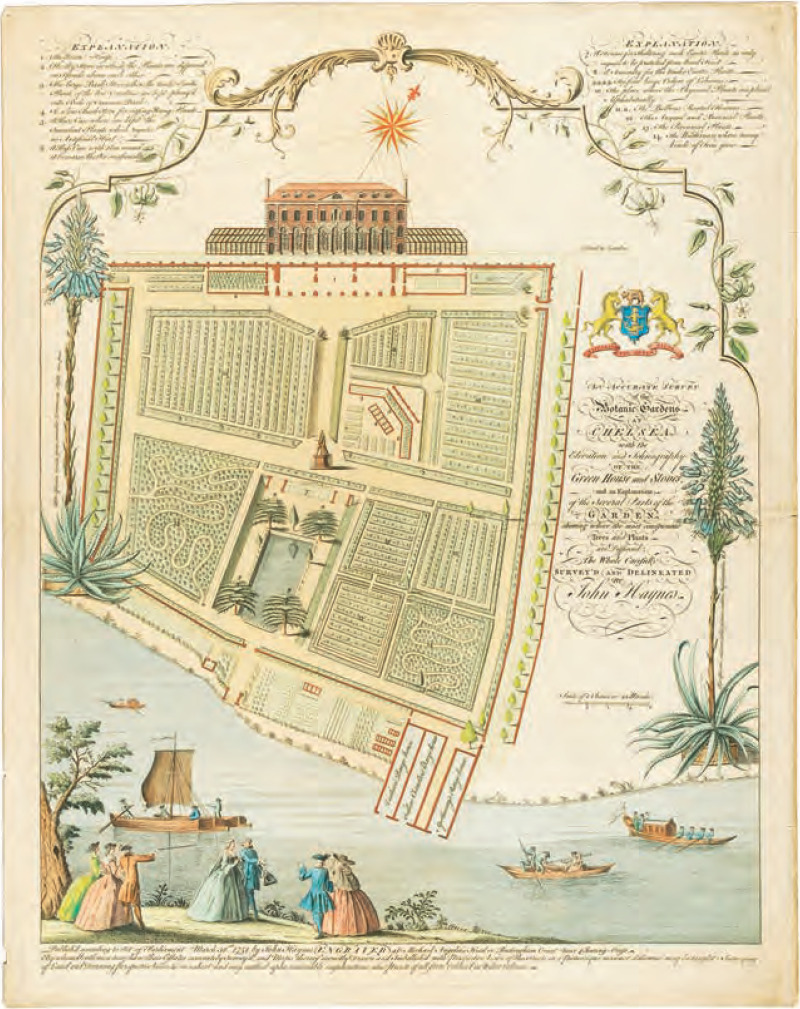
Plan of Chelsea Physic Garden in 1751 (Image: Wallace Collection)

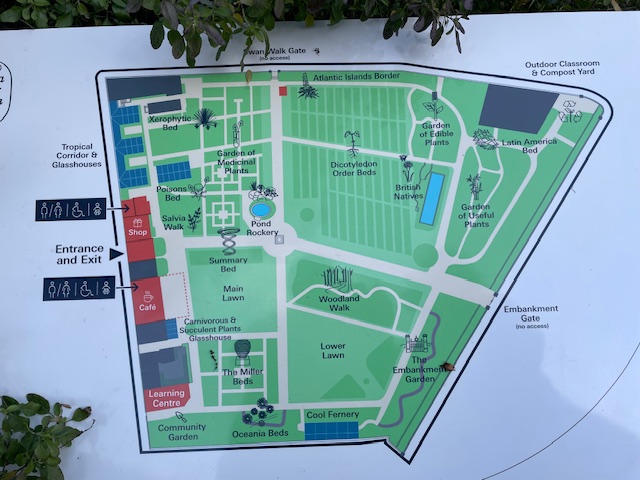
Cultivating medicinal herbs and other useful plants from around the world, ensconced in its own microclimate, these precious four acres are bounded by busy thoroughfares, elegant Georgian terraces and lofty Edwardian apartments. The physic garden was established on the site of a market garden in the village of Chelsea  by the Worshipful Society of Apothecaries in 1673. It was meant as an outdoor classroom for apprentices to study medicinal plants and their uses. An independent charity since 1983, the hitherto private garden only opened its door in the wall to the public in 1987.

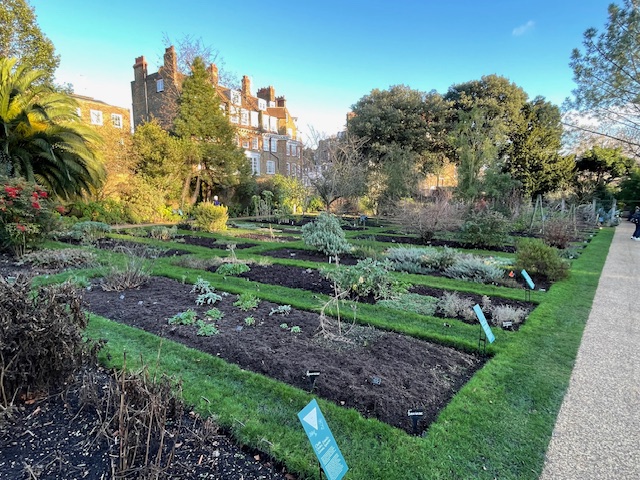
Dicotyledon Order beds

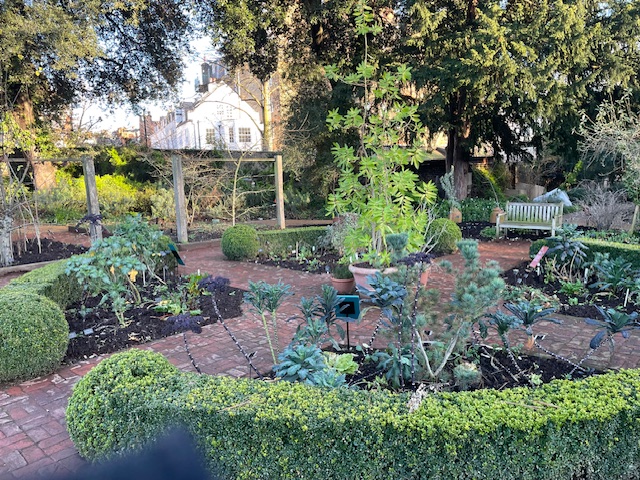
We had a relaxing lunch in the cafe before exploring. I ambled off to crop some pertinent facts while the head gardener took her own more knowledgeable and thoughtful turn around the grounds. Being early February we only expected to take in a  structural sense of the place, but its sheltered site and great variety of plants in different sections meant there was much to see and admire, and of course no crowds to navigate – unlike the major art exhibitions we’d visited.

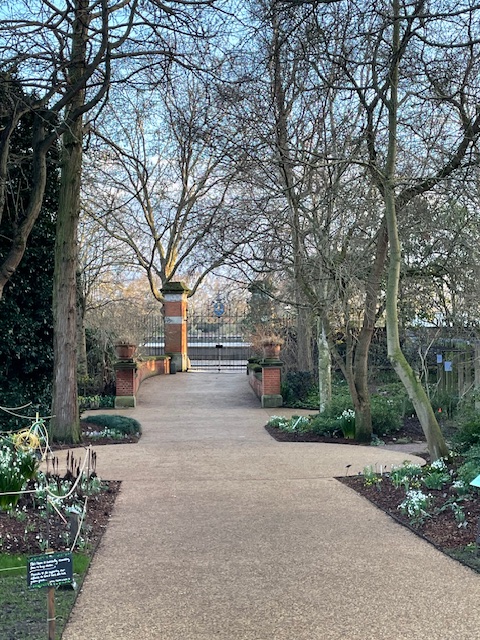
The Water Gate

Up to mid Victorian times the site enjoyed a river frontage, with  plant bearing barges plying their way downstream to Apothecary Hall, Blackfriars, in the City of London. Construction of the Thames Embankment –  a huge undertaking carrying underground railway, sewage pipes, walkway and road – divorced garden from river highway. Now an elegant water gate marks the old entrance route and baffle boards by boundary railings soften the traffic noise.

The garden was once famous for its spectacular Cedar of Lebanon trees; being one of the first places in England where they were grown successfully from seed. Alterations to the water table caused by the embankment barrier saw those venerable trees wither and they had to be felled. A rare failure for an institution that started its international seed exchange programme as long ago as 1682.

Thinking fondly of  the horticultural businesses that flourish in the famous ‘Rhubarb Triangle’ of  West Yorkshire I learnt that the technique of forcing (light prevention) was accidentally discovered here back in 1817. Another claim to fame is the rockery round the central pond, originating from 1723,  credited with being the first of its kind in the world. In the same year the garden’s glasshouses, heated by stoves, produced pineapples and other tropical fruits, which says something about the status of the place at that time. Only the very wealthiest in Georgian Britain could afford heavily taxed glass for greenhouses and the staff necessary to produce such exotic produce on home ground.

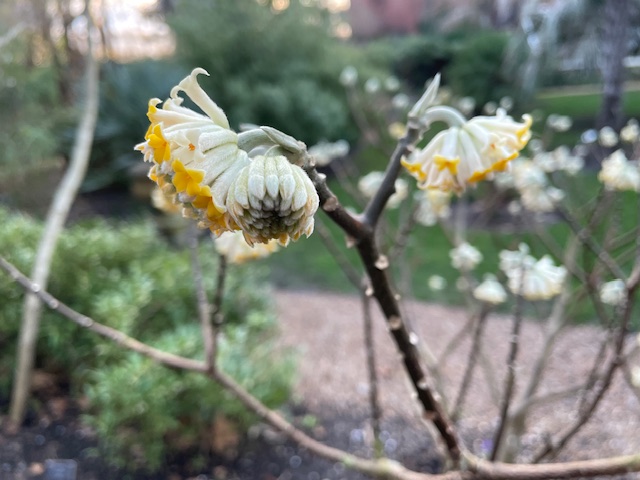
Arrested by an entrancing aroma, my nose led me to a plant with yellow tufts of flowers called Edgeworthia Chrysantha, AKA the Paperbush shrub, which originated in China. The long inner bark of the plant, known in Japan as Mitsumata, was used for centuries to make bank notes there, so strong and tear proof is the natural fibre when pulped. A fascinating origin story, just one of many plant histories recounted here.

The section given over to poisonous plants is clearly a visitor favourite. A student nurse who completed her Apothecary training in 1917 and who lived nearby, between the wars, was Agatha Christie. She famously used that insider knowledge of deadly plants grown here – hemlock, belladonna, foxglove et al  – in the plots of her many murder mystery novels. 

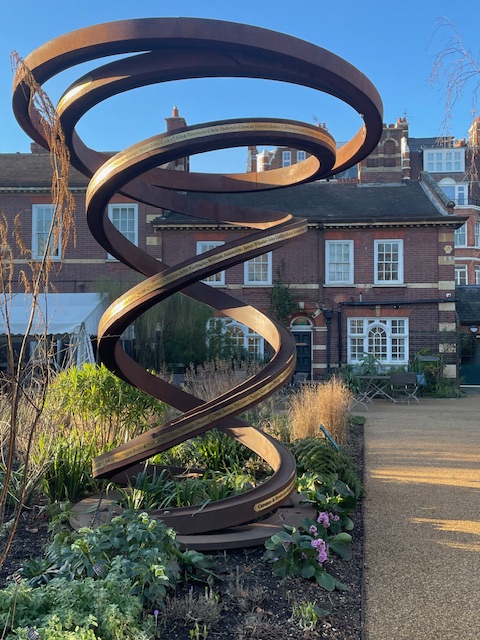
Although you wouldn’t know it  at this time of year, the spiral eyecatcher of a contemporary sculpture, marking the garden’s 350th anniversary in 2023, also doubles as plant support in the summer months, which is pleasing.

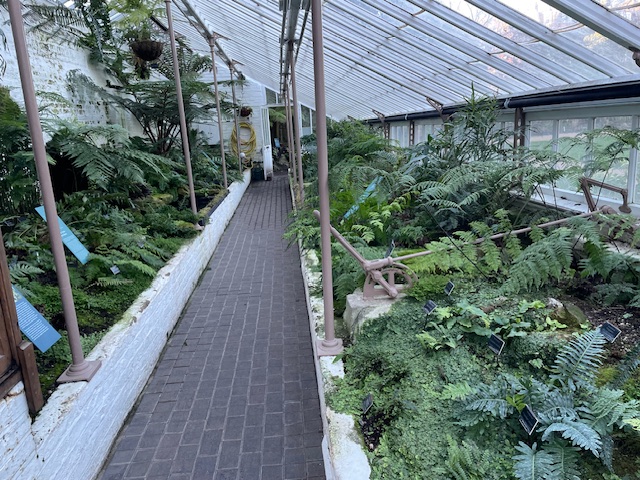
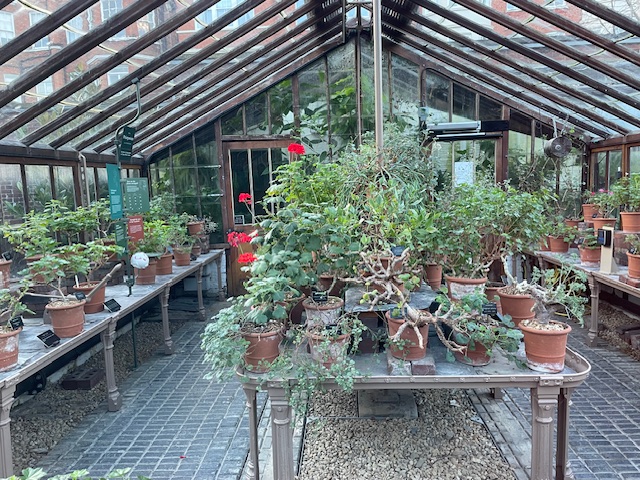
Another impressive structure is the original Victorian cool fernery and adjoining glasshouse, comprehensively restored thanks to funding from the Heritage Lottery. These elements of the garden were particularly popular in the C19th century when Chelsea  further extended its reputation as the foremost collection of medical plants in the UK. 

As country dwellers we found this venerable cultivated corner of the capital a quietly engaging draw. Remarkable that it hosts as many as 80,000 visitors a year and that more than 4,500 species of edible, useful and medicinal plants from home and abroad have are on show here. Our quiet afternoon discovery allowed us to appreciate its semi-dormant state while imagining what it would be like in other seasons…Cue return visit!

More at: https://www.chelseaphysicgarden.co.uk/
Light Over Jutland

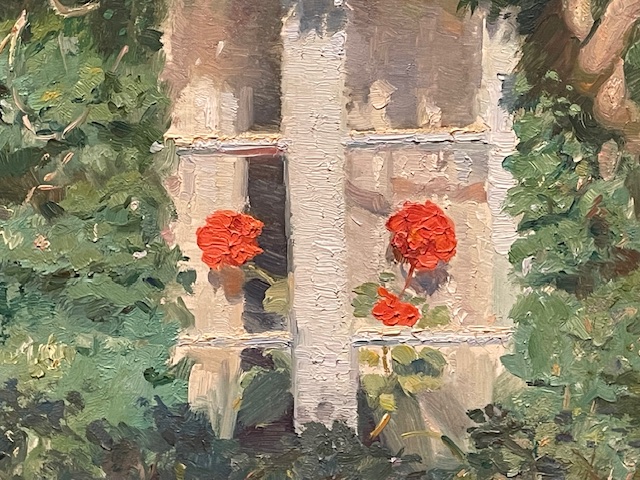
The Old Window (detail) Oil painting by Anna Ancher

Maybe it’s from watching too much Danish television and cinema, but the northern region of Jutland lodges in my imagination as a cold windswept archipelago breeding outlaws, from Viking raiders to Scandi noir murderers. How refreshing then to set the record straight with a welcome immersion in the luminous world created by one of that country’s most celebrated artists, Anna Ancher.

Last week, on a rain soaked Tuesday morning, we slipped into the serene interior of the UK’s oldest public art collection, the Dulwich Picture Gallery in south London. We’ve previously caught some fine shows here but this one was different in that the artist was hitherto unknown to us.

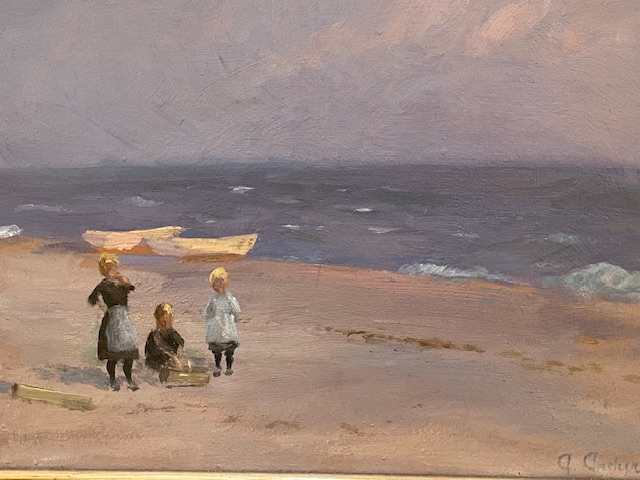
Children on the beach at Skagen

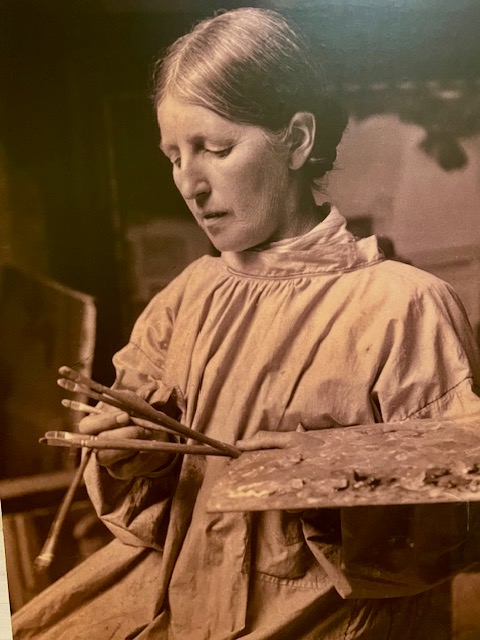
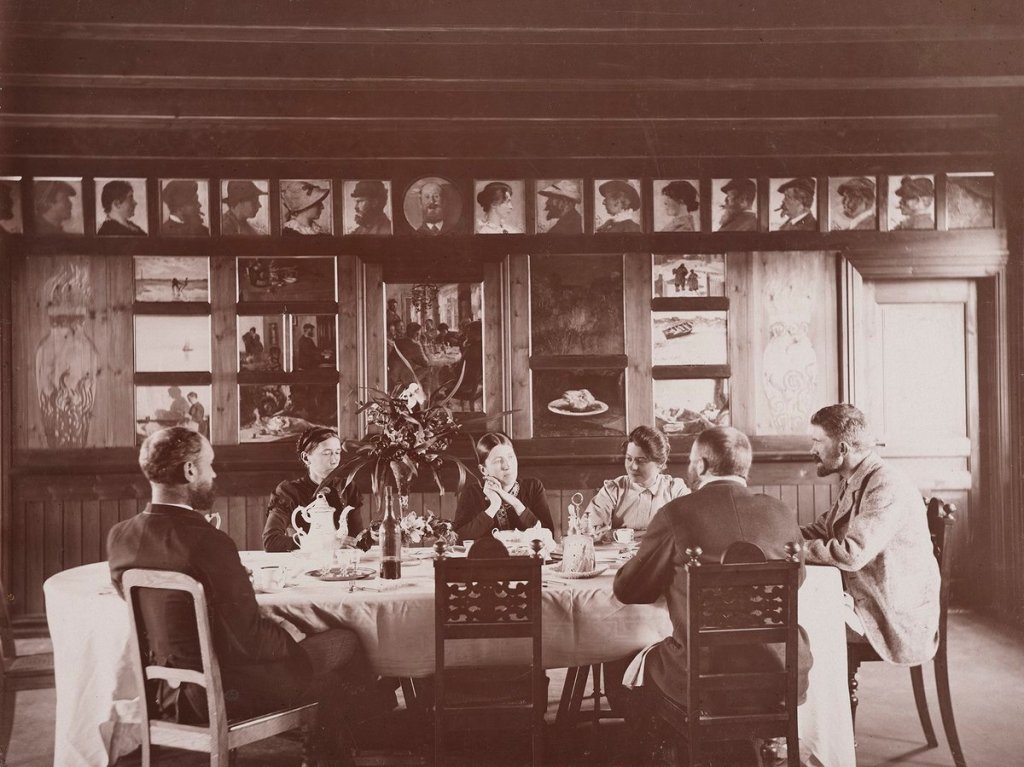
Women artists of Anna’s day – she lived from 1859 to1935 – faced huge barriers in pursuing their careers. Her family, the Brondum’s, ran the only hotel in the remote town of Skagen (pronounced Skay-en) where she was born and spent most of her life. It became a lively centre of artistic activity from the 1870’s and still trades today in what has become an upmarket seasonal resort town of uniform bright walls and red tile roofs.

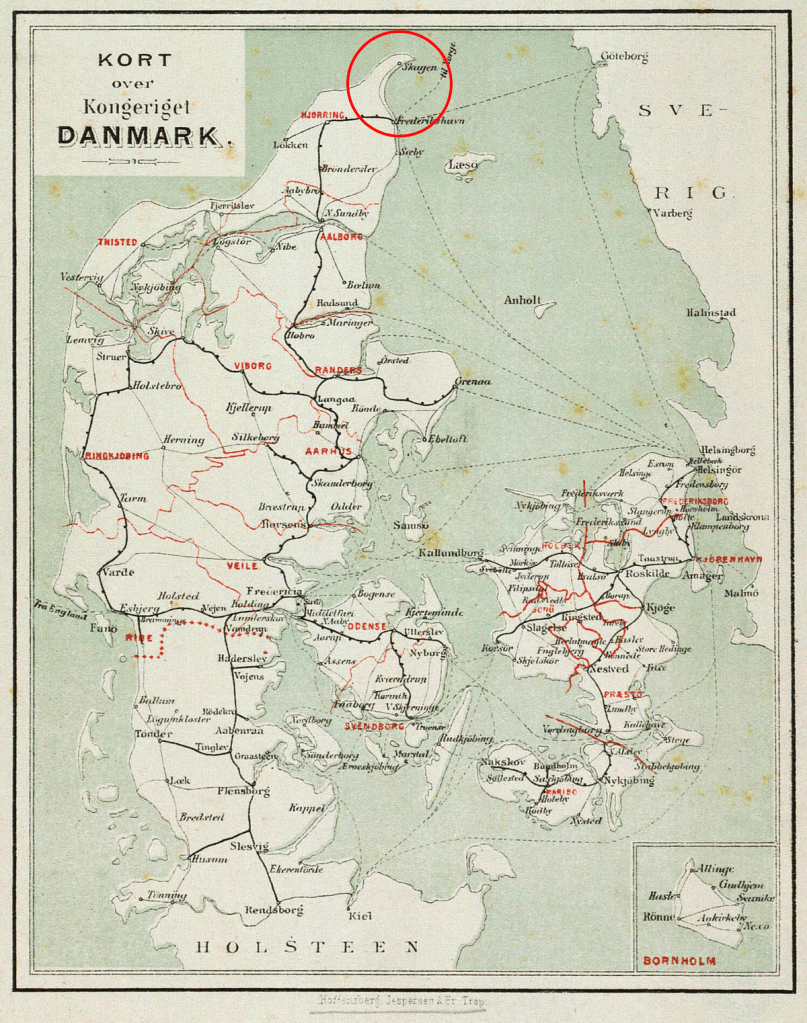
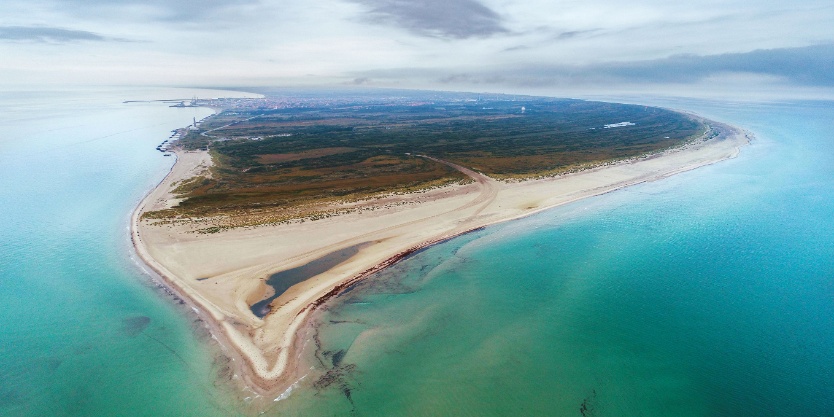
Emerging artists were drawn then to what was a near inaccessible spot at the very northern tip of Jutland, where the Skagerrak and the Kattegat seas meet. An exposed lone finger of land defined by sand dunes and continual beaches under vast open skies. One of those dynamic young  incomers, Michael Ancher, became Anna’s husband and collaborator.

Anna, central, and her circle at the Brondum’s Hotel / Art Museums of Skagen, historic photo collection.

At that time most of the indigenous inhabitants led a hard existence as farmers and fisherfolk and many, like Anna’s mother Ane, were devout protestants. Surprisingly perhaps, Ane supported her daughter by paying for private art lessons in Copenhagen. (Women were banned from the official schools) Later both Anna and Michael studied in France where the liberating influence of impressionism was key to further development.

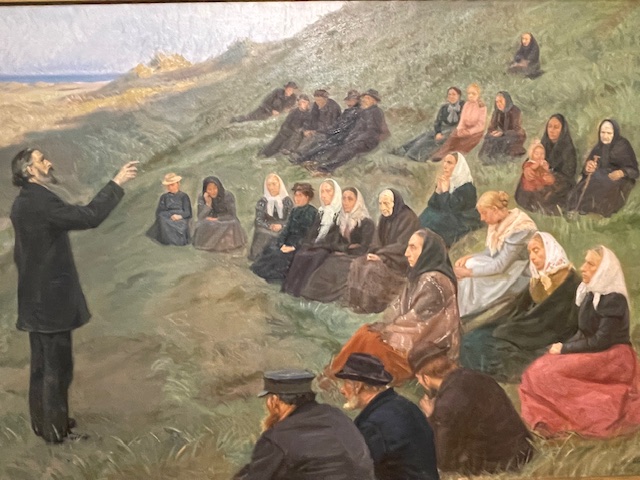
Anna was not just confined to the traditional female realms of home and family for subject matter and she demonstrated her compositional skills in large scale works like this one from 1903. The Skagen mission church congregation her mother belonged to, seated in the dunes ,listening  to a sermon given by their local preacher.

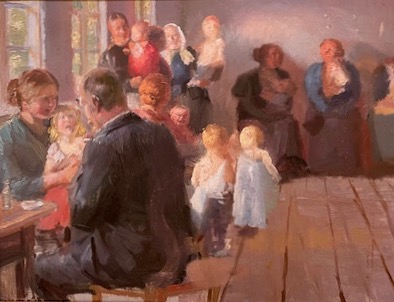
Particularly liked this little picture of mothers bringing children to be vaccinated against smallpox. The practice had been compulsory in Denmark since 1810 but then, as now, it was a cause of controversy. With Michael modelling as the doctor, alongside local women and children, clearly shows which side of the argument the Anchers favoured.

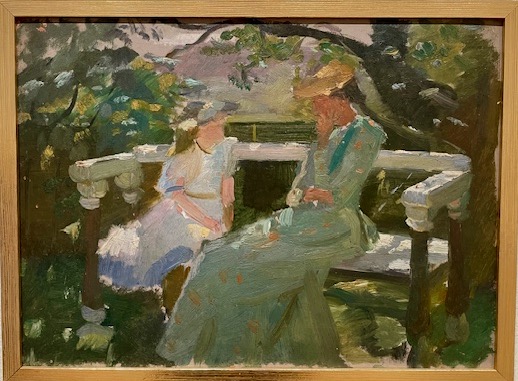
Another eye catching small study in oils shows the Ancher’s daughter Helga, with Anna’s cousin Ane Torup, dressed in green, at home on the bench in a summer garden (c.1892).

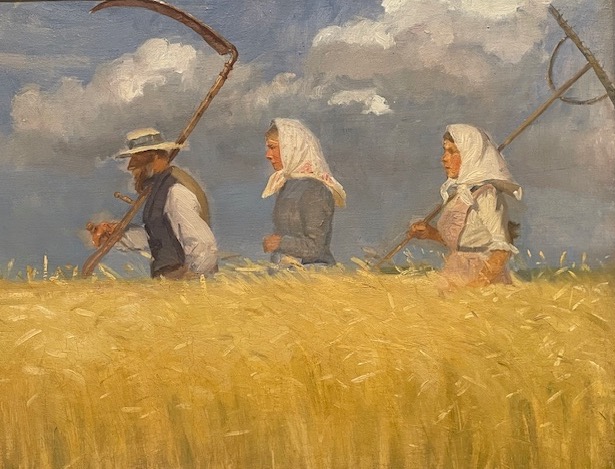
Farmland had been painstakingly reclaimed from sandy heath and this vibrant close study of harvesters in the corn from 1905 both focuses and intensifies the colouration of the scene, where the sturdy workers set out to reap the rewards of their year’s labour.

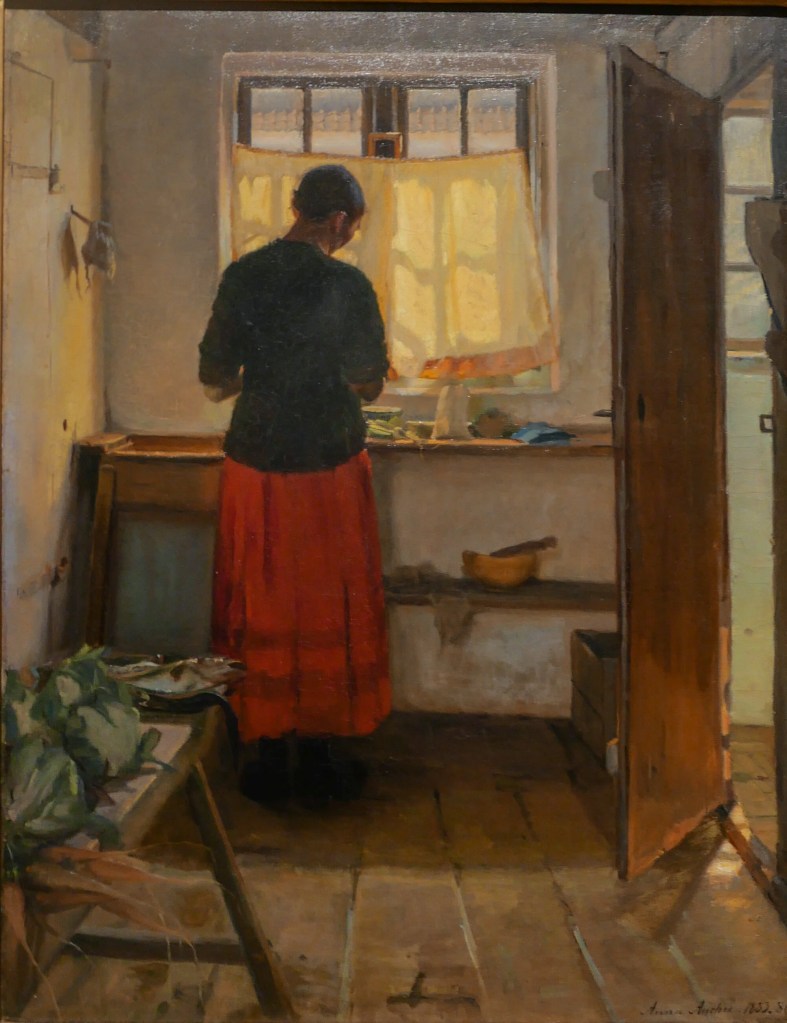
One of the major oil paintings on display is a wonderful portrait from 1886 of a maid in the kitchen which demonstrates Ancher’s particular genius. A fascinating composition imbued with intimacy and stillness. Entrancing in its luminosity, with echoes for me of Vermeer.

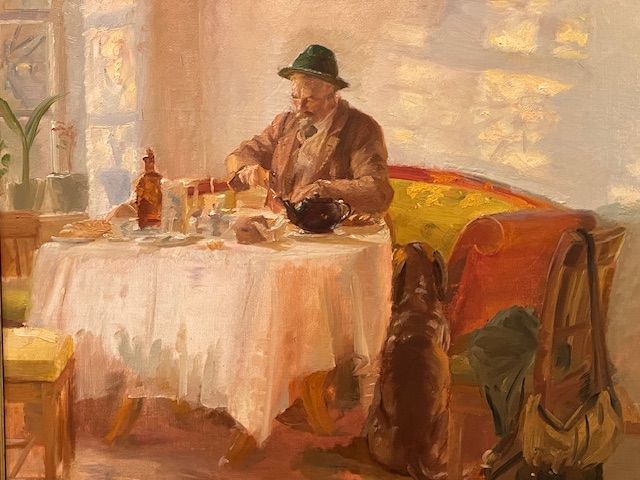
Before the Hunt, Michael Ancher painted by Anna

Thank you Dulwich for bringing us this cultural gift from rural Denmark. I for one will – literally – see that land in a rather different light from now on. The exhibition continues to 8th March. https://www.dulwichpicturegallery.org.uk/whats-on/anna-ancher-painting-light/

Grenen nature reserve, beyond Skagen. Image: Christian Faber

On Turner and Constable

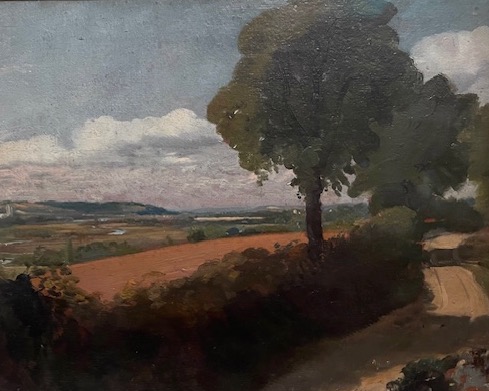
John Constable: View of Dedham Vale 1809 Oil paint, paper on canvas

When you live in the country but you’d like to know how others see the country then you need to head for the city. That’s what we did last week to indulge in a double dose of artistic genius served up for our consumption at Tate Britain.

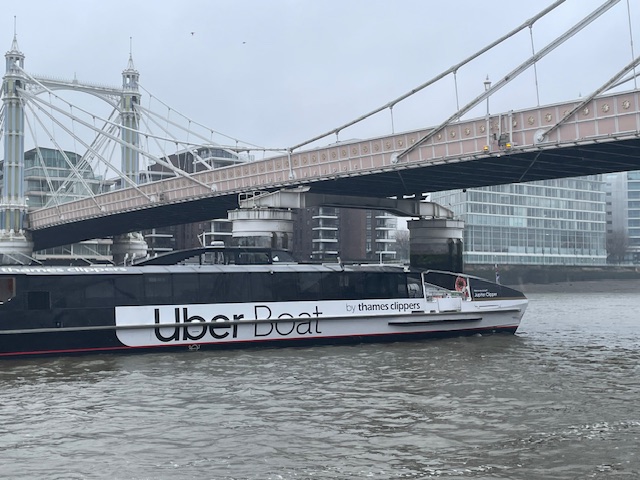
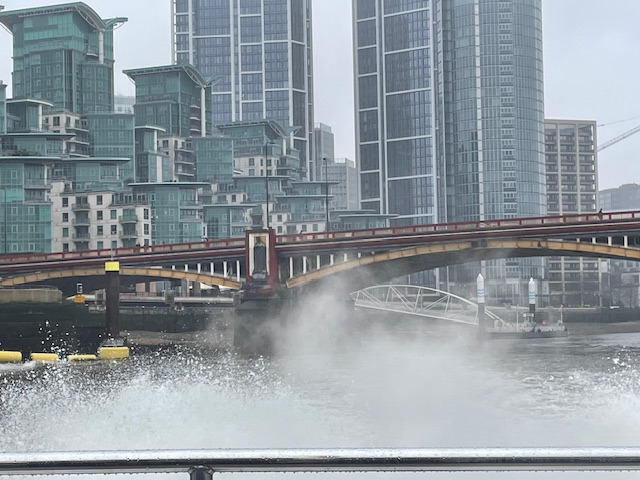
Arrived at Millbank by boat on one of the catamaran Uber river taxies that ply their trade on the Thames. Pricey, but worth it for the vistas afforded. Powerful engines allow for nimble sideways docking and a surprising turn of speed on the fast flowing floodwaters. Graceful bridges backed by sky blocking glass walled monoliths at Vauxhall with remnants of more graceful human scale buildings elsewhere on the river banks.

JMW Turner and John Constable. The two mighty creative engines that powered and defined the art of landscape painting in early C19th England. The Tate exhibition bills the two men as ‘Rivals and Originals’ and an intriguing combo they proved to be when viewed here in tandem.

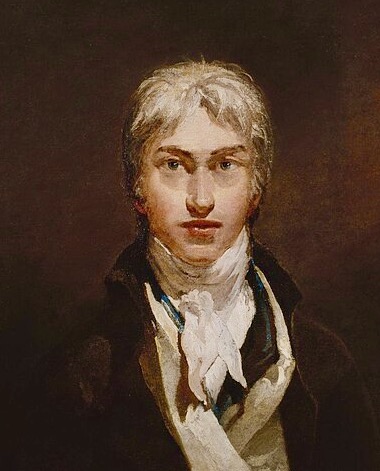
JMW Turner Self portrait 1799

Weaving in and out of the mass of fellow visitors we were skilfully drawn into their overlapping visions of a land and people in flux, complimenting and contradictory by turns.

Both men were out touring in summer and working up drawings and sketches to a finished state  back in their respective London studios throughout the winter, for display at the Royal Academy show, where they’d eventually secure top billing as leading members;  feted, criticized and praised in equal measure by critics, patrons and public alike.

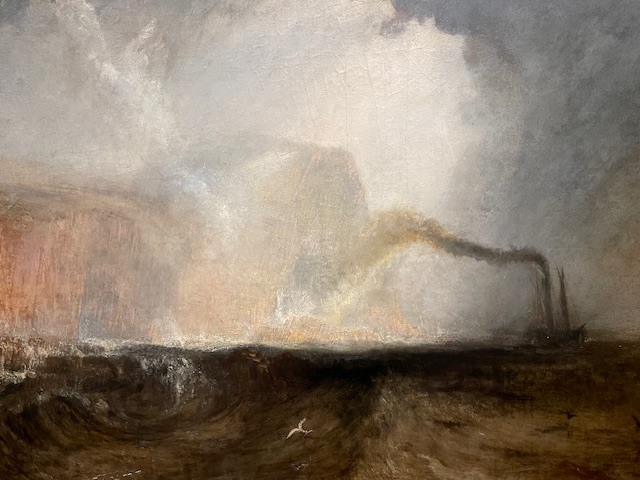
Turner: Steam Ship off Staffa

We were introduced to two very different personalities from contrasting social backgrounds. Joseph Mallord William Turner (1775-1851) was the son of a Devon born barber and wigmaker who had set up shop in Covent Garden. The proud father displayed his precocious 15 year old son’s drawings in the shop window to attract custom.

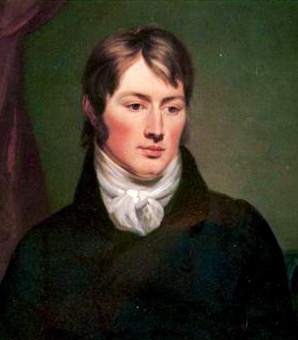
John Constable by R C Reinagle (1799)

By contrast Constable’s father was a prosperous miller and coal merchant in rural Suffolk who disapproved of his son’s artistic ambitions. John Constable (1776-1837) comes across as an introspective, conservative and conscientious countryman while Turner was quite at home in the capital; an eccentric showman and gallery owner, secure in his own genius.

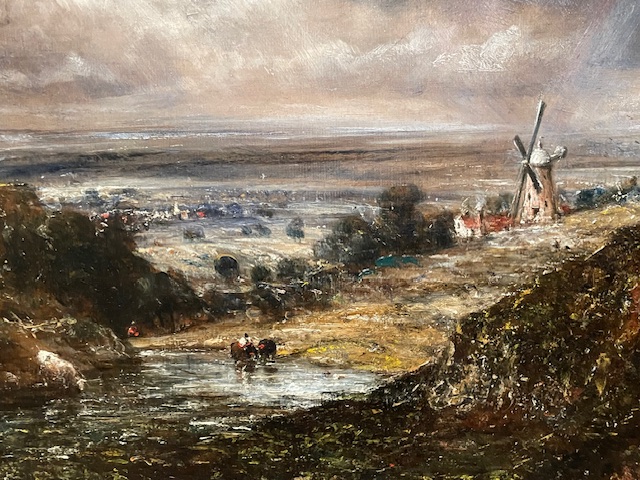
Constable: detail from oil painting of Hampstead Heath 1835

Against both their families initial opposition Constable married Maria Bicknell, a neighbour and childhood sweetheart, and subsequently supported a large family of seven children. For a while they lived out of London, in Hampstead village and Brighton, for the sake of Maria’s fragile health. Success came much later to him than it did Turner. Scaling up to work on larger canvasses his ‘Six footers’ helped secure artistic and economic success on being accepted as a member of the R.A. in 1829. Turner never married, though it’s believed he fathered two illegitimate daughters who he looked after. He also had Sandycombe lodge built in Twickenham for his widowed father. A fascinating miniature Italianate villa, still standing, recently restored and well worth a visit.

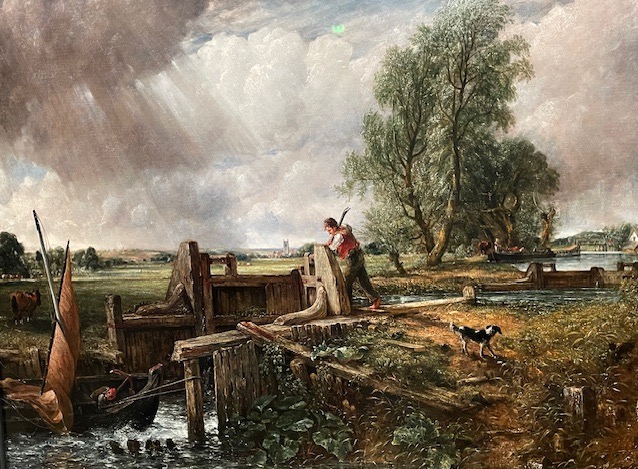
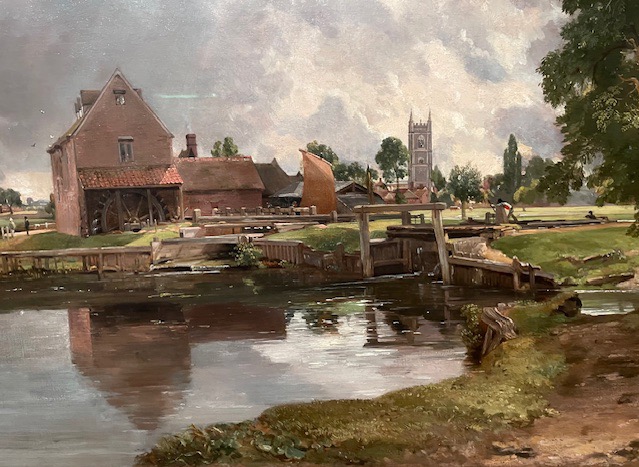
Constable: Dedham lock and Mill (1818)

The exhibition displays  a combined 170 works by the two artists. Constable’s masterpieces with the greatest appeal show us the working people of his native Suffolk going about their business in a quintessentially English pastoral setting. It seems idyllic on the surface but was often the opposite due to the huge changes wrought by the agricultural revolution then in full swing. A situation chronicled by contemporaries like William Cobbett in his ‘Rural Rides’ series of newspaper reports across the southern English counties.

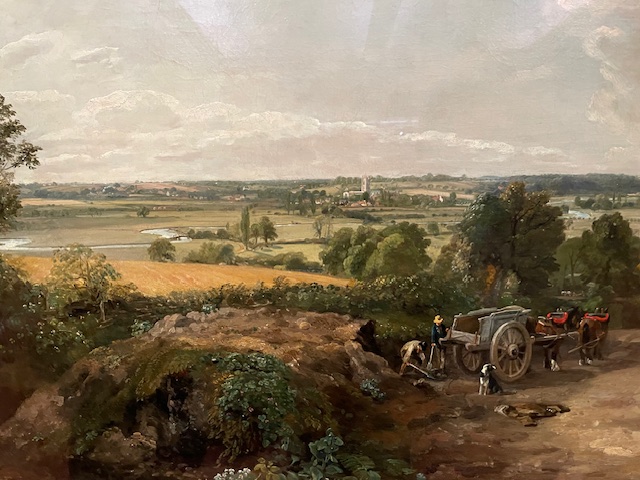
 I like this Constable picture of a muck heap, painted as a childhood friend’s wedding gift. Not the most obvious subject for a conjugal gift…Or is it? Composted fertility, spread on the land to increase yields, has a more obvious meaning. Like his most famous painting ‘The Haywain’ collie and patches of red feature as signatures to this otherwise everyday rural scene.

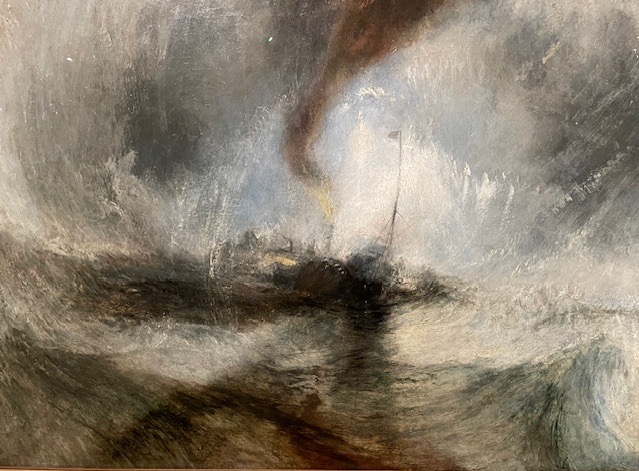
In Turner’s thrilling immersion we’re pitched into the dynamics of mechanised invention engaged with great elemental forces . ‘Snow storm – Steamboat off a Harbour’s Mouth’  (1842) is an outstanding  example of the artist’s innovative style. Turner claimed he was lashed to a mast so he could safely observe the scene. I mused to think how much more disorientating this kind of artistic vision would have been when first viewed by the public.

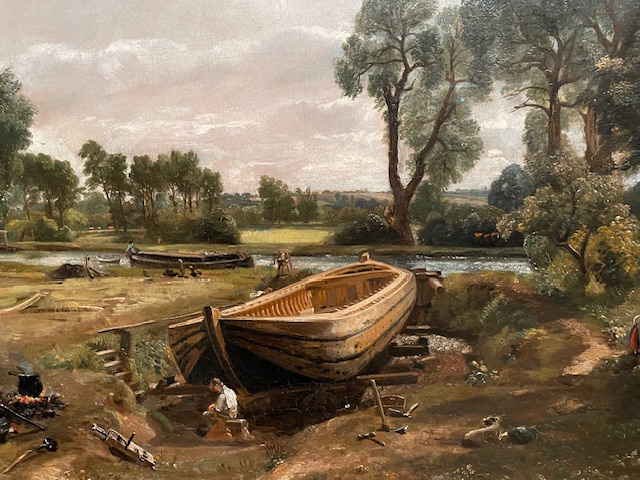
By way of contrast Constable reveres the age old crafts – boat building in a dry dock off the River Stour. Barges like this floated his father’s stores of grain to Flatford mill and beyond. They were the foundations of the family’s fortunes and are lovingly captured in this oil painting of  1815. Constable must have revisited his childhood self in such scenes. A warm memory, in his own words, of a ‘careless boyhood…which made me a painter.’

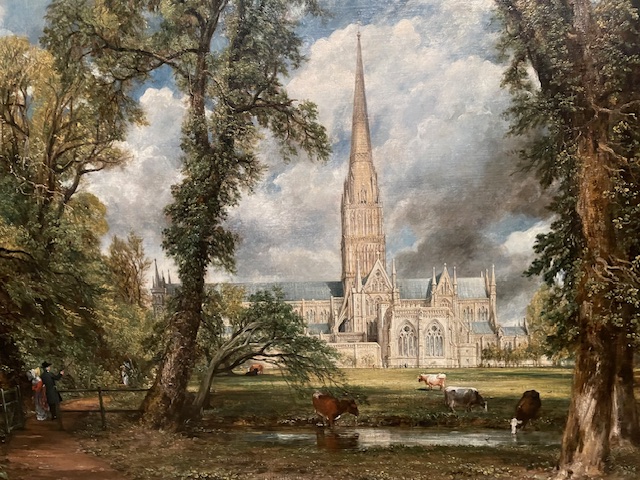
Constable’s studies of Salisbury Cathedral in different weathers are famous works, reminding us of his deep Anglican faith and concern for the church in the face of social and religious reform. I loved the attention to detail in this painting, commissioned by the bishop, seen at the far left of the picture with his wife. Constable’s celebrated portrayal of clouds and loose handling of paint would prove a major influence on contemporary French artists, helping to lay the foundations of impressionism. That would not have impressed his patron though, who we are told, disliked the conflicted cumulous and wanted a more serene sky.

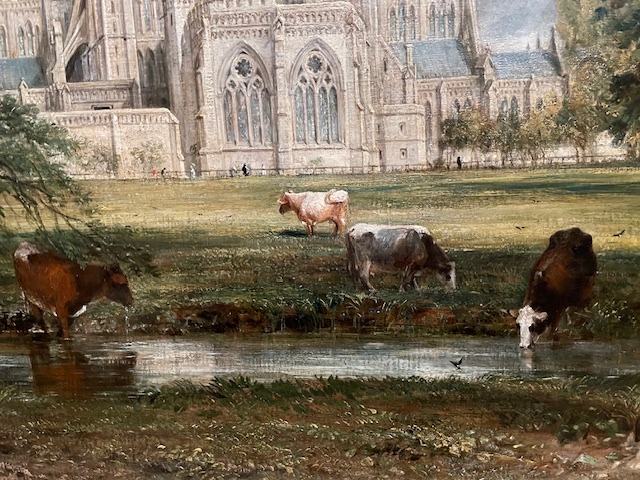
My eye was more drawn down earthwards, to the creatures in the foreground. Like the work of the C17th Dutch master Aelbert Cuyp, Constable clearly had a soft spot for cows, and they seem to represent the kind of rural contentment and prosperity he so valued. The beast on the left, having just drunk from the river, drools water while on the right a house martin hovers to catch flies over the stream. 

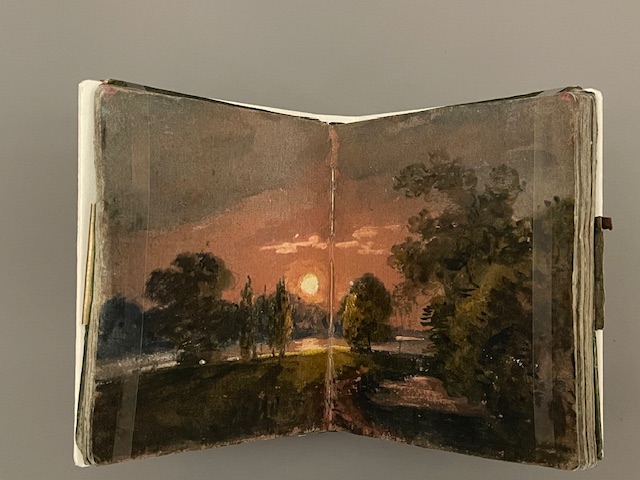
Turner travelled extensively all over Britain and ,during breaks in the Napoleonic wars, across western Europe too. He worked rapid sketches in different mediums. I liked this small notebook sunset from a tour of 1796-7 executed in gouache,  pencil & watercolour.

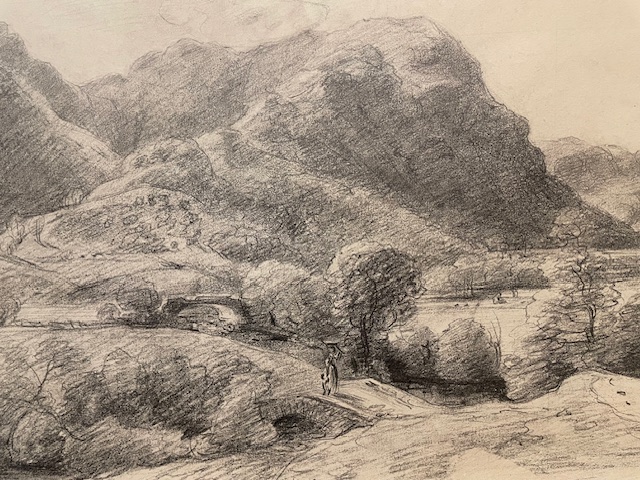
Constable too was no slouch on this outdoor tour mission. Six weeks spent touring the Lake District in 1806  sharpened his drawing skills as this fine pencil sketch of Borrowdale shows…I wondered if he ever met the Wordsworth’s on his perambulations then? What a conversation the Cumbrian poet and his sister may have had with artist from East Anglia.

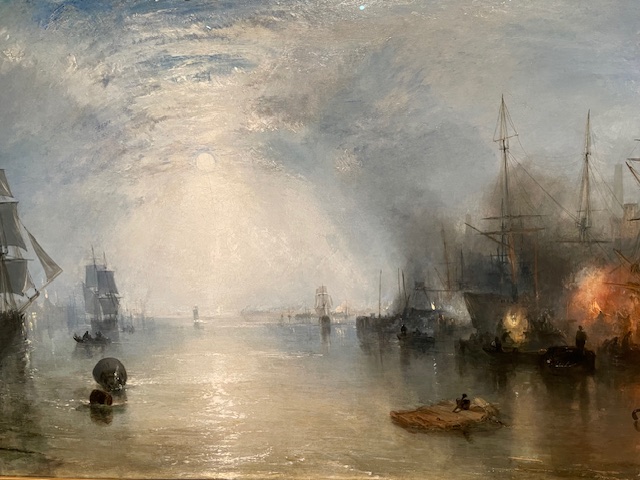
Turner’s association with Northumberland is reflected in a handful of paintings on show. ‘Keelmen Heaving in Coals by Moonlight’ is one.  It’s not specified which Tyne river port of Shields – North or South – is referred to. The image is typically dramatic yet also has a melancholic tone. The  keelmen transferred vast amounts of regionally mined coal from their barges (keels) to sail boats bound for London and other rapidly expanding industrial towns and cities. But It’s 1835 and the rapid spread of railways is already making transport by these means redundant.

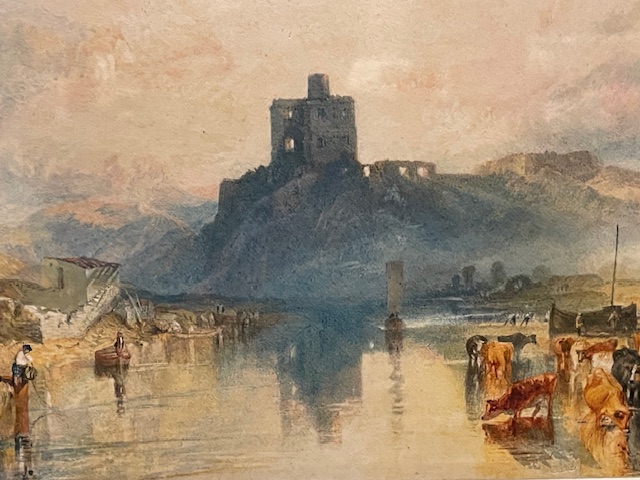
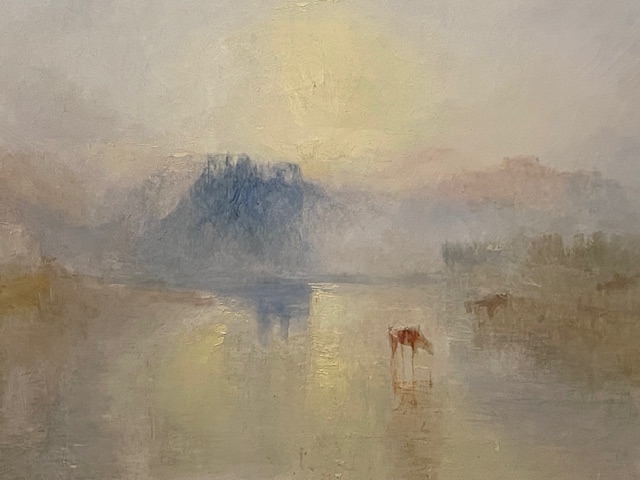
At the other end of the county Turner was drawn both as a young artist of 22 and as an old master to the ruins of Norham Castle on the English bank of the  River Tweed, the boundary with Scotland. He clearly loved the place and his views at sunrise were recalibrated from the infused romance of 1823 (above) to light drenched abstraction in 1845 (below). The latter interpretation opened the door to modernism and, by acknowledgement, the major contemporary art prize awarded in his name.

All in all a great show which does both artists justice in refreshing our understanding, documenting and illuminating their roles in that  revolutionary age. The exhibition continues to 12th April. https://www.tate.org.uk/whats-on/tate-britain/turner-and-constable

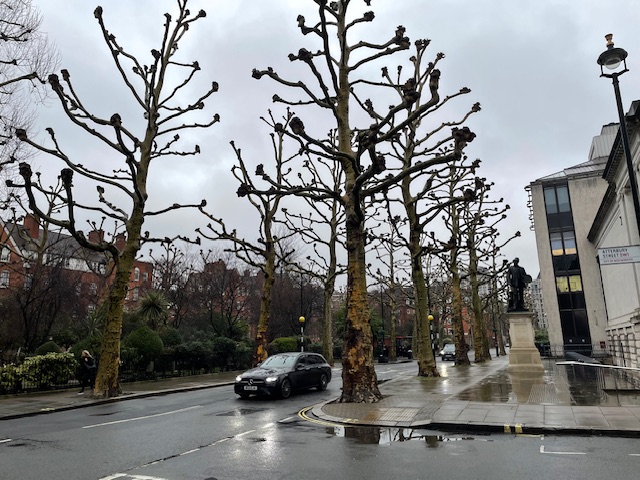
On leaving  we emerged into a street lined with mature plane trees,  their bare branch stumps rounded like boxing gloves, punching the grey London sky. After hours  infused in great art  you can’t help but wonder at these natural forms tailored to urban life, like an outside extension to the gallery…Wonder what JMW and John  would have made of them?

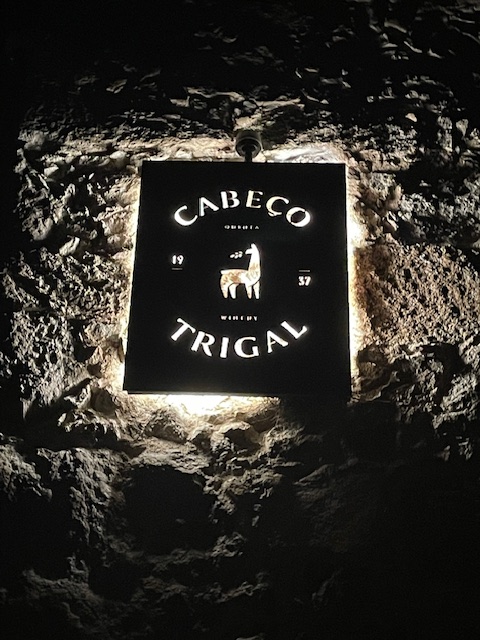
Cabeco Trigal

‘The colours, aromas, flavours, textures and the melody of laughter’  

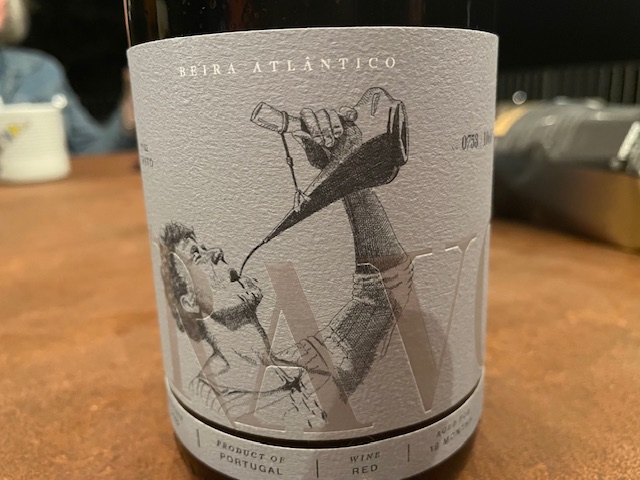
(Cabeco Trigal wine bottle label).

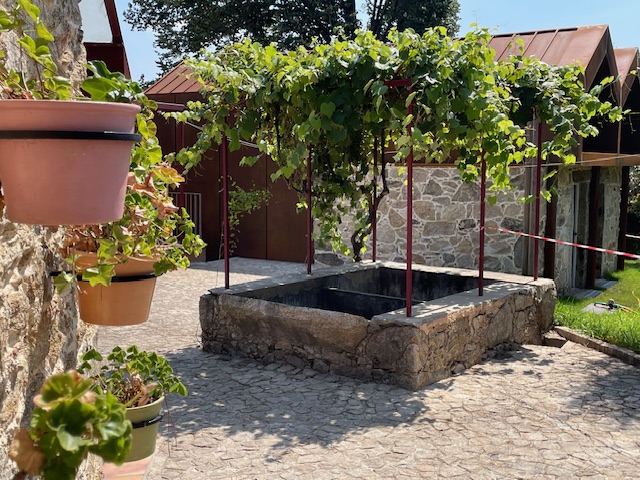
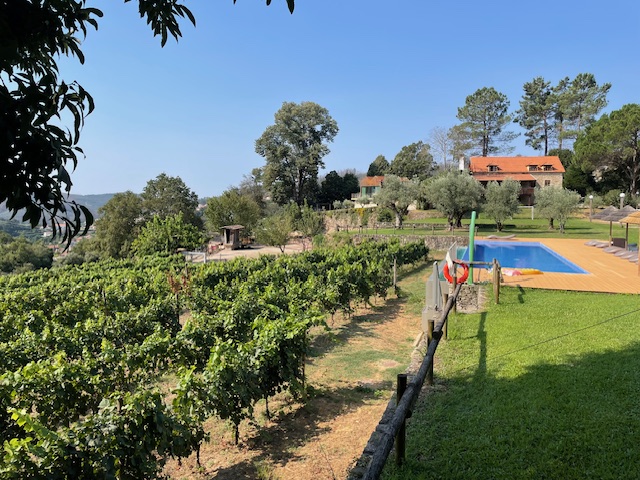
The Air B&B we stayed in had some very attractive features, being a modernised traditional dwelling with all mod cons, lovely outdoor open pool and extensive private grounds.

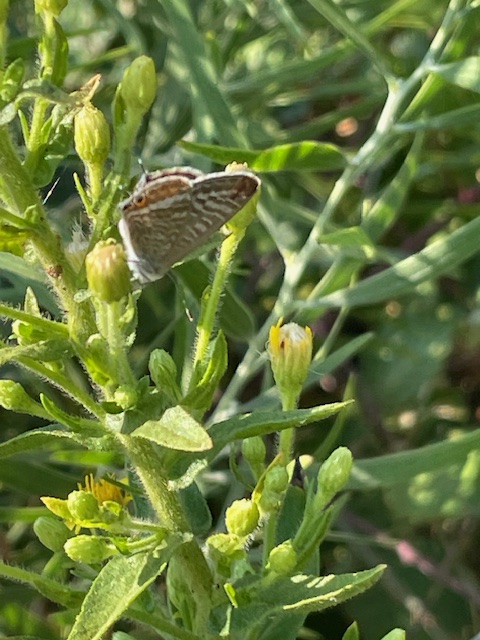
The lawn between house and pool had remained green despite the punishing heat, being the toughest of varieties refreshed by evening sprinkling and morning dews. Many long tailed blue butterflies were about while squadrons of house martins dived, dipped and sipped from the pool water, most thrillingly while I was in it, swimming alone. Jays were seen in the surrounding woodlands. Our lovely accommodation apart, the other aspects of the place had particular rural interest that made this establishment stand out from the crowd.

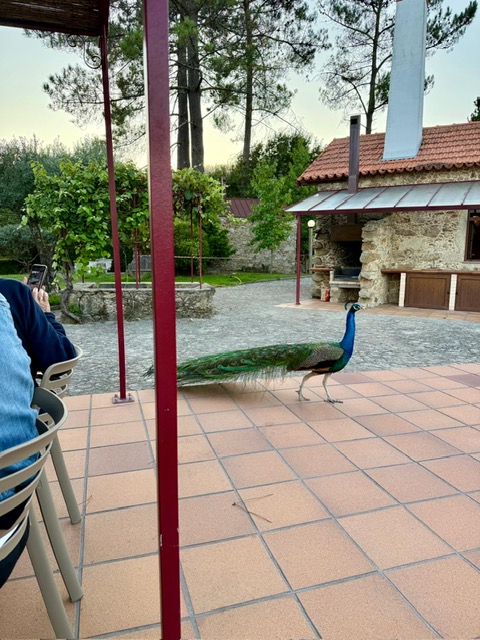
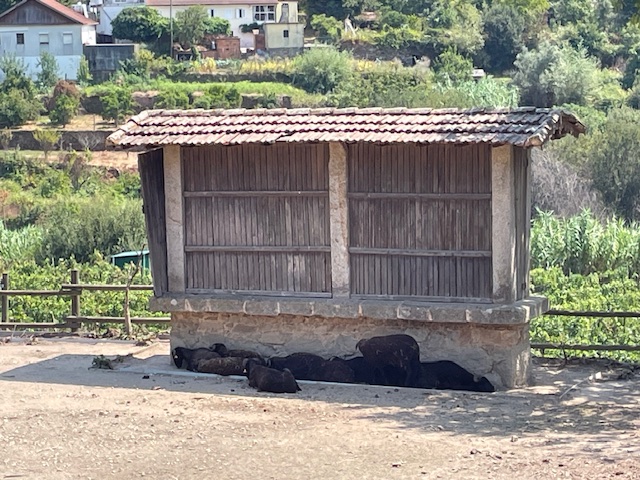
Cabeco Trigal is also a quinta (winery) and a smallholding with traditional breeds of sheep and pigs, alongside horses and llamas. The last features as the estate logo. Animal grazing being sparse it is subsidised with hay and grain. Sheep sheltering from the sun in the shadow of trees or the traditional horreo (granary). Pigs wallowing in mud pools, free roaming male peacocks punctuating the air with their screeches.

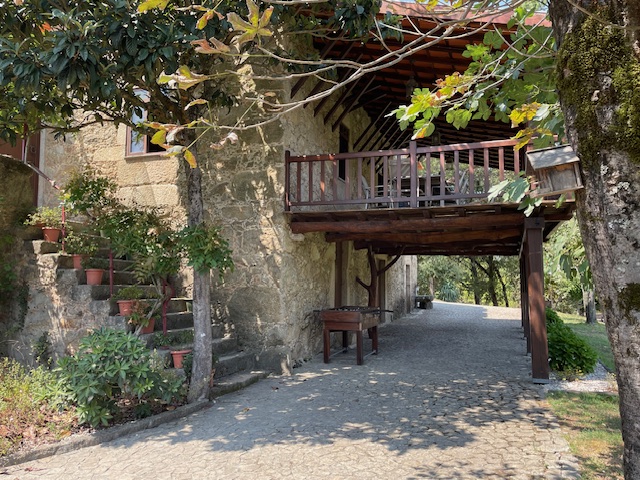
Tiago, the owner and our genial warm hearted host, is an architect by profession who lives with his family nearby. He specialises in repurposing industrial buildings and the tasteful conversion of this his family farm complex, including extra bedrooms in the adjacent barn cum workshop, succeeds splendidly in effectively blending old and new materials.

As temperatures climbed we appreciated even more the cool retreat three floors of indoor space provided, as well as the welcome shade of its wide wooden balcony overlooking the wider estate, with views across the hillside.

What especially endeared it to me was that house and barn were originally constructed of the light grey granite which defines the local topography. Growing up on the edge of Dartmoor this was a comforting reminder of that happy connection of time and place.

Our host is proud of his family’s long history in the Vouga valley. To honour the patrimony he embarked earlier this century on a multi-faceted passion project to reinvent what remained of a once grand estate, here at the cabeco (high place).  Modernising the old farmhouse and repurposing the remaining land by switching away from arable (Trigal means wheat field) to develop and extend the existing wine production on artisan lines was central to that vision. Holiday rental income is the third aspect underpinning the enterprise.

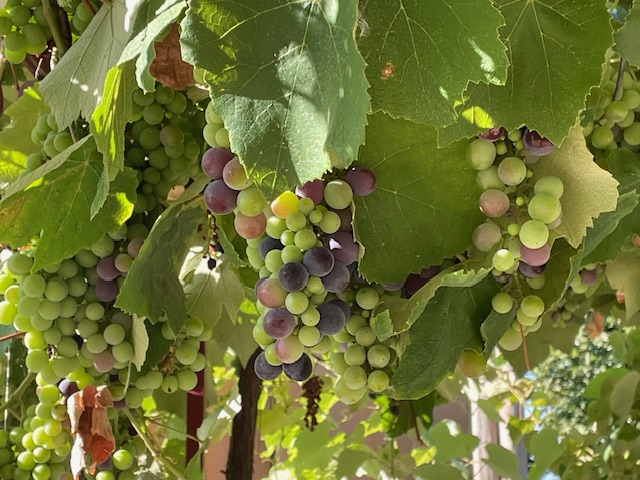
Intense cultivation here, fully utilising the land’s south facing terracing, involves controlled animal grazing in the aftermath of harvesting and again in the spring to control weed growth. Tiago told us that the land here is not ideal terroir for wine production, being rich enough for grain but not for vines which thrive best on impoverished soils. And that’s the reason they cannot go organic. Minimal, though essential, chemical treatment is necessary to ensure successful growth of the new varieties of grapes they’ve planted.  

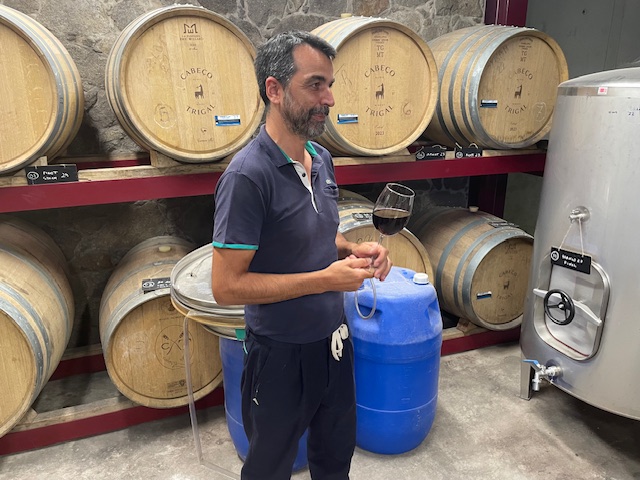
We joined Tiago early in our stay in the workshop underneath the barn, standing amongst the stainless steel vats where the ‘22 and ‘23 harvests of merlot, pinot noir etc stand alongside the French oak barrels the vintages will eventually be transferred to for maturation. He consults  throughout with Louis, his business partner and wine maker, who oversees the whole process.

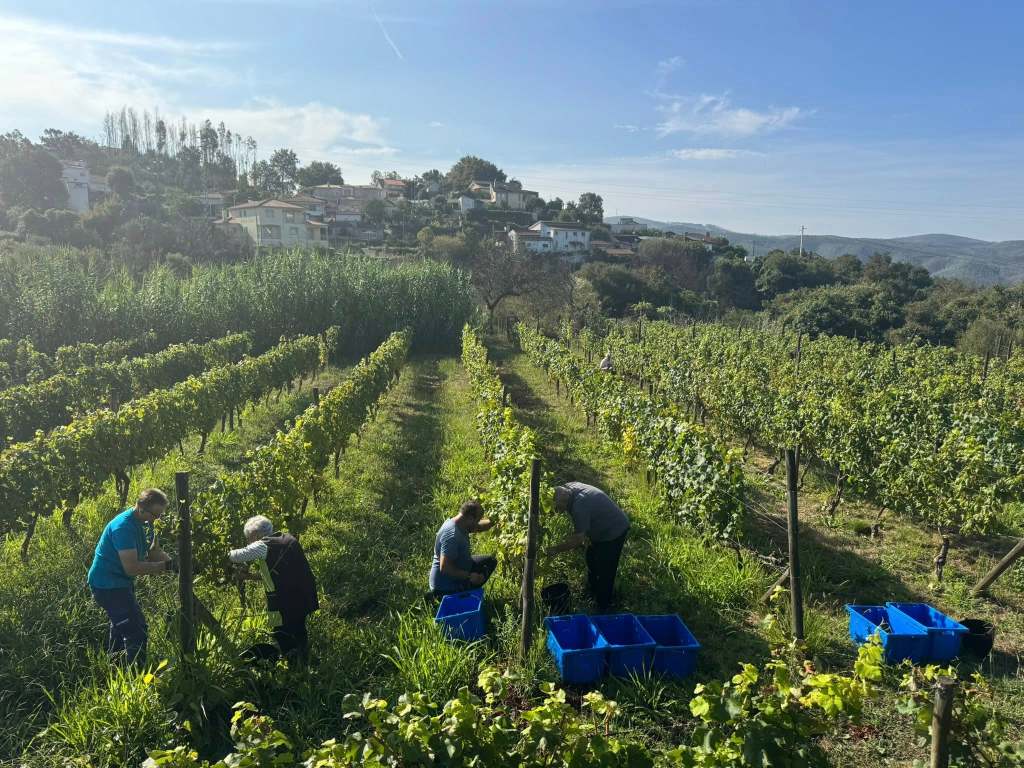
That day Tiago was testing the grape juice to calculate how far off harvesting they were. His sampling tool logged a 10.5 degrees alcohol strength, not the 12 or 13 various varieties need to be at harvesting. (At the time of publishing that would be now.) Friends and neighbours join in to pick, sort and trample the grapes, earning their just reward in produce!

The metal press is used for processing  the chardonnay, sauvignon blanc and other native Portuguese white grape varieties. Interestingly, the actual pressing utilises minimal weight to ensure longer extraction and subsequent subtly of flavour. It’s in the final balancing  process that the skill of the experienced winemaker comes to the fore.

We understood there to be some 6,000 litres currently in production, which makes for approximately 8,000 bottles. These are individually sealed with wax by hand after labelling at the bottling plant.

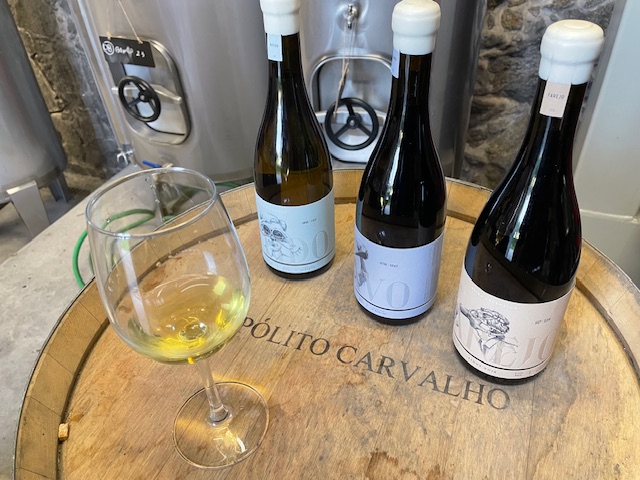
Unsurprisingly you don’t find Cabeco Trigal wines on the shelves of local supermarkets where we noticed the average price of the country’s home product is around €8. Portugal’s main wine producing regions lie to the south and they produce  there industrially at scale. No, these bottles cost around €20 if retailed locally and Michelin starred restaurants are the main customers.

We loved the distinctive quirky line drawings employed for each label. A bottle’s appearance should be an entree for the eyes and these do that. Here’s a translation of one of the key sentences on each label, which neatly sums up what they have set out to achieve.

‘On a hillside where the ancient wheatfields turn to lush vineyards that colour the bucolic mountain landscape, these are our wines in an environment of perfect co-existence with our people and farm animals’.

The much anticipated wine tasting with Tiago on our penultimate night was a convivial affair. The final evening we followed through on his recommendation and enjoyed delicious traditional specialities on the riverside terrace of a local restaurant. it was a pleasure to end that last evening with the remaining bought samples back home. Toasts was raised to the spirit of Portugal in general and one enterprising wine producer in particular.

You can see more pictures of this year’s harvest at https://www.facebook.com/QuintadoCabecoTrigal

Bussaco

‘Bussaco Forest cannot be described, the best is to get lost in it.’  Jose Saramago

Having been told about the Bussaco National Forest by my cousin who had visited recently we were keen to discover it for ourselves during this holiday. An hour and a half’s drive from base by good main roads and testing twisters through mountainous foothills led us to this unique walled in world, one of the botanical wonders of the Iberian peninsula.

We entered from the spa town of Luso via the Serpa gate, one of 11 gateways that punctuate the 5 K (3.1 mile) boundary wall. Only mildly alarmed when the keeper in her lodge warned us that walking any distance into the forest from the centre was entirely at our own risk due to the heightened possibility of wildfire outbreaks.

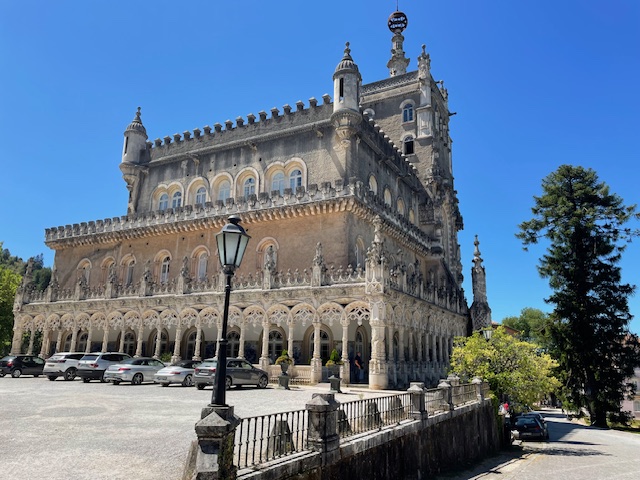
It would have been no great hardship to have spent our time in and around the park’s historic centre, which consists of a former royal palace cum luxury hotel (below), monastery, now a museum (above), formal gardens, café and visitor centre. 

Although Bussaco was originally an early 7th Century Benedictine foundation the one we see today was established by the more austere Barefoot Carmelite order when they took stewardship of the buildings and park in the early C17th.

The brothers zealously set about gradually replicating the Holy Land’s Mount Carmel at Bussaco as a kind of desert, blending nature with God’s spiritual estate.

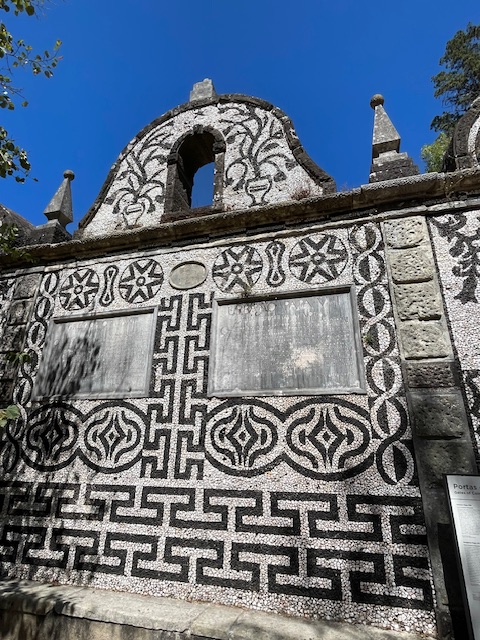
Many of their structures have exteriors distinguished by tessellated designs fashioned from quartz and adhesive tar while the interior of their monastery have coverings of native grown cork freely utilised to insulate walls ceilings and doors against winter cold.

The brothers ordered existence was rudely disrupted in September 1810 when the Duke of Wellington, commanding a combined mass of 50,000 Anglo Portuguese troops, based his command post in the monastery, using the monks cells for offices.

The British general’s army defeated Marshall Massena’s French forces here at Bussaco, halting their advance on Lisbon, a turning point in the country’s campaign of liberation from Napoleonic invasion.

The adjacent royal palace was built between 1888-1905 on part of the demolished monastery. Since 1910 and the fall of the monarchy it has been a luxury hotel, one of the finest in the land. Its initial architect, the Italian Luigi Mantini, also designed sets for grand opera, and it shows. What a brilliantly grand statement of opulence it makes to the world.

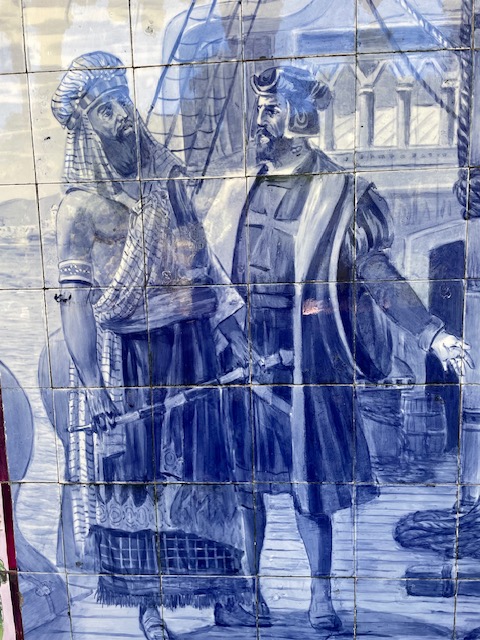
The obliging hotel receptionist let us take a look around the sumptuous ground floor. Large scale blue and white azulejos (tiles) decorate walls and stairs, some displaying the battle of Bussaco and others scenes from Portugal’s ‘Age of Discovery’ in the late 15th and early 16th centuries. At that time Portugal established its maritime trading outposts, stretching from Brazil to southern Africa, Goa in India to Macau off the coast of China.

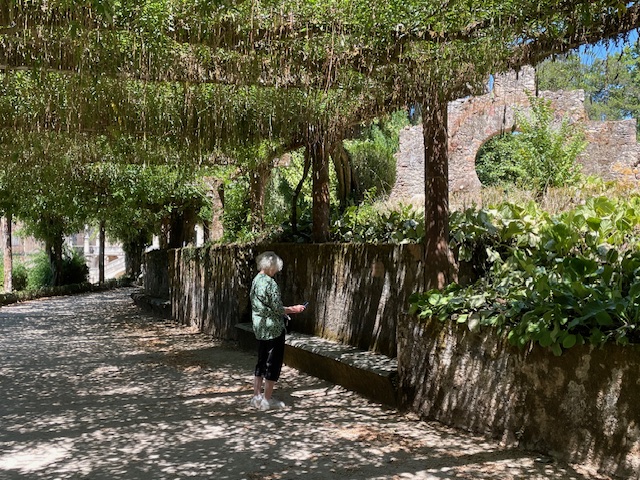
The formal gardens provide a graceful unifying setting for the two contrasting buildings, although box blight and a certain faded glory added to a suitable sense of gentle decay.

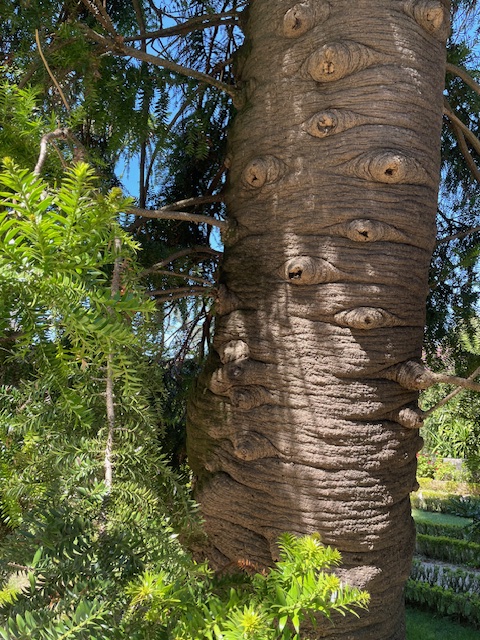
The arboretum remains the true natural glory of the place. Some 400 native trees and shrubs grow alongside 300 specimens brought back home as the result of colonisation and exploration. Mexican Cypress, American redwoods, Chilean pines, many oaks, laurel, holly and ferns to hundreds of Camellia species are set around walks, steps, ponds, fountains, statues and other formal features – we saw just a fraction.

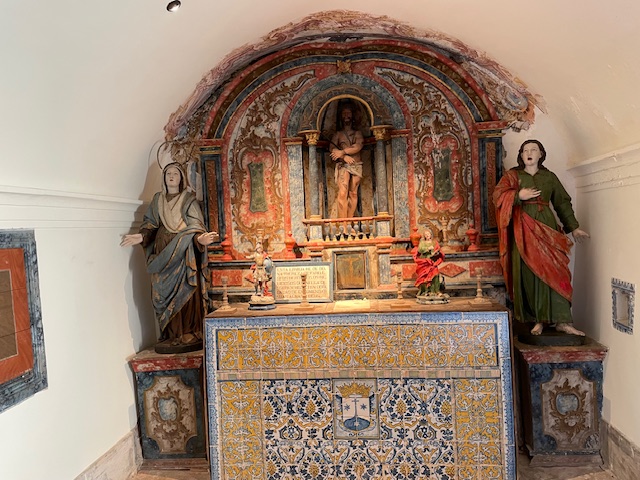
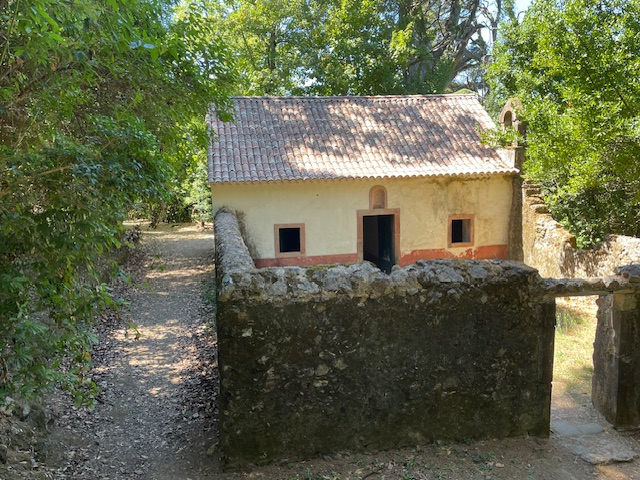
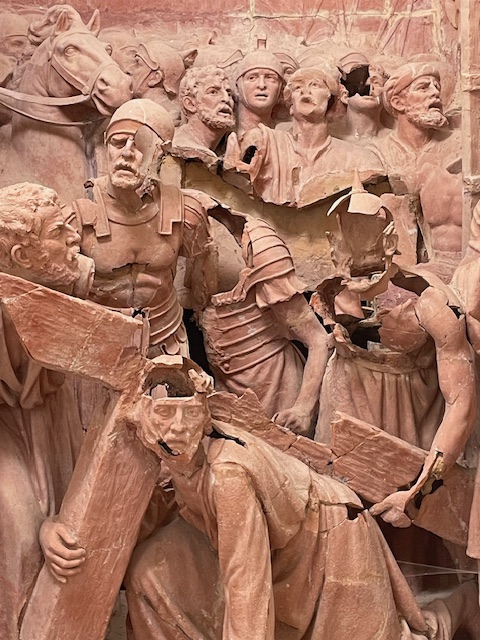
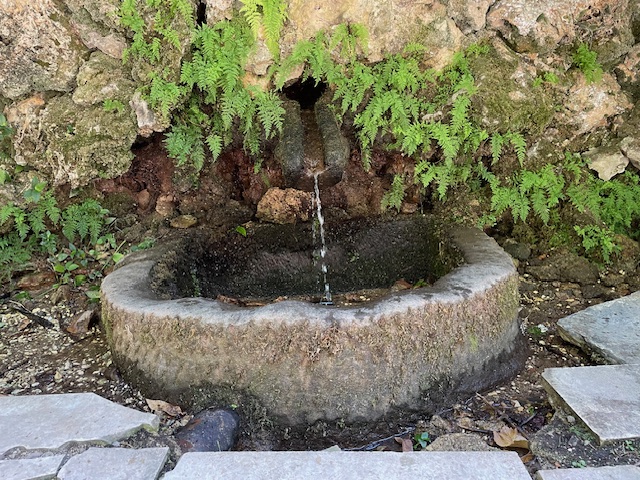
Leaving the formal gardens  for an upper woodland walk, we found ourselves on the Via Crucis- a lane of dappled shade linking enclosed stations of the cross – eventually leading to a purpose built hermit’s house with enclosed yard, now an empty shell, one of three around the domain.

The stations house life size red clay tableaux, vividly recreating scenes from the passion of Christ. Hermit retreats and devotional stations were originally set up by the Carmelite monks shortly after they  took over the estate in 1628.  A number seemed to have suffered damage, adding an unintentional modern feel of abstract dislocation to the dramatic scenes of heightened emotion.

Later learned this damage was caused by a particularly violent storm that struck the area in January 2013, severely affecting both buildings and trees and recovery has been hampered by lack of funds and resources. The state took over Bussaco when Portugal’s monasteries were dissolved in 1834, and today managerial responsibility lies with a charitable foundation, which has had to fundraise widely to painstakingly restore the place.

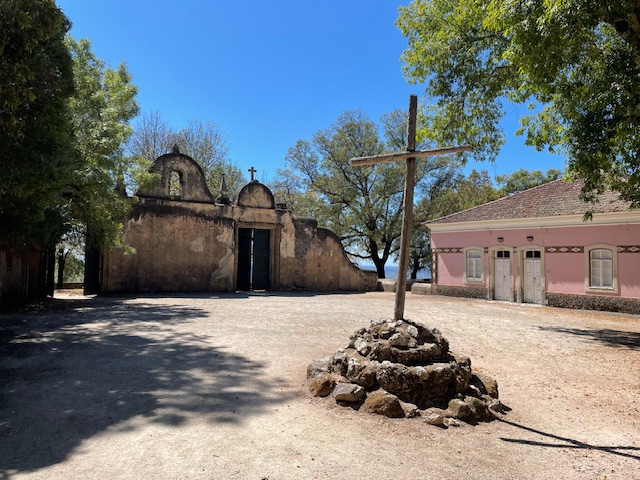
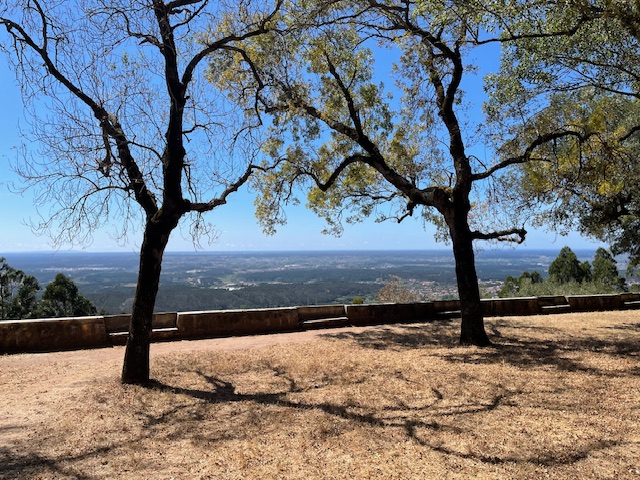
Our stroll took us to another entrance way – not accessible to traffic – the Coimbra gate which yielded surprise vistas beyond the canopy, across the wide plain, to the Atlantic coast.

Lingered by the great doors, now ajar, and the currently unoccupied lodge house (sometime holiday accommodation) with its pink washed walls. Wondered at the wall sign, a papal bull of 1623 forbidding, on pain of excommunication, the felling of trees within the walls or the entry of women!

Historical misogyny apart, I warmed to this early attempt at nature conservation. An atmospheric spot inviting reflection and ease, one where time seemed to have stood still. Stepping out on to the terrace in the full glare of the sun, the bone dry brown grass  crunched loudly underfoot, providing a reminder of the gatekeeper’s words on arrival.

Popular with the Portuguese themselves for its cultural and botanical importance, though less well known to foreign visitors, the Mata Nacional do Bussaco lives up to its reputation, inviting a return to sample further corners, in another season.

Vouga voyage

Recently returned from a week’s holiday in the valley of the River Vouga, mid-way between its outlet at Aveiro on the coast and the city of Viseu near its source in the Serra Lapa.

Like the other major rivers of Portugal The Vouga runs its 148 KM course from east in the mountains to the Atlantic in the west. It was once a major transport route for countryside produce; from wines, granite, metals and timber to fruit and other agricultural produce. (In the 17th Century most of their oranges were exported to England) By 1913, a train line had replaced the inland river boats, which in turn gave way to EU funded new roads that twist and turn above the Vouga’s sinuous green waterways. We enjoyed three separate outings sampling distinctive phases of the river’s flow and topography.

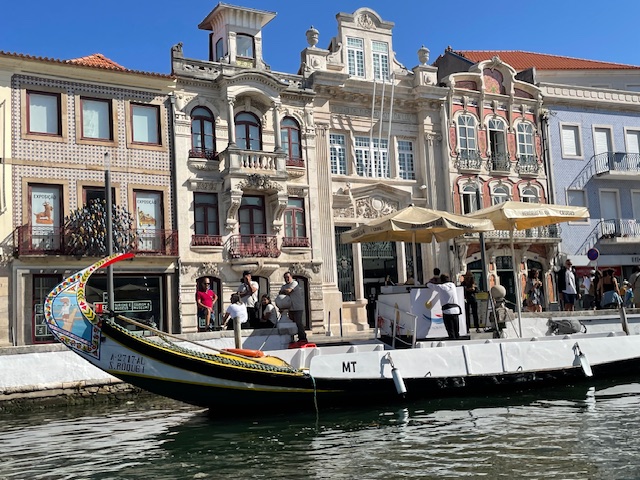
Took a fun day out to swell the ranks of other tourists milling around ‘The Venice of Portugal’, as the city centre of old Aveiro is dubbed. A major port in late medieval times it later became famous for commercial salt abstraction, fishing and seaweed harvesting.

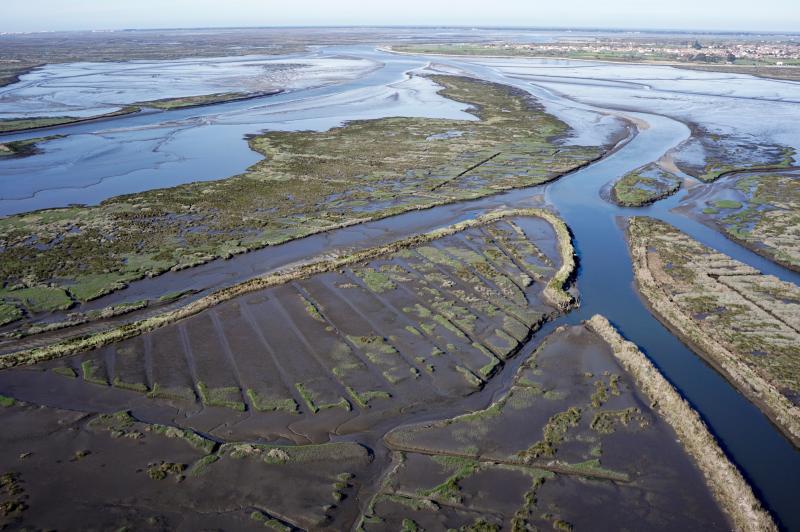
Ria Aviero ecosystem image credit: CESAM

The extensive lagoon and dune ecosystem of the Ria de Aviero, as this estuarial stage of the Vouga is known, now enjoys international status as a major bird sanctuary, home to some 20,000 overwintering wildfowl, the most photogenic of which being pink flamingos.

Trips around the centre’s canal system are a must and the colourfully decorated flat bottomed barges – Molicheiros – that once carried seaweed, salt and general goods now carry human cargo on 45 – 60’ guided excursions.

Unsurprisingly, the last fishing lofts lining the canals have finally closed and are being developed into luxury waterside apartments.

Back on land we visited an Art Nouveau house, now a museum with fine decorative detail, one of many tasteful villas that reflect an early C20th era of increased wealth and pride amongst its leading merchants.

The other end of the Vouga could not be more different. Foreign tourists like us were in short supply here in the mountains, probably because of the limited visitor attractions to lure people up from the popular coastal strip and dangerously high summer temperatures. The Upper Beira  region suffered badly last September from wildfires, causing evacuations and widespread disruption, and we sensed a nervousness even now, lest they return.

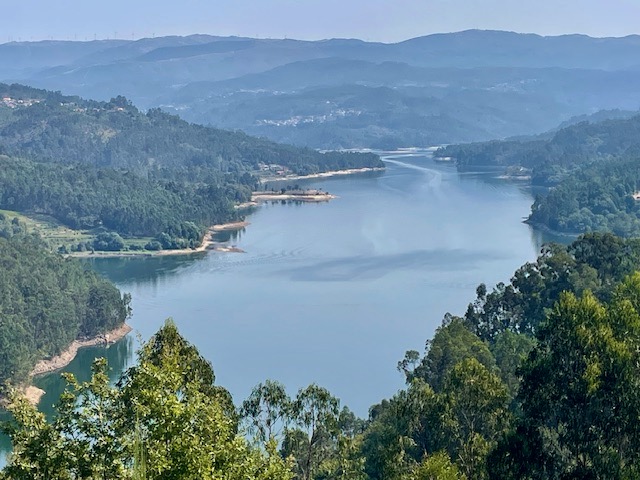
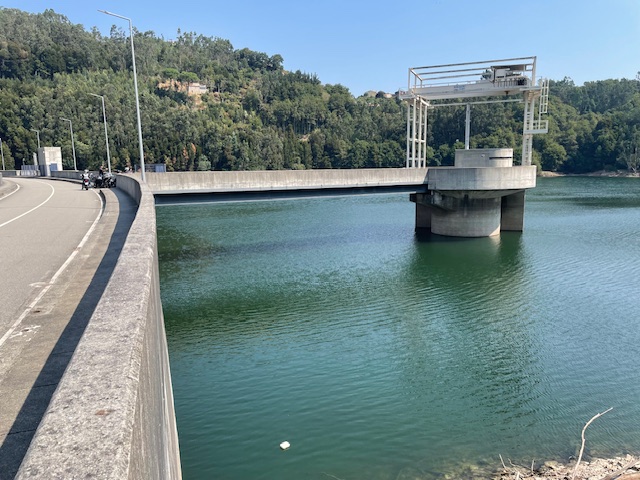
We stopped off at the Ribeirado dam and looked along the 14km long reservoir it created. It was built earlier this century to supply hydroelectric power, ease flooding and increase scarce water reserves. The road runs along the broad arc of the high dam wall, the power station and its infrastructure far below, where the river re-emerges. With the sheer valley walls either side the whole presents as a peerless study in concrete.

The brightest objects encountered in this uniformly grey spot were the red, blue and yellow recycling bins in the car park. Ominously, the control tower in the reservoir emitted flashing light and warning noises every few minutes. If this location were to feature in a future James Bond film or dystopian TV drama it would not surprise us. A perfect setting of its kind.

Another day we walked the middle reaches of the river. Was keen to access an upper trackway I’d clocked above the road while driving to our holiday accommodation nearby.

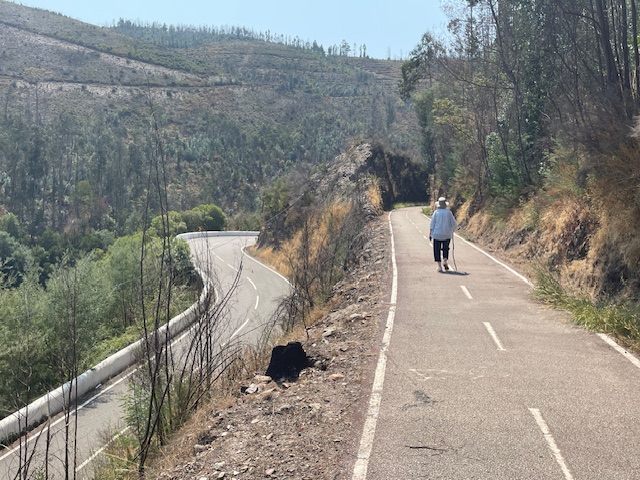
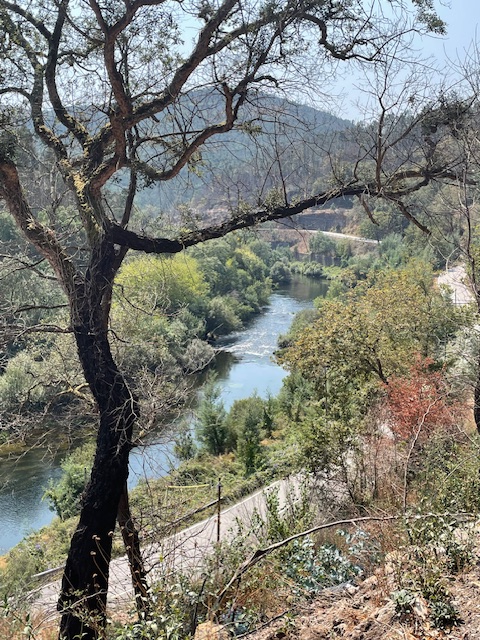
As suspected this was once a single track railway. Built just before WW1 it closed in 1980 and its repurposed state, the former Vale Das Voltas line offers superb viewpoints of the valley.

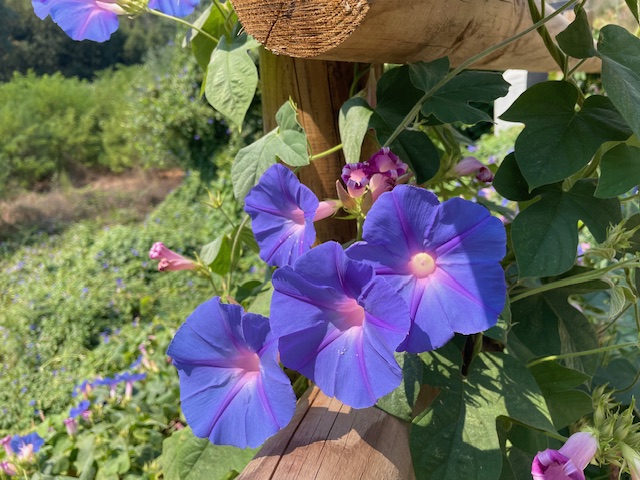
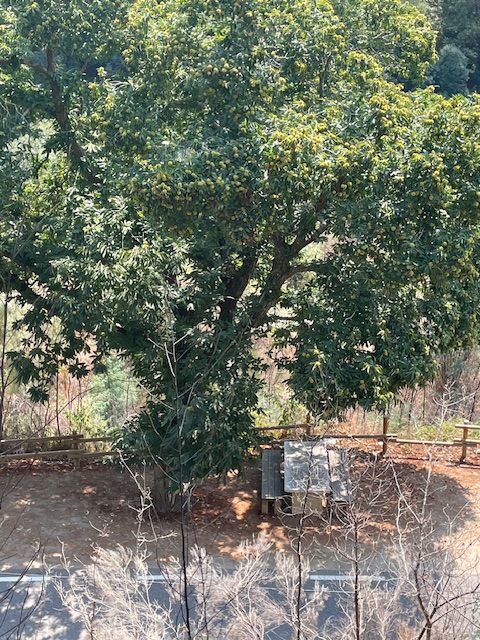
Our parking place by the road revealed a picnic table made from a single slab of local granite set under the awning of a mature horse chestnut tree. Masses of richly purpled convolvulus – bindweed – curled around the wood  rails.

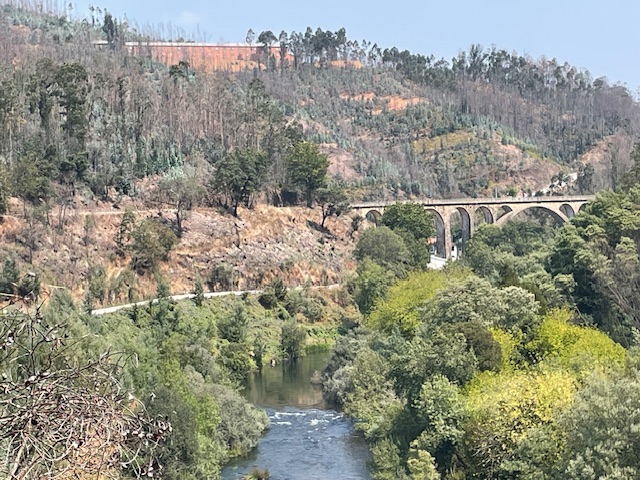
The track is understandably popular with cyclists, yet we only encountered four other pedestrians on our amble to and from the route’s spectacular highlight, the Santiago rail bridge at Pessegueiro do Vouga. It’s one of the highest stone masonry bridges in Portugal, with eleven arches and 165m high deck, gracefully spanning river and wooded slopes.

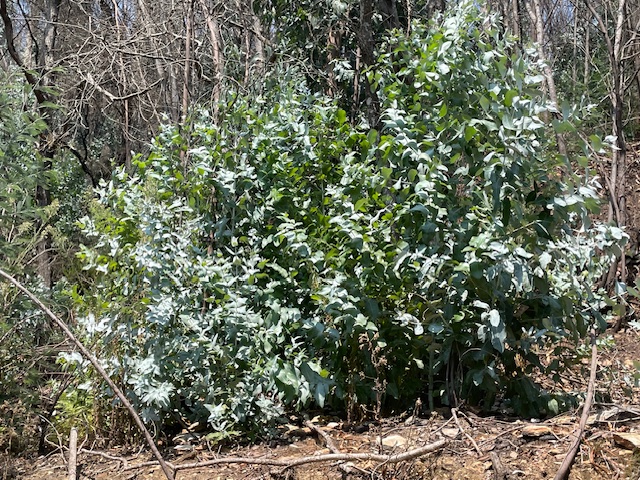
Our walk revealed a stark reminder of last year’s big burn. Blackened trunks and boughs in abundance. A contentious issue in these parts is the preponderance of silvery leaved eucalyptus trees, commercially planted to supply nearby works with biomass and extracted oils. That process is also understood to cause environmental air pollution.

This alien tree, of Australian origin, successfully sustains itself on steep slopes with minimum moisture and burns easily. Eucalyptus rapidly colonises cleared land post fire and is hard, if not impossible, to eradicate.

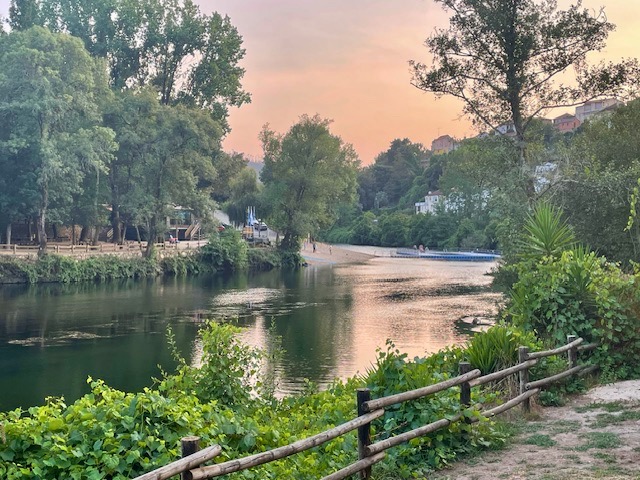
Our walk ended ‘off line’. Carefully crossing the white walled switchback of a highway, we descended to the quiet stillness of river bank and cooling shade of willow and alder that thrive here on its stony floodplain.

This middle stretch of the Vouga is officially designated a ‘Site of Community Interest’. That means minor blockages like weirs that present obstacles for migrating species of trout, eel, shad, barbel, lamprey or mullet are being gradually removed and in some places fish passes are being installed. Otters, birds of prey and many other species of birds and insects are also able to thrive here where human habitation is scarcer.

Delighted in encountering dragonflies and butterflies I waded barefoot in and allowed the hundreds of trout fry mingling in the sunlit shallows to continue feeding and flitting around my feet. A cooling calm end to our lovely lone amble under the afternoon sun.

Bountiful Berwickshire

We’re recently back from a celebratory weekend away, organised in secret as a gift to share with the significant other. Found a place near enough to drive to easily but far enough away to make for a proper countryside adventure. Some highlights then, as follows.

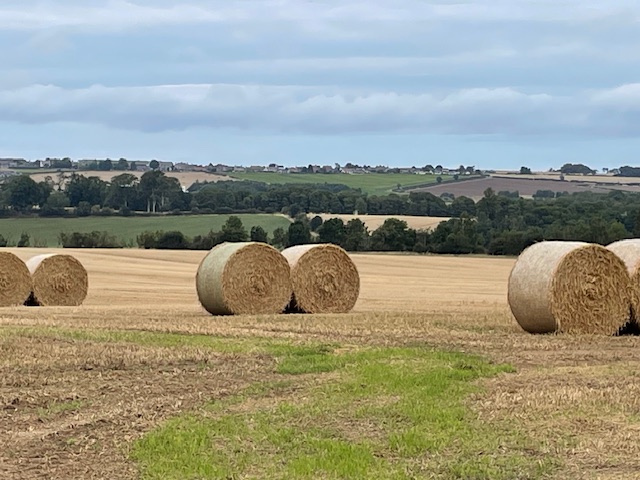
We arrived in Berwickshire, in the wide valley of the River Tweed and its tributary the Whiteadder, for our stay in the village pub at Allanton. All around the area huge combines, tractors and trailers were cutting, winnowing, baling and carrying off barley and specialist wheat. They continued late into the night, headlights glowing, growling over wide rolling fields with the lanes alive to traffic up to midnight. A fascinating contrast for us who live in the grassy uplands of west Northumberland where log lorries and tipper trucks loaded with gravel for forest roads are the big beasts of rural transport.

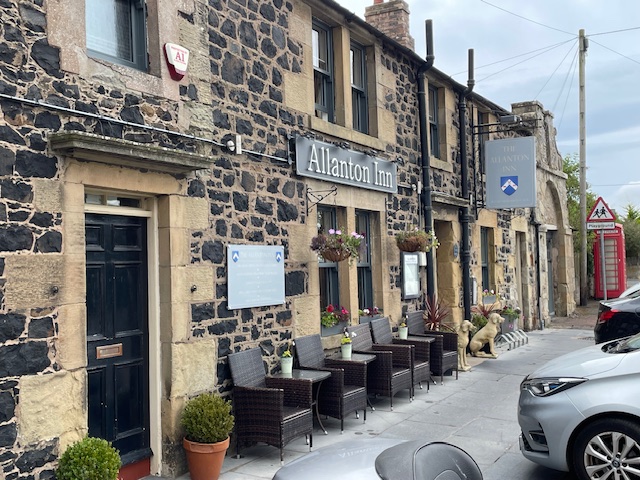
We sat out in the pub’s pleasant back garden with a refreshing pint before supper gazing over a scene of blond stubble and waving grain, shadows stretching to far woodlands, the land glowing warm under a setting sun. The Allanton Inn really is at the heart of its rural community. A family run business, part of an ecosystem of small independent local producers and suppliers, proud of their good food offer – from honey and ice cream to meat and eggs – as we were to partake of it. The perfect relaxed hostelry from which to explore this side of the border.

This is a land of big estates and large farms, the metal and concrete barns mostly modern and huge enough to properly house mountains of grain and straw. The population is much sparser now than it would have been in the pre-machine agrarian age. It’s extraordinary to note that within the radius of a couple of miles some of the great figures of the Scots enlightenment were born and grew up. These include the moral philosopher David Hume, geologist James Hutton and botanist and populariser of the tea plant, Robert Fortune.

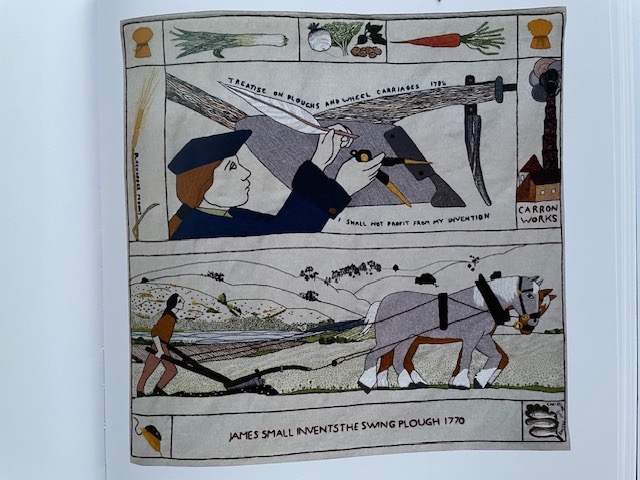
Most touchingly of all is the story of the least known of these worthies and the revolutionary device he freely gifted to agriculture, one that would help fashion the arable landscape around us today. In the 1770’s local engineer James Small used a smithy on the  former Blackadder estate at Allanton, using mathematics to experiment on different mouldboards, curvatures and patterns to produce his improvement on the ‘Rotherham’ cast iron swing plough. Previously many men were needed to work teams of oxen to pull a flat wooden plough while Small’s only required a pair of shire horses and a single ploughman to operate. Small even demonstrated his invention to ‘Farmer’ George III and his ‘Scots Plough’ was rapidly copied and developed by others as he not wish to profit from his invention by taking out a patent and sadly died in 1793 of overwork and poverty. Modern day embroiders have honoured his memory as James and the plough feature as one of the wonderful metre square panels in the Great Tapestry of Scotland, on permanent display in Galashiels.

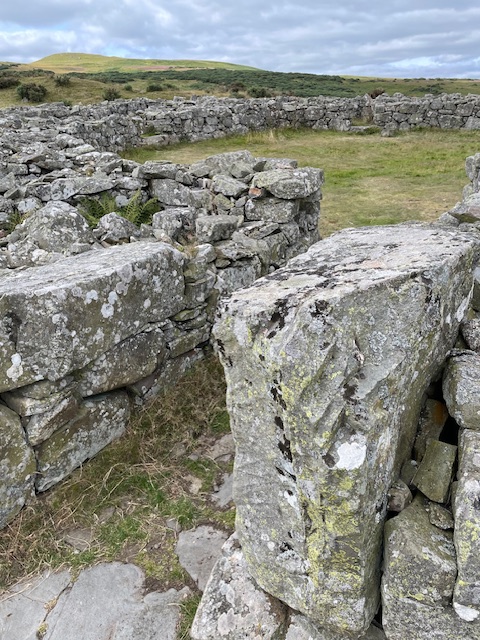
Situated on the eastern edges of the Lammermuir hills, below the lofty summit of Cockburn Law and overlooking a steep valley sits Edin’s Hall Broch. It was the high point of a circular five mile walk we took over fields, through woods, along tracks and heathland paths.

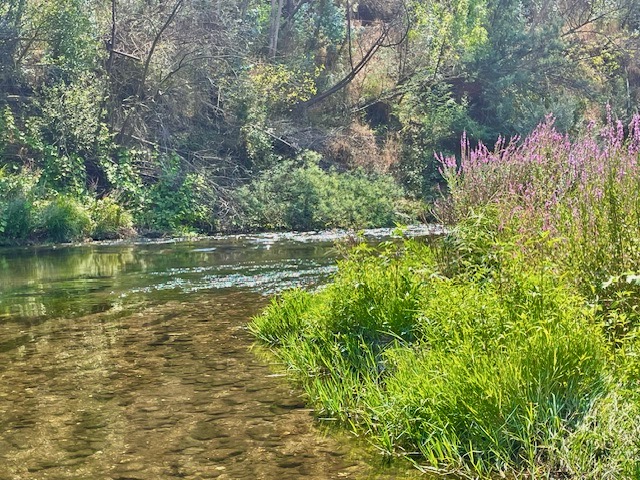
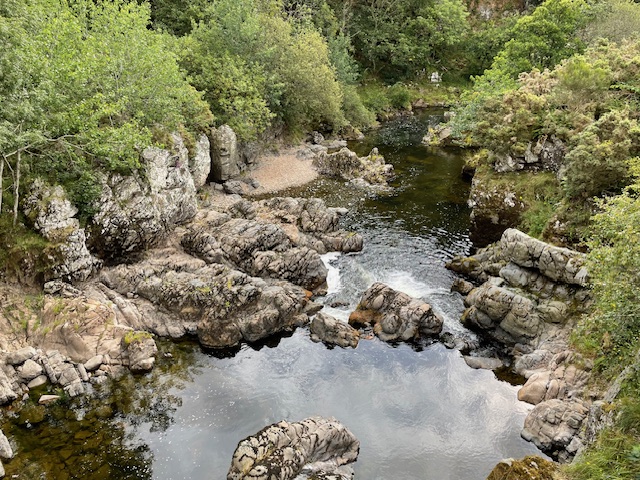
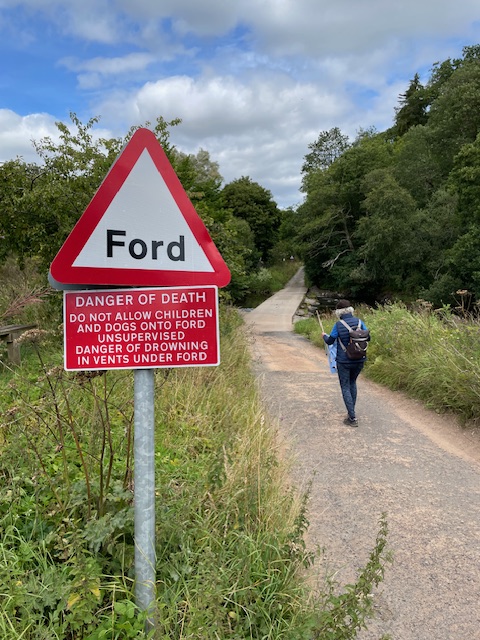
We made two separate crossings of the infant River Whiteadder by ford and footbridge. Summer picturesque as the scene was, one could imagine the place when the waters were in spate. The road sign at Abbey St Bathans reminds drivers of the risks.

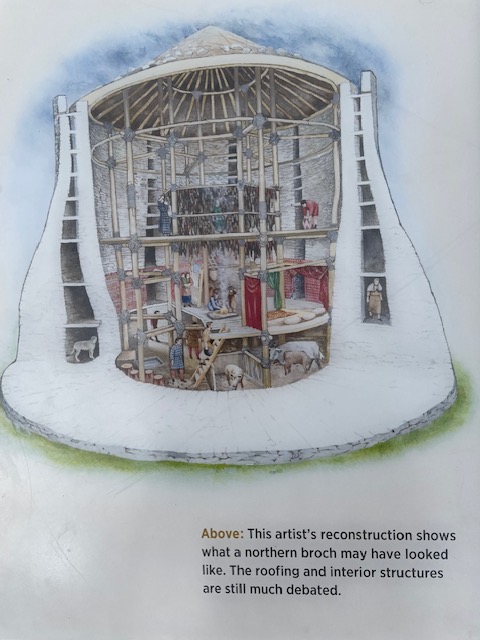
Brochs – ancient fortified tower houses – are usually found in the highlands and far north of Scotland so the one here is something of a geographical oddity. Our slow climb to reach it enhanced by seeing male wall brown and small copper butterflies basking in the sun and fluttering ahead as we climbed through swathes of tall bracken.

Dated to the 1st century AD what really lends Edin’s Hall broch a sense of wonder is that so much stone remains to define its walls, wide enough to incorporate chambers and stairs. The centre point gives a 360 degree experience of what was once a whole community’s secure home and stores, standing at least two levels high and probably roofed with timber. Hard by  the broch are remains of later hut circles, ditches and ramparts. Awed as we were we couldn’t help wondering though where its inhabitants would have sourced their water supply, with not a spring in sight.

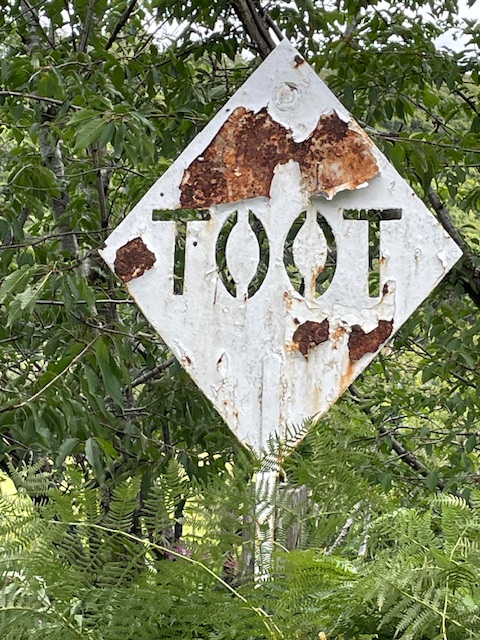
Picking up a metalled lane diving down into the wooded valley bottom we came upon this weathered sign at a hairpin bend. The only thing near a toot we heard on the descent was from the occasional whirr of spokes or tinkling bells as racing cyclists shot by with friendly waves. Like them we appreciated a rest break at the friendly informal tearooms in the old stables of the original village woodyard by the river. We can testify that the home baked fruit scones are superb.

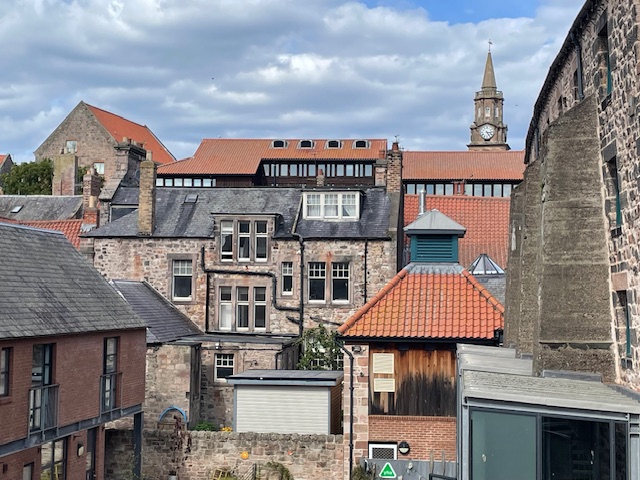
Every few years sees us on a return visit to Berwick. A preamble along the massive Elizabethan ramparts leads literally ‘off the wall’ into the multi-storied Granary gallery, a former Georgian warehouse on the quay overlooking the three great bridges, monuments of different centuries, that carry road and rail links across the great border river.

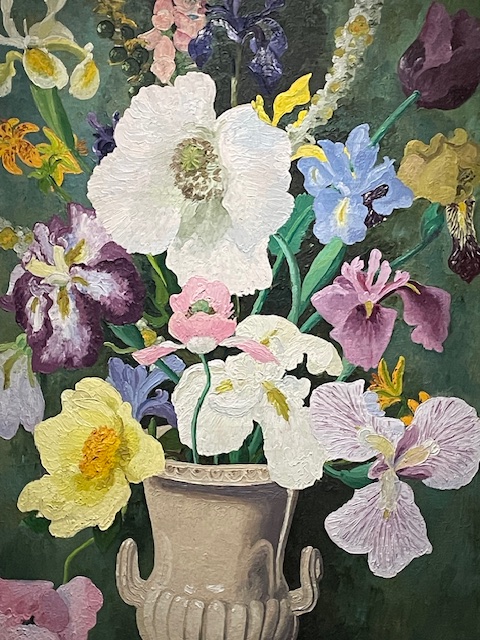
The retrospective exhibition we’d come to see at the Granary was of the respected artist, teacher and plantsman Cedric Morris (1889-1982). We found it something of a mixed bag. His flower painting, especially of Irises, remain glorious testimony to his knowledge and ecological awareness. The best known self-portrait and studies of Parisian café life in the 1920’s insightful and sensual. 

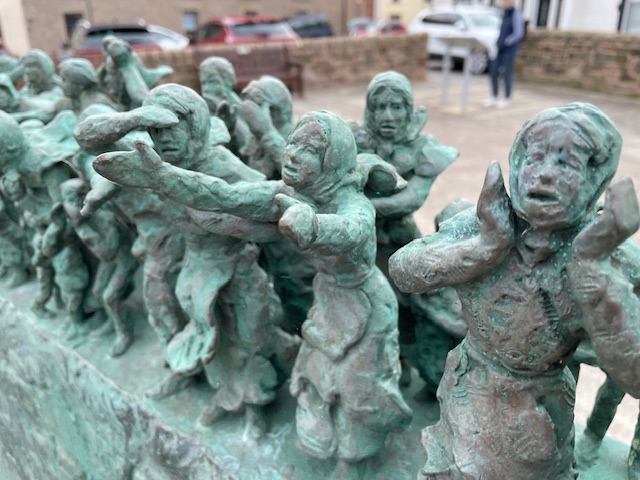
The art that really moved us though was on the seafront across the border at Eyemouth. In October of 1881 a terrible storm wreaked havoc on the Berwickshire coast, and 189  local fishermen were drowned, leaving behind 78 widows and 182 children. The town’s fortunes went into long term decline in the wake of this, Scotland worst recorded fishing disaster.

‘Widows and Bairns’ represents real people, arranged in groups above the name of their boats. Sculpted by Jill Watson and cast by Powderhall Bronze it opened in 2016. We watched visiting families stop and talk about the story. The best kind of public art, rooted in people’s history, powered in this instance by tragic drama to command our attention and stimulate conversation.

In the 21st century, the community here has been embracing eco based industries and sustainable tourism and this attractive harbourside town – like Berwick across the border – seems on the cusp of change for the better. The broader Eyemouth story is well told in the delightful volunteer run museum housed in a former church.

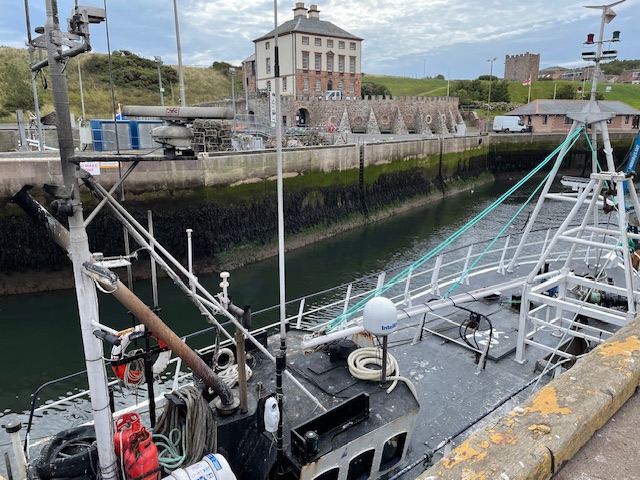
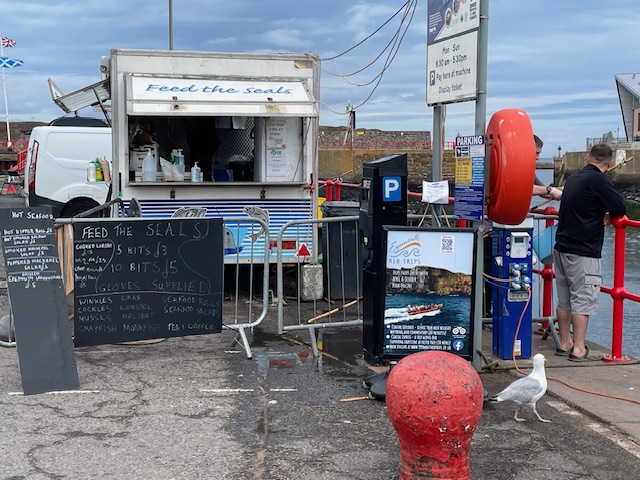
We also enjoyed taking a leisurely stroll along the narrow harbour around the mouth of the river Eye with its working fishing boats, quayside  processing plants and local produce stalls. (kipper rolls anyone?) These merge with an array of smart locally based retail businesses (excellent Italian ice creams), the sandy town beach and restored stone jetty with its bright red handrails and fine prospect.

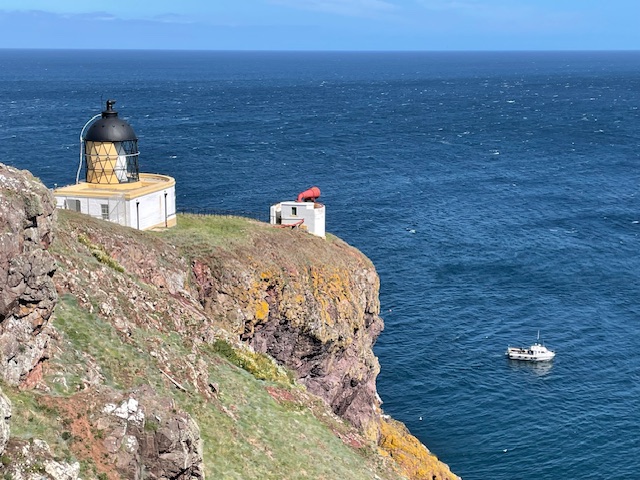
A little further up the rocky coast lies St Abb’s Head, named for a Northumbrian princess who founded a monastery here, now long lost, following her safe delivery from shipwreck. Fittingly a lighthouse, dating from the 1860’s and built by the Stevenson family (who else?), still casts its powerful light from the head. Unusually, it is tucked into the cliff below the lighthouse keepers cottages (now holiday accommodation) as the higher ground above and beyond has always been prone to mist and rain, obscuring vision at sea. Hence the red painted fog horn, seen below.

If we’d been here in late Spring we’d have witnessed the vast flocks of gannets, razorbills, gannets, kittiwakes and other seabirds that crowd the nursery rockfaces and for which the bird reserve is nationally renowned. Their guano, whitening the masses of red blue sandstone rocks, is striking but the birds and their fledglings were no longer in evidence this bright breezy morning in August. Instead masses of house martins dominated the clear blue skies above small bobbing boats filled with visitors tasking in the awesome sea level view of this spectacular headland.

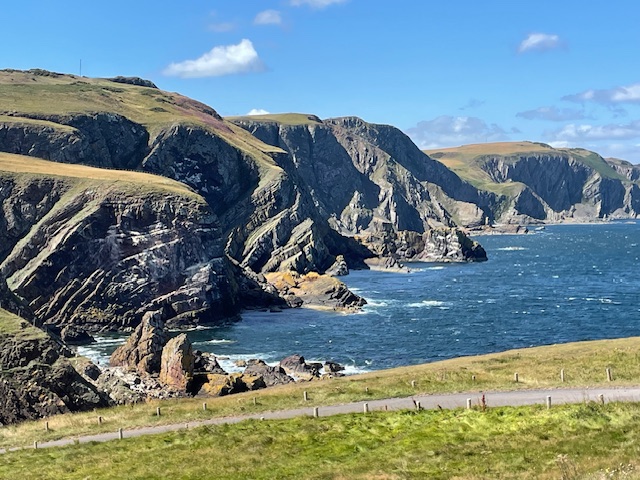
Our return leg, mostly along the single track lighthouse access road, revealed a stunning surprise vista of more cliffs running northwards. Once out of the severe wind tunnel blast between those cliffs and St Abb’s head, the path drew us away into the calm serenity of a narrow fresh water loch in a ravine fringed with reed and sheltered by woods. The National Trust for Scotland run the excellent visitor centre in an old farm complex where we parked to start and finish our wonderfully rewarding  four mile trek.

Recently shorn cheviot sheep at St Abb’s head

Hanging Stones

When it comes to rest and recreation it pays to walk. The health and wellbeing benefits are obvious. It’s not so often though that you pay to walk. But that’s what we did a few weeks ago. And for a very good reason.

The Hanging Stones art project is unique. Ten restored or rebuilt former agricultural buildings, each containing a bespoke art installation, situated in the heart of the North Yorkshire Moors National Park, all linked by a 6 mile walk. It’s the creation of one of the UK’s – and indeed the world’s – leading sculptural landscape artists, Andy Goldsworthy. His long working relationship with stone dates back to time spent as a teenage farm labourer, maintaining and repairing dry stone walls in his native Yorkshire.

Our party of five was one of four groups of no more than six members booked each day. The trail begins and ends in the village of Rosedale Abbey. Parties set out every two hours along public paths, tracks and bridleways into the increasingly steep sided valley that is Northdale, defined on both sides by high bare moorland. At the highest point we saw the group ahead descending and those behind us ascending.

In his 2018 prospectus Goldsworthy wrote: ‘The walk is an integral part of Hanging Stones, the artery by which people will give life to the buildings….It will be both discreet and dramatic. Visible to those who know it is there and hidden to those that don’t’.

The Rosedale Abbey area has a long history of mining and quarrying although tourism, agriculture and field sports appear to provide most employment income these days. The highest part of our walk was on a permissive path that threaded through the source waters of the north beck, on whose steep bracken and heather clad slopes stand a dozen or more shooting butts. Returning along the lower valley floor we skirted an immaculately kept shooting lodge, currently under wraps, awaiting the open season in August.

This project clearly could not have happened without the approval and financial backing of the area’s main landowner, the Rosedale Estate, a 4,000 acre commercial grouse moor. Most of the North York Moors is owned by the King as Duke of Lancaster but this particular holding belongs to Carphone Warehouse founder David Ross. His philanthropic foundation supports arts, educational and sports activities. http://www.davidrossfoundation.co.uk/

With the buy in of the local community, the foundation and the National Park Authority, Goldsworthy’s vision and consummate skill has harnessed all the necessary elements to produce an outstanding example of renewal within a protected upland landscape. Work started in 2019 after a struggle to accommodate the proposal to the strict planning laws governing national parks it was given permission to proceed. The result is emotionally charged and thought provoking in its playful linked exposition.

 Goldsworthy says: ‘One of the rationales for working with buildings is that sound, atmosphere and materials are amplified when experienced inside a confined space’ That sense of theatre, which also invokes the atmosphere of a shrine or chapel, is the hallmark of the most effective of the interiors. Dramatic use of natural light and intense application of materials or textures onto the building fabric is fantastic.

From weave of rusted barbed wire to powdered ochre paint, burnt boughs to woven logs or light bending thicket of poles in gravel – each environment works its rough magic, drawing you into a sensual response.

The barn that displays the eponymous hanging stone – all 11 tonnes of it – is brilliant testimonial to structural engineering that teases visual perception of mass in space.

Elsewhere a new build barn traverses the ruin of an old farmhouse floor where the mosaic of concrete and broken flags yield clues of former occupation. This put me in mind of Thomas Hardy’s poem ‘The Self-Unseeing’ whose opening lines run: Here is the ancient floor / Footworn and hollowed and thin,/ Here was the former door/ Where the dead feet walked in.

We enjoyed our packed lunches at the ramble’s half way point, following a steep upward scramble through swathes of bilberry covered moorland slopes. Here a large table sits in a little house perched on the open moor’s cusp. Through the open door on a clear day we enjoyed fine views across the high moorland plateau and cleave of dale spread out below.

Passing the shorn trunk of a wayside ash at one point I noted the cut section and wondered if this was an incidental wayside art work or just some essential tree surgery.

Goldsworthy’s attention to detail helps seal the overall impression. His way markers are subtle oval metal markers set into stone gateposts, some of which also feature small square through holes.

We spoke to a friendly farmer who asked if we were enjoying the art works. Later we saw him rounding up sheep with his collies astride a quad. I suspect he, like many here, are pleased to see redundant buildings restored and repurposed. Later, passing by another farm, we were presented with a picture book collection of ducks, geese, lambs, calves, dogs and goats, all putting up a cacophonous chorus of sound, much to our delight.

Cistercian nuns founded a priory in 1258 at Rosedale, establishing the wool trade which sustained them up to dissolution in 1539. In more recent times, from the 1850’s – 1920’s, high quality magnetic iron stone mining became the principal industry. On leaving we passed abandoned roasting kilns atop the valley’s precipitous Chimney Bank road, but with gradients of up to 33% it felt wise not to stop. 

I came away from this remarkable walk with a deeper understanding of how Goldsworthy and his collaborators created these amazing site specific art works, utilising natural local materials to complement and enhance a sensitive and highly protected rural environment.

It proved a memorable  immersive experience in which we as visitors are part of the synergy generated within each of those boxes of delight. Like all great art the effects are cumulative, resonating and lingering in the imagination long after actual contact.

The complex, often contradictory issues and compromises involved in the planning, funding and execution of this project has intrigued me almost as much as the actual installations themselves. I feel that’s worth a tenner of anyone’s money, to allow one the chance to walk in wonder, to witness and reflect on a particular genius of place and time.

If you are able to experience Hanging Stones for yourself I’d urge you do so. Along with a set time on the allotted day you get a map and key that unlocks each building. Moderate map reading skills and stamina are needed, depending on seasonal weather conditions. Demand is high though. We hear that there’s no availability until February 2026.

More information and to book: https://hangingstones.org/