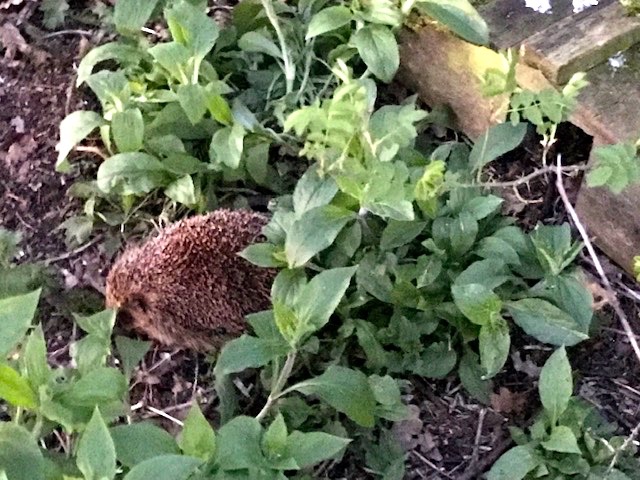
Following on from my last blog about hedgehog hibernating in the shelter I went down to the bottom of the garden at dusk to check for occupant activity. I was regaled with a fearsome snorting and eventually found the source in the undergrowth, a male hog foraging outside the shelter I’d set up a few years back. If the source of the grunting wasn’t known I’d have felt fear in my bones as it had a positively ghost like disembodied quality. On the way back to the house, going round a corner into spilt light from a window, the form of another hedgehog came into view. Wow! two sightings in one night. This one appears slightly smaller than the first. A female, I wondered? Is there a possible mating scenario in progress? Who knows, am just happy to have helped provide a home for these endearing and endangered species.
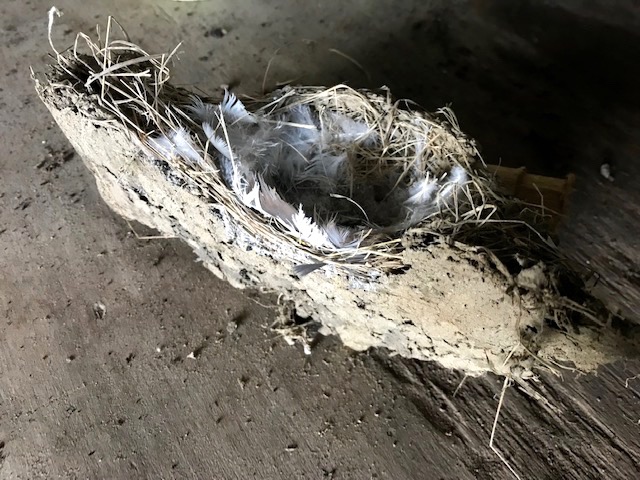
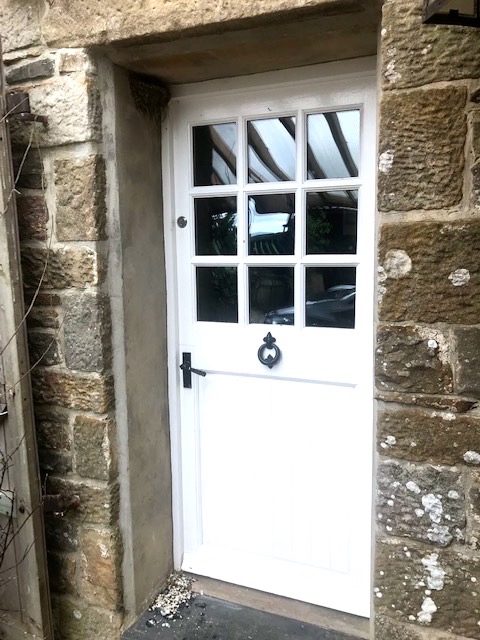
They’re back. The first swallows have arrived, or rather we made our first positive identification, on Tuesday 23rd. That’s earlier by a week than last year. There has been aerial aggro since as rival pairs clash in the course of scoping the best nesting sites under our roofed deck. Earlier this year we took down the last nest built for a late brood outside the main house entrance on the yard side. The parents took flight every time anyone entered or left with a noisy flurry of cheeps. Their mud and grasses stick on structures are things of beauty. We want the adult birds to set up their summer homes instead in the usual sites they normally favour, time honoured spots under the deck eaves or high in the old railway goods carriage that serves as our garden hut.
Discovering old nests in the garden long after being abandoned is always a delight. The James Grieve apple espalier has become such a spreader over the south wall of the house that its summer foliage effectively disguised the presence for the first time of a blackbird’s nest, its rough weave now gradually unravelling.
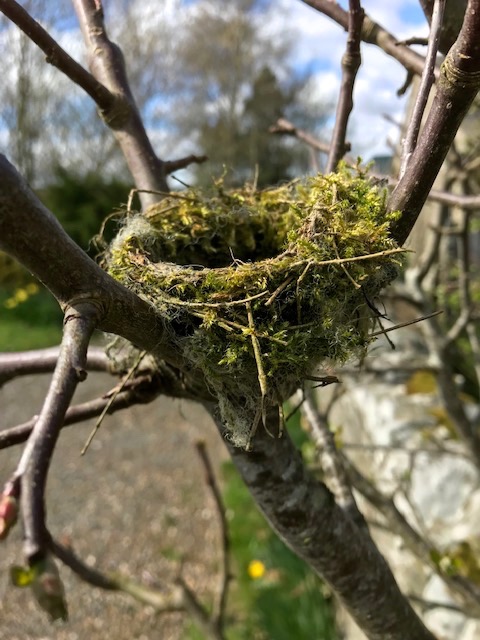
In a nearby apple tree, whose branches hang over the roadside, a pair of garden birds (possibly goldfinches) had fabricated a delicate looking but stubbornly resilient nest of grasses and moss secured with spiders webs in the branch fork.
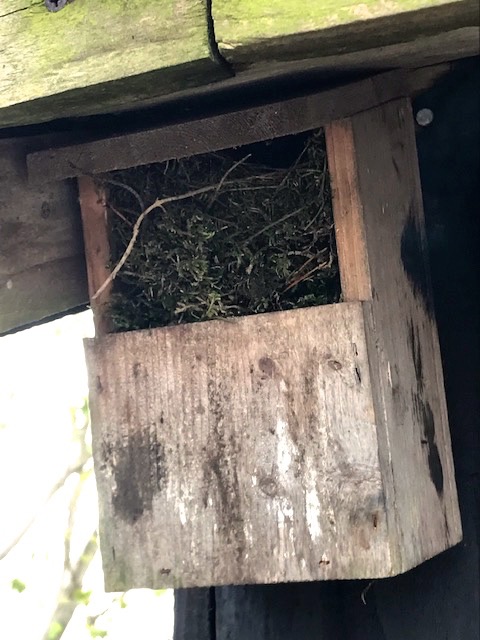
This season a male wren has taken possession of an open sided box under the eaves of the garage/workshop, stuffing it chock full of moss. The cock bird will make a number of nests in various locations and his jenny will make her choice of the most suitable in which to lay her clutch of eggs. Haven’t spotted any other would be homes yet so hope this might be the des res decided on so we can watch their progress from a distance.
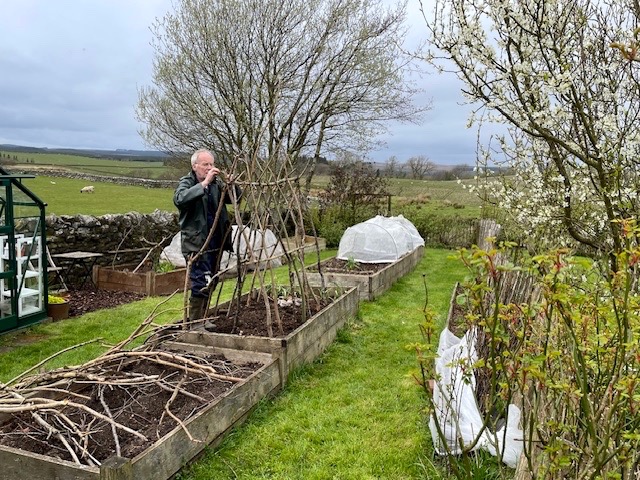
Footnote. For someone not over endowed with higher level technical skills I am rendered content by slowly getting simple rustic constructions in place outdoors. Selecting and lashing together coppiced branches for the beans and peas gives a small satisfying feeling at the end of an afternoon’s work in the garden.
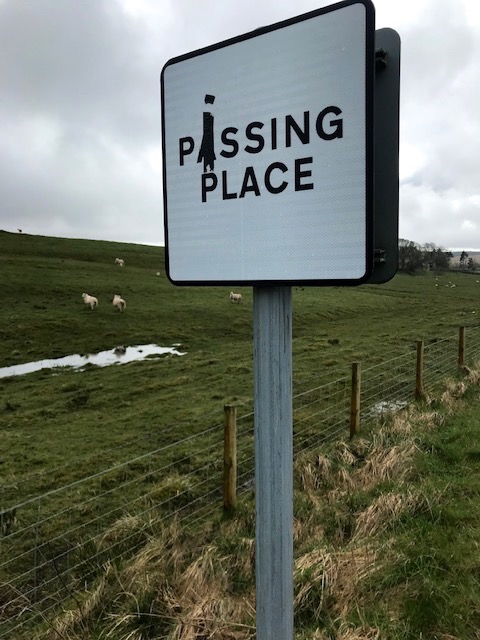
Two recent roadside artistic interventions between home and village caused some reflection. One – a pair of lost child’s woollen gloves displayed hands up at twigs end – has wit and style. The other hasn’t. Clearly a tall person altered the road sign lettering, or carried a stepladder in their vehicle to do so.
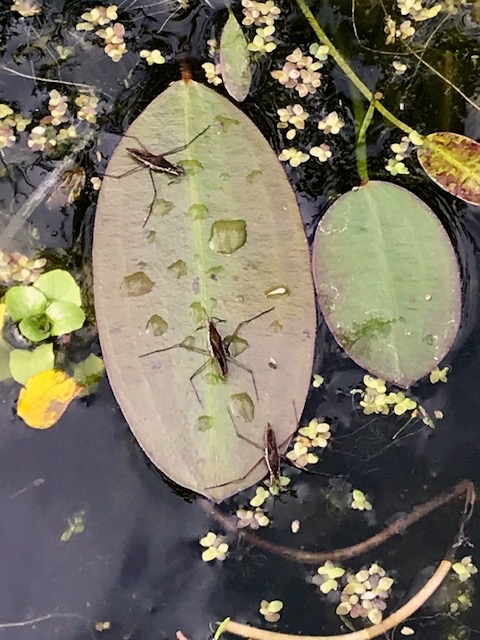
I take stock of activity down on the ponds most days. Delighted to see the water skaters are back. They like to park up on the oval leaves of the water hawthorn, like taxicabs in the rank, waiting to skate away at a moment’s notice across the viscous surface in search of sustenance. Of three pairs of legs each insect has, the middle ones are for rowing while rear and front pairs do the steering. Thick pads of hair repel water, preventing it from sinking while the tips of the steering legs detect tiny vibrations emitted by its even smaller insect prey.
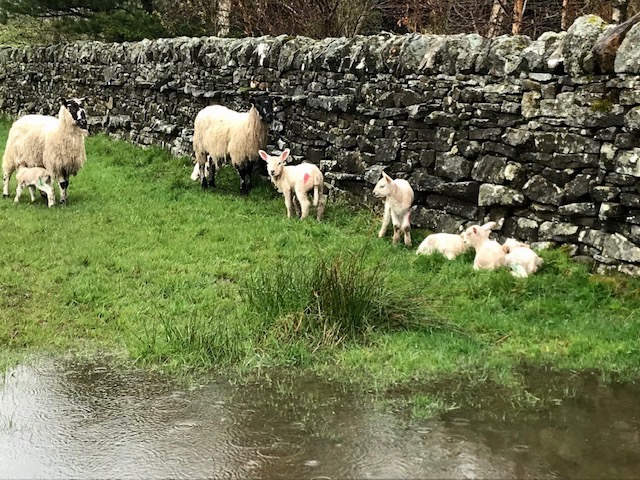
The meadow next to home is slowly filling up with this year’s lambs and unsurprisingly they look a lot happier and healthier as the weather finally perks up. The ewes have been shielding their vulnerable offspring from the deprivations of cold wind and incessant rain. Last week the lambs with their thin fleeces shivering and subdued were seeking shelter with their anxious dams against our garden wall. Our farming neighbours despair at the knock on effects of this wettest of springs.
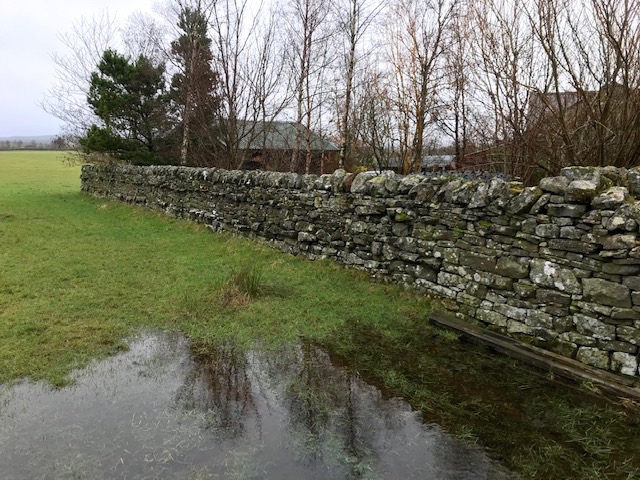
One long section of our field wall we had rebuilt three years ago. (See ‘A Wall Between Us’ December 2021). That upkeep of that long stretch of meandering stonework is our responsibility, not the farming neighbour’s, so needs keeping a watchful eye on. I’ve plugged gaps in sections by retrieving fallen or buried stones. Here’s a sandstone slab covered in grass and moss dug up and slotted in between the original capstones, well encrusted with colonising lichen.
Spring is synonymous with blossom of course and I have a special affection for the dense exuberance of mazzard (cherry) blossom that sets its heartlands in the north Devon countryside ablaze. Here at home I admire the delicate display our eight years old damson gives out. A robust small tree, it grows surprisingly well considering the exposed location. This variety, Shropshire prune, reminds me of the many damsons that will now be blooming en masse in the Lyth valley, south Lakeland.
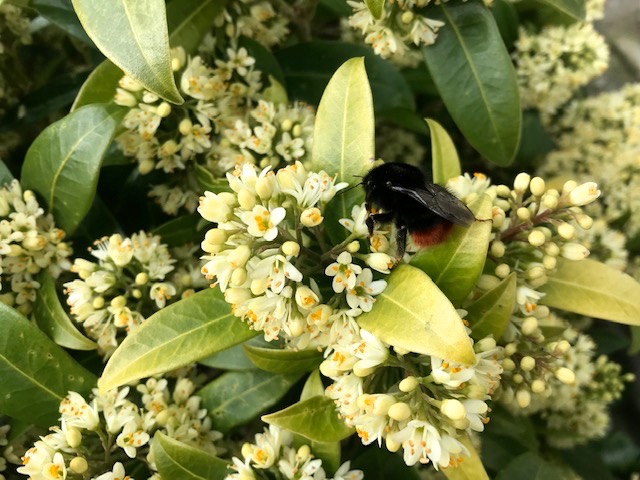
If I were a flying insect in our garden though – like this red tailed bumblebee – my blossom favourite would have to be the Skimmia under the kitchen window. This bush’s powerfully enticing aroma gets a host of bees and flies of all types topped up on nectar.
Impressed that the apple mint, planted in error free of its containing pot years back is now escaping garden confinement through fencing into the field beyond. Our neighbours’ Texel tups spend the summer grazing here so they will surely sample it. Mutton and mint. The perfect combo.
The inclement weather has delayed first cutting of garden grass this year. April 16th proved dry, calm and sunny enough to risk firing up the mower to do the first trim.
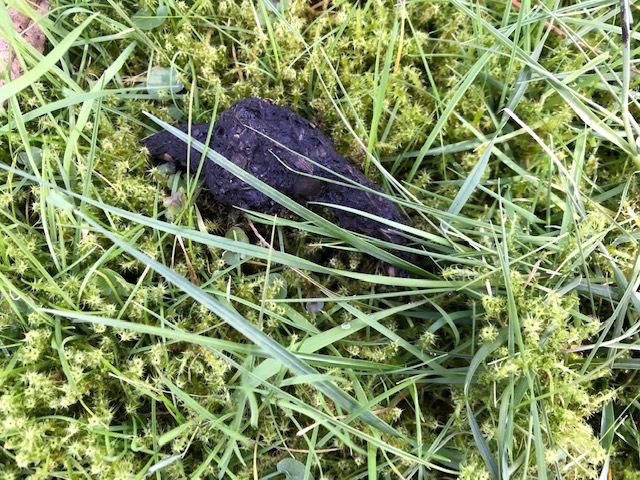
Looking like dead slugs, the half dozen or so black faeces spied on the lower grass area tells me the hedgehog –in- residence is no longer hibernating but is up and about again in the evenings.
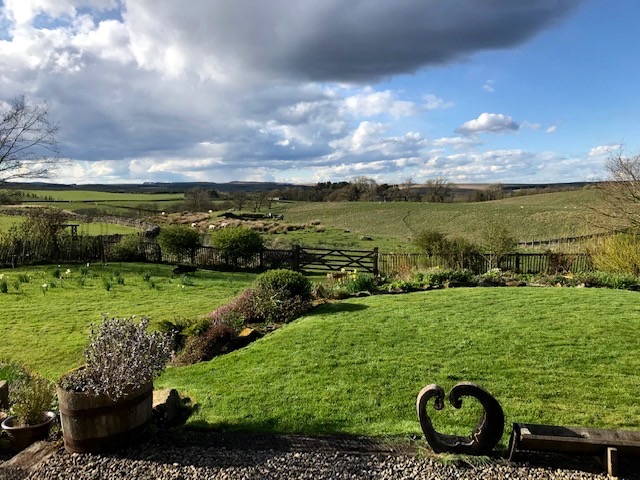
The satisfaction of doing the first mow is to frame the garden’s features – beds, orchard, meadow, ponds, copses, paths et al. The smaller birds, like dunnock and robin seem to appreciate that a slightly shorter sward is easier to quarter in search of worms and insects. The garden now looks refreshed and whole. With more sunshine bathing it in golden light at day’s end our patch presents as near perfect a scene as one could wish for at this turning point in the year.
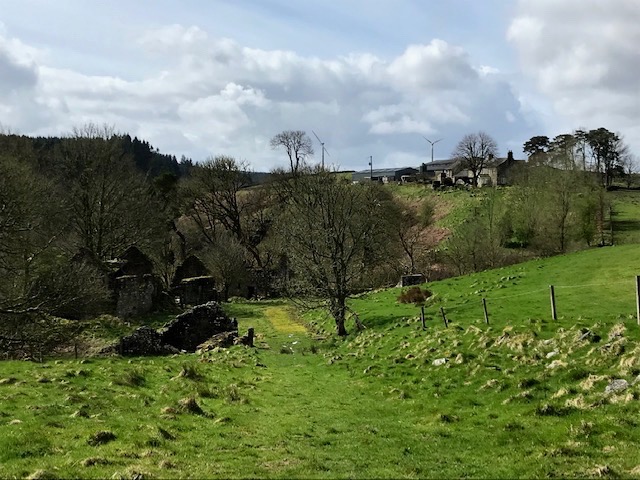
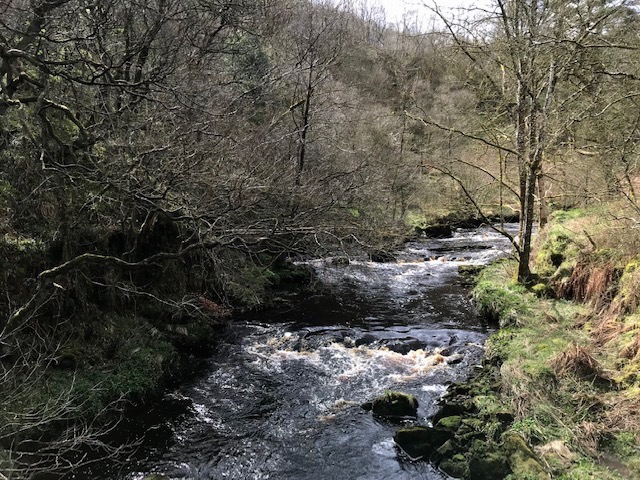
A linear ramble on Sunday along a nearby burn was long overdue. Starting with a mooch around a distinctive abandoned farmhouse and outbuildings, more ruinous as each year passes, teetering on the cliff edge above the burn below.
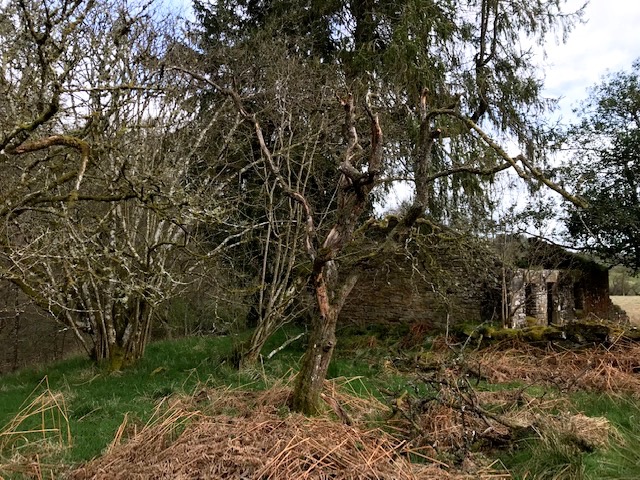
Descended to cross the river via a wooden footbridge, the land opened up again, and we’re at the melancholy ruined cottage overlooking a deep pool. In summer the bracken here is waist high but now the path is bare and muddy. The cottage garden has stands of gleaming hazel, once coppiced but no longer. A magnificent holly tree stands guard over the ruins.
Inside the shell of the roofless building sycamores and a handful of tall pines also grow unhindered. Kielder forest is estimated to be home to half of England’s endangered red squirrel population and we saw evidence of their dining on a fallen stone, re-used as their dining table. The pinecones they feast upon easily sourced from the trees above.
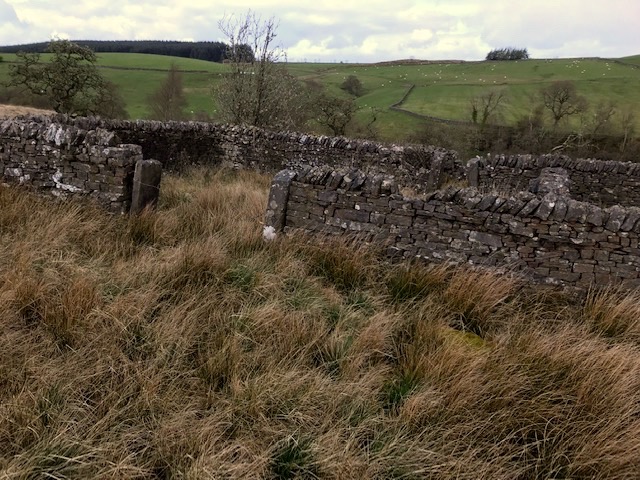
We ascended the fell side, following a thin path, little more than a sheep trod, through swathes of bleached grasses, over boggy patches where rivulets drain to the burn below. We paused at a large rectangular stell, or sheep pen. Seemingly no longer used, its dry stone walls still in good order, strands of barbed wire across the entrance.
Later we admired a fine stand of oaks bordered on the far side by river gorge and on ours by a dry stone wall, mossed over and tumbled down. The grove must have been planted at least a century or so ago, securing it from disturbance.
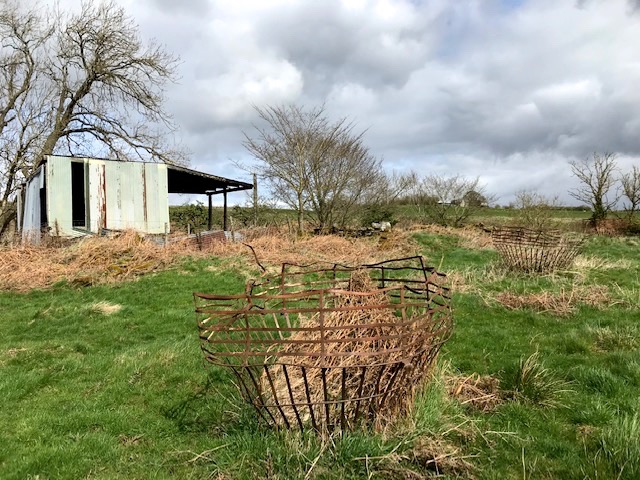
A trio of exuberant metal strap structures we encountered were fascinating. Can’t make up my mind whether they were improvised ring feeders, where hay is dropped for stock, or an elaborate protection for growing saplings to save them being grazed by deer, sheep or cattle.
When our path joined the Pennine Way, we followed the broader track back down into the sandstone gorge to cross the fierce flowing peaty waters once again. The valley’s steep sides retain great value as vertical nature reserves, sustaining mature trees and shrubs, refuges for wildlife from bad weather and sheep grazing.
Here in the valley bottom three years ago we talked with the farmer and his brother-in-law who were planting and staking rowan, oak and hazel as part of their higher stewardship commitment. Those trees are now well established and growing on well. Very satisfying to see the woodland extended and welcomed back into the valley like this. All credit to them for the work. This time around we met and chatted with a lone walker of similar vintage to ourselves, coming up at pace behind as we slowly climbed the bank. Turned out he had motor biked it over from home near Chorley in Lancashire that morning, parked up at Housesteads fort on the Roman Wall and was doing a ten mile circular walk before heading home again.
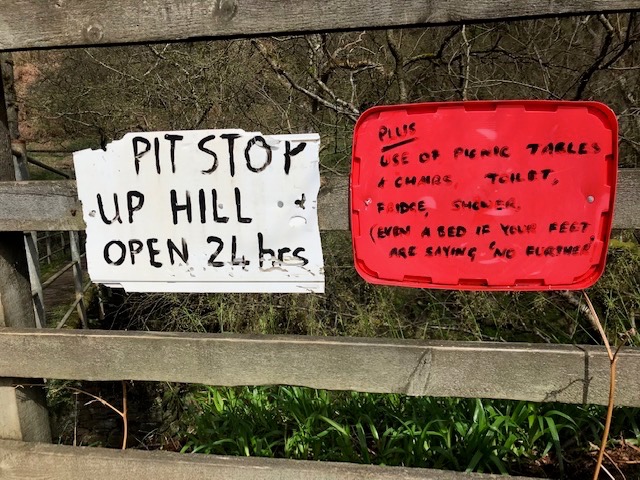
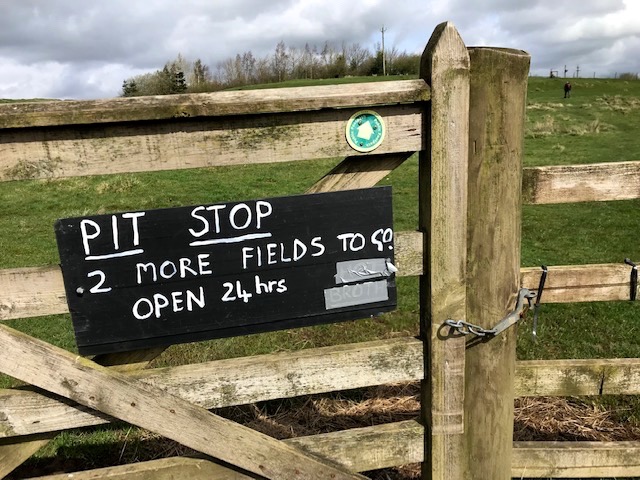
Anyone who has walked or run the trail at this point knows about the ‘pitstop’ at the farm here that overlooks the gorge (site of a listed 16th century bastle or fortified house). This extraordinary help yourself ‘service station’ in the barn is open 24 hours.
A godsend for many a weary long distance wayfarer. I’ve also written about it in an earlier diary; ‘Pitstop’ January 19th 2023.
Today over the vista of rough grazing the pair of resident curlew were rising and falling, filling the air with their delicious bubbling calls. On the ground we enjoy another foraging visit by a hare, seeking tastier morsels in our garden than what’s available to it in the surrounding open farmland. With no dogs or cats about they keep closer company than usual as we are not perceived as a threat. The odd nibbling of daffodil and camassia foliage in the meadowland is overlooked for the pleasure of their company.
Stoat Image by British Wildlife Centre
Another four legged wild visitor that grabbed the attention recently was a stoat. Its appearance, systematically quartering the boundary between garden and field, was mesmerising. Mustela erminea is differentiated from its weasel cousin in being larger, with a bounding gait and longer tail completed by a distinctive black tip. Though a fierce predator, tackling prey up to five times its size, the stoat in turn is predated by foxes and raptors. The creature’s handsome chestnut and cream body vanished for a few seconds in amongst the willow boughs that frame the ponds. I’d set them up there as over winter shelter for mice and amphibians and it was one of those creatures the stoat emerged with in its mouth – too small for me to identify at a distance, even with binoculars. It then bounded off at pace toward the crags, another rodent retreat in our field, the site of an abandoned stone quarry.
Two sets of grandchildren along with their parents were with us over Easter and the kids all love the pond. An excited dipping session netted a fine collection of male and female palmate newts along with sightings of mature frogs under marginal stones. Meanwhile Holly, the family’s young sprocker spaniel (cocker/springer mix) couldn’t stop herself from diving in and out of the wildlife ponds at every opportunity. The marsh marigold, newly flowering, was partly flattened but has quickly recovered since.
Image of adolescent palmate frog from Wikipedia Commons
Moving pots and tubs at this time of year inevitably risks exposes hibernating residents. Best accidental discovery was an adolescent newt, appearing more dead than alive. Not the dark colour of those active creatures the children observed in the pond but instead this newt was a deep pink/red colour and the skin not smooth but bumpy. I quickly popped the inert form under another ceramic, returning an hour later to get a photograph only to discover it gone – so clearly not so torpid after all! The image above is the nearest I can find to represent its appearance.
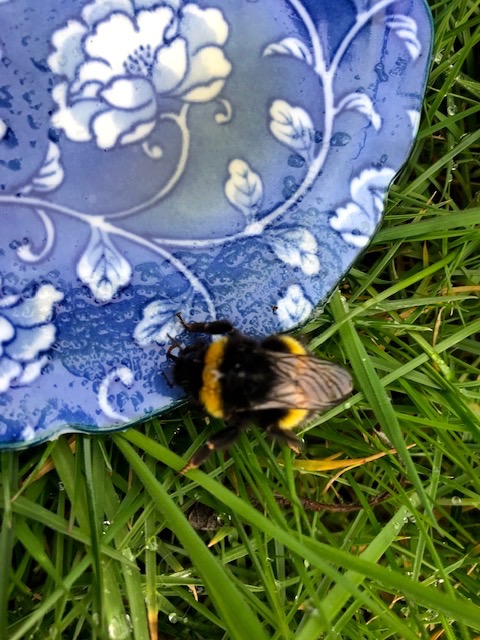
Solitary bees are also emerging, weak and seeking nourishment, and one such staggering buff tail bumblebee I provided with a dash of sugar water to help it power up. But it managed without my help and later disappeared so I hope it survived in the cool damp weather we’ve been subjected to in recent weeks.
Tentatively raised the former compost bin top to check if the other known hibernating creature in our garden thinks it’s Spring yet. but no, the hedgehog is still tucked up inside its duvet of moss, leaves and accumulated vegetation. This improvised low shelter I placed in the copse near the water a few years ago but this is the first time it’s been occupied by a an overwintering hog, which is wonderful.
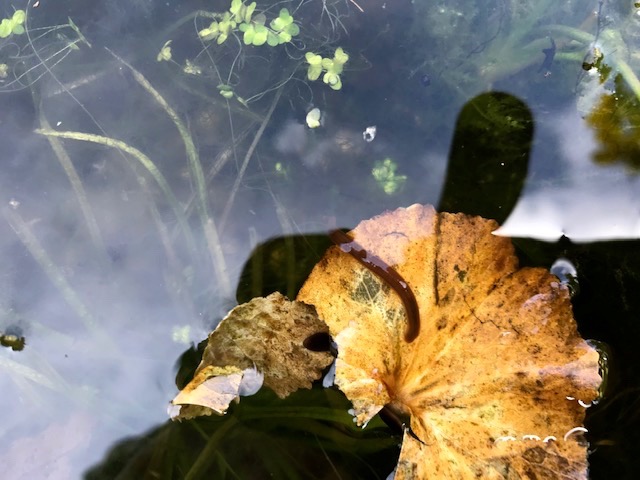
Back at the pond, after the families left, I noticed some shiny brown spots on a dead leaf by the margin. Closer inspection revealed these fleshy blobs to be both animate and elastic…Leeches. Segmented parasitic worms, with suckers either end. These fascinating tiny creatures are hermaphrodites and move by means of peristalsis; self-propulsion by alternately contracting and lengthening parts of their bodies, like earthworms do. Once common when used extensively in medical practice for bloodletting and controlling toxins there are 17 species to be found in UK freshwaters. Despite being an officially protected species since 1981 numbers have dropped drastically. Delighted to have them in residence here, part of the ponds healthy ecosystem, despite their otherwise unsettling reputation.
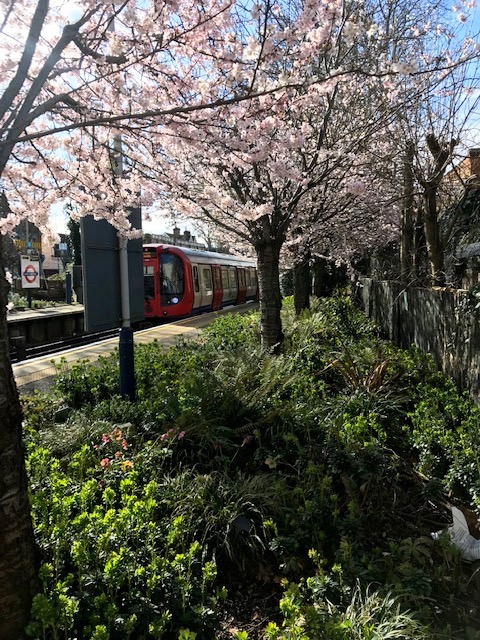
Once or twice a year we head south on the train into the maw of the metropolis. London of course is entrancing and aggravating, enlivening and brutal by turn. We’re fortunate in being able to stay with family, one household in Forest Hill, the other ‘tween Kew and Richmond. Both are leafy inner suburban enclaves with environmental and historic attractions of their own.
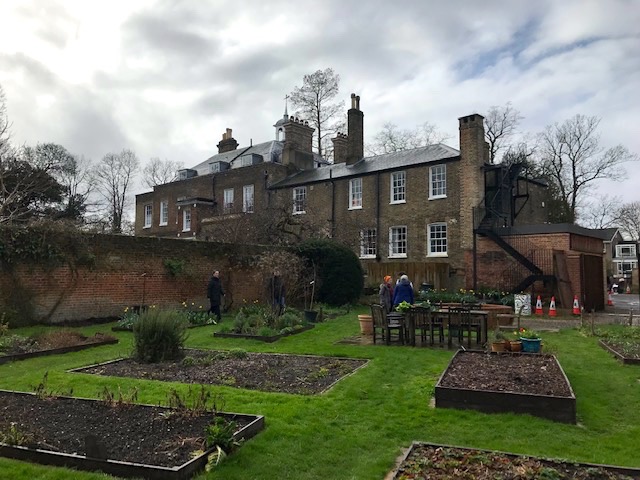
The nearest we got to being back home in the country on this visit was in the heart of Dulwich village, the morning that Bell House opened its many roomed interior and two acres of garden to the general public. https://www.bellhouse.co.uk/
The mansion was built in 1767 by wealthy printer and publisher Thomas Wright, a former High Sheriff and Lord Mayor of London, as his country retreat. We got to ring the eponymous bell on our tour of the house, led by a volunteer guide. Community minded Mr Wright installed it to give warning on the outbreak of fires, when the fire fighters whose activities he subsidised would turn out to tackle any blaze.
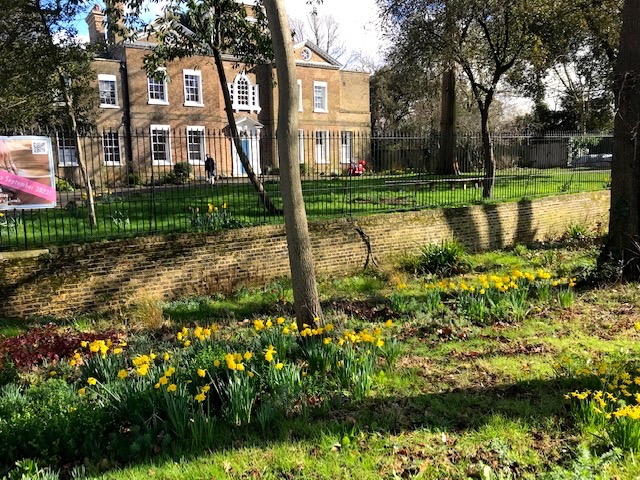
We also got access to the cellar rooms and saw the original household water pump. The spring below that it is a source of the little river Effra, a tributary of the Thames, that flows unobtrusively through Dulwich. There’s a hint of its subterranean existence at the front of the house between the grounds and College road, where the sunken ditch or ha-ha regularly floods with its waters.
Another famous occupant of the house in the early 19th century was Anthony Harding, a silk merchant who opened the world’s first department store, in fashionable Pall Mall, in 1789. Bell House today is home to a registered charity which hosts a department store’s worth of community activities, including printing, which would no doubt have pleased those original occupants. The many upstairs rooms are workshops and home to gardeners and artists in residence.We explored grounds of mature mixed woodlands, kitchen and walled garden, orchards, lawns, flowerbeds and shrubbery plus enclosed stable yard and neighbouring cottages. The sun made an appearance after rain and the spring air was resonant with bird song, the unseen urban world seemingly far away.
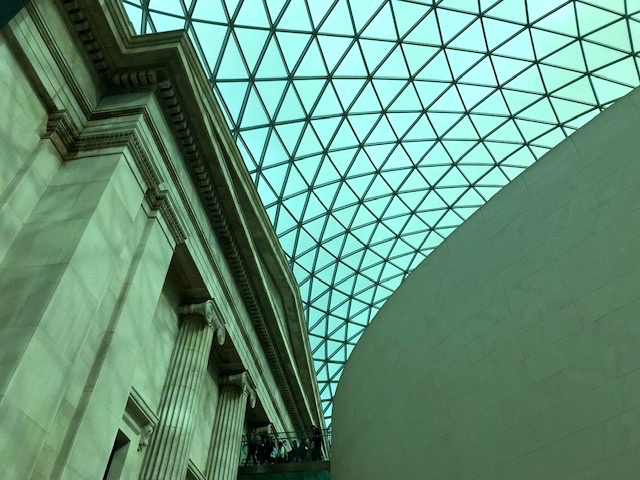
When not experiencing the vernal delights of affluent Dulwich or Richmond our long weekend in London was packed with cultural activities around the centre. Years have passed since either of us has been to the British Museum. A great magnet for visitors from all over the world, the queues are a little longer these days as security checks are now standard in marquees outside. The special exhibition we’d come to see was Legion: Life in the Roman Army. https://www.britishmuseum.org/exhibitions/legion-life-roman-army
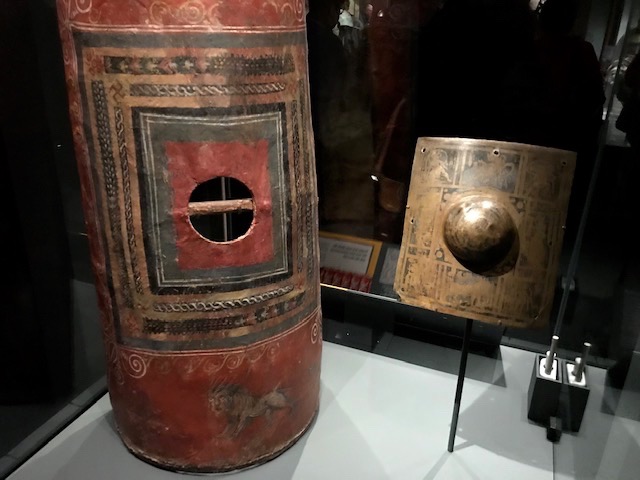
Roman soldier’s scutum (shield) and boss…the latter found in the Tyne River.
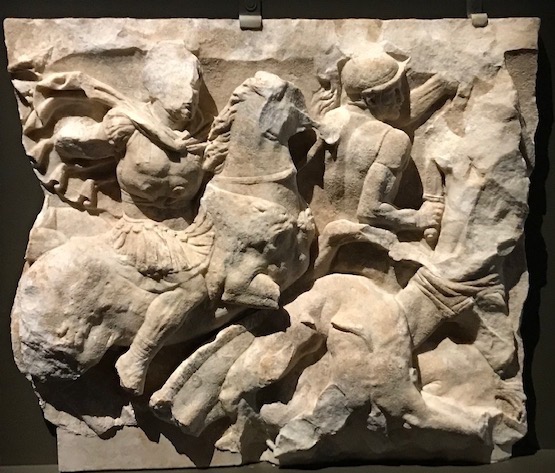
A very thorough and well-curated show it was too, rounded out with audio-visual immersive displays. A comprehensive review of the soldiers lot, made remarkable by the quality and range of the artefacts on display, from cavalry masks, armour and shields to gambling games and even marching socks.
Proud too that many of these treasures were sourced from Northumberland; the Roman forts and settlements of Vindolanda, Chesters, Housesteads and Corbridge.
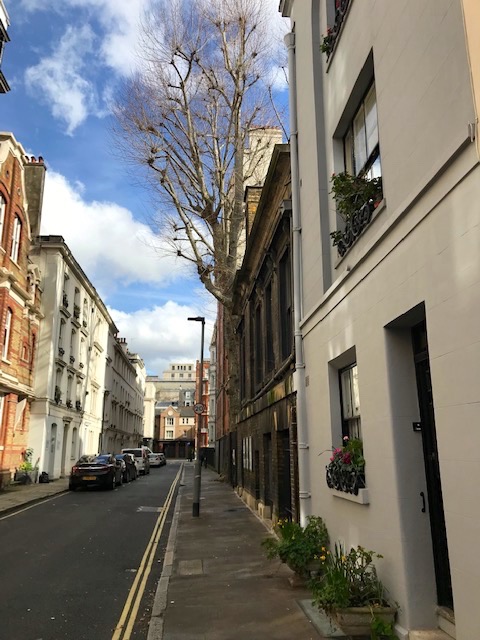
After a leisurely lunch in the excellent restaurant up aloft we went exploring in nearby streets. Love the way the biggest and constantly coppiced of pollution resistant plane trees, dating from Victorian times, manage to enhance the compact high sided buildings, like this one in Russell Street.
I’ve a special fondness for Bloomsbury and Covent Garden, not just for their rich architectural and cultural history but for the nomenclature. Much of the area was owned and developed over the centuries by the dukes of Bedford, who also enjoyed sizeable income from former monastic estates gifted them at the Restoration by Henry VIII. Those extensive mineral rich estates in Devon included my hometown of Tavistock, the moorland hamlet of Taviton, the family’s hunting lodge at Endsleigh. Along with the dynasty name of Russell, all are are commemorated here in the names of the elegant squares and streets, places and rows.
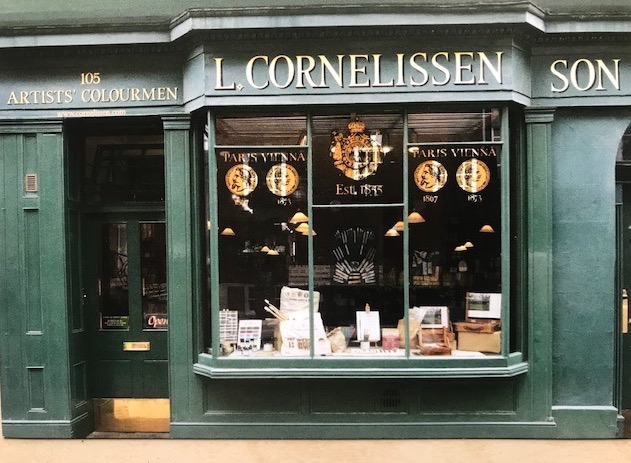
For many years Kim’s been sourcing professional art materials online from http://www.cornelissen.com and took this opportunity to introduce me to the actual shop at 105 Great Russell Street. Cornelissen’s retain the original 1855 shop front and internal layout, which attracts customers from all over the world.
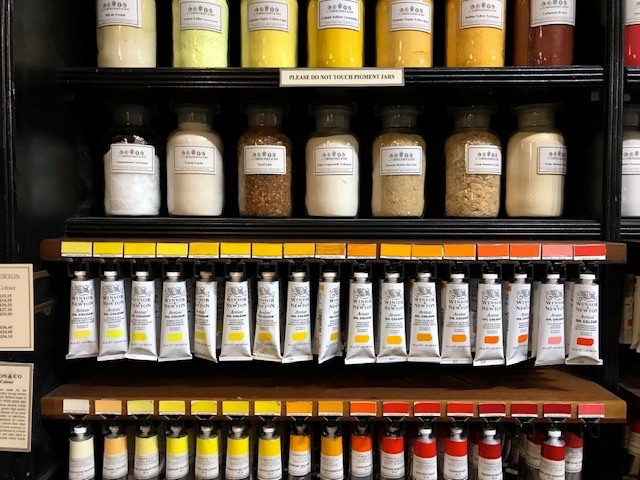
Browsing while Kim shopped, I marvelled at the paint crystals and pigments stored in glass jars above a huge range of oil paints in tubes hanging in racks.
John Nixon: Feeling (Watercolour 1781) One of vive exploring the senses.
The Cartoon Museum used to be in Little Russell Street, but moved some seven years ago to larger premises in the basement of a modern building in Wells Street (off Oxford Street). Have been meaning to visit for ages so good to finally do so on another of our days out in town. Something of a hidden gem it hosts a wonderful selection of British cartoons, caricatures and comic art from the 18th Century to the present day. https://www.cartoonmuseum.org/
G M Woodward: A Concourse of Actors (1804)
Wallace & Gromit fans would delight in the section devoted to the making of that stop animation classic The Wrong Trousers. My favourite works though remain the earthy satiric imagery from the skilled pens and brushes of Gilray, Rowlandson and their contemporaries.
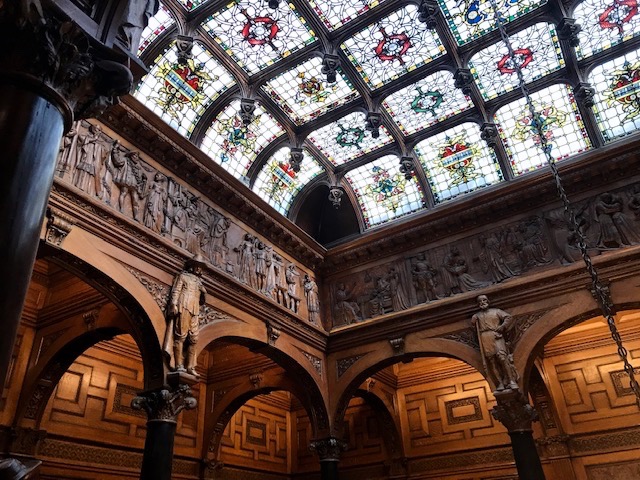
That same day we re-visited a favourite artistic haunt discovered in recent years. 2 Temple Place was completed in 1895, a singular gothic cum arts and craft building, the creation of hotel and property magnate William Waldorf Astor. Part estate office and part private residence, the building expresses the eccentric American multi-millionaire’s lifelong love of craft, literature and decorative arts.
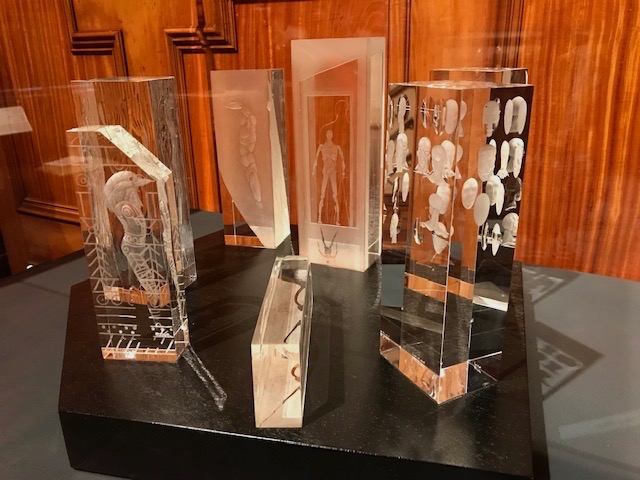
The Bulldog Trust is a charity that mounts changing exhibitions of arts and crafts in the magnificent oak panelled rooms at Temple Place, curated from regional museums and galleries on particular themes.
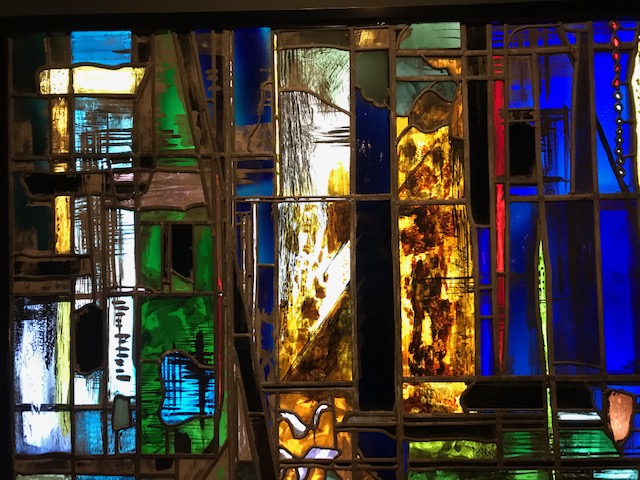
This one was centered on centuries of glassworks, entitled Heart of Glass, and included work from traditional glass making centres like Sunderland and Stourport. Remarkably for a non-institutional organisation entry is free of charge, although donations welcomed. More about 2 Temple Place here: https://twotempleplace.org/
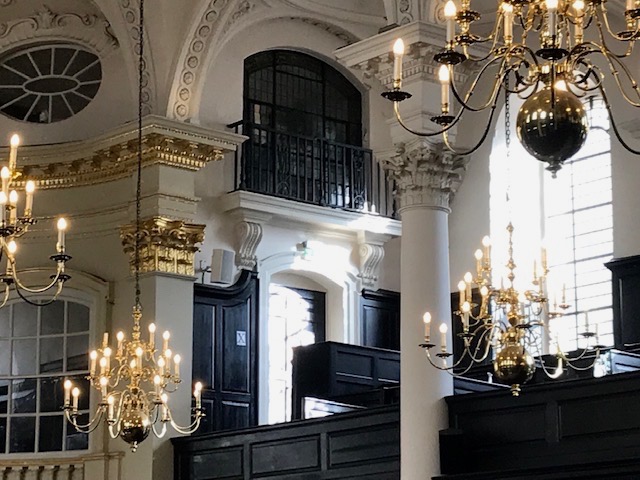
En route from Temple Place to the Cartoon Museum we had lunch in the bustling brick lined crypt of St Martin-in-the-Fields in Trafalgar Square. https://www.stmartin-in-the-fields.org/ This elegant architectural jewel, designed by James Gibb in the 1720’s, is now a multi-purpose inclusive space playing host day and night to a wealth of musical concerts as well as being a major charitable institution tackling the problems of homelessness in the capital and beyond.
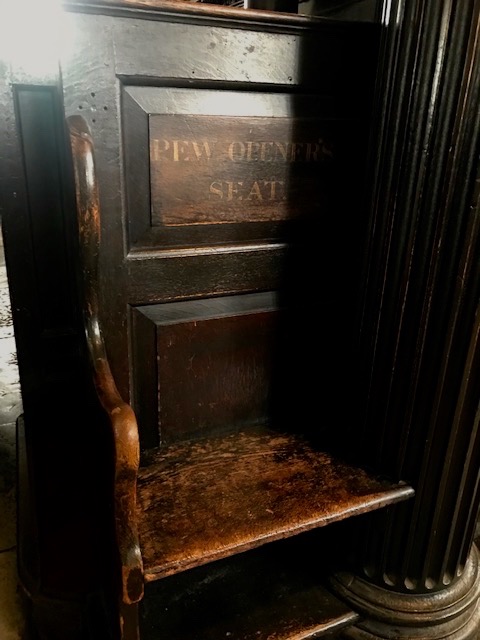
Loved the detail of the beautiful light filled interior, like this seat set aside for the official pew opener. As the church website states ‘It’s a place of encounter between God and humanity, the wealthy and the destitute, culture and commerce. We welcome you into the warmth of this vibrant community’.
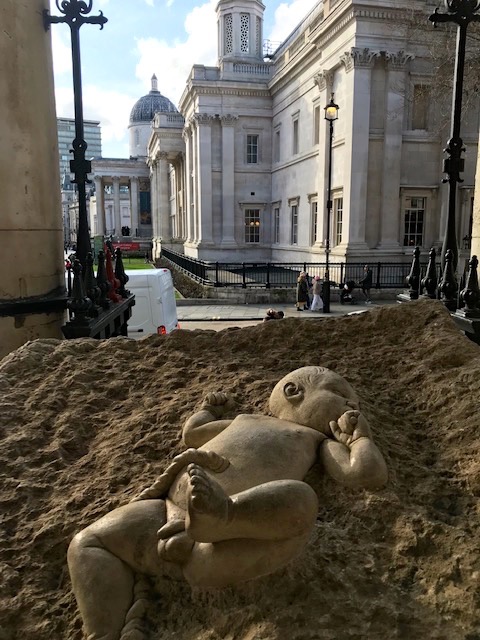
Mike Chapman’s powerful sculpture of a Christ like new born babe swaddled in a large bed of Portland stone, made to celebrate the millennium, installed under the portico overlooking the square, sums it all up well…In the Beginning.
All the world’s a stage/And all the men and women merely players/They have their exits and their entrances/And one man in his time plays many parts/His acts being seven ages. (From: As You Like It)
I estimate my actual 72 years of age to roughly correspond with 5 and a half of Shakespeare’s seven ages. Somewhere between the Justice, with his propensity for ‘wise saws and modern instances’ and the ‘lean and slipper’d pantaloon, with spectacles on nose and pouch at side’.
For a while now, as a daily mental exercise to match the physical, I’ve set my muscle memory the task of learning some favourite pieces from the Bard’s work. There are different reasons for choosing each one. John’o’Gaunt’s ‘This England’ speech from Richard II for example because having founded and run a theatre company inspired by the word ‘demi-paradise’ and keeping this country diary as ‘This Other Eden’ it was high time to get the whole thing under my belt. Add a clutch of famous soliloquies from the mouths of Hamlet, Macbeth, Prospero, Richard III etc. and you get the picture.
Without the context of artistic process through company rehearsal and direction there’s still pleasure to be had in line learning for learning’s sake and the extra appreciation of the man and his work that results through private study and practice. And yet, one still feels the need of an audience, however minimal, to complete the exercise. Luckily a non-actor friend who has nurtured a lifetime’s love of poetry proved generous in giving me their time to meet that challenge. We agreed an outdoor setting was best. Having not yet seen for ourselves what had become of the sycamore infamously felled by person or persons unknown last September, we set out alongside the whinstone ridge to do so.
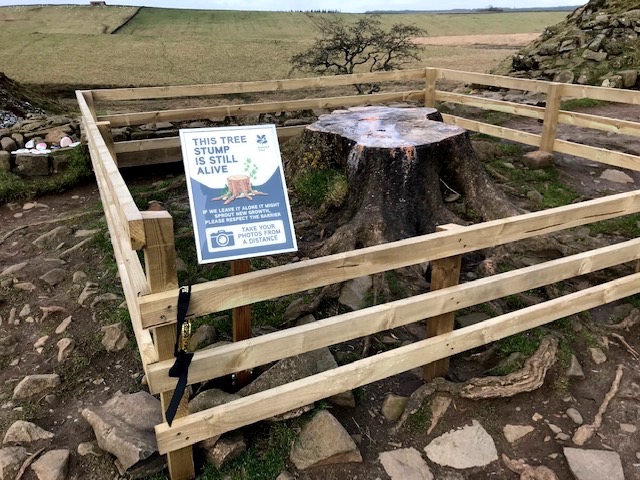
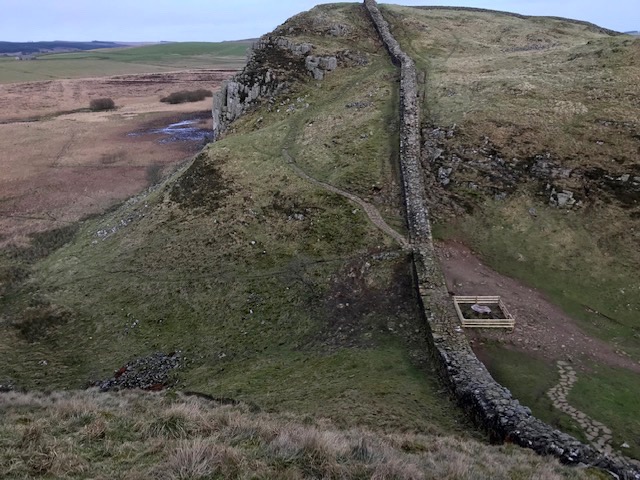
We perched in the lee of Hadrian’s wall overlooking the fenced stump of the iconic tree, reflecting on its meaning and great loss. That was followed by conversational recall of some of our favourite poems and blank verse before breaking off to enjoy a simple picnic. At this point we caught the sound of ethereal instrumental music from an unseen source. Suddenly, from the other side of the wide wall, three lanky teenage boys emerged carrying a ghetto blaster. Oblivious of our presence, we became their de facto audience, witnessing an improvised lament for the tree’s cruel demise. Ritual complete they got off their knees, laughed awkwardly and moved at pace up the steep side of the gap to disappear over the brow. We were left alone again, suitably bemused, yet happy to be upstaged by their singular homage.
Oh for a muse of fire that would ascend the brightest heaven of Invention. A kingdom for a stage, princes to act and monarchs to behold the dwelling scene….Mission resumed, I’d just started giving the opening Chorus speech of Henry V when the rival muse of air suddenly appeared to play its part by filling and blowing my empty sandwich bag away downhill at great speed. I continued the speech while running to retrieve the ballooning plastic. Returned breathless but triumphant, completing the run in both senses of the word, and thus we both fell about laughing.
More speeches were let loose on the breeze, as we ambled uphill and down on the way back, in between meeting and greeting fellow ramblers. Another unusual cultural foray on a dull winter’s day, getting those speeches out into the open and improvising freely around their delivery before my receptive, astute and amused audience of one. Valued in return the conversation that came of it. My friend’s life away before retirement was one spent in the higher echelons of the corporate business world, so many aspects of communication discussed around our complimentary career disciplines and ways of working. Hamlet’s advice to the players was in there too, echoing beyond our footsteps, before being borne away by the western winds….Suit the action to the word, the word to the action, with this special observance, that you o’erstep not the modesty of nature. For anything so o’erdone is from the purpose of playing, whose end, both at the first and now, was and is to hold, as ‘twere, the mirror up to nature…
It’s been a relief having entered a spell of milder weather where the sun occasionally makes an appearance and a hints of the coming Spring bring signs of cheer. This has been the most consistently wettest and windiest winter at the corner house since I first arrived, back in 2010. Venturing out a short while back, on a walk up the lane to its highest point, I was leaning heavily into a persistent wall of invisible pressure that had to be clocking up speeds of some 70 – 80 mph.
The storms were serious enough to cause power outages on separate days and all normal communications went down hereabouts. Out came the candles, tea lights and series of battery operated camping lights and the early evening darkness was warmed alight enough to be made workable in. Smokeless coal and a regular stock of logs along with the oil powered Aga for cooking and heating carried us through the mini-emergency.
The garage workshop, which forms the sheltering west side of the gravelled yard, flooded a fortnight ago for the first time ever. The water table below the permanent upland pasture that surrounds us must have reached saturation point. The excess water oozed out of the slightly higher neighbouring meadow, through the drystone garden wall and into our wood clad outbuilding, streaming over its concrete floor before draining away. No permanent harm done but a reminder of what to expect from now on in wintertime. Curious to know if further evidence of climate change will express itself in an opposite state of more severe heat and drought during summers to come.
Learning the lesson from Storm Arwen (See journal for Dec 7th 2021: Arwen and After) we now have an emergency LPG powered generator installed, off the floor, in a corner of the garage/workshop, but didn’t go through the motions to activate it on this occasion. Keeping the water pump and freezers going would be priority. To be more confident, when better weather returns, we’ll have to go through the switching drill.
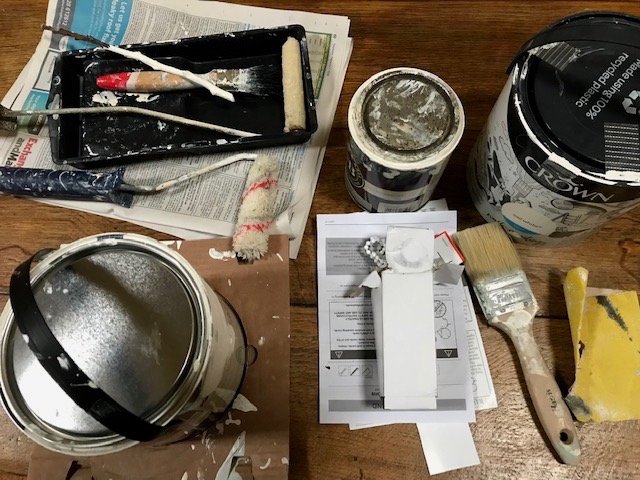
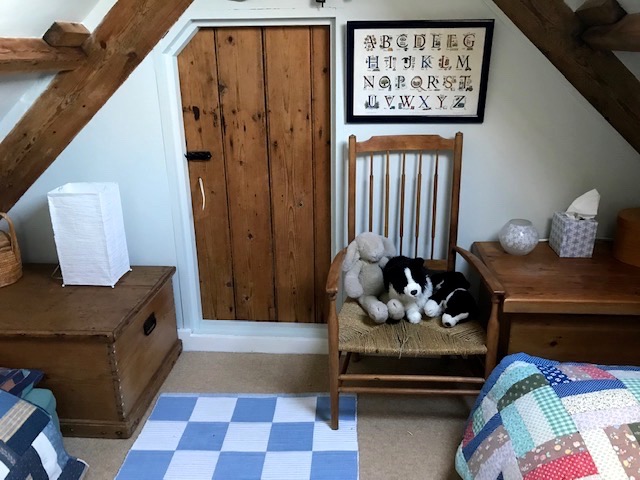
Rubbish weather outside means there’s no excuse not to get on with long delayed jobs inside. One such is repainting the attic bedroom the grandchildren use as their base when visiting. I love the challenge, once finally started, and catch up on a lot of radio programmes and podcasts in the process.
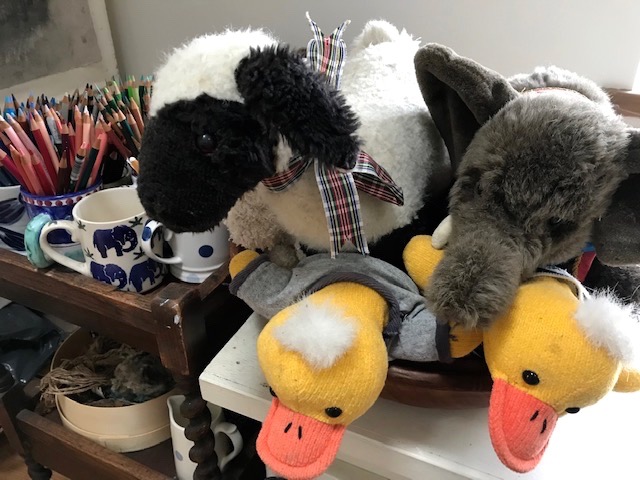
Clean out the scores of houseflies hibernating in the rebate of the two Velux windows set in the sloping roof. That job completed I go on this past week to repaint the walls in Kim’s studio. Moving some of her former models and palette of coloured pencils in the process.
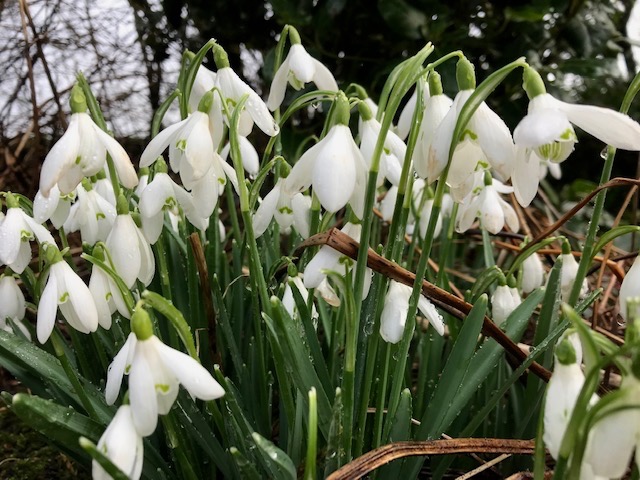
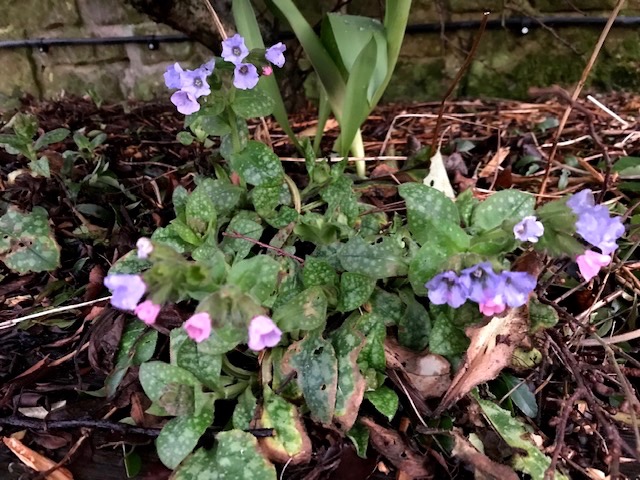
On a cheerful note, Spring flowers are come again…most noticeably aconites, lungwort and snowdrops. (The latter still spreading happily of its own accord to new sites in garden banks and beds) The host of daffodils both on the roadside and in the more sheltered yard side copse are starting to bloom.
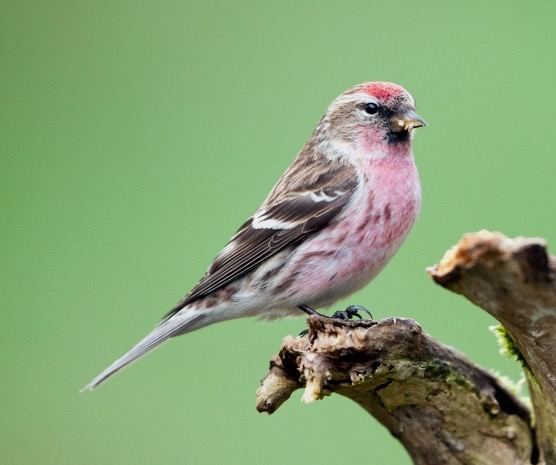
Unusual seasonal visitors joining the home crew of garden birds at the seed feeder have been a pair of Lesser Redpolls. At least I think that’s what they were but I couldn’t get a closer look at these gregarious finches for long enough to make sure they were not the very similar looking linnets, flocks of which were previously spotted a few years back on neighbouring farmland.
A new year’s resolution has been to nominate a day each week that in normal times for me to go out on cultural away days with friends. This gives Kim the time she needs to properly focus on new projects at the drawing board, free of distraction! It’s a mutually satisfying project that’s going great guns so far. A recent outing was blessed with a rare day of rain and wind free weather. My friend Rob and I took the train to Carlisle from Hexham, a scenic journey along one of the world’s oldest intercity rail lines. We fell into enjoyable conversation with two other senior gents with similar interests to ourselves who were on a Newcastle /Workington away day jolly, changing trains at Carlisle’s solidly outsize Citadel station.
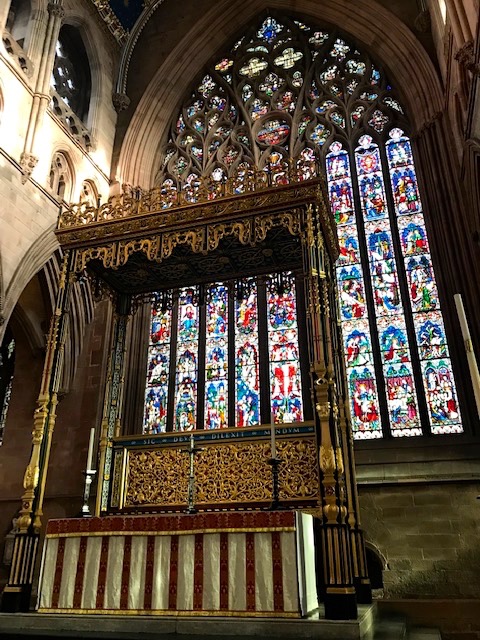
Despite half the border city’s attractions either being closed mid week or undergoing refurbishment we had no shortage of things to re-discover elsewhere around the centre. The magnificent cathedral provided a fantastic focus and the historic urban quarter that its great red sandstone mass dominates was also full of interest.
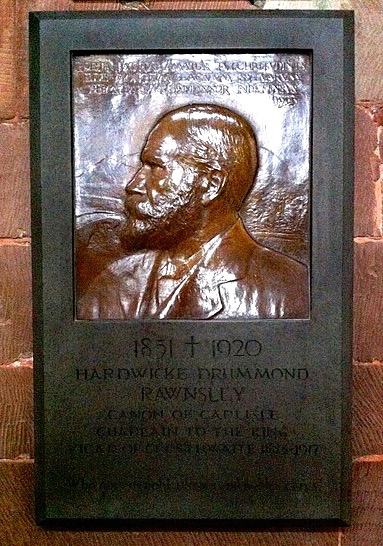
Formerly the church of the prestigious Augustinian priory, what Carlisle’s seat lacks in status and grandeur compared to say Lincoln or Salisbury, it makes up for in the way of curious treasures and warmth of welcome its staff extend the visitor. The volunteer guides here are friendly and obliging with time to chat and answer questions. The information panels in the aisles are hanging cloth banners, outlining the lives and achievements of interesting lesser known figures associated with the building down the ages. Pleased to see featured a character I’d once played – Reverend Hardwicke Rawnesley. (Diary of April 24th 2022 Castle, Lake and Tarn has more about this influential Victorian cleric & pioneering conservationist).
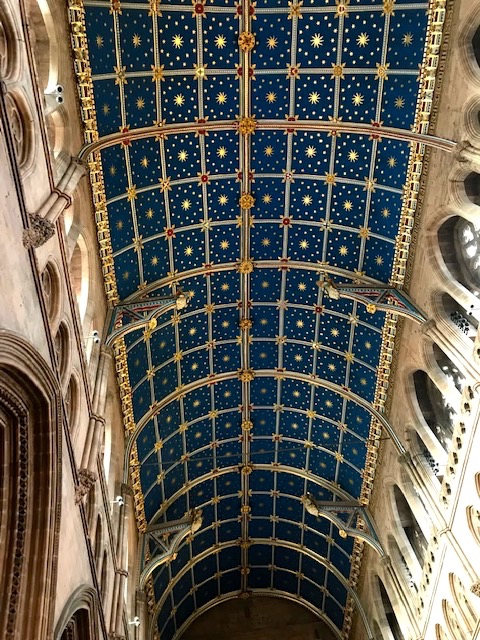
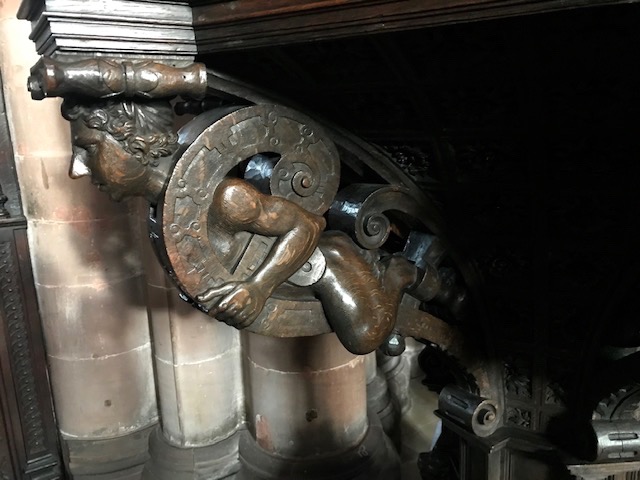
Amongst those Cathedral’s treasures are the Tudor Salkeld panelled wooden doorway with its profiled faces of worthies, the magnificent star spangled barrel roof put in during the mid Victorian restoration and an imposing Jacobean wooden pulpit with its curious carved supports, as well as the magnificent medieval choir stalls and their reverse side C 15th full length paintings of the saints. Interesting to note that figures at ground level have been defaced by protestant iconoclasts at some point post-Reformation whilst those tiered above and out of immediate reach have not, thus retaining their facial features.
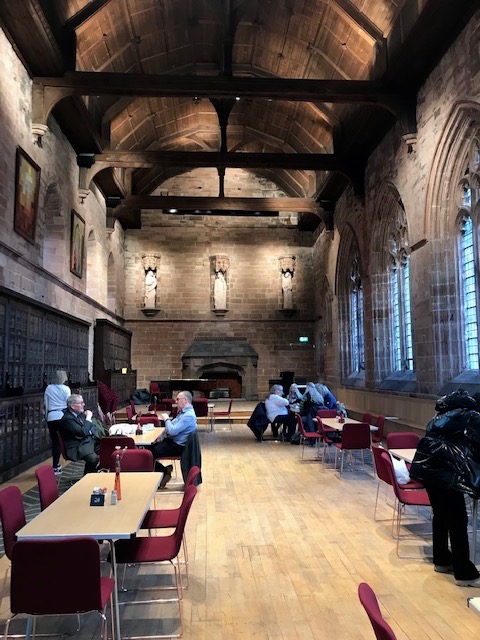
The new fratery here, adjacent the cathedral entrance, is an inviting place to relax over food and drink. Rob & I gravitated to the spacious overflow setting of the cathedral library for our delicious lunch. Continuing our walkabout along the city walls, overlooking station and lines north we bumped into a Scottish master brewer involved in the comprehensive restoration of a former long closed pub here as a bar with its own microbrewery and visitor centre.
It’ll be the first brewery to open in Carlisle city centre since 1987 when the last traditional brewery closed. Lots of chat about heritage hops and brewing techniques with our genial interlocutor before we headed back down along some old lanes and cobbled byways.
We discovered a fascinating mix of private town houses and former grand institutions, in various states of transformation, which drew us on with growing interest and hopes for the further renewal of an historic city which I remember advertising itself once as ‘Worth a Closer Look’.
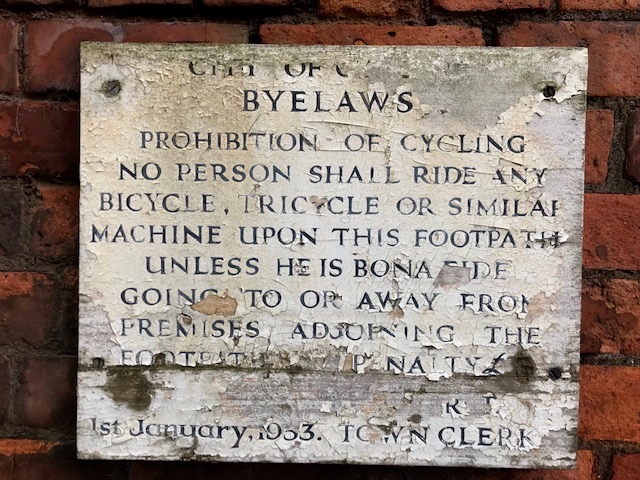
Now, in that respect we all love an old public notice still clinging on, despite vagaries of wear and neglect, like this one in a Carlisle alleyway…
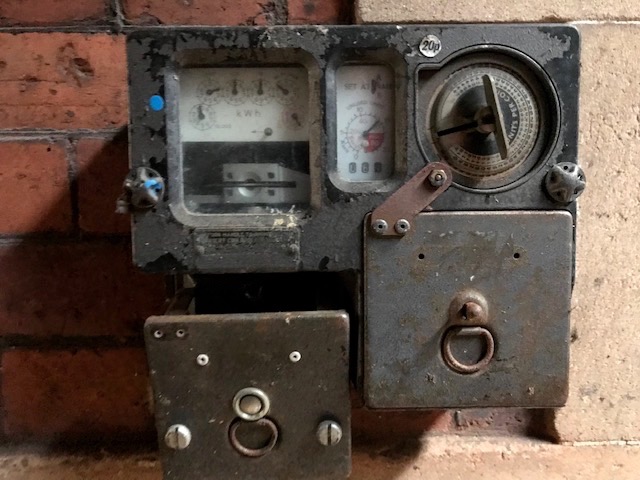
Another surprise was this old meter. What would it have powered in its public place of a run down arcade? When was it last used? Incidental street art now but obviously essential once.
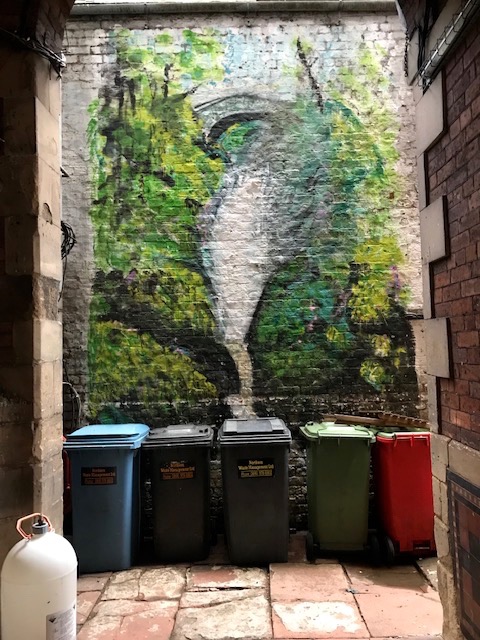
The surprise takeaway though from our day out was discovering a random series of officially sanctioned street art brightening the environment of otherwise unloved and overlooked urban scruff points. Hurray for the association of freelance artists collectively known as Blank Wall Assassins for cheering the eye with their range of pop-up graphic contributions. Particularly loved this iconic Lake District view of Aira Force filling a focal point, framed by a covered ginnel populated with pigeon nests and commercial wheelie bins. Brilliantly effective work by artist Martin Evans (2020)
So yes, Carlisle was worth a closer look alright and once Tullie House gallery and museum with its delightful garden reopen, and on a day when English Heritage are open for visitors at the great border citadel that is the castle, we’ll no doubt be back for more…not to mention a pint at that new micro-brewery on the west walls, which is due to open this summer!
A weekend walk in the wider locality drew us to a favourite spot on the fell that defines our northern boundary of view. The only lay-by was full of cars. Shooters in the field. So we drove on down the other side, thinking where to now? Then I remembered a summer trek with a walking friend in a neighbouring valley, a place to which one day I swore to return…This must be the day.
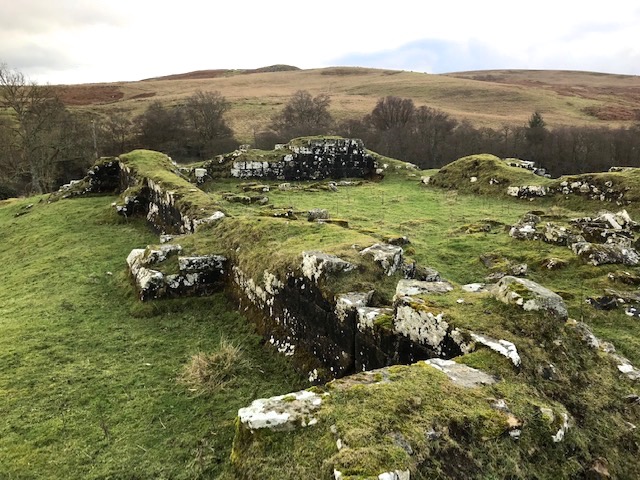
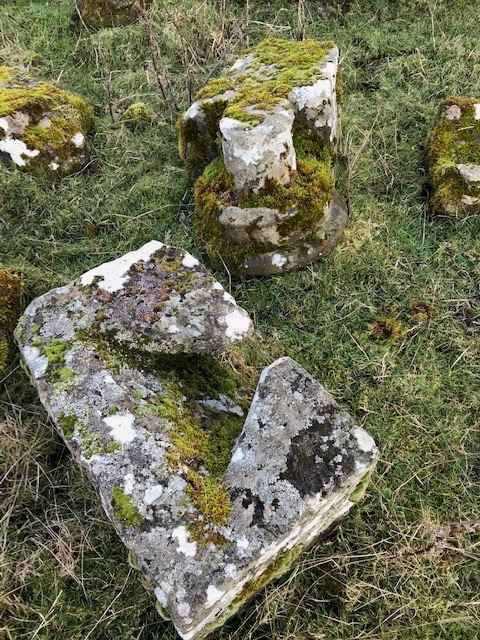
Our part of Northumberland up to the time of Edward I’s imperial expansion over the border was relatively peaceful, which meant that most of the fortified houses and castles hereabouts were built by Scottish barons as their kings held sway here. Dally castle is a good example, overlooking a circling loop of the Chirdon burn. It sits impressively on the end of a ridge, part severed from it by a deep defensive ditch. Only the lower portion of its thick walls remain today, plus a generous scattering of dressed stone, including remains of columns and fish tail arrow slits.
Dally was originally constructed not as a castle but as a two storey ‘hall-house’ by David de Lindsay in the 1230’s. It was gifted him by Margaret, sister of King Alexander II of Scotland. Two centuries later, as times turned more violent and insecure in the age of the Border Reivers, that defensive hall was remodelled as a much more formidable three story ‘tower house’. Come the gradual return to political stability after the union of the crowns in the 17th Century Dally was eventually abandoned and dismantled. Its ready supply of dressed stone further depleted down the decades for re-builds of a water mill at its foot and additions to nearby estate buildings. Enough remains today to give a clear footprint and the site yields views over the alder lined course of the burn, in-bye fields and exposed fell sides flanking this now peaceful upland valley.
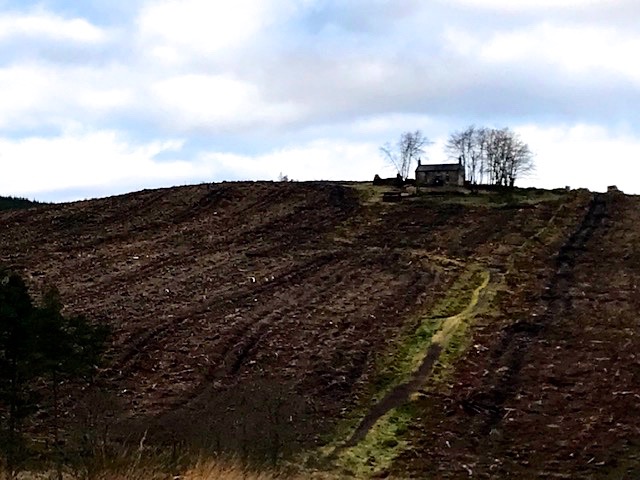
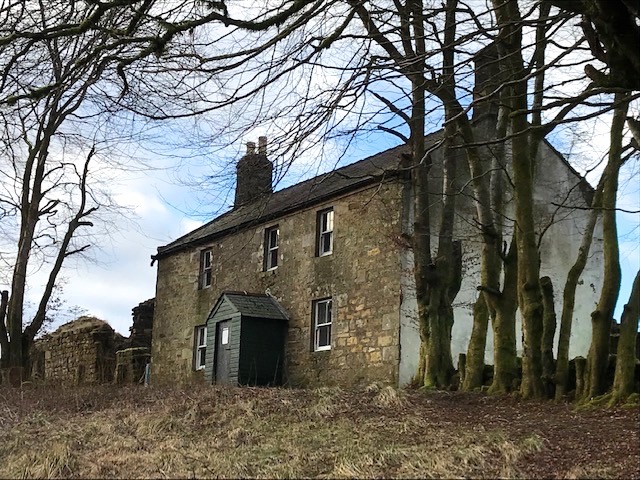
We followed our noses, having no map, driving on up the vale to find a parking place at the point it becomes a private access track. Continuing on foot we came to the forest edge where a surprising vista suddenly opened to view on our right. Roughside was a working farm until the 1950’s when the Forestry Commission took possession and evicted the last tenants. All its fields were then thickly planted with sitka spruce and the farmhouse and remaining outbuildings gradually disappeared from view as the trees grew up around them. Last year that whole stand of trees was clear felled and the isolated steading on its ridge came blinking back out of conifer confinement into the light.
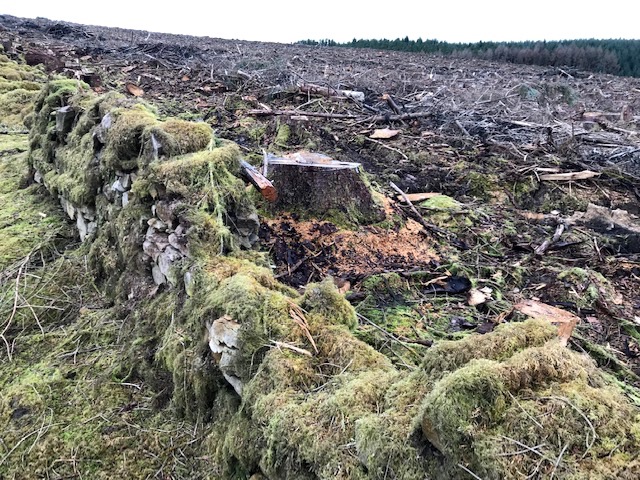
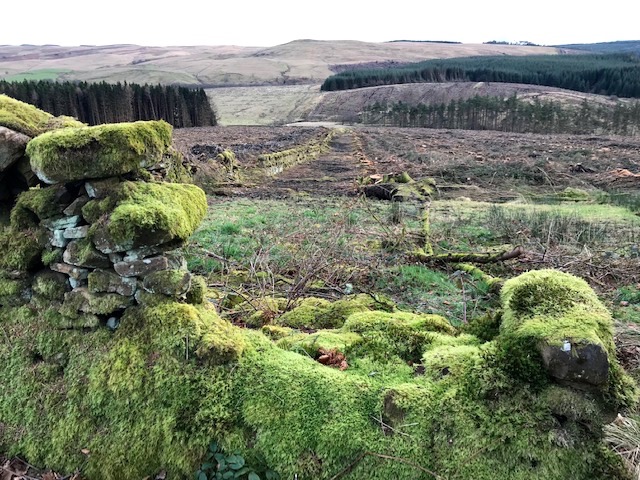
Strange feeling it was to progress slowly uphill along the bridleway, crossed and crushed by the heavy plant used to clear the closely packed plantation. It was a mild day, clear sky, with no wind, so the air still bore the scent of resin from the stumps of pine and abundant brash. The farm’s former dry stone field walls breached in many places. Now, back in the sun, the accumulated seven decades of mosses that thickly line wall and ground will fall away under exposure to sun, wind and rain and the land take back some of its former wild character.
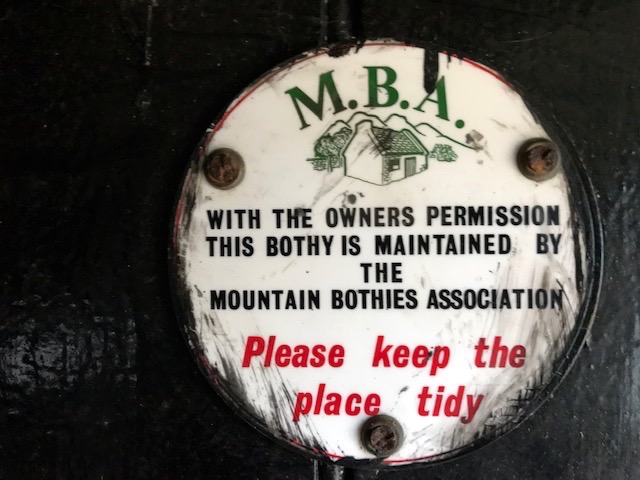
What saved the old farmstead becoming yet another forgotten ruin in the great post-war forestation was the action of the MBA in buying it from the Commission in 1989. The Mountain Bothy Association is a remarkable institution, formed and run by a dedicated band of volunteers. Founded 1965 in Galloway by local enthusiasts it’s a registered charity dedicated to maintaining otherwise abandoned buildings in the wildest, most remote parts of the UK as basic shelters for ramblers and backpackers.
The word bothy originally meant farm accommodation for itinerant labourers. Although the number of farm workers severely declined in the 20th century the number of leisure walkers increased so the functionality and adaptability of such places gave many a new purpose. Today over 100 such shelters are in the MBA’s care. Northumberland has 7 of the 11 bothies to be found in England, 3 of which are here in the Kielder Forest Park.
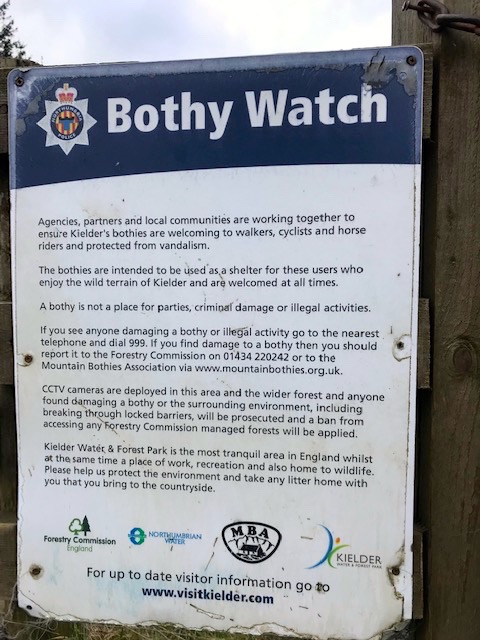
The Bothy Code is a common sense respect agenda. i.e. respect for other users, the surroundings and the building itself. In recent times selfish people turning up to party en masse with drink and drugs have caused problems, with additional issues of litter dumping and vandalism. A warning sign on the access track reminded us of that abuse.
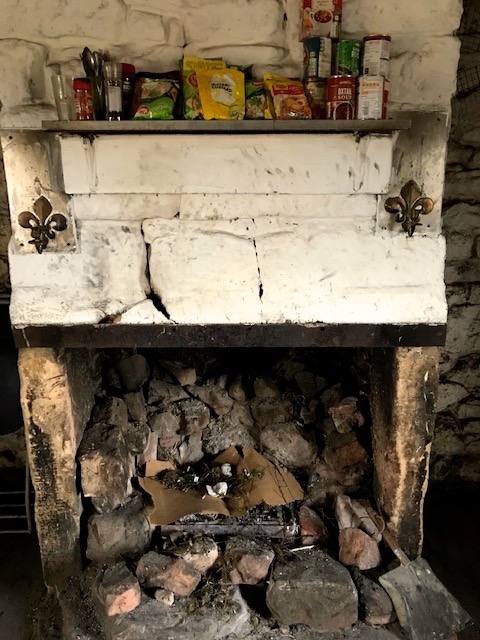
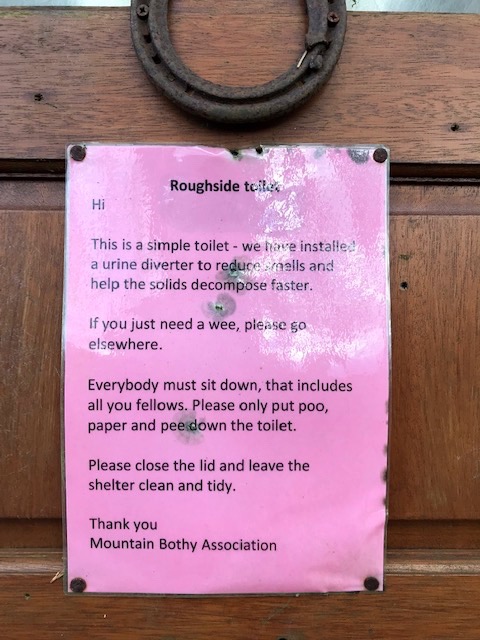
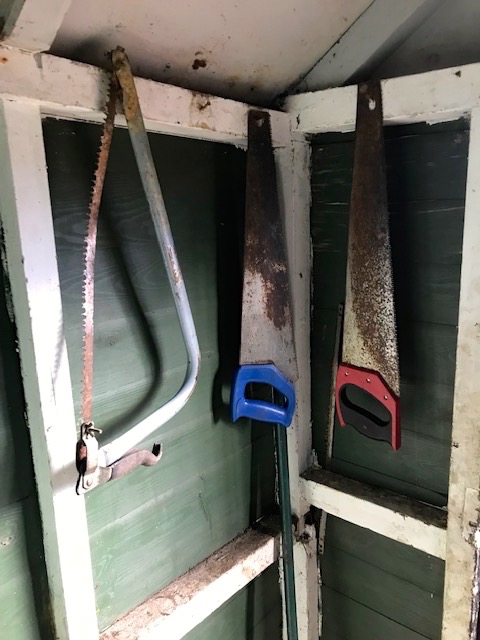
We set about exploring the various rooms in the old two storey building. All the basic necessities were in place, including saws to cut logs for the fire, carpet covered wood boxes to sleep on, a fresh spring water supply and an outside compostable toilet.
An MBA team visits to do structural maintenance and check all’s well. Our Goldilocks moment came in discovering one of the upstairs bedrooms to be occupied, although no one actually present, just all the walking and camping gear on two separate bed boxes and a roaring log fire in the grate!
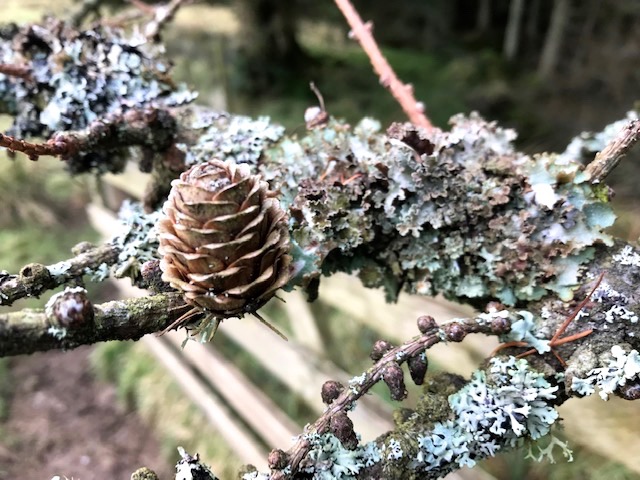
We returned back down to the car by a slightly different route, skirting the forest edge where the rushing stream marked its boundary. Fascinated by the mature larch trees we passed, their bare branches swinging out over the wire fence, encrusted with lichen, cups of cones balanced elegantly on each bough.
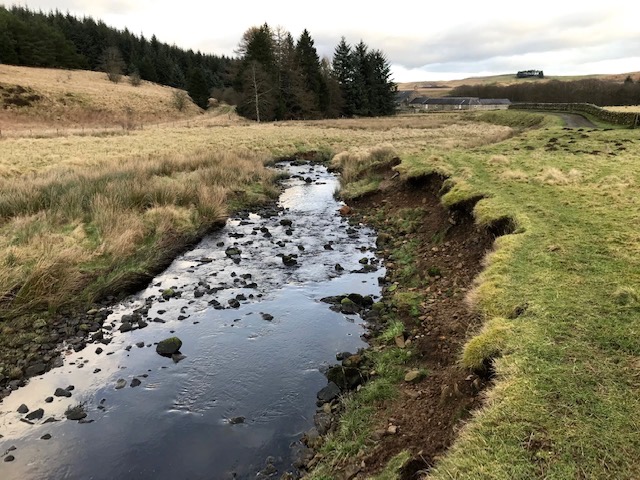
The stream here, a headwater of the Chirdon burn, is narrow enough to stride over, and characteristically noisy, full of peaty brown water. Clearly it must carry force in spate, as the undercutting of the land at turning points clearly indicated.
We had parked near a handsome traditional stone built Georgian farmhouse, part of whose land fronting the burn had been transformed into a wild meadow garden, defined by circular grass paths and a large pond. The former farm’s single storey L shaped outbuildings had been converted into a pair of high spec fully equipped holiday lets, rebadged as cottages. Looking them up online back home we saw they were being let for an average £800 per week each. Made us smile to think we’d now seen, in one visit, both ends of the spectrum of accommodation on offer to visitors in our remote corner of England.
Here we come a-wassailing/Among the leaves so green/Here we come a-wandering/So fair to be seen.
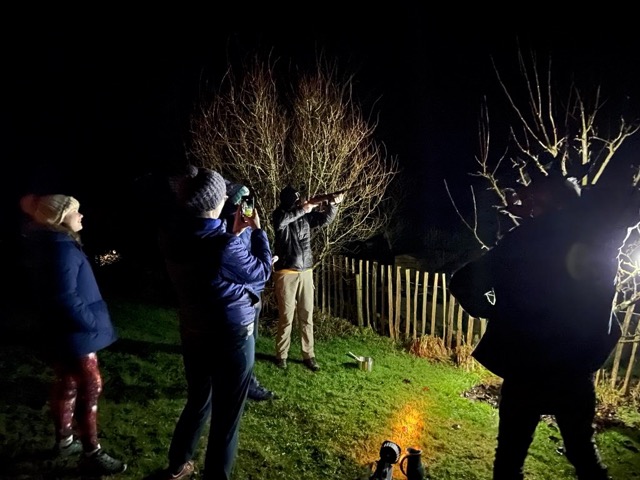
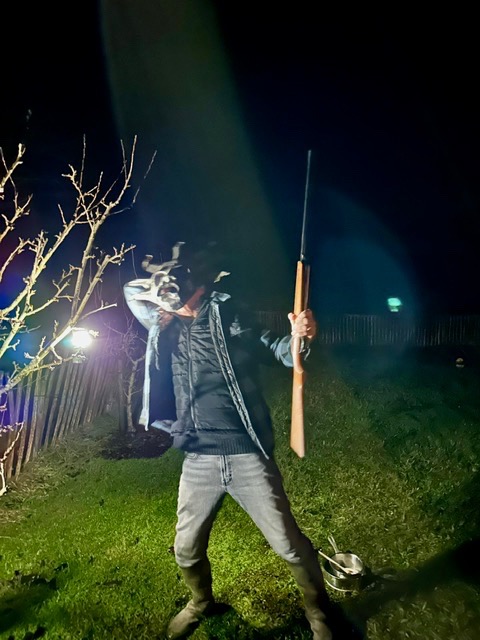
With family staying at the Corner House over the New Year break I persuaded them into celebrating the seasonal horticultural spirit, seeing out the old to usher in the new. After supper on NYE we got noisy with saucepans and wooden spoons around the Arthur Turner, the oldest and largest of our apple trees, carousing it with a wassailing song in ragged harmony.
Emily (10) poured a libation of cider round the roots before brother Harry (13) discharged a few pellets from the air rifle through the bare branches to see off any lurking evil spirits. Yours truly, in a mask I’d once worn in a production of The Tempest many moons ago, brandished the airgun for good measure while chanting a scatter rhyme to close proceedings. We all loved the impromptu fun in reconnecting, however haphazardly, with that most ancient of traditions – placating the gods to ensure good harvests in the year to come.
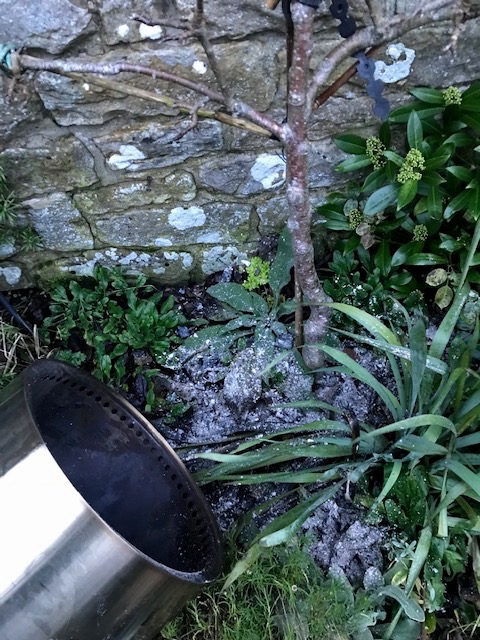
The mild spell of weather allowed us to enjoy successive evenings socialising on the deck round the fire pit, with a variety of rugs and cushions for warmth and comfort. Dried logs and briquettes fuelled the mesmerising flames, captured and reflected in the steel drum. In following days I tipped the residual wood ash around some of the cordoned apples out front, raking the grey matter into the damp soil. A good source of potassium, it may yet prove a more scientific boost to productivity than our turn of the year ritualistic carryings on!
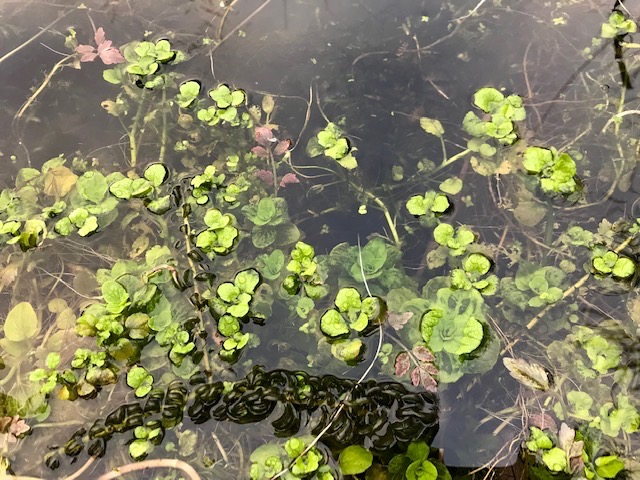
Elsewhere in the garden the wildlife ponds are full to the brim from weeks of rain. During a recent cold snap, in lifting one of the larger edge stones, a frog dived for cover under the film of ice. As noted here before, this year’s newtlets are in there too, hiding out from frogs and other predators like diving beetles or dragon fly larvae in the mass of oxygenating weed.In the new and much deeper pond the watercress has become well established, and is still putting out fresh green leaves, above tangles of floating white roots. It really is the most useful cover and shelter for so many aquatic animals and insects.
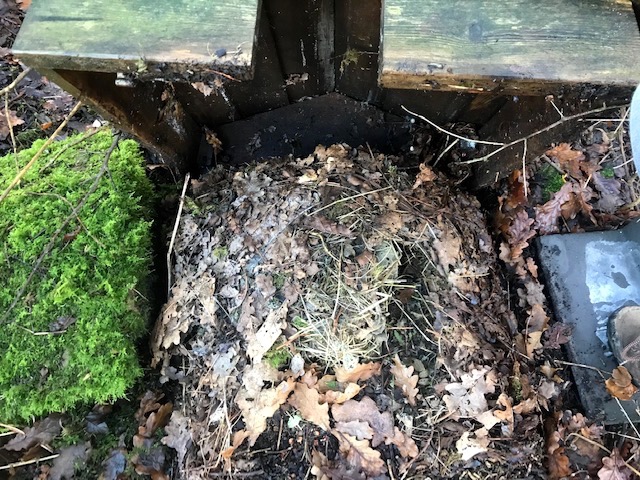
Nearby, underneath the blackthorn and oak in the copse, I lifted the lid of one of the old compost bin tops, placed there for animal shelter years back, to delightedly discover it has a resident this winter. A great round mass of leaves, grass stalks and other plant matter with a clear trail in and out. Not sure if that indicates a hedgehog in residence or a rodent of some kind…Must keep an eye on it over the weeks to come.
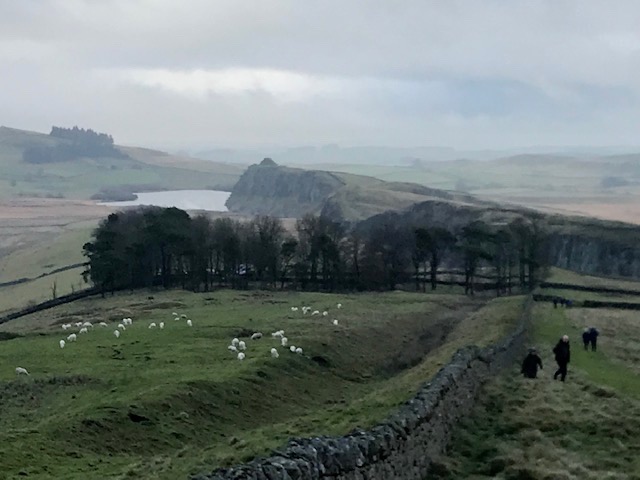
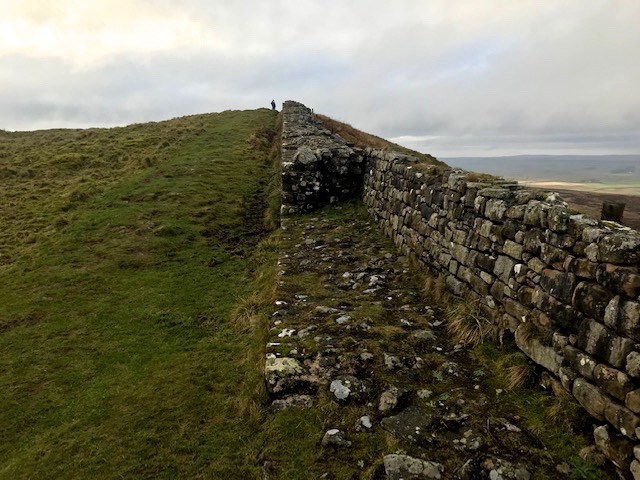
Enjoyed a family outing along a favourite section of Hadrian’s Wall. We chose not to take the more rugged and scenic right turn from Steel Rigg. That leads walkers eastwards to the gap which no longer features the sycamore that bears its name, notoriously felled in a devastating act of vandalism earlier in 2023. Simply cannot yet bring ourselves to see the sorry sight of a boxed off tree stump.
Instead we took the path less travelled by, gradually ascending westwards to the highest point along the wall at Winshields, which also happens to be the midway point on the original 73 mile long northern frontier of the Roman Empire, from sea to sea. Particularly struck by the section just below the trig point where the ridge’s field boundary wall, running along the exposed foundations of the Roman structure, meets the original wall and once again resumes its wide onward stride.
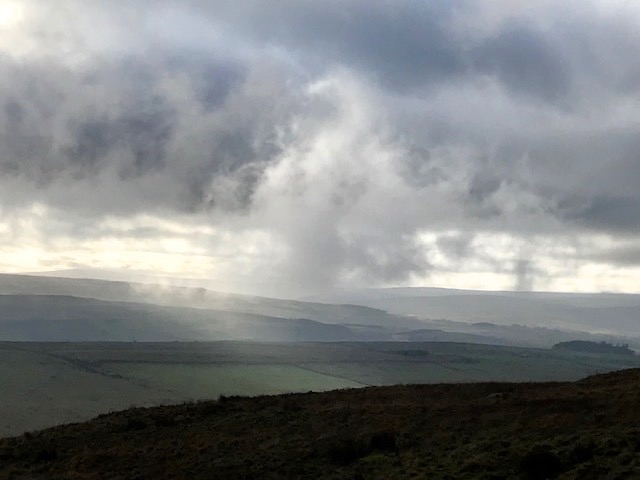
The atmospheric panorama presented us was a winter best, with distant rolling mists alongside clear sun lit patches, harmonic shades splayed across the fells subtly changing under a diffuse wash of pale light – a water colourist’s dream!
Back where we had parked at The Sill, the National Park’s visitor centre, a good post walk lunch was enjoyed in the upstairs café. The gift shop here stocks a good selection of items produced or sourced from within the park’s boundaries (including Kim’s books!) The amount of merchandise – from post cards and posters to book covers and beer bottle labels – that feature the iconic lone sycamore only adds greater poignancy to the collective sense of loss.
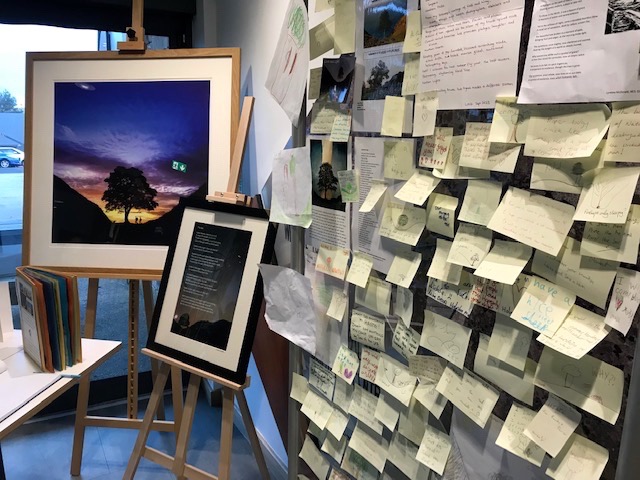
The visitor centre has a display of people’s handwritten posts and pictures that mark its tragic demise, which we viewed as we left. A reminder of how much that singularly graceful tree has been missed and mourned by so many hereabouts and indeed everywhere else.
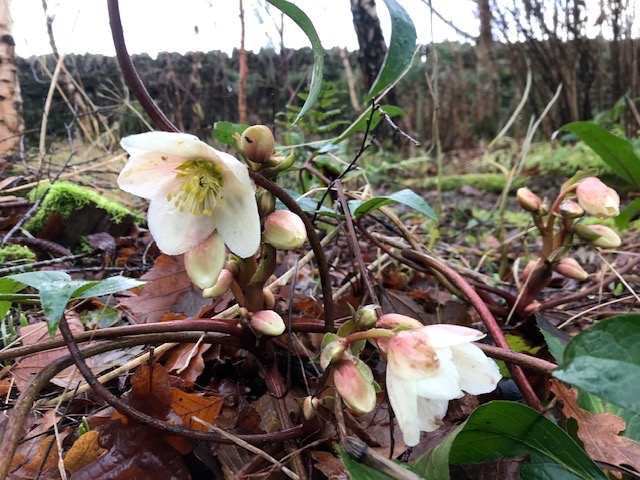
Bidding the family farewell on New Year’s Day we noted a splash of colour by the yard gate. A hellebore, emerged from the humus rich soil of the copse. With no flowering rival in sight this beautiful ‘Winter Rose’ really is the most cheering of company and a symbol of hope and renewal for the year to come.






















 STEPHEN TOMLIN