Hare Raising

A brief summary of the past month’s wild animal activity in our out-by rural garden. The big advantage of having no dogs or cats on the premises increases chances of encountering wild animals and the privilege it brings of seeing them up close.

New born leveret: Image by wildwelfare.org.uk

Star event has been the up close sighting over three evenings of baby hares – leverets – hanging out in forget-me-nots that have colonised gravel paths between house and hedge. Our viewpoint from the pantry window  being just a few yards away. I’ve not the equipment to capture images in near darkness, but the youngsters intimate interaction is engraved in the memory. Best night ‘s observation was the second. Four of the brood bundled together grooming  each other’s fur while a fifth, just a foot away, lay facing out into the gathering dark. Was it keeping watch for their dam or on guard duty for predators? Whatever the reason the outrider eventually came back to its brethren and joined in the ongoing grooming process.

Occasional spotted individual growing leverets since during  the day, shooting in and out of close packed flower beds and full leafed copses. The mainstay of family life is their mother, the Jill, who we first saw regularly at Winter’s end. She seemed to have adopted our ever growing garden rubbish tip, t’other side of the fence, as her nursery. Miniature versions of the parents, leverets are born above ground in a shallow depression, or form, and each weighs in around 100 gms (3.5 oz) Unlike rabbits they are fully formed when born, with eyes and ears open. The Jill feeds her litter twice a day but goes foraging, keeping her distance to deter predators like foxes, stoats and weasels from tracking their location. The leverets in turn remain motionless throughout and their colouration helps them blend into the background. They venture out as they grow – as we witnessed – and are fully grown at six months.

When it comes to seeking out the hidden birthplaces of creatures around the garden we were intrigued to see which of the many wrens nests would be the Jenny’s chosen location to lay her eggs. This one amongst the flowerpots won out. Amusing to see the nestlings sporting top knots of moss wrested from their nest lining. Whirring forms of fledglings often seen since about the place. One’s had to be shooed out of the house and others from under the cars in the yard before driving out.

The railway goods waggon that’s our unusual garden shed has in successive years been home to nesting swallows, blackbirds, robins and pied wagtails, each fiercely protective of  territorial space. We have indoor residents and  under-the-eaves tenants, and thus they co-exist. The wagtails usually opt for either the suspended metal watering can or bucket. The spill of feather, grass and wool lining indicate eventual fledging. Later came across a second wagtail nest within a tangle of rampant clematis, montana rubens, outside the bathroom.

The rain brings amphibians  and their ilk out to forage. A frog amongst prostate free flowering  lysmachia nummularia at the old pond’s edge one day, or the elegant emergence from cover of a leopard slug on another damp day. There are around forty types of slug in the UK, most of which are not supposed to be crop pests. This one’s beneficial in feeding on  a diet of fungi, plant or animal matter and in turn is preyed on by hedgehogs and birds.

Moor and Tor

I love landscapes of dramatic contrasts, territory where man has made his mark for better or worse over thousands of years. Growing up on the edge of Dartmoor instilled that taste and fed a curiosity to discover more. My predecessors had worked its quarries for stone and extracted its mineral wealth through mining so I love any opportunity to get reacquainted with such a diverse multi-layered history. The 365 square miles that make up the Dartmoor National Park is the largest area of natural open land in the south of England, with a fascinating story of evolution and settlement. It was certainly a compelling reason to choose Dartmoor as a ‘Mastermind’ semi-final subject  back in 1991 and I loved doing the research.

Image of Lee Moor pit by Mindat.org

So, here we were, on the last leg of this holiday, coming away from the South Hams through Ivybridge, following the twisting B road that hugs the southeast contours of Dartmoor, heading for Tavistock on its western side. At Shaugh Prior the high banked hedges give way to wide highways and verges floured with dust from endless lorry loads of clay product. Looming above steep slopes of oak woodlands are waste tips of sand and stent (waste rock) produced over many years by the Lee Moor China Clay works. Extraction is by ‘wet mining’ in vast pits using high pressure hoses to create a slurry which is filtered to extract the fine soft white clay prized for its low plasticity. Huge amounts of waste are created in the process, hence the ‘mountains of the moon’ landscape that characterises this corner of Dartmoor.

We parked inland, north of the works, by Brisworthy plantation. I was expecting to find a block of conifer. Many such plantations were established on ‘unproductive’ moorlands nationwide by the Forestry commission in the wake of WW1 to help meet the nation’s shortage of timber. Brisworthy though, it turns out, is a mature plantation of deciduous wood, walled and fenced, consisting mainly of beech, planted in the C19th. I think it must have been Lord Morley, the major local landowner, who was responsible, following the fashion for beech tree planting by his contemporaries, most notably on Exmoor.

;John Parker (1772-1840), 1st Earl of Morley by FR Say; National Trust, Saltram House

It was also Lord Morley who granted Cornish entrepreneurs China Clay extraction rights back in the 1830’s. Dartmoor is a massive eroded plateau of granite and over millions of years its gradual decomposition results in the formation of kaolin. It’s essential for making bone china, hence the alternative name, and is also used to manufacture products from paint and paper to cosmetics and toothpaste.

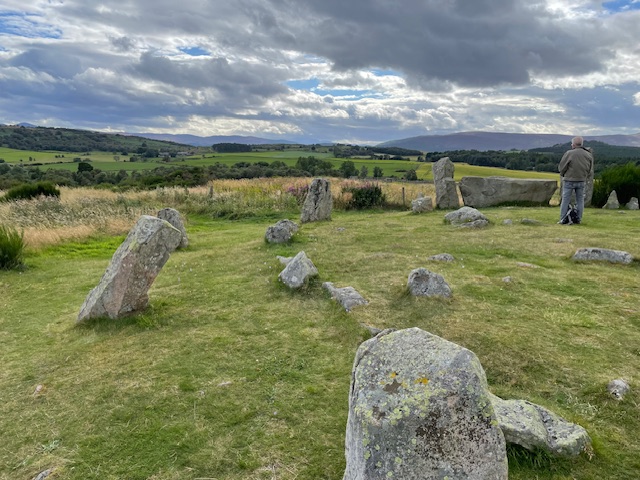
We were curious to see what antiquities could be discovered on this short circular walk. The area of the Upper Plym valley – some 6 square miles – boasts over 300 Bronze Age, medieval and later sites. Our first stop was one of these special places, Brisworthy stone circle. I think it may be a surprise to many, me included, that so many of Dartmoor’s 90 recorded stone circles have been extensively restored. Brisworthy is no exception. Back in 1909 pioneering archeologists put 17 of the original fallen granite blocks back in their holes, to join those still standing. There’s a gap where a couple are missing and these are now thought to form part of the neighbouring field wall.

That stout hedge bank has been the subject of extra protection from grazing by pole and barb fencing, allowing plant life to regain a footing. In amongst the whortleberries, foxgloves and gorse there’s a metal sign to remind us that the Ministry of Defence use Ringmoor Down for ‘dry training’ (exercises using blank ammunition) The army has been using great swathes of the remote high moor for military training since mid Victorian times.

Crossing Legis Lake (stream) by the ford was a minor challenge, the ground being very uneven. Obvious signs of disruption where streaming for tin ore (cassiterite) had occurred during the middle ages when the moor was northern Europe’s principal source of tin. The earliest written record of tin mining on Dartmoor in 1158 references activity here at Brisworthy and nearby Sheep’s Tor.

Legis Tor is surrounded by clitter (granite scree) so requires surefootedness. Good view from the summit, or rather, summits.  Waste tips and Plymouth one way, the bare sweep of moorland around the upper Plym valley with cattle grazing, the other way. The granite here on Legis Tor has a pinkish tinge that sunrise and sunset would pick up to add extra glow to its profile. Who knows, maybe that gave the landmark extra cache back in the Neolithic and Bronze ages to attract humans to settle on its slopes.

Legis Tor vermin trap image by Richard Knights / Dartmoor Walks website

So dense the amount of granite blocks and clitter that I searched in vain to find the perfectly preserved vermin trap the eminence is noted for. This area was developed from the 15th century on an increasingly large scale as a site for farming rabbits. These warrens needed protecting from natural predators like stoats and weasels, hence the traps at boundaries. Basically, granite boxes with channels leading to a slate door that could be sprung to trap intruders. Medieval farms were converted to house rabbits and hares. Thin topsoil over solid granite stopped them burying out while earth and granite ‘pillow mounds’ kept them penned in. Clearly, the factory farming of its day! Of Dartmoor’s historic warrens six of them are to be found here in the Upper Plym valley. Maybe the proximity to markets in Plymouth was the deciding factor in establishing them hereabouts.

The flora of Dartmoor is typical of damp acid soils, with plants like the ground hugging yellow flowers of tormentil, able to survive in amongst tough grasses hard grazed by ponies, sheep and cattle. Heath milkwort, with its pretty blue and white flowers, caught my eye. It was prescribed by medieval herbalists to nursing mothers in the belief that it made ‘milk more abundant’. The idea came via its Greek name for ‘much milk’ from the effect it had on cows grazing it.

Reave Boundary Bank

Returning on a parallel route we traced the intersection of two reaves, or ancient earth boundary banks. Another stone circle – Ringmoor – complete with stone row revealed itself in amongst the heather and bracken. Restored in the early part of the C 20th by the famous curate and squire of Lewtrenchard manor, the Rev. Sabine Baring Gould (Composer of ‘Onward Christian Soldiers’). By all accounts it was done with more enthusiasm than understanding…Oh dear. It still has an appeal to passing walkers like us though.

Thought of the hardy folk who lived here, and the remains of their round houses and animal pounds. People who constructed those rows and circles for their rituals and how gradually they exhausted the supplies of timber, effectively causing an ecological disaster, so that they moved off the moor to the valleys below, clearing and settling again, using the denuded high land as summer grazing grounds. And so the appearance of the landform developed to be more like it is today.

Redstart Image Margaret Holland / The Wildlife Trusts

Returning to Brisworthy plantation we met a wildlife photographer setting off with her extensive kit, who told us the wood is home to migrant birds like pied flycatcher and redstart that breed here. The latter has a special fondness for the mild wet conditions found in the temperate rainforests of the UK’s western coastal areas. Ponies and their foals were in evidence too, grazing the woodland boundary banks. We were lucky to have such a fine day to enjoy the views and discover the archaeology, dry under foot with no mist or fine rain to lead us astray. Enough was experienced in our few hours ramble to keep me going until the next opportunity arises to rediscover another part of the place I still call home in my heart.

Behoofed on Blackdown

There are over 1200 hill forts in England. Mostly built in the Iron Age, between 900 BC and the Roman Invasion in the first Century AD. Their construction seems to reflect an age of increased conflict fuelled by a growing population, in stronger tribal groupings, disputing rights over land and resources.  Some hill forts were built on earlier Neolithic causeway enclosures, some incorporate burial barrows. They all vary greatly in size, form, defensive strength and number of occupants, from a handful of families to a whole community hundreds strong, plus assorted livestock & food stores.

Reconstruction of iron Age fort: Image credit Explore GB

The Roman occupation may have put an end to native tribes setting up fortresses that could threaten imperial rule but some of these distinct man made features were reused beyond their own era. Just up the road from where we were staying, north of the village of Loddiswell which is itself situated on a hillside, there is one such place, and we were keen to pay it a visit.

Blackdown Rings, 600 feet above sea level, gives distant views over a wide swathe of South Hams countryside, from Dartmoor to the north, southwards to the coast and slopes down to the valley of the Avon, or Aune, river that physically connects the two. In ancient times this valley would have provided a trade route and rich hunting grounds, so clearly well worth overlooking and hence, controlling. A great location for a defensive settlement atop its gritstone summit.

Ariel Image by Richard Hook

The former fort extends over 6 acres (2.45 hectares) defined by an earthwork rampart with external ditch and counterscarp bank, these days picked out by hawthorn and other tough little trees. What makes it special is that the Normans, following their conquest of England in 1066, adapted the N.W. corner of the site as a motte and bailey castle. Like many a visitor before us we had to ascend the man made mound (motte) to overlook the immediate enclosure (bailey) with the larger original enclosure sloping away beyond. Presumably that wider enclosure would have secured their livestock and supplementary facilities. No permanent settlement evolved over time in this case, that wood walled military command base never became a permanent stone structure and this stretch of high land on hard rock resorted to heath and pasture.

View from the top of the motte

Today ewes and their lambs graze the slopes and the land is owned and managed by a charitable trust named after the site’s former owner Sir Matthew Arundell, whose will of 1591 bequethed it ‘for the good and behoof of the parishioners of Loddiswell.’ Combined with other parish lands the income raised from investments down the centuries support a range of village causes. Here at Blackdown Rings all the information boards were paid for out of the trust’s funds.

The Line crossing lane near Loddiswell. Image: Coast and Country Cottages

Time caught us short on this holiday or we would have extended the original intention to walk the waymarked paths along the wooded Avon valley at our feet as it has a fascinating modern history. The former railway branch, known as the ‘Primrose Line,’ once wove a scenic journey from its junction with the Plymouth/Exeter mainline at South Brent, via a tunnel into the Avon valley, intertwining with the river and on across to Kingsbridge. Despite a spirited local campaign to turn it into a heritage line the 12 miles of track were raised and removed after closure in 1963, an early victim of the Beeching cuts.

Former railway line crossing the Avon in the woods

The same era that saw a third of Britain’s rail lines closed down also saw a huge increase in the planting of commercial conifer, encouraged by tax breaks. This was often achieved at the expense of ‘unproductive’ deciduous woodlands that could be cleared to make way for them. Protesters in different locations across the country banded together to oppose the trend and in this corner of Devon local residents led by Kenneth Watkins formed The Woodland Trust to do just that.

River Avon woods. image: The Woodland Trust

Today we were looking over some 344 acres of ancient, semi-natural and newly planted woodlands that the trust own and manage here in the Avon valley. One of those woodlands, the very first to be purchased and saved from clear felling back in 1972, has been re-named Watkins Wood in honour of the charity’s founder. It’s one of 1,000 woods open to the public that the Woodland Trust manage nationwide in 2024, thanks to the combined efforts of its 500.000 members and supporters.

Maiden Castle Reconstruction. Image: English Heritage

Footnote: Bemused to learn when researching this entry that the top three hill fort hotspots in England are in Northumberland (where I live) with 271 recorded sites, Devon (where grew up) with 89 and Cornwall (where born) with 77. So, plenty more to discover yet!

Estuary Amble

‘He that prays and preaches best will fight best’ Oliver Cromwell.

We were staying on the inland side of Aveton Giffard and returning from our day at Ringmore and Ayrmer cove, stopped off to discover more about the place, off the roundabout on the main road, near where the River Avon turns tidal.

Walter Giffard was a serious backer of William of Normandy’s invasion of England in 1066 having provided 30 ships and 100 Knights. Giffard (the name means ‘chubby cheeks’ in old French) was richly rewarded by the Conqueror. The ton, or settlement, on the Avon was one of hundreds of manors granted him. Walter went on to become one of the King’s commissioners responsible for compiling the Domesday Book. Later, in 1178, the Giffard family added Challington in Staffordshire to their tally of land. Boscobel – that I wrote about four diaries ago – was part of that estate. Remarkably Challington remains the Giffard family seat.

The Road Bridge at AG – Photo credit Barry Deakin / Creative Commons

Aveton Giffard – AG – lies at the tidal high reach of the River Avon, and is the lowest crossing point, originally by a ford over bedrock, and from the C15th by a bridge. That bridge, widened and strengthened is now the A379 today, linking the market towns of Modbury and Kingsbridge.

Civil War Musketeers Recreation. Photo Credit: The Sealed Knot

When Civil War broke out in 1642 the towns in the far south-west by and large sided with Parliament and the rural areas tended to favour the King’s side.In the last diary I mentioned the Royalist rector of  Ringmore, Reverend William Lane, who, as it happens was also Rector of AG and equally active in raising a Royalist militia here. He had a small wooden stockade built on one the hills on glebe (church) land overlooking the vital river bridge, intending to halt Parliamentary forces crossing. However, the range and power of their muskets was insufficient to stop the Roundheads, and the bridge and village was taken and the clergyman and his men had to retreat in haste. It was for this act of resistance, as well as his activities in Ringmore, that caused him to be a fugitive, as described in my last diary.

We started our stroll downstream from a car park, formerly the site of a sawmill. On the opposite bank is some 42 acres of former grazing marsh, a nature reserve today, run by Devon wildlife Trust. The site’s name, South Efford, betrays its origins as the river’s southernmost fording place at ebb tide. We followed the single track tarmaced road, hugging the shallow winding waters, and which floods every high tide, as the roadside markers clearly demonstrate. Before the road was built walkers used irregular stepping stones, known as ‘the dog biscuits’ to pass over the marsh. This is clearly not a place to get stuck or ‘run the tide’ and there are few passing places.

Danish Scurvygrass growing on the edge of the tidal road

The Avon, or Aune, is one of the many Devon rivers that rise on Dartmoor and end their course as Rias, or sunken river valleys. Avon or Afon in Welsh means river in old English. Some 23 miles long, with the last three miles of its course as a sunken river valley, or Ria. This opening up as shallow estuary, bordered by marsh pasture and steep sided wooded hillsides makes for a topography that is particularly rich in animal, bird and marine life. Because of that the estuary itself was designated a Marine Conservation Zone (MCZ) by DEFRA in 2019.

A little egret caught our attention as it fished the mud with a studied long limbed urgency, but the most striking sight to meet our eyes were two two yachts that had somehow come to grief, marooned on mudbanks mid-stream. Their slimy green glow lent a distinctly haunting presence to the waterway here at low tide. A sharp contrast to the smart little motorboats we saw their proud owners happily working away on.

More time and we’d have made a circular walk of it, coming back via woods and fields over the down with the views of village and valley it would have offered. Incredibly Aveton Giffard’s narrow winding Fore Street of cream coloured terraced houses carried the A379 right up until 1990. Small wonder the villagers held a street party here when the by-pass opened. 

Fore Street, Aveton Giffard. Image: Tony Atkin/Creative Commons

Beyond Journey’s End

No west country holiday is complete without a swim in the sea. As a weak swimmer I rarely goes out of my depth. The ideal spot needs to have a gradual incline, without strong tides, sheltered and preferably not crowded. I found such a place here, at Ayrmer cove. A grey shingle beach where a stream meets the sea, defined either side by cliffs composed of huge slate slabs dating from the Devonian era, formed between 395 – 345 million years ago.

The sublime joy of letting go, diving then floating, eyes closed, limbs akimbo, bobbing about on the lapping waters of the little bay. Then, about to wade ashore, re-opening eyes to the wide blue yonder, there’s a brimstone butterfly riding the breeze just above my head, a happy symbol of this sensual interlude.  

Kidney Vetch by the beach

Once again thanks are due to the National Trust for owning and maintaining such a place. (On leaving we passed a van’s worth worth of cleared flotsam and jetsam stacked ready for collection). The 20’ walk from the Trust’s landscaped car park on a cul-de-sac outside Ringmore village and the lack of any facilities might also explain its quiet unspoilt state. A few dog walkers, occasional passing ramblers on the coastal trail, and a handful of bathers under the cliffs. Just perfect.

We’d taken one track down the valley, between banks of flower filled hedges, and returned via the field path running parallel on the other side of the little valley. Cows with calves at foot grazed contentedly, hock high in lush meadows brightened by kingcup and other marsh plants. We ambled with our gear, entering cooling woodland shade awash with ferns, before the final ascent back to Ringmore.

This must be one of the prettiest of Devon’s ancient villages, with many a thatched cottage proudly kept and no street lighting along its narrow circling thoroughfares more like paths than roads. The ‘Journey’s End’ pub enjoys a great reputation for its evening meals (The chef and his family live permanently on site, which might help explain why) It’s named after the seminal play set on the Western front in WW1, first performed in London’s West End in 1929. Certainly proved a fitting place to complete our lovely sea blessed outing today.

Based on his own experience as an officer in the conflict, R.C.Sheriff (1896-1975) wrote ‘Journey’s End’ while staying on holiday here and the New Inn (already ancient) was subsequently renamed in its honour. An archetypal old building of low beams, nooks and crannies I fancied it oddly reflective of the officers’ mess in the trenches where the play’s action is set. I wondered if, back in the 1920’s, it might have put Sherriff in mind of that place he knew so intimately and could evoke so powerfully through drama.

Histories of past conflicts affected the parish church too, or rather one of its rectors. All Hallows is a venerable building too, though much restored. In 1637 a new incumbent was appointed Rector here. William Lane was a staunch Royalist who, when civil war broke out in England in 1642, set to raising and training a village militia for King Charles’ cause. In retaliation for his guerrilla action in the area a detachment of troops sailed up from Parliamentary HQ in Plymouth, landed at Aymer Cove, marched up the valley, set fire to the Rectory and arrested Reverend Lane’s two eldest sons. The man himself spent the next few weeks hiding in the Church Tower, aided and supported by loyal parishioners, before making his escape to France. Loved this story for its parallels with the other tales of Royalist rebellion and rout we’d encountered on this holiday, from Boscobel to Colyton….And it doesn’t end there.

Overbeck’s & Overlord

Now in the care of the National Trust, Overbeck’s consists of 3.5 acres of terraced gardens set on a precipitous rocky hillside outside Salcombe, giving fabulous views over the extensive Kingsbridge estuary – a great example of a sunken river valley, or ria. Its sheltered position allows semi-tropical and tender plants to flourish and a team of three gardeners backed up by volunteers do an effective job in both maintaining and enhancing this special horticultural haven.

Each garden room opens to another as you rise up or step down to enter them. The contrast of tall semi-tropical trees and native foliage is striking. The green, white and black County flag reminding us of the Devon Riviera location.Trees planted more over a century ago in the woodland area, laced through with winding paths and hidden viewpoints, have added more privacy as they’ve grown to maturity, as well as providing extra shelter.

Otto Overbeck Self portrait oil on canvas .1902

The garden created around the house known as ‘Sharpitor’, built in the 1890’s, was used in WWI as a convalescent home for wounded soldiers. The estate was left to the Trust in the will of wealthy scientist and inventor, Otto Overbeck (1860 – 1937) who had retired here in 1928. He had made a fortune through his patented medical therapy of ‘electric rejuvination’ and this funded further development of the garden complex that bears his name today.

Our attention was drawn to an example of puya chilensis, a member of the pineapple family, flowering now for the first time in twenty years. In its native South America small birds and mammals seeking nectar act as pollinators, and sometimes they end up feeding it too. The leaves have vicious inward facing barbs so any unfortunate creature getting caught by them only adds to its diet.

Liked the decorative ironwork that around the place, that adds a distinctive playful touch, the creation of a local blacksmith. His work ranges from curly-wurly handrails to concave gate toppings and stencilled sign over the steps leading down from the entranceway. Another graceful touch is the century old bronze figure known as ‘First Flight’ in the garden’s largest flat area – a former tennis court – now appropriately enough known as the statue garden.

Parking at Overbeck’s is very restricted so we walked a mile or so there and back from the car park at east Soar, inland out on the headland, which opened our eyes to other fascinating aspects of the topography. The car park was doubling as a depot for all manner of trucks bearing the full range of kit needed for filming a major motion picture on location. We worked out that it was ‘The Salt Path’.

The book by Raynor Winn tells the story of her and husband Moth’s trek along the length of the south-west coastal path from Minehead to Poole at a time when they were homeless, and he had an illness diagnosed as being terminal.

A publishing sensation it is being filmed over the course of a year, starring Gillian Anderson as her and Jason Isaacs as him. What you’re looking at above are a stack of interlinking flooring used to minimise impact of equipment and facilities on a protected landscape like the coastal path.

Wide farm fields today stretch towards the sea but this place was once a hive of activity after RAF Bolt Head was constructed here in WW2.  This fighter base on the English Channel, home to spitfires and typhoons, was at its busiest in the lead up to D-Day – Operation Overlord – whose 80th anniversary we will be marking on June 6th.

The military aerodrome closed in 1947, replaced by a smaller private facility for light aircraft. We were amused to see a Range Rover pulling a cutter at speed, back and forth, along the strip bordered by a cereal crop, maintaining peak grass performance.  The original strip was built on a layer of sheep’s wool overlaid with metal grid. I’m wondering if that’s still in place under the grass.

Heartened to see the NT rangers have been reconstructing lost hedge banks. These would have been original field boundaries, grubbed out to accommodate the construction of the wartime air base. With native varieties of shrub planted on top, in time the traditional deep hedge banks should look as if they’ve always been there.

Leaving Overbeck’s we climbed steeply by path and steps to gain the high open spaces skirting Bolt Head. And what an impressive stretch of coastline it is. A simple plaque on a viewpoint overlooking the estuary reminded us of how fiercely powerful the elements can be and the immense bravery of those who risk their lives to save others from natural disaster.

There are fantastic views from the coastal path to be enjoyed on a lovely clear day. Turning off for the car park inland, we threaded through traditional meadowland. A welcome stop off and chats with fellow ramblers at East Soar’s barn.

The farmstead is now run as an outdoor activity centre for young people and other groups, with goats, sheep and other farm animals for the young people to encounter and learn about. They even host weddings in the barn. A last stretch back along the straight access track to the car and we were away. Another wonderful day on the Devon coast, with special thanks to the National Trust for helping making it so at every turn.

Sensory map of Overbeck’s by Jess Jones

Mothecombe

West country gardens hold a special allure. in the English horticultural world. Milder climates, sheltered situations, the effect of the gulf stream and an earlier spring all play their part even with the effects of climate change at play. So it was a special treat on this holiday, based on this holiday in the heart of the South Hams, to go visiting two of them, starting with Mothecombe, ten miles east of Plymouth.

We were joined by our dear friend Michael Gee. He and Kim being passionate knowledgeable gardeners they share accumulated plant insight and appreciation. Michael hosted me when performing with Barnstaple based Orchard Theatre in the 1980’s, touring new plays and adaptations of classic novels around the southwest. I’ve mentioned Michael before, an expert on mazzards (Devon cherries) and the county’s apple orchards, for which he received a British Empire Medal from the late Queen.

Mothecombe is situated by the mouth of the Erme, one of many fast flowing rivers that drain Dartmoor to the north. Sheltered by lush deciduous woodlands, in its own microclimate, the salt laden breezes that blow into the cove at the bottom end have little effect on the upper reaches of the little valley which in turn defines its extensive gardens, manor house and estate village. That said a terrible storm in 1990 blew down a lot of older trees which has opened areas up for new planting since.

The handsome Queen Anne mansion, with nearby Flete House and their respective estates, were inherited by the Mildmay family in 1873. Mothecombe House was modernised and extended in the 1920 ‘s, with Edwin Lutyens as architect. Today 5,000 acres of coast and countryside remain of the once even more extensive Flete estate, centered on Mothecombe and the Erme estuary. Between 1982 – 2019 the 15 acre interlinked gardens were the preserve of Anne Mildmay-White. We enjoyed a good conversation with her as she was on duty taking visitor tickets and providing refreshments in the reception area situated in a converted stable block. Turns out Michael and she had once worked together fundraising for the Devon Community Foundation charity, so they enjoyed catching up.  

During Anne’s custodianship the emphasis was on wildlife friendly improvements to garden and grounds. The former cut flower garden was turned into a pollinator plant hotspot when 250 lavender plants, with 12 varieties, were established there, alongside pollen rich annuals and perennials. On the wall was a big notice board showing the common varieties of solitary bees you’re most liable to encounter in UK gardens. This sheltered corner acts as open-air classroom when Bee Conservation Trust volunteers give talks and training sessions for adults and local school children.

We lingered in Lutyens’ handsome refashioned walled garden in front of the house, with its wisteria adorned terraces and wide flower borders. Just outside were impressive specimen trees like magnolia and the wide spreading pink blossom glory of a venerable Judas tree (cercis siliquastrum).

From there we followed our noses through the informal orchard, on through the camellia walk, down into mature woodlands to where the path ended overlooking Mothecombe beach. Watched keen surfers, riding waves rolling in as the cove narrowed up to rock pools and near deserted sweep of sandy shore.

Returning through the woods, we could see through to where the next generation of the family were leaving their mark on the land – a series of shallow ponds feeding off the combe’s stream had been excavated. In a few years they will no doubt look as embedded as the rest of the extended garden landscapes. Came across the original ornamental pond and bog garden, a feature half hidden by exotic blooming evergreens and giant gunnera.  We also encountered small pieces of contemporary metal sculptures of birds and animals skilfully fashioned from cutlery, like this kingfisher.

Higher up, where the valley opens and spreads, a former horse paddock is being regenerated as traditional meadow. Since 2020 it’s been seeded with yellow rattle yearly and subject to seasonal mowing, removal and grazing by sheep. A work in progress as the profusion of these semi-parasitic annual flowers continue to weaken the grasses, allowing meadow grasses and flowers to re-establish.

Being a private estate, Flete is an attractive self-contained location for shooting feature films and its beautiful outdoor locations have been seen in versions of Sense & Sensibility, Rebecca and My Cousin Rachael.

A thatcher was at work replacing reeds on the roof of one of the old estate cottages, back up to the car park in the fields where visitors for beach or gardens start their trek. The former Victorian schoolhouse is now a café and restaurant and nine of the old cottages are leased as holiday lets. We’re sure there’s no shortage of takers.

We came away from this visit impressed by the achievements of respective generations of one family in creating a fascinating multi-layered garden complex here at the centre of their estate. A sustained and sustaining private passion where visitors are made welcome to explore and immerse themselves in.

Mothecombe House, Holbeton, Devon PL8 1JZ

A RHS partner garden and open every Tuesday 10-4 from 1st April – 30 Sept. Admission £6

more at: www.flete.co.uk

Rebel Rails

‘The most rebellious town in Devon’. That’s the defiant legend of Colyton in East Devon. One of the first Saxon settlements in the county, the town’s street patterns reflect that period but sadly we’d little time today for further exploration as our friends, with whom we were staying in nearby Lyme Regis,  were taking us for a ride. Literally. But first, a bit more about that proud boast…

Charles Stuart was already father to a two year old boy when he turned up at Boscobel on the run after his army’s defeat at Worcester in 1651, the incident I wrote about in the last but one country diary. That child, James, that the teenage prince had by his first known mistress Lucy Palmer, would be the eldest of fourteen illegitimate children the ‘Merry Monarch’ would father in his lifetime. Following Charles II’s restoration to the throne, the thirteen year old was given the title of Duke of Monmouth. Later that same year, 1662, he was married to Anne Scott, 4th Countess of Buccleuch, taking her last name and additional title of Duke of Buccleuch. He then had a successful military career, winning key battles and becoming the poster boy for protestant populism. (Interestingly his Buccleuch descendants are one of the richest aristocratic landowning families in Britain today).

Touted as Charles II’s protestant successor, Monmouth attempted on Charles’ death in 1685 to wrest the throne from his catholic uncle James, duke of York. Landing at Lyme, Monmouth issued a declaration accusing James II of poisoning his father, usurping the throne and ruling against the law. The West Country, with its strong protestant sympathies caused many to flock to his colours. Colyton excelled itself in contributing 105 men to the righteous cause, more than any other town in the region, hence the soubriquet.

The Monmouth rebellion came to a tragic end when James II’s professional army ruthlessly crushed the largely untrained yeomen insurgents at Sedgemoor on the Somerset levels – the last full scale battle fought on English soil. Monmouth fled the bloody scene, but unlike his father before him, failed to secure help in escaping to safety abroad. Apprehended by pursuers in the New Forest just days later, Uncle James showed no clemency and Monmouth was publicly executed for treason in London. (An awful botched job, taking five attempts by the executioner to part head from body)

The ‘bloody assizes’ held in towns across the western counties in the wake of the failed uprising was presided over by the infamously sadistic Judge Jeffries. He sentenced hundreds of wounded and captured rebels to be hanged and hundreds more to be transported for life to the plantations of the West Indies, and many unfortunate Colyton men were amongst those so punished. Three years later the ‘Glorious Revolution’ led to Protestantism’s new aristocratic champion William of Orange overthrowing his father-in-law James II, who subsequently fled into permanent continental exile.

Nearly 330 years later we are amongst the thousands of visitors who associate this area less with tragic rebellion and more with fun rail trips on heritage trams. The Seaton tramway runs along narrow gauge lines for over three miles through the lower Axe river valley, from Colyton to the seaside resort of Seaton on the UNESCO designated Jurassic Coast.  On the way the track crosses a busy road and passes two nature reserves, home to many species of wading birds.

The colourful, immaculately preserved collection of heritage trams was started in 1949 by engineering entrepreneur Claude Lane. Previously run as seaside attractions in North Wales and Eastbourne the trams found a permanent home here on the former rail branch line. Closed under the Beeching cuts in 1967 it reopened as a tramway in 1970, and has gone from strength to strength ever since.

I was impressed by the purpose built modern terminus at Seaton as well as the modernised 1868 original railway station outside Colyton, at the other end, where we enjoyed lunch on the platform. The joy of this sunny afternoon outing was the fab half hour ride on the top deck down to Seaton. Wonderful all round uninterrupted views you only get seated on the open deck, with the return leg a sheltered more sedate experience on the lower deck.

Viewing trams approach on the other line, watching the freshwater river merge into its tidal estuary on one side and taking in the marshland nature reserve with its hides, wooden walkways, reedbed marshes and shallow lagoons on the other. Another West Country attraction experienced. Long may it continue to bring smiles to the faces of all who travel on these beautiful engines, young or old.

Footnote: The Monmouth Rebellion had been my chosen subject back in 1990 when I was recovering from industrial injuries sustained on a theatre tour and decided to fill in the time by applying to compete in the next season of ‘Mastermind’ on TV. The BBC production team said there wasn’t enough information on this topic for their QMs to set questions so I was reluctantly persuaded to drop it. They used the same argument about my subsequent choice of ‘Dartmoor and its Environs’ but I stood my ground and they gave way…A successful rebellion, as I went on to win that round of the competition.

New Work Wonder

High on a wooded Cotswold escarpment, commanding extensive views southwards across Gloucestershire to the Bristol Channel, sits a former Tudor hunting lodge transformed into a Georgian country house, complete with 750 acres of gardens and parkland. Another fine rural rest point on our journey south, this time courtesy of the National Trust.

Newark (‘New Work’) was originally built by Sir Nicolas Poynz. Important enough to be painted by Hans Holbein, he was one of those hardnosed courtiers who benefitted hugely from the reformation wrought by their all powerful patron Henry VIII. A novel building, designed to show off his newly acquired wealth and hunting domain, this original section was built with dressed stones from Kingswood monastery, an asset stripping process overseen by Poyntz as High Sheriff of Gloucestershire.

Over two centuries later, in the 1790’s, the Clutterbuck family added their bit of new work, a cleverly designed harmonious extension, complete with false windows to retain symmetry. They also landscaped the gardens and approach road in the fashionable romantic style of the day. Of exiled protestant Huguenot stock the Clutterbucks also added the huge mullioned window that floods the main staircase with light, emphasising elegant heraldic decoration in the process.

We had tea on the garden terrace, taking in the vista of rolling pastoral greenery, soaking up the sunshine while it lasted.  Amusing to see and hear the resident peacocks wafting at will about the place, to everyone’s delight. Heading indoors we enjoyed an unhurried wander through the intriguing layers of Newark’s architectural evolution. It also reveals a comfortable modern domesticity, with eclectic art and ceramic collections filling the downstairs living rooms.

This element is the legacy of Texas architect Bob Parsons, who had served as a soldier in Europe during WW2. He fell in love with what had become a dilapidated unloved place inherited by the Trust in 1949 and in return for a peppercorn rent, he and his male partner cleverly restored the building to life during the last 30 years of the last century. As is so often the case in conservation matters our country owes a debt to enlightened foreigners who love and care for our neglected heritage more often than we sometimes do.

A leisurely amble down through the woodland garden and paths, viewing the imposing house on the ridge from a different angle, rounded off our visit.

A 20’ drive from the M5, Newark is clearly ‘a happy place’, well worth discovering for its restful elegant features, indoors and out.

https://www.nationaltrust.org.uk/visit/gloucestershire-cotswolds/newark-park

A Royal Progress

‘….only one way to pass the next day….to get up into a greate oak in a pretty plain place, where we might see round us…(it) had been lop’t (pollarded) some 3 or 4 years before and being growne out again very bushy and thick, could not be seen through.’ Charles II, describing how he hid in an oak tree at Boscobel in 1651

It’s a long, long drive from the north east corner of England to the far south-west. Breaking up the many miles with rests and stopovers makes a big difference to the experience. Doing the research I thought Boscobel House, a short drive west off the A5 from its junction with the M6 near Wolverhampton, might be a good place to meet the first of those requirements on day one of our recent travel south.

Prince Charles c.1648 Image: National Portrait Gallery

On September 3rd 1651 Charles Stuart fled the bloody scene of his army’s disastrous defeat by Cromwell’s Ironsides at the battle of Worcester. The demoralised prince and a handful of associates, now with a huge price on their heads, found refuge at this isolated hunting lodge in the early stages of their escape. Built in the previous century, in the midst of managed woodlands, its name means ‘beautiful wood.’ The property of recusant local landowners, the Gifford family, Boscobel had form as a ‘safe house’, used previously to hide the banned itinerate catholic priests who ministered to them. Their loyal tenants, the Penderels, took in the royal fugitive at great personal risk to themselves. They sheltered, fed and re-clothed the party, who continued their way disguised as servants and labourers, to be aided and guided by other royalist sympathisers, eventually taking ship at Shoreham into exile at the French royal court.

Boscobel: Image via English Heritage

The dramatic story of Charles’ adventures was retold by the then King in 1680 to Samuel Pepys, augmenting earlier eyewitness accounts. The saga’s most famous episode had taken place at Boscobel when the fugitive monarch hid in an oak tree in the grounds while parliamentary troopers scoured the land below and house beyond. So popular was the tale that 29th May (Charles II’s 30th birthday and date of his restoration) became a national public holiday from 1660 to 1859. Public houses were named or renamed ‘The Royal Oak’ while at Boscobel itself sightseers came in their droves, taking away branches and twigs as souvenirs. An encasing brick wall was built to protect the tree from further diminution but that only seems to have hastened its demise by damaging the roots. 

Royal Oak 2 (c.1700s) & 3 (2001)

An acorn from the original took root in the early C18th alongside and that’s the tree you view today behind its railings. A lightening strike in 2000 destroyed one half of the canopy and straps now bound the trunk to stop it splitting. To mark the 350th anniversary of Charles’ stay, his namesake, the then Prince now King Charles III planted another successor oak nearby, which appears to be thriving. What impressed us most though, as we strolled through the rippling meadow, was that part of the ‘beautiful wood’, later cleared for agriculture, has been replanted in our century with native trees, including those propagated from the famous oak.  It also reminded me of what happened closer to home last year at Sycamore Gap and how that singular tragic act of vandalism created a greater awareness and debate about the importance of native trees in the landscape that will – hopefully – result in new woodlands being planted in the right places as investment in natural capital to benefit us all, wherever we live. 

We were fascinated as much by Boscobel’s complex structure as a building, as by its part in history. Arriving upstairs to view the priest hole under floorboards where the prince spent an uncomfortable night and the attic room where he scanned the countryside for pursuers conveyed a strong sense of living history.  It’s a small miracle Boscobel House and farm has survived relatively intact for the public to enjoy today and that is partly due to the Evans family, wealthy Midlands industrialists, who bought the place in 1812 and in the romantic spirit of the age set about restoring the place to what they perceived it to be in the 17th century.

The Victorian farmyard we really took to. A prosperous working farm up until 1967, its planned set of interlinked stables and barns invite the visitor to explore a fabric of worked surfaces softly lit by diffused sunlight the quiet midweek day we visited. The oldest part of the site, the late Tudor north range (below), remodelled as a dairy in Victorian times, boasts an impressive hall roof structure.

Now in the care of English Heritage, Boscobel had a major upgrade between 2019 – 20. With a reception area and café in converted outbuildings together with regional heritage breeds – Tamworth pigs, Shropshire and Ryeland sheep, Sebright and Dorking chickens – all add to the place’s agrarian attractiveness.

The famous historic episode set against the vernacular architecture of venerable timber frame house, farmyard brick buildings and restored gardens make for an enjoyable immersive experience. A restful welcome break on our own modest more comfortable royal progress across the country.

Farm’s Cider Press

Plan your own visit by visiting: https://www.english-heritage.org.uk/visit/places/boscobel-house-and-the-royal-oak/