July Days

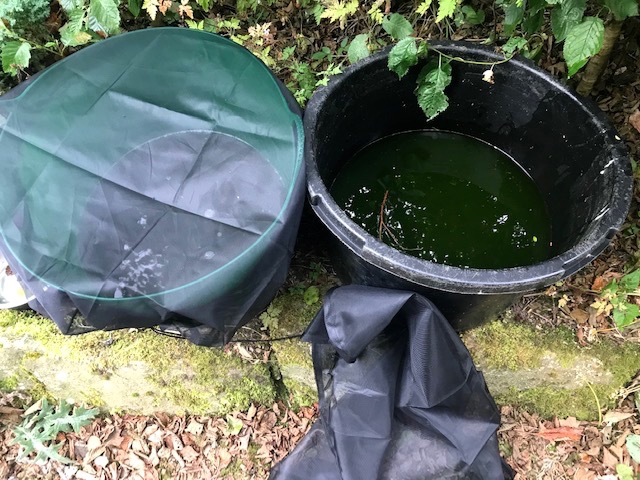
Temperatures have been taking wild swings, from sizzling to chilly. More thankfully rain revived the greenery and topped up the near empty water butts. We continue to save bath water and fill the zinc trough in the yard. Very pleased to source and fit covers for our other open top tubs thus ending the accidental drowning of summer songbirds. Being permeable they let the rainwater in and will keep falling leaves out. A real win-win and only regret I didn’t do it earlier.

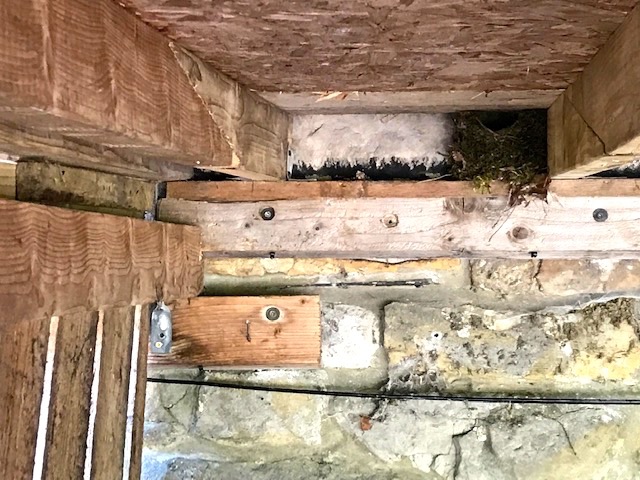
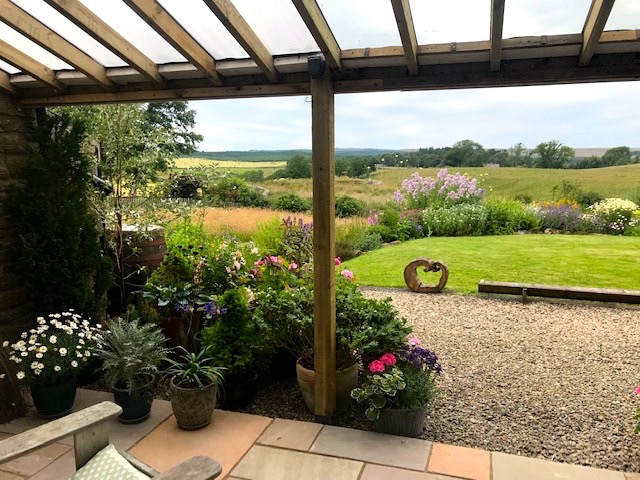
Sitting on the deck, reading or writing, I hear the whirr of wren wings as the parents nurture a second brood in their moss mounded nest high above the log stack. At the other end of the stone paved deck the second set of swallows swoop in to their mud thatch home in the rafters. We thought this pair was about to produce young but despite much coming and going and general twittering nothing’s happened so far. Do they go through the reproductive motions only to then prove barren I wonder?

Wren’s nest above log store

This year’s swallow babies, now in the avian stage of teenagerdom, have taken to hanging together out on the telephone wire running the length of the lane between us and Southridge. Our crew and the much larger kin group up at the farm number in excess of 30 juvenile birds. Insect activity is high, especially on humid windless days, and all our resident bird species – wagtail, wren, robin, dunnock, tits – are actively feasting and foraging on them, some to raise a second brood. From my study window I see the swallows beating the air in freeze frame, picking off the assorted bugs that get corralled under the glass pitched roof of the porch just feet across from their nest.

Delighted to spot the elegant shapes of willow warblers – delightful melodious summer visitors – insect hunting on the garden foliage. Even more delighted to eventually distinguish them from their near identical cousins, the chiff chaffs.

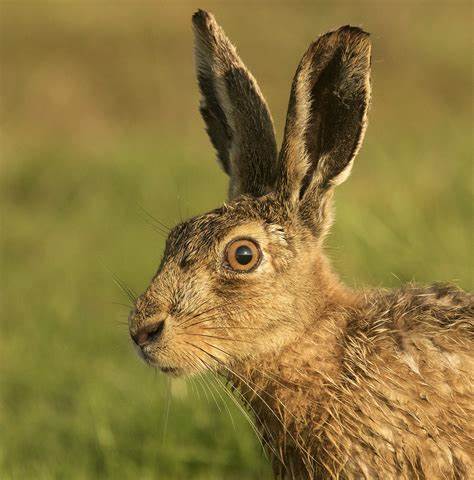
Another wild animal that likes what our summer garden has to offer is a brown hare. It turned up the other evening in the fading light, cautious yet fearless, making a leisurely circuit round the gravel paths and steps, sampling plants as it lopped along. Kim thinks it was probably responsible for dispatching some of the kale plugs she planted earlier in the season. That doesn’t stop us from being thrilled that it’s gracing our patch. Laden with symbolism in most human cultures, such a beautiful creature will be forgiven almost anything.
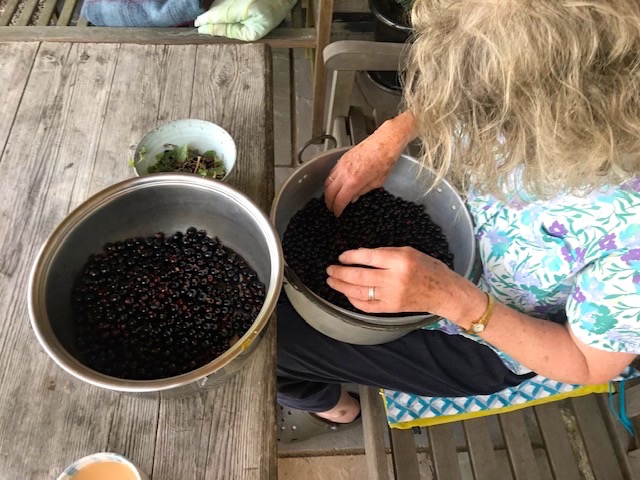

Any guest at the corner house this time of the year might well be invited to help pick a seemingly endless supply of fruit from the laden branches of our blackcurrant bushes. (If only we could get raspberries to thrive in the same way!) What isn’t turned into jam gets packed away in plastic bags for the freezer.

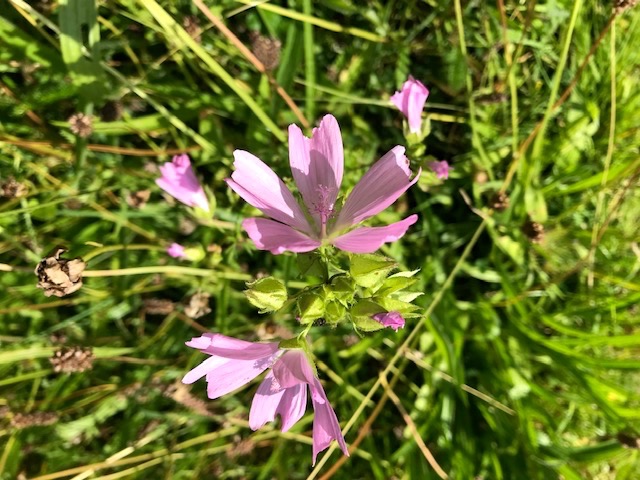
The meadow as it matures produces new flower species each year. Making a welcome debut in 2022 is that pretty wayside plant, musk mallow. More common in the drier south this plant originated from the shores of the Mediterranean. The French name for mallow is ‘mauve’ and is where the colour name came from.

Having the two youngest grandchildren (Max 7 & Lois 5) in residence with their mum for five days recently was lovely. Did lots of stuff together and got the two little Londoners that little bit closer to nature. A walk in the nearby woods, following the stream, worked a treat. Especially when we came upon scores of tiny froglets making their intrepid way across the path, hopping through the grass to reach water. 

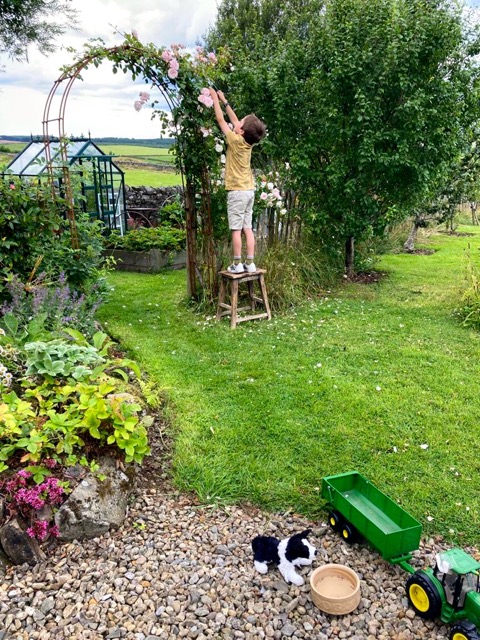
Another time I gave the children jobs to do in the garden (under close supervision) like lifting potatoes, deadheading spent roses or watering plants in pots. Hopefully this may give them both a taste for gardening in future…

Max adores his miniature version of ‘Floss’ while Lois has long been in love with Seymour and Henry and the two little ducklings that were Kim’s models for the picture book were never far from her side during the children’s stay with us.

Walk in the Woods

But most where trees are sending / Their breezy boughs on high / Or stooping low are lending / A shelter from the sky.

(From: ‘Moonlight, Summer Moonlight’ by Emily Bronte)

A favourite local walk threads through a mile and a half of mixed woodlands and riverside where Kielder Forest intersects with the rough upland pasture that surrounds it. I think of this as the Forestry Commission’s factory shop window. With nearly nine trees in ten being either a Sitka or Norway spruce, the vast bulk of the country’s biggest made forest does not invite entry for rest and recreation, but this delightful spot they’ve created always does, whatever the season. This week, during a rare spell of prolonged warm dry weather, it made for a fine cooling stroll with visiting family.

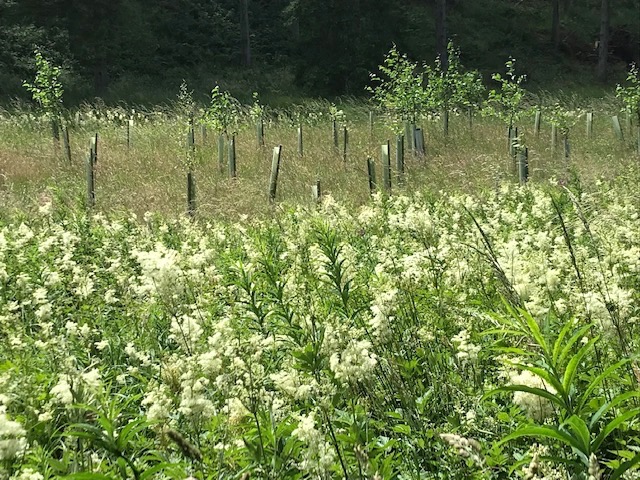
Youngest son Patrick is a chef at a Lake District gastro pub and pointed out as we passed a bank of it that Meadowsweet is as good a bet as elderflower to make a seasonal cordial from. Took the man at his word and the creamy blossoms picked were prepared immediately by him on returning home…And yes, it does indeed.

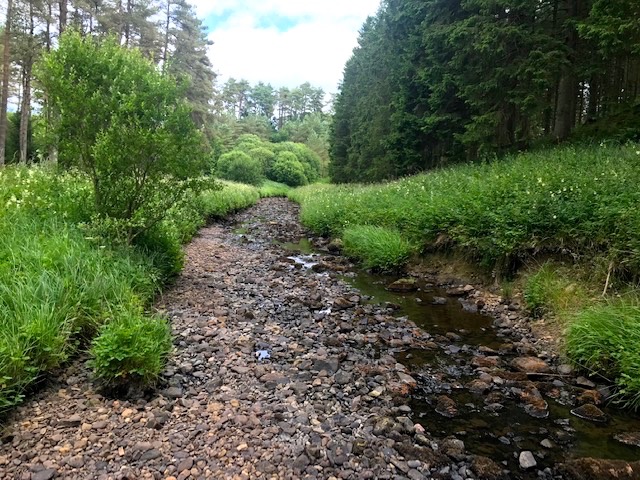
Shocked to find the normally fast flowing burn so perilously low and sluggish. We watched inch long salmon or brown trout fry (I’m not sure which species) as they darted through the stony shallows seeking shelter and food. The Tyne, of which this stream is a tributary, is currently the only English river in a stable state to support healthy salmon numbers.

This is partly due to major environmental improvements cleaning up the post-industrial river estuary and partly due to the well established salmon breeding centre by the north Tyne river headwaters in Kielder village. (A tourist attraction in itself). The centre releases many thousands of fry into the North and South Tyne river systems every year. Survival rates for game fish in the wild are low; only around 1 in 20 salmon and trout fry survive their first year of life.

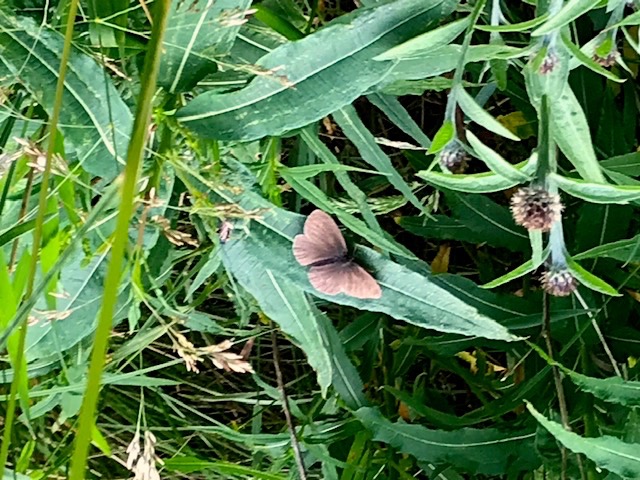
Flocks of goldfinches flicking through the lodge pole pines while the cool woods and wide rides at this point are alive with butterflies. Most of them were reluctant to settle, so unable to take a decent photo with my phone. However daughter Grace and I managed to ID a male Meadow Brown. This common butterfly feeds on grasses and loves this sort of environment. There were even greater numbers of ringlets on the wing. Giveaway dark velvety appearance with the halo fringe of white and the palest of dots on the wing in the one I eventually got a shot of when it finally alighted.
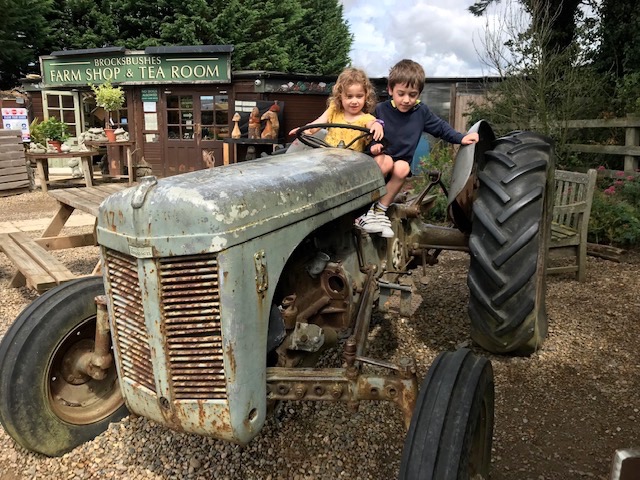
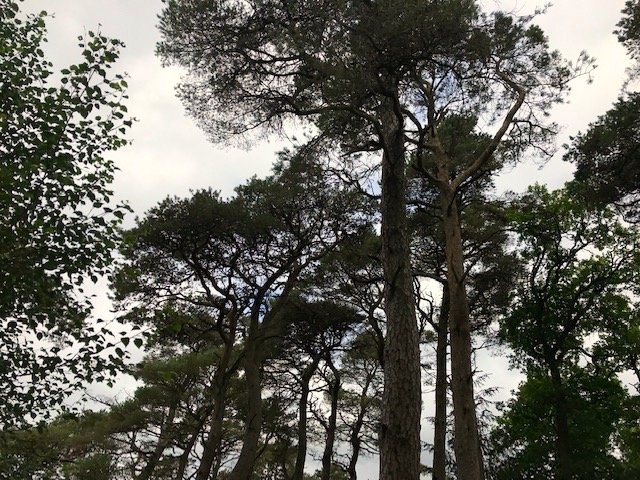
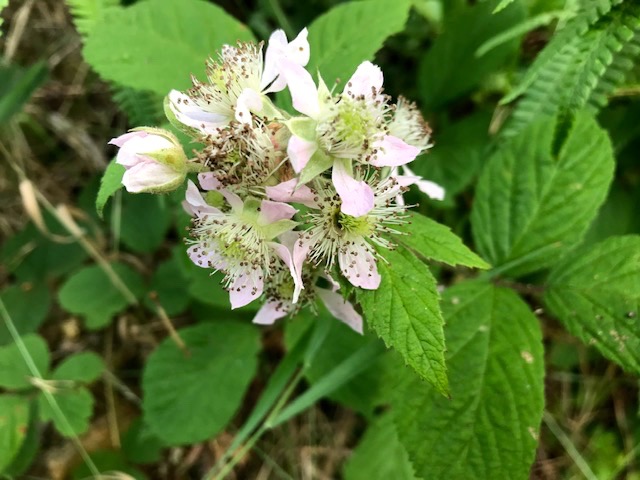
Both butterfly species love nectar rich brambles, of which there were a good supply here on the wooded slopes below the pines. I admire the subtle mauve colouring of the flowers and forget about the plant’s wounding barbs.

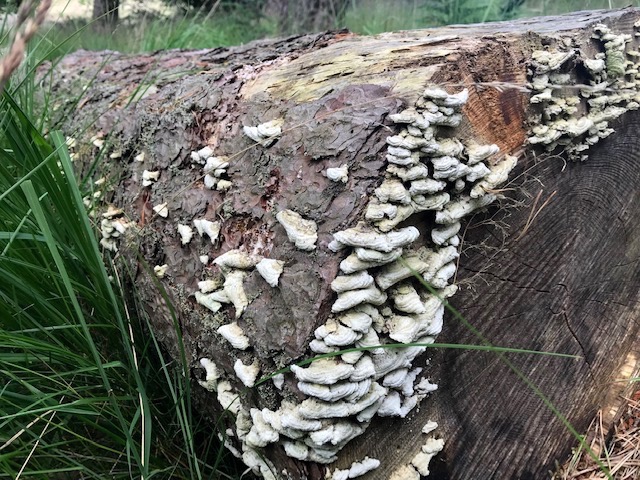
The forest is estimated to be home to half of England’s endangered red squirrel population and (as noted in ‘Red Alert’) it was here I last saw some in early January last year. No sightings now but always glad to see something striking, like this fungi working its way through a fallen tree trunk or a toppled shallow rooted conifer re-configuring the forest floor.

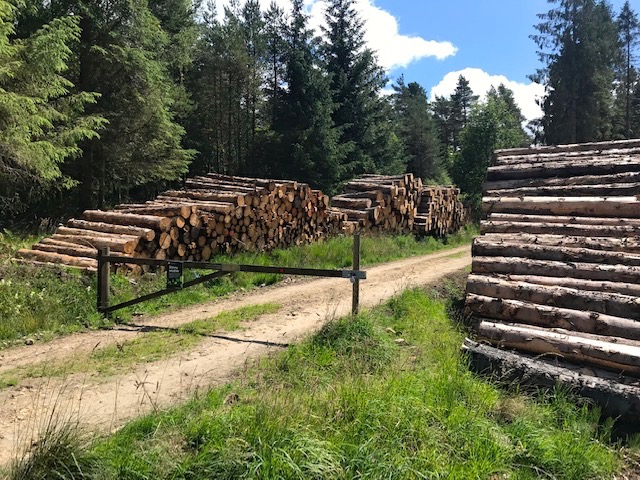
The winter storms brought down whole swathes of mature trees, causing a path diversion and the foresters have been gradually cutting and clearing masses of windblow timber on this site. Most is now stacked and ready to be loaded and driven off to be turned into chipboard, used as fuel for biomass or sliced up in saw mills.

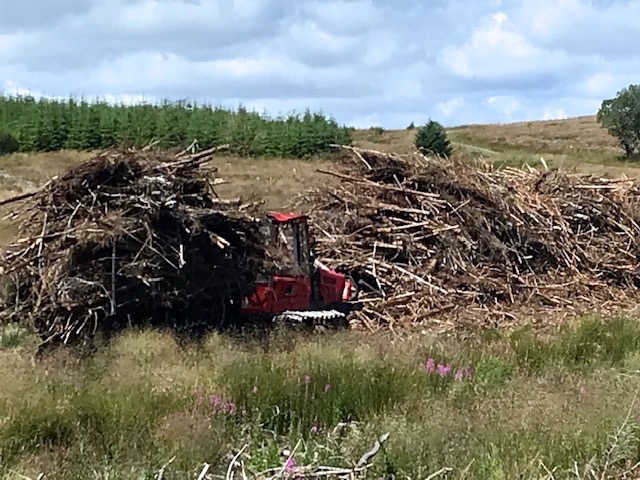
Across the narrow tarmacked lane a whole hillside was clear felled last year. Today we heard then saw a harvester on caterpillar tracks lifting and stashing a stout wall of brash and brushwood left in the wake of that clearance. They’ll be replanting soon and I’ll be interested to see whether it’ll be all spruce or a mix with deciduous and/or pine.

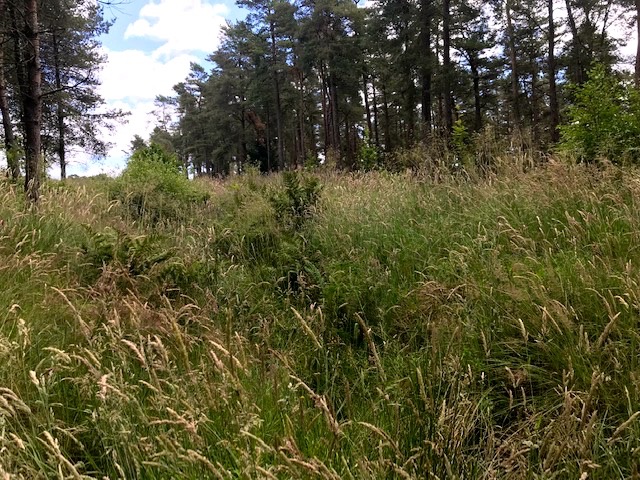
At one point the path crosses over, or rather through, a shallow bank and ditch, even less noticeable when filled with the flush of tall summer grasses. This is a section of what was once an ancient south to north earthwork known as the Black Dyke, which predates Hadrian’s Wall (where the dyke disappears as the Roman wall runs east to west across it). The earthwork is traceable from the junction of the Allen and South Tyne River to above the North Tyne between Bellingham and Tarset; a distance of approximately 13 miles. The planting of Kielder forest in the 20th century obliterated more, but here the course is clear, while elsewhere the dyke and bank have been incorporated into field boundaries or used as farm tracks and footpaths. It’s generally assumed – though cannot be proved for lack of evidence – the earthwork was originally intended as a boundary between neighbouring Iron Age tribes.

I was reminded of another ancient earthwork, the Giant’s Hedge in Cornwall, a section of which I ‘d walked last month. (see ‘Rail and Trail’ entry)

Hay Up

Through the ample open door of the peaceful country barn / A sunlit pasture field with cattle and horse feeding / And haze and vista, and the far horizon fading away. Walt Whitman: A Farm Picture

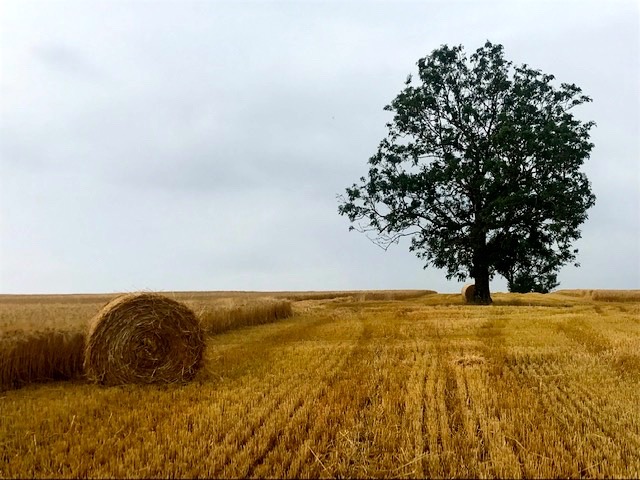
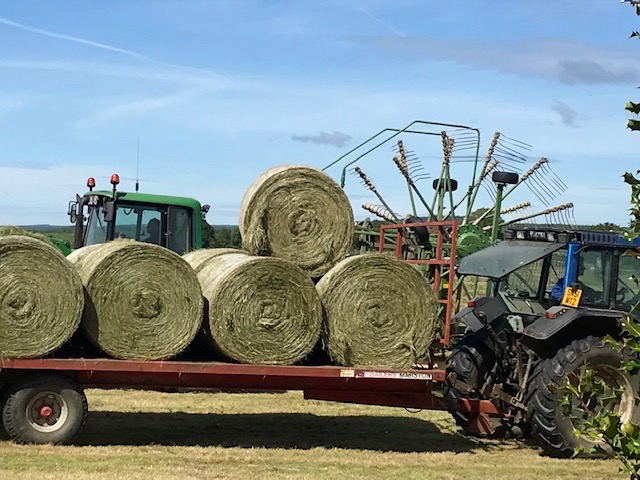
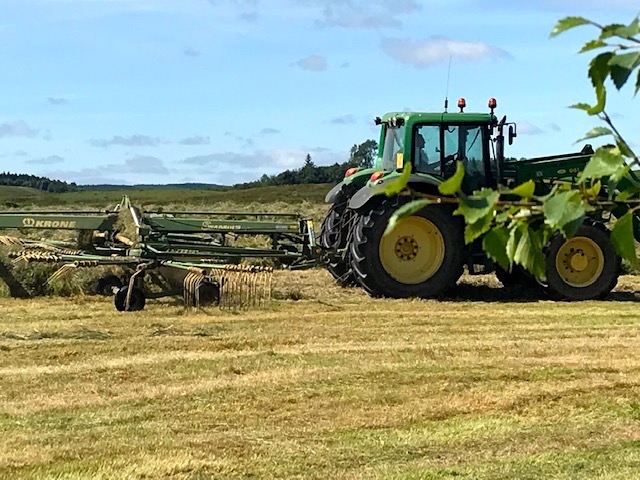
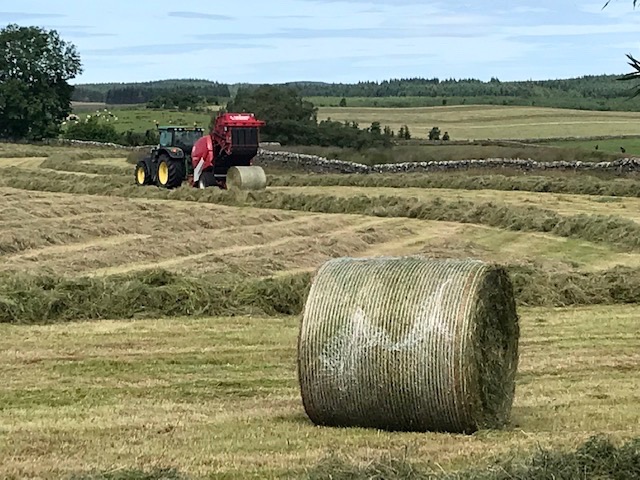
The summer heat wave has finally arrived, like a long awaited and keenly anticipated guest. Here in the far north of England we’re allowed to revel in its luxurious presence. House and garden are surrounded by fields and the lanes are busy with verge to verge fast moving machinery as farmers and contractors make proverbial hay while the sun shines.

Our neighbouring big meadow was finally cut and turned mid week and on Saturday morning the same contractors returned for part two. First the rowing up with tractor and tedder (machinery that can both spread and ‘row up’ cut hay), soon joined by the tractor with baler and finally a tractor hauled long flat bed trailer makes an appearance with another tractor whose hydraulic forks lift and load the round bales that the baler has just dropped. The whole exercise is fabulously efficient and as skilfully and gracefully executed as a piece of dance theatre.

I make little videos of each stage of process to WhatsApp for viewing by the youngest grandchildren, Max (7) and Lois (5) at home in London who love all things mechanical in action; from cranes to trains to agricultural kit. I did the same last year so this is probably old hat to them now, but I hope they like to be reminded of these classic countryside scenes none the less.

Eldest grandson Joe (18) has, to our delight, opted for a career in farming. We fixed him up for initial work experience with two of our neighbours last year and he’s gained a place at Newcastle University to study agriculture, starting this Autumn. Earlier this Summer he did a two day tractor driving course near his home in the Scottish Borders so in a few years time, who knows, maybe it will be Joe driving one of those tractors in a field near us at hay time!

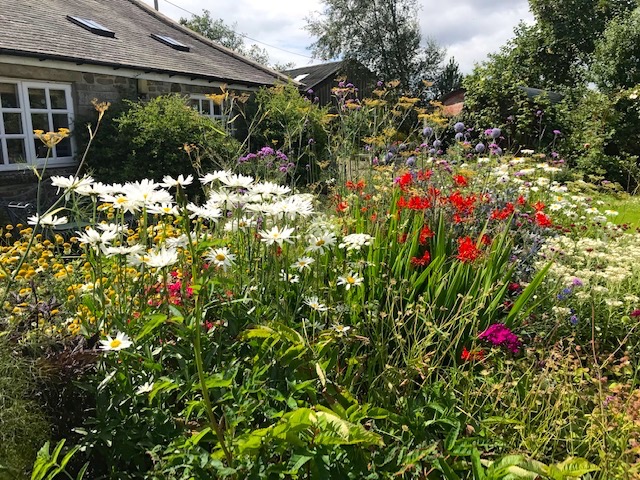
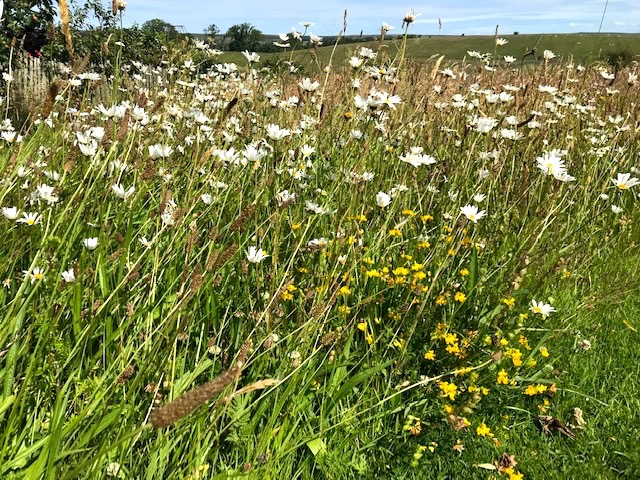
The garden meadow has produced a flush of oxeye daisies where none flowered before. It was a bordering metre wide strip I’d scarified in previous years so chances of seed taking were greatly increased. Still surprised me though as it took a couple of years for them to finally flower there. Meanwhile the yellow rattle, now spreading freely of its own accord without me needing to reseed by hand, is colonising large patches of grass and consequently reducing the height and density of the sward so that next year, with any luck, other more delicate meadow plants should be able to join the floral cast on display. The pretty yellow flowers have now mostly died away to brown seed pods, whose characteristic rattle give the plant its common name.

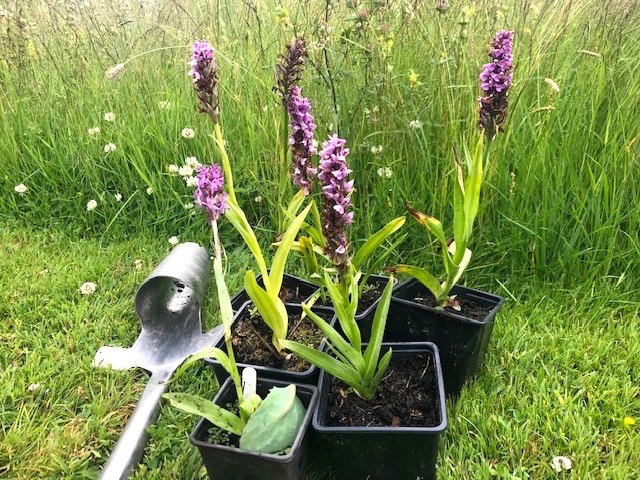
The common orchids bought at a local nursery’s closing down sale last summer, re-planted as plugs in the meadow borders have, to my great delight, taken and spread. Having a clump of birds foot trefoil making a debut in the most intensively prepared top triangle of meadow made me very happy too. I hope it too colonises next year. And that, in essence, is the joy of any meadow a gardener creates. You never know what will happen year on year as the character changes with the appearance of different plants, whether deliberately planted or opportunistic arrivals.

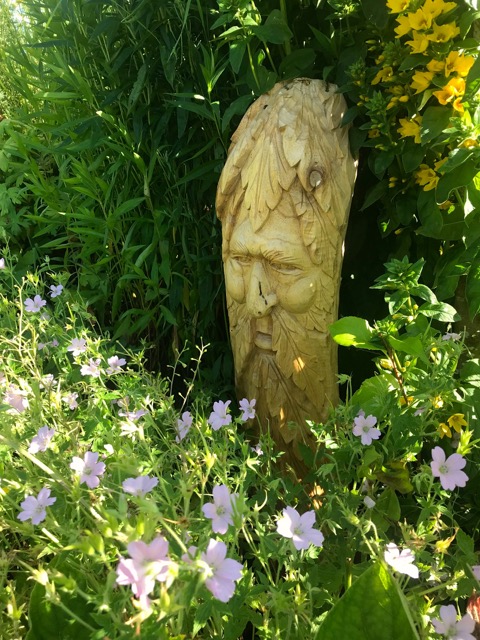
I’ve a soft spot for that recurring symbol of pre Christian paganism, the green man. While walking the main thoroughfare out of Polperro when we were back in Cornwall  last month I discovered the workshop of a local woodcarver and bought one of his green man imaginings fashioned from a curving flank of ashwood, to station in our garden back home. Lots of places it could go but for now it has residence in the lush flower and shrub beds of the bank border. I hope it will be happy there, keeping an eye on the landscape.

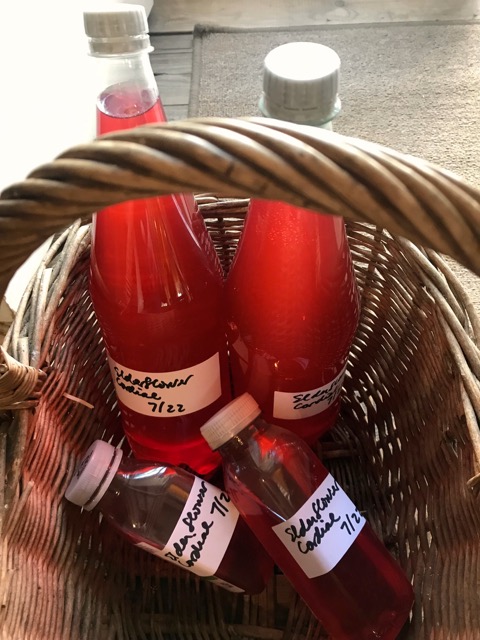
I love gathering heads of elderflower from our garden trees for Kim to make cordial. Particularly like the blossoms of our single black elder which yield a beautiful deep pink cordial. Some we’ll have over the coming weeks while the rest (decanted in plastic bottles) goes to the freezer to re-conjure the scent of summer in winter.

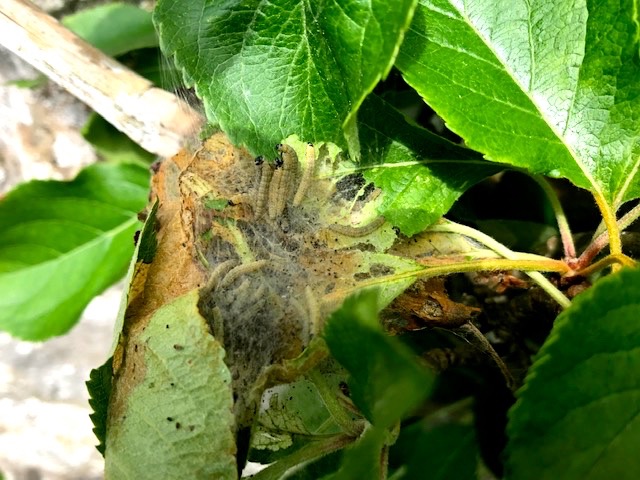
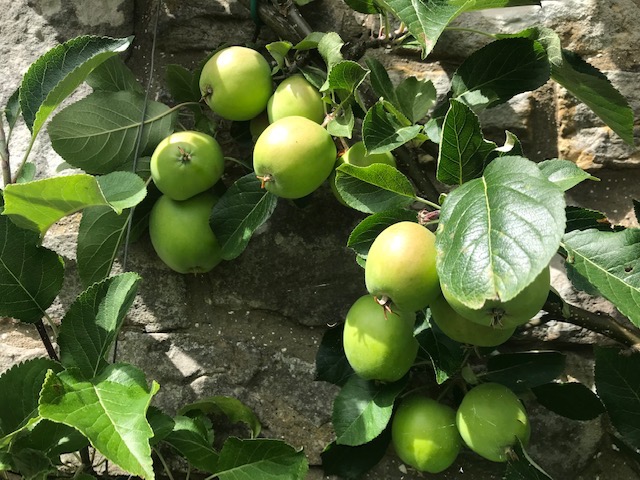
We’ve caterpillar tent moths camping out on the apple fans for the first time this year. Going round removing them whole by hand eased the problem and reduced chances of the caterpillars devastating leaves and buds. All the apple varieties doing well and the fruit beginning to swell. The James Grieve, the oldest established and most productive of the fan varieties on our south facing wall, doing particularly well.

Two swallow pairs nested this year and one couple are currently sitting on a second brood we suspect, having built a second nest. I guess they have the time to do so, but why bother I wonder? Unless, of course, they’re not the same parents. I say this because the pair that set up shop in our open fronted garden shed (the old railway goods wagon chassis) seem not to have bred there successfully. After initial nest building flights in and out seemed to cease I found a dessicated newly hatched dead nestling on the ground beneath their nest there. There was also a lot of intense chirruping and chasing agro a few weeks back between adults in and around the traditional open porch area where the first pair nested. It could be that the second duo have forced their way in from the old hut to what is clearly the more favoured location. Only a team of ornithologists working with ringed birds could tell if my theory is true!

Swallow flight path…Nests and night roosts are above this viewpoint

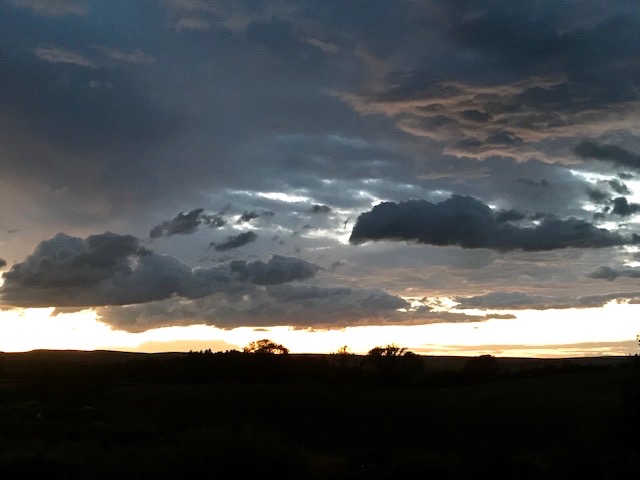
Northumberland skies are the gift that keeps on giving. Sunsets crown the darkened uplands in spectacular fashion with an infinite variety of clouds forms, while daytime scenes remind us just how busy the skies are with summer flights, as plane vapour trails dissolve in the azure of a near cloudless sky.

Moor to Sea

Third leg of our west country odyssey spent in the highly entertaining company of our old friend Michael, staying over at his home at Landkey near Barnstaple.

Michael’s low beamed cob walled cottage faces directly onto the road at the front but out back a long narrow garden stretches gently down to a footbridge that crosses the leat which once powered the village’s old sawmill three doors down. This leads to an attractive stream, wavering with weed and water crows foot, forming a boundary with pastures the other side frequented by sheep and rabbits.

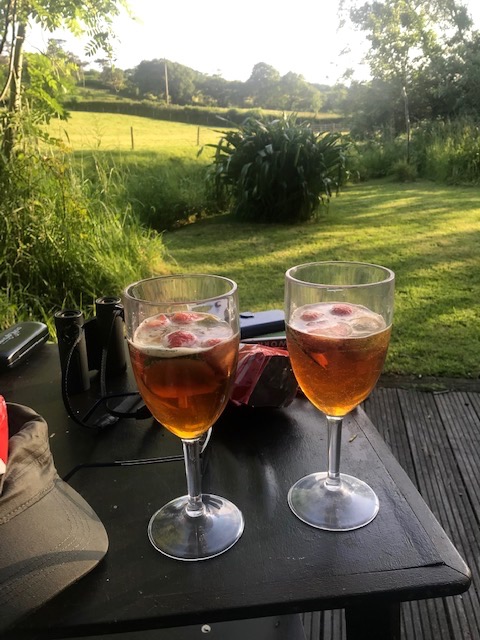
Luckily the bunnies aren’t inclined to cross the watery barrier so the small patches of produce Michael grows on what is effectively an island are not unduly threatened. This quiet secluded spot also has apple trees set in a mini-meadow and is the perfect spot to relax with a Pimm’s on a sunny afternoon!

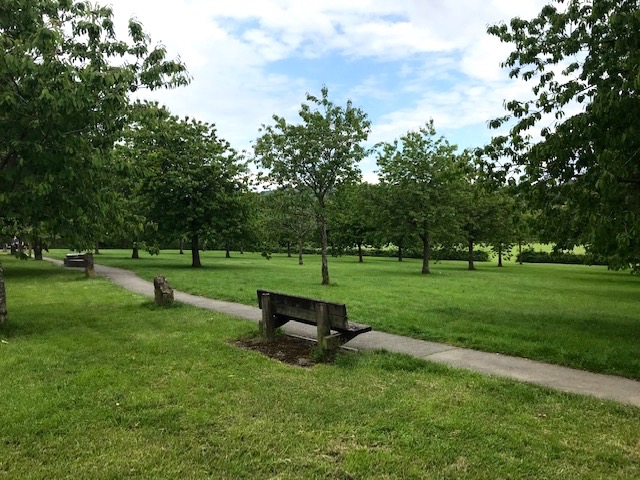
We took a stroll around the lovely Millenium Green, in the creation of which Michael played a key role and is chairman of the charitable trust set up to plant and maintain its local distinctiveness. Mazzards are cherries peculiar to north Devon, first recorded in the 16th Century and a commercial crop in these parts until WW2. The flowering season draws sightseers to admire the mass of stunning blossom.  The green (orchard) has become a source of great pride to the villagers.

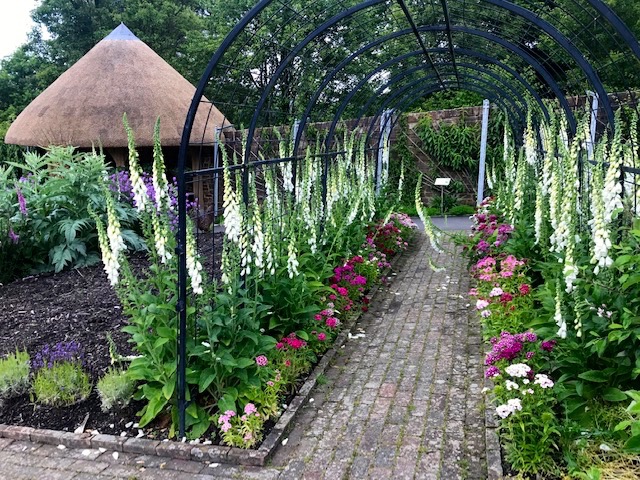
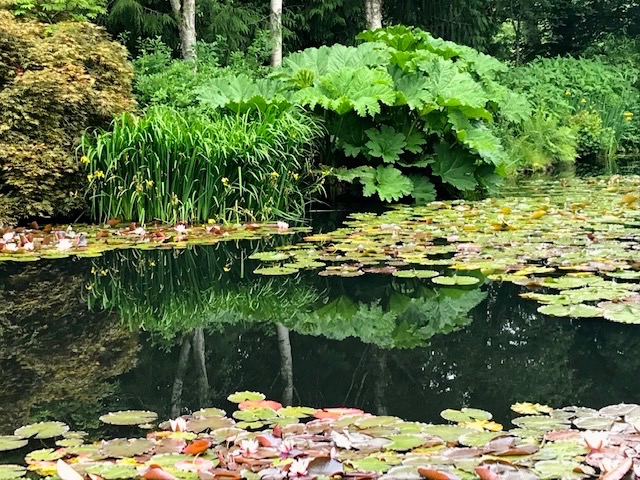
A return trip to RHS Rosemoor in the Torridge valley is always a pleasure. Love the wonderfully varied well curated horticultural environments. Each leads artfully one to another, and are full of interest, whatever the season. Am especially drawn to the rise of meadow field, damp stream side, generous ponds, orchards of regional apple varieties and classic cottage garden…No doubt subconsciously seeking further inspiration and making comparisons to home.

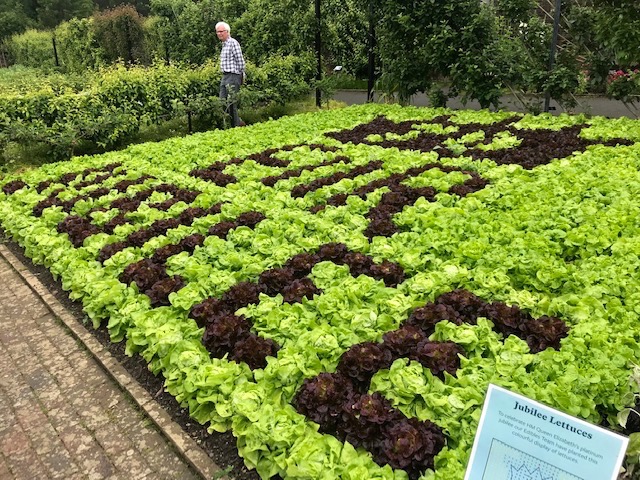
Visiting over the platinum jubilee holiday so amused to encounter this neat and witty leafy tribute to HM The Queen from the gardening crew…

Next day Michael gave us a whistle stop tour of Lynton and Lynmouth in the car, so we could get our bearings. Climbing out of the super steep valley of the Lyn River on the A39 we came up to the hamlet of Countisbury on Exmoor.

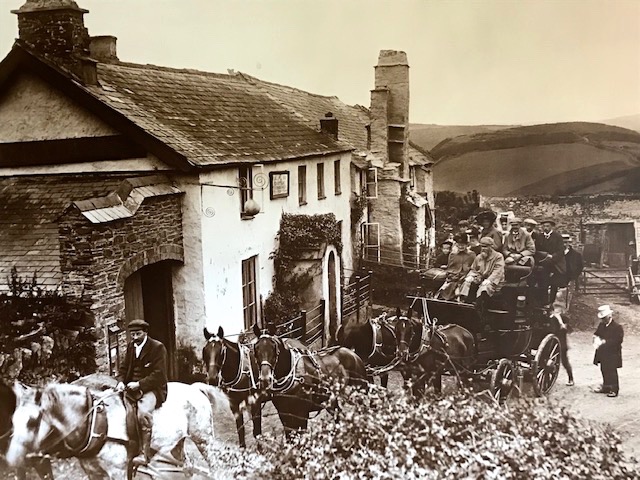
Parked at the Blue Ball Inn, a Grade II listed building dating from the 17th century, and clearly popular with visitors down the years as this wonderful photo from late Victorian times shows. We returned for an outside lunch here after a walk round Countisbury Head, which is in the care of the National Trust.

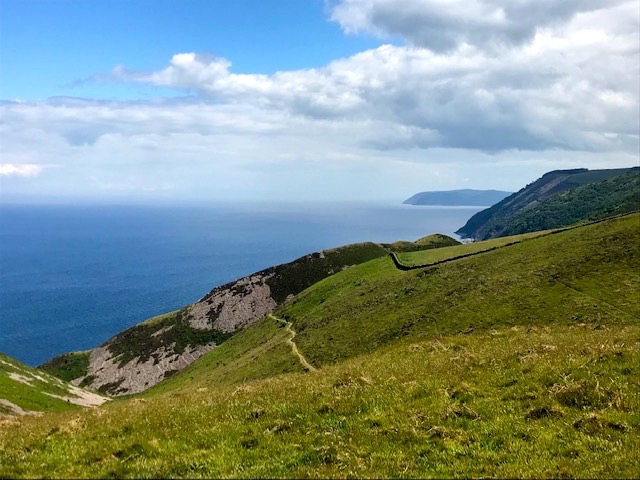
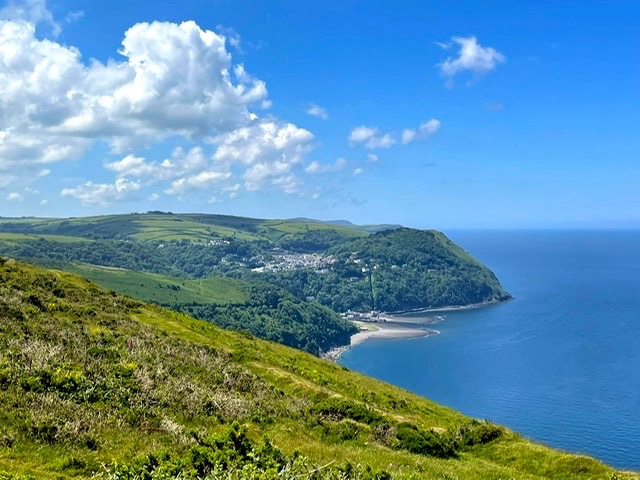
At nearly 1,000 feet this is the highest point on the whole south-west Coastal path, and not to be traversed if you’ve no head for heights. We were blessed with good weather to enjoy fabulous vistas up along the Somerset coast eastward (above) or looking back along the Devon coast westward (below) while across the Bristol Channel the extensive expanse of South Wales clearly presented itself, from Glamorgan to Pembrokeshire. The imposing mass of Exmoor too looked stunning seen from the television mast on the high point that commands a 360 degree sweep over valleys hills and sea.

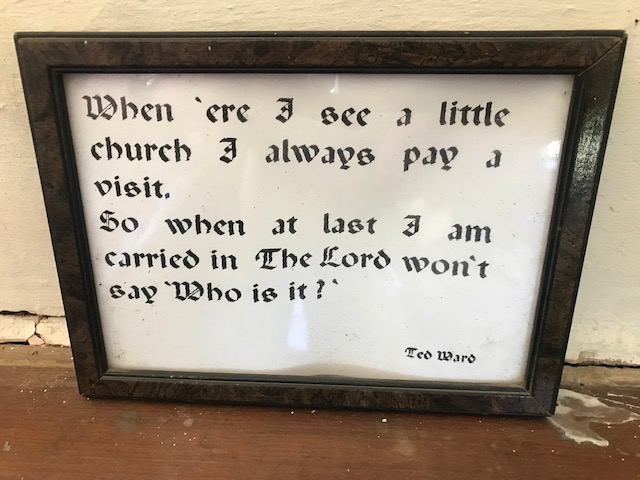
Countisbury’s name is deprived from the old English Cune + Burgh meaning camp on the headland and it was here that the Saxons defeated a Danish invading force in AD878. The little parish church of St John the Evangelist, tucked into the hillside with its graveyard just above the pub car park, was a modest but charming old place and we particularly liked this sign by the alms box.

Linhay, Tallet and Barn

Tom and I have been friends since our secondary school days in Devon in the 1960’s. Have known his wonderful wife Janet since they were married and in recent years they’ve become firm friends with Kim too, cemented by their mutual understanding and shared vocation as hill farmers. A trip back to the western flanks of Dartmoor is not complete if we don’t meet up. Nothing quite matches a traditional farmhouse lunch where the lamb is home produced and beats anything you’d ever sample at the finest restaurant for flavour and texture.

Kim’s stone litho print of a pair of Blue faced Leicester tups has a special place on the farmhouse kitchen wall, as our friends keep rams of this breed themselves.

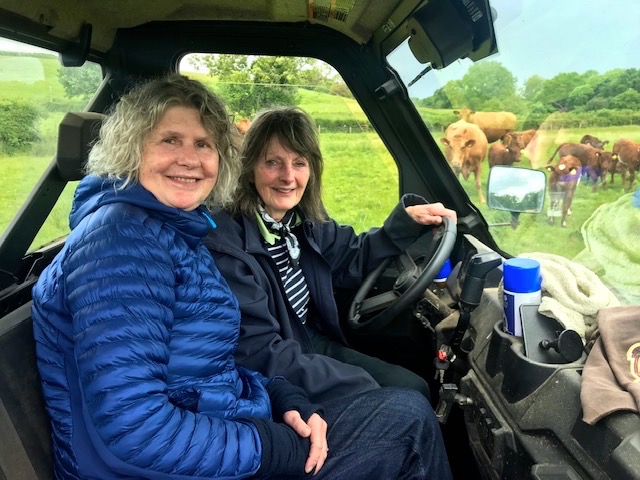
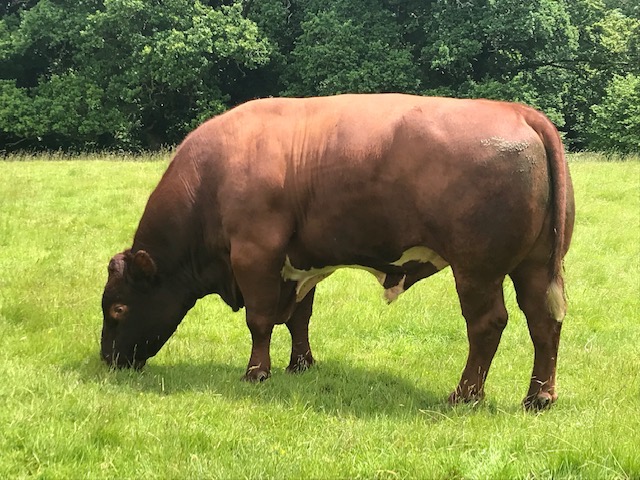
Before Tom could get back to join us for that exquisite lunch Janet had invited us to join here in the all terrain vehicle on a jaunt down the lanes to their riverside pastures for an inspection of their herd of South Devon cows with calves at foot. The sire, a pedigree Beef Shorthorn bull – informally dubbed Anthony – was beached recumbent on the sward. Janet got out to give him a firm but gentle poke so he’d heave himself up and walk on a few yards before resuming his rest. That way she’d know he was in good working order with no mobility problems.

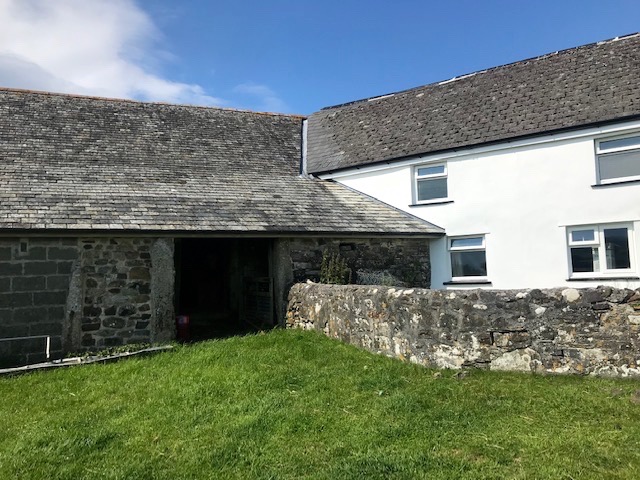
After a great catch up conversation over lunch we stepped out again, pausing to admire the terrace of house martin dwellings under the eaves before a trip down to the track to the original farmstead over the brow. The new farmhouse where our friends live is a Duke of Bedford model farm dating from the 1850’s. Tom’s forebears were the Duke’s tenants, who’d come up from Cornwall to run this then state of the art agricultural holding. The new structures superceded the old longhouse style dwelling, partly embedded into the field beyond, and connected at right angles to its barn.

Following the passing of Tom’s parents, who had retired here when management passed down the line, the old farmhouse has been undergoing a gradual programme of repair and refurbishment to bring it up to modern standards. The barn, which qualified for heritage grant aid, has been beautifully restored to peak condition. Renewed lime mortar re-pointing and electrical wiring has allowed installation of interior strip lighting to greatly improve working conditions for lambing and other routine tasks.

The old barn has been expertly re-roofed in a traditional ‘graduated’ style where the slates vary in length and width, with the larger slates closer to the eaves and the smaller ones closer to the top of the roof. This style was developed in the days when local quarries produced slate on an ‘as available’ basis, rather than in specific sizes, which required the roofer to sort the slates by hand when they arrived on the job site. By laying the longest and widest slates at the eaves, where they carry the most water, and ‘graduating’ to several other lengths closer to the top, water is more effectively diverted away from the building. A properly constructed graduated slate roof like this one shows no obvious disconnect between the different sizes of slates used as the eye moves up the roof.

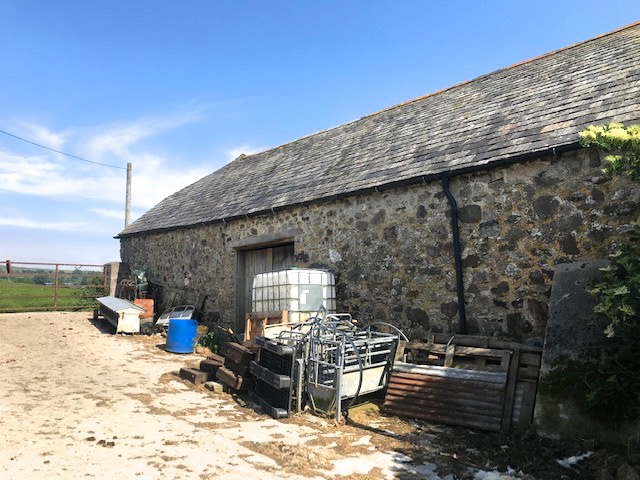
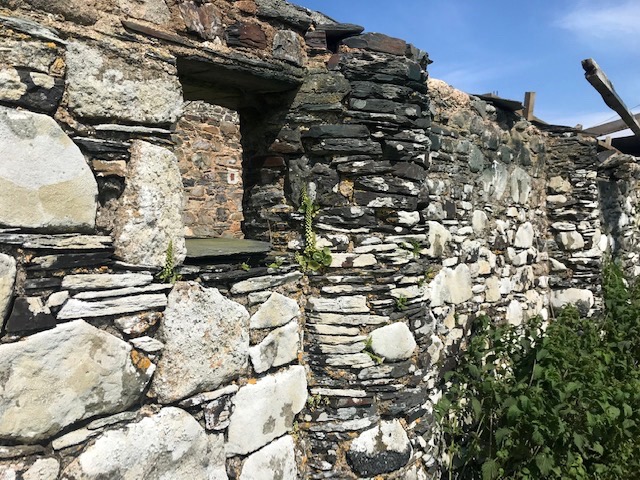
The winter storms had ripped the rusted corrugated roof from its moorings on a shed set into the lower side of the yard across from house and barn. Looking more closely at this much altered rectangular building my attention was drawn to some curious features. Small square windows and, more strikingly, regularly spaced stone pillars set within the oldest looking wall. Presumably the pillars preceded the wall, indicating an open structure and a load bearing capacity. So why this feature, and what was the original function? Did some research in my friend Michael Gee’s library at our next port of call in north Devon and was able to get back to my friends with what I’d discovered.

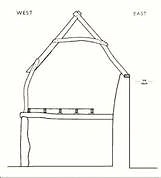
Their humble building must originally have been a linhay and tallet. These were once common in Devon and Somerset but today you’d be hard put to find one in anything like its original condition. (As with many redundant old farm buildings they have been converted into attractive holiday accommodation). A linhay is a two storey open fronted building that housed cattle through the winter months with a tallet, or hayloft, above. First recorded in the 17th Century they went on being built well into the 19th so they clearly served a very practical purpose. Today large prefabricated metal and wood farm sheds sheltering bigger numbers of livestock have dispensed with such structures. The true original Linhay had circular wood or stone piers (either granite or mortared stone) at the front with no internal divisions within; examples varying from one to eighteen bays in length. (Each bay being approx. 8 – 10 feet square. The tallet, normally constructed of wood and 6-8 feet above ground level, with the eaves of the double pitched roof some 4-6 feet above that). Hay could be easily loaded from a cart drawn up alongside and conveyed to the animals housed beneath through the winter. An added advantage was that hay provided extra insulation for the stock below. In some farms the linhay was adapted to garage carts when not used for cattle.

Here’s an example on a farm at Holwell, mid Devon, which has had wall infill for the linhay part and whose pillars stretch right to the top of the tallet section.

Barbican

The outer defence of a castle or walled city, especially a double tower above a gate or drawbridge. Usually barbicans were situated outside the main line of defence and connected with the city walls with a walled road called a ‘neck’.

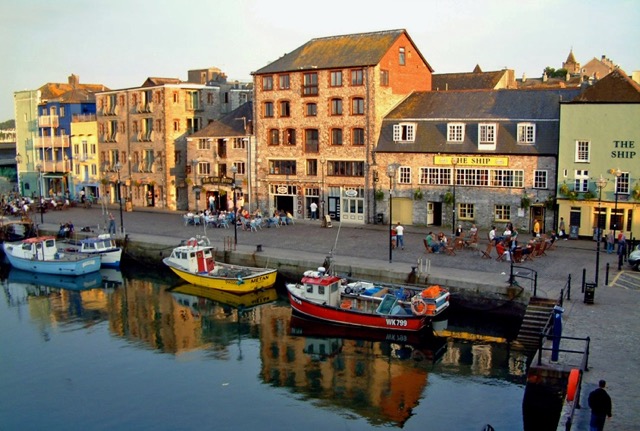
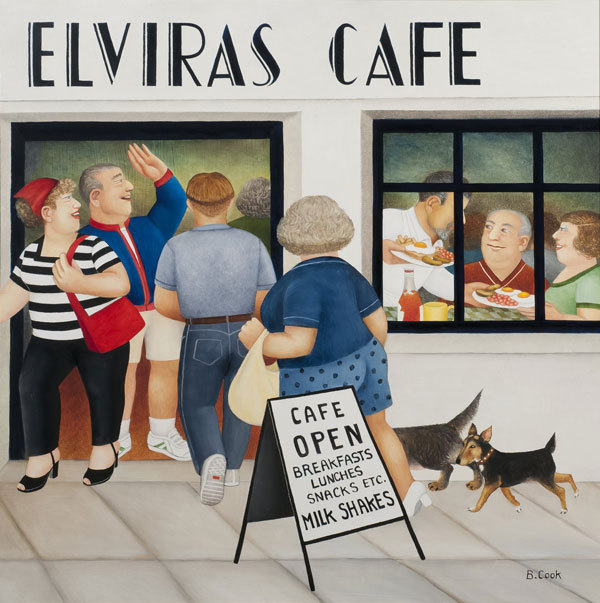
A day trip to Plymouth, car free, thanks to the Looe to Liskeard rail connection. I remember the odd brief visit to the Barbican, many years apart when it was a more workaday waterfront environment rather than the leisure and cultural destination it has now become. That spirit was captured in the exuberant life affirming paintings of local landlady and self taught artist Beryl Cook (1926-2008). Victoria Wood memorably described her hugely popular and instantly recognisable work as ‘Rubens with jokes’.

This is the historic heart of the settlement that grew to be known as Plymouth and the C14th castle on the hill the Barbican led to only exists as a fragment today. The modern day harbour walls are crammed with commemorative plaques, most famously the one recording the sailing of the Mayflower for America in 1620. Over the road that leads to the hoe and its outstanding views, the great grey cliff like bastions of the Royal Citadel, built in the wake of the civil war and still a military base, marks one boundary of this eclectic maze of narrow cobbled streets where post war social housing rubs shoulders with expensive penthouses. Today the harbour is chock full of yachts moored at pontoons while the old Victorian fish quay has become home to a variety of eateries and artisan outlets. The new quay, relocated across Sutton harbour, thrives as a major landing and market for the commercial fishing community and the neighbouring national aquarium draws the crowds .

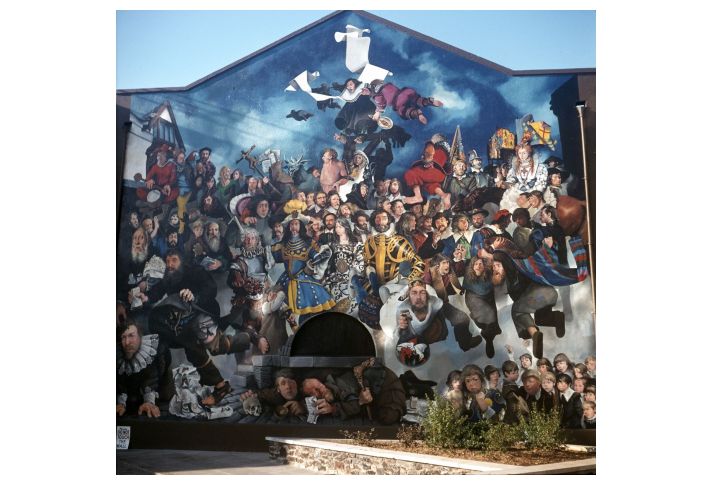
I’d recalled from my youth the astonishing mural produced by that other famous Barbican artist and resident, Robert Lenkiewicz (1941-2002). Eventually rediscovered his ‘Everyone is Welcome’ old studio and, on its end wall, the now ghosted and crumbling 300 square foot mural. Created with such verve 50 years ago, and fusing art and life in using local people as his models, it celebrates the metaphysics of the English Renaissance and the Barbican’s role as a dynamic mercantile powerhouse at that time c. 1580-1620. Here’s an online re-coloured version. More at: https://www.robertlenkiewicz.org/

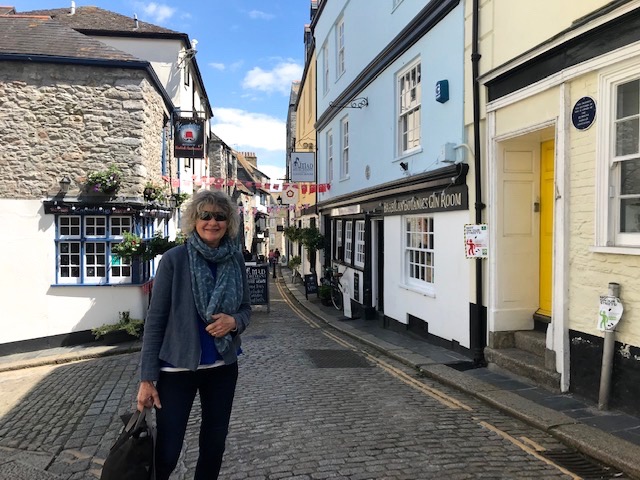
The Barbican’s Southside Street leads one way traffic into what is billed as the largest concentration of cobblestoned streets to be found anywhere in the country. Sitting out on the pavement of the busy narrow thoroughfare over a coffee we watched as a lorry driver halted and man managed all traffic for nearly ten minutes so he could, deftly as any athlete, unload and deliver two pallets worth of goods to one of the many art and craft galleries here

There are some 200 listed buildings in the Barbican, many of them only existing today thanks to bodies like the Plymouth Barbican Trust (PBT) formed in 1957. No 32 New Street has been a museum since being saved from demolition by a big public campaign in the 1930’s and has recently been extensively renovated and given new visitor facilities by the city council. In descending its three wooden floors we discovered a history reflecting that of the neighbourhood at large. Built by a local merchant adventurer in the 1580’s (when the street actually was new) the house was subdivided in the 18th with a wigmaker occupying the middle floor. As the middle classes left to the suburbs in the 19th century the lower floor had a through passage added and rooms were given over to multi-occupation. A female sex worker’s story is told here. The Elizabethan house, like others in New Street, recycles a ships mast as newel post, around which the steep stairs wind, extending through to the loft.

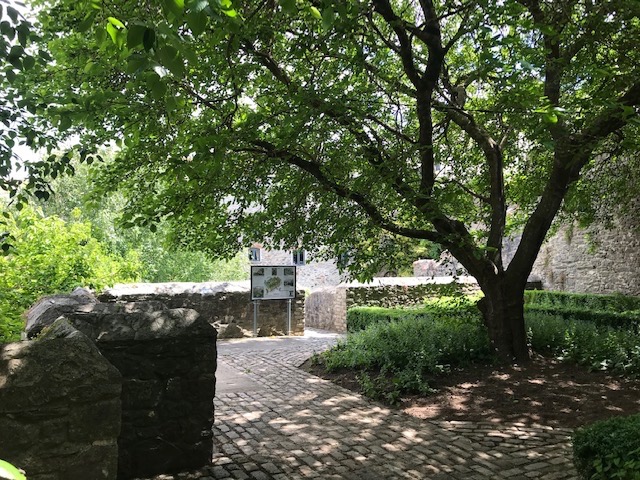
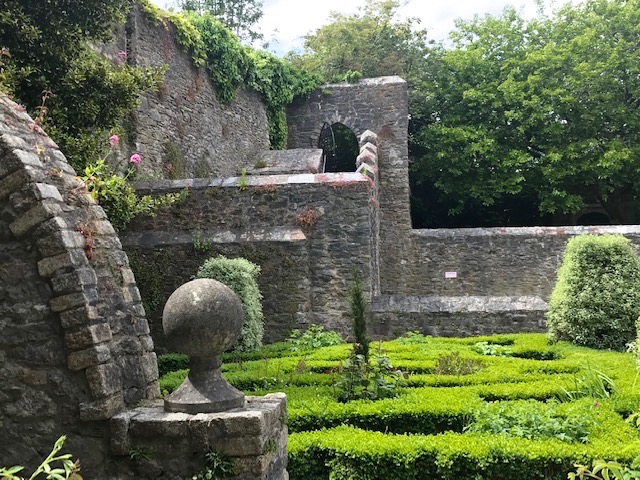
The biggest surprise was an attraction I never knew existed until this day. The Elizabethan Garden is actually a recreation of garden designs from the C17th and is a PBT initiative dating from 1970, set behind the New Street properties where once cottages had stood, cleared as slums in the last century, and can only be accessed by a narrow side passage & steps. We were entranced by the garden’s specimen black mulberry tree, the boxwood knot garden, gravelled paths and cool fountain. An inscribed slab lists all those who sailed in the Mayflower and a stone replica of the ship is set in an arch.

The contrast of formalised greenery with walls of grey marble stones was striking. A welcome peaceful haven stepped back from the heart of the old town, overlooking the long narrow gardens of New Street’s cafe bars with their shaded outdoor seating. (proved ideal for a laid back lunch, al fresco).

Despite the old city centre being largely destroyed in WW2 and the naval dockyards badly damaged the Barbican itself survived relatively unscathed and now seems to embrace yet another social and cultural role for the 21st century.  

Rail and Trail

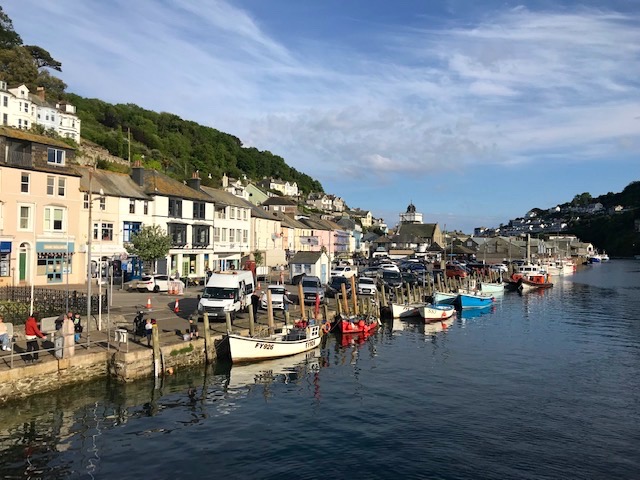
East Looe Quayside

Enjoyed a recent family holiday back in the home country. There were outings we took together, like a return visit to the Lost Gardens of Heligan and to the picture book perfect village of Polperro and ones I took on my own to indulge twin loves exploring the countryside on foot and by rail. This holiday offered the opportunity to do both, on the same day!

An affordable summer trip to the seaside for working class families, when I was a boy growing up in west Devon, was a coach trip over the border to Looe. The narrow winding streets of the old fishing port were thronged with visitors then, as indeed it is now. I recall a crowded beach with legions of deck chairs with boat trips fishing for shark especially popular with the menfolk vying to land the biggest catch. Today we saw no deck chairs anywhere on the beach and the resort prides itself on its shark conservation programme.

Our rented cottage in West Looe gave a fantastic view over the confluence of the east and west rivers in their respective sunken river valleys, or ‘rias’. The conjoined Looe river is relatively shallow and fast flowing, sparkling clear, green with waving weed, hundreds of small boats moored on it and bustling extended harboursides to east and west. Sitting out on our veranda, we could see the two carriage trains arrive and depart along the riverbank embankment, appearing from this distance like a model train set. Dating from 1860, the former mineral line was built to replace a canal carrying quarried granite and other produce for export with fish, lime and other imports coming inland. The line was extended in 1901 via a steeply inclined horseshoe loop which finally connected it to the main line at Liskeard. Looe then became the main seaside resort for nearby Plymouth. Housing to accommodate a rapidly expanded population pushed the ancient town’s boundaries up the steep hillsides, linked by flights of steep steps and lanes. It was in one of those former artisan dwellings we were staying.

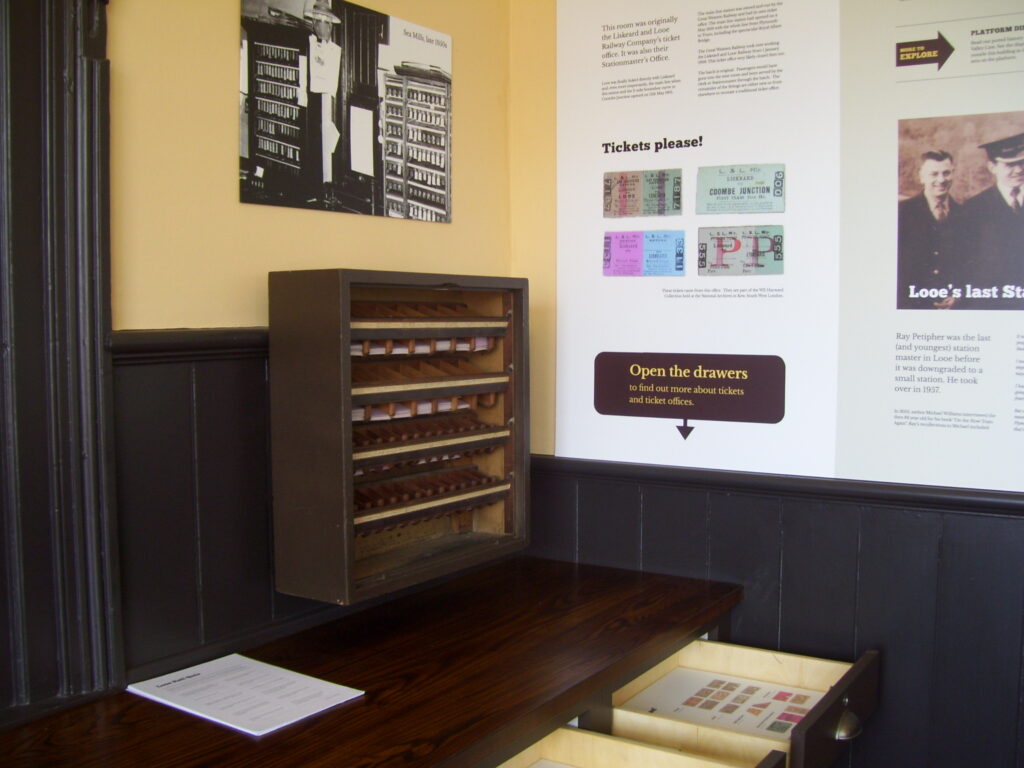
Liskeard Station Terminus of the Looe Valley Line: Part of the Museum

The sweeping Beeching cuts of the 1960’s proposed closure of the Looe branch. Only the last minute intervention of Transport Minister Barbara Castle overrode that terrible decision and the line is once again thriving, with passenger numbers doubling in the 21st century. The three stations the track passes through are all request stops. One has what is possibly the most charming station name in the country: ‘St Keyne Wishing Well’. Along with Causland and Sandplace halts it is well maintained by the community rail partnership that manages the line today.

The line is better loved and much improved since the early 1980’s when it was in a sorry state due to under funding and general neglect. I was last here in 1982 undertaking my first TV film role. A 30’ contemporary paranormal drama entitled ‘The Beast’, one of six ‘West Country Tales’ produced by BBC South West, directed by John King (Father of naturalist & broadcaster Simon King). The narrator, also a character in the story, is seen travelling the line in the opening sequence. I wince today when revisiting my own performance as a hapless husband and householder who becomes the beast’s victim. There is a (poor quality) copy on You Tube.

The temperate rainforest of the East Looe River is a delight to travel through by train and the conductor was busy taking fares and dealing with passenger enquiries while also being responsible for working the points at Combe Junction while the driver swops ends. The train then reverses and revs its way out of the valley bottom, up onto the steepest of engine straining inclines, hedge greenery swirling in its wake, to slide under the high arches of the main line viaduct and through concrete tunnels below the A38 to emerge into the restored and well maintained terminus at Liskeard. There, an ace museum in the original waiting room and booking hall tells the line’s fascinating history. More at: https://dcrp.org.uk/category/looe-valley-line/

Jack the Giant, having nothing to do / Built a hedge from Lerryn to Looe’

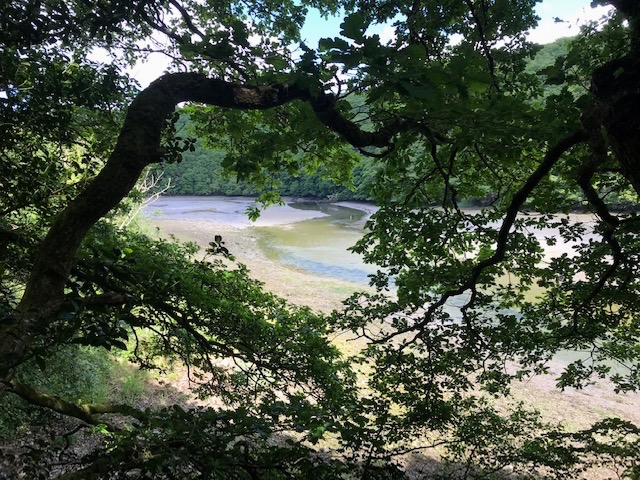
Despite the temptation to start a walk at one of the rail halts I opted instead to take my country stroll on foot from the holiday home. Circumnavigating the huge visitor car park next where the town’s old boat building yard stood by the confluence of the rivers, to Kilminorth Woods. Everything changed as I was immersed in the cool quiet of its shady green groves stretching from estuary to hilltop. Below me, where oak boughs daily touch high tides, little egrets were quartering the esturial mudflats joined by a scattering of crows. Kilminorth is now an official nature reserve and the biggest area of semi-natural deciduous woodland in Cornwall. Commercially worked for at least four hundred years this varied woodland was a rich source of sustainable timber for a whole range of construction, agricultural and boat building uses.

At some point in the 6th Century local chieftains had built a nine mile tribal boundary wall and ditch in the west Looe valley and large sections of this remarkable structure remain today in the wood that it probably preceded. Today the roots of invasive trees have altered the nature and appearance of this of the stone flanked earth bank but it remains an impressive landscape feature.  

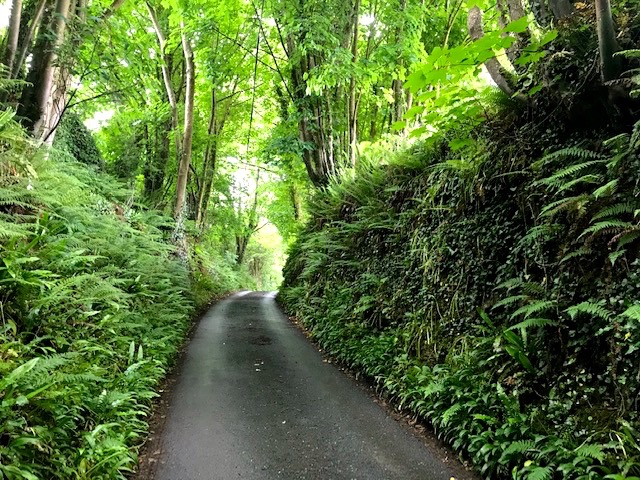
I emerged from the woodland to continue uphill along a narrow sunken lane dense with ferns, mosses and other damp loving plants typical of this precious topography; an increasingly fragile one as our climate changes. 

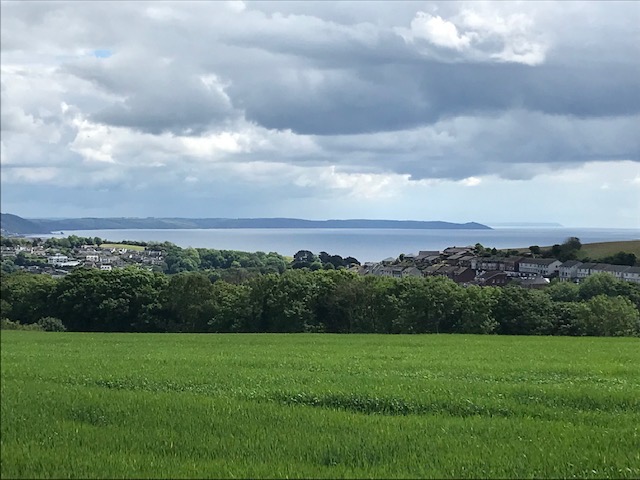
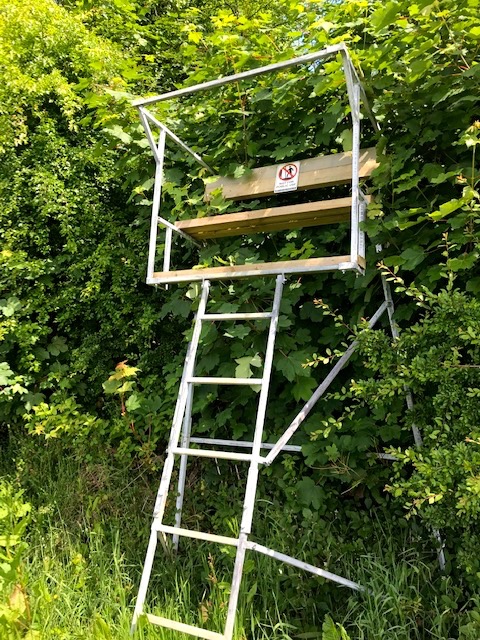
Once the land had slowly levelled off, I found myself back under the sun on rough farm tracks skirting a quarry and ploughed fields, yielding fine views over blue seas and distant shorelines. Despite the promise held out by initial signage the public footpath disappeared at some point and I had to zigzag my way by field boundaries looking for signs of a legitimate way forward. Thought I’d discovered it when what from a distance looked like a high style turned out to be a shooting seat for wildfowlers.

Fortunately, just a few yards further along, I found sufficient breach in the earth bank to regain access to the woods. Threading through the undergrowth, putting up speckled wood butterflies and startled blackbirds, I eventually regained the wide tracks that lead me, weary but happy, back to base.

A Hut A Byens

Tell me a thing or two about bones / how they rise from the earth like stalks of wheat / vertebrae on vertebrae / defying gravity for a while, odds stacked / and when the breath is passed / only bones remain. (From One Day a Year by Juana Adcock)

Last year Kim was commissioned to do the illustrations for a poetry booklet which involved her heading over to the other end of the county to do some on site research. I happily went along as her bag carrier, and history being my bag I was more than happy to carry it!

Our destination was Bamburgh. The one time capital of Bernicia, as the Saxon kingdom of Northumbria was known when allied with Deria (modern day County Durham). The sea roads were the motorways of the day and the fortress cum palace atop the mass of Whin sill rock, then as now, dominates this awesomely beautiful stretch of coastline.

Bamburgh – or Bebbanburg as it was then known – was the centre of Christianity in the north of England and home of the early Celtic saints who established and rooted the faith here and at nearby Lindisfarne, or Holy Island. It remains a major place of pilgrimage, secular & religious, to this very day. St Aidan, called from Iona by King Oswald in AD 635, founded the first church that bears his name. The village’s current parish church is Grade 1 listed and it was this, in part, we were coming to discover more about.

Our destination was also the inspiration for Bernard Cornwell’s series of historical novels set in 9th Century set here and in the other Saxon kingdoms of Wessex & Mercia, The Warrior Chronicles, brilliantly adapted for television as The Last Kingdom. We’re both huge fans so having even this most transcendental connection with saga’s protagonist Uhtred, son of Uhtred, rightful lord of Bebbanburg made us very happy. In our rugged hero’s own words, ‘Destiny is all’!

In the early 19th century a violent storm revealed part of the extensive dune system south of the castle to be a long forgotten graveyard. Little was made of the discovery in the ‘bowl hole’, as the spot is known locally, and the site was lost again to common memory until recently when from 1997 – 2007 a detailed comprehensive scientific study was made of the remains of the 110 individuals whose bodily remains were re-discovered there. Thanks to the wonders of radiocarbon dating we know them to be members of the Saxon royal household, who had lived during the 7th and 8th centuries. Burial in the foetal position, pre AD 900, with faces looking west indicates a Christian burial site, though whether they were all Christian or not it’s impossible to say. Approximately half were born and brought up away from this area. Immigrants who had come to serve the court in one capacity or the other from as far away as Mediterranean Europe and Scandinavia – or closer to home – from Scotland, Cumbria and Ireland.

Apart from dental decay caused by richer sweeter foods these folk enjoyed relative good health, indicating high status. (Their diet was more animal based than marine, which seems curious for a coastal community). It’s the unique identifiers that bring individuals into sharper focus though. The 20 year old professional warrior who had suffered severe axe wounds, or the Irish seamstress with the nick between her incisor teeth caused by habitual biting of thread; the middle aged monk from the Hebrides who could have accompanied Aidan, the nine year old girl and her Mediterranean born mother who brought her here, and so on.

Musing on all this and more after lunch in one of the village’s cafes we wondered the near deserted sea shore and dunes, never far from the lengthening shadow of that ever present fortress on the rock, restored and extended by the Victorian arms magnate Lord Armstrong and still a family home. I lingered in Kim’s wake, with bag for samples and shoot, while she focused her camera lens on marram grass in the sand dunes, or gathered shells and seaweed under the wash of the retreating tide. The great expanse of bright winter sky arching over the timeless sea road, empty now of any visible traffic.

In 2016 the bodies of the dead, laid in zinc ossuary boxes imported from the continent, were escorted on horse drawn hearses before large crowds of onlookers to be solemnly re-interred in the crypt of St Aidan’s after a special service. Today an audio-visual display illuminates the story of the Bamburgh Bones on the crypt’s medieval stone walls, while the caskets – like safe deposit boxes with crosses – lie behind a frieze of Celtic style metalwork securing their new found place of eternal rest. We drove home enlightened by the poignancy of the migration story, grateful to have been immersed in the spirit of place. Darkness made visible, thanks to science and the power of human imagination.

But now something of seashell, something of seafoam,/is the arrangement of your puzzle in a vault / beside the sea, where flickers a candleflame / for what they didn’t find. There’s a strongbox for the rest. (From Find by Jacob Polley)

The Bamburgh Bones project is an ongoing cultural enterprise combining the skills and resources of community, academic and tourist bodies, supported by the Heritage Lottery Fund. Find out more at: https://bamburghbones.org/

Footnote. Three days after our visit Storm Arwen struck and we spent the next 10 days living a modern day version of ‘the dark ages’ without electric power. Those experiences are recorded elsewhere on these pages. Kim, keen to make the best of winter daylight hours, set up her easel and drawing equipment by the south facing living room window and started the drawing process for what would become ‘A Hut A Byens’.

Sitting still for hours without heating added an extra challenge. (It certainly kindled an empathy with all those hard working monks illuminating the gospels back in the day at Lindisfarne). When power was restored the pace of work picked up and she met her deadline in mid January.

Poems commissioned and arranged by Dr John Challis (Newcastle Centre for the Literary Arts, Newcastle University) and Dr Tony williams (Northumbria University) in partnership with Jessica Turner and Northumberland Coast, AONB.

Skyeldeman, wor nyems, fetched far fr’ hyem / Hanted amang ee, a hut a byens / Happed up wi’ sand ahint the Fairen. / Hunkered i’ the Boolie Hyel / Waitin’ on a hooley /T’howk ‘em oot, th’ baad unkent. (From A Hut A Byens by Katrina Porteous) Translated from the Northumberland coastal dialect, with its roots in the Anglo-Saxon as: Stranger, our names, fetched far from home / Hung around among you, a heap of bones / Covered up with sand in the lee of the Inner Farne. / Crouched in the Bowl Hole / Waiting for a storm / To unearth them, the remains unknown.

Garden Notes

It’s that time of the year when all gardeners are up and at it on their patch of paradise. Kim’s the plantswoman who created our garden from scratch here at the corner house some 18 years ago and I’ve been her willing deputy since moving in six years ago. Descended from a long line of gardeners, with the practised artist’s eye for colour, form and texture Kim has created something special at the edge of the known gardening world. Growing up in an interwar council house in west Devon in the 1960’s my family enjoyed the benefits of having front and back gardens plus a generous size allotment a stone’s throw away. That’s where I got my interest and grounding in the basic craft.

Our garden’s generous three quarters of an acre spread has given me the responsibility and challenge to tackle all the things my guiding light doesn’t like doing. i.e. lawn mowing, spreading and raking gravel on the yard and along paths, moving big heavy pots and stones, sawing and shredding, construction etc. We share the tedious but necessary regular tasks between us, like watering pots and hand weeding. Her centre of industry currently is the vegetable garden raised beds with their protective pop-a-domes and the small but essential greenhouse where many small miracles are fashioned to ensure production. My mainly self taught husbandry centres on meadow, orchard and pond.

This year’s apple blossom has been exceptionally good. Frosts have not been a problem so far (fingers crossed) so setting for fruit has been good. Our south facing aspect greatly benefits the fruit trees espaliered on that side of the house – the stone gives shelter and retrains heat, and they thrive. The James Grieve for instance, the first variety we planted six years ago, has spread luxuriantly. The pear and apple trees re-planted in wooden pots two years ago – well fed, in good compost and mulched with bark – also thrive on that walled garden south side.

Of the stand alone trees in our other orchard the three year old Katy, (grown for juicing) is currently a riot of creamy white flowers. Next to it is a Christmas Pippin, my particular dessert favourite in being small crisp and flavourful. Its brave show of blossom too promises a bumper final crop this season. The biggest tree is an Arthur Turner and a fine cooker displaying the blousiest of blossoms.

Spring housekeeping done on my beloved pond. Removed a tangle of excess oxygenating weeds to avoid choking more delicate plants like water hawthorn and a small lily recently bought. Cleared and deepened a channel between the stony beach and the deepest section by taking out some pebbles and baskets of marginal plants that had succumbed to weeds or died off. I was delighted to spy from the overlooking bathroom window a male blackbird taking his morning bath and drink in this new waterway. One of the visiting grandchildren spied a pair of young frogs under a capstone by the waters edge and I saw them myself today. Frog spawn is usually spotted in the water troughs or streamlets in nearby fields but never in our pond. This being a palmate newt dominated spot adult common frogs are only seen in spring and summer. If they ever laid eggs in the water here they would be eaten by adult newts. Frogs, like the resident toads, are very useful in keeping a check on slugs, snails and other garden pests. A stack of logs beyond the stony beach provides shelter for overwintering newts, frogs and toads as well as attracting the insect life that gradually breaks them down.

The meadow, of all my ongoing garden projects, is the one most in flux. The garden lawns link and frame all main areas – beds, borders, woodland and shrubs –  but a large roughly triangular section is always left unmown. I started the labour intensive process of turning its top corner and edges into a flower meadow. Four years in and already we see an increase of emerging plantain (deliberately seeded) as well as meadow cranesbill and cow parsley (self seeded). Most of all though the yellow rattle liberally sown every year is spreading into the heart of the growing sward, as intended. This annual is key in meadow creation, being a semi-parasitic that lives on the roots of dominant grasses, in this case rye and couch, weakening them to allow more delicate meadow flowers to take purchase and establish. There have been successive waves of predominant flowers dominating from the clay seed mix I used – first poppies, then marigolds – so we await to see what this season throws up as herbal front runner. A couple of weeks ago I broadcast lesser knapweed in spots where random daffodils had been growing and then added the displaced bulbs to the massed line up on the roadside out front. The linear spread of established daffodils there put on a cheering show for the passing world, from March into April and even now, into May.

In Other News…Swallows returned earlier than usual, on 28th April to be exact. Caught them acrobatically copulating on the wire over the yard yesterday and see that nest building is in progress under the new deck roof. They seem to have started one then abandoned it in favour of another, dark with still damp mud. Elsewhere in the garden I think we have a pair of greenfinches nesting for the first time.

Last autumn the storm battered old wood gazebo collapsed and was replaced by a metal arch that has slowly rusted once exposed to the elements. Have now made it a pair by installing another at the other, lower, entrance to the vegetable garden. I’ve re-positioned a climbing Tayberry on one side and a thornless blackberry on the other. (Both of them failed to grow happily elsewhere). Here’s hoping they thrive as much as the New Dawn climbing rose and Blue Angel clematis do on the other arch.

The canny texel tups over the hedge continue to revel in the lawn clippings I serve up for them by way of a ready meal. In the next field their offspring lambs in happy gangs are playfully running around with all the joys of spring as they do every year. A dip in the ground by our stone wall their favourite playground.

Initial dismay at the sight of more molehills in our field transfigured in seeing the positive side.  A happy hour spent bagging up soil of such fine tilth to use filling pots for Kim’s ever growing range of plants and shrubs.

Walk on the Greenside

Delighted to receive an invitation to a talk and walk at Greenside Farm last Saturday morning. Owners Charles Bennett and his wife Charlotte are seeking to restore harmony with nature by protecting valuable habitats and creating new ones while at the same time making ends meet financially in producing the food our nation needs.

Greenside – AKA Middleton Farm North – is just two years into a transformation that will see it become a herbal grass rich nature friendly farming operation. Up until 2020, when its last harvest was gathered in, 70% of this 400 acre farm in the Wansbeck valley was given over to arable production. Now they’re experimenting with bird friendly fields, digging a string of new ponds, replanting hedgerows and have created 40 acres of new woodlands.

Significantly the Bennetts’ no longer keep any farm animals of their own but instead let out all their pastureland to neighbours, concentrating time and resources instead on developing infrastructure and securing funding streams, private and governmental, to match their labour and investment. Charlie freely admits they could not have done so much so quickly without the voluntary input of the Alnwick Wildlife Group whose hours of free manpower has been crucial in in preparation and planting.

Charlie Bennett is a charismatic, articulate and humorous figure in his early 50’s whose family has been involved in farming since the 16th century. He’s also a regular columnist on rural affairs for The Northumbrian Magazine. The Bennetts’ were initially won over to join this new wave of regenerative farmers by the example of leading ‘re-balancer’ Isabella Tree and her family whose pioneering work on their 3,500 acre Knepp estate in Sussex is chronicled in her best selling book Wilding.

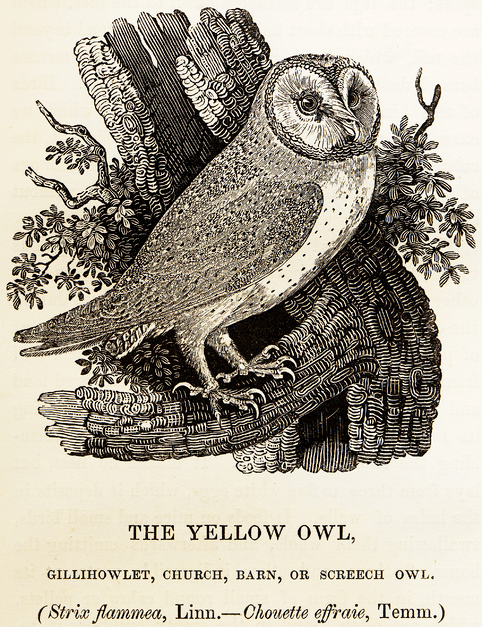
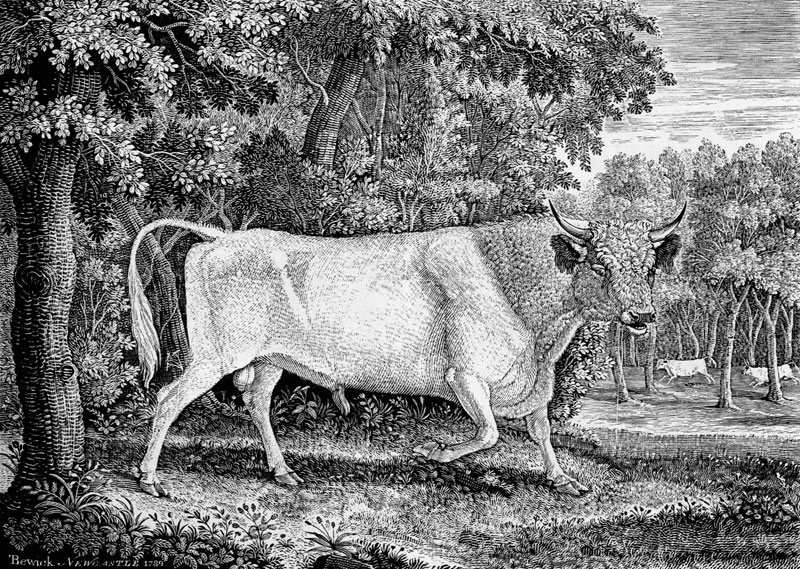
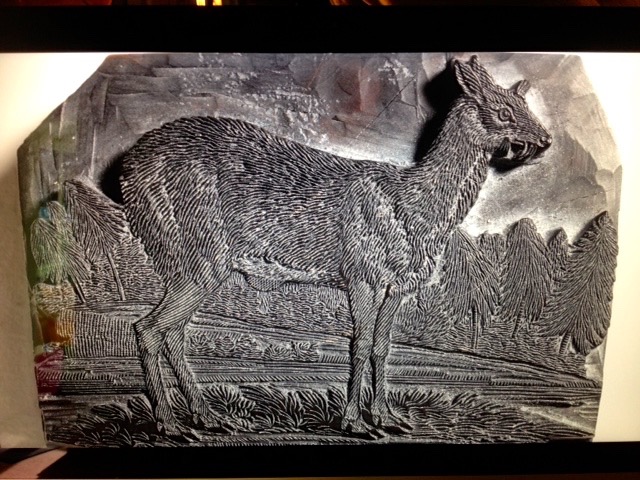
Research took Charlie to the Lit & Phil in Newcastle where he was excited to discover a detailed 1805 map of the farm (then known as Hartburn Grange) when it was owned by trustees of the Greenwich Hospital in London and whose profits generated income for naval pensioners. This in turn opened his eyes to the extraordinary achievements of one of Northumberland’s most famous sons, the wood engraver and naturalist, Thomas Bewick (1753-1828) whose work is probably far more familiar to people than the life of the man who created so many miniature masterpieces over 200 years ago. Charlie is using a spread sheet as well as good old fashioned field observation to record the presence of flora and fauna known to Bewick in his day and track the hoped for re-emergence, alongside the presence of new species introduced since late Georgian times.

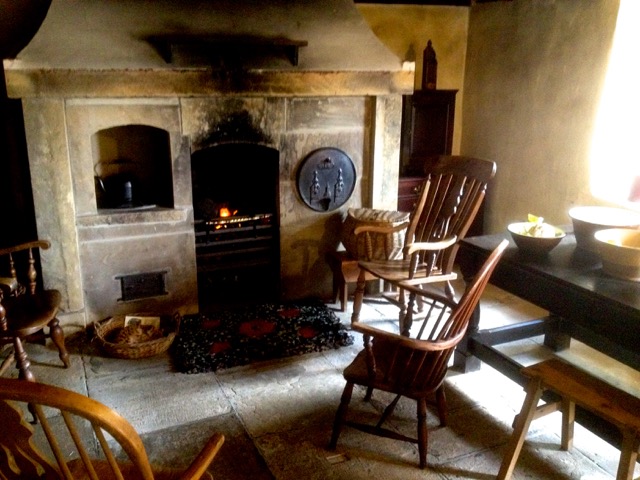
The kitchen in the Bewick birthplace farmstead at Cherryburn

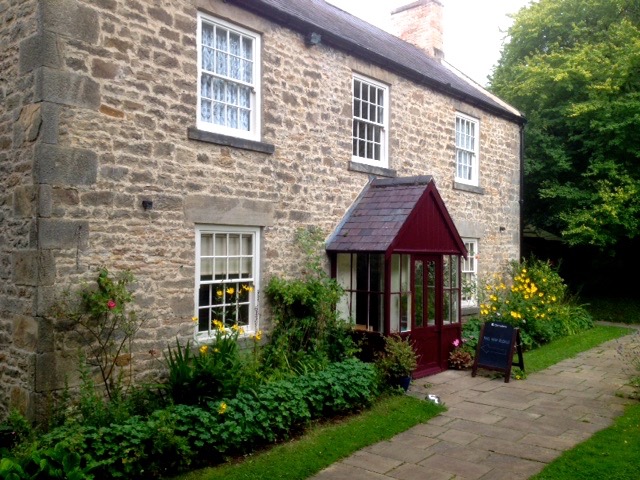
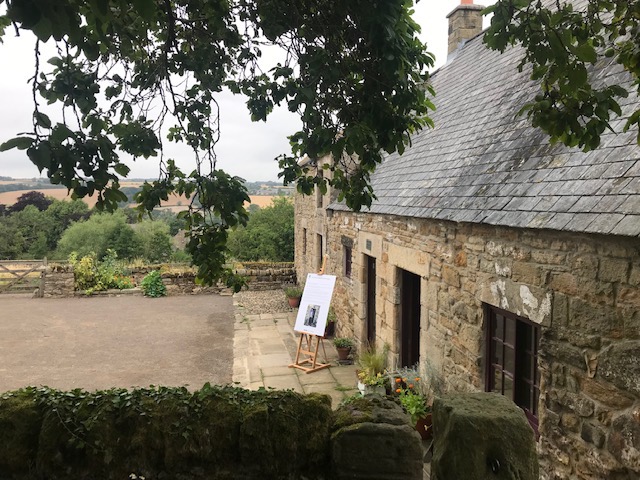
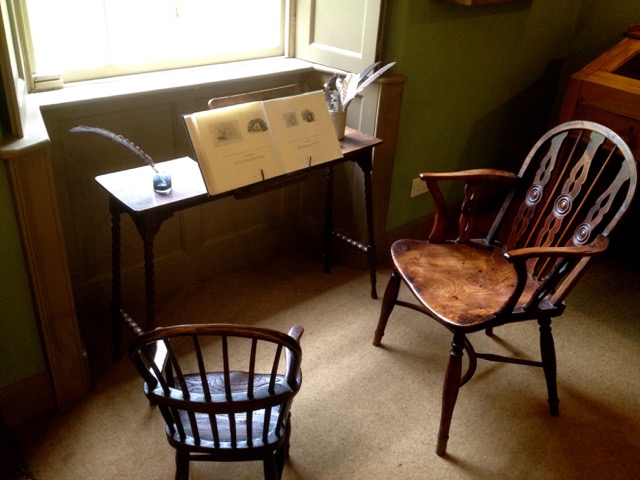
I volunteer at Cherryburn, the Tyne valley farm that was Bewick’s birthplace, now a museum run by the National Trust. The Bewick Society, who organised today’s visit, was formed in 1989 to promote interest in the life and work of the great man and the world in which he practised his craft. Find out more about the society and its activities here: http://www.bewicksociety.org

Charlie and his two Labradors lead the way along the old railway embankment

Following an informal introductory talk and questions in the farm’s open sided modern barn over tea and biscuits we set off for our amble round the farmlands. The happy buzz of conversation between us as individuals ranged widely as we sauntered or paused to take it all in. We crossed former traditionally ploughed ‘rigg and furrow’ (ridge & furrow) fields with skylarks singing high above. Learn that the Bennett’s grass lets run longer than normal but are subject to lower stocking densities, attempting to strike the right conservation/grazing balance needed for sustainability and renewal, eliminating the inputs of synthetic fertilisers.

Hawthorn hedges have been planted, old ones enriched, and the stone flanked earth banks (Kests) they grow on gradually being restored. Other hedges, where practicable, are being allowed to spread much wider and higher than conventional yearly cut hedges. They’re managed on a three year rotation, allowing them to be both effective as stock control and fulfil their maximum conservation potential. New fencing also preserves the odd yellow flowered whin (gorse) groves between pastures, a familiar sight in this part of the world.

Bewick’s wood engraving of a yellowhammer from The Book of British Birds

Experimental seeding of one field to encourage foraging by wild birds has had mixed results. The variety of cover sown was more attractive to pigeons and rats than visiting birds. Conversely another seeding trial has attracted record breaking numbers of yellowhammers, a threatened bird species, once common on arable land.

Whin Grove & Dead Ash

One field we strolled through was bordered by a line of dead and dying Ash trees, in various stages of decay, due to die back. Charlie is leaving them standing on the basis they’ve a chance to produce disease resistant seeds and their passing still enriches the natural food chain. Other large grass leys have mini-copses of trees planted protected by stockproof rectangles of wood planks. Once established these ‘arboreal fountains’ should provide 360 degree cover and shelter for stock, whatever the season.

We navigated a burn with its steep wooded banks, yellow bright with celandine and cowslip. A sheltered damp meadow here produces a wealth of flowers in summer. Wherever possible mesh tree guards used instead of the old style non-biodegradable plastic ones, an exercise supported by the Woodland Trust.

We joined up and followed the single trackbed of the disused Wansbeck branch line, past a single platform, all that remains of Middleton North station, now thick with invasive trees. In amongst the brambles a mass of white starred stitchwort and yet-to-flower borage is lining the permanent way.

Further on an owl nesting box sits snugly under the arch of a stone bridge, that would have once facilitated the movement of stock between fields. We eventually return to cross it, enjoying views over the Wansbeck valley beyond.

Explored a new bird hide, next an ivy covered ruin of a brick built wayside hut, overlooking newly dug pond in a medieval quarry known to have provided the stone to build nearby villages. School parties sometimes visit the farm and this is one of the places they particularly like.

Passed a small orchard that produces an apple variety that has no registered provenance, which is fascinating to an apple grower like me. Excellent dessert quality fruit Charlie assures us, but not good keepers.

The River Wansbeck is a narrow winding lowland stream (its course marked by classic oxbow lakes) but environmentally important for having native white clawed crayfish living in its waters. (The invasive red clawed species threatens their existence in the UK, and the government have given the native breed protected status with all that implies regarding everyday aspects of management). Otters, another once endangered species, have returned in recent times and seen off the remaining alien mink along the valley. Two success stories. Yet nature is unsentimentally interactive and Charlie has witnessed otters enjoying a gourmet snack of white crayfish skillfully hunted then chewed at leisure on the riverbank!

Skirt the new woodlands, edged with a fine line of cherries in glorious blossom, before crossing a verdant lane to learn more about the series of ponds scrapped out of blue clay bordering the farm’s biggest field, a south sloping former moor or ‘waste’ that was ‘improved’ in the 18th century. Those old field drains have now being blocked where found, helping re-wet the lower ground and reducing flooding danger on the adjacent road. Amazingly, this project was made possible by Coca-Cola Corporation who operate a bottling plant for Abbey Well spring water at nearby Morpeth. Corporate responsibility policy obliges them to help restore or otherwise enhance water resources in the area they extract from.

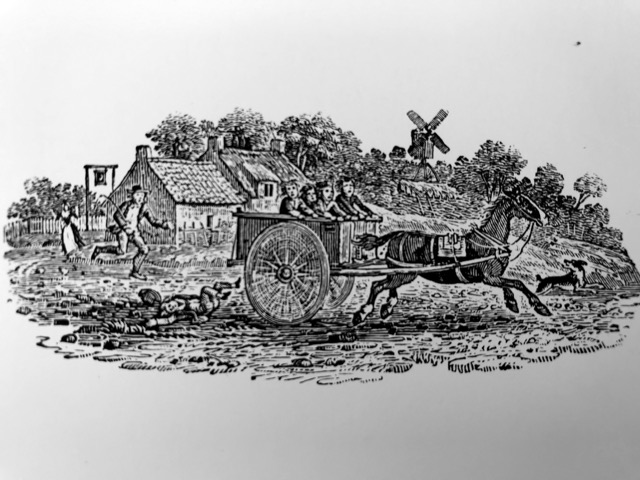
Thomas Bewick ‘Tale-piece’ to illustrate a page in his Book of British Birds. (Actual size approx 6 times smaller)

Back at the barn some folk needed to leave for other commitments. We stayed on, appetites sharpened by the walk and good company, to enjoy our picnic lunch enjoying further lively conversation, sparked by reactions to what we’d witnessed this morning. It’s a challenging balancing act that Charlie and his family have embarked upon. One that they’ve embraced with energy and initiative and one in which we all – as producers, consumers and concerned citizens – have positive parts to play. Can’t wait to return in future to see where they’ve got to….

More information at http://www.middleton-north.co.uk