‘Who can impress the forest, bid the tree/ Unfix his earth bound root?’ (MacBeth)
Apart from being based in Pitlochry Festival Theatre in the late 1970’s, rehearsing an extensive autumn long tour of schools in the highlands and Islands, I ‘ve never been to Perthshire. As it happens neither had Kim, so a few days staying with friends Robin and Linda in Aberfeldy, at the start of this August’s Scottish holiday was a treat.

Aberfeldy we discovered is a bustling small town of independent shops and businesses – including a community run cinema – proud to be Scotland’s first Fairtrade town. Robert Burns in 1787 wrote a poem about the Dens of Moness, the ancient wooded gorge high above the town. Inspired by its profusion of birch trees he called it ‘The Birks of Aberfeldie’ and today a statue of the bard sits in lonely splendour on the leafy banks of the fierce little river. His original pen having been nicked a twig suffices for replacement.

A lovely 1.5 mile circular steep sided walk immersed us in the narrow valley’s sylvan charm. Our friends went off the path at one point to gather chantarelles for a risotto supper but we demurred for fear of attracting tics. Sure enough, later Robin would be showing us how to remove and properly dispose of the three tiny bloodsuckers which had attached to his calf muscle in the course of foraging.
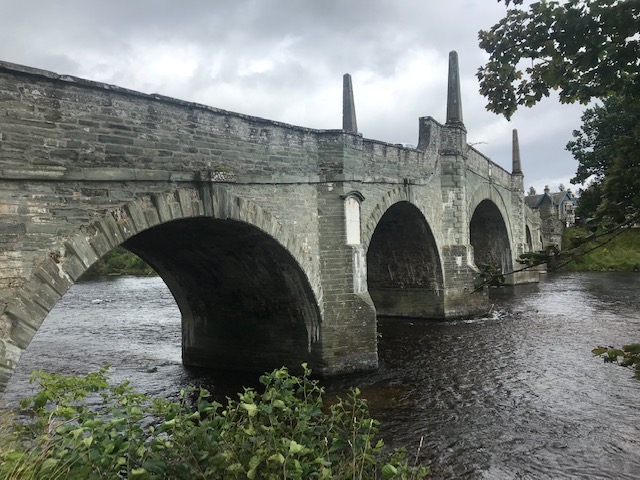
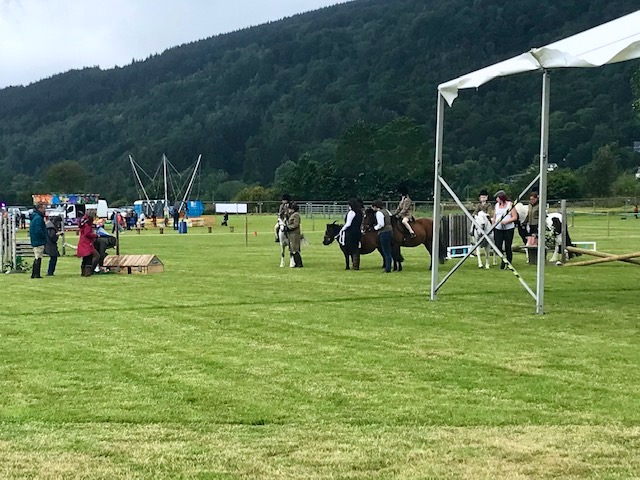
Next day was the first day of the annual Aberfeldy show. Dodging the traffic, we crossed the River Tay by General Wade’s elegant hump backed road bridge. It was designed by William Adam and opened in 1733, laying the foundation stone of the town’s subsequent growth as a rural centre. The show was delightful and I was unexpectedly charmed by the equestrian competitions’ assortment of riders and mounts; the little people dressed to the nines on their ponies, with adults leading, put one in mind of Thelwell’s classic cartoons.
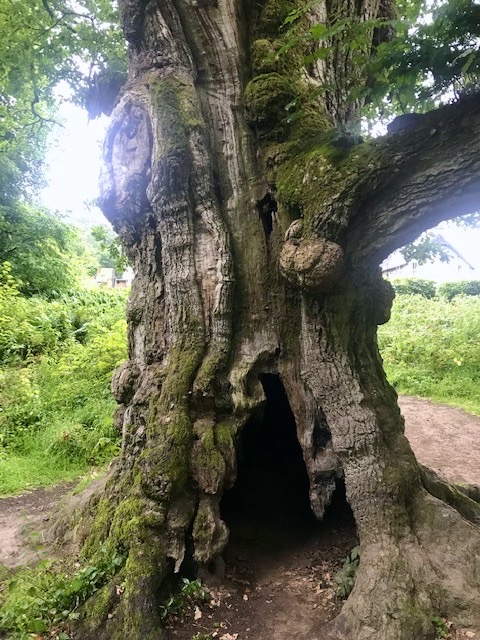
Friday night we drove to Birnam, at the heart of Perthshire ‘Big Tree’ country. Followed the Tay downriver through the remnants of the great deciduous forest that once clothed these hills, where now conifers predominate. Stopped to admire the 500 year old oak, a symbol of the wood that is famously associated with Shakespeare’s Macbeth. A troupe of travelling London actors was licensed to play in nearby Perth in 1589….Was the bard amongst their number? The lower trunk, which is hollow, was submerged by floods caused by Storm Desmond in 2015 and that weakened it. To avoid danger of splitting under its own weight supports have been added to lower boughs.
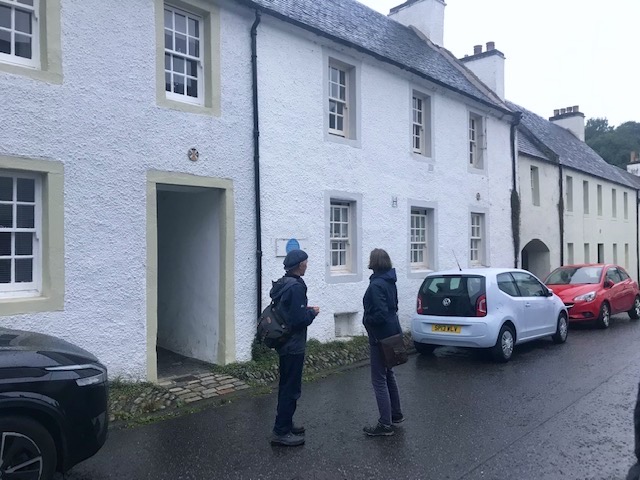
On to cross the broad river on a grand former toll bridge into historic Dunkeld, the elegant ancient borough framed by tree covered slopes. We discovered the pretty square and street leading to the gated ruins of the cathedral, both of which were saved from dereliction in the mid C20th. We were surprised to come across this link with Canadian history on the wall of one of the old terraced houses.

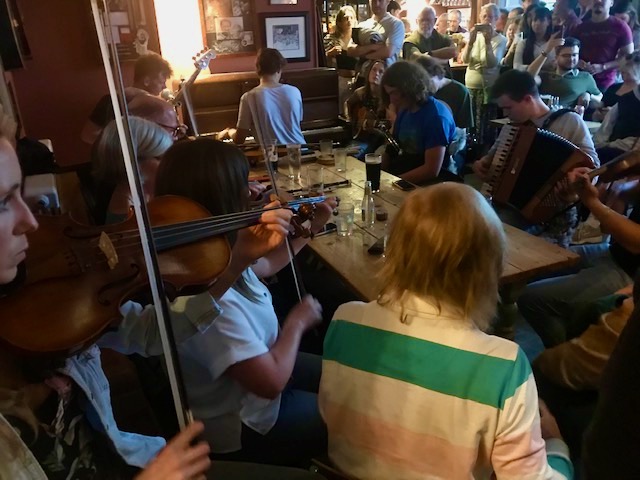
The bar of the Tayside Inn, a former grand temperance hotel, was already buzzing when we got there with an appreciative crowd come to hear a posse of young (and not so young) traditional musicians weaving their rough magic, infused and varied with jazz and rock influences. More instrumentalists turned up and we squeezed ourselves into the standing room only corner and cheered and clapped as they wooed us all with their ace instrumental skills.
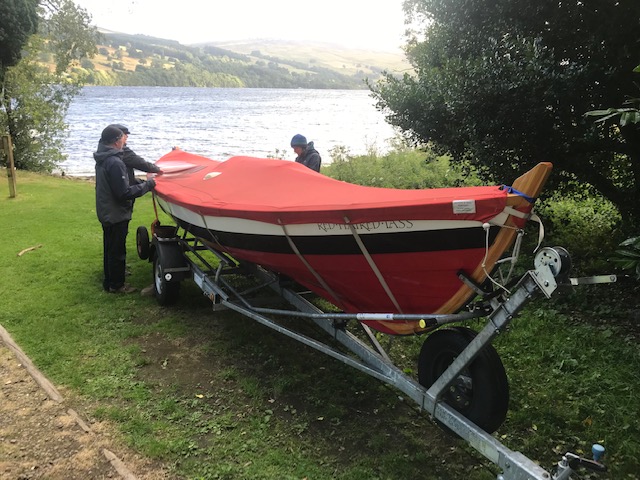
We took a trip up to the resort village of Kenmore on Loch Tay. Linda introduced us to her friend, the red haired lass – a skiff moored under canvas by the water. Linda and her club mates had painstakingly constructed it themselves from a template. Every modern racing boat has to be built to the same design, to ensure fair competition. The Loch Tay team is the only Scottish inland crew, the rest being coastal based. I’ve loved watching gig racing in the bays and estuaries of Cornwall and Pembrokeshire so would delight to see this form of rowing action on the open water too. Gig boats, we were told, are slimmer in the beam and have six oars at work while skiffs have four.

 STEPHEN TOMLIN
Hi Steve, you went to a delightful place. Did you visit Fortingall where there is a 5000 year old Yew tree? Also Fortingall is reputed to be the birthplace of Pontius Pilate!
LikeLike
Hi Pascal…Glad you liked. No time for the famous Yew on this occasion, but maybe when we visit next.
LikeLike