Busie old fool, unruly Sunne,/Why dost thou thus,/Through windows, and through curtaines, call on us?/Must to thy motions lovers seasons run? From: The Sunne Rising (Donne’s poem is lettered on the side of Prospect Cottage)
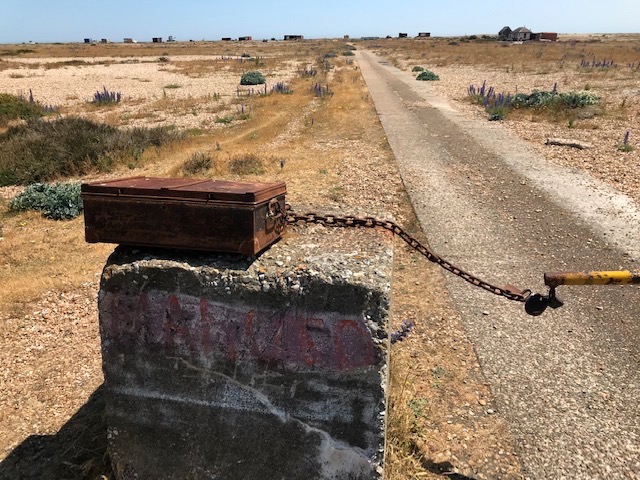
Unique is a much over used word. Applied to Dungeness though it is spot on. The outing here was aided and abetted by a good old friend of ours who lives up on the Sussex Downs and had visited many times before. He also had wheels so no need to get the bus from our base in Rye over the county border to this corner of Kent.
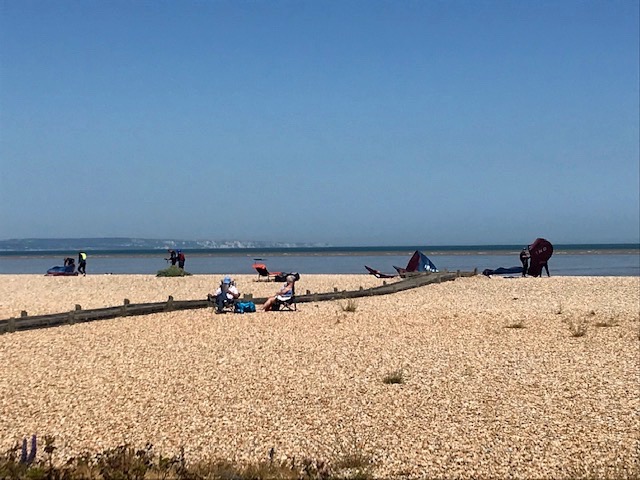
Often referred to as England’s only desert Dungeness is one of the largest shingle banks in Europe, a result of coastal longshore drift over the centuries. This triangular bulwark defines and protects Romney Marsh behind it. The etymology of ‘Dungeness’ makes the association between the two topographies clear as it means ‘head of the marsh with manured pasture’ in Old English. The marsh has long since been drained to become fertile farmland where native Romney sheep and Sussex Red cattle graze, which we had admired when crossing it by rail on the line to Rye from Ashford.
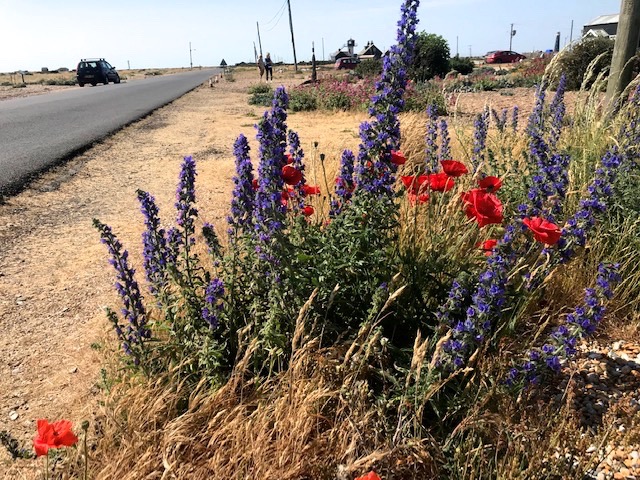
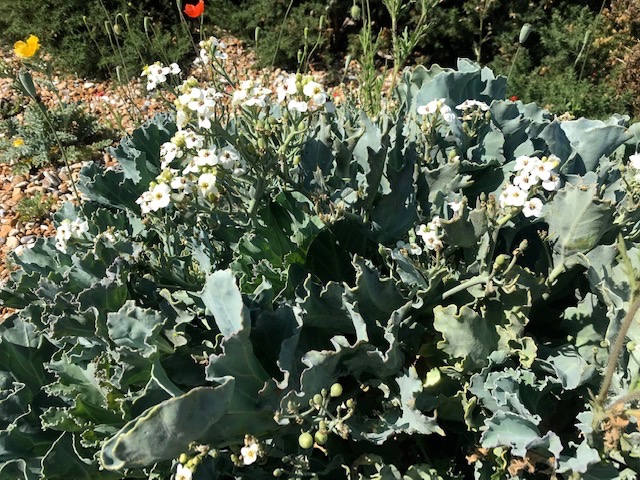
Both a national nature reserve and SSSI, Dungeness today is home to 600 different types of plant, an astonishing third of the total found in the UK as a whole. We were thrilled to see plants that are rarities elsewhere thriving here.
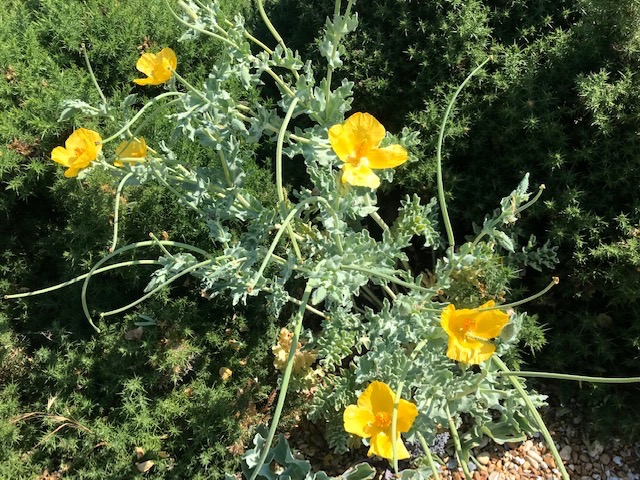
Nectar rich beauties such as vipers bugloss, sea kale, mouse eared hawkweed, horned yellow poppies (above), sea pea etc freely colonising beach and roadsides.
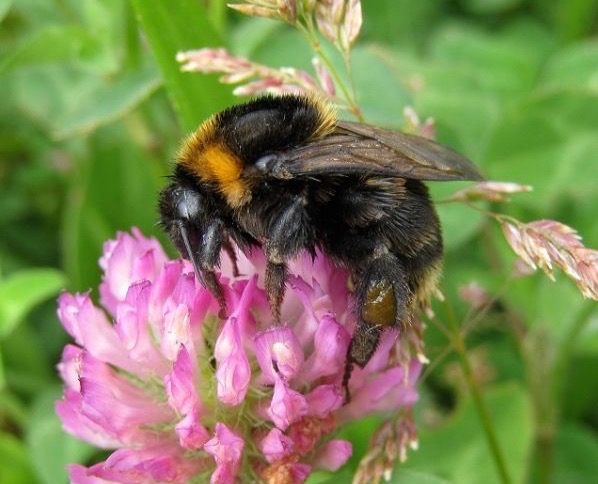
An Anglo-Swedish scientific programme has recently re-established a population of short-haired bumblebees here, where they were last logged in the UK back in 1988 and officially declared extinct in 2000. They need species rich grassland to survive and Dungeness has no shortage of food plants.
We watched a kestrel hovering in the clear blue sky above as our friend recalled seeing harbour porpoises hunting through channels between shingle banks exposed at low tide.

We called in at an artisan weaver’s studio then watched a tractor delivering a trailer full of produce to a roadside shack doing a brisk trade in fresh fish and shellfish. Our lunch destination though was a local landmark, the Pilot Inn.
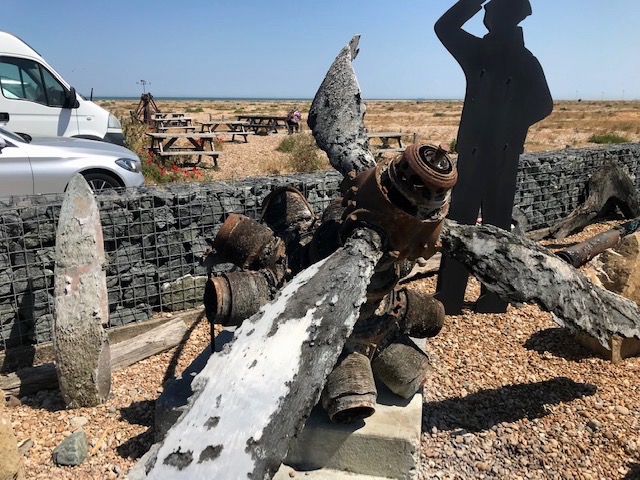
We duly sampled ‘the best fish & chips in England’ outside the bustling hostelry, watching the world go by while guarding our grub from a raiding party of starlings. The engine wreckage of WW2 planes and memorials to killed aircrews stand poignantly nearby.

Across the way men were rebuilding and extending one of the original shacks. Many of these simple dwellings were converted railway carriages and goods waggons occupied from the 1920’s by workers from London seeking an affordable rudimentary home by the sea. These days such places are snapped up by the well healed seeking a get away in what remains the most remote and least populated part of south east England. We saw one place – a cool black wood cube with swish interiors and panoramic windows – reportedly being rented out for £1700 a week.
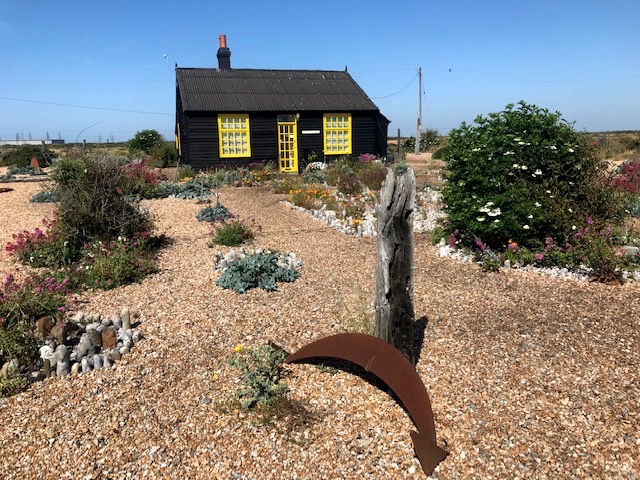
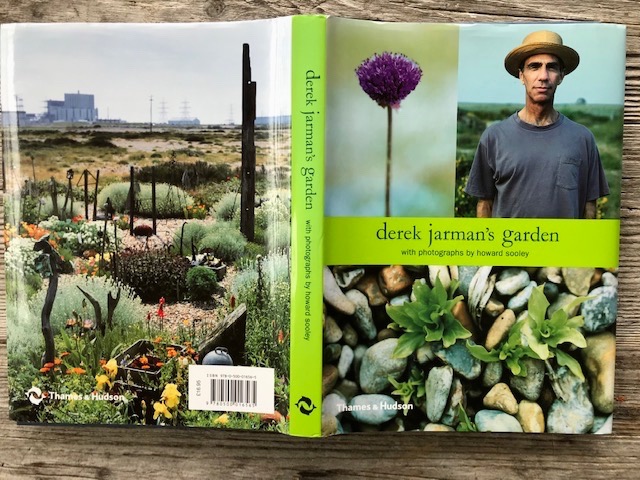
What attracted Kim & I here initially was Prospect Cottage (Above). Built in 1900, and the former home of a local fishing family it was bought by film maker and gay rights activist Derek Jarman. A beloved home from 1986 to his death in 1994, it was made famous by his writing.

The iconic garden the artist created, intermingling native plants with found and organic objects in a seemingly boundless state, has been influential on garden design ever since. After a national fundraising campaign Prospect Cottage was acquired by a charitable trust and is now managed as an artists retreat, although I expect getting any privacy or peace here in the height of summer to work would be problematic.
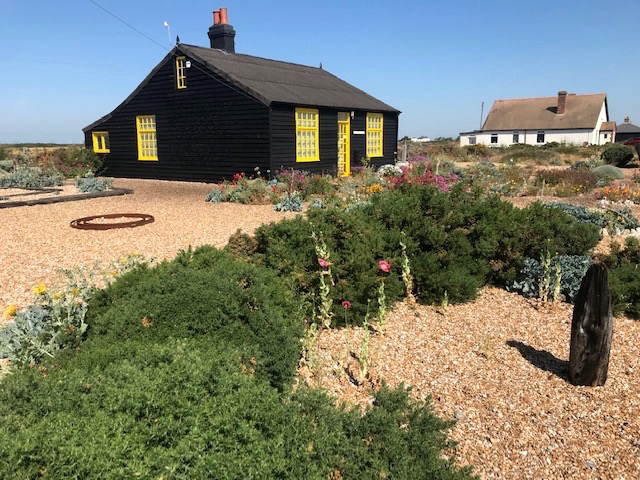
We circled and explored the garden with the remaining art forms time and tide had gifted its famous occupant. A lot of the original sculptures are elsewhere for safekeeping as they would surely have been nicked by now, as there are no defining fences, hedges, walls or other formal boundaries hereabouts.
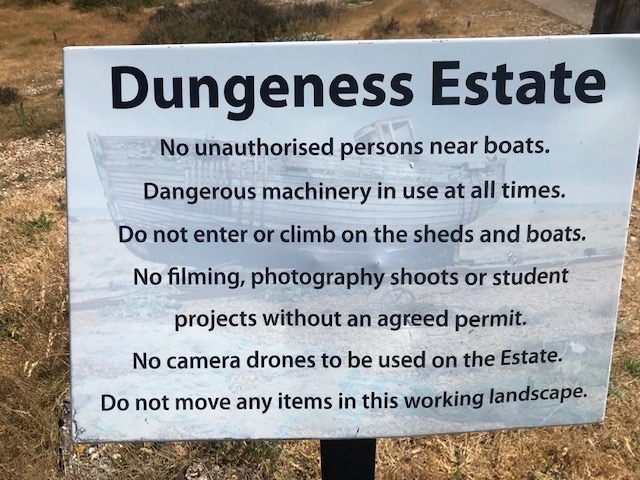
Dungeness itself is a formal entity in being an estate. It extends to 468 acres (190 hectares) and contains some 100 homes on 99 year leases, although only around a third are occupied all year round. It’s not hard to imagine this as a bleak exposed place to live in winter, that would make or break the will to be a seriously committed resident. For many years a family owned and run business, in 2015 the estate was put up for sale and was bought by the French energy giant EDF for a sum in excess of £1.5 million. This is no lucrative development opportunity as Dungeness is highly protected, but as the buyer also happens to be the area’s biggest employer it makes business sense.

Britain’s nuclear power stations are all situated on our coasts because they need huge amounts of water to cool the reactors. EDF own and run Dungeness power station, the dominant landmark that defines the ness’s western horizon. Built in stages from 1965, andgenerating electricity by 1983, it was due to close in 2018 but is now scheduled to remain operational ‘til 2028. The company had previously been paying up to £100,000 per annum to the estate to move shingle from the other (eastern) side of the ness to stabilise and reinforce the sea defences on its western flank.
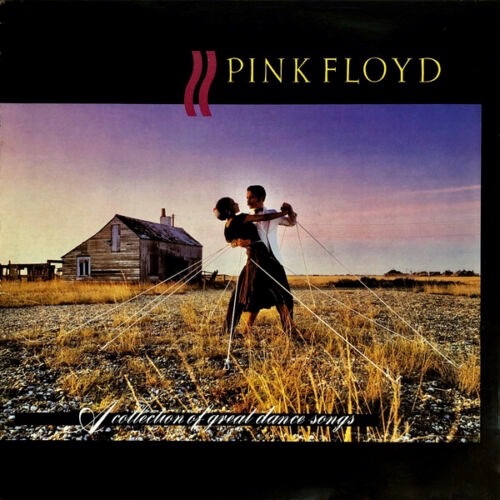
This special environment being only an hour and a half’s drive from London makes it a magnet for visual artists and has featured on a host of album covers, music videos and dramas, like this 1981 offering from Pink Floyd. The cost of running the estate is partly met by issuing filming rights, currently £1500 a day for commercial film or photography or £300 for students.

It can be hard work walking over the shingle. We took our time though, to absorb the sights and sounds of the great gravelly bank as we followed its coastal crest westwards. In the old days locals attached short planks to their feet to gain easier traction. These days orange plastic mats ease passage for pedestrians to reach the shore.
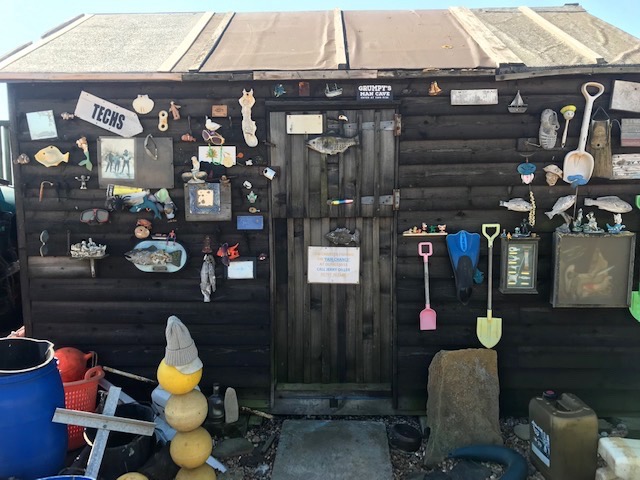
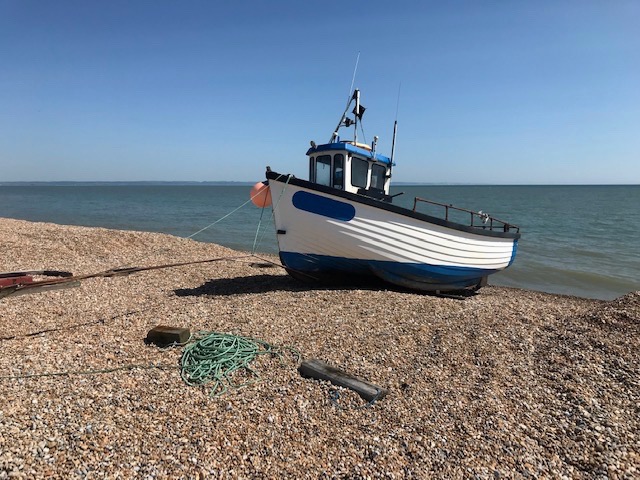
Fishing boats are hauled up the strand by winches and their gear secured in boxes by the boats or in tar coated wooden huts, some of which are liberally decorated with a collection of signs. Incidental art works in the spirit of the place.
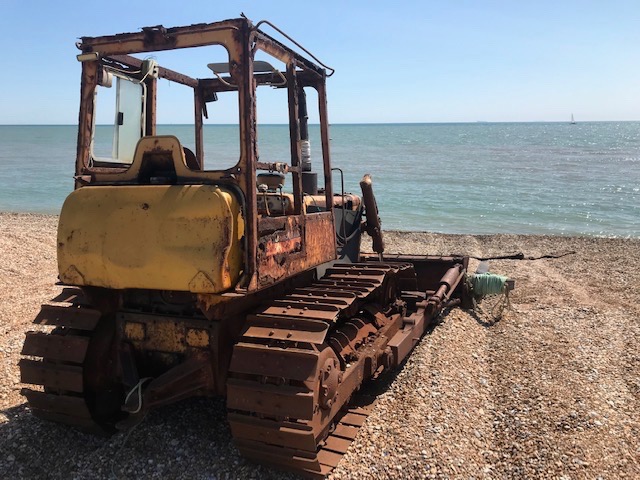
Wind, rain, waves and salt laden air take a terrible toll of wood and metal. Abandoned boats and collapsed winches, even a rusted out bulldozer punctuate the steep sided bank. As it recedes inland the shingle rises and falls in gentle swells, colonised with more vegetation the further back it goes.
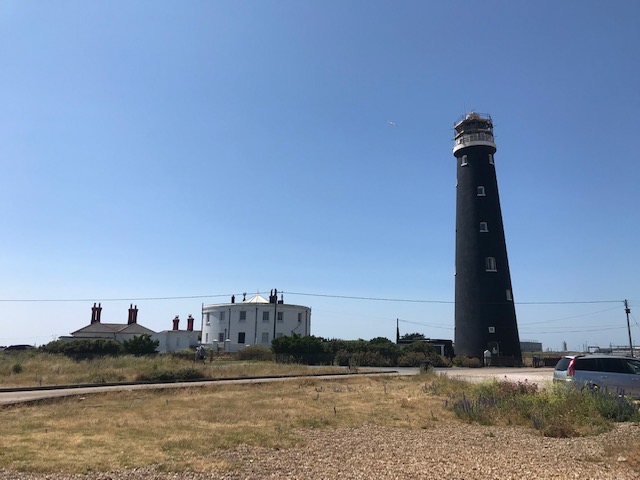
Our constant way marker was the former lighthouse. There have been seven buildings on the ness since 1615 and this one, now a museum, opened in 1904. The white buildings are former lighthouse keepers cottages.
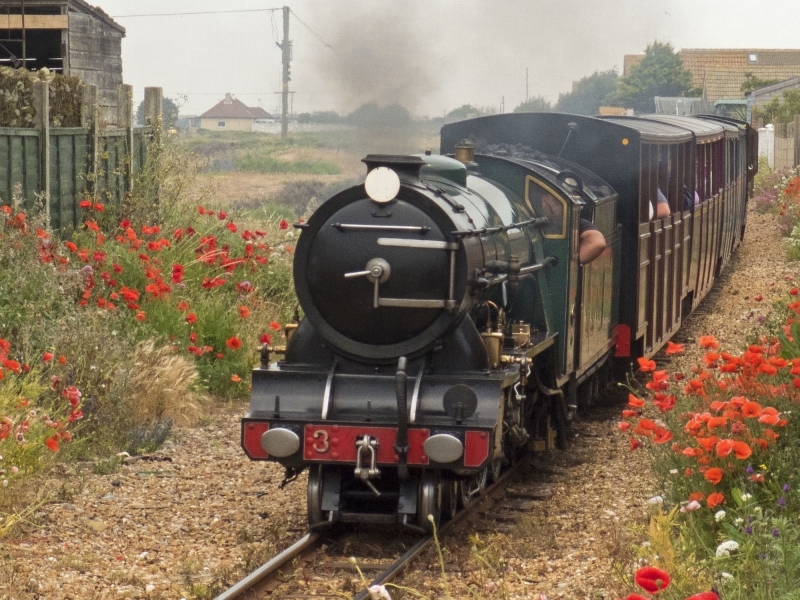
Sadly time and logistics did not allow us to incorporate a return trip on the UK’s smallest (15” gauge) regular passenger steam train line, all 13.5 miles of it. The Romney, Hythe and Dymchurch Railway, operational from 1927, is a major tourist draw today and just hearing and seeing the immaculately preserved engines steam and whistle their way through the landscape was a pure delight.
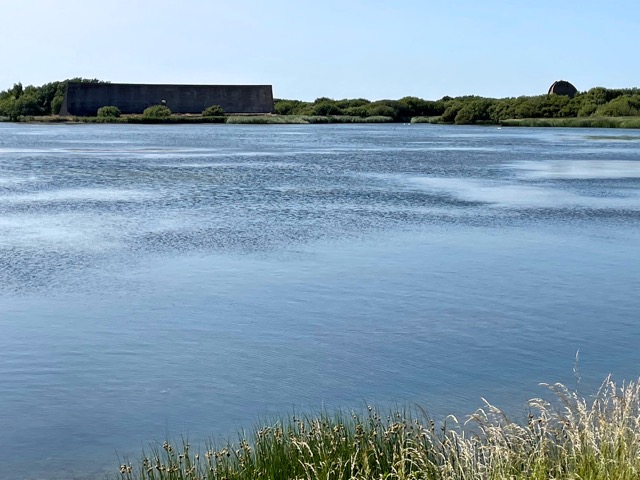
They’re not obvious to find and when you do discover them they’re not really accessible. As befits former military sites they don’t render up secrets willingly. I’m talking about the acoustic mirrors or ‘listening ears’ now protected from incursion – except on special open days – by a moat. Extensive extraction of gravel in recent years has created a wildlife lake and the three experimental concrete structures are marooned on an island where they sit, like ancient monoliths, peeping skywards over trees towards France some 30 miles away.
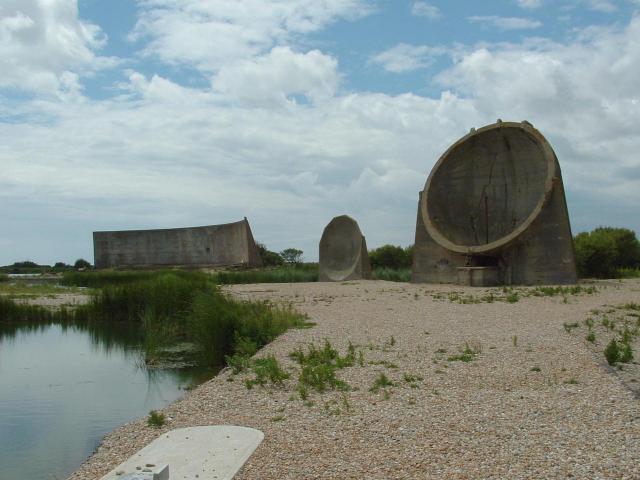
Built between the wars on what was then Ministry of Defence land the 200ft long wall and two circular dishes equipped with microphones were designed to pick up the sounds of approaching enemy aircraft. An early warning system that was soon to be made redundant by the invention of Radar in 1938.
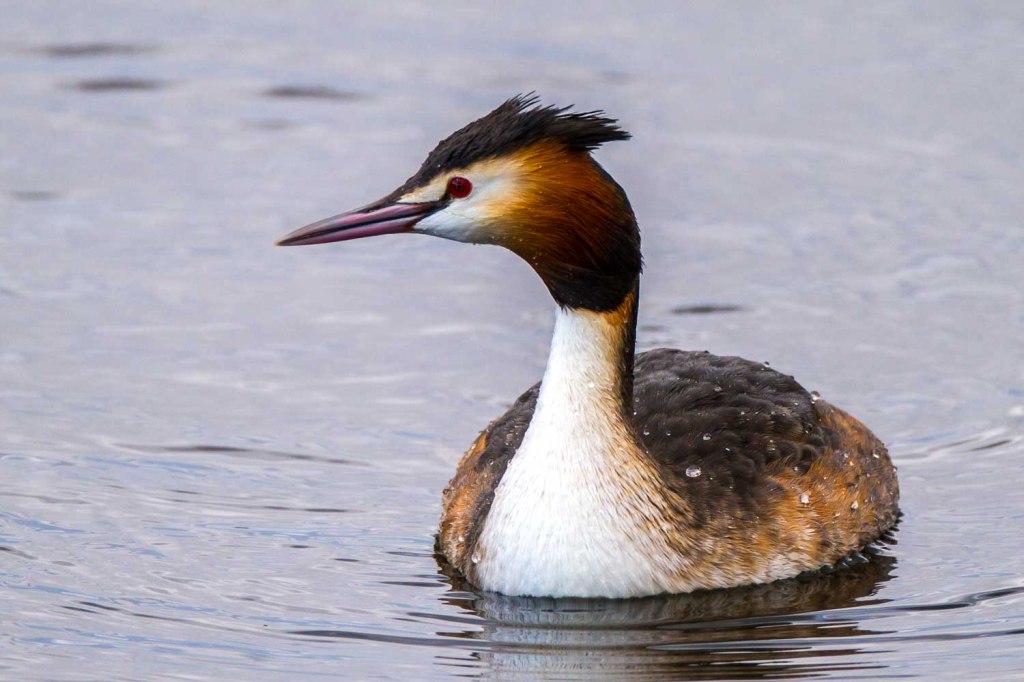
The waters here were remarkably clear, green weeds waving from the depths beyond its cool shore. Resting from the heat on the escarpment I saw a great crested grebe dive and swim to catch a small fish before resurfacing. Elsewhere mallards and their ducklings sailed in and out of reed beds. Shags, goldeneye and coots were out there on the lake too, with swallows slicing the air above them.
Beyond that still planes were coming in and out of Lydd airport (AKA London Ashford Airport). Controversially the former RAF base is earmarked for runway extension to take bigger, heavier commercial traffic. Beyond that, and dating from 2008, stretches the largest onshore wind farm in the south of England, generating 60 megawatts of electricity for the grid.
Nukes, planes and turbines exist cheek by jowl at Dungeness with an incredible richness of flora and fauna. A treat for curious creatives or lovers of life on the edge, providing us with one of the most fascinating and rewarding of walks yet.

The moon is even more spectacular. The sunset turns the seashore into a rosy mirror, with streaks of pink cloud. Then the moon comes, and casts a silvery path across the waves, a shimmering carpet for the stars. Dungeness, Dungeness, your beauty is the best, forget the hills and valleys. (From: Derek Jarman’s Garden)

 STEPHEN TOMLIN
Hi Steve
Unique indeed. Look closely, though, at the gravel in front of the bulldozer and you can see ridges which suggest that this bulldozer is still in use!
All the best Pascal
>
LikeLike
Now that would be a miracle. Its guts were gone, roast rusted and empty. Perhaps its ghost rumbles on regardless!
LikeLike