There can be few such small islands (all of 1 mile wide x 3 miles long) that pack so much variety into such a small space and have such a rich spiritual inheritance as Iona. Leaving the car behind at Fionnaphort after an hour’s drive across the Ross of Mull on single track roads was a welcome moment. Only the few hundred residents and essential delivery services are allowed to bring their vehicles over.
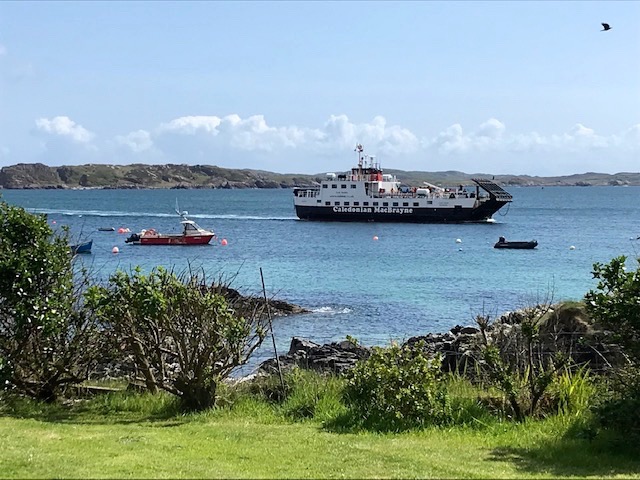
It’s a brief ferry journey over the Sound to the Isle’s township of Baile Mor. We were greeted on landing by old friends who retired to live here permanently eight years ago. Not wanting to impose ourselves on them we’d booked a room at one of the two island hotels. A real bonus though in being hosted for excursions or supper at home, getting the inside stories while watching the world go by from the front garden of their home overlooking the sea. We also enjoyed conversations with fellow guests at the St Columba hotel. Many were North Americans on the ancestry trail, combining that with a visit to the iconic medieval abbey, adjacent museum and Augustinian nunnery founded by Ranald, Lord of the Isles, around 1200.
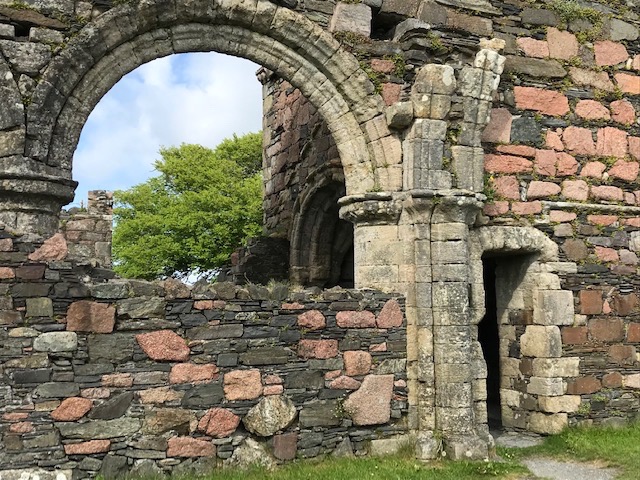
The latter was my favourite building, remarkably well preserved considering its disuse since the reformation, with an atmosphere all of its own. One roofless space leads on to another, from the former church into remains of cloisters, refectory and chapter house with stone benches around the walls. This all helps to create a lingering sense of the stern religious life led here by these aristocratic women and the female pilgrims they hosted.

Founded in AD 563 by Irish monks led by St Columba the abbey quickly established itself as the centre of Christian learning and practice in Scotland and, through the saint’s successors, went on into Northumbria at Lindisfarne and beyond. The tradition of pilgrimage to the island following Columba’s death in AD 597 saw many Scottish kings and nobles buried in the abbey’s precepts. In more recent times the late Labour Leader John Smith (1938-1994) was interred in the extension to the graveyard.
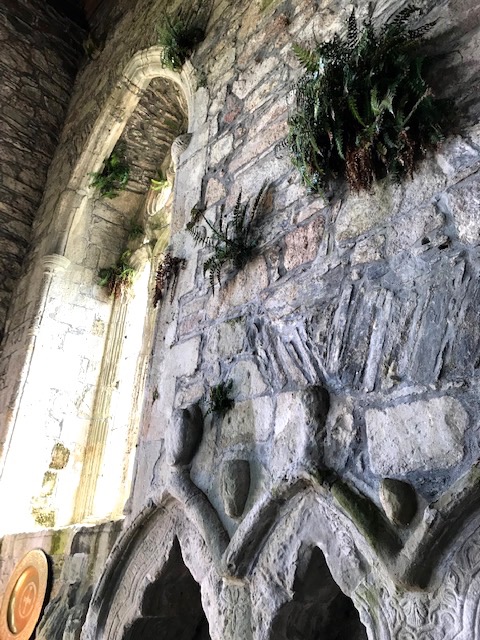
The Abbey’s impressive interior exudes a simple unadorned solemnity, lit and lifted by reflected sea light, original gothic segments merged with rebuilt fabric, intricate detail filling resonant spaces. Water ingress has been a major problem in recent times and repair work is continuing. We were fascinated by the damp loving ferns growing profusely from the mortar between blocks of wall stone.
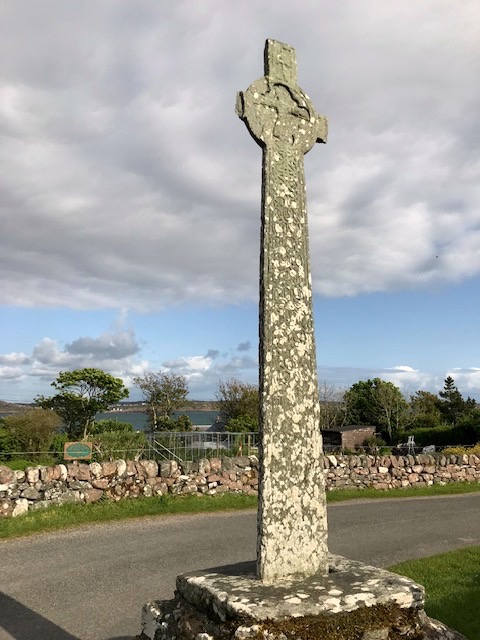
There’s an original medieval wayside marker en route to the abbey (Maclean’s Cross) and another grander one (St Martin’s) by St Columba’s shrine at the Abbey’s main entrance. One of the very few places in the country where such devotional monuments can still be seen in situ. The pilgrims paved path on which the series of guiding high crosses were situated, dates from the 700’s and is known as ‘The Street of the Dead’.

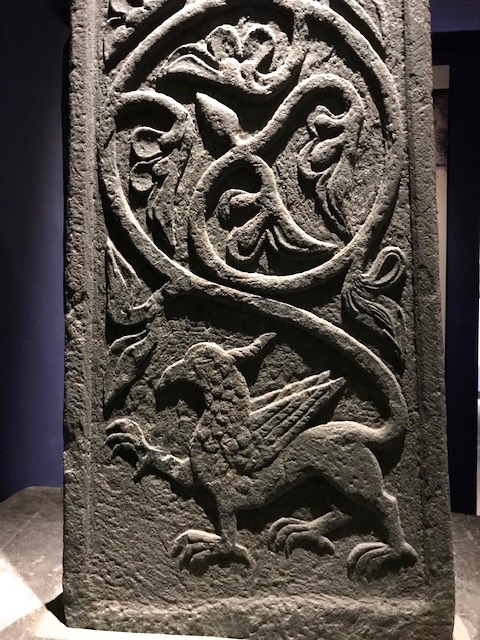
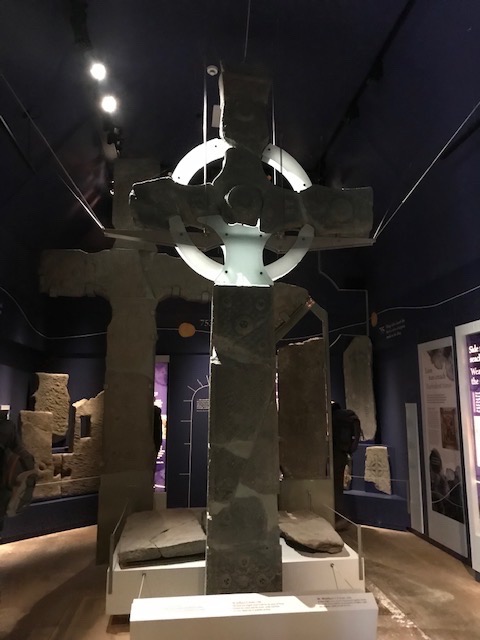
The Abbey Museum has a fantastic collection of ancient stone crosses and gravestone markers, cleverly lit and displayed for maximum visual impact. These effigies of warlords and clan chiefs carved in stone are powerful reminders of their status in life and need to be suitably presentable in death. Interesting too that nearly all monuments were carved elsewhere then transported by boat.
The abbey was restored in the early 20th Century by the devout 8th Duke of Argyll, Iona’s owner, who was later buried here with his wife in a side chapel. More major work was undertaken in the 1930s by members of what became known as the Iona Community, led by Rev. George MacLeod, a charismatic Glasgow cleric.

The arts & crafts style influenced cloisters and some of the interior rebuild dates from then. Since 1980 much of the island has been in the care of the National Trust for Scotland while the heritage religious structures fall under the auspices of Historic Scotland.
The local community founded and runs a heritage centre and café in the old schoolhouse. (The modern primary school is nearby) It’s a place echoing to the sound track of a rookery in the lush sheltered woods behind and ewes with their bleating lambs on the glebe meadow in front.

Our friends love the life here and are active in community affairs, despite some mobility issues. Fund raising for a new all purpose community centre, helping run the folk museum and organising or supporting a whole range of social activities. Housing is a big issue on all the Western Isles. Not enough of it and the extra costs of materials, transport and accommodation for builders all add greatly to costs. Yet the demand remains great. A small old house overlooking the quayside recently sold for £1 million.

Thrilled to catch the unmistakable call of the corncrake. This rare farmland bird – a member of the rail family and related to coots and moorhens – was once widespread and survives here thanks to the island’s low impact traditional farming practice which allows them to nest on the ground in peace.. Although we heard their trademark harsh rachet of a song we never once saw them. The birds had flown in from Mozambique the month before for their summer holiday, secreting themselves away in reedbeds, clumps of flag iris (a surprisingly profuse grower here) and other vegetation. Another African migrant and threatened species we did manage to see as well as hear was the cuckoo.
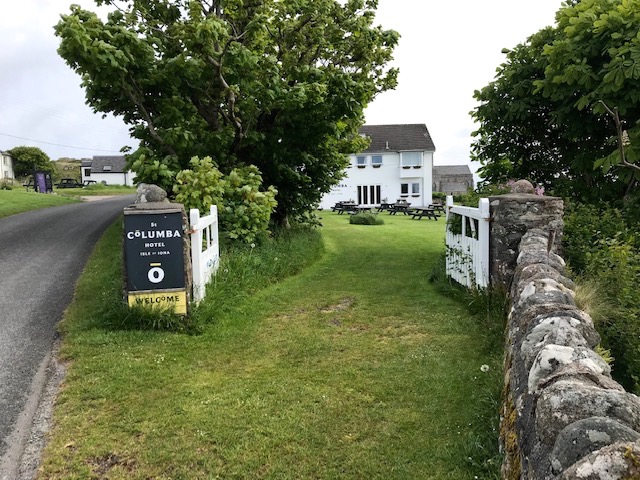
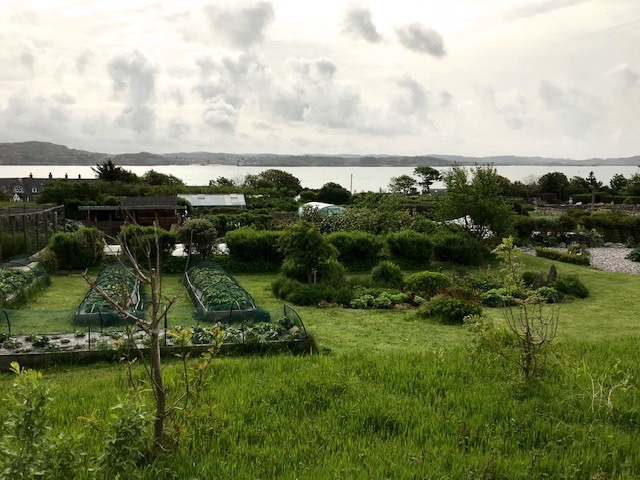
The Columba is run by a partnership of business people who are members of the Iona Community and a good portion of their bookings revolve around the needs of retreats and pilgrims, hence the quiet ease and comfort. Every room has a radio but no TV. Situated next to the Abbey grounds, it has no car park but runs an electric minibus pick up service to and from the quay. The entry to reception is via a grass track through the grounds with lovely panoramic views over the sound. The Argyll and the Columba hotels share extensive and well managed organic vegetable gardens open to the public to supply their respective kitchens.
Our friends arranged a walk over the hill to the wild coast facing the Atlantic, appropriately called ‘Bay at the Back of the Ocean’. On the way there we passed a lot of returning walkers. We’d earlier seen these passengers from a cruise ship, moored to the north, near the island of Staffa, arrive at the pier in batches. They were ferried in at high speed on ribs and we joked that these particular immigrants in small boats would be welcomed ashore as they had money to spend and didn’t intend staying longer than a few hours. More seriously we were informed that some cruise ships in the Hebrides have a greater population of passengers than Mull itself (3,000) and dealing with that kind of mass tourism is a major challenge to island communities not just here but the world over.
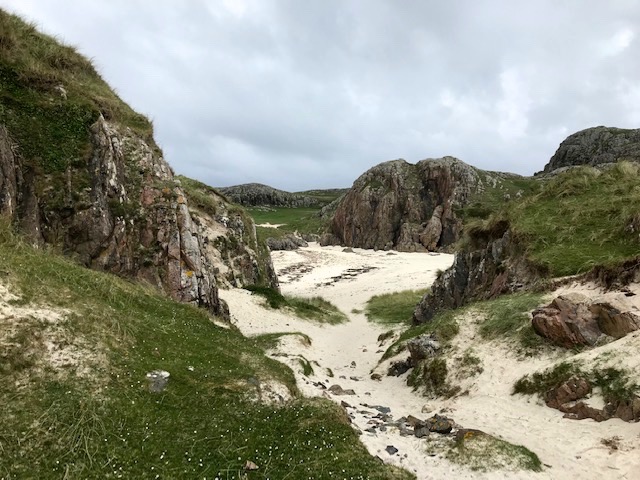
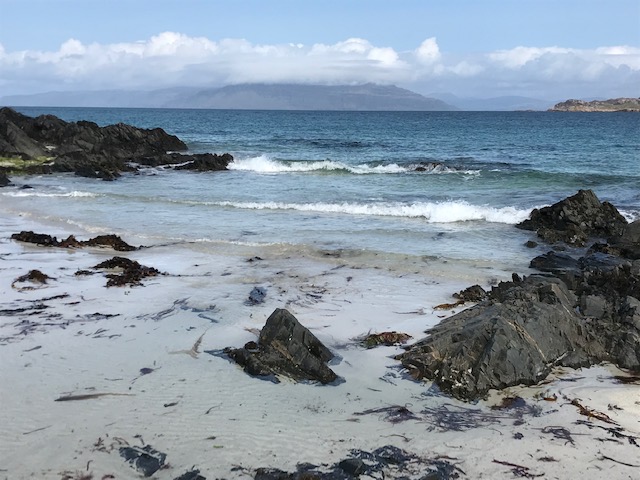
No inhabited Scottish island of any importance fails to boast a golf course and Iona is no exception. The windswept green gives way to more protected areas of rare machair grassland (sandy soil traditionally grazed by low levels of stock) currently awash with daisies and other tiny flowers. That in turn leads to wide white beaches of tiny pieces of crushed shell between dark rocky promontories.
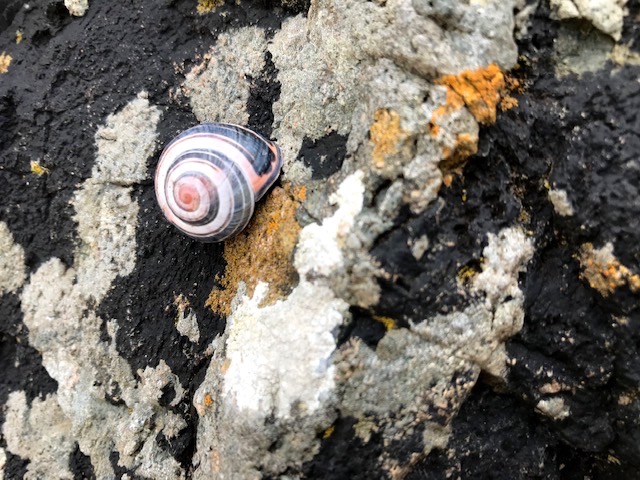
Delighted to discover that Iona is a place where snails go on holiday. Abandoning their normal mud coloured shells for beach ready shades of blue and white that are more appropriate to this environment. And of course those shells will eventually contribute to the wonderful beach’s long term sustainability along with all the crustaceans.

Although only on Iona for a few days we already know we’ll be back to experience more of what this remarkable island has to offer.

 STEPHEN TOMLIN
The nineteenth century poet John Clare wrote “The Landrail” about the elusive corncrake and its call that haunts all those who hear it. https://allpoetry.com/The-Landrail
Despite hearing many Crex rattle, he never saw one.
[audio src="https://en.wikipedia.org/wiki/File:Crex_crex,_July_2010.ogg" /]
While they are very scarce in western Europe (largely confined to the Outer Hebrides and west of the Shannon/Donegal), they breed unhindered in Russia and Kazakhstan. In 2015, BirdLife International estimated there are more than one million pairs in European Russia alone.
SOURCE: https://www.irishtimes.com/news/environment/michael-viney-a-fresh-range-of-measures-to-keep-our-corncrakes-alive-1.4840281
LikeLiked by 1 person
Lovely account, reminding me of my own visit a few years ago. A very, very special place.
LikeLiked by 1 person