here where the landscape /is a long conversation/and the breeze/a list of the missing/and of the dead/read from the surface/of these stones/that do not forget. (From A Northern Aspect by Paul Farley)
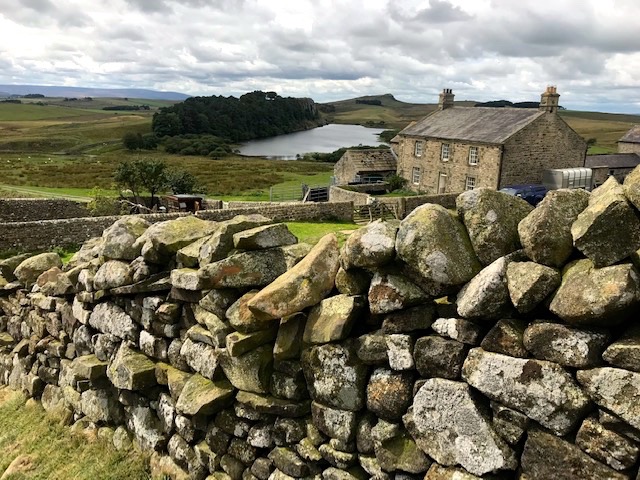
Here in Hadrian’s Wall country you can have endless fun spotting how many buildings have, at one time or another, recycled the component parts of that once mighty edifice. When the Romans left in 410AD all that precious building resource was up for grabs. Neighbouring farmsteads, churches and fortified sites owe a huge debt to the Roman legionnaires for quarrying, dressing and transporting those millions of whin sill (hard dolerite) and softer sandstone blocks.

A UNESCO world heritage site since 1987, This year marks the wall’s 1,900th birthday and a host of different activities have been taking place along its 76 mile length. My indomitable cousin Quetta, a retired archaeologist from London, was up here recently for a week as part in a ‘Secret Histories’ holiday study group. Based at the Beaumont hotel in Hexham these curious souls were ferried from Wallsend to the Solway, with all manner of stops in between, discovering all there was to know about this famous world heritage site and the extraordinary civilisation that built it. The experts leading the party pointed out other sites of interest that they’d no time in the packed schedule to visit. One of them was Chollerton Church, just down the road from us, and Quetta was keen to visit when she came to stay with us for a few days afterwards, as indeed were we.

The first church of St Giles was a wooden building consecrated in 1097. It was rebuilt in stone in the mid C13th by the local landholding family of Swinburne and sympathetically restored from near dereliction in 1875. Chollerton is a few miles upstream from Cilurnum, the fort at Chesters, where the wall crossed the north Tyne River. Not too far then to haul four handsome pillars to support the roof on the south side of the nave of that new stone church, back in the 1260’s.
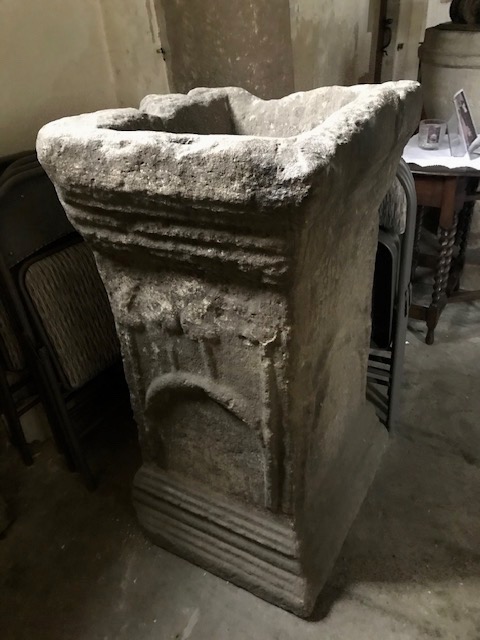
Another Roman recycled stone relic was originally an altar dedicated to Jupiter, discovered in the churchyard in 1827. It was turned upside down, re-purposed as a font, which was a little odd really as they already had a font! That one is circular (with a fine Jacobean wooden cover) probably fashioned for the new C13th church. Do the families of infants about to be baptised get to choose which stone receptacle they want used?
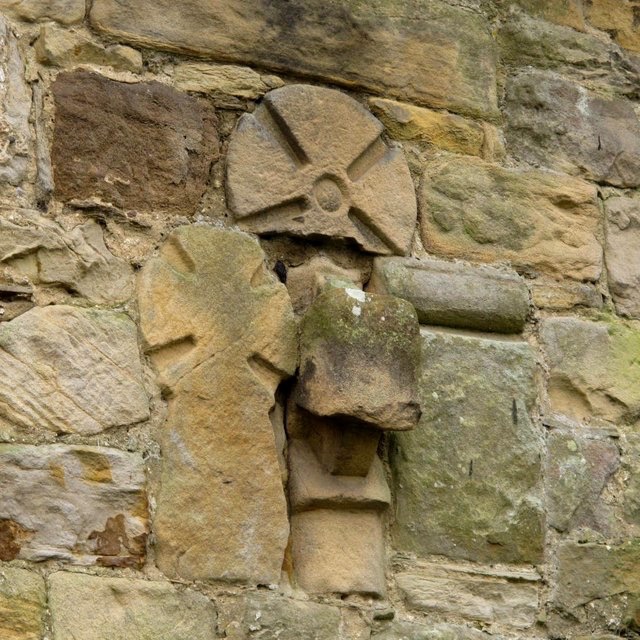
A walk around the churchyard revealed high up on the north wall of the chancel a former window blocked with small stone crosses formerly used to mark medieval graves…Were they recycled skywards when the church was restored in the 1870’s I wondered?
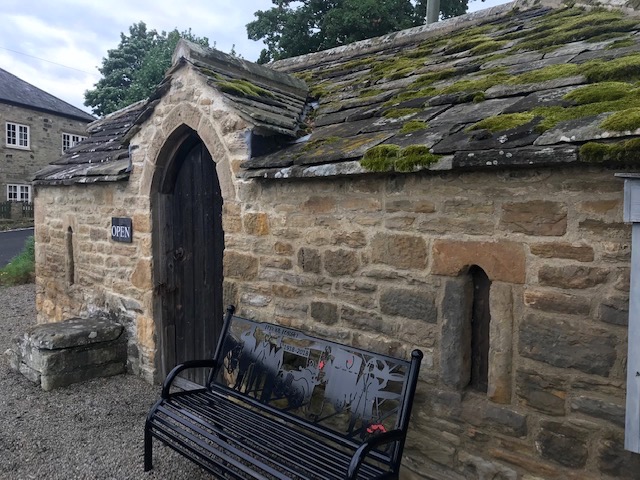
The church ground’s other unusual feature was a complete surprise to us. On arriving we’d taken the sign saying ‘Open’ only referred to the church and not to the single storey building by whose old wooden door it hung. So it was a bit of a thrill to step into what was an early C19th church hearse house and stable block. Restored seven years ago, there are illustrated information panels on the wall about the village and its history.
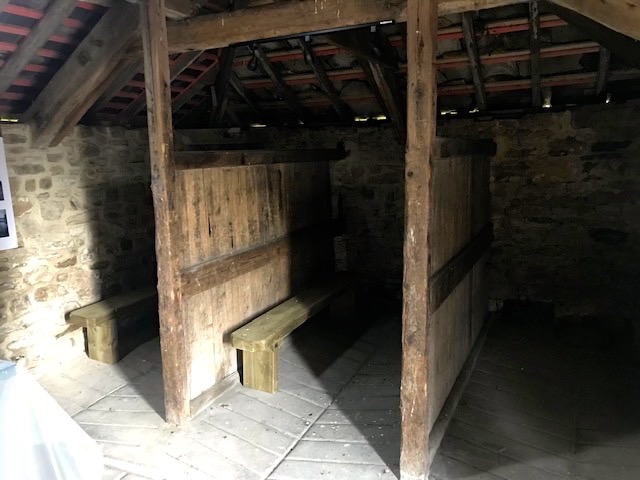
As well as the stalls for horses and bearers coffin carriage, I liked the pattern of drainage rills in the floor and the fact that the building was formerly the village post office. Today the parish is home to under a thousand people while in 1851 the population was over 5,000. Much of the housing has disappeared, along with all its agricultural and industrial trades.
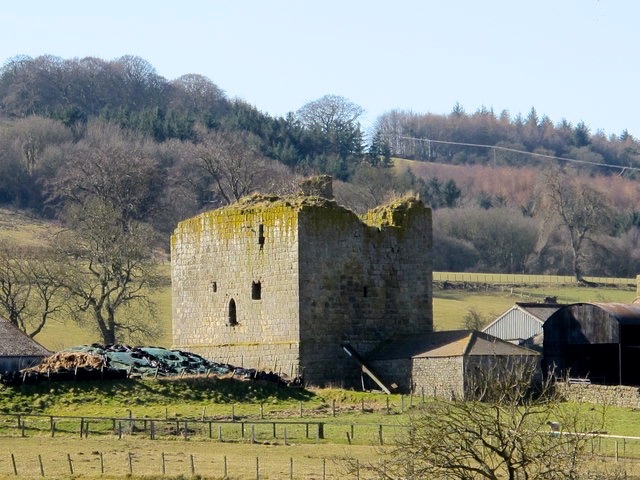
On leaving we noticed a mile southwards the impressive remains of an unaltered C15th century bastle (fortified house) known as Cocklaw Tower. This was the former home of feudal landowners the Errington family, some of whose tombs lie in the church. Today all that’s left of the medieval settlement of Cocklaw is a large farm whose modern buildings surround the tower. Unsurprisingly the substantial three storey tower with its vaulted first floor is largely made of recycled Roman stone.

 STEPHEN TOMLIN
I enjoyed this very much as a visitor to the church. I wonder if there were any pangs of conscience as stones were led from the wall. Our church at Heavenfield also has relics from the wall which was only 50 metres distance.
Bill walton
LikeLike