Vouga voyage

Recently returned from a week’s holiday in the valley of the River Vouga, mid-way between its outlet at Aveiro on the coast and the city of Viseu near its source in the Serra Lapa.

Like the other major rivers of Portugal The Vouga runs its 148 KM course from east in the mountains to the Atlantic in the west. It was once a major transport route for countryside produce; from wines, granite, metals and timber to fruit and other agricultural produce. (In the 17th Century most of their oranges were exported to England) By 1913, a train line had replaced the inland river boats, which in turn gave way to EU funded new roads that twist and turn above the Vouga’s sinuous green waterways. We enjoyed three separate outings sampling distinctive phases of the river’s flow and topography.

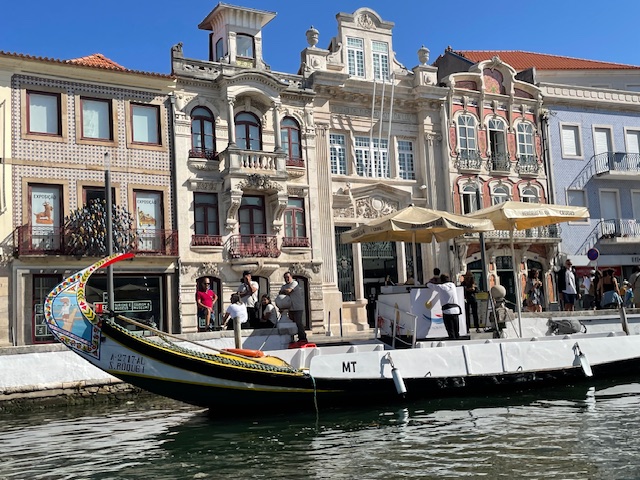
Took a fun day out to swell the ranks of other tourists milling around ‘The Venice of Portugal’, as the city centre of old Aveiro is dubbed. A major port in late medieval times it later became famous for commercial salt abstraction, fishing and seaweed harvesting.

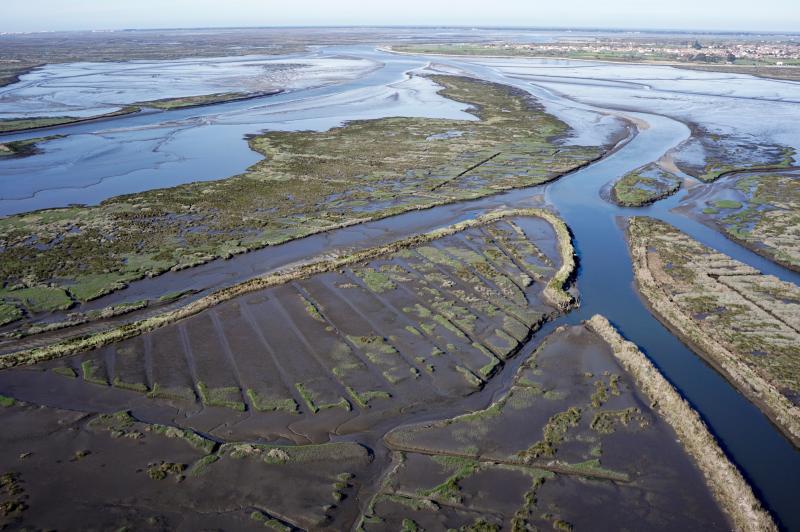
Ria Aviero ecosystem image credit: CESAM

The extensive lagoon and dune ecosystem of the Ria de Aviero, as this estuarial stage of the Vouga is known, now enjoys international status as a major bird sanctuary, home to some 20,000 overwintering wildfowl, the most photogenic of which being pink flamingos.

Trips around the centre’s canal system are a must and the colourfully decorated flat bottomed barges – Molicheiros – that once carried seaweed, salt and general goods now carry human cargo on 45 – 60’ guided excursions.

Unsurprisingly, the last fishing lofts lining the canals have finally closed and are being developed into luxury waterside apartments.

Back on land we visited an Art Nouveau house, now a museum with fine decorative detail, one of many tasteful villas that reflect an early C20th era of increased wealth and pride amongst its leading merchants.

The other end of the Vouga could not be more different. Foreign tourists like us were in short supply here in the mountains, probably because of the limited visitor attractions to lure people up from the popular coastal strip and dangerously high summer temperatures. The Upper Beira  region suffered badly last September from wildfires, causing evacuations and widespread disruption, and we sensed a nervousness even now, lest they return.

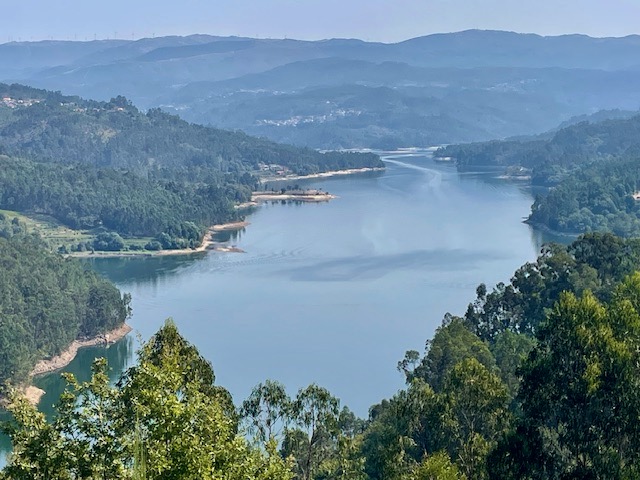
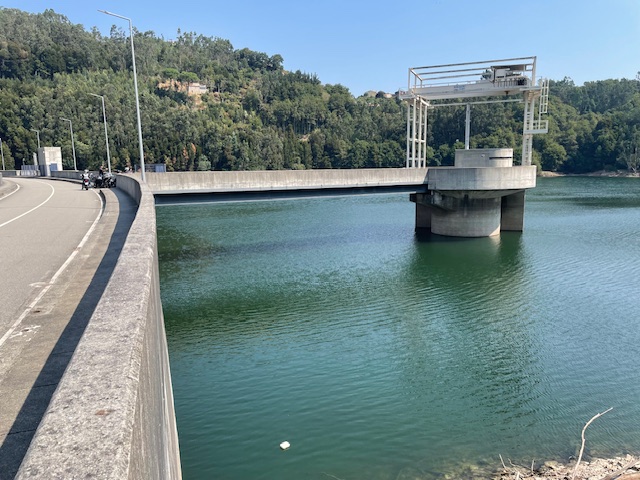
We stopped off at the Ribeirado dam and looked along the 14km long reservoir it created. It was built earlier this century to supply hydroelectric power, ease flooding and increase scarce water reserves. The road runs along the broad arc of the high dam wall, the power station and its infrastructure far below, where the river re-emerges. With the sheer valley walls either side the whole presents as a peerless study in concrete.

The brightest objects encountered in this uniformly grey spot were the red, blue and yellow recycling bins in the car park. Ominously, the control tower in the reservoir emitted flashing light and warning noises every few minutes. If this location were to feature in a future James Bond film or dystopian TV drama it would not surprise us. A perfect setting of its kind.

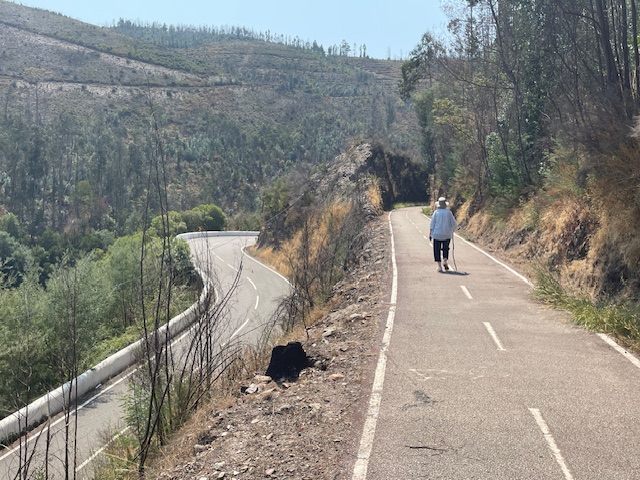
Another day we walked the middle reaches of the river. Was keen to access an upper trackway I’d clocked above the road while driving to our holiday accommodation nearby.

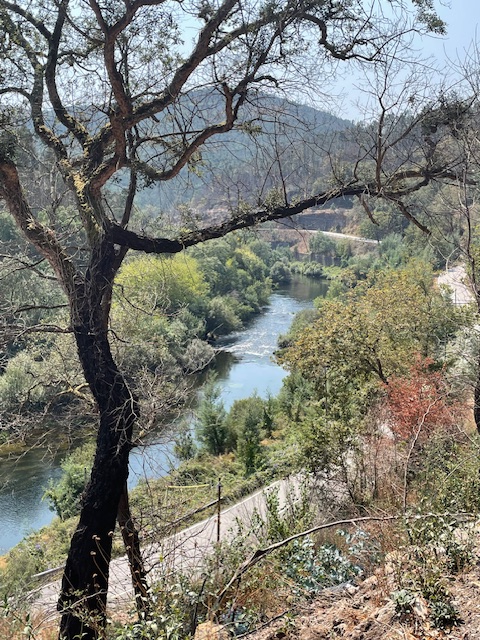
As suspected this was once a single track railway. Built just before WW1 it closed in 1980 and its repurposed state, the former Vale Das Voltas line offers superb viewpoints of the valley.

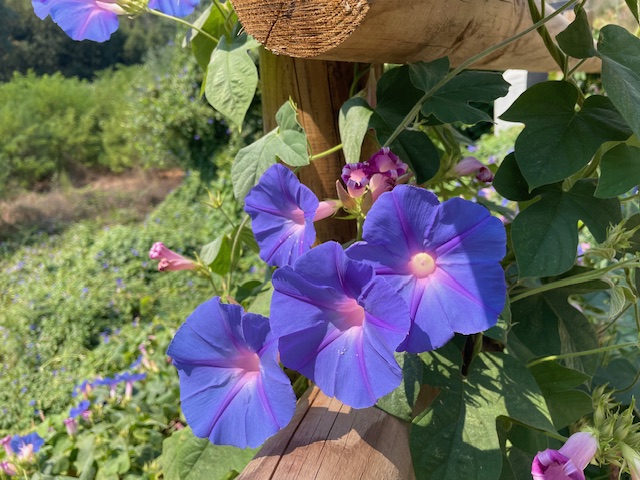
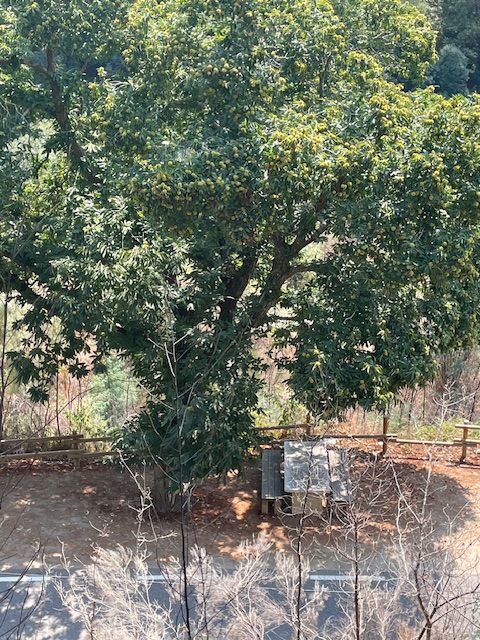
Our parking place by the road revealed a picnic table made from a single slab of local granite set under the awning of a mature horse chestnut tree. Masses of richly purpled convolvulus – bindweed – curled around the wood  rails.

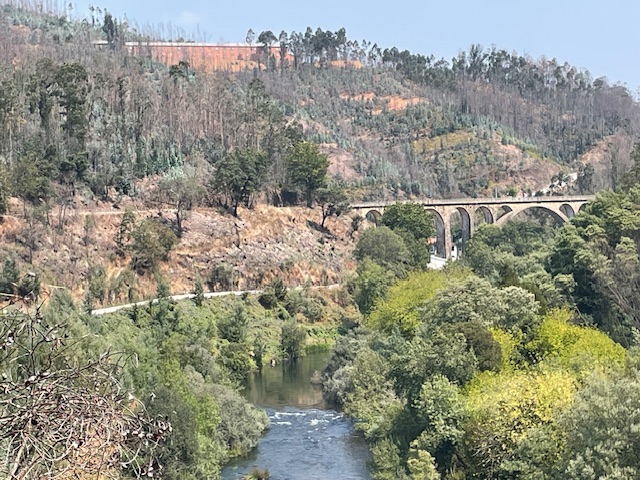
The track is understandably popular with cyclists, yet we only encountered four other pedestrians on our amble to and from the route’s spectacular highlight, the Santiago rail bridge at Pessegueiro do Vouga. It’s one of the highest stone masonry bridges in Portugal, with eleven arches and 165m high deck, gracefully spanning river and wooded slopes.

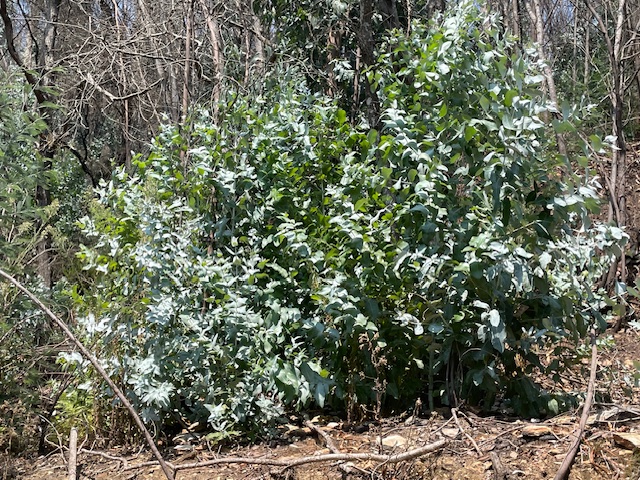
Our walk revealed a stark reminder of last year’s big burn. Blackened trunks and boughs in abundance. A contentious issue in these parts is the preponderance of silvery leaved eucalyptus trees, commercially planted to supply nearby works with biomass and extracted oils. That process is also understood to cause environmental air pollution.

This alien tree, of Australian origin, successfully sustains itself on steep slopes with minimum moisture and burns easily. Eucalyptus rapidly colonises cleared land post fire and is hard, if not impossible, to eradicate.

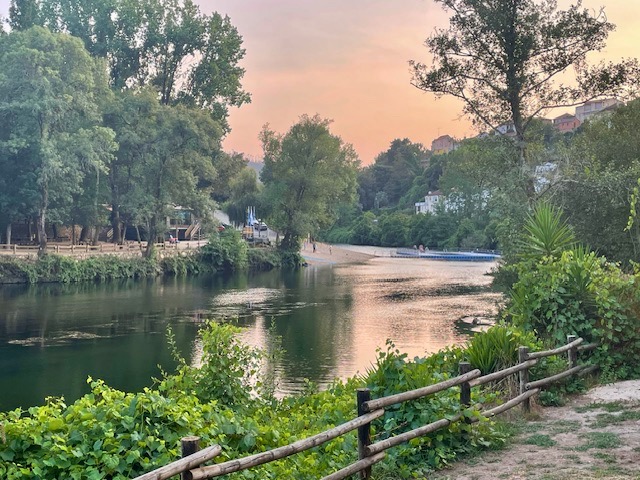
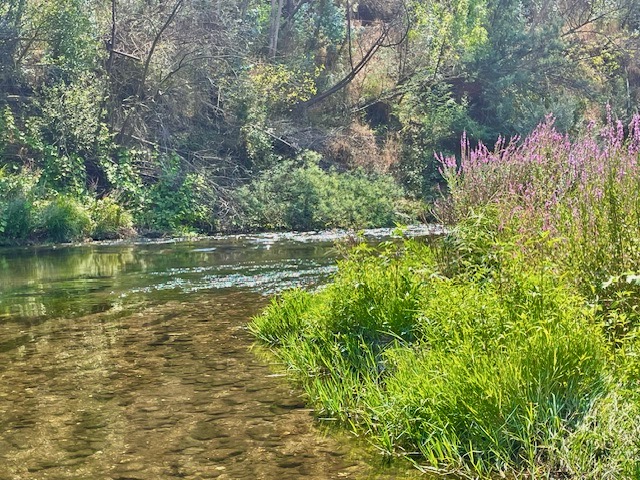
Our walk ended ‘off line’. Carefully crossing the white walled switchback of a highway, we descended to the quiet stillness of river bank and cooling shade of willow and alder that thrive here on its stony floodplain.

This middle stretch of the Vouga is officially designated a ‘Site of Community Interest’. That means minor blockages like weirs that present obstacles for migrating species of trout, eel, shad, barbel, lamprey or mullet are being gradually removed and in some places fish passes are being installed. Otters, birds of prey and many other species of birds and insects are also able to thrive here where human habitation is scarcer.

Delighted in encountering dragonflies and butterflies I waded barefoot in and allowed the hundreds of trout fry mingling in the sunlit shallows to continue feeding and flitting around my feet. A cooling calm end to our lovely lone amble under the afternoon sun.

Hanging Stones

When it comes to rest and recreation it pays to walk. The health and wellbeing benefits are obvious. It’s not so often though that you pay to walk. But that’s what we did a few weeks ago. And for a very good reason.

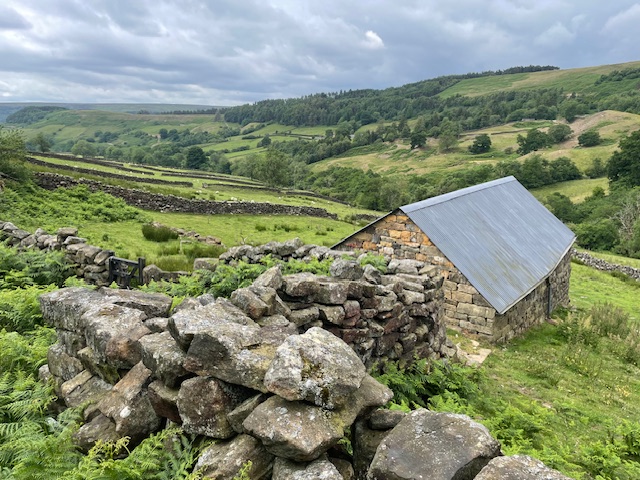
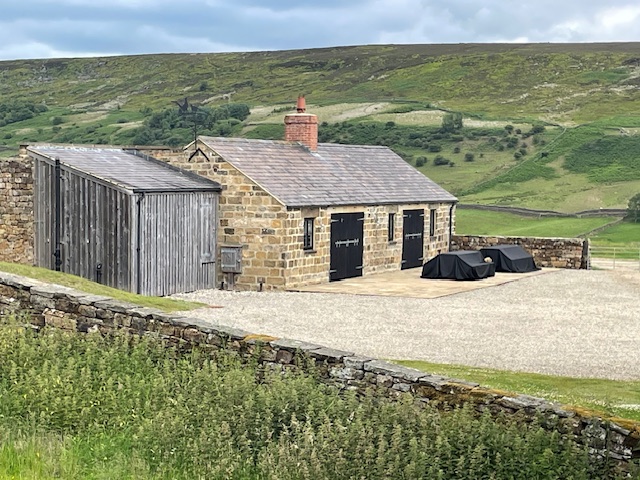
The Hanging Stones art project is unique. Ten restored or rebuilt former agricultural buildings, each containing a bespoke art installation, situated in the heart of the North Yorkshire Moors National Park, all linked by a 6 mile walk. It’s the creation of one of the UK’s – and indeed the world’s – leading sculptural landscape artists, Andy Goldsworthy. His long working relationship with stone dates back to time spent as a teenage farm labourer, maintaining and repairing dry stone walls in his native Yorkshire.

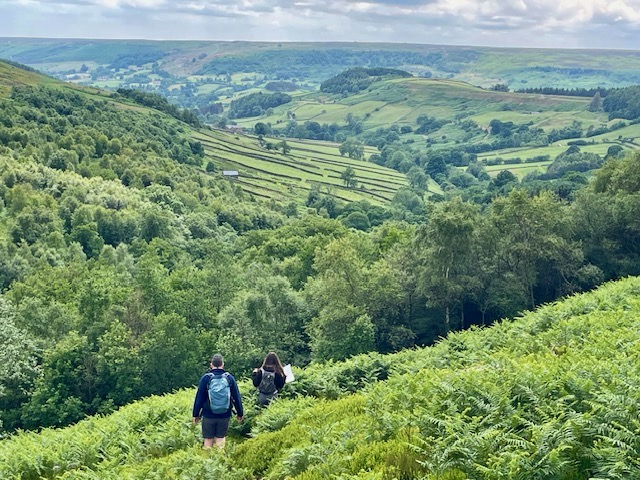
Our party of five was one of four groups of no more than six members booked each day. The trail begins and ends in the village of Roseland Abbey. Parties set out every two hours along public paths, tracks and bridleways into the increasingly steep sided valley that is Northdale, defined on both sides by high bare moorland. At the highest point we saw the group ahead descending and those behind us ascending.

In his 2018 prospectus Goldsworthy wrote: ‘The walk is an integral part of Hanging Stones, the artery by which people will give life to the buildings….It will be both discreet and dramatic. Visible to those who know it is there and hidden to those that don’t’.

The Roseland Abbey area has a long history of mining and quarrying although tourism, agriculture and field sports appear to provide most employment income these days. The highest part of our walk was on a permissive path that threaded through the source waters of the north beck, on whose steep bracken and heather clad slopes stand a dozen or more shooting butts. Returning along the lower valley floor we skirted an immaculately kept shooting lodge, currently under wraps, awaiting the open season in August.

This project clearly could not have happened without the approval and financial backing of the area’s main landowner, the Rosedale Estate, a 4,000 acre commercial grouse moor. Most of the North York Moors is owned by the King as Duke of Lancaster but this particular holding belongs to Carphone Warehouse founder David Ross. His philanthropic foundation supports arts, educational and sports activities. http://www.davidrossfoundation.co.uk/

With the buy in of the local community, the foundation and the National Park Authority, Goldsworthy’s vision and consummate skill has harnessed all the necessary elements to produce an outstanding example of renewal within a protected upland landscape. Work started in 2019 after a struggle to accommodate the proposal to the strict planning laws governing national parks it was given permission to proceed. The result is emotionally charged and thought provoking in its playful linked exposition.

 Goldsworthy says: ‘One of the rationales for working with buildings is that sound, atmosphere and materials are amplified when experienced inside a confined space’ That sense of theatre, which also invokes the atmosphere of a shrine or chapel, is the hallmark of the most effective of the interiors. Dramatic use of natural light and intense application of materials or textures onto the building fabric is fantastic.

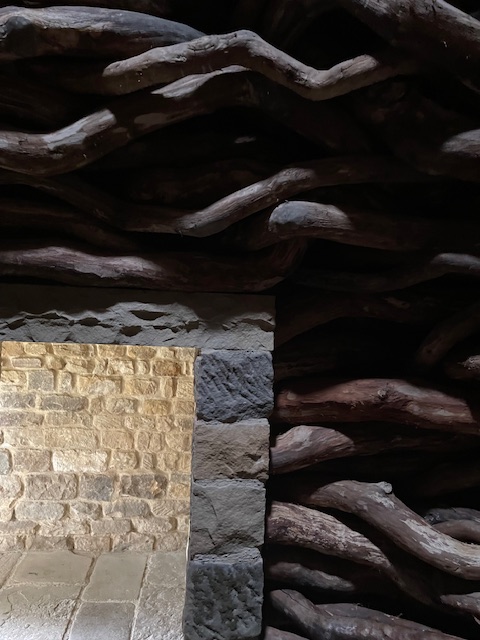
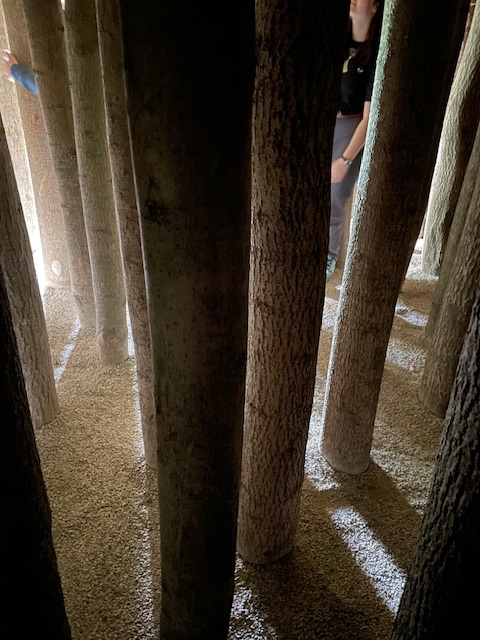
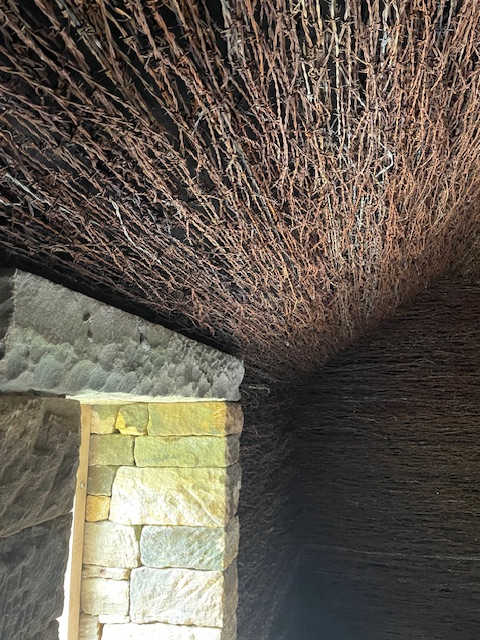
From weave of rusted barbed wire to powdered ochre paint, burnt boughs to woven logs or light bending thicket of poles in gravel – each environment works its rough magic, drawing you into a sensual response.

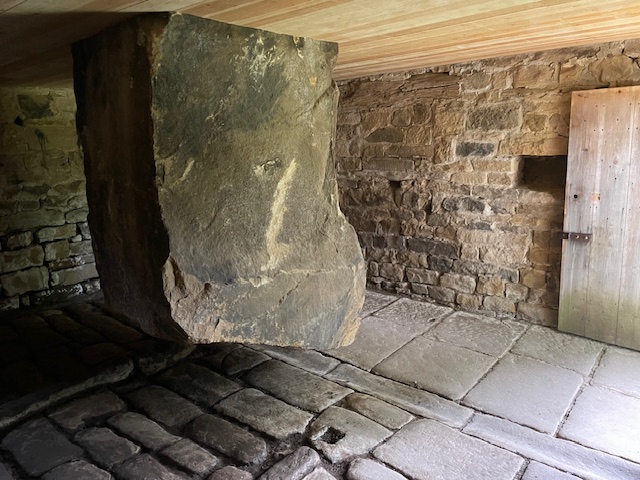
The barn that displays the eponymous hanging stone – all 11 tonnes of it – is brilliant testimonial to structural engineering that teases visual perception of mass in space.

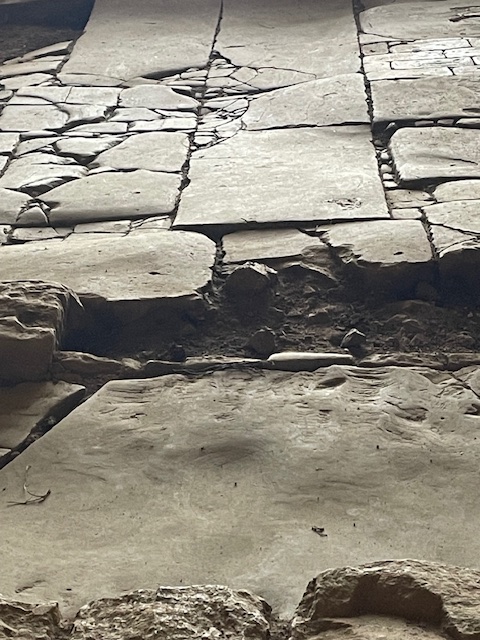
Elsewhere a new build barn traverses the ruin of an old farmhouse floor where the mosaic of concrete and broken flags yield clues of former occupation. This put me in mind of Thomas Hardy’s poem ‘The Self-Unseeing’ whose opening lines run: Here is the ancient floor / Footworn and hollowed and thin,/ Here was the former door/ Where the dead feet walked in.

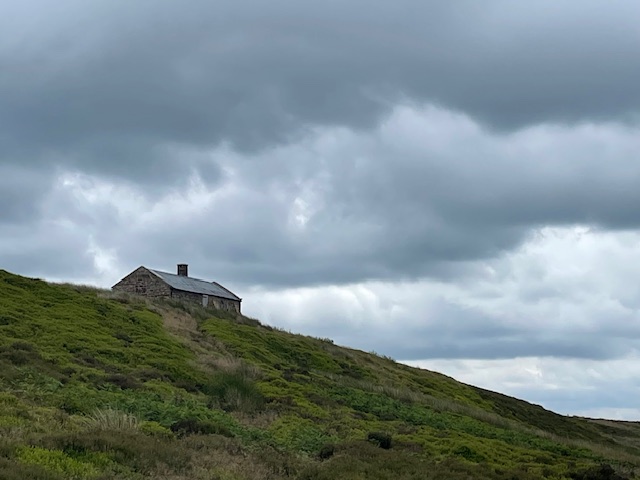
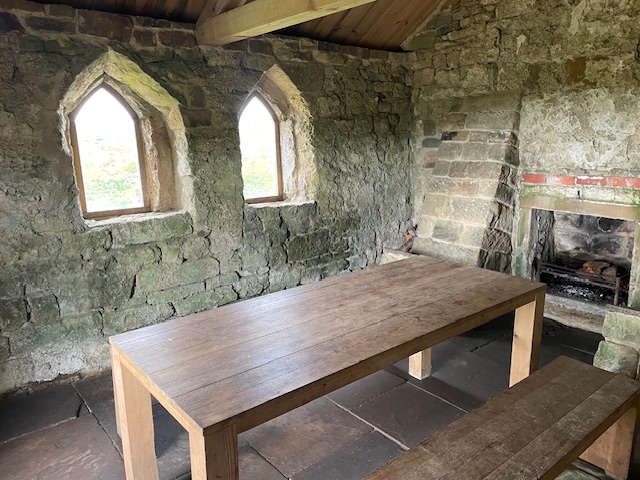
We enjoyed our packed lunches at the ramble’s half way point, following a steep upward scramble through swathes of bilberry covered moorland slopes. Here a large table sits in a little house perched on the open moor’s cusp. Through the open door on a clear day we enjoyed fine views across the high moorland plateau and cleave of dale spread out below.

Passing the shorn trunk of a wayside ash at one point I noted the cut section and wondered if this was an incidental wayside art work or just some essential tree surgery.

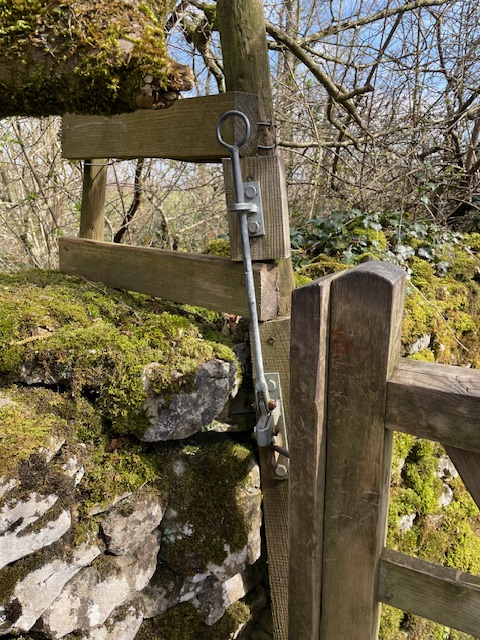
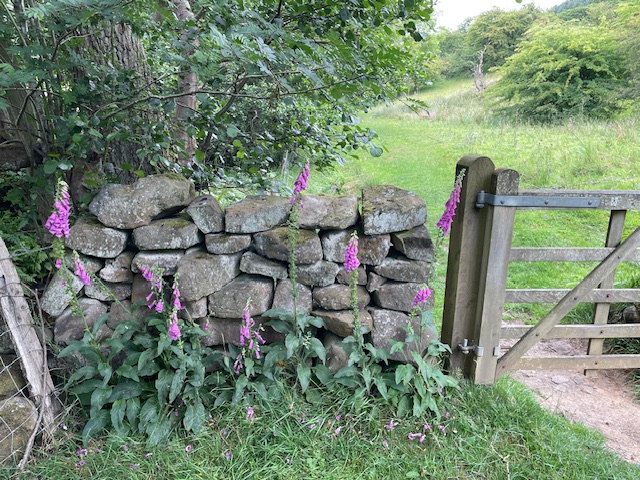
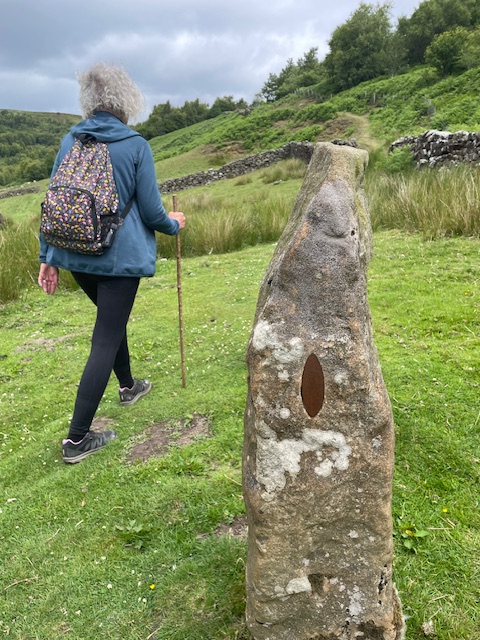
Goldsworthy’s attention to detail helps seal the overall impression. His way markers are subtle oval metal markers set into stone gateposts, some of which also feature small square through holes.

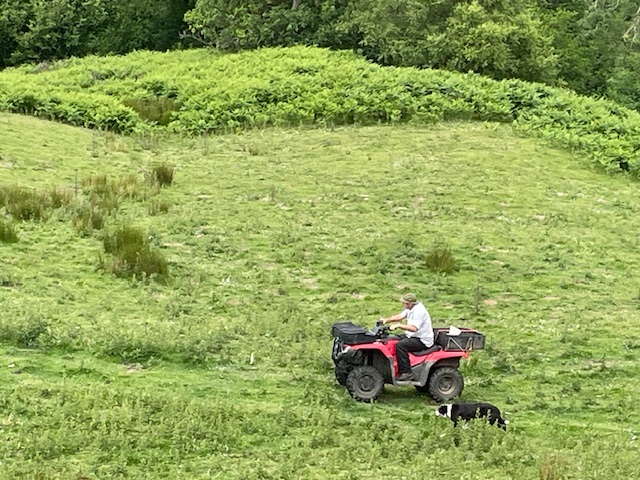
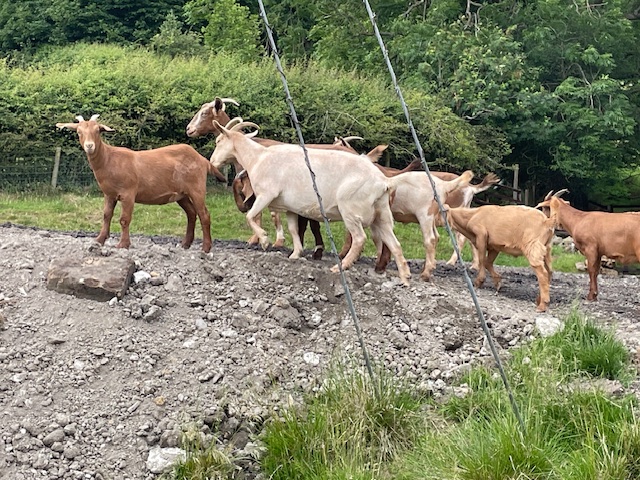
We spoke to a friendly farmer who asked if we were enjoying the art works. Later we saw him rounding up sheep with his collies astride a quad. I suspect he, like many here, are pleased to see redundant buildings restored and repurposed. Later, passing by another farm, we were presented with a picture book collection of ducks, geese, lambs, calves, dogs and goats, all putting up a cacophonous chorus of sound, much to our delight.

Cistercian nuns founded a priory in 1258 at Roseland, establishing the wool trade which sustained them up to dissolution in 1539. In more recent times, from the 1850’s – 1920’s, high quality magnetic iron stone mining became the principal industry. On leaving we passed abandoned roasting kilns atop the valley’s precipitous Chimney Bank road, but with gradients of up to 33% it felt wise not to stop. 

I came away from this remarkable walk with a deeper understanding of how Goldsworthy and his collaborators created these amazing site specific art works, utilising natural local materials to complement and enhance a sensitive and highly protected rural environment.

It proved a memorable  immersive experience in which we as visitors are part of the synergy generated within each of those boxes of delight. Like all great art the effects are cumulative, resonating and lingering in the imagination long after actual contact.

The complex, often contradictory issues and compromises involved in the planning, funding and execution of this project has intrigued me almost as much as the actual installations themselves. I feel that’s worth a tenner of anyone’s money, to allow one the chance to walk in wonder, to witness and reflect on a particular genius of place and time.

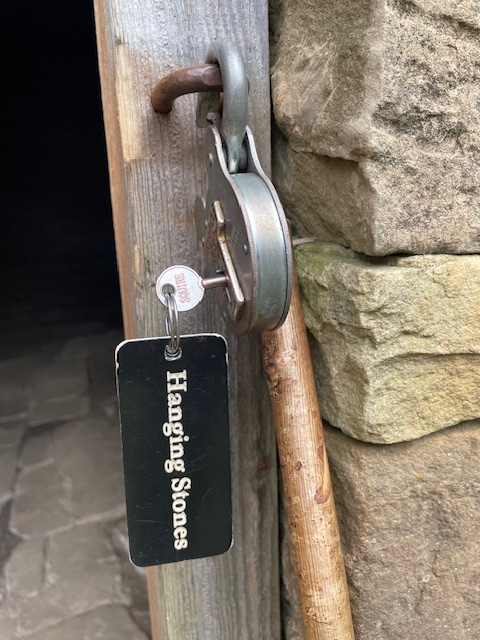
If you are able to experience Hanging Stones for yourself I’d urge you do so. Along with a set time on the allotted day you get a map and key that unlocks each building. Moderate map reading skills and stamina are needed, depending on seasonal weather conditions. Demand is high though. We hear that there’s no availability until February 2026.

More information and to book: https://hangingstones.org/

Clennell Wood Walk

Shooting the Bird woodcut by Luke Clennell

I’ve been a member of the Bewick Society  (http://www.bewicksociety.org/) since I was first associated with Cherryburn, the artist and naturalist’s birthplace in the Tyne valley, and I’ve written about it here in the past. Recently I was amongst a small group of members who went on a walk from Tritlington, just north of Morpeth, to discover more about one of Bewick’s most accomplished apprentices, Luke Clennell, and the semi-ancient woodland there that today bears his name.

Our genial host was Michael Hunter, a Newcastle based landscape gardener, who during lockdown in 2020 bought three acres, a quarter of Clennell’s wood (formerly known as Robin Hood wood). With his Patterdale terrier Roo on a long lead (when not cradled in in his arms) Michael filled us in on the remarkable history of this rolling landscape between the A1 to the west and the Northumbrian coast a few miles east.

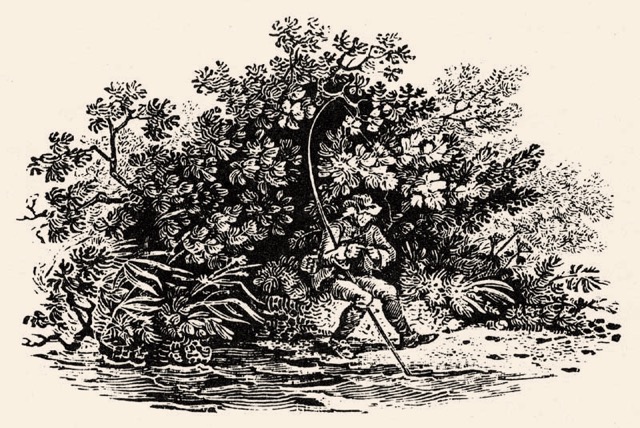
Born the son of tenant farmers in the nearby village of Ulgham Luke Clennell (1781-1840) was one of Thomas Bewick’s most promising pupils. with a similar rural background to his master. Young Luke was apprenticed to an uncle, a grocer in Morpeth, but so all consuming was his appetite and aptitude for drawing that the uncle and local patrons persuaded Bewick to take the 16 year old on in his Newcastle workshop. Clennel quickly became his master’s principal assistant, helping produce the hugely influential second edition of A History of British Birds and was responsible for some of its distinctive ‘tale pieces,’ small woodcuts wittily reflecting rural life, that tail ended the book’s sections.

The Angler is just one example of his skill and showcases Clennell’s particular ability in handling foliage. When his apprenticeship ended the young man left to set up on his own in London where he fulfilled his ambition to be a painter. Initially successful Clennell took on a massive commission in 1814 from his patron, the earl of Bridgewater, to commemorate a dinner of worthies at a post Napoleonic war conference that proved to be his undoing. In struggling to complete 400 separate sittings, sketching heads of attendees, the artist’s mental health, already strained by the death of his wife, collapsed and the painting was completed by another artist. Luke returned to his homeland and the care of family but never properly recovered, spending the last nine years of his life in the Newcastle asylum.

It’s hard now, overlooking this unremarkable stretch of rolling farmland to envisage the stark industrial landscape it presented to the world between 1990 and 2005. Then the wood we were visiting was an isolated island – saved from destruction by its official status as an ancient semi-natural woodland – marooned in a vast strip mining operation.The Stobswood open cast mine was operational1990 – 2007. During that time British Coal abstracted 13 million tons of coal and 250,000 tons of fireclay from the 580 hectare (1,433 acre) site. Appropriately the site known as the biggest hole in Europe had at its operational heart the biggest digger in Europe ‘The Ace of Spades’. This massive walking dragline was better known to locals as ‘Big Geordie’ and dominated the skyline for miles around.

Today that abyss has been completely filled in and restored as agricultural land, wetland, meadows and new woodlands. We could see on our approach along the public footpath that the woodland extension is currently dominated by colonising birch which will eventually give way to native species like oak, rowan and willow.It was a strange sensation walking over that swathe of restored land as the earth was spongy underfoot, not yet having properly settled, a process which will take years. It has been seeded with a wild flower mix so might be interesting to see how that fares as time passes. It was also a different consistency to the heavy clay of the unaffected land we passed, where bullocks grazed in old grass meadows by the infant riverside and its bank stabilising alders and willows.

Michael shares the 12 acre wood with three other buyers, their boundaries marked by coloured wooden posts. One focuses on shooting with a mini-range; another is given over to ornithology with many bird boxes and avian friendly settings while the third is an exemplar of wood craft, with renewed coppicing , dead hedging and other examples of traditional woodland management.

Michael and his family revel in their visits to the site and he’s allowed by regulation to camp out for a set number of nights a year. In that time he’s become (literally) a lot closer to nature, as an unobtrusive witness to the secret lives of its animal inhabitants, in particular hares, badgers, roe deer and foxes.

We visited the well established badger setts and traced their trods through the undergrowth of bluebells, wild garlic, dogs mercury and grasses. Stopping for a brew under the dappled canopy he pointed out the shallow depressions where deer have lain, the places where hares congregated to frolic of an evening.

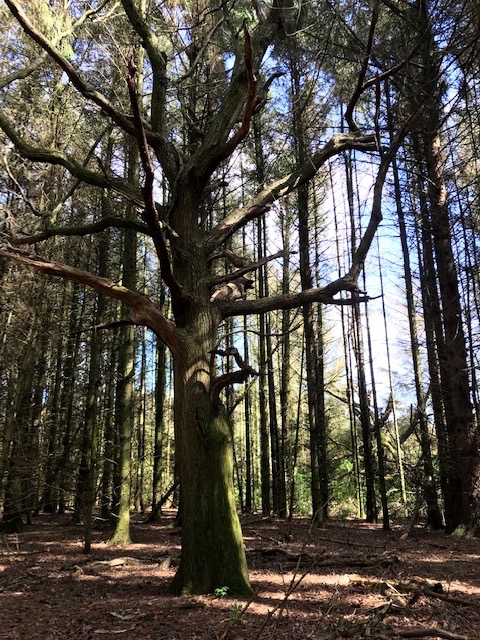
At some point in the 20th century the three quarters of acre at the wood’s heart had been cleared of broadleaf and replanted with spruce for commercial purposes. That sits awkwardly with the rest of the site, and we hoped it might be cleared and restored one day. Hauntingly, in amongst the dark looming pole straight conifers stood an old oak tree, a sole survivor from the past, seemingly dead but on closer examination still hanging on in there, with leaves emerging in its highest canopy to greet the hint of spring sun..

Having immersed ourselves for a happy couple of hours in this impressive survivor of semi-ancient woodland we left with a renewed faith in the ability of nature to recover from the severest sieges. Cheered too at the stewardship of individuals like our host whose actions help restore the balance of life, living in  harmony with and learning from the natural world. As we walked back over the brow of the hill I couldn’t help but feel that the essence of Luke Clennell’s troubled genius is resident in the wood he would have known as a boy, at home in a place where his artistic spirit can rest at peace.