Cabeco Trigal

‘The colours, aromas, flavours, textures and the melody of laughter’  

(Cabeco Trigal wine bottle label).
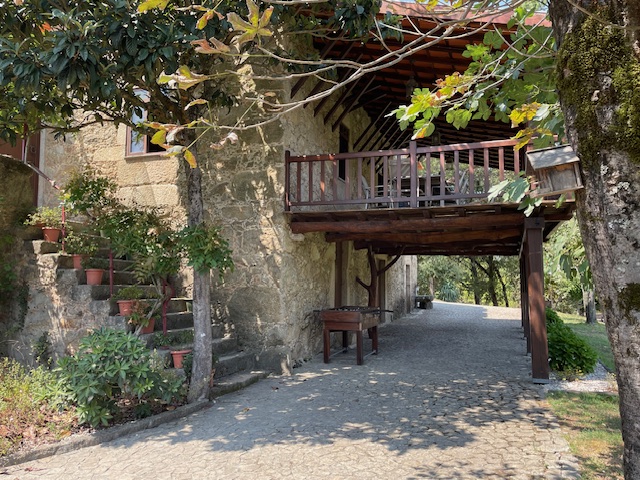
The Air B&B we stayed in had some very attractive features, being a modernised traditional dwelling with all mod cons, lovely outdoor open pool and extensive private grounds.
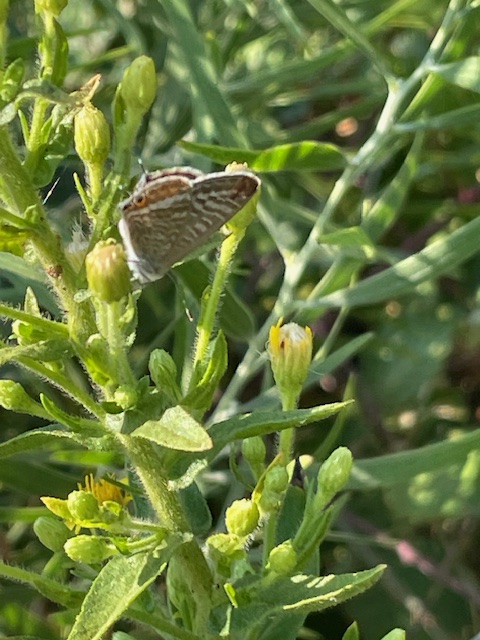
The lawn between house and pool had remained green despite the punishing heat, being the toughest of varieties refreshed by evening sprinkling and morning dews. Many long tailed blue butterflies were about while squadrons of house martins dived, dipped and sipped from the pool water, most thrillingly while I was in it, swimming alone. Jays were seen in the surrounding woodlands. Our lovely accommodation apart, the other aspects of the place had particular rural interest that made this establishment stand out from the crowd.
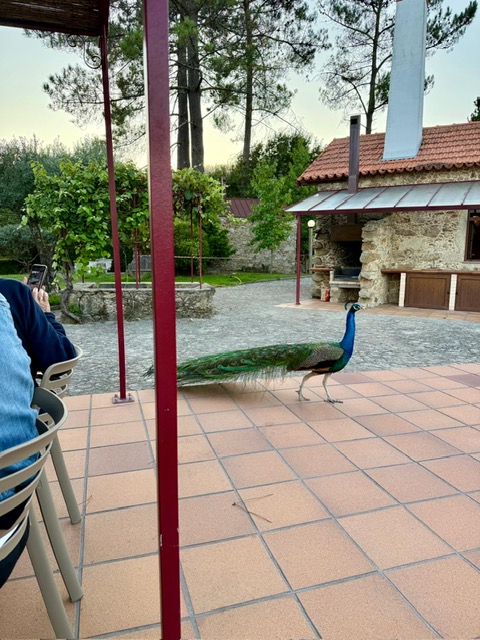
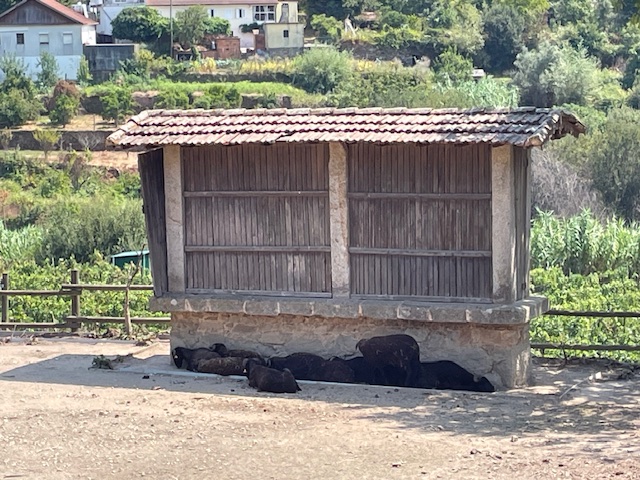
Cabeco Trigal is also a quinta (winery) and a smallholding with traditional breeds of sheep and pigs, alongside horses and llamas. The last features as the estate logo. Animal grazing being sparse it is subsidised with hay and grain. Sheep sheltering from the sun in the shadow of trees or the traditional horreo (granary). Pigs wallowing in mud pools, free roaming male peacocks punctuating the air with their screeches.
Tiago, the owner and our genial warm hearted host, is an architect by profession who lives with his family nearby. He specialises in repurposing industrial buildings and the tasteful conversion of this his family farm complex, including extra bedrooms in the adjacent barn cum workshop, succeeds splendidly in effectively blending old and new materials.

As temperatures climbed we appreciated even more the cool retreat three floors of indoor space provided, as well as the welcome shade of its wide wooden balcony overlooking the wider estate, with views across the hillside.
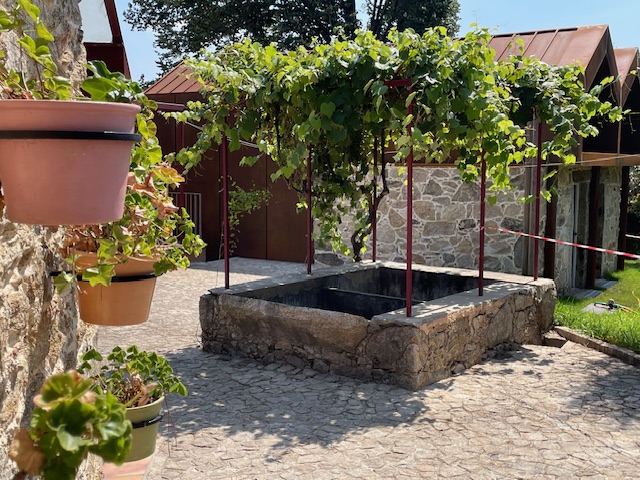
What especially endeared it to me was that house and barn were originally constructed of the light grey granite which defines the local topography. Growing up on the edge of Dartmoor this was a comforting reminder of that happy connection of time and place.
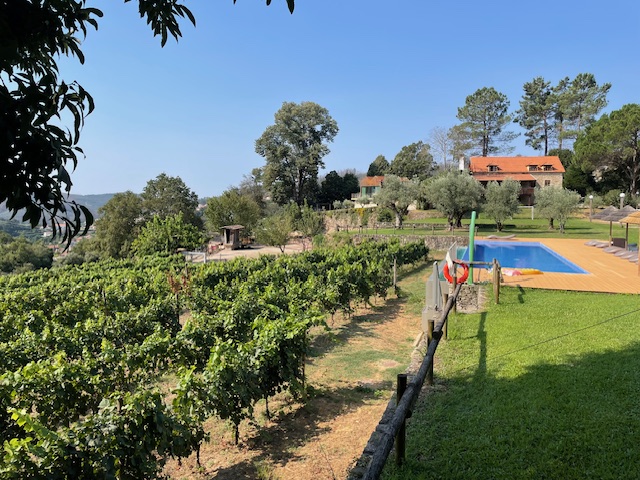
Our host is proud of his family’s long history in the Vouga valley. To honour the patrimony he embarked earlier this century on a multi-faceted passion project to reinvent what remained of a once grand estate, here at the cabeco (high place).  Modernising the old farmhouse and repurposing the remaining land by switching away from arable (Trigal means wheat field) to develop and extend the existing wine production on artisan lines was central to that vision. Holiday rental income is the third aspect underpinning the enterprise.

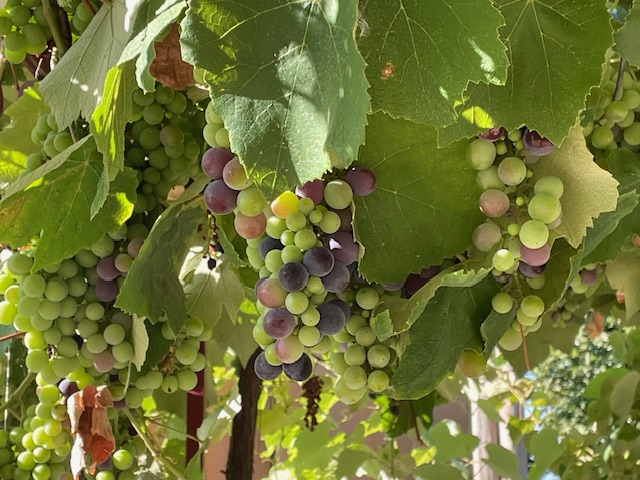
Intense cultivation here, fully utilising the land’s south facing terracing, involves controlled animal grazing in the aftermath of harvesting and again in the spring to control weed growth. Tiago told us that the land here is not ideal terroir for wine production, being rich enough for grain but not for vines which thrive best on impoverished soils. And that’s the reason they cannot go organic. Minimal, though essential, chemical treatment is necessary to ensure successful growth of the new varieties of grapes they’ve planted.  
We joined Tiago early in our stay in the workshop underneath the barn, standing amongst the stainless steel vats where the ‘22 and ‘23 harvests of merlot, pinot noir etc stand alongside the French oak barrels the vintages will eventually be transferred to for maturation. He consults  throughout with Louis, his business partner and wine maker, who oversees the whole process.
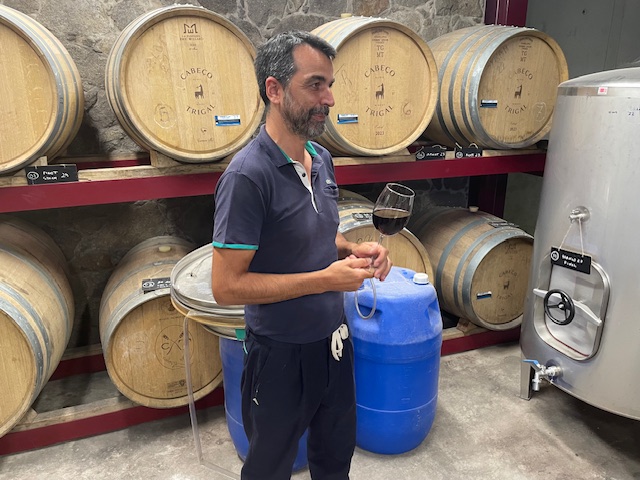
That day Tiago was testing the grape juice to calculate how far off harvesting they were. His sampling tool logged a 10.5 degrees alcohol strength, not the 12 or 13 various varieties need to be at harvesting. (At the time of publishing that would be now.) Friends and neighbours join in to pick, sort and trample the grapes, earning their just reward in produce!

The metal press is used for processing  the chardonnay, sauvignon blanc and other native Portuguese white grape varieties. Interestingly, the actual pressing utilises minimal weight to ensure longer extraction and subsequent subtly of flavour. It’s in the final balancing  process that the skill of the experienced winemaker comes to the fore.

We understood there to be some 6,000 litres currently in production, which makes for approximately 8,000 bottles. These are individually sealed with wax by hand after labelling at the bottling plant.
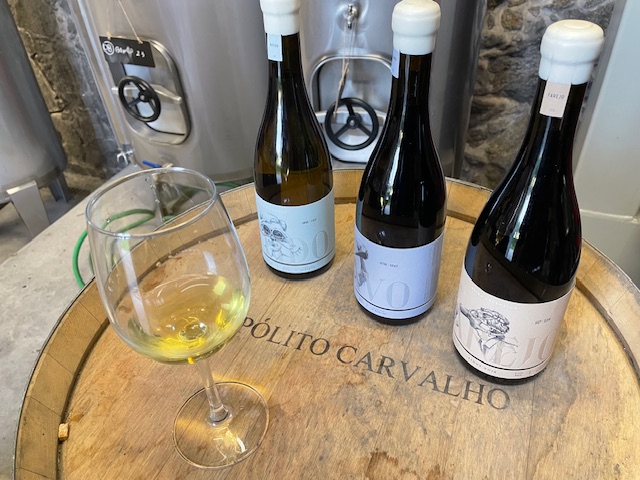
Unsurprisingly you don’t find Cabeco Trigal wines on the shelves of local supermarkets where we noticed the average price of the country’s home product is around €8. Portugal’s main wine producing regions lie to the south and they produce  there industrially at scale. No, these bottles cost around €20 if retailed locally and Michelin starred restaurants are the main customers.
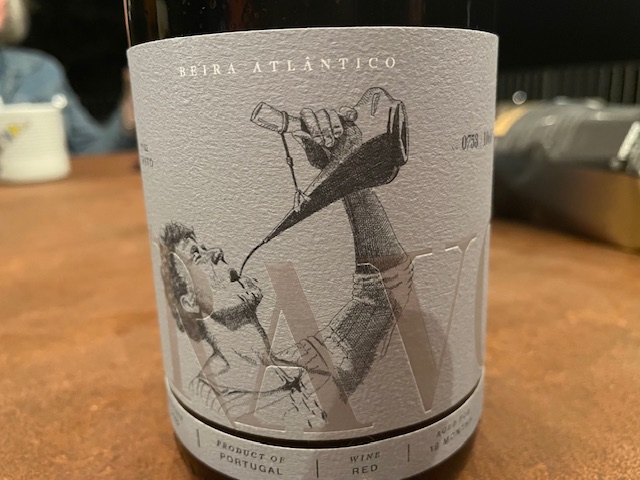
We loved the distinctive quirky line drawings employed for each label. A bottle’s appearance should be an entree for the eyes and these do that. Here’s a translation of one of the key sentences on each label, which neatly sums up what they have set out to achieve.

‘On a hillside where the ancient wheatfields turn to lush vineyards that colour the bucolic mountain landscape, these are our wines in an environment of perfect co-existence with our people and farm animals’.

The much anticipated wine tasting with Tiago on our penultimate night was a convivial affair. The final evening we followed through on his recommendation and enjoyed delicious traditional specialities on the riverside terrace of a local restaurant. it was a pleasure to end that last evening with the remaining bought samples back home. Toasts was raised to the spirit of Portugal in general and one enterprising wine producer in particular.
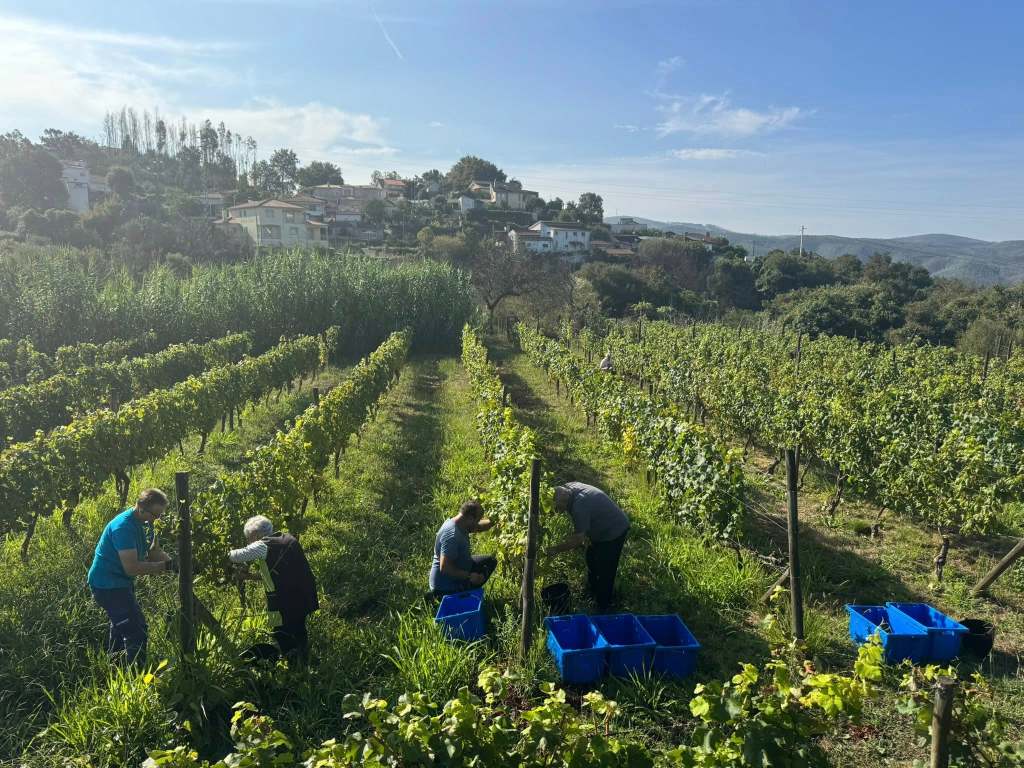
You can see more pictures of this year’s harvest at https://www.facebook.com/QuintadoCabecoTrigal
Bussaco

‘Bussaco Forest cannot be described, the best is to get lost in it.’  Jose Saramago

Having been told about the Bussaco National Forest by my cousin who had visited recently we were keen to discover it for ourselves during this holiday. An hour and a half’s drive from base by good main roads and testing twisters through mountainous foothills led us to this unique walled in world, one of the botanical wonders of the Iberian peninsula.

We entered from the spa town of Luso via the Serpa gate, one of 11 gateways that punctuate the 5 K (3.1 mile) boundary wall. Only mildly alarmed when the keeper in her lodge warned us that walking any distance into the forest from the centre was entirely at our own risk due to the heightened possibility of wildfire outbreaks.

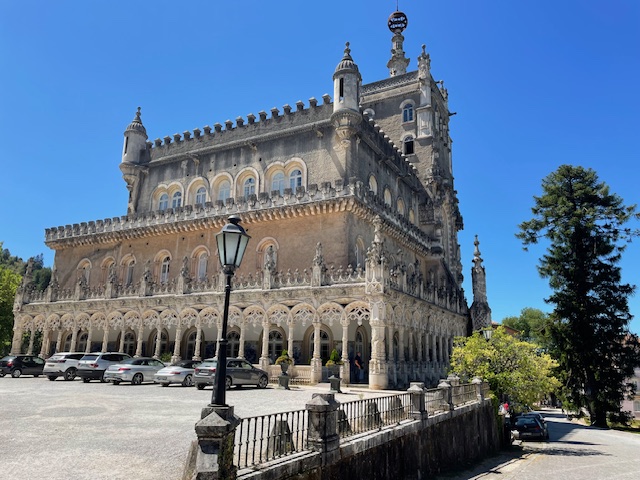
It would have been no great hardship to have spent our time in and around the park’s historic centre, which consists of a former royal palace cum luxury hotel (below), monastery, now a museum (above), formal gardens, café and visitor centre. 

Although Bussaco was originally an early 7th Century Benedictine foundation the one we see today was established by the more austere Barefoot Carmelite order when they took stewardship of the buildings and park in the early C17th.

The brothers zealously set about gradually replicating the Holy Land’s Mount Carmel at Bussaco as a kind of desert, blending nature with God’s spiritual estate.

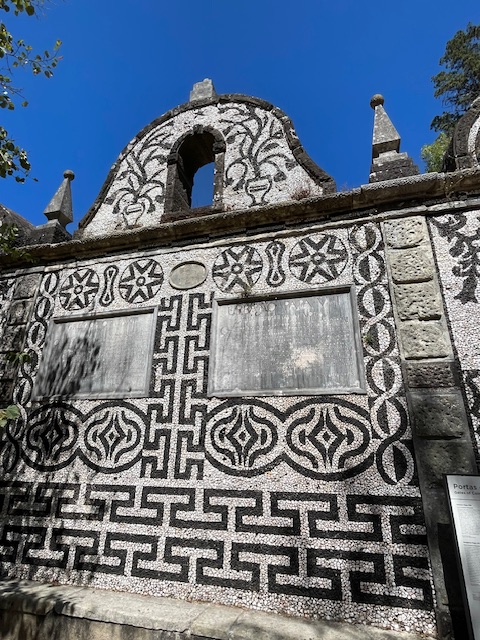
Many of their structures have exteriors distinguished by tessellated designs fashioned from quartz and adhesive tar while the interior of their monastery have coverings of native grown cork freely utilised to insulate walls ceilings and doors against winter cold.

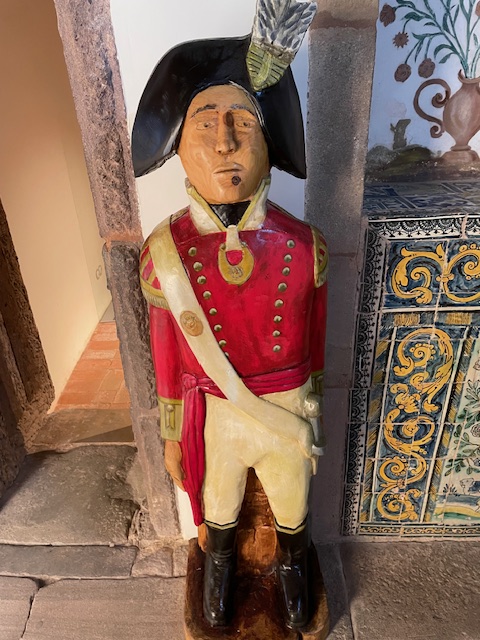
The brothers ordered existence was rudely disrupted in September 1810 when the Duke of Wellington, commanding a combined mass of 50,000 Anglo Portuguese troops, based his command post in the monastery, using the monks cells for offices.

The British general’s army defeated Marshall Massena’s French forces here at Bussaco, halting their advance on Lisbon, a turning point in the country’s campaign of liberation from Napoleonic invasion.

The adjacent royal palace was built between 1888-1905 on part of the demolished monastery. Since 1910 and the fall of the monarchy it has been a luxury hotel, one of the finest in the land. Its initial architect, the Italian Luigi Mantini, also designed sets for grand opera, and it shows. What a brilliantly grand statement of opulence it makes to the world.

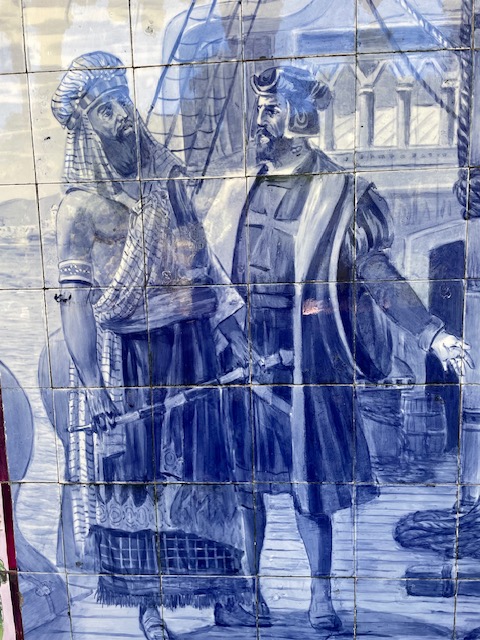
The obliging hotel receptionist let us take a look around the sumptuous ground floor. Large scale blue and white azulejos (tiles) decorate walls and stairs, some displaying the battle of Bussaco and others scenes from Portugal’s ‘Age of Discovery’ in the late 15th and early 16th centuries. At that time Portugal established its maritime trading outposts, stretching from Brazil to southern Africa, Goa in India to Macau off the coast of China.
The formal gardens provide a graceful unifying setting for the two contrasting buildings, although box blight and a certain faded glory added to a suitable sense of gentle decay.

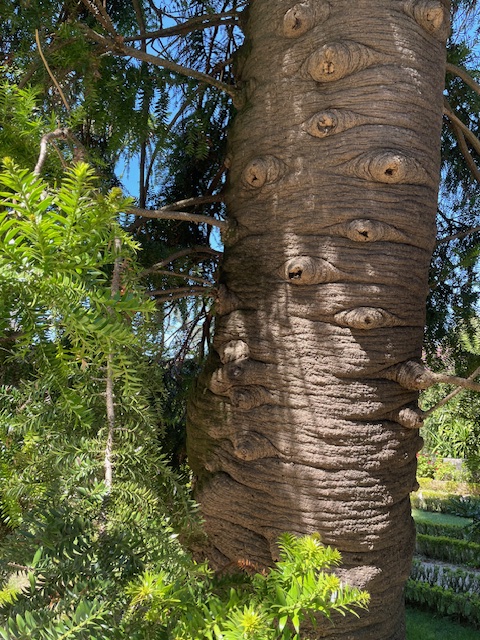
The arboretum remains the true natural glory of the place. Some 400 native trees and shrubs grow alongside 300 specimens brought back home as the result of colonisation and exploration. Mexican Cypress, American redwoods, Chilean pines, many oaks, laurel, holly and ferns to hundreds of Camellia species are set around walks, steps, ponds, fountains, statues and other formal features – we saw just a fraction.

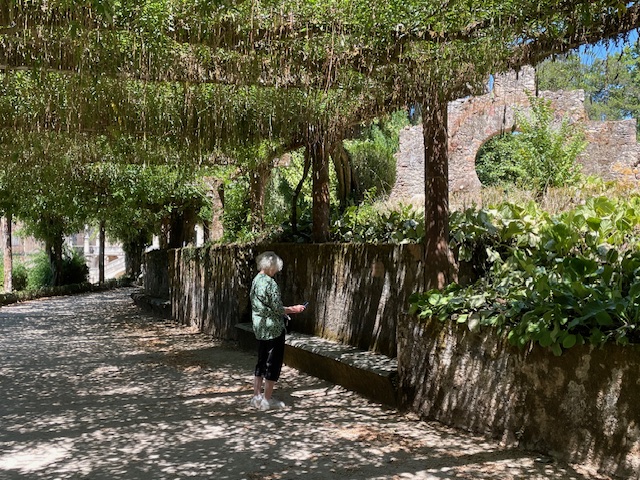
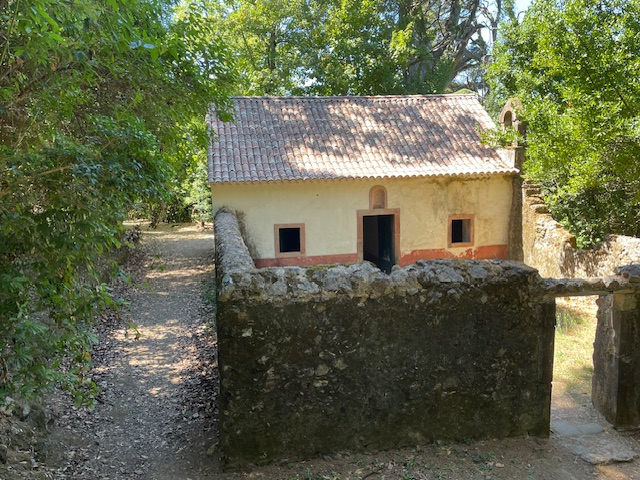
Leaving the formal gardens  for an upper woodland walk, we found ourselves on the Via Crucis- a lane of dappled shade linking enclosed stations of the cross – eventually leading to a purpose built hermit’s house with enclosed yard, now an empty shell, one of three around the domain.

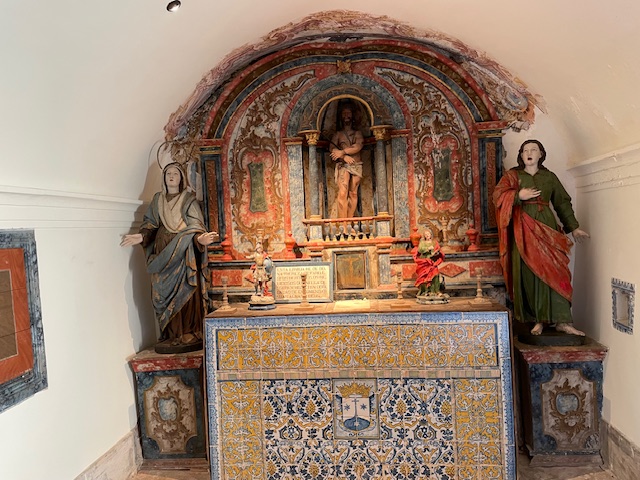
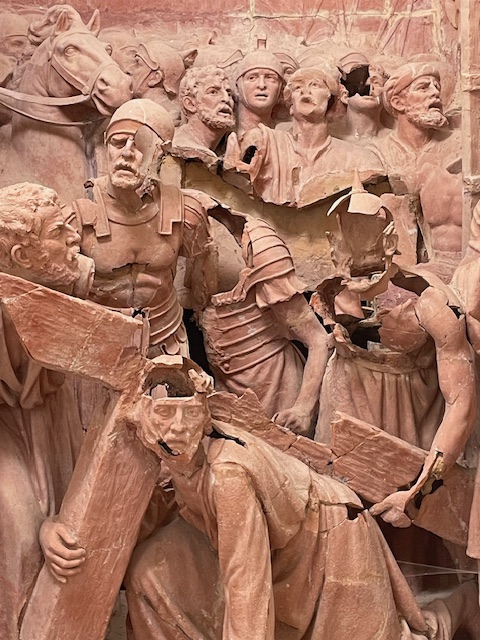
The stations house life size red clay tableaux, vividly recreating scenes from the passion of Christ. Hermit retreats and devotional stations were originally set up by the Carmelite monks shortly after they  took over the estate in 1628.  A number seemed to have suffered damage, adding an unintentional modern feel of abstract dislocation to the dramatic scenes of heightened emotion.

Later learned this damage was caused by a particularly violent storm that struck the area in January 2013, severely affecting both buildings and trees and recovery has been hampered by lack of funds and resources. The state took over Bussaco when Portugal’s monasteries were dissolved in 1834, and today managerial responsibility lies with a charitable foundation, which has had to fundraise widely to painstakingly restore the place.

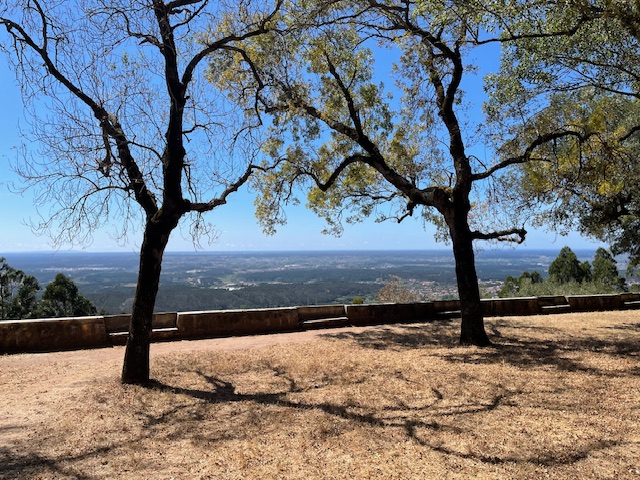
Our stroll took us to another entrance way – not accessible to traffic – the Coimbra gate which yielded surprise vistas beyond the canopy, across the wide plain, to the Atlantic coast.

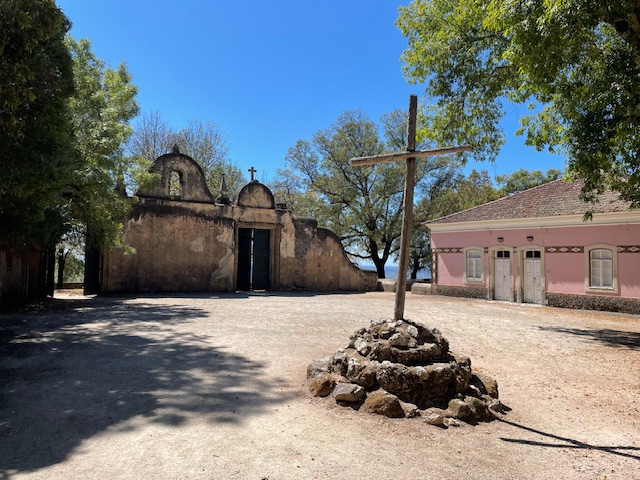
Lingered by the great doors, now ajar, and the currently unoccupied lodge house (sometime holiday accommodation) with its pink washed walls. Wondered at the wall sign, a papal bull of 1623 forbidding, on pain of excommunication, the felling of trees within the walls or the entry of women!

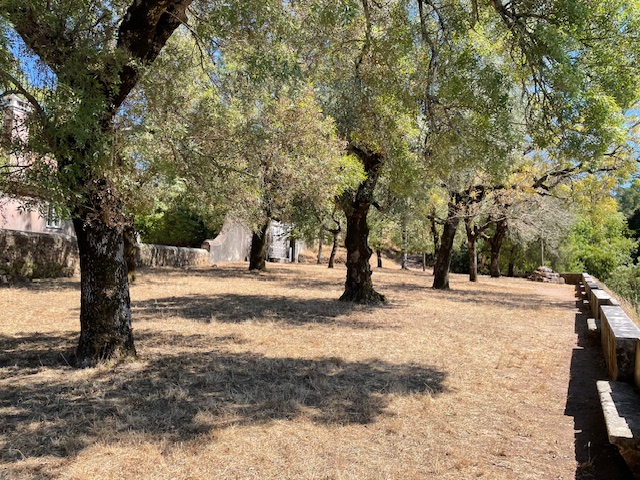
Historical misogyny apart, I warmed to this early attempt at nature conservation. An atmospheric spot inviting reflection and ease, one where time seemed to have stood still. Stepping out on to the terrace in the full glare of the sun, the bone dry brown grass  crunched loudly underfoot, providing a reminder of the gatekeeper’s words on arrival.

Popular with the Portuguese themselves for its cultural and botanical importance, though less well known to foreign visitors, the Mata Nacional do Bussaco lives up to its reputation, inviting a return to sample further corners, in another season.

Vouga voyage

Recently returned from a week’s holiday in the valley of the River Vouga, mid-way between its outlet at Aveiro on the coast and the city of Viseu near its source in the Serra Lapa.

Like the other major rivers of Portugal The Vouga runs its 148 KM course from east in the mountains to the Atlantic in the west. It was once a major transport route for countryside produce; from wines, granite, metals and timber to fruit and other agricultural produce. (In the 17th Century most of their oranges were exported to England) By 1913, a train line had replaced the inland river boats, which in turn gave way to EU funded new roads that twist and turn above the Vouga’s sinuous green waterways. We enjoyed three separate outings sampling distinctive phases of the river’s flow and topography.

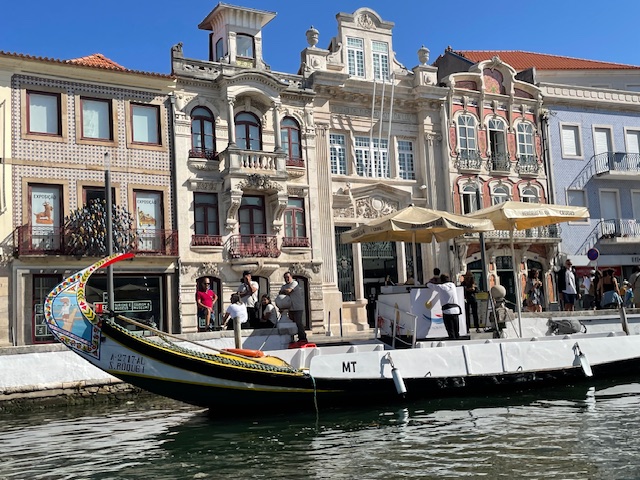
Took a fun day out to swell the ranks of other tourists milling around ‘The Venice of Portugal’, as the city centre of old Aveiro is dubbed. A major port in late medieval times it later became famous for commercial salt abstraction, fishing and seaweed harvesting.

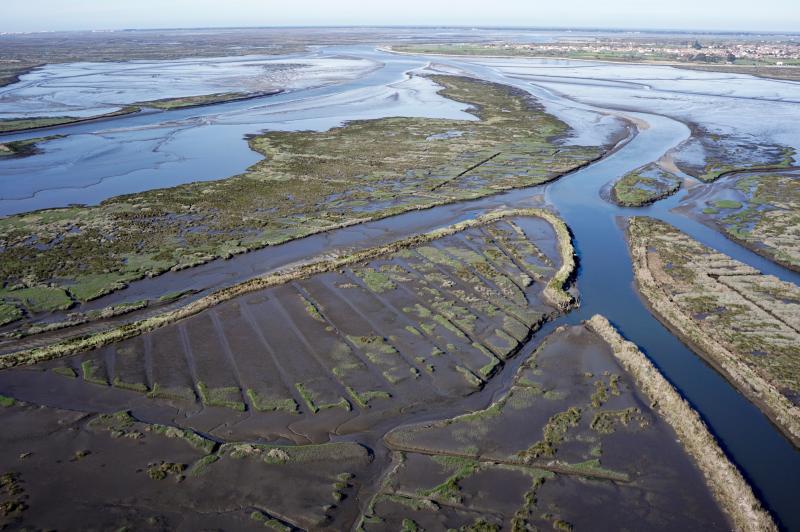
Ria Aviero ecosystem image credit: CESAM

The extensive lagoon and dune ecosystem of the Ria de Aviero, as this estuarial stage of the Vouga is known, now enjoys international status as a major bird sanctuary, home to some 20,000 overwintering wildfowl, the most photogenic of which being pink flamingos.

Trips around the centre’s canal system are a must and the colourfully decorated flat bottomed barges – Molicheiros – that once carried seaweed, salt and general goods now carry human cargo on 45 – 60’ guided excursions.

Unsurprisingly, the last fishing lofts lining the canals have finally closed and are being developed into luxury waterside apartments.

Back on land we visited an Art Nouveau house, now a museum with fine decorative detail, one of many tasteful villas that reflect an early C20th era of increased wealth and pride amongst its leading merchants.

The other end of the Vouga could not be more different. Foreign tourists like us were in short supply here in the mountains, probably because of the limited visitor attractions to lure people up from the popular coastal strip and dangerously high summer temperatures. The Upper Beira  region suffered badly last September from wildfires, causing evacuations and widespread disruption, and we sensed a nervousness even now, lest they return.

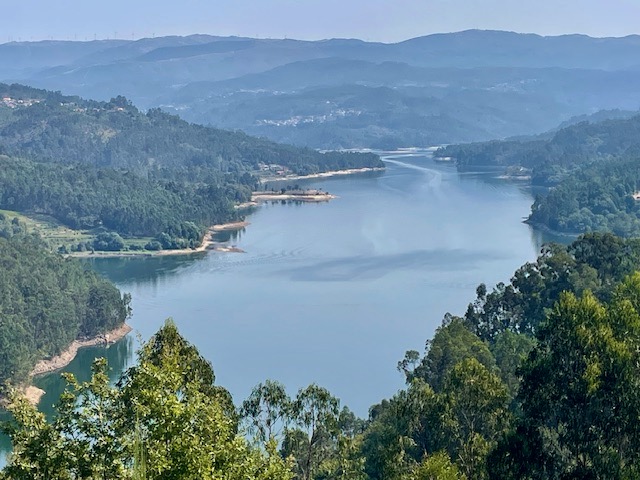
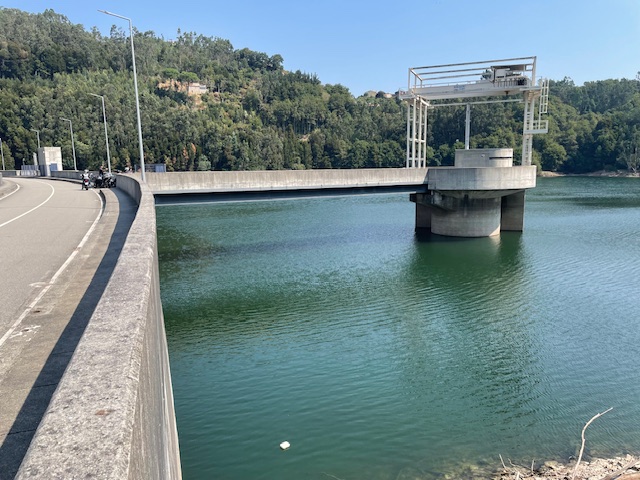
We stopped off at the Ribeirado dam and looked along the 14km long reservoir it created. It was built earlier this century to supply hydroelectric power, ease flooding and increase scarce water reserves. The road runs along the broad arc of the high dam wall, the power station and its infrastructure far below, where the river re-emerges. With the sheer valley walls either side the whole presents as a peerless study in concrete.

The brightest objects encountered in this uniformly grey spot were the red, blue and yellow recycling bins in the car park. Ominously, the control tower in the reservoir emitted flashing light and warning noises every few minutes. If this location were to feature in a future James Bond film or dystopian TV drama it would not surprise us. A perfect setting of its kind.

Another day we walked the middle reaches of the river. Was keen to access an upper trackway I’d clocked above the road while driving to our holiday accommodation nearby.

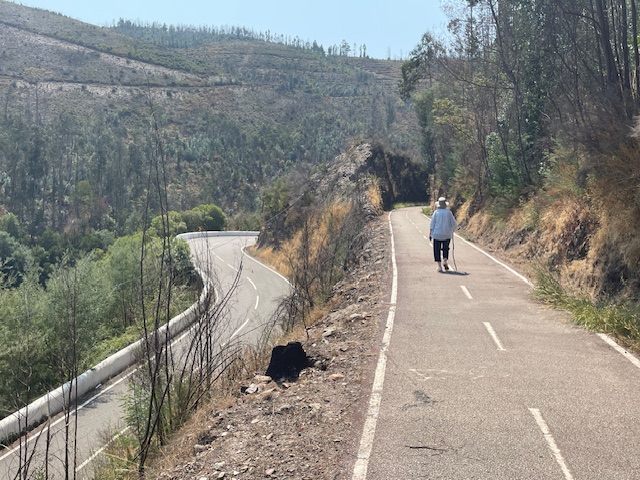
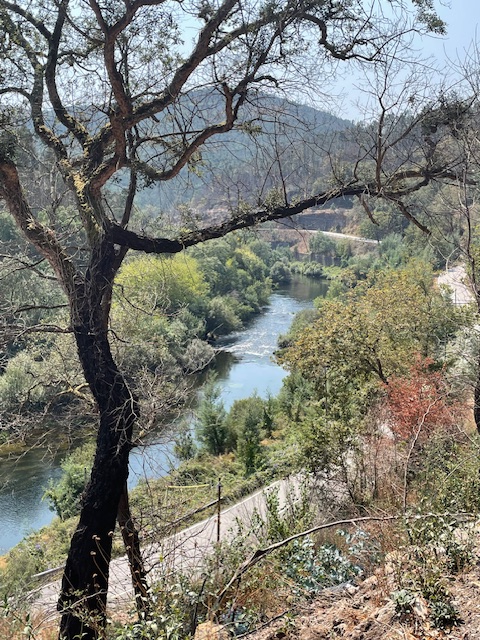
As suspected this was once a single track railway. Built just before WW1 it closed in 1980 and its repurposed state, the former Vale Das Voltas line offers superb viewpoints of the valley.

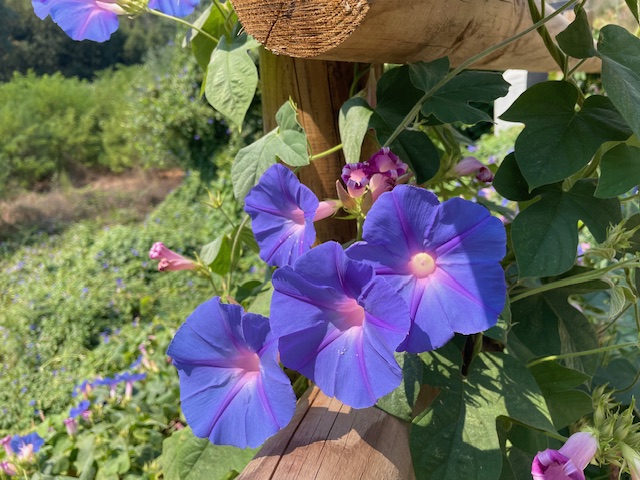
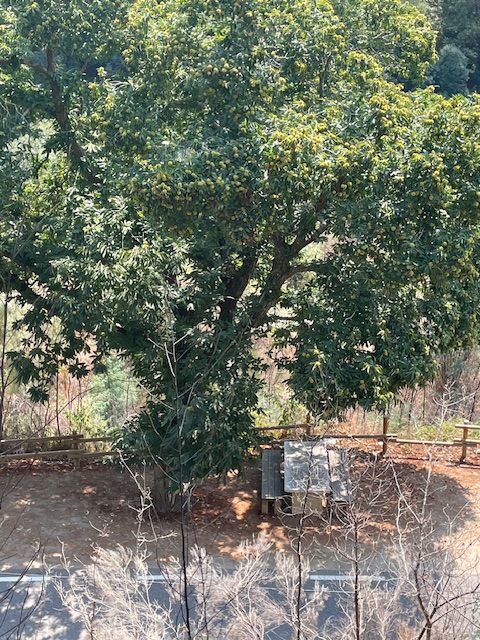
Our parking place by the road revealed a picnic table made from a single slab of local granite set under the awning of a mature horse chestnut tree. Masses of richly purpled convolvulus – bindweed – curled around the wood  rails.

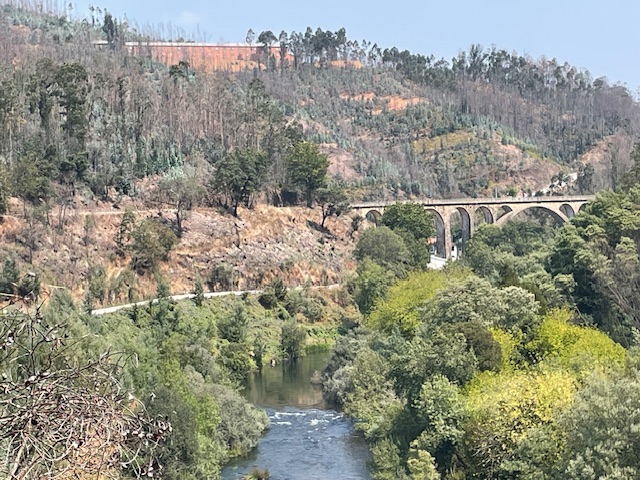
The track is understandably popular with cyclists, yet we only encountered four other pedestrians on our amble to and from the route’s spectacular highlight, the Santiago rail bridge at Pessegueiro do Vouga. It’s one of the highest stone masonry bridges in Portugal, with eleven arches and 165m high deck, gracefully spanning river and wooded slopes.

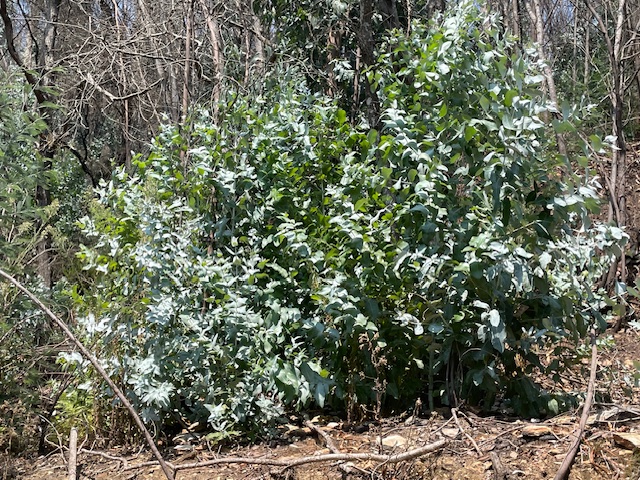
Our walk revealed a stark reminder of last year’s big burn. Blackened trunks and boughs in abundance. A contentious issue in these parts is the preponderance of silvery leaved eucalyptus trees, commercially planted to supply nearby works with biomass and extracted oils. That process is also understood to cause environmental air pollution.

This alien tree, of Australian origin, successfully sustains itself on steep slopes with minimum moisture and burns easily. Eucalyptus rapidly colonises cleared land post fire and is hard, if not impossible, to eradicate.

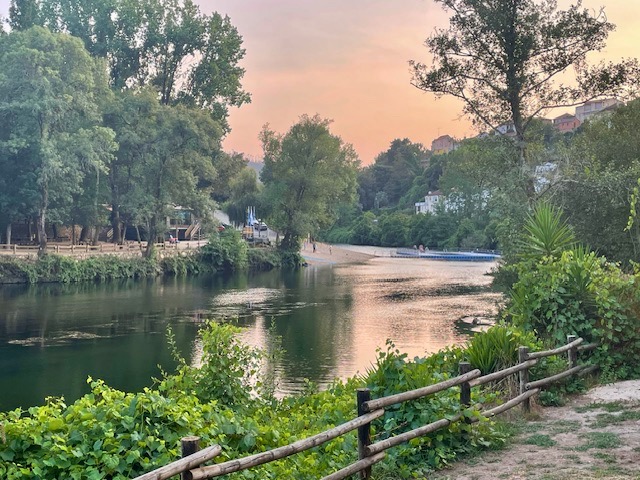
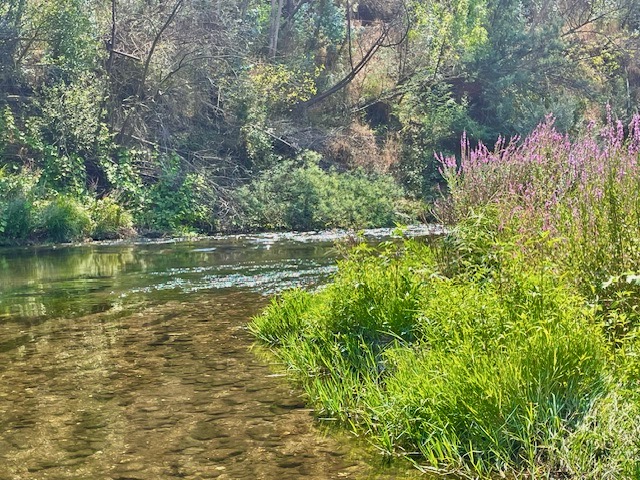
Our walk ended ‘off line’. Carefully crossing the white walled switchback of a highway, we descended to the quiet stillness of river bank and cooling shade of willow and alder that thrive here on its stony floodplain.

This middle stretch of the Vouga is officially designated a ‘Site of Community Interest’. That means minor blockages like weirs that present obstacles for migrating species of trout, eel, shad, barbel, lamprey or mullet are being gradually removed and in some places fish passes are being installed. Otters, birds of prey and many other species of birds and insects are also able to thrive here where human habitation is scarcer.

Delighted in encountering dragonflies and butterflies I waded barefoot in and allowed the hundreds of trout fry mingling in the sunlit shallows to continue feeding and flitting around my feet. A cooling calm end to our lovely lone amble under the afternoon sun.