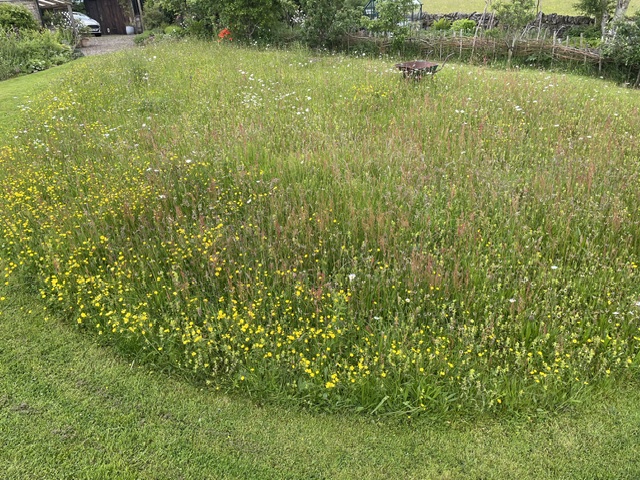
Regular readers of these occasional notes will know I’ve been gradually forming and managing a meadow area in our country garden since I came to live at the Corner house nine years ago.. The tough grasses have been weakened through autumn seeding of yellow rattle, with various meadow flower mixes to follow. Before seeding I manhandled a hired petrol driven scarifier over the ground until its cumbersome circling caused a strained muscle which finally caused me to desist.
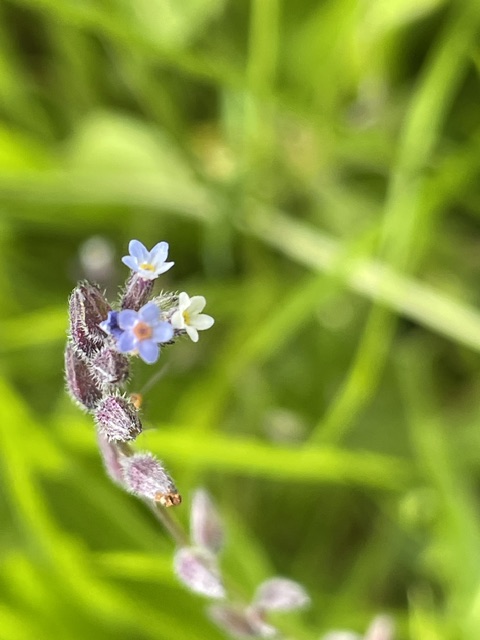
The seasonal groundwork paid off. Every summer we enjoy a different plant line up. Initially dominated by poppies, ox eye daisies. Later, buttercups claimed the wetter end while sorrel and bugle, alongside umbellifers like cow parsley, yarrow and pig nut have found their happy place in the drier or thinner soiled sections. I even chanced a few plugs round the lusher grass margin – musk-mallow, ragged robin, meadow crane’s bill, chickweed. They hold their own, but do not spread. A kneel down reveals the arching form of that smallest of pasture flowers, field forget-me-not. (above) A tiny delicate delight.
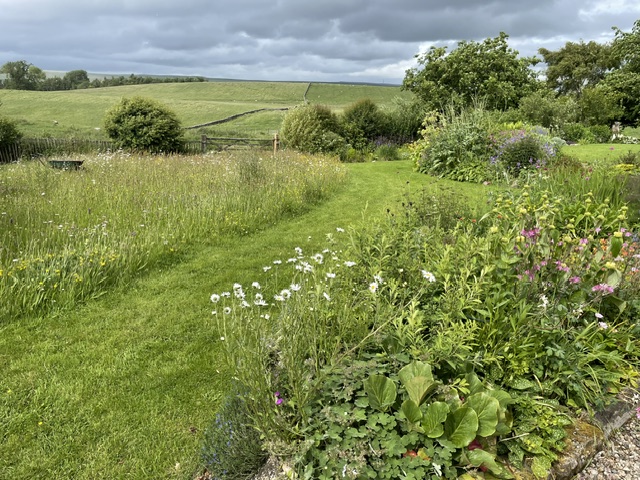
This spring my heart sank when I realised that one plant in particular had usurped the field. Ribwort plantain (Plantago lanceolata) is suddenly everywhere. It’s also escaped into the mown grass area that border the roughly triangular island of meadow slope, which is more problematic. The semi-parasitic yellow rattle has worked only too well in weakening the variety of vigorous grasses whose roots it feeds on. Those grasses have been replaced by masses of vigorous free seeding plantain, with its deep root and basal flattening leaves. Most of the more delicate seeds listed in the original meadow mix have never been spotted.
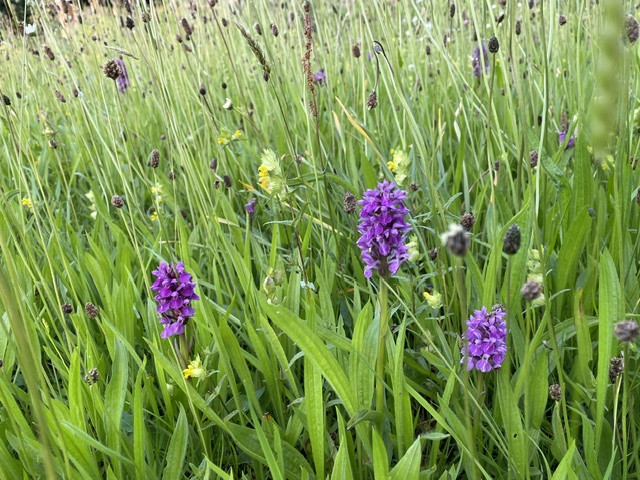
Or so I thought…Returning from holiday, looking with joy over the emerging meadow, I counted more than sixty orchids. Thinned grasses have allowed these beauties to find the light, despite the dominating presence of plantain. Although photo ID tells me these are common spotted orchid I have my doubts as there’s not a spot of any kind on their basal leaves and the flower configuration seems not to quite fit the description.
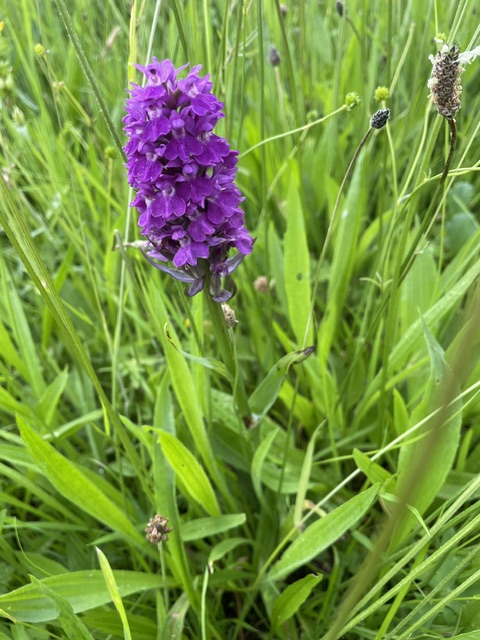
Then I recalled that in the early days of managing this patch I’d bought a couple of orchid plugs (variety unknown) from a small local independent nursery that was closing down and had subsequently planted them on the meadow margin. They reappeared for a few years and then disappeared. There are 57 varieties of native orchid in the UK and ours may be a hybrid of common varieties, as originally sourced from that local nursery. The important thing is that they’re back and thriving in this dynamic ecosystem. As orchids depend on a symbiotic relationship with mycorrhizal fungi in the soil to allow their minuscular seeds to germinate and grow we clearly have a meadow in good heart.
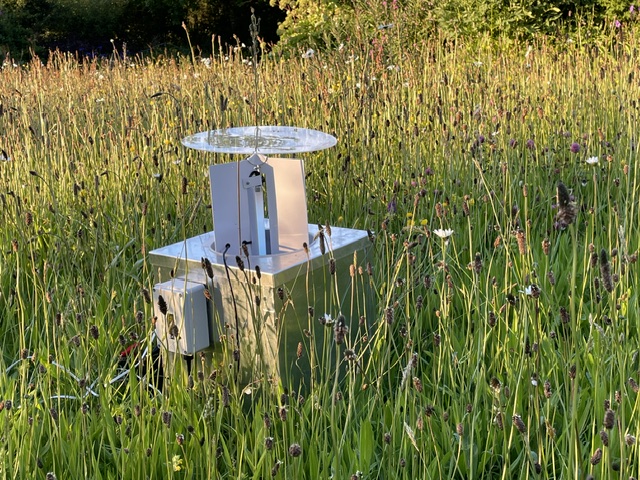
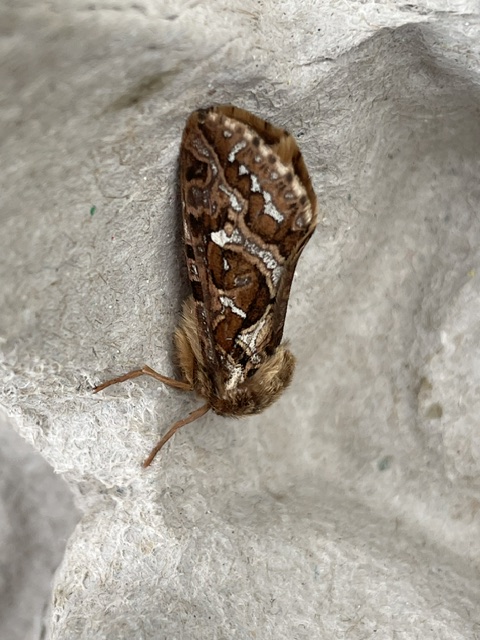
All plants have an essential pollinating relationship with moths, butterflies, hoverflies, bees etc. The other night I set the moth trap in the meadow and amongst the haul was this Common Swift, (Korscheltellus lupulina) which feeds on the roots of grasses and small plants, while its larvae live underground.
Overlooking the garden, low down on the north facing wall of the studio/office, sits our new bird box with camera. A fabulous family Christmas gift which, when set up in early April, attracted tenants in the shape of blue tits. The little birds painstakingly assembled layer upon layer of moss, sheep wool and feathers. The birds deep dive manoeuvres to mould the cup of nest was fascinating to observe and we waited with baited breathe to see one egg after another laid. At a dozen the reproductive strategy was clear. A high loss number.
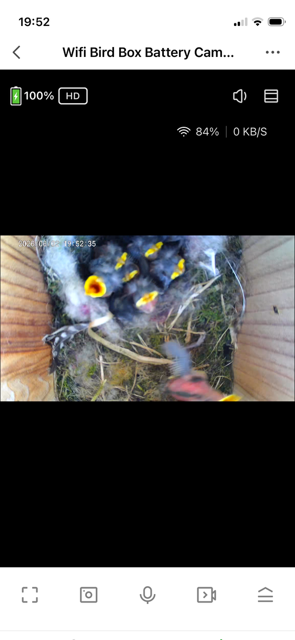
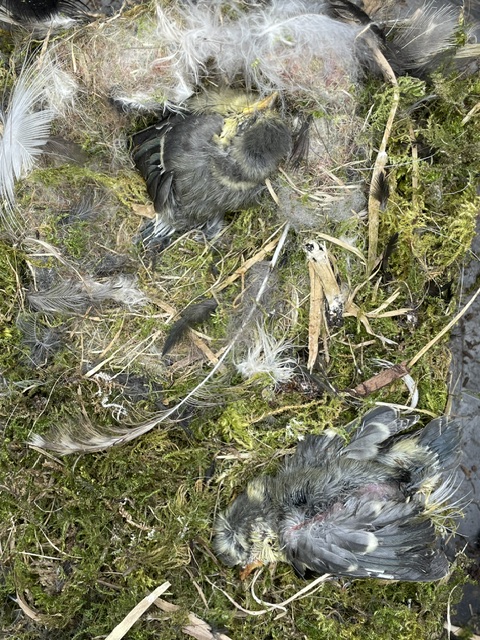
The chicks hatched, one by one, only to weaken and die in much the same way until eventually only two feathered nestlings remained. They looked ready to fledge. The next day though they too had expired. Those two fledglings apart, what had happened to their siblings? No sign of them so can only presume the parents had disposed of their tiny corpses. And what of those adult birds? Did the chicks starve because the parents could not source enough caterpillars to feed their brood? Had one or both parents been suddenly predated, causing the last two chicks to starve to death? Did parasites or bacterium play a part in their demise?…We’ll never know but it was a fascinating, if sobering, opportunity to witness at close hand avian life & death through the intimate unblinking eye of technology.
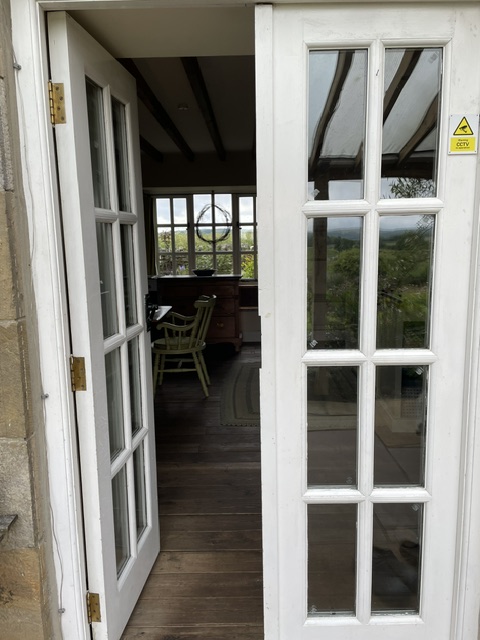
By contrast our returning swallows present with another successful breeding achievement. Two fledglings have joined the parents in aeronautical manoeuvres in the skies above. Their year on year return to the nest under the open porch roof always gladdens the heart. This year’s brood are more prone than usual to making attempted fly throughs when the door to the garden is open. We have got used to coaxing them back out but now keep the door closed more than usual. The young hare that spends so much of its time in and around our house has been seen in the past to stop at the doorstep to sniff the air before thinking better of it and lopping off again.
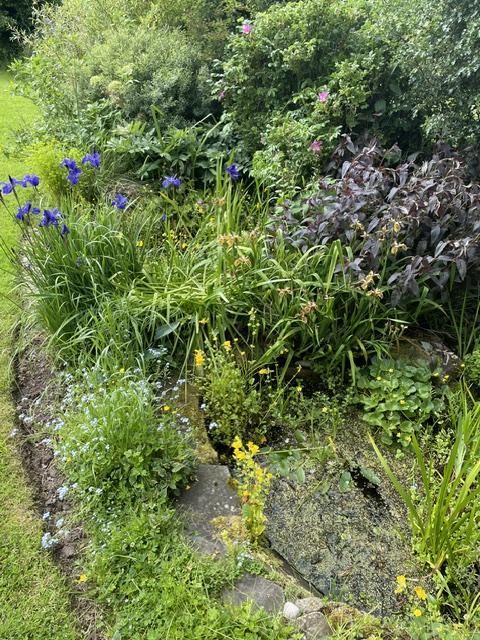
Down by the ponds plant growth has been more fecund than ever. Water avens seeding, different varieties of irises in bloom, intermingling yellows of monkey flower and native buttercup. Surface blanket weed regularly removed here on the deeper of the two wildlife ponds to allow the lily and water hawthorn to spread. Unseen below, the breeding palmate newts continue to thrive in a cool dense environment of oxygenating weeds teeming with micro-insect life.
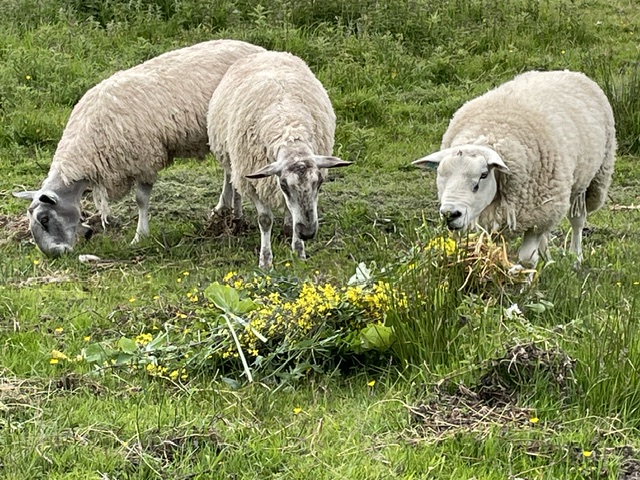
The tups on the crags continue to do sterling work in munching through the majority of our green garden waste, delivered them in the wheelbarrow.