Hare Raising

A brief summary of the past month’s wild animal activity in our out-by rural garden. The big advantage of having no dogs or cats on the premises increases chances of encountering wild animals and the privilege it brings of seeing them up close.

New born leveret: Image by wildwelfare.org.uk

Star event has been the up close sighting over three evenings of baby hares – leverets – hanging out in forget-me-nots that have colonised gravel paths between house and hedge. Our viewpoint from the pantry window  being just a few yards away. I’ve not the equipment to capture images in near darkness, but the youngsters intimate interaction is engraved in the memory. Best night ‘s observation was the second. Four of the brood bundled together grooming  each other’s fur while a fifth, just a foot away, lay facing out into the gathering dark. Was it keeping watch for their dam or on guard duty for predators? Whatever the reason the outrider eventually came back to its brethren and joined in the ongoing grooming process.
Occasional spotted individual growing leverets since during  the day, shooting in and out of close packed flower beds and full leafed copses. The mainstay of family life is their mother, the Jill, who we first saw regularly at Winter’s end. She seemed to have adopted our ever growing garden rubbish tip, t’other side of the fence, as her nursery. Miniature versions of the parents, leverets are born above ground in a shallow depression, or form, and each weighs in around 100 gms (3.5 oz) Unlike rabbits they are fully formed when born, with eyes and ears open. The Jill feeds her litter twice a day but goes foraging, keeping her distance to deter predators like foxes, stoats and weasels from tracking their location. The leverets in turn remain motionless throughout and their colouration helps them blend into the background. They venture out as they grow – as we witnessed – and are fully grown at six months.
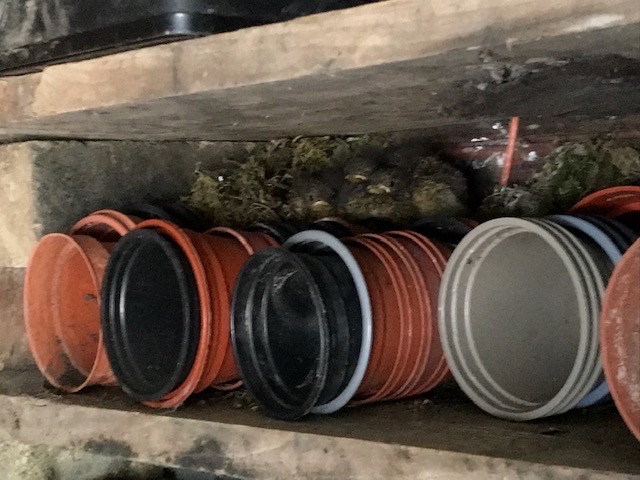
When it comes to seeking out the hidden birthplaces of creatures around the garden we were intrigued to see which of the many wrens nests would be the Jenny’s chosen location to lay her eggs. This one amongst the flowerpots won out. Amusing to see the nestlings sporting top knots of moss wrested from their nest lining. Whirring forms of fledglings often seen since about the place. One’s had to be shooed out of the house and others from under the cars in the yard before driving out.

The railway goods waggon that’s our unusual garden shed has in successive years been home to nesting swallows, blackbirds, robins and pied wagtails, each fiercely protective of  territorial space. We have indoor residents and  under-the-eaves tenants, and thus they co-exist. The wagtails usually opt for either the suspended metal watering can or bucket. The spill of feather, grass and wool lining indicate eventual fledging. Later came across a second wagtail nest within a tangle of rampant clematis, montana rubens, outside the bathroom.
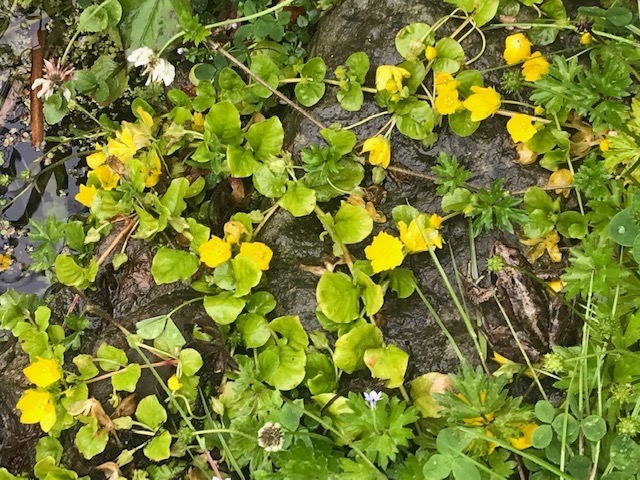
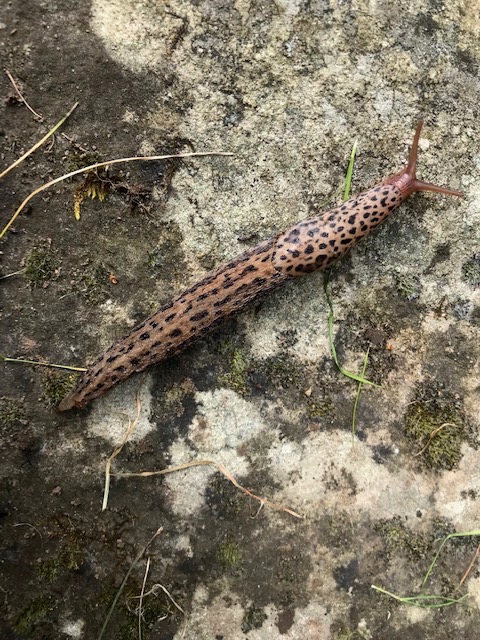
The rain brings amphibians  and their ilk out to forage. A frog amongst prostate free flowering  lysmachia nummularia at the old pond’s edge one day, or the elegant emergence from cover of a leopard slug on another damp day. There are around forty types of slug in the UK, most of which are not supposed to be crop pests. This one’s beneficial in feeding on  a diet of fungi, plant or animal matter and in turn is preyed on by hedgehogs and birds.
Clennell Wood Walk

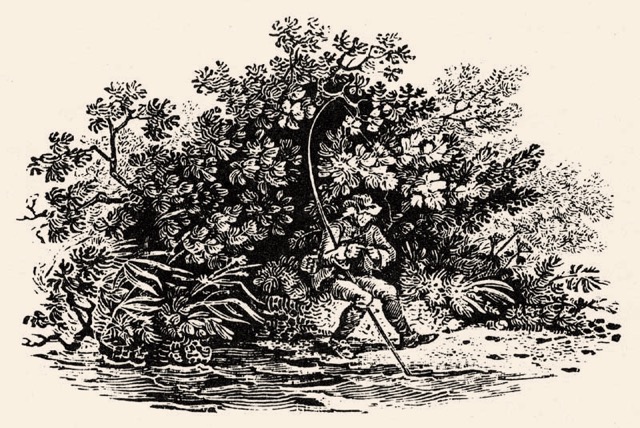
Shooting the Bird woodcut by Luke Clennell

I’ve been a member of the Bewick Society  (http://www.bewicksociety.org/) since I was first associated with Cherryburn, the artist and naturalist’s birthplace in the Tyne valley, and I’ve written about it here in the past. Recently I was amongst a small group of members who went on a walk from Tritlington, just north of Morpeth, to discover more about one of Bewick’s most accomplished apprentices, Luke Clennell, and the semi-ancient woodland there that today bears his name.

Our genial host was Michael Hunter, a Newcastle based landscape gardener, who during lockdown in 2020 bought three acres, a quarter of Clennell’s wood (formerly known as Robin Hood wood). With his Patterdale terrier Roo on a long lead (when not cradled in in his arms) Michael filled us in on the remarkable history of this rolling landscape between the A1 to the west and the Northumbrian coast a few miles east.

Born the son of tenant farmers in the nearby village of Ulgham Luke Clennell (1781-1840) was one of Thomas Bewick’s most promising pupils. with a similar rural background to his master. Young Luke was apprenticed to an uncle, a grocer in Morpeth, but so all consuming was his appetite and aptitude for drawing that the uncle and local patrons persuaded Bewick to take the 16 year old on in his Newcastle workshop. Clennel quickly became his master’s principal assistant, helping produce the hugely influential second edition of A History of British Birds and was responsible for some of its distinctive ‘tale pieces,’ small woodcuts wittily reflecting rural life, that tail ended the book’s sections.

The Angler is just one example of his skill and showcases Clennell’s particular ability in handling foliage. When his apprenticeship ended the young man left to set up on his own in London where he fulfilled his ambition to be a painter. Initially successful Clennell took on a massive commission in 1814 from his patron, the earl of Bridgewater, to commemorate a dinner of worthies at a post Napoleonic war conference that proved to be his undoing. In struggling to complete 400 separate sittings, sketching heads of attendees, the artist’s mental health, already strained by the death of his wife, collapsed and the painting was completed by another artist. Luke returned to his homeland and the care of family but never properly recovered, spending the last nine years of his life in the Newcastle asylum.

It’s hard now, overlooking this unremarkable stretch of rolling farmland to envisage the stark industrial landscape it presented to the world between 1990 and 2005. Then the wood we were visiting was an isolated island – saved from destruction by its official status as an ancient semi-natural woodland – marooned in a vast strip mining operation.The Stobswood open cast mine was operational1990 – 2007. During that time British Coal abstracted 13 million tons of coal and 250,000 tons of fireclay from the 580 hectare (1,433 acre) site. Appropriately the site known as the biggest hole in Europe had at its operational heart the biggest digger in Europe ‘The Ace of Spades’. This massive walking dragline was better known to locals as ‘Big Geordie’ and dominated the skyline for miles around.

Today that abyss has been completely filled in and restored as agricultural land, wetland, meadows and new woodlands. We could see on our approach along the public footpath that the woodland extension is currently dominated by colonising birch which will eventually give way to native species like oak, rowan and willow.It was a strange sensation walking over that swathe of restored land as the earth was spongy underfoot, not yet having properly settled, a process which will take years. It has been seeded with a wild flower mix so might be interesting to see how that fares as time passes. It was also a different consistency to the heavy clay of the unaffected land we passed, where bullocks grazed in old grass meadows by the infant riverside and its bank stabilising alders and willows.

Michael shares the 12 acre wood with three other buyers, their boundaries marked by coloured wooden posts. One focuses on shooting with a mini-range; another is given over to ornithology with many bird boxes and avian friendly settings while the third is an exemplar of wood craft, with renewed coppicing , dead hedging and other examples of traditional woodland management.

Michael and his family revel in their visits to the site and he’s allowed by regulation to camp out for a set number of nights a year. In that time he’s become (literally) a lot closer to nature, as an unobtrusive witness to the secret lives of its animal inhabitants, in particular hares, badgers, roe deer and foxes.

We visited the well established badger setts and traced their trods through the undergrowth of bluebells, wild garlic, dogs mercury and grasses. Stopping for a brew under the dappled canopy he pointed out the shallow depressions where deer have lain, the places where hares congregated to frolic of an evening.

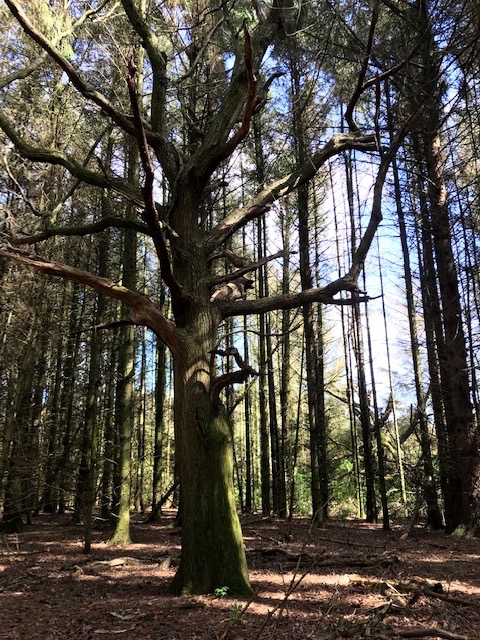
At some point in the 20th century the three quarters of acre at the wood’s heart had been cleared of broadleaf and replanted with spruce for commercial purposes. That sits awkwardly with the rest of the site, and we hoped it might be cleared and restored one day. Hauntingly, in amongst the dark looming pole straight conifers stood an old oak tree, a sole survivor from the past, seemingly dead but on closer examination still hanging on in there, with leaves emerging in its highest canopy to greet the hint of spring sun..

Having immersed ourselves for a happy couple of hours in this impressive survivor of semi-ancient woodland we left with a renewed faith in the ability of nature to recover from the severest sieges. Cheered too at the stewardship of individuals like our host whose actions help restore the balance of life, living in  harmony with and learning from the natural world. As we walked back over the brow of the hill I couldn’t help but feel that the essence of Luke Clennell’s troubled genius is resident in the wood he would have known as a boy, at home in a place where his artistic spirit can rest at peace.