Dingle: Dun, Bee & Boat

The distinctive peninsulas that characterise this south west corner of Ireland present challenges to the modern day tourist, with cars and coaches traversing narrow twisting roads. Meanwhile the locals have to put up with peak season congestion as they go about their everyday business. It’s lucky then that nobody seems in a hurry to get anywhere fast.
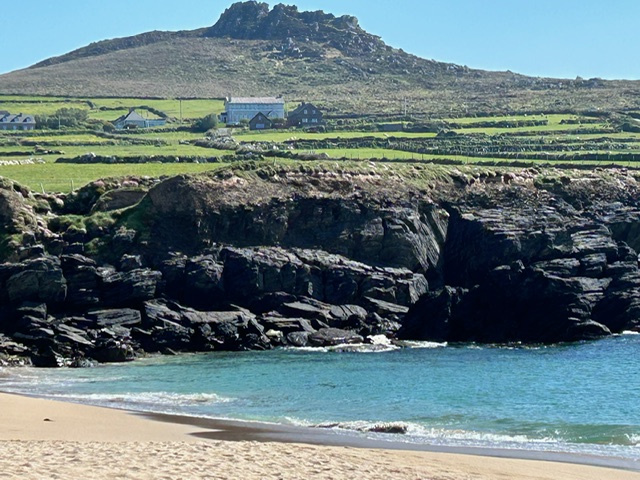
The Dingle peninsula boasts over 2,000 historical monuments and that reflects its remote location and farming way of life over thousands of years. Rocks cleared from patchworks of land built drystone field walls and farmhouses that distinguish this rugged landscape.

The ancient inhabitants of the peninsula were skilled in using the water as their sea roads. These would also have been trade routes and their culture and artefacts reflect that. We were lucky enough to get some sense of their world from the handful of sites visited on our traverse of the 38k/24 mile circular route marketed for tourist purposes as the Slea Head Drive. As advised we drove clockwise, with the traffic and not against it.

A Mountain range dominates the centre of the 48k/30m long peninsula, ending at the westernmost point in Ireland around Dunmore Head. It was here in 1588 that two of the remaining ships of the Spanish Armada’s failed invasion of England were tragically wrecked. The narrow road in and out of Dingle town, its busy main population centre, hugs the jagged coastline by cove cliff and beach.

Dun Beag (‘small fort’) on the cliffs at Fahan has a beautifully created visitor centre inspired by traditional vernacular design. Here we watched an introductory film while sitting in the dark on animal hides in an intimate environment, suggesting the domestic interior of the 5,000 year old promontory fort below.

The streamside path leading to the fort with its massively wide dry stone walls is unexpectedly graced by lilies, while the bare sea cliffs below sport patches of thrift.
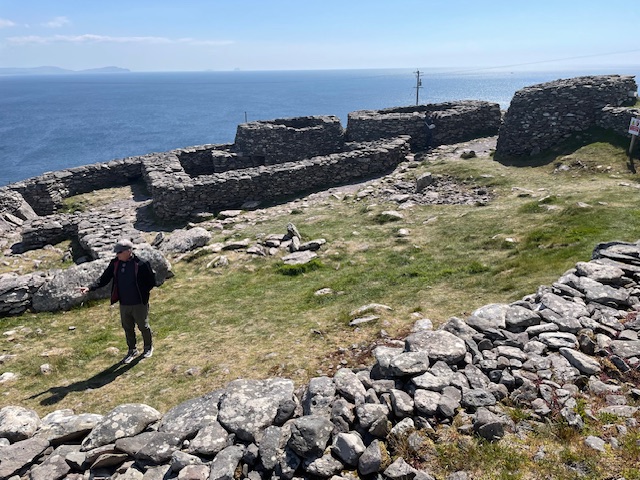
Storm damage this century has been extensive and fences now secure the site from over enthusiastic exploration but it still exudes a strong sense of its ancient role guarding the wild sea ways. This once formidable stronghold created was in the Iron Age, though archaeological evidence suggests Dun Beag remained in use between 8th – 11th centuries.
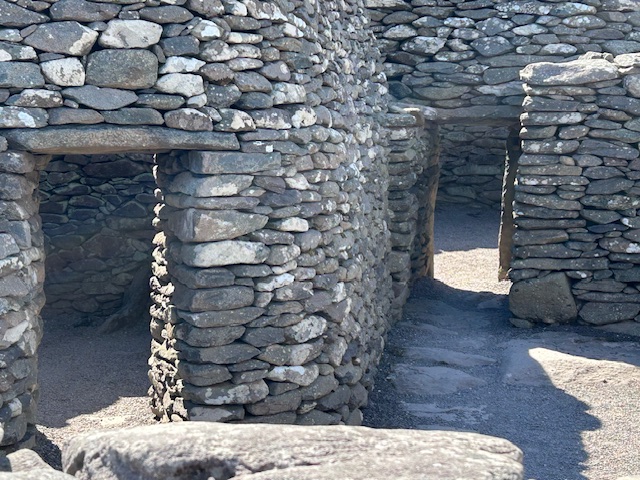
A short drive westwards brought us to the a group of Clochlans, better known because of their shape as beehive huts. Dating from the early medieval period they were home to Christian communities of farmers and fisherfolk and are remarkably well preserved. We learned that although significant historic monuments like these belong to the state, owners of the land have the right to grant paid access to the public.
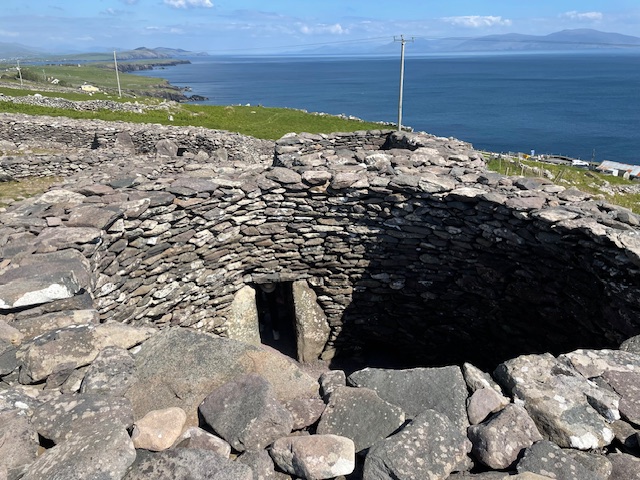
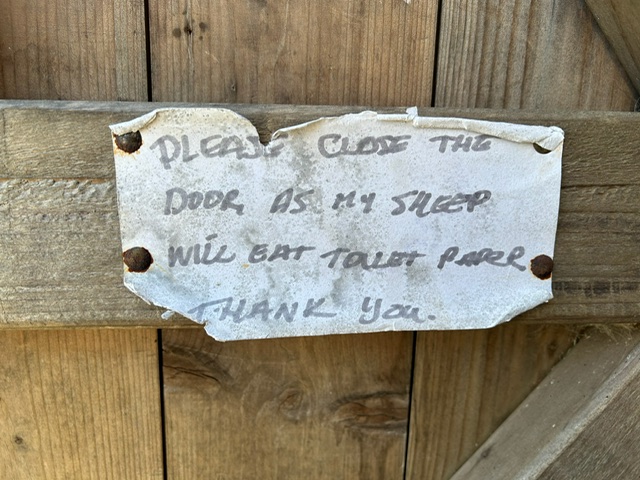
Here the huts are part of a wider offer by Aiden, the occupying farmer and his family, to feed lambs and watch sheep dogs at work. A nice line in farming for tourism in the C21s. Good on them. 
Beyond this compact set of interlinked dwellings I glimpsed another cluster higher up the hill and the farmer’s dad (who it turned out had spent most of his working life in England as a labourer), told me access rights were in dispute and the owners were keeping it as was and unvisited. He felt those buildings were even more complete and whole than their own.
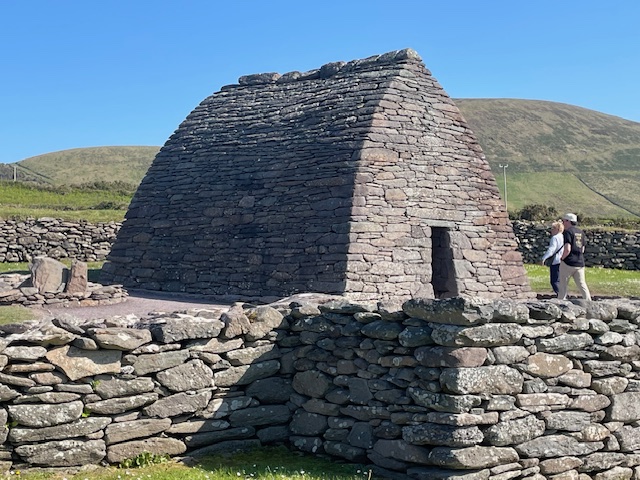
Our trio of antiquities was completed by a visit to the early Christian oratory at Gallarus. Dating from around 500 AD and fashioned in the shape of an upturned boat, the chapel is lit only at the far end by a simple window. An austere and striking symbol of the Celtic Church overlooking a harbour that has outlasted Viking raids, Norman conquests and everything the weather has thrown at it.
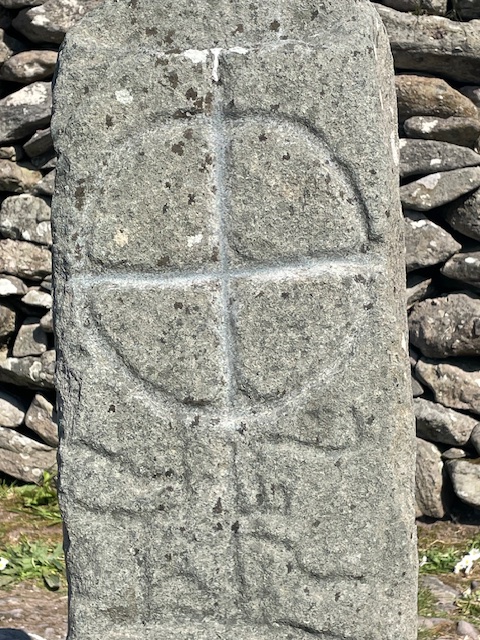
Made of gritstone the oratory measures 8m long x 5m wide and 5 m high. Some graveyard stones remain, like this simple cross inscribed in stone.

Thought of the skill seen in constructing beehive huts when viewing this little church, as the stones of various graded sizes meet to form the roof ridge. Also bore in mind that the central aisle of a church is called the nave because of that upturned boat shape, from Latin ‘navis’ for ship.  

We left Dingle entranced by the extraordinary sights, sorry not to have time to do more but glad to have sensed the life of the past through wonderfully well preserved examples of its fortifications, homes and churches.
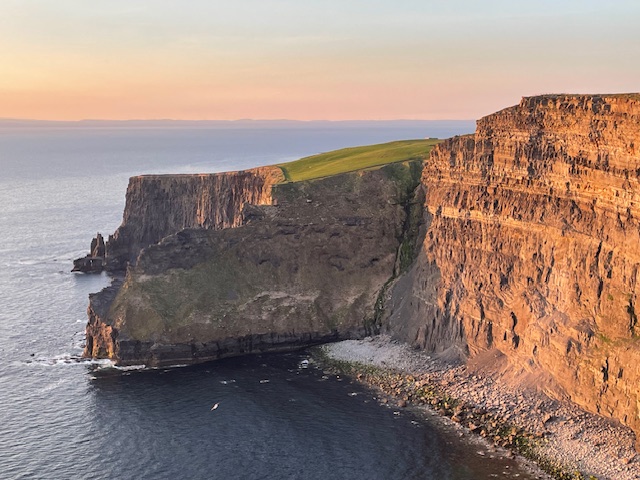
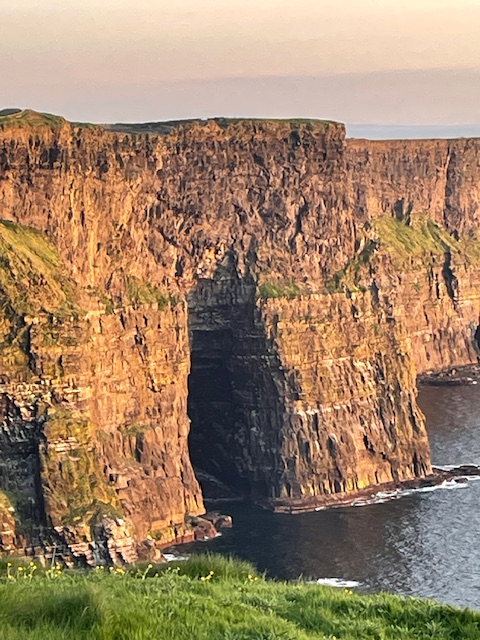
Cliffs of Moher

You know that Ireland’s road infrastructure has improved dramatically in the 21st century when you see day trips offered in Dublin to this tourist mecca in County Clare on the ‘Wild Atlantic Way’. That’s a 3.25 hour coach journey to cover the 268k (166m) trip, mostly by motorway, and the same back. One very long day out. And there are no shortage of takers.

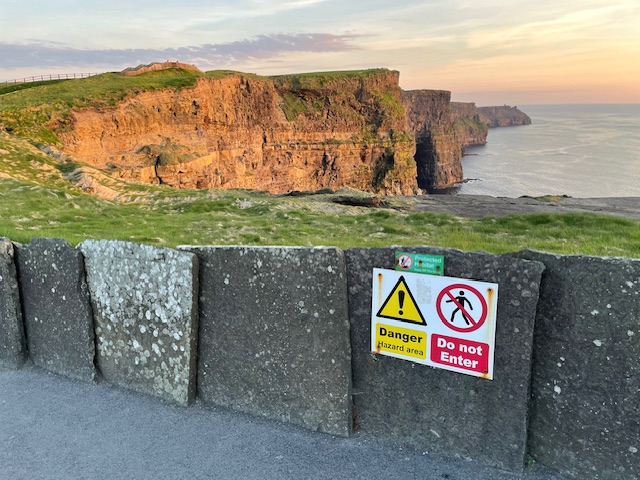
We visited on a weekday evening after the park had closed and crowds had left. To my mind this has to be the best time as the setting sun was starting to illuminate to great effect the 8 Km (5 miles) of high cliff faces, 214 m/700ft at their tallest, to dazzling effect. The place lives up to its hype, especially on yet another glorious blue sky day, offering sublime views over becalmed seas towards America way out west. The sheer cliff faces, eroded by wind and water into caves and stacks in places, providing a wealth of different breeding sites for over 20 species of sea bird and we watched some of them wheel about us in the golden light.

The cliffs consist of carboniferous rock, including shale and sandstone, and once formed part of a delta system 320 million years ago, carried up here from the equator on vast tectonic plates; broken, fractured and stratified on its snail’s pace journey north.

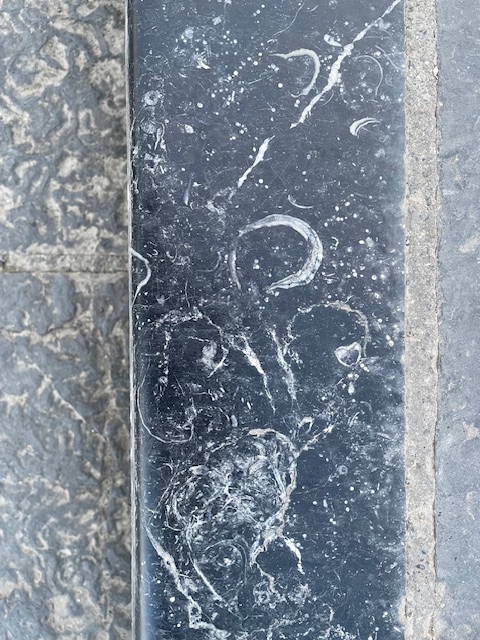
We climbed and descended the cliff tops on wide black marble like steps, tucked  in behind a protective barricade of grassed flagged bank, preserved to accommodate the thousands who pay to visit each day. These handsome steps are fashioned from locally quarried Liscannor stone and I loved looking closely at them as they contain a wealth of fossils: crinoids and ammonoids and other unidentified creatures whose trails are preserved for eternity.

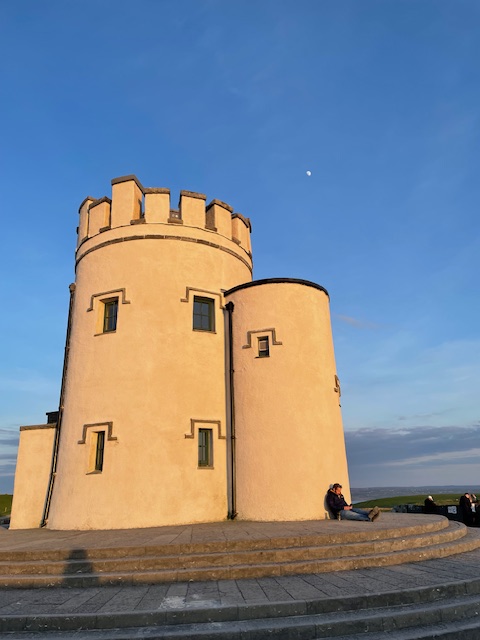
The Cliffs of Moher are named for a deserted prehistoric fort on a headland that once stood here before being replaced by a look out during the Napoleonic wars, when national defence was key. In peace time the invasion has been internal and despite concerns about road congestion and overcrowding the locals we talked to welcomed the income tourism brings in its wake.  

Reflecting the intrinsic importance of music in the culture buskers have pitches set aside for them at key points along the walks and the nearby village of Doolin is acknowledged as a centre of traditional Irish music.

A far sighted local landowner built a viewing place in 1835, now named after him – O’Brien’s Tower – to help foster a  growing trend and provide local alternative employment for the remote rural community of the day. Since 2011 The Cliffs of Moher have been part of Ireland’s latest UNESCO Geo-park, along with that most remarkable of internationally renowned landscapes, The Burren….More of which in the next diary.

Thoor Ballylee and Coole

Our recent holiday with family in Ireland threw up the opportunity to visit two inter connected places in the Galway countryside associated with two of the country’s great cultural figures.

An ancient bridge, and a more ancient tower,
A farmhouse that is sheltered by its wall,
An acre of stony ground,
Where the symbolic rose can break in flower,
Old ragged elms, old thorns innumerable,
The sound of the rain or sound
Of every wind that blows;
The stilted water-hen
Crossing Stream again
Scared by the splashing of a dozen cows.

W.B.Yeats ‘My House’ (1928)

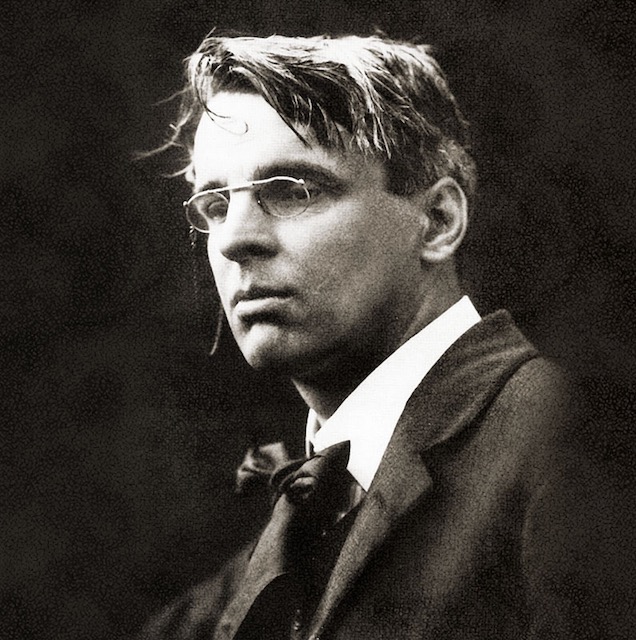
Thoor Ballylee is a C14th Hiberno-Norman defensive tower on the gentle banks of the Streamstown river in the west of Ireland built by the De Burgos, or Burkes, a Norman clan whose power base was in this area. It had fallen into a state of decay when the poet W B  Yeats first saw it in 1898 while staying with his friend and artistic collaborator Lady Augusta Gregory at neighbouring Coole Park.

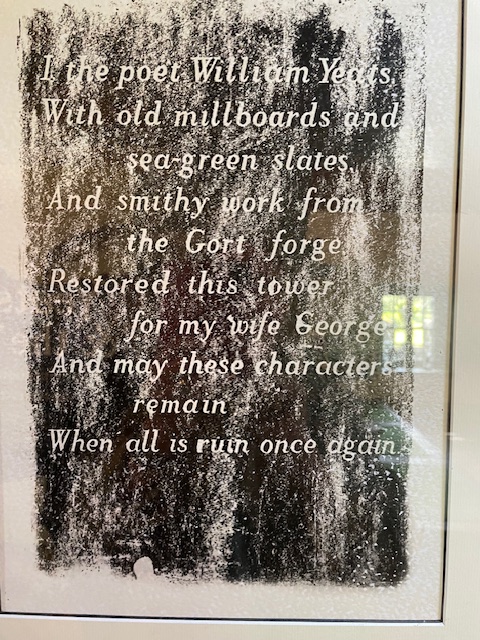
Eventually, as a newly married man with two children wanting a home away from Dublin in the west from where his own family originated, Yeats bought the romantic though ruinous structure for £35 in 1916. Working closely with local craftsmen he and his wife George carefully restored the structure to make it habitable as their summer residence through the 1920’s.

Interesting to note that neither he nor fellow protestant notable Lady Gregory were directly threatened by either of the feuding sides during the rebellion against British rule or the bitter civil war that followed. As respected cultural icons they were otherwise shielded from the violence and atrocities that marked the ‘Troubles’ across Ireland.

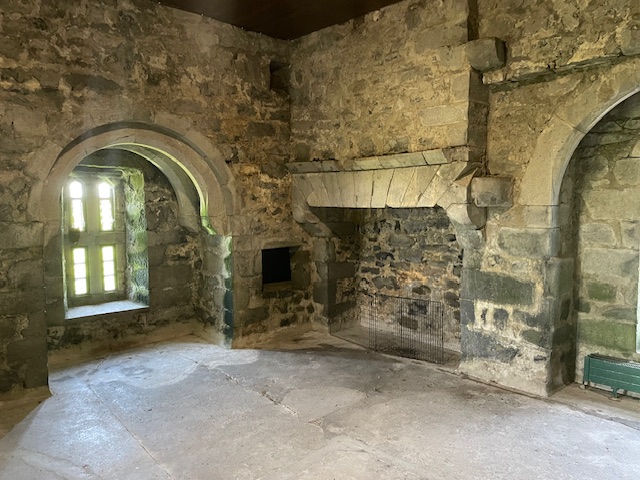
It’s not hard to see why the tower became the Yeats’s happy place, acting as both a refuge and an inspiration. George decorated and furnished rooms in the arts and crafts style while also developing the skill of fishing from the  windows! Friends visited regularly and everyone enjoyed the socialising. Yeats wrote some of his best poetry here; work that appears in the collections ‘The Tower’ (1928) and ‘The Winding Stair’ (1933).

Yeat’s deteriorating health, along with the damp and damage wrought by winter floods eventually caused the family to sell up and move away. Summers were increasingly spent abroad in France, with its kinder climate, better suited the ailing artist, but he never forgot this place or its importance in his life. Nor did admirers of his work forget him when in the summer of 2015, to mark the 150th anniversary of Yeats’s birth, the Yeats Thoor Bally Lee Society re-opened the tower to visitors and have continued to do so each season ever since. It is now a thriving cultural centre offering courses, talks and literary themed events.

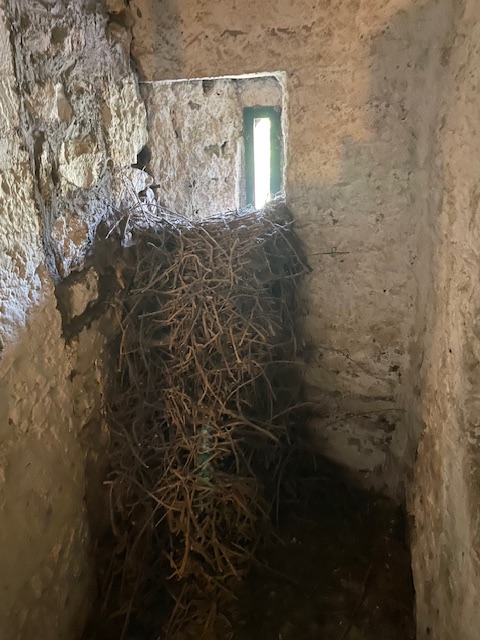
We loved chatting with the cheerful knowledgeable warden and exploring all four floors of the tower. Intrigued by the stack of crow’s nest below one of the slit windows and surprised by the alarmed cries of a returning parent just as I caught sight of the fledglings within.

From the top, I took in extensive views over surrounding pastoral landscape rich in hedging, banks, woods and fields. The white flood of flowering hawthorn everywhere. Curiously the gentle sparkling stream below literally disappears within these woods. This distinctive Karst limestone country is known for its turloughs – intermittent lakes that fill with water from streams like this one that drain back into the water table, having no surface outlet.

Under my window ledge the waters race,/Otters below and moor-hens on the top,
Run for a mile undimmed in Heaven’s face,/Then darkening through ‘dark’ Raftery’s ‘cellar’ drop,/Run underground, rise in a rocky place/ In Coole demesne, and there to finish up/
Spread to a lake and drop into a hole./What’s water but the generated soul?’

                                                                                              ( W.B. Yeats ‘Coole Park and Ballylee’, 1931)

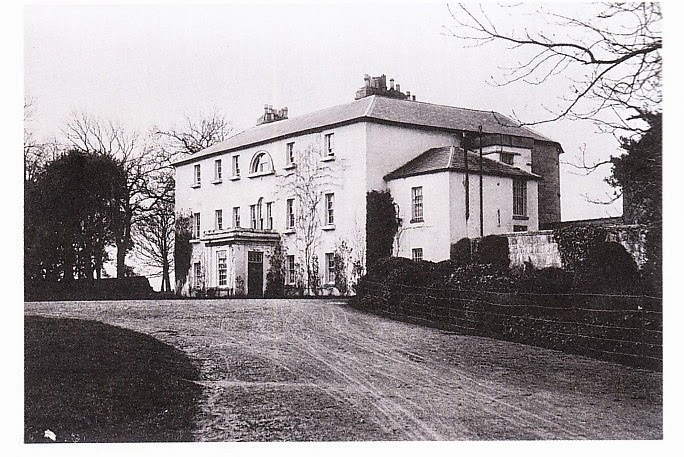
We followed the hidden line of flow on leaving Yeats Tower and within a few miles were at Coole Park, now a national nature reserve stretching over 1,000 acres (400 Hectares). The woods here have been attracting visitors from when they were first developed by the Gregory family in the late C18th. Coole Park was home to  Lady Augusta Gregory (1852-1932) and in her widowhood her genius for inspiration made it a centre for the movers and shakers involved in the Irish Literary renaissance, from Synge to Shaw, Casey to Yeats.

“These woods have been well loved, well-tended by some who came before me, and my affection has been no less than theirs. The generations of trees have been my care, my comforters. Their companionship has often brought me peace.” ( Lady Gregory, 1931)

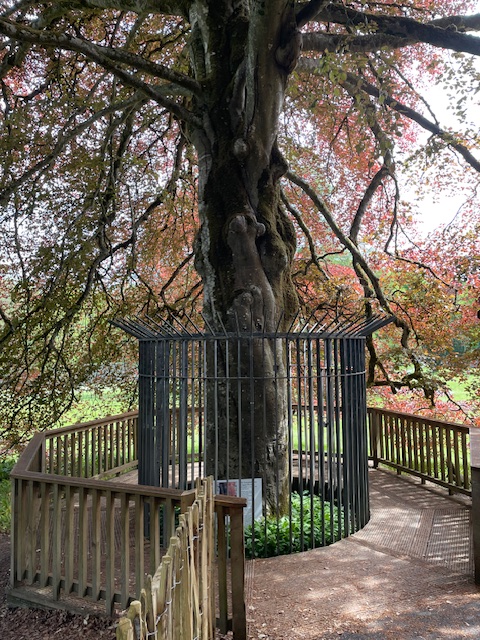
We were quickly enfolded into that peaceful, unhurried arboreal world and instantly appreciated the spell it must have cast on others. Although there was no time to discover the lakes with their swans or walk the woodland paths beyond the centre we did find the famous autograph tree – a venerable copper beech – where the great  men of letters carved their initials during their frequent visits. Their incisions now stretched and compacted by growth and stoutly defended from further additions by the public by railings.

‘Here poet, traveller, scholar take your stand / when all these rooms and passages are gone’ (Yeats)

The Georgian house was demolished in 1941, although the handsome restored stable block has a museum, facilities and excellent tea rooms serving imaginative good quality food, so a most enjoyable lunch was had here.

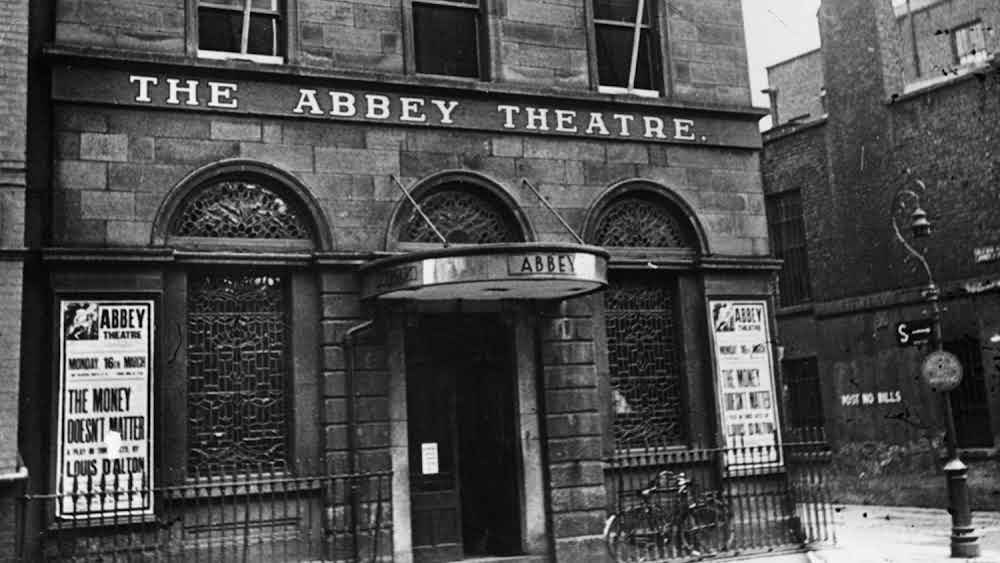
Yeats had first arrived at Coole in 1897, physically and psychologically exhausted and was nursed back to health and a more sustainable  lifestyle by Lady Gregory. As he described: “I found at last what I had been seeking always, a life of order and labour” Lady Gregory prescribed for him a balanced regimen of work and relaxation. It was the beginning of a lifelong friendship that saw them  in 1904 co-found with others the Abbey Theatre in Dublin. In so doing they were preparing the ground for independence by writing, producing and performing plays about Irish life for Irish people.

More here: www.yeatsthoorballylee.org and https://www.coolepark.ie