Where are the men who came before us/ Who led hounds and hawks to the hunt, / Who commanded fields and woods? / Where are the elegant ladies in their boudoirs / Who braided gold through their hair / And had such fair complexions?
Extract from an anonymous poem c. 1275, trans. Michael R Burch)
There are more than one and a quarter million objects on display in the Victoria & Albert Museum. Since 2009 the medieval and Renaissance treasures are displayed in five galleries in that vast C19th cultural complex. On our recent London visit we confined ourselves to just one gallery, and were not disappointed with what was discovered. Here’s a bit about a handful of treasures on display connected with the west and north of England.
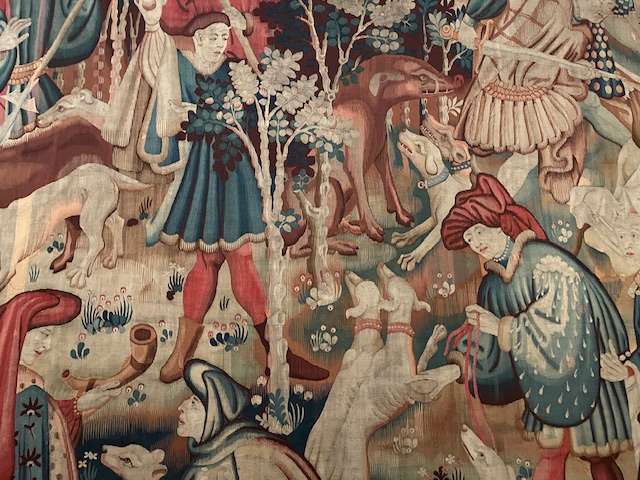
The wealth and power of a medieval English king pales in comparison to the richest and most splendid of European courts upheld by the magnificent Dukes of Burgundy, centred on what is now roughly southern Holland and northern Belgium. These towns and cities were the nexus of the continent’s major trading centres in luxury goods and services. This huge Flemish tapestry dated 1425-30, completely covers the gallery end wall. Formerly lodged at Hardwick Hall Derbyshire it was accepted by HMG in lieu of death duties on the estate of the 10th Duke of Devonshire.
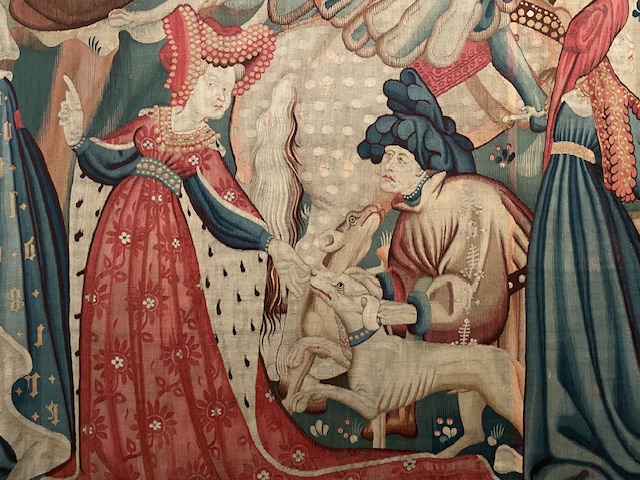
Conspicuous wealth is on show here, the tapestry’s narrative function as great as that of its role decorating and insulating a castle or household interior. Only Kings and aristocrats were allowed to hunt game, like the bears and boars depicted here, and participants attire is strictly status related, eschewing practical hunting clobber. The ladies fur for example is miniver, an expensive pelt from the bellies of hundreds of Baltic squirrels culled in winter.
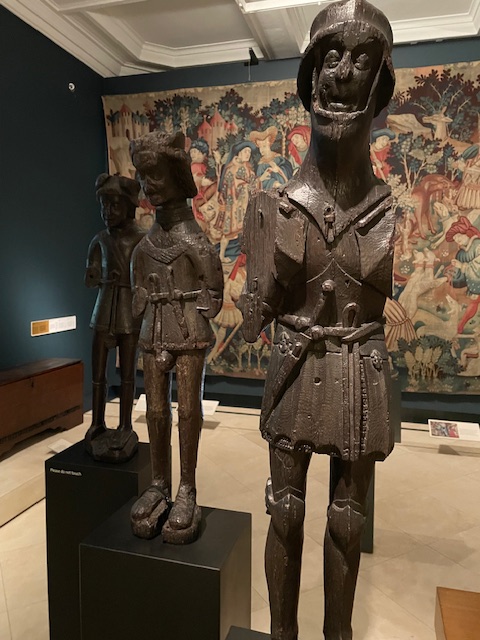
Three unique half-life size oak figures stand out against a background of the great tapestry. A knight, his squire and man-at-arms; three orders of society in a great feudal household. Dating from the early 1500’s, they’re believed to have supported heraldic devices, and were placed high in the great hall of Kirkoswald or Naworth castle in Cumberland, properties held by the powerful Dacre dynasty. The armed man’s helmet or sallet was an essential piece of soldering kit but it also limited the wearer’s vision and impaired his breathing. In 1461, during the battle of Towton, a helmetless Lord Dacre was killed by an arrow while taking a desperately needed drink of water. A monument marks the fatal spot of that terrible battle in the Wars of the Roses. (We visited in 2025 https://stephentomlin.co.uk/2025/05/01/towton-field/)
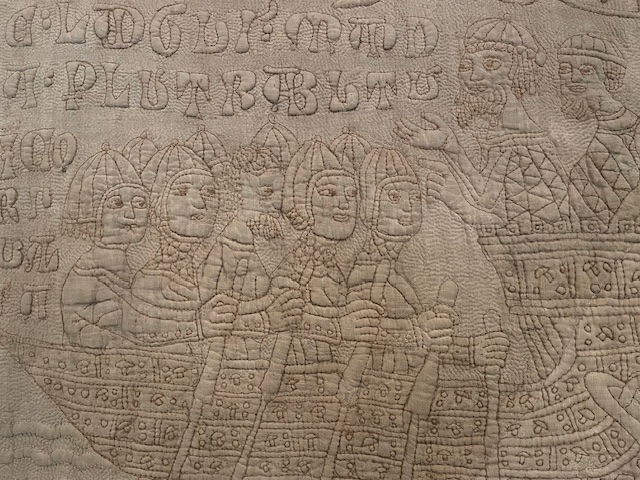
The tragic epic romance of Tristan and Isolde in Cornwall had huge appeal to the wealthy elites right across Europe and lots of art work reference it. This superb broadcloth bed covering, made in Florence for a rich merchant family between 1360-1400, really goes to town on the tale.
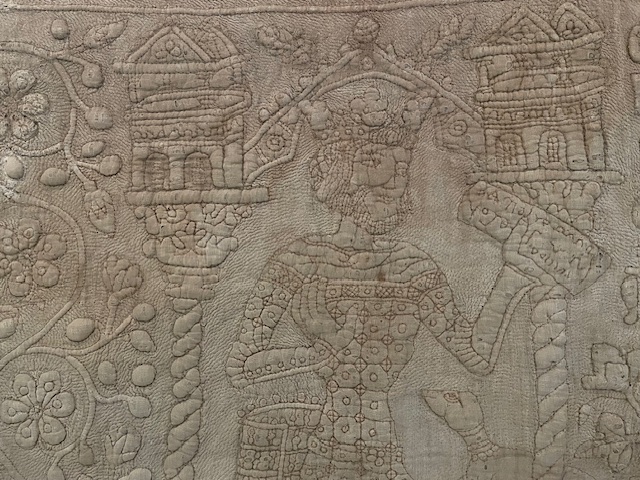
It’s a wonderful display of compressed narrative detail chronicling the epic story, with extra pieces attached at various times, fashioned from linen and cotton. Kim, who comes from a long line of quilters, was particularly impressed with the skill involved in its execution.
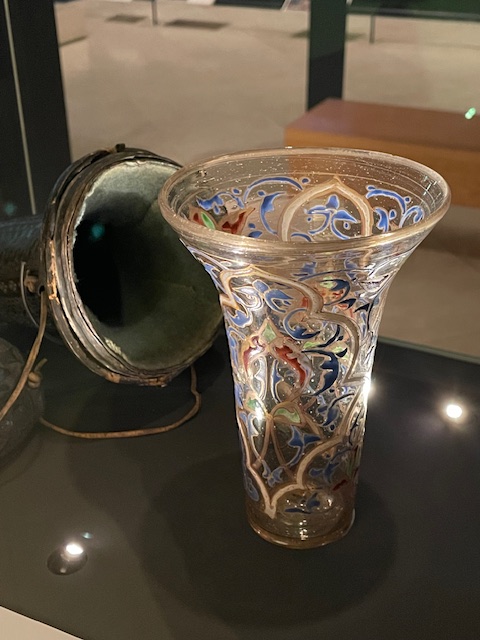
Surviving examples of luxury medieval Islamic glassware are exceptionally rare so this pristine one from Syria or Egypt dated to c.1350 has special significance. A talisman of the Musgrave family at their seat of Hartley castle and later at Edenhall in Cumbria ‘The Luck of Eden Hall’ has been protected in part by the 15th century leather case and – if local legend is to be believed – by fleeing fairies, who left it in human hands with the warning ‘If this cup should break or fall / Farewell the luck of Eden Hall.’ Curiously, in northern farming circles it remains customary to gift ‘luck money’ to the buyer of one’s stock at market as a token of goodwill.
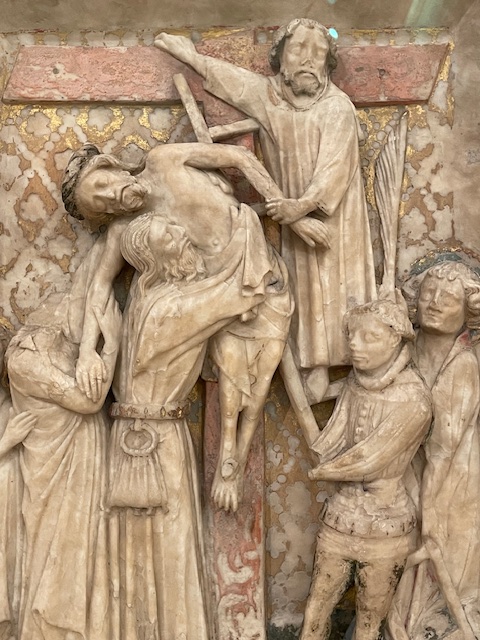
Finally…this small C14th alabaster fragment of a lost altarpiece from a Midlands church is a fine example of a deposition. The top figure’s steadying arm on the cross and Joseph of Aramathea’s handling of the slumped body of Christ help fix a moment of tender compassion. The odd missing head or hands of the other figures bear witness to the vagaries of time, or the action of iconoclasts. Along with the faded original bright colouring, this narrative scene exudes a sense of loss and sacrifice.
 STEPHEN TOMLIN