Marchmont

A while back we were in the audience for a talk at Newcastle Central library, part of a nationwide book launch, given by the academic, multi-award winning writer and broadcaster Dr James Fox. (https://www.drjamesfox.co.uk/)

James had been all over the UK unearthing the vital if under appreciated role of craft makers in forging our country’s cultural history and local identity. Dry stone-wallers, clockmakers, blacksmiths, weavers, milliners, saddlers, cutlers and coopers are among the array of past and present practitioners who get a mention in Craftland: A Journey Through Britain’s Lost Arts and Vanishing Trades. It has also been broadcast, with the author reading, as a BBC Radio 4 Book of the Week. (Sadly not currently available on BBC i-player)

James’s understanding and eloquent evocation of past and present practices couldn’t fail to draw us into his own well-crafted narrative. Beyond buying the handsomely produced book we were reminded that the best way to ensure a future for today’s craftspeople is by seeking out and, if possible, paying good money for their unique hand crafted products.

John Williamsom is a traditional Devon stave basket maker. We bought one of his baskets a couple of years ago for general purpose use around the garden. https://basketmakersassociation.org.uk/makers/

Earlier this month, we headed north to an open studios event, near Greenlaw, deep in the Berwickshire countryside. The winding 3.5 mile private drive from the village, along a leafy single track lane, hinted at its final destination being a grand one, which duly turned out to be the case.
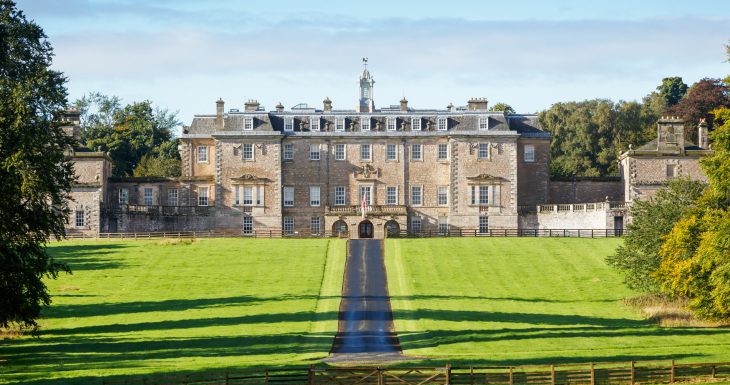
Marchmont is an C18th Palladian mansion at the heart of a 5,500 acre farming estate. The house with its grand Georgian interiors and sumptuous art works is only open to the public for a few days each year, and for staging occasional operatic and other musical events. In recent times, up until 2005, the main building was a Sue Ryder home before becoming a private residence once again.( https://www.marchmonthouse.com/)
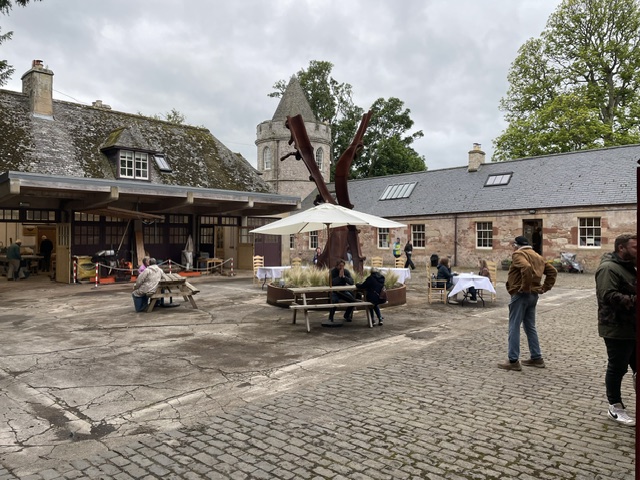
But it wasn’t the house we’d come to see today. Circling its imposing grand frontage we arrived at the equivalent of a town house’s tradesmen’s entrance – the old coach house, stables, garages and adjacent walled garden.
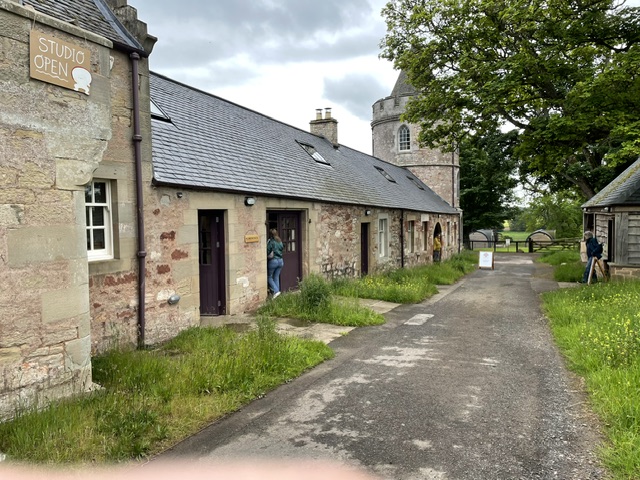
The solidly graceful pink sandstone courtyard was abuzz with activity. This substantial hub is home to the workshops of silversmiths and weavers, furniture makers, potters, artists and illustrators. Converted, managed and given rent free.
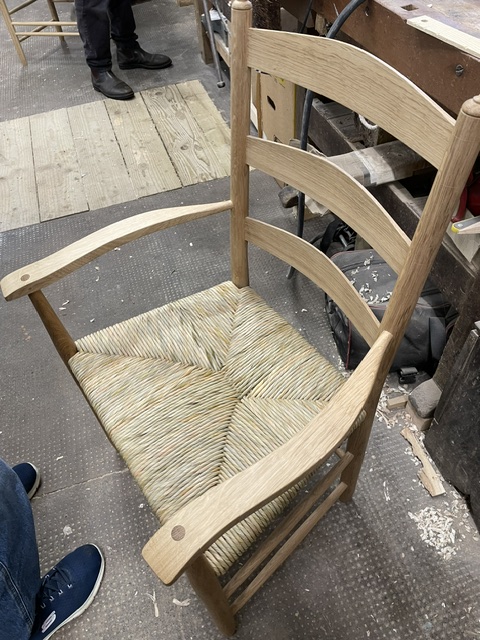
Particularly struck by the beautiful chairs in oak or ash with their rush seats, all worked from locally sourced timber and sedge. The makers demonstrated turning, steam bending and finishing.
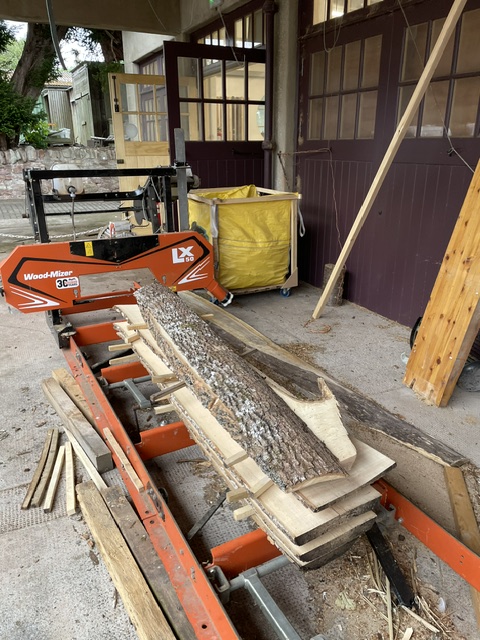
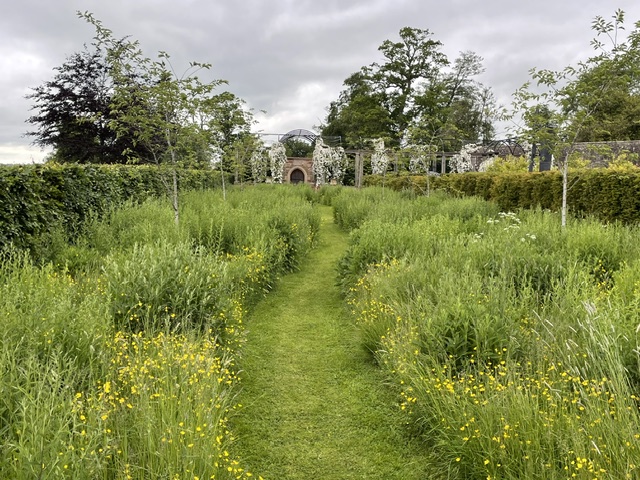
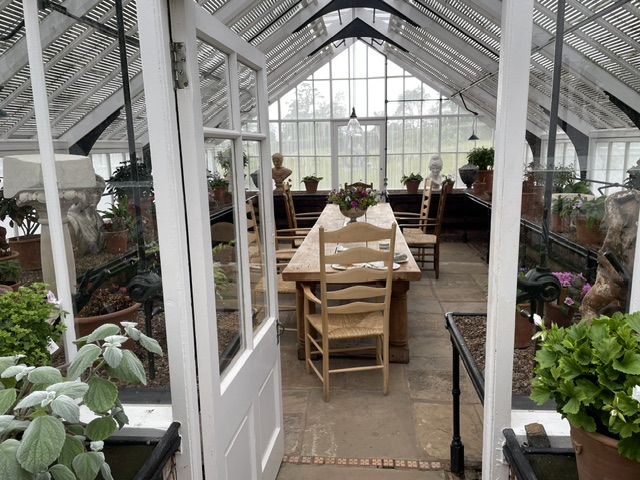
The open day also encompassed the mansion’s former walled garden and its interlinked elegant garden rooms and conservatories.
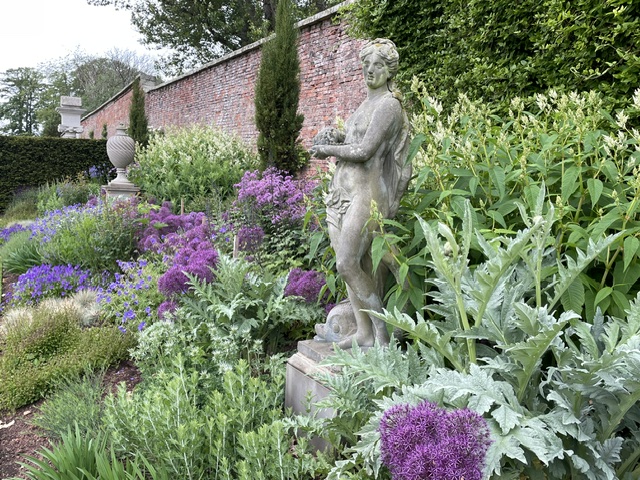
The planting of the expansive garden, contrasting repetitive masses of meadow plants contrasting playfully with the formal lines of topiary, hedging and wide flower borders was a pleasure to explore.
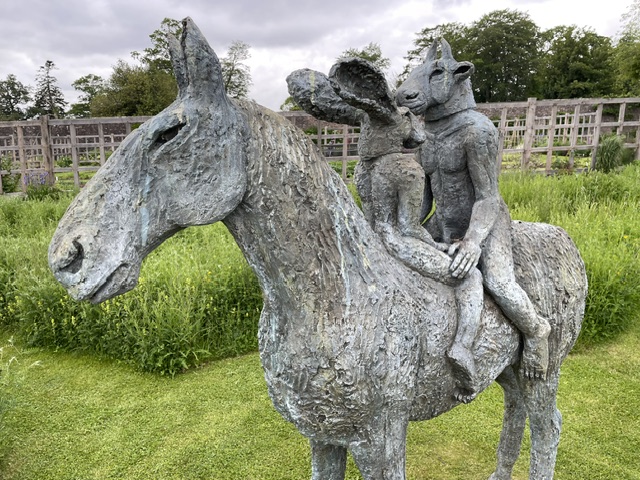
Commissioned contemporary works and the estate’s original classical garden statuary combine to make this walled garden a fine outdoor sculptural gallery.
All the above has been made possible by the charitable foundation set up in memory of the late entrepreneur and investor Hugo Burge (1972-2023) whose family trust have run the Marchmont estate since 1988. (https://www.hugoburgefoundation.org/)
A self-confessed arts and crafts geek this much loved charismatic benefactor did not hold back from putting his money where his mouth was. Inspired by the latent talent to be found here in his adoptive home land in the Borders, Hugo commissioned art works and opened garden and stable block for arts residencies and educational courses.
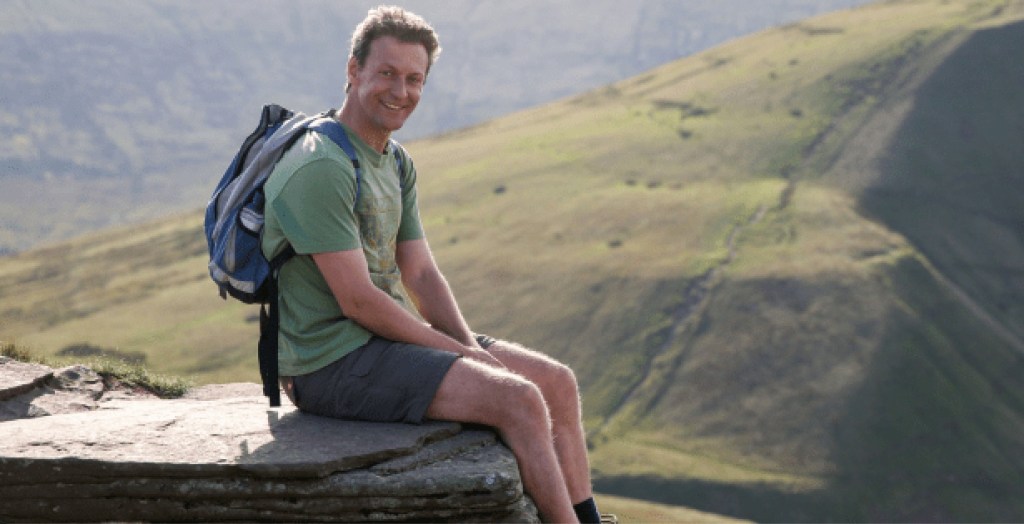
Which brings me back to Craftland author James Fox who is also the Hugo Burge Foundation’s creative director, part of a management team that is realising the wider ambitions of its late patron in supporting and developing craft based activities.

And not only here in the countryside but further afield in urban settings. I wish them well in their work and hope they can interact with a wider range of lesser known artisan trades before those more endangered craft and their skills pool disappear for good.

‘The wonderful thing about adventures is you never quite know where you are going…’ ( Hugo Burge)

In 2019 we had a section of our dry stone field wall re-built. Here the guys have started work, lining up coping stones before carefully dismantling the wall itself.

Medieval Treasures

Where are the men who came before us/ Who led hounds and hawks to the hunt, / Who commanded fields and woods? / Where are the elegant ladies in their boudoirs / Who braided gold through their hair / And had such fair complexions?

Extract from an anonymous poem c. 1275, trans. Michael R Burch)

There are more than one and a quarter million objects on display in the Victoria & Albert Museum. Since 2009 the medieval and Renaissance treasures are displayed in five galleries in that vast C19th cultural complex. On our recent London visit we confined ourselves to just one gallery, and were not disappointed with what was discovered. Here’s a bit about a handful of treasures on display connected with the west and north of England.

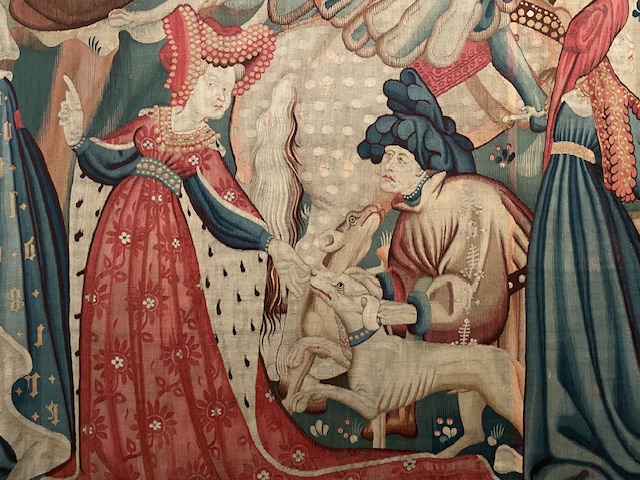
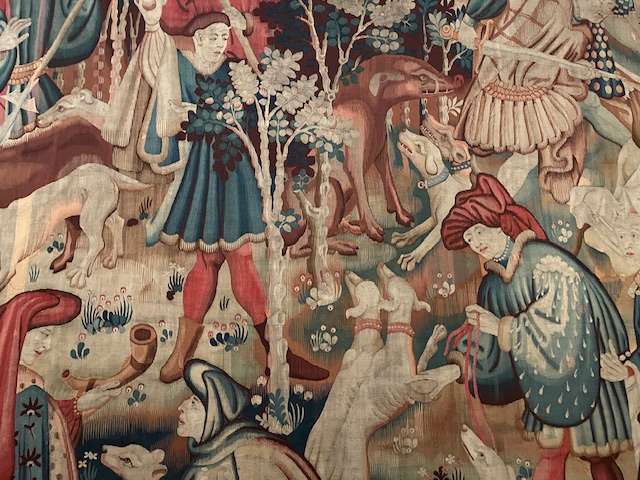
The wealth and power of a medieval English king pales in comparison to the richest and most splendid of European courts upheld by the magnificent Dukes of Burgundy, centred on what is now roughly southern Holland and northern Belgium. These towns and cities were the nexus of the continent’s major  trading  centres in luxury goods and services. This huge Flemish tapestry dated 1425-30, completely covers the gallery end wall. Formerly lodged at Hardwick Hall Derbyshire it was accepted by HMG in lieu of death duties on the estate of the 10th Duke of Devonshire.

Conspicuous wealth is on show here, the tapestry’s narrative function as great as that of its role decorating and insulating a castle or household interior. Only Kings and aristocrats were allowed to hunt game, like the bears and boars depicted here, and participants attire is strictly status related, eschewing practical hunting clobber. The ladies fur for example is miniver, an expensive pelt from the bellies of hundreds of Baltic squirrels culled in winter.

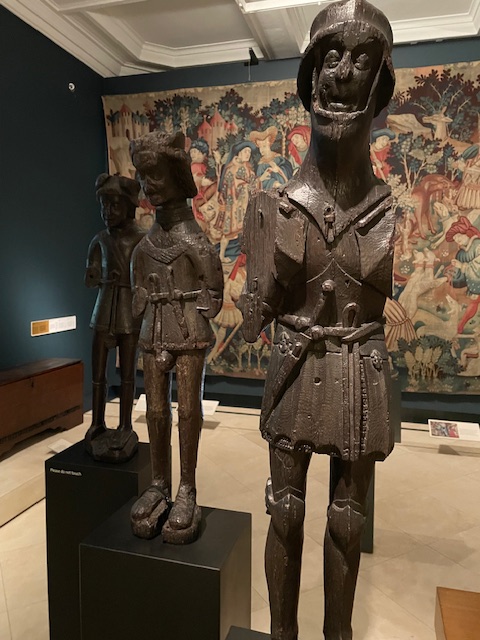
Three unique half-life size oak figures stand out against a background of the  great tapestry. A knight, his squire and man-at-arms; three orders of society in a great feudal household. Dating from the early 1500’s, they’re believed to have supported heraldic devices, and were placed high in the great hall of Kirkoswald or Naworth castle in Cumberland, properties held by the powerful Dacre dynasty. The armed man’s helmet or sallet was an essential piece of soldering kit but it also limited the wearer’s vision and impaired his breathing. In 1461, during the battle of Towton, a helmetless Lord Dacre was killed by an arrow while taking  a desperately needed drink of water. A monument marks the fatal spot of that terrible battle in the Wars of the Roses. (We visited in 2025 https://stephentomlin.co.uk/2025/05/01/towton-field/

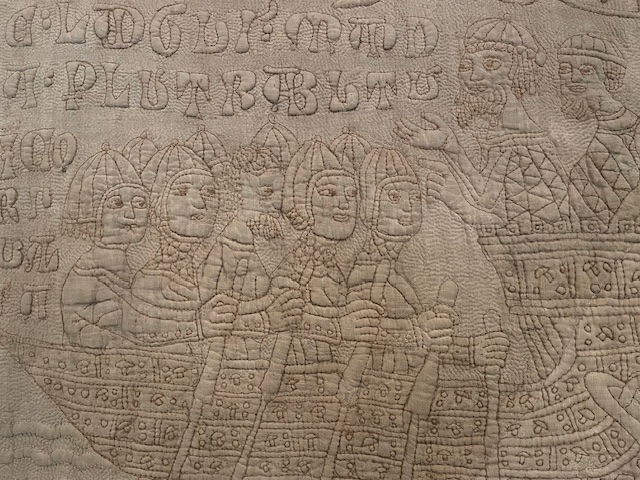
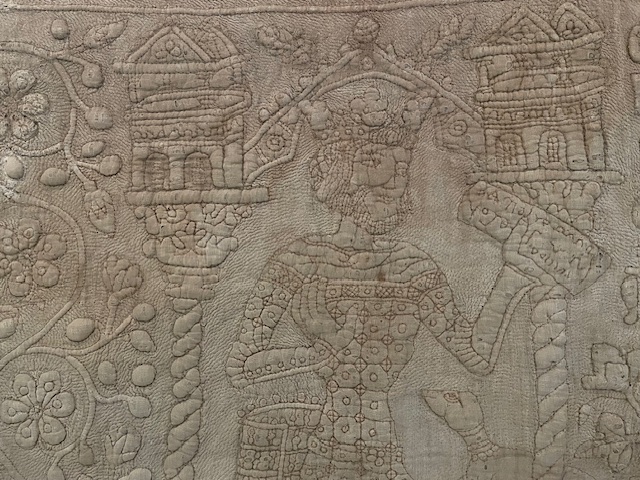
The tragic epic romance of Tristan and Isolde in Cornwall had huge appeal to the wealthy elites right across Europe and lots of art work reference it. This superb broadcloth bed covering, made in Florence for a rich merchant family between 1360-1400, really goes to town on the tale.

It’s a wonderful display of compressed narrative detail chronicling the epic story, with extra pieces attached at various times, fashioned from linen and cotton. Kim, who comes from a long line of quilters, was particularly impressed with the skill involved in its execution.  

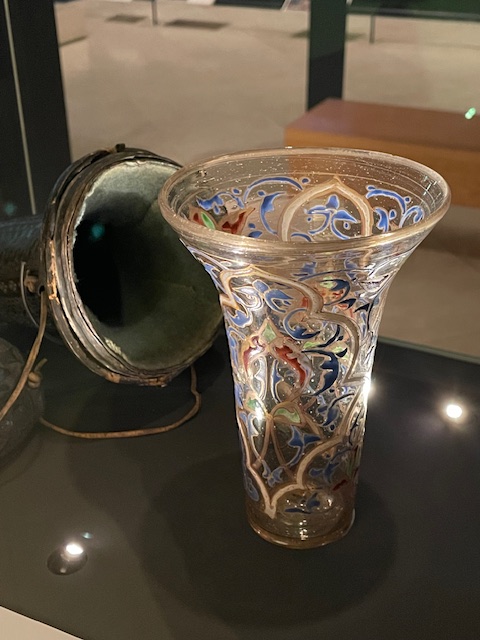
Surviving examples of luxury medieval Islamic glassware are exceptionally rare so this pristine one from Syria or Egypt dated to c.1350 has special significance. A talisman of the Musgrave family at their seat of Hartley castle and later at Edenhall in Cumbria ‘The Luck of Eden Hall’ has been protected in part by the 15th century leather case and – if local legend is to be  believed – by fleeing fairies,  who left it in human hands with the warning ‘If this cup should break or fall / Farewell the luck of Eden Hall.’ Curiously, in northern farming circles it remains customary to gift ‘luck money’ to the buyer of one’s stock at market as a token of goodwill.

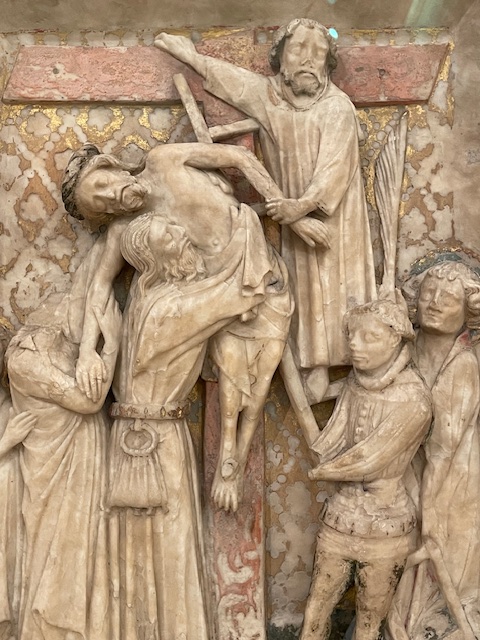
Finally…this small C14th alabaster fragment of a lost altarpiece from a Midlands church is a fine example of a deposition. The top figure’s steadying arm on the cross and Joseph of Aramathea’s handling of the slumped body of Christ help fix a moment of tender compassion. The odd missing head or hands of the other figures bear witness to the vagaries of time, or the action of iconoclasts. Along with the faded original bright colouring, this narrative scene exudes a sense of loss and sacrifice.