Where are the men who came before us/ Who led hounds and hawks to the hunt, / Who commanded fields and woods? / Where are the elegant ladies in their boudoirs / Who braided gold through their hair / And had such fair complexions?
Extract from an anonymous poem c. 1275, trans. Michael R Burch)
There are more than one and a quarter million objects on display in the Victoria & Albert Museum. Since 2009 the medieval and Renaissance treasures are displayed in five galleries in that vast C19th cultural complex. On our recent London visit we confined ourselves to just one gallery, and were not disappointed with what was discovered. Here’s a bit about a handful of treasures on display connected with the west and north of England.
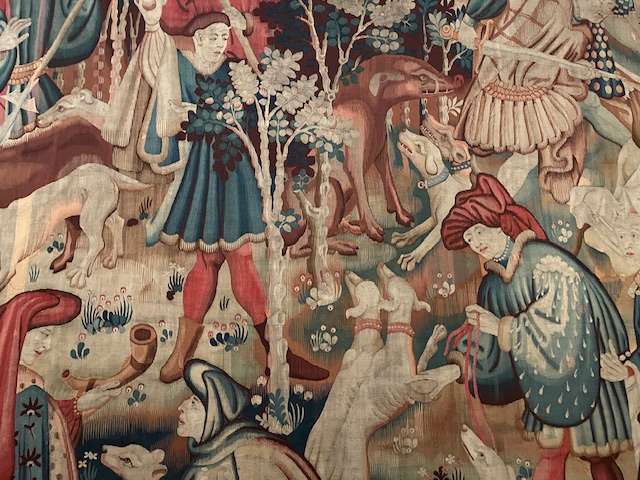
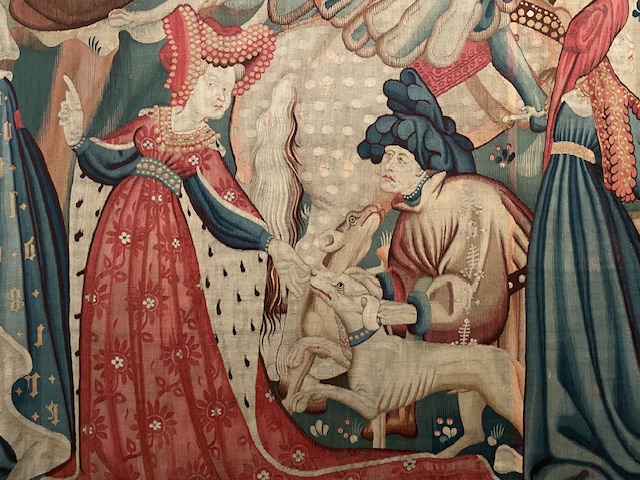
The wealth and power of a medieval English king pales in comparison to the richest and most splendid of European courts upheld by the magnificent Dukes of Burgundy, centred on what is now roughly southern Holland and northern Belgium. These towns and cities were the nexus of the continent’s major trading centres in luxury goods and services. This huge Flemish tapestry dated 1425-30, completely covers the gallery end wall. Formerly lodged at Hardwick Hall Derbyshire it was accepted by HMG in lieu of death duties on the estate of the 10th Duke of Devonshire.
Conspicuous wealth is on show here, the tapestry’s narrative function as great as that of its role decorating and insulating a castle or household interior. Only Kings and aristocrats were allowed to hunt game, like the bears and boars depicted here, and participants attire is strictly status related, eschewing practical hunting clobber. The ladies fur for example is miniver, an expensive pelt from the bellies of hundreds of Baltic squirrels culled in winter.
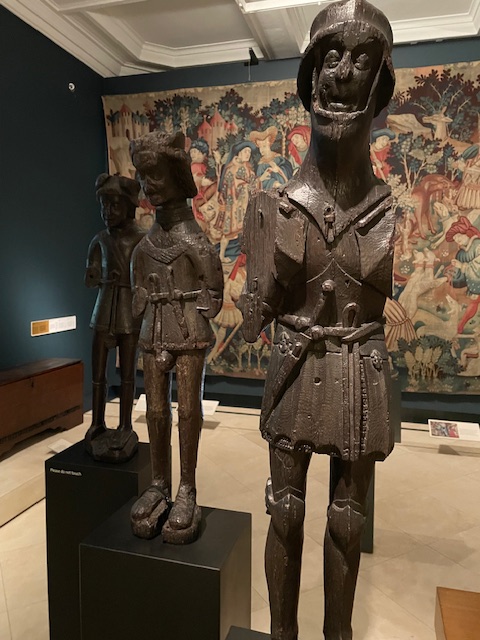
Three unique half-life size oak figures stand out against a background of the great tapestry. A knight, his squire and man-at-arms; three orders of society in a great feudal household. Dating from the early 1500’s, they’re believed to have supported heraldic devices, and were placed high in the great hall of Kirkoswald or Naworth castle in Cumberland, properties held by the powerful Dacre dynasty. The armed man’s helmet or sallet was an essential piece of soldering kit but it also limited the wearer’s vision and impaired his breathing. In 1461, during the battle of Towton, a helmetless Lord Dacre was killed by an arrow while taking a desperately needed drink of water. A monument marks the fatal spot of that terrible battle in the Wars of the Roses. (We visited in 2025 https://stephentomlin.co.uk/2025/05/01/towton-field/)
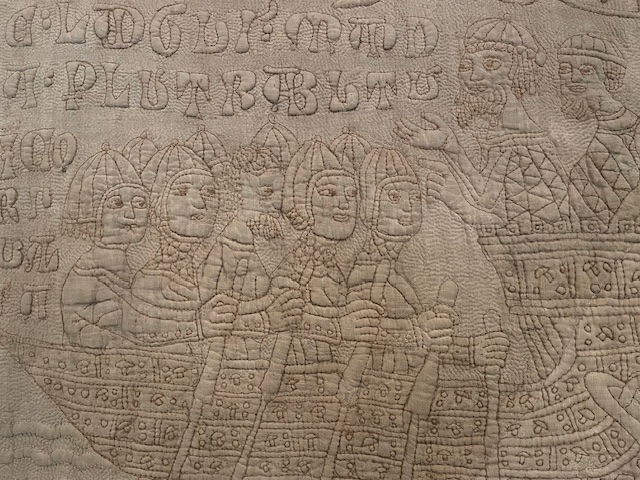
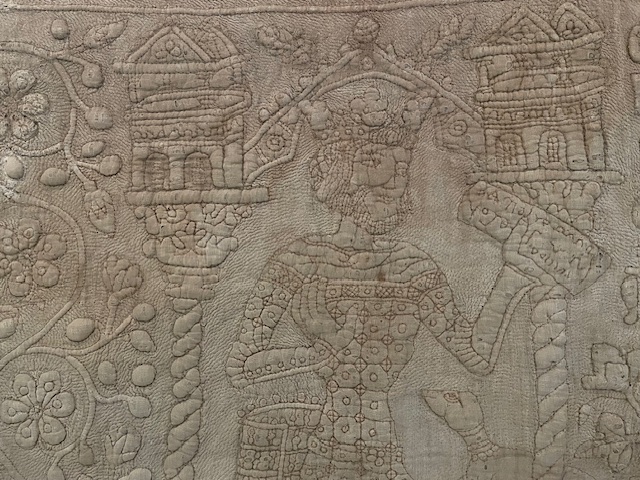
The tragic epic romance of Tristan and Isolde in Cornwall had huge appeal to the wealthy elites right across Europe and lots of art work reference it. This superb broadcloth bed covering, made in Florence for a rich merchant family between 1360-1400, really goes to town on the tale.
It’s a wonderful display of compressed narrative detail chronicling the epic story, with extra pieces attached at various times, fashioned from linen and cotton. Kim, who comes from a long line of quilters, was particularly impressed with the skill involved in its execution.
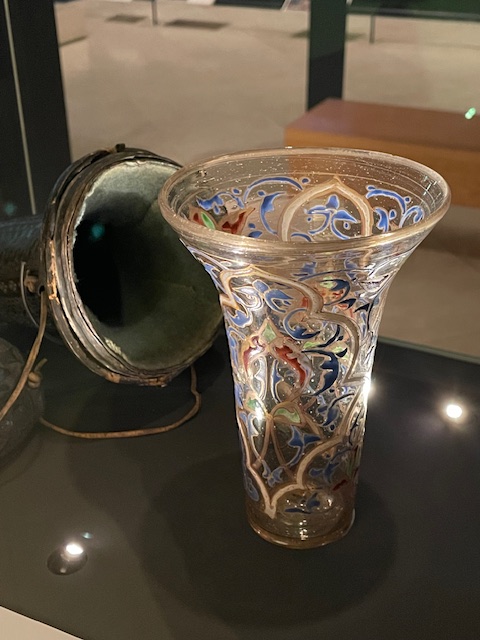
Surviving examples of luxury medieval Islamic glassware are exceptionally rare so this pristine one from Syria or Egypt dated to c.1350 has special significance. A talisman of the Musgrave family at their seat of Hartley castle and later at Edenhall in Cumbria ‘The Luck of Eden Hall’ has been protected in part by the 15th century leather case and – if local legend is to be believed – by fleeing fairies, who left it in human hands with the warning ‘If this cup should break or fall / Farewell the luck of Eden Hall.’ Curiously, in northern farming circles it remains customary to gift ‘luck money’ to the buyer of one’s stock at market as a token of goodwill.
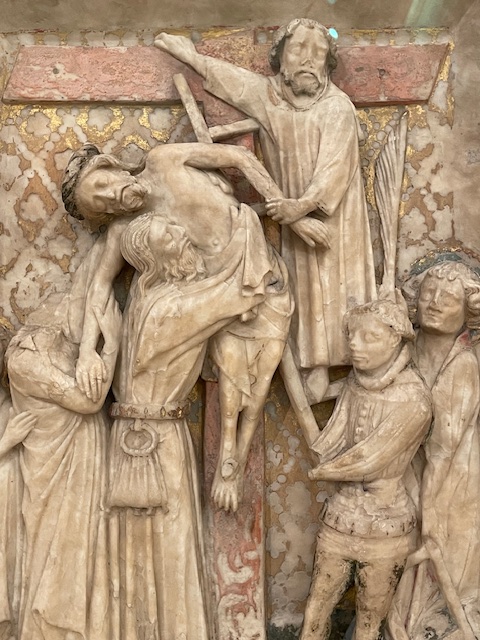
Finally…this small C14th alabaster fragment of a lost altarpiece from a Midlands church is a fine example of a deposition. The top figure’s steadying arm on the cross and Joseph of Aramathea’s handling of the slumped body of Christ help fix a moment of tender compassion. The odd missing head or hands of the other figures bear witness to the vagaries of time, or the action of iconoclasts. Along with the faded original bright colouring, this narrative scene exudes a sense of loss and sacrifice.
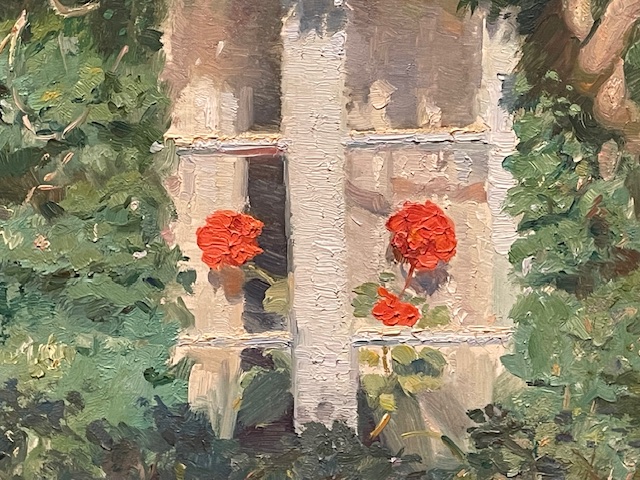
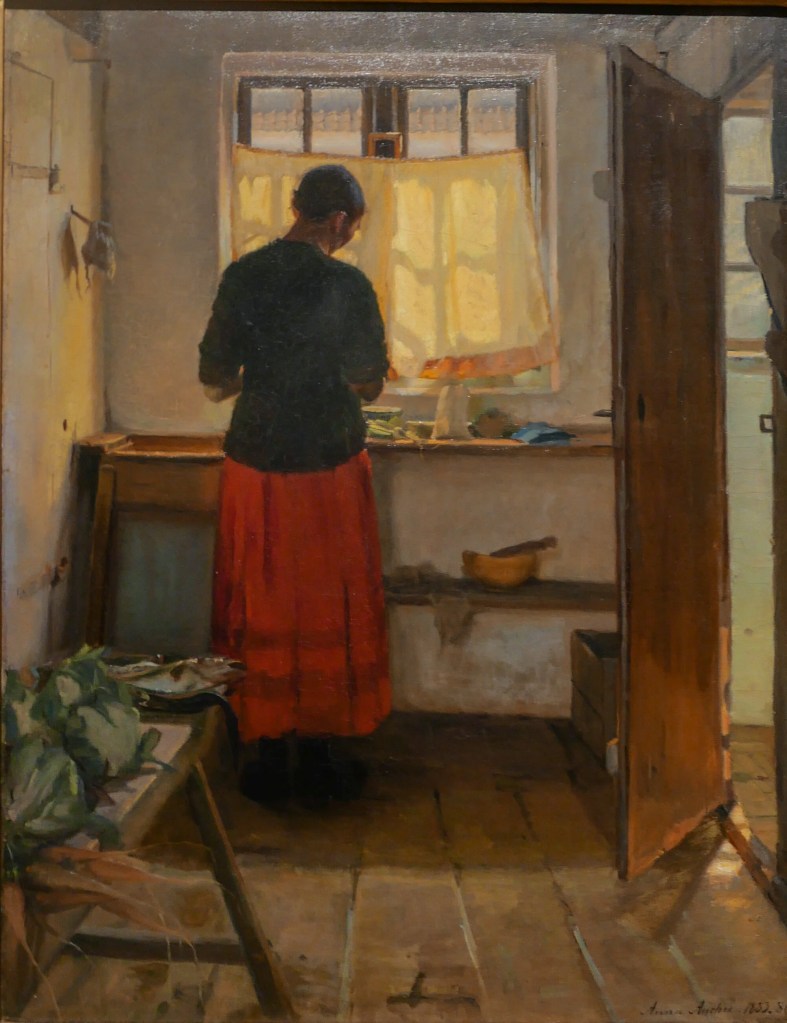
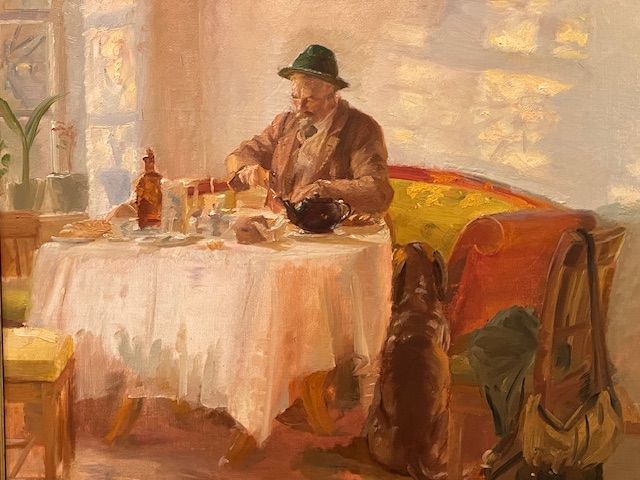
The Old Window (detail) Oil painting by Anna Ancher
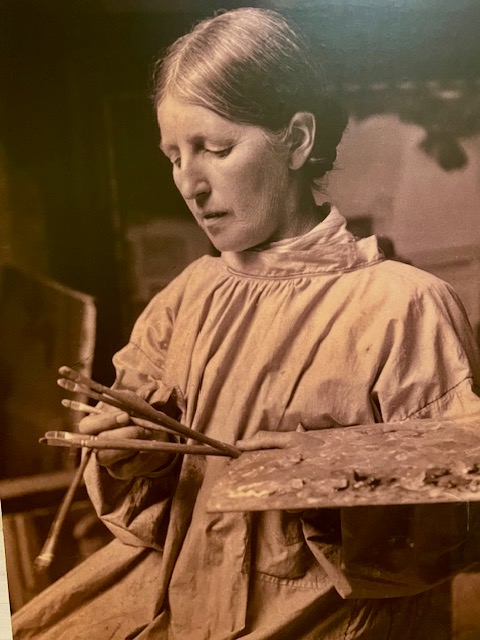
Maybe it’s from watching too much Danish television and cinema, but the northern region of Jutland lodges in my imagination as a cold windswept archipelago breeding outlaws, from Viking raiders to Scandi noir murderers. How refreshing then to set the record straight with a welcome immersion in the luminous world created by one of that country’s most celebrated artists, Anna Ancher.
Last week, on a rain soaked Tuesday morning, we slipped into the serene interior of the UK’s oldest public art collection, the Dulwich Picture Gallery in south London. We’ve previously caught some fine shows here but this one was different in that the artist was hitherto unknown to us.
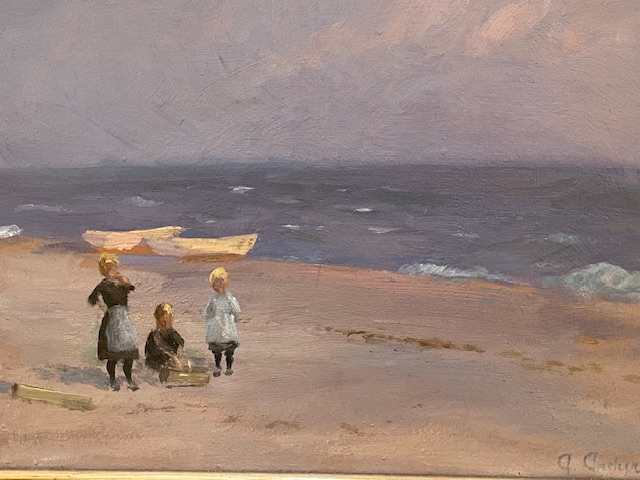
Children on the beach at Skagen
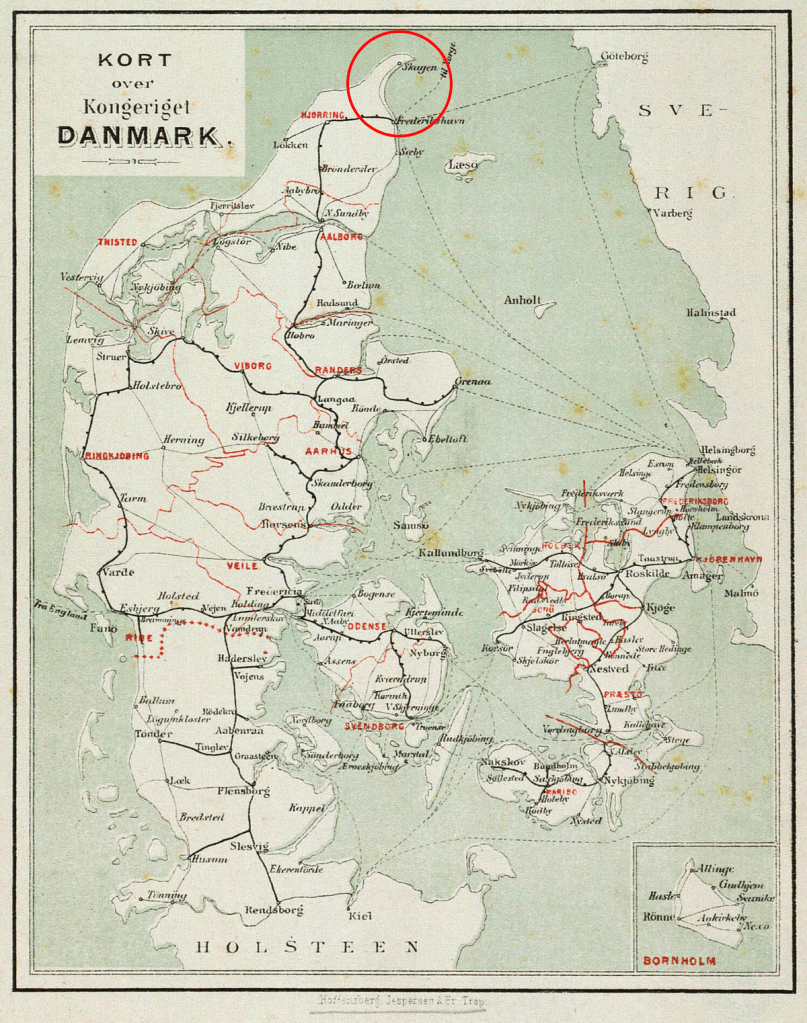
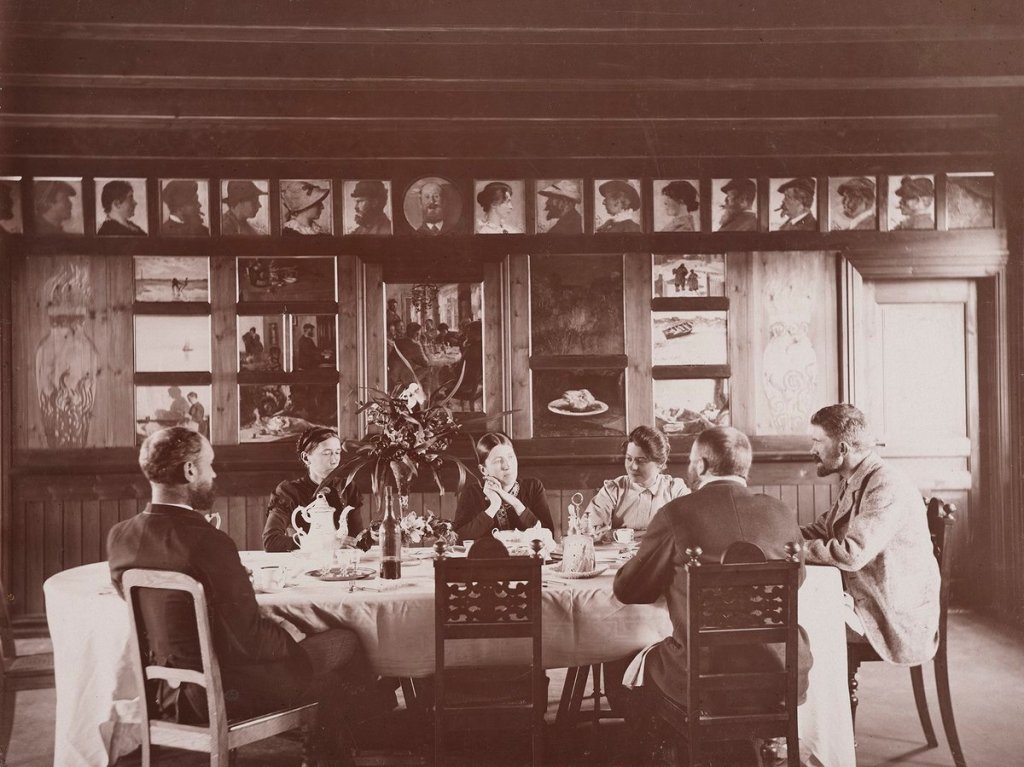
Women artists of Anna’s day – she lived from 1859 to1935 – faced huge barriers in pursuing their careers. Her family, the Brondum’s, ran the only hotel in the remote town of Skagen (pronounced Skay-en) where she was born and spent most of her life. It became a lively centre of artistic activity from the 1870’s and still trades today in what has become an upmarket seasonal resort town of uniform bright walls and red tile roofs.
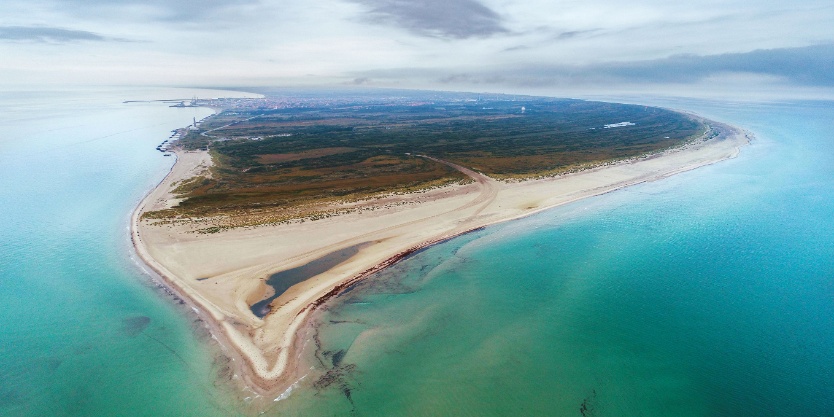
Emerging artists were drawn then to what was a near inaccessible spot at the very northern tip of Jutland, where the Skagerrak and the Kattegat seas meet. An exposed lone finger of land defined by sand dunes and continual beaches under vast open skies. One of those dynamic young incomers, Michael Ancher, became Anna’s husband and collaborator.
Anna, central, and her circle at the Brondum’s Hotel / Art Museums of Skagen, historic photo collection.
At that time most of the indigenous inhabitants led a hard existence as farmers and fisherfolk and many, like Anna’s mother Ane, were devout protestants. Surprisingly perhaps, Ane supported her daughter by paying for private art lessons in Copenhagen. (Women were banned from the official schools) Later both Anna and Michael studied in France where the liberating influence of impressionism was key to further development.
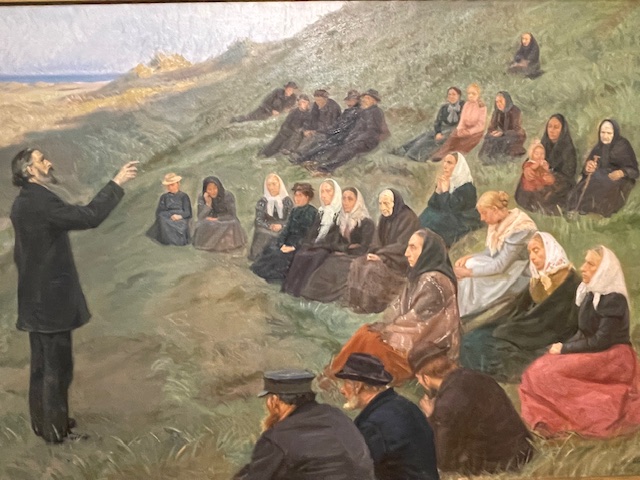
Anna was not just confined to the traditional female realms of home and family for subject matter and she demonstrated her compositional skills in large scale works like this one from 1903. The Skagen mission church congregation her mother belonged to, seated in the dunes ,listening to a sermon given by their local preacher.
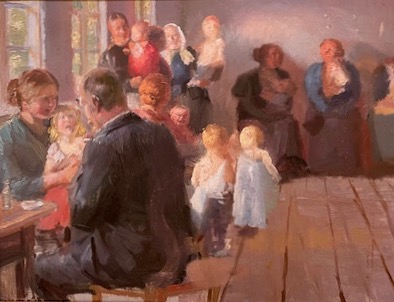
Particularly liked this little picture of mothers bringing children to be vaccinated against smallpox. The practice had been compulsory in Denmark since 1810 but then, as now, it was a cause of controversy. With Michael modelling as the doctor, alongside local women and children, clearly shows which side of the argument the Anchers favoured.
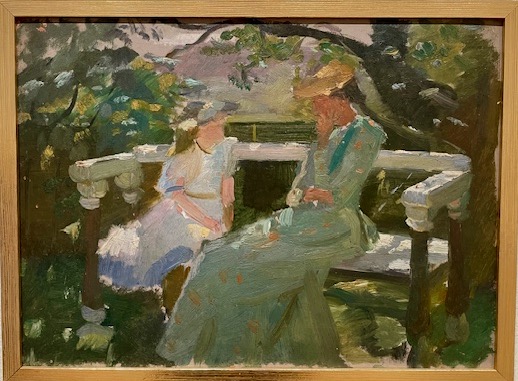
Another eye catching small study in oils shows the Ancher’s daughter Helga, with Anna’s cousin Ane Torup, dressed in green, at home on the bench in a summer garden (c.1892).
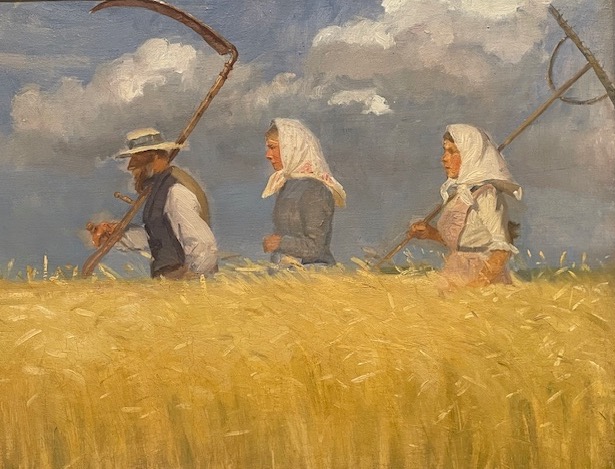
Farmland had been painstakingly reclaimed from sandy heath and this vibrant close study of harvesters in the corn from 1905 both focuses and intensifies the colouration of the scene, where the sturdy workers set out to reap the rewards of their year’s labour.
One of the major oil paintings on display is a wonderful portrait from 1886 of a maid in the kitchen which demonstrates Ancher’s particular genius. A fascinating composition imbued with intimacy and stillness. Entrancing in its luminosity, with echoes for me of Vermeer.
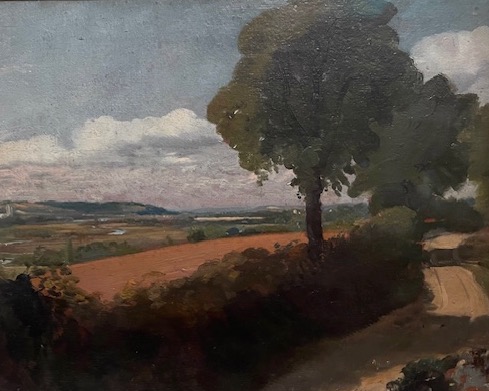
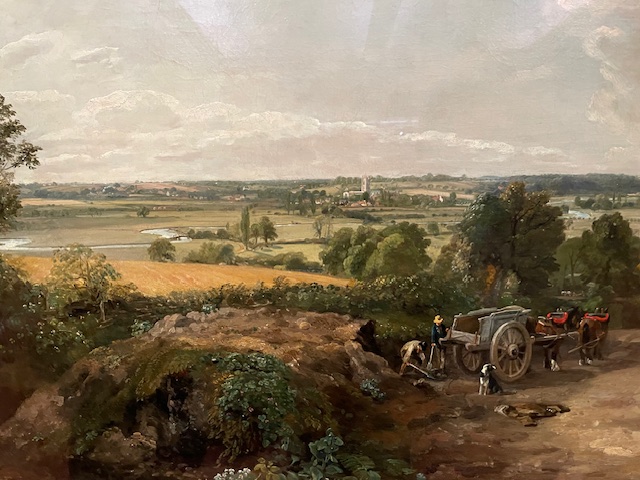
John Constable: View of Dedham Vale 1809 Oil paint, paper on canvas
When you live in the country but you’d like to know how others see the country then you need to head for the city. That’s what we did last week to indulge in a double dose of artistic genius served up for our consumption at Tate Britain.
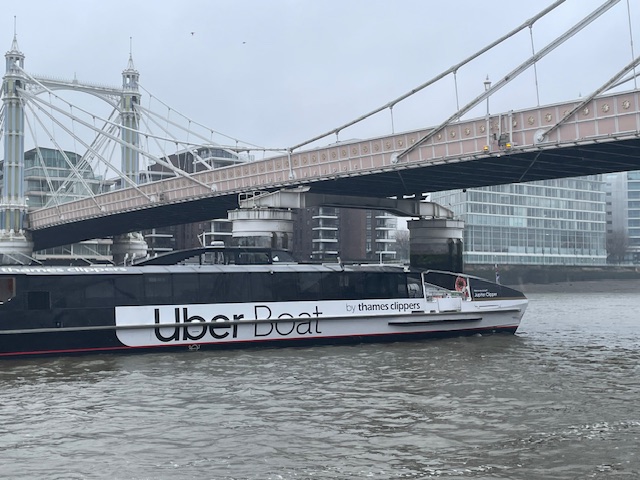
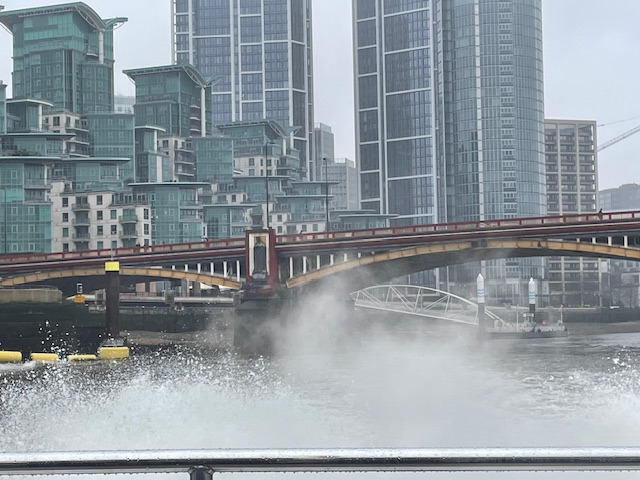
Arrived at Millbank by boat on one of the catamaran Uber river taxies that ply their trade on the Thames. Pricey, but worth it for the vistas afforded. Powerful engines allow for nimble sideways docking and a surprising turn of speed on the fast flowing floodwaters. Graceful bridges backed by sky blocking glass walled monoliths at Vauxhall with remnants of more graceful human scale buildings elsewhere on the river banks.
JMW Turner and John Constable. The two mighty creative engines that powered and defined the art of landscape painting in early C19th England. The Tate exhibition bills the two men as ‘Rivals and Originals’ and an intriguing combo they proved to be when viewed here in tandem.
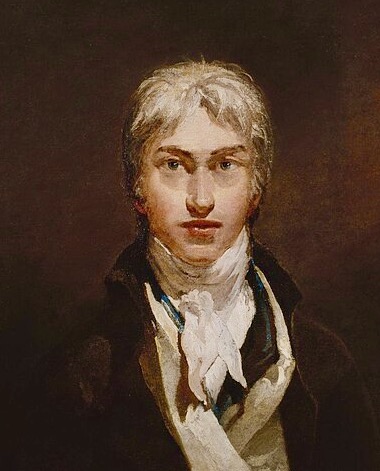
JMW Turner Self portrait 1799
Weaving in and out of the mass of fellow visitors we were skilfully drawn into their overlapping visions of a land and people in flux, complimenting and contradictory by turns.
Both men were out touring in summer and working up drawings and sketches to a finished state back in their respective London studios throughout the winter, for display at the Royal Academy show, where they’d eventually secure top billing as leading members; feted, criticized and praised in equal measure by critics, patrons and public alike.
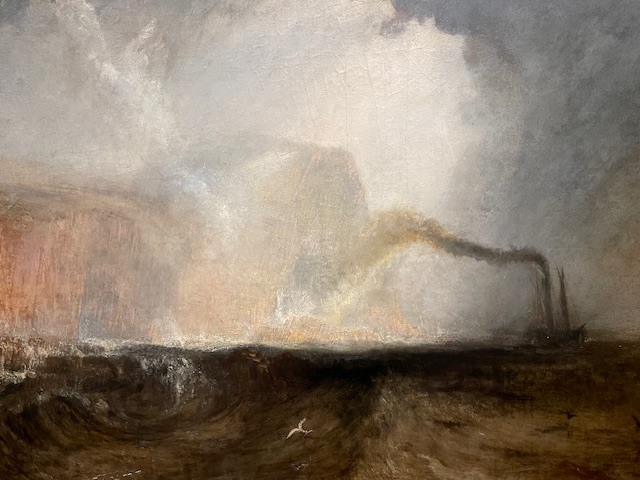
Turner: Steam Ship off Staffa
We were introduced to two very different personalities from contrasting social backgrounds. Joseph Mallord William Turner (1775-1851) was the son of a Devon born barber and wigmaker who had set up shop in Covent Garden. The proud father displayed his precocious 15 year old son’s drawings in the shop window to attract custom.
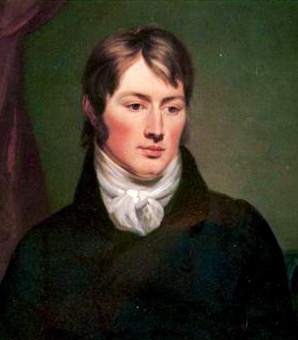
John Constable by R C Reinagle (1799)
By contrast Constable’s father was a prosperous miller and coal merchant in rural Suffolk who disapproved of his son’s artistic ambitions. John Constable (1776-1837) comes across as an introspective, conservative and conscientious countryman while Turner was quite at home in the capital; an eccentric showman and gallery owner, secure in his own genius.
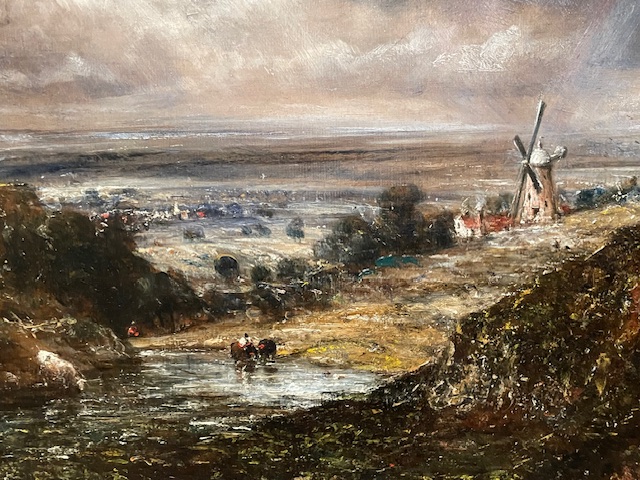
Constable: detail from oil painting of Hampstead Heath 1835
Against both their families initial opposition Constable married Maria Bicknell, a neighbour and childhood sweetheart, and subsequently supported a large family of seven children. For a while they lived out of London, in Hampstead village and Brighton, for the sake of Maria’s fragile health. Success came much later to him than it did Turner. Scaling up to work on larger canvasses his ‘Six footers’ helped secure artistic and economic success on being accepted as a member of the R.A. in 1829. Turner never married, though it’s believed he fathered two illegitimate daughters who he looked after. He also had Sandycombe lodge built in Twickenham for his widowed father. A fascinating miniature Italianate villa, still standing, recently restored and well worth a visit.
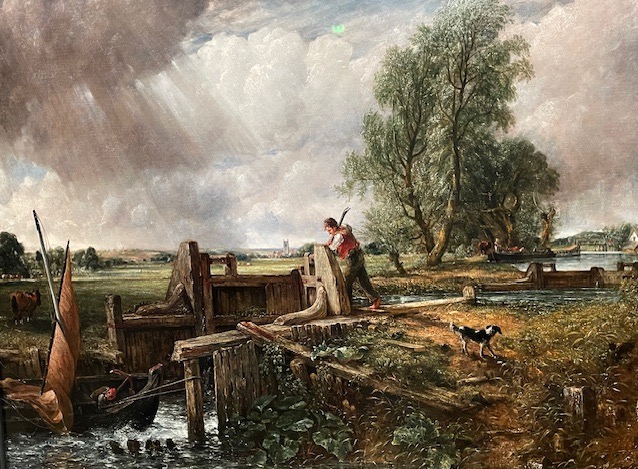
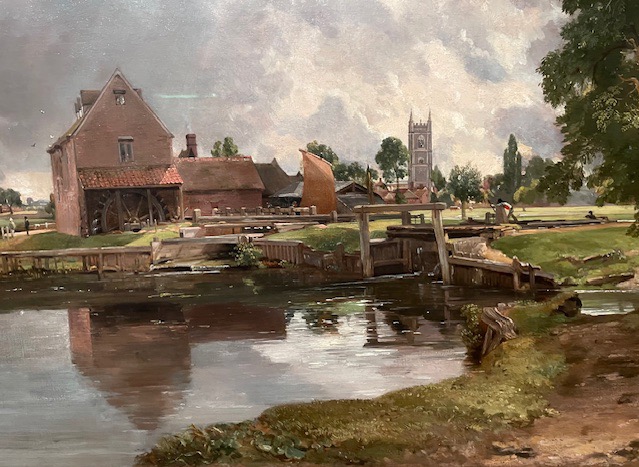
Constable: Dedham lock and Mill (1818)
The exhibition displays a combined 170 works by the two artists. Constable’s masterpieces with the greatest appeal show us the working people of his native Suffolk going about their business in a quintessentially English pastoral setting. It seems idyllic on the surface but was often the opposite due to the huge changes wrought by the agricultural revolution then in full swing. A situation chronicled by contemporaries like William Cobbett in his ‘Rural Rides’ series of newspaper reports across the southern English counties.
I like this Constable picture of a muck heap, painted as a childhood friend’s wedding gift. Not the most obvious subject for a conjugal gift…Or is it? Composted fertility, spread on the land to increase yields, has a more obvious meaning. Like his most famous painting ‘The Haywain’ collie and patches of red feature as signatures to this otherwise everyday rural scene.
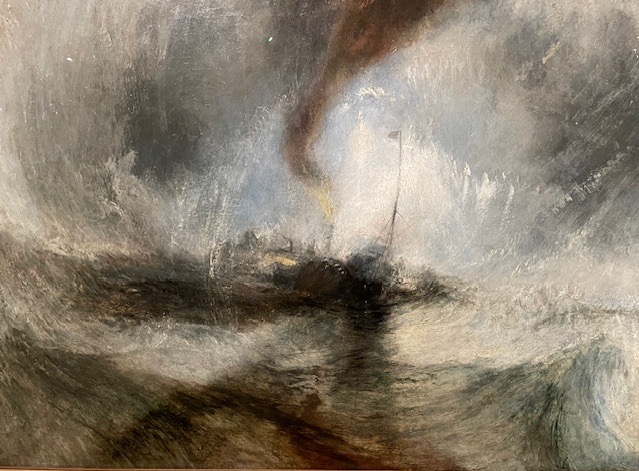
In Turner’s thrilling immersion we’re pitched into the dynamics of mechanised invention engaged with great elemental forces . ‘Snow storm – Steamboat off a Harbour’s Mouth’ (1842) is an outstanding example of the artist’s innovative style. Turner claimed he was lashed to a mast so he could safely observe the scene. I mused to think how much more disorientating this kind of artistic vision would have been when first viewed by the public.
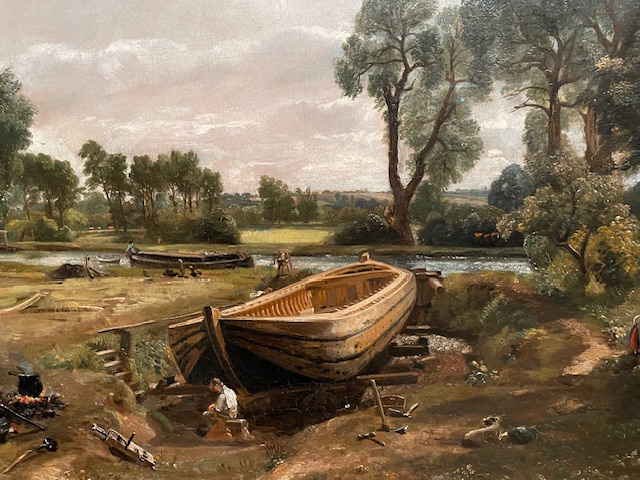
By way of contrast Constable reveres the age old crafts – boat building in a dry dock off the River Stour. Barges like this floated his father’s stores of grain to Flatford mill and beyond. They were the foundations of the family’s fortunes and are lovingly captured in this oil painting of 1815. Constable must have revisited his childhood self in such scenes. A warm memory, in his own words, of a ‘careless boyhood…which made me a painter.’
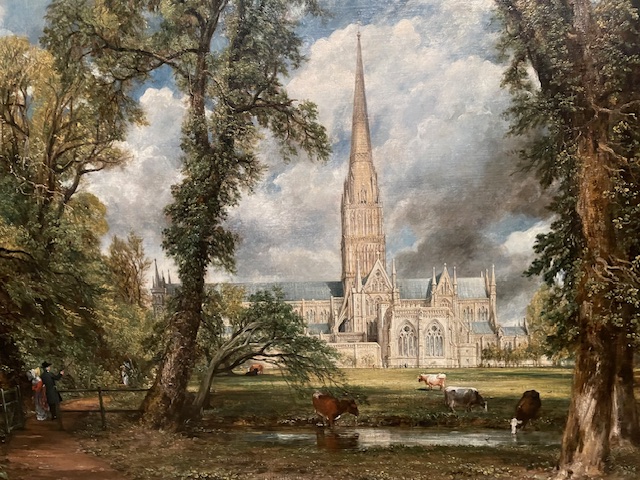
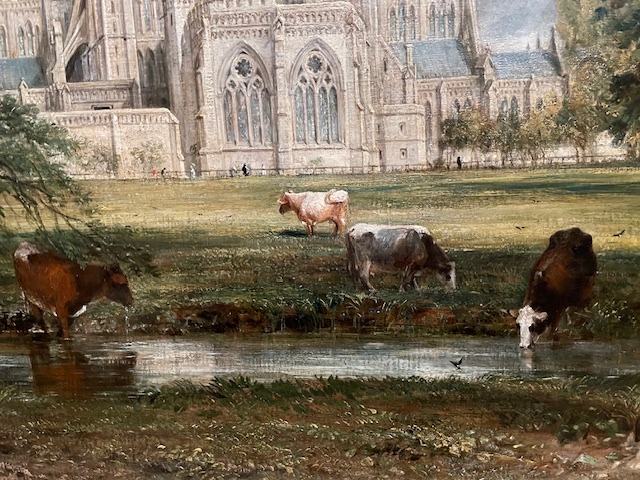
Constable’s studies of Salisbury Cathedral in different weathers are famous works, reminding us of his deep Anglican faith and concern for the church in the face of social and religious reform. I loved the attention to detail in this painting, commissioned by the bishop, seen at the far left of the picture with his wife. Constable’s celebrated portrayal of clouds and loose handling of paint would prove a major influence on contemporary French artists, helping to lay the foundations of impressionism. That would not have impressed his patron though, who we are told, disliked the conflicted cumulous and wanted a more serene sky.
My eye was more drawn down earthwards, to the creatures in the foreground. Like the work of the C17th Dutch master Aelbert Cuyp, Constable clearly had a soft spot for cows, and they seem to represent the kind of rural contentment and prosperity he so valued. The beast on the left, having just drunk from the river, drools water while on the right a house martin hovers to catch flies over the stream.
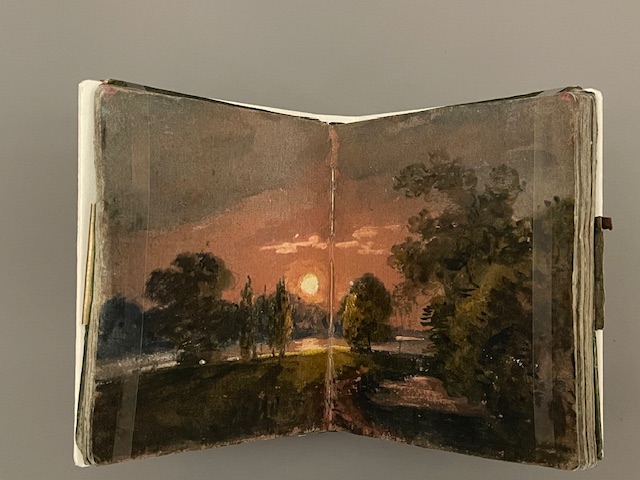
Turner travelled extensively all over Britain and ,during breaks in the Napoleonic wars, across western Europe too. He worked rapid sketches in different mediums. I liked this small notebook sunset from a tour of 1796-7 executed in gouache, pencil & watercolour.
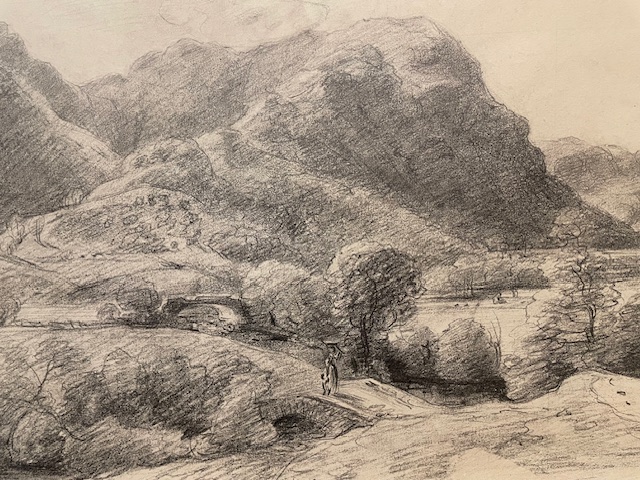
Constable too was no slouch on this outdoor tour mission. Six weeks spent touring the Lake District in 1806 sharpened his drawing skills as this fine pencil sketch of Borrowdale shows…I wondered if he ever met the Wordsworth’s on his perambulations then? What a conversation the Cumbrian poet and his sister may have had with artist from East Anglia.
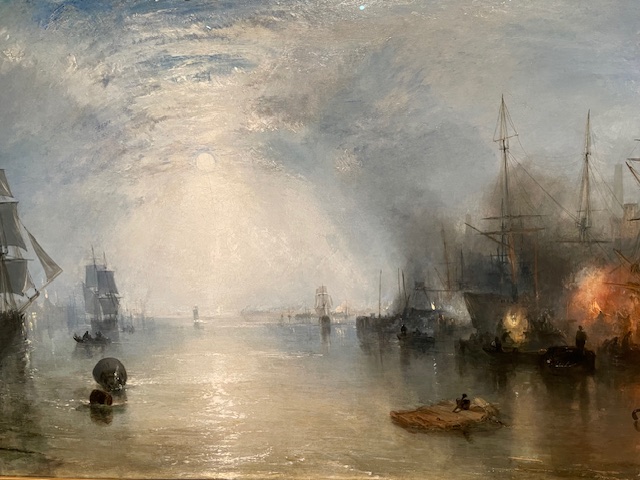
Turner’s association with Northumberland is reflected in a handful of paintings on show. ‘Keelmen Heaving in Coals by Moonlight’ is one. It’s not specified which Tyne river port of Shields – North or South – is referred to. The image is typically dramatic yet also has a melancholic tone. The keelmen transferred vast amounts of regionally mined coal from their barges (keels) to sail boats bound for London and other rapidly expanding industrial towns and cities. But It’s 1835 and the rapid spread of railways is already making transport by these means redundant.
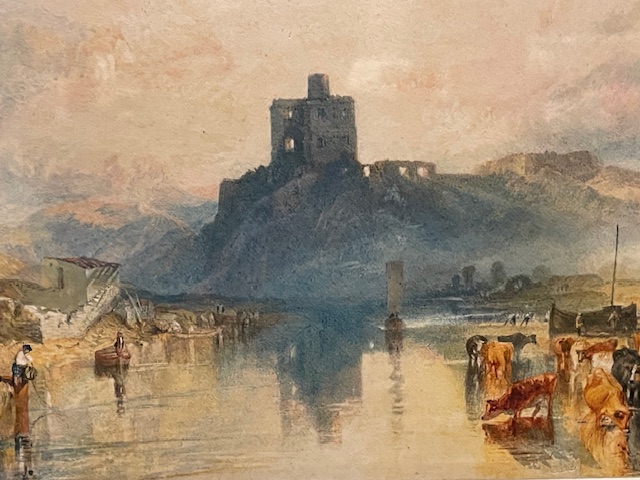
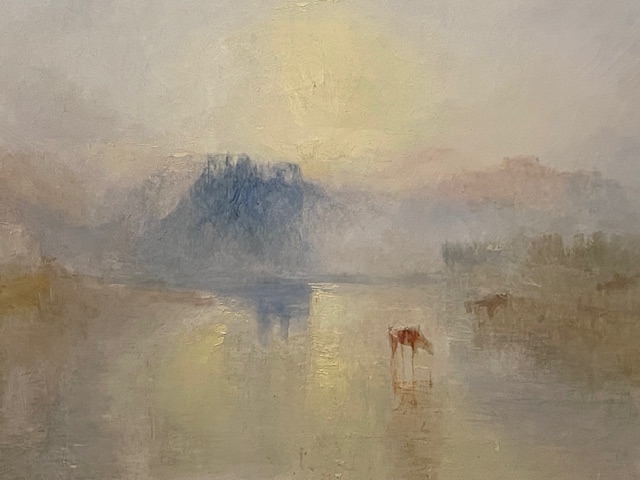
At the other end of the county Turner was drawn both as a young artist of 22 and as an old master to the ruins of Norham Castle on the English bank of the River Tweed, the boundary with Scotland. He clearly loved the place and his views at sunrise were recalibrated from the infused romance of 1823 (above) to light drenched abstraction in 1845 (below). The latter interpretation opened the door to modernism and, by acknowledgement, the major contemporary art prize awarded in his name.
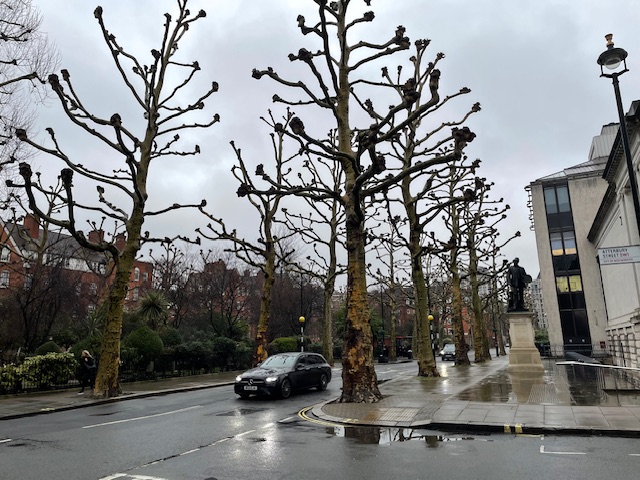
On leaving we emerged into a street lined with mature plane trees, their bare branch stumps rounded like boxing gloves, punching the grey London sky. After hours infused in great art you can’t help but wonder at these natural forms tailored to urban life, like an outside extension to the gallery…Wonder what JMW and John would have made of them?
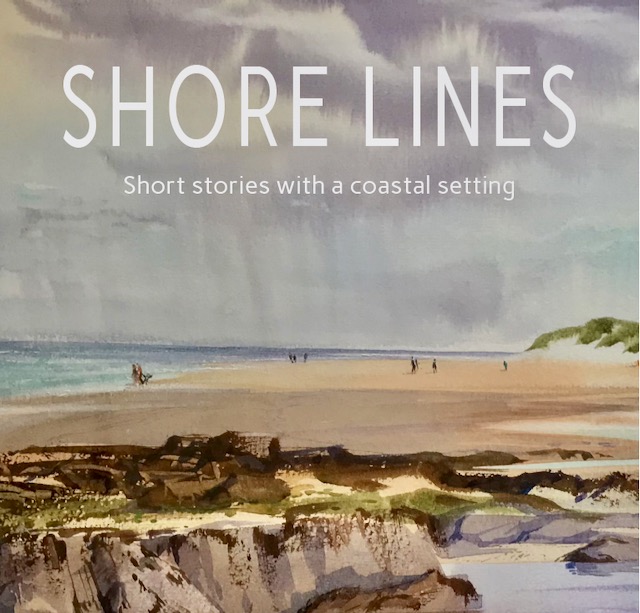
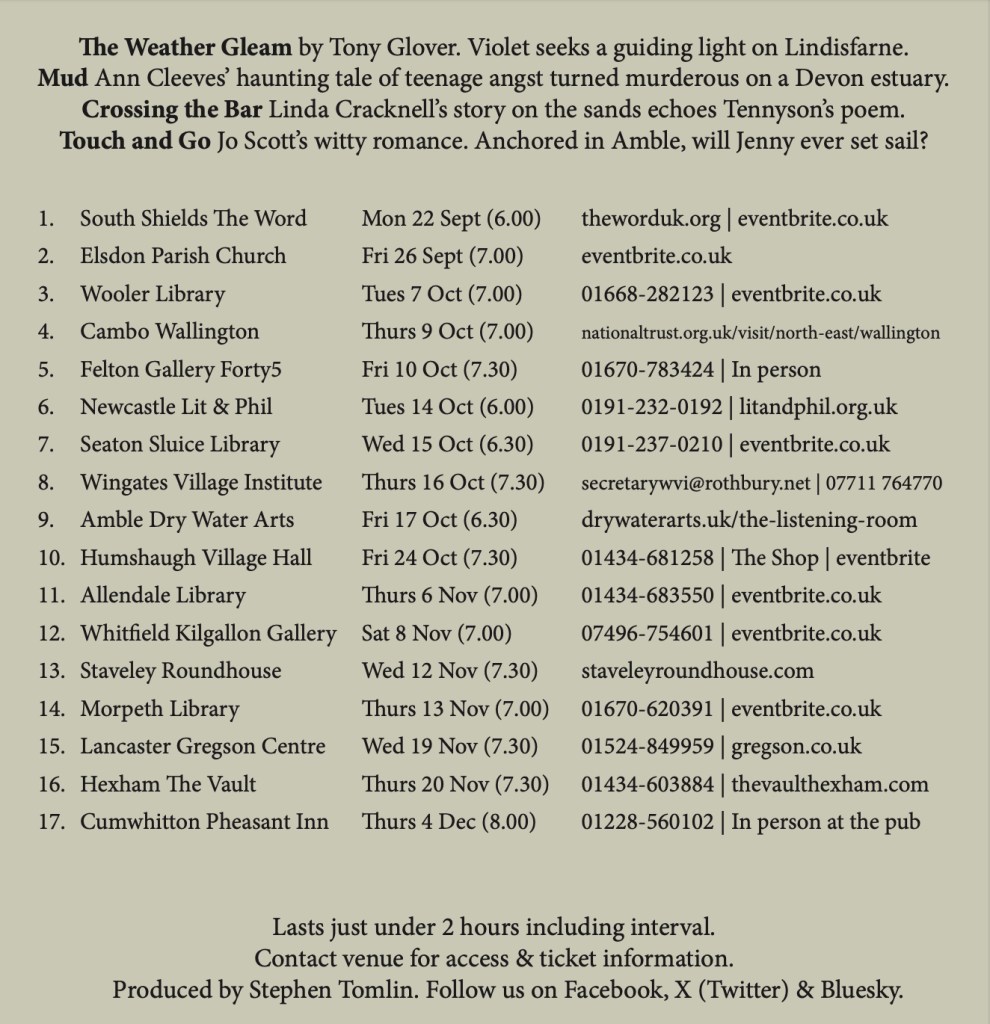
Experienced the usual emotional mixture of pleasure and relief that this year’s ‘Shore Lines’ tour for The Border Readers had ended earlier this month. A pub’s not a bad place to come to the end of the road in and The Pheasant at Cumwhitton in the Eden valley is an exceptionally warm and welcoming hostelry.
Screenshot
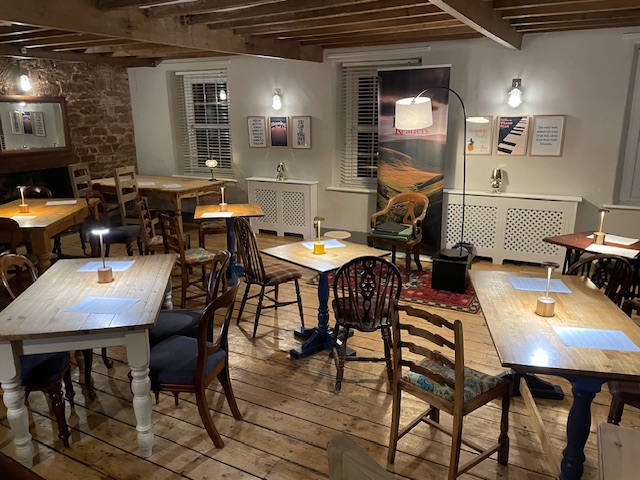
The function room upstairs set out with tables and chairs proves the most intimate of surroundings for this final gig for myself and fellow readers Grace and Wynne. A bonus in having writer Linda Cracknell and her partner Robin with us. Linda’s short story, ‘Crossing the Bar’ was originally commissioned and broadcast by BBC Radio 4 in 2018, and was inspired by Tennyson’s classic poem ‘. I picked them up earlier from Armathwaite station on the fabled Settle – Carlisle line a few miles away. A beautifully preserved Victorian village station, wreathed now in a swirling mist, my friends the only passengers getting off here, who were more than pleased to see me emerge from the gloom. Very atmospheric indeed.
The Pheasant set up
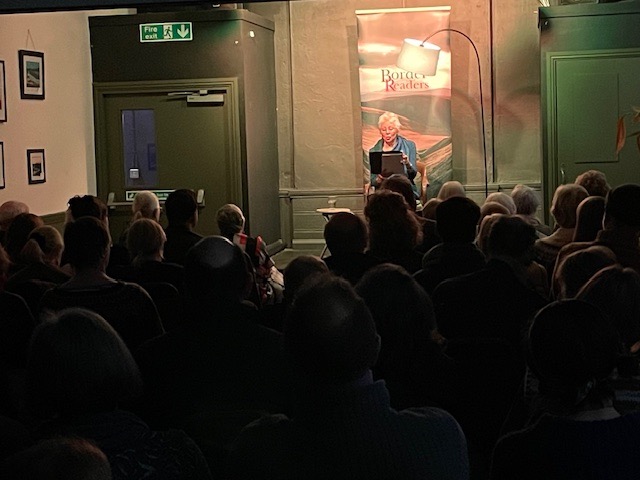
Other highlights of the tour included a sell-out debut at The Gregson Centre in my former home town of Lancaster. A lively celebration, with family in the audience and readings shared with old pals and demi-paradise associates, Roberta and Helen. I use to captain the Gregson bar’s ‘B’ team, part of the city ‘s pub quiz league, so it’s a place dear to my heart.
Roberta Reads at The Gregson
I always assume our annual themed literary event to be a cost neutral production but this year, to make sure I was not kidding myself, I crunched the numbers and, lo and behold, that was indeed the case. Those calculations make no account of hours spent as producer – this is after all a retirement passion project – but in every other way it continues to pay for itself as a non for profit community based cultural venture.
Caught ‘Miniature Worlds’ the latest exhibition at the Laing Art Gallery, Newcastle a few weeks ago. It explores the intricate beauty of small-scale landscapes across three centuries of British art. (Intro at https://www.youtube.com/watch?v=dgQf9zt3x7o&t=59s) There is work by Thomas Bewick (1753 – 1828) a particular favourite, thanks to my association with Cherryburn, the farm which was his childhood home in the Tyne valley, and which I’ve written about here in the past. Bewick’s exquisitely executed borderless wood cut vignettes and ‘tale pieces’ that accompanied his text about birds and animals he depicted were hugely influential in both artistic and natural history terms.
Other favourites took me back to an early love of literature gained through the great childhood classics, like Jon Tenniel’s unforgettable illustrations for Lewis Carol’s ‘Alice’s Adventures in Wonderland’.
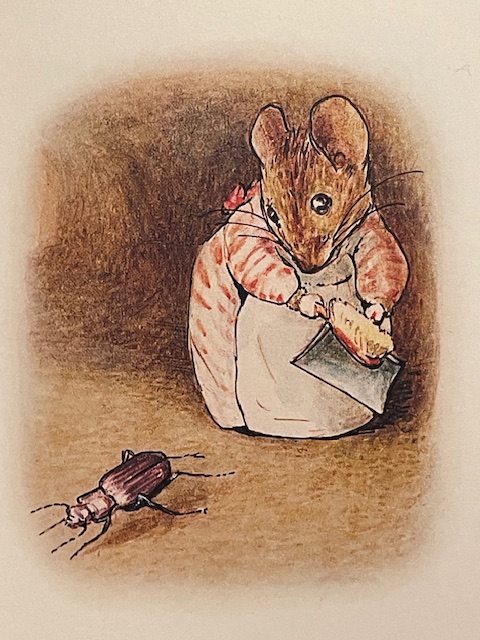
And who can resist Beatrix Potter’s charming animal character studies in watercolour for those love-to-handle little books published by Frederick Warne in the early C20th.
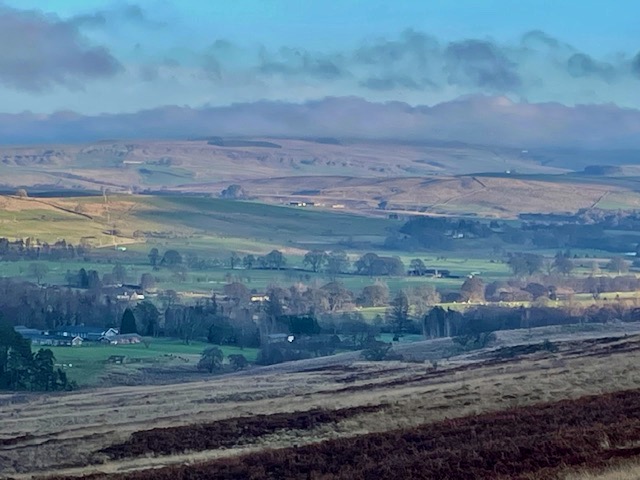
The countryside around lies dormant now but the play of weather over it never ceases to impress. The changing climate has brought with greater unpredictability, with milder winter days and heavier rains. Bare branches reveal last year’s tiny nests of moss, feathers and grass.
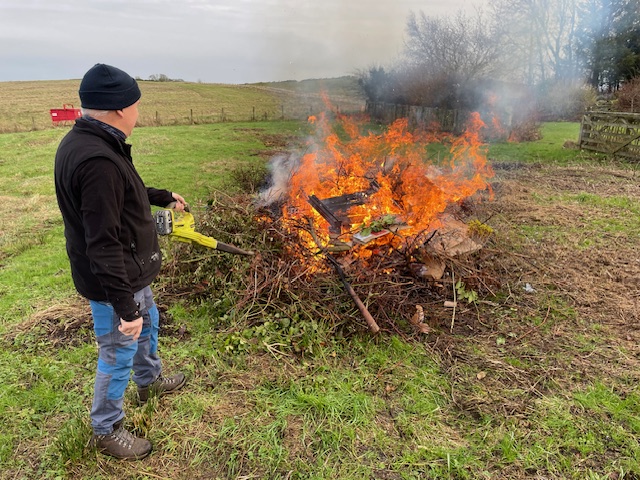
Gardening tasks undertaken when weather permits include clearing banks of dead foliage, starting to prune, nourishing compost heaps, fishing surplus leaves from the ponds. With the help of a neighbouring friend, who brought his leaf blower to push the necessary oxygen, we had fun setting a bonfire in the field with cautious use of petrol to ignite the damp mass.
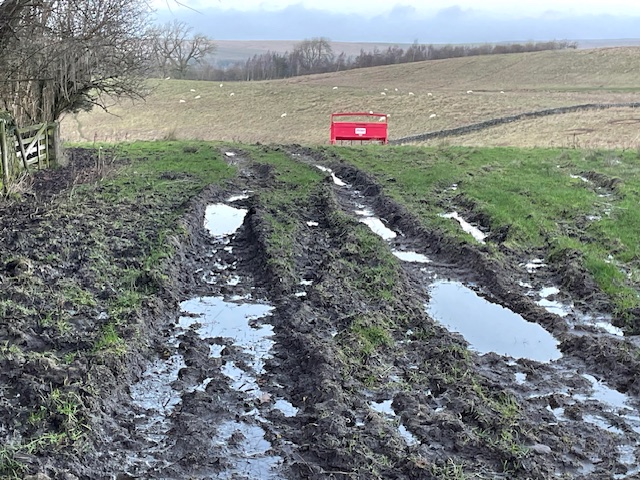
Neighbouring farms’ cattle and sheep are rotated around sodden pastures. My eye caught by the substantial red metal creep feeder which allow the shorthorn herd’s calves dedicated access through metal bars to get their fill of hay. A foretaste of Spring and the lambs to come. Flocks of ewes graze, rumps raddle marked by tups in harness. A Suffolk lords it in one neighbour’s field, A Texel in another and an old favourite from past years, Southridge’s Border Leicester in the field opposite us. BLT I call him. He’s always fearless and inquisitive when we meet so suspect he’s been used to handling from an early age. Curiously, there’s no harness on him, but has obviously been hard at work.
BLT
Bumping in to friends out and about we are related some hairy tales, disarmingly told with great humour. One person, out walking on remote hills to the north of the county succumbs to a heart episode caused by arrythmia which floors him. Ringing 999 he’s told to text a number. Rescue services precisely locate through GPS and a stand by air ambulance helicopter is swiftly dispatched to hoist and whisk him away to hospital in Berwick.
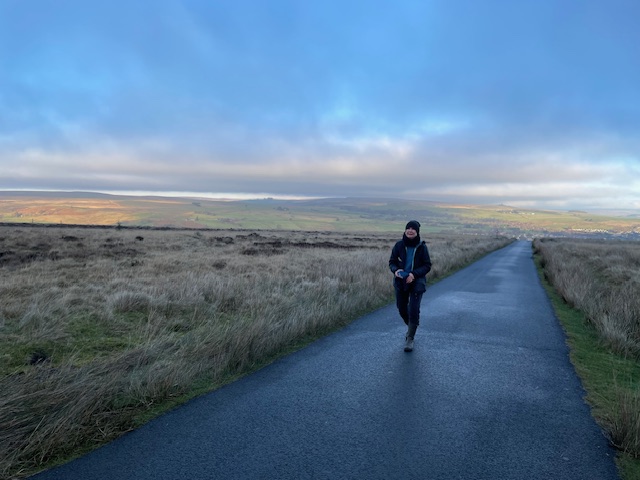
Walking to visit the neighbours t’other side of the fell
Our egg supply is down. The neighbour who supplies them says a badger dug a tunnel into the coupe overnight and wiped out over half the hens and ate what eggs it could find too.
A walk over the fell leads us to an artistic friends household selling home-made artefacts for Christmas, all on display in a cosy made-to-order shepherd’s hut next their cottage. We pop into the kitchen to pay and are invited to stay for another hour or so for a long overdue laughter loaded catch up over coffee and home made mince pies.
There’s a nearby lane, along which the long distance trail runs, narrow and undulating with dry stone walls, trees and shrubs either side. It boasts a good crop of haw berries popping red against a thick crusted layer of lichen. Benefits of not cutting back means a vital food source for birds while the presence of the lichen proving pure air quality in these uplands.
Kim in a flurry of home baking and making for Christmas so really looking forward to sampling what’s on offer. Here’s our Christmas best wishes to you and yours. Look forward to having your company on this occasional country diary page through 2026!
What is this life if, full of care /We have no time to stand and stare? / No time to stand beneath the boughs / And stare as long as sheep or cows From ‘Leisure’ by W H Davies
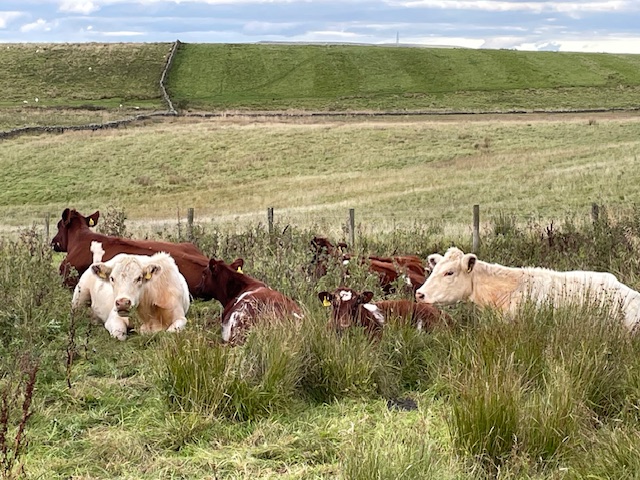
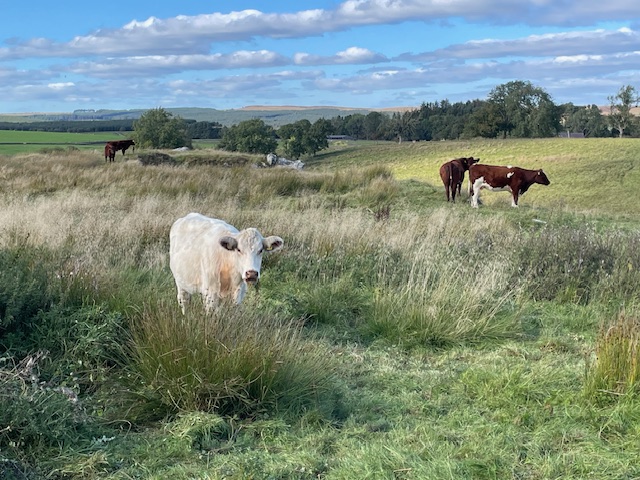
The four acres of rough grazing in before our house – the crags – has had no stock on it since the spring when the Texel tups were taken off so vegetation has grown dense and high. A word with our farming neighbour at Southridge and we wake up last week to a small herd of cows in situ.
They’re beef shorthorn and white shorthorn cows with respective calves. These native bovine cousins are well suited to this environment being hardy foragers on poor grassland, easy calvers and good milk providers with a docile temperament for safer handling. They’re not only happy imbibers of our edible garden waste but their hearing is acute enough to catch the field gate opening, suddenly appearing over the crags as leafy foodstuffs arrive in my wheelbarrow.
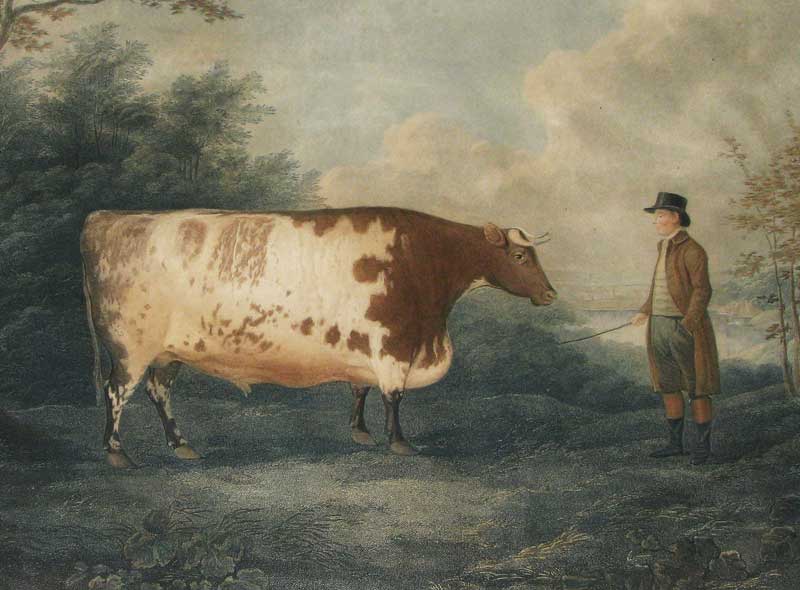
The Durham Ox (1802) by John Boultbee: A national touring attraction weighing 171 stones
Delighted to discover that Shorthorns had their origin over 200 years ago here in the north-east of England through selective interbreeding of Teeswater and Durham cattle. The breeders herd book, dating from 1822, is the world’s oldest and the Shorthorn proved itself as adaptable to milk production as to meat when most farms were smaller mixed use holdings. On a larger scale, from Argentina to Australia and north America the breed rapidly established itself through C19th pioneering settlement and today some 40 breeds of cattle worldwide have their genes.
It’s the Shorthorn bred for beef that’s best known now, as agricultural history post 1945 has greatly increased specialisation and boosted yields, undermining the mixed farming model. The strains of Shorthorn originally bred for dairy have been vastly outnumbered nationwide by the larger black and white mega milk producers that are Friesian/Holsteins.
We’ll drink to that!
The Higher Stewardship Scheme incentivises hill farmers to return to stocking native breeds. White Shorthorn in particular benefit as it is officially registered ‘At Risk’ by the Rare Breeds Survival Trust. Their endurance is in part due to the cows being put to (black) Galloway bulls, producing the Blue Grey beef cattle often seen across the borderlands. Originally known in the 19th Century as the ‘Cumberland White’ the breed has its heartlands very near us on the Northumberland/Cumberland border where the official society of breeders was founded at The Greenhead Hotel just off Hadrian’s Wall in 1962. Fitting then to have two of those distinctive white cows on our patch with their suckler calves sired in this case by a beef shorthorn bull.
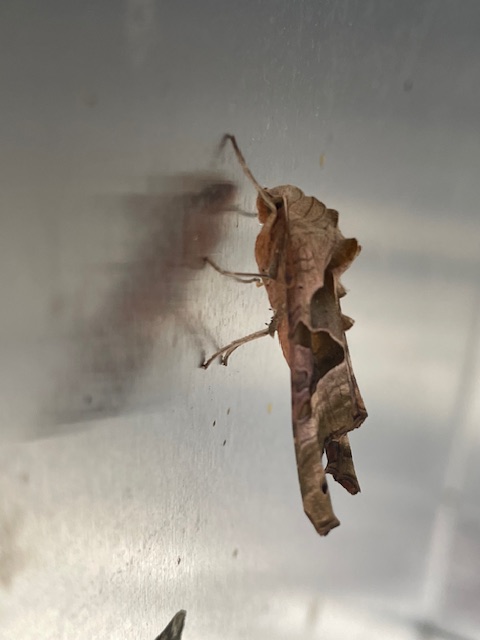
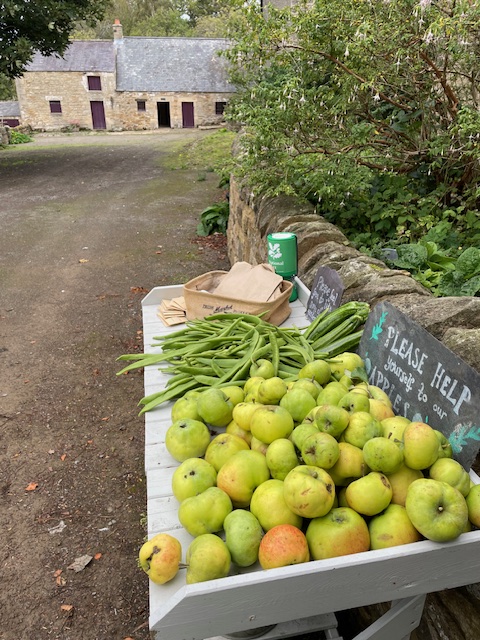
In other news…A bumper year for apples so can hardly keep up at home juicing, pureeing or chip drying our orchard’s output. Recent moth trap reveals a fine example of seasonal camouflage with an Angle Shade demonstrating its October fallen leaf act. Volunteering in the garden at Cherryburn, I leave with some runner beans and a courgette from the take away table.
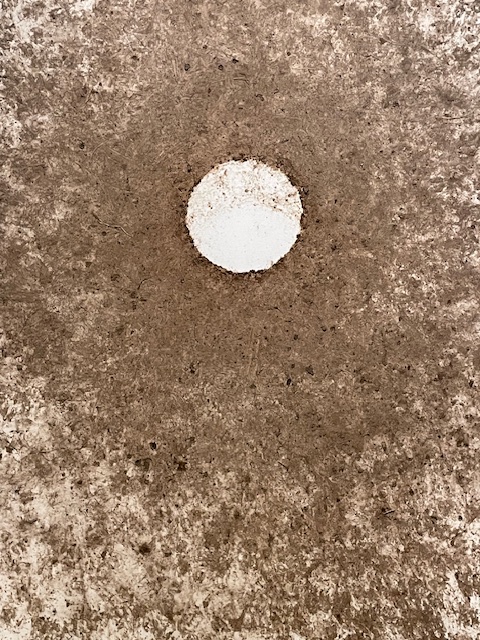
Enjoy a day trip to National Galleries of Scotland in Edinburgh for the wonderful Andy Goldsworthy retrospective. (showing to Nov 2nd). Here’s a detail from a recent ‘Sheep Painting’ of his created in mud and muck on dried canvas by action of flock in field round a mineral block, removed.
We’re recently back from a celebratory weekend away, organised in secret as a gift to share with the significant other. Found a place near enough to drive to easily but far enough away to make for a proper countryside adventure. Some highlights then, as follows.
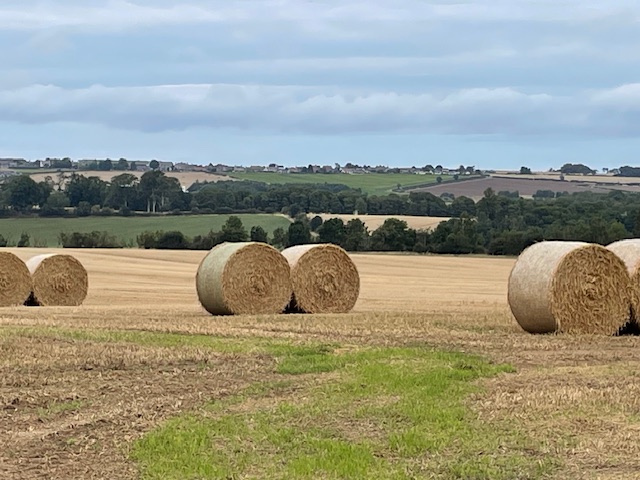
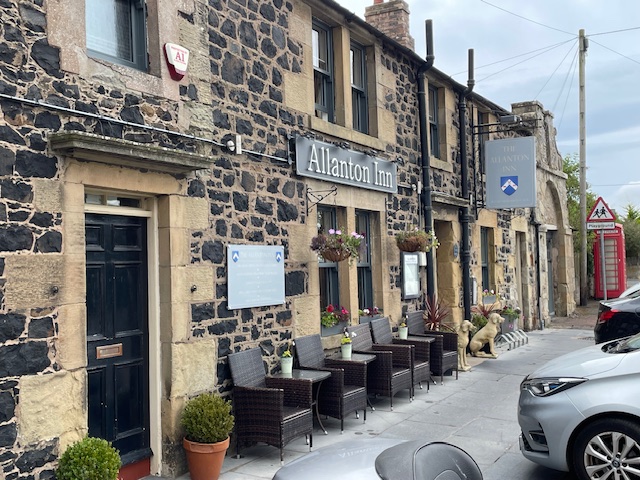
We arrived in Berwickshire, in the wide valley of the River Tweed and its tributary the Whiteadder, for our stay in the village pub at Allanton. All around the area huge combines, tractors and trailers were cutting, winnowing, baling and carrying off barley and specialist wheat. They continued late into the night, headlights glowing, growling over wide rolling fields with the lanes alive to traffic up to midnight. A fascinating contrast for us who live in the grassy uplands of west Northumberland where log lorries and tipper trucks loaded with gravel for forest roads are the big beasts of rural transport.
We sat out in the pub’s pleasant back garden with a refreshing pint before supper gazing over a scene of blond stubble and waving grain, shadows stretching to far woodlands, the land glowing warm under a setting sun. The Allanton Inn really is at the heart of its rural community. A family run business, part of an ecosystem of small independent local producers and suppliers, proud of their good food offer – from honey and ice cream to meat and eggs – as we were to partake of it. The perfect relaxed hostelry from which to explore this side of the border.
This is a land of big estates and large farms, the metal and concrete barns mostly modern and huge enough to properly house mountains of grain and straw. The population is much sparser now than it would have been in the pre-machine agrarian age. It’s extraordinary to note that within the radius of a couple of miles some of the great figures of the Scots enlightenment were born and grew up. These include the moral philosopher David Hume, geologist James Hutton and botanist and populariser of the tea plant, Robert Fortune.
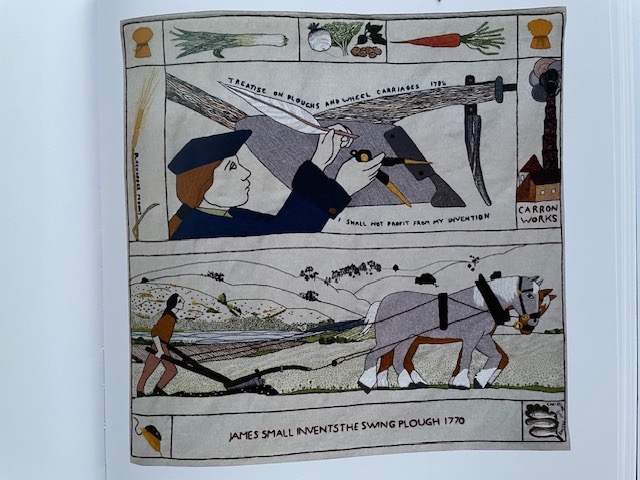
Most touchingly of all is the story of the least known of these worthies and the revolutionary device he freely gifted to agriculture, one that would help fashion the arable landscape around us today. In the 1770’s local engineer James Small used a smithy on the former Blackadder estate at Allanton, using mathematics to experiment on different mouldboards, curvatures and patterns to produce his improvement on the ‘Rotherham’ cast iron swing plough. Previously many men were needed to work teams of oxen to pull a flat wooden plough while Small’s only required a pair of shire horses and a single ploughman to operate. Small even demonstrated his invention to ‘Farmer’ George III and his ‘Scots Plough’ was rapidly copied and developed by others as he not wish to profit from his invention by taking out a patent and sadly died in 1793 of overwork and poverty. Modern day embroiders have honoured his memory as James and the plough feature as one of the wonderful metre square panels in the Great Tapestry of Scotland, on permanent display in Galashiels.
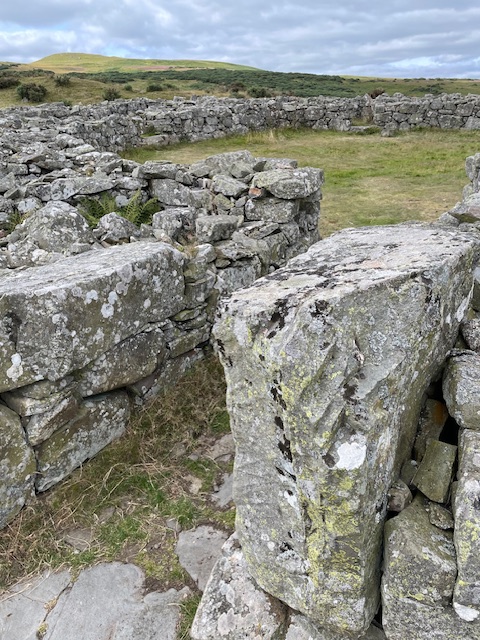
Situated on the eastern edges of the Lammermuir hills, below the lofty summit of Cockburn Law and overlooking a steep valley sits Edin’s Hall Broch. It was the high point of a circular five mile walk we took over fields, through woods, along tracks and heathland paths.
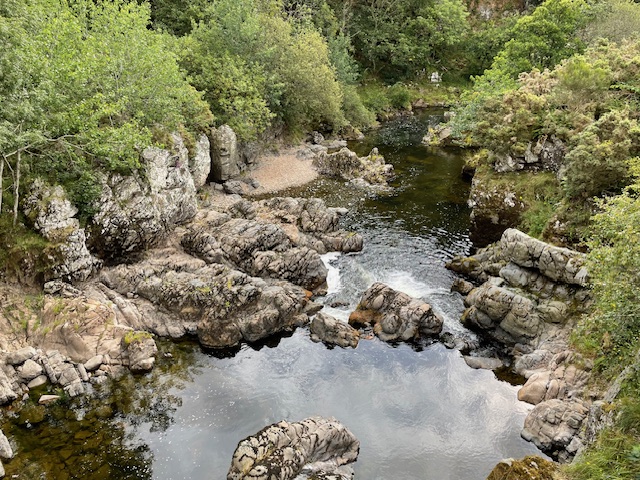
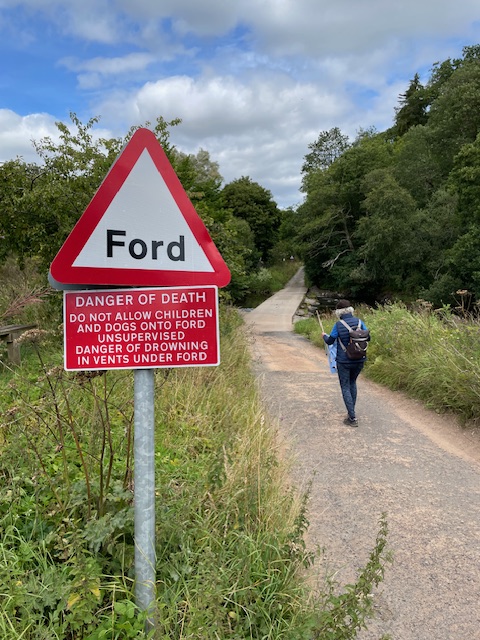
We made two separate crossings of the infant River Whiteadder by ford and footbridge. Summer picturesque as the scene was, one could imagine the place when the waters were in spate. The road sign at Abbey St Bathans reminds drivers of the risks.
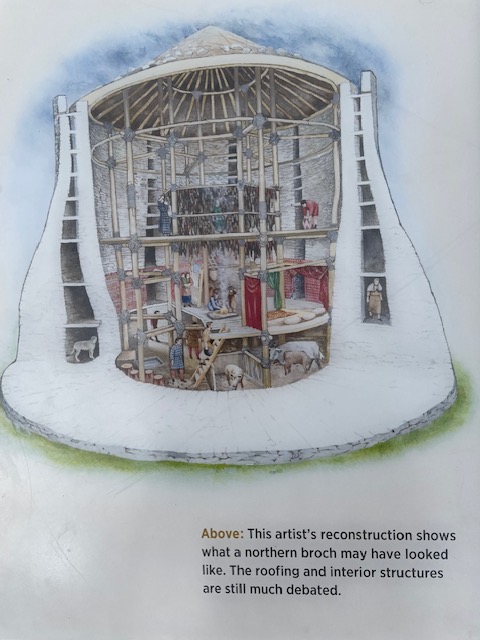
Brochs – ancient fortified tower houses – are usually found in the highlands and far north of Scotland so the one here is something of a geographical oddity. Our slow climb to reach it enhanced by seeing male wall brown and small copper butterflies basking in the sun and fluttering ahead as we climbed through swathes of tall bracken.
Dated to the 1st century AD what really lends Edin’s Hall broch a sense of wonder is that so much stone remains to define its walls, wide enough to incorporate chambers and stairs. The centre point gives a 360 degree experience of what was once a whole community’s secure home and stores, standing at least two levels high and probably roofed with timber. Hard by the broch are remains of later hut circles, ditches and ramparts. Awed as we were we couldn’t help wondering though where its inhabitants would have sourced their water supply, with not a spring in sight.
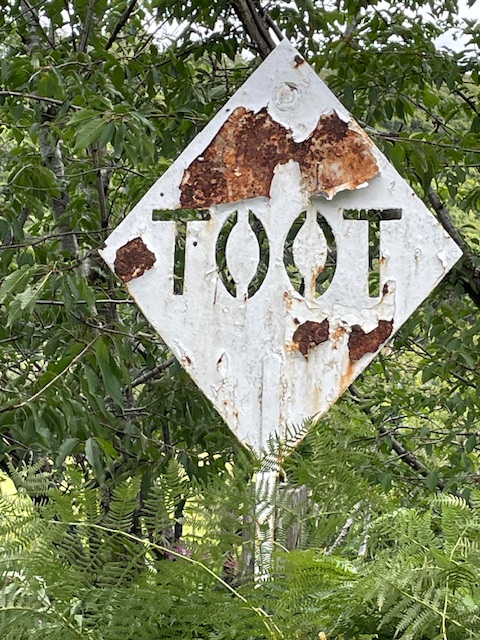
Picking up a metalled lane diving down into the wooded valley bottom we came upon this weathered sign at a hairpin bend. The only thing near a toot we heard on the descent was from the occasional whirr of spokes or tinkling bells as racing cyclists shot by with friendly waves. Like them we appreciated a rest break at the friendly informal tearooms in the old stables of the original village woodyard by the river. We can testify that the home baked fruit scones are superb.
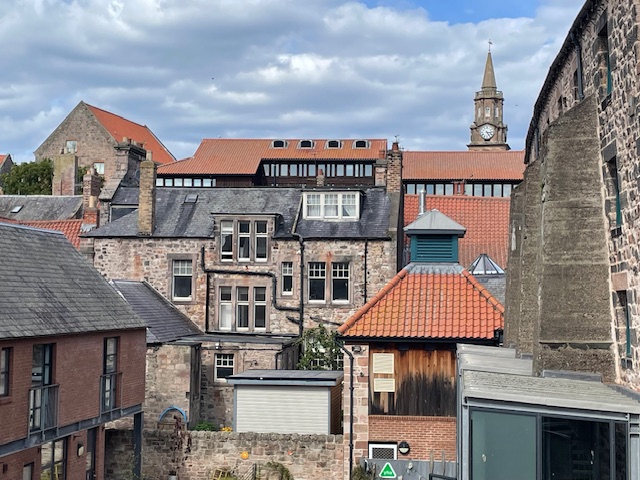
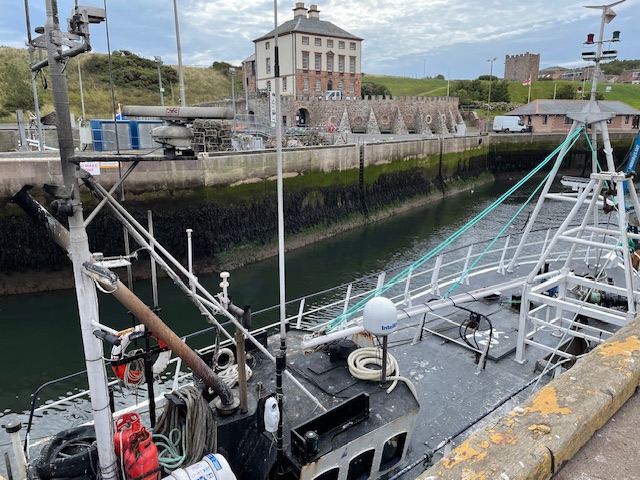
Every few years sees us on a return visit to Berwick. A preamble along the massive Elizabethan ramparts leads literally ‘off the wall’ into the multi-storied Granary gallery, a former Georgian warehouse on the quay overlooking the three great bridges, monuments of different centuries, that carry road and rail links across the great border river.
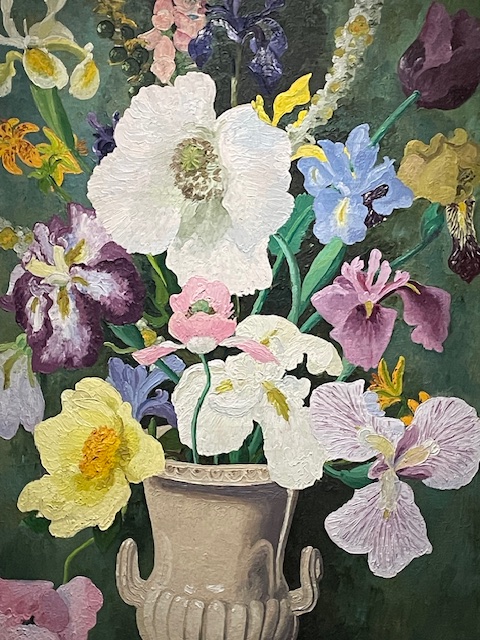
The retrospective exhibition we’d come to see at the Granary was of the respected artist, teacher and plantsman Cedric Morris (1889-1982). We found it something of a mixed bag. His flower painting, especially of Irises, remain glorious testimony to his knowledge and ecological awareness. The best known self-portrait and studies of Parisian café life in the 1920’s insightful and sensual.
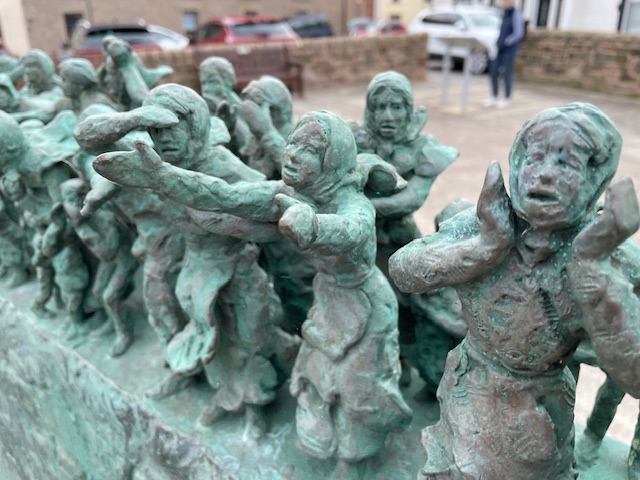
The art that really moved us though was on the seafront across the border at Eyemouth. In October of 1881 a terrible storm wreaked havoc on the Berwickshire coast, and 189 local fishermen were drowned, leaving behind 78 widows and 182 children. The town’s fortunes went into long term decline in the wake of this, Scotland worst recorded fishing disaster.
‘Widows and Bairns’ represents real people, arranged in groups above the name of their boats. Sculpted by Jill Watson and cast by Powderhall Bronze it opened in 2016. We watched visiting families stop and talk about the story. The best kind of public art, rooted in people’s history, powered in this instance by tragic drama to command our attention and stimulate conversation.
In the 21st century, the community here has been embracing eco based industries and sustainable tourism and this attractive harbourside town – like Berwick across the border – seems on the cusp of change for the better. The broader Eyemouth story is well told in the delightful volunteer run museum housed in a former church.
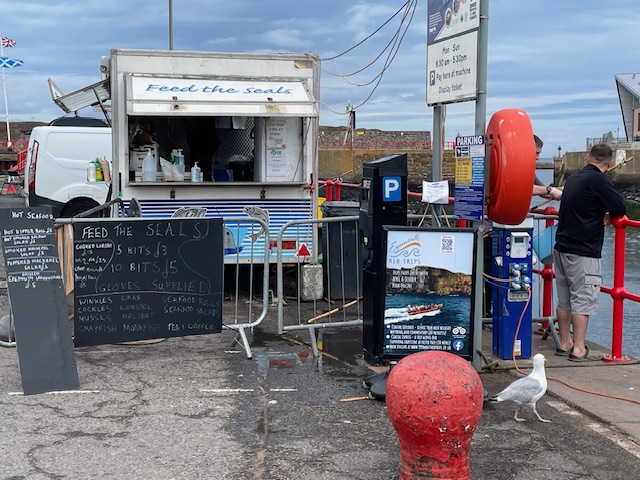
We also enjoyed taking a leisurely stroll along the narrow harbour around the mouth of the river Eye with its working fishing boats, quayside processing plants and local produce stalls. (kipper rolls anyone?) These merge with an array of smart locally based retail businesses (excellent Italian ice creams), the sandy town beach and restored stone jetty with its bright red handrails and fine prospect.
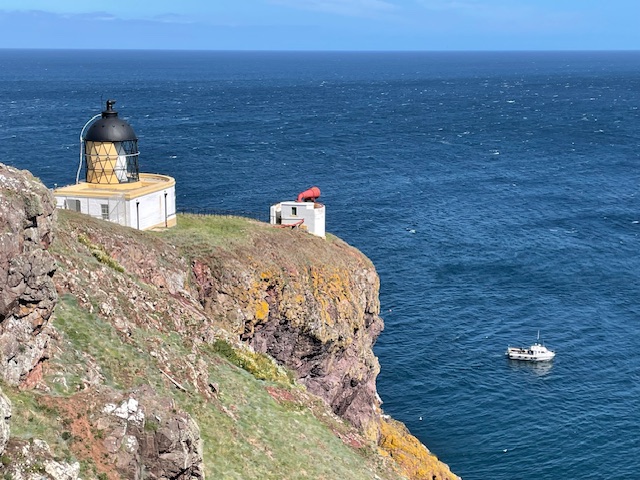
A little further up the rocky coast lies St Abb’s Head, named for a Northumbrian princess who founded a monastery here, now long lost, following her safe delivery from shipwreck. Fittingly a lighthouse, dating from the 1860’s and built by the Stevenson family (who else?), still casts its powerful light from the head. Unusually, it is tucked into the cliff below the lighthouse keepers cottages (now holiday accommodation) as the higher ground above and beyond has always been prone to mist and rain, obscuring vision at sea. Hence the red painted fog horn, seen below.
If we’d been here in late Spring we’d have witnessed the vast flocks of gannets, razorbills, gannets, kittiwakes and other seabirds that crowd the nursery rockfaces and for which the bird reserve is nationally renowned. Their guano, whitening the masses of red blue sandstone rocks, is striking but the birds and their fledglings were no longer in evidence this bright breezy morning in August. Instead masses of house martins dominated the clear blue skies above small bobbing boats filled with visitors tasking in the awesome sea level view of this spectacular headland.
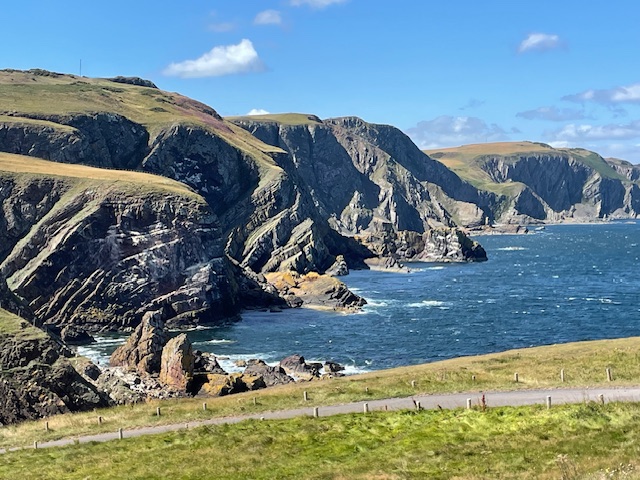
Our return leg, mostly along the single track lighthouse access road, revealed a stunning surprise vista of more cliffs running northwards. Once out of the severe wind tunnel blast between those cliffs and St Abb’s head, the path drew us away into the calm serenity of a narrow fresh water loch in a ravine fringed with reed and sheltered by woods. The National Trust for Scotland run the excellent visitor centre in an old farm complex where we parked to start and finish our wonderfully rewarding four mile trek.
When it comes to rest and recreation it pays to walk. The health and wellbeing benefits are obvious. It’s not so often though that you pay to walk. But that’s what we did a few weeks ago. And for a very good reason.
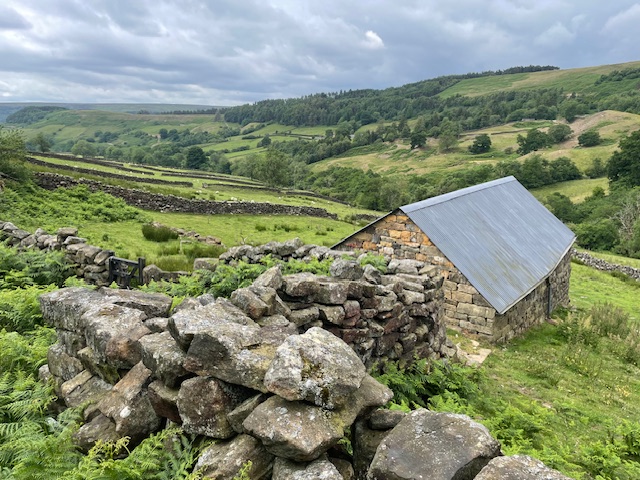
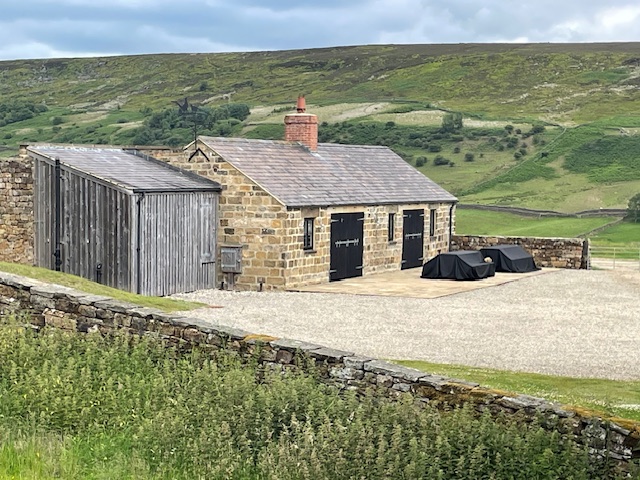
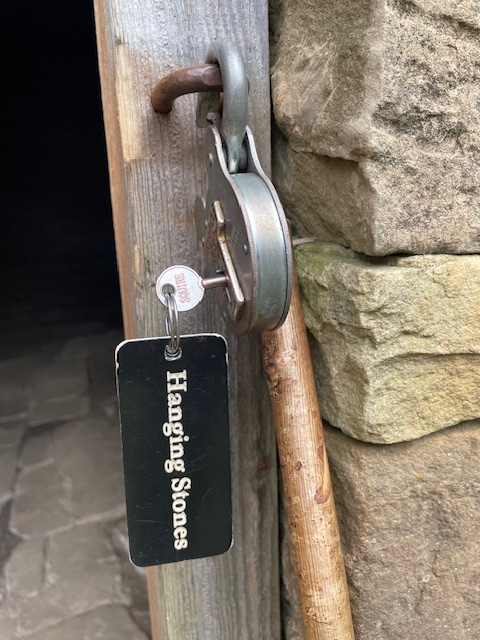
The Hanging Stones art project is unique. Ten restored or rebuilt former agricultural buildings, each containing a bespoke art installation, situated in the heart of the North Yorkshire Moors National Park, all linked by a 6 mile walk. It’s the creation of one of the UK’s – and indeed the world’s – leading sculptural landscape artists, Andy Goldsworthy. His long working relationship with stone dates back to time spent as a teenage farm labourer, maintaining and repairing dry stone walls in his native Yorkshire.
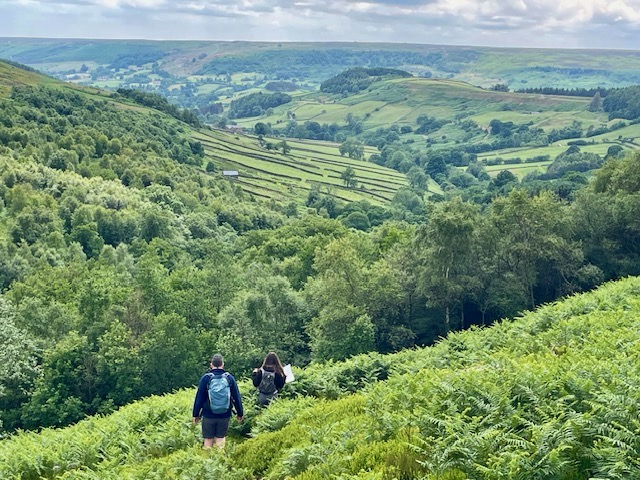
Our party of five was one of four groups of no more than six members booked each day. The trail begins and ends in the village of Roseland Abbey. Parties set out every two hours along public paths, tracks and bridleways into the increasingly steep sided valley that is Northdale, defined on both sides by high bare moorland. At the highest point we saw the group ahead descending and those behind us ascending.
In his 2018 prospectus Goldsworthy wrote: ‘The walk is an integral part of Hanging Stones, the artery by which people will give life to the buildings….It will be both discreet and dramatic. Visible to those who know it is there and hidden to those that don’t’.
The Roseland Abbey area has a long history of mining and quarrying although tourism, agriculture and field sports appear to provide most employment income these days. The highest part of our walk was on a permissive path that threaded through the source waters of the north beck, on whose steep bracken and heather clad slopes stand a dozen or more shooting butts. Returning along the lower valley floor we skirted an immaculately kept shooting lodge, currently under wraps, awaiting the open season in August.
This project clearly could not have happened without the approval and financial backing of the area’s main landowner, the Rosedale Estate, a 4,000 acre commercial grouse moor. Most of the North York Moors is owned by the King as Duke of Lancaster but this particular holding belongs to Carphone Warehouse founder David Ross. His philanthropic foundation supports arts, educational and sports activities. http://www.davidrossfoundation.co.uk/
With the buy in of the local community, the foundation and the National Park Authority, Goldsworthy’s vision and consummate skill has harnessed all the necessary elements to produce an outstanding example of renewal within a protected upland landscape. Work started in 2019 after a struggle to accommodate the proposal to the strict planning laws governing national parks it was given permission to proceed. The result is emotionally charged and thought provoking in its playful linked exposition.
Goldsworthy says: ‘One of the rationales for working with buildings is that sound, atmosphere and materials are amplified when experienced inside a confined space’ That sense of theatre, which also invokes the atmosphere of a shrine or chapel, is the hallmark of the most effective of the interiors. Dramatic use of natural light and intense application of materials or textures onto the building fabric is fantastic.
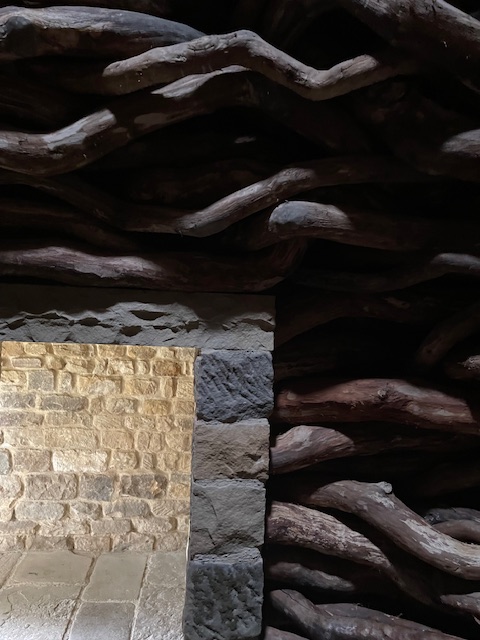
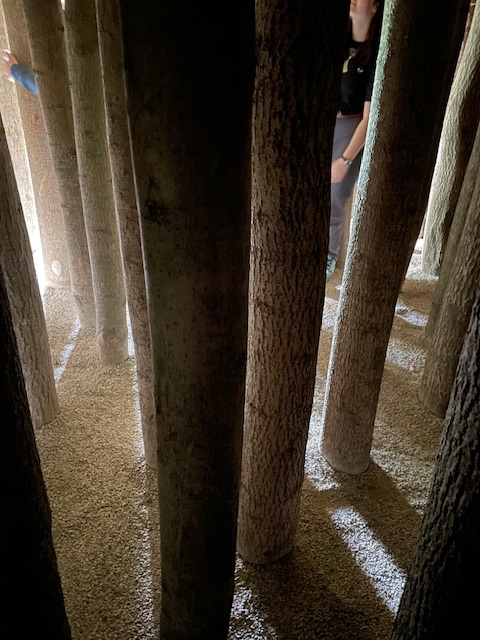
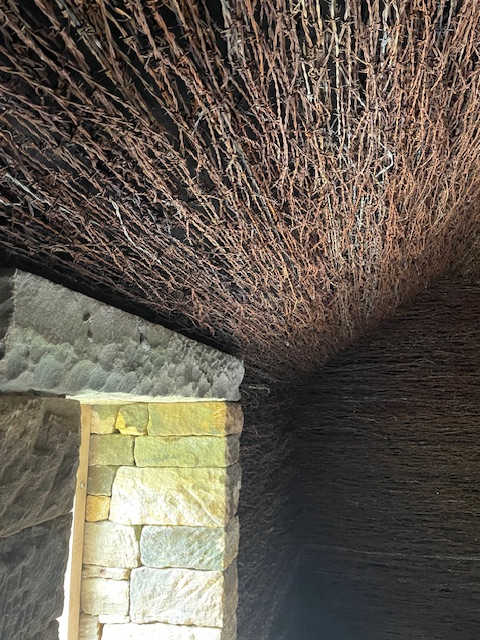
From weave of rusted barbed wire to powdered ochre paint, burnt boughs to woven logs or light bending thicket of poles in gravel – each environment works its rough magic, drawing you into a sensual response.
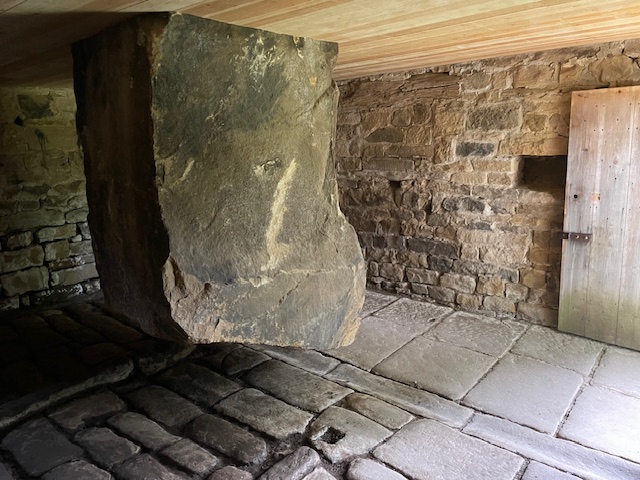
The barn that displays the eponymous hanging stone – all 11 tonnes of it – is brilliant testimonial to structural engineering that teases visual perception of mass in space.
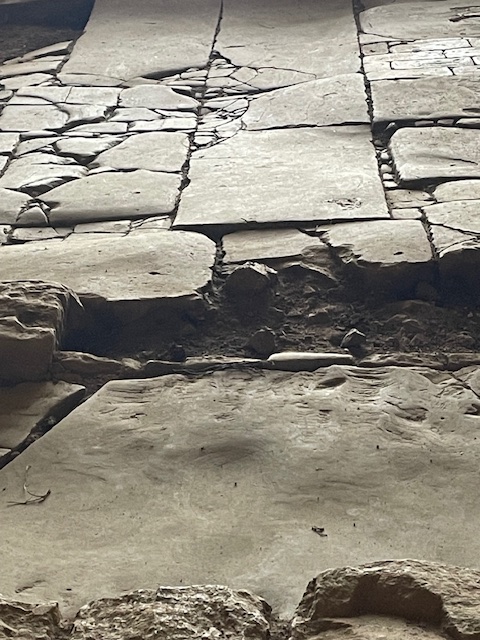
Elsewhere a new build barn traverses the ruin of an old farmhouse floor where the mosaic of concrete and broken flags yield clues of former occupation. This put me in mind of Thomas Hardy’s poem ‘The Self-Unseeing’ whose opening lines run: Here is the ancient floor / Footworn and hollowed and thin,/ Here was the former door/ Where the dead feet walked in.
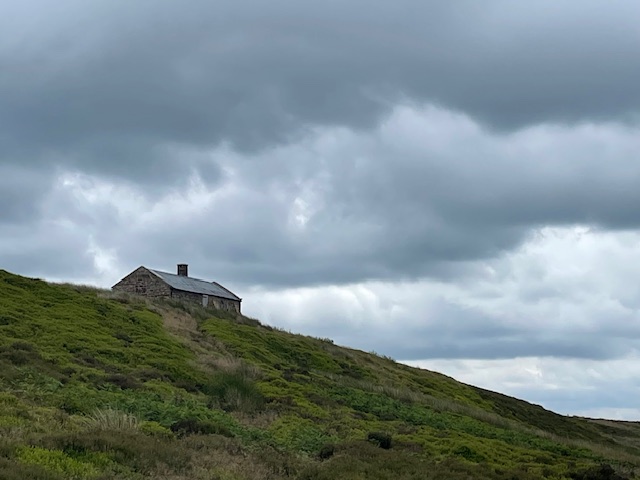
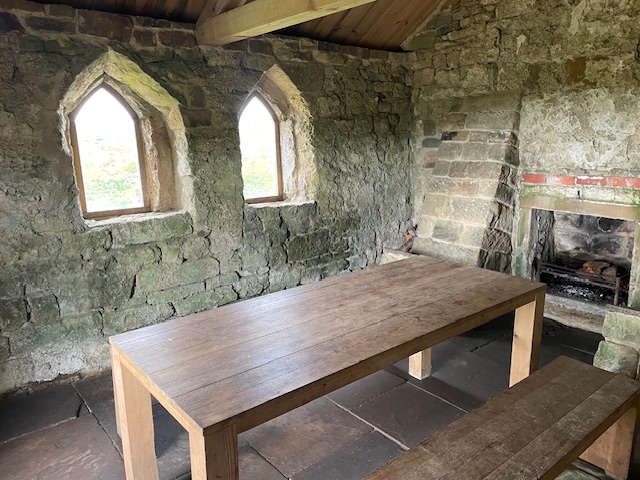
We enjoyed our packed lunches at the ramble’s half way point, following a steep upward scramble through swathes of bilberry covered moorland slopes. Here a large table sits in a little house perched on the open moor’s cusp. Through the open door on a clear day we enjoyed fine views across the high moorland plateau and cleave of dale spread out below.
Passing the shorn trunk of a wayside ash at one point I noted the cut section and wondered if this was an incidental wayside art work or just some essential tree surgery.
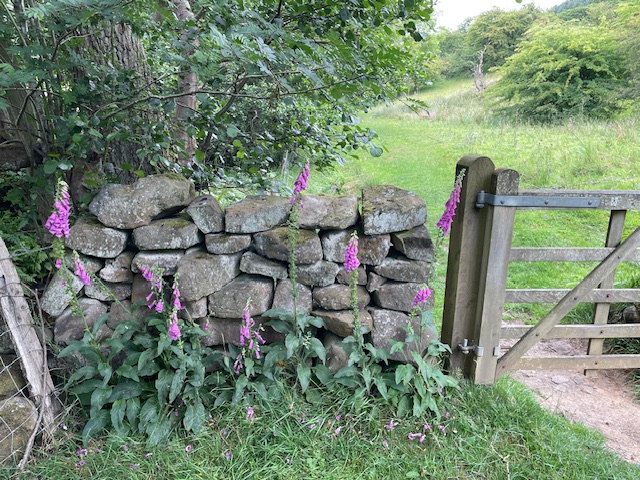
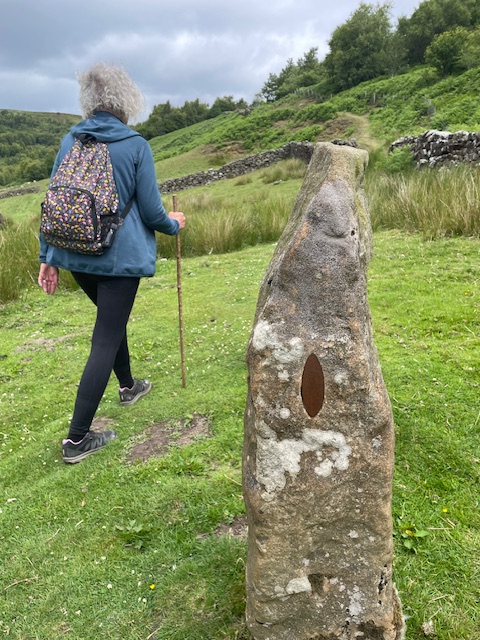
Goldsworthy’s attention to detail helps seal the overall impression. His way markers are subtle oval metal markers set into stone gateposts, some of which also feature small square through holes.
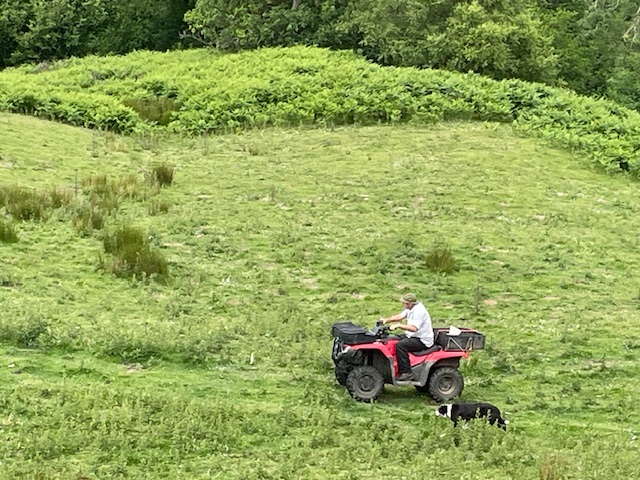
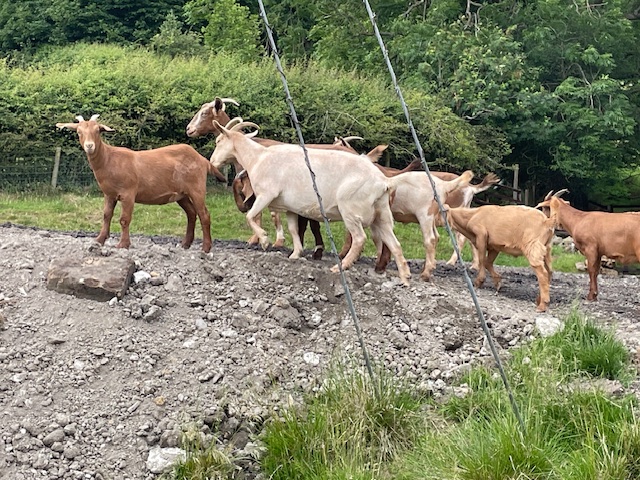
We spoke to a friendly farmer who asked if we were enjoying the art works. Later we saw him rounding up sheep with his collies astride a quad. I suspect he, like many here, are pleased to see redundant buildings restored and repurposed. Later, passing by another farm, we were presented with a picture book collection of ducks, geese, lambs, calves, dogs and goats, all putting up a cacophonous chorus of sound, much to our delight.
Cistercian nuns founded a priory in 1258 at Roseland, establishing the wool trade which sustained them up to dissolution in 1539. In more recent times, from the 1850’s – 1920’s, high quality magnetic iron stone mining became the principal industry. On leaving we passed abandoned roasting kilns atop the valley’s precipitous Chimney Bank road, but with gradients of up to 33% it felt wise not to stop.
I came away from this remarkable walk with a deeper understanding of how Goldsworthy and his collaborators created these amazing site specific art works, utilising natural local materials to complement and enhance a sensitive and highly protected rural environment.
It proved a memorable immersive experience in which we as visitors are part of the synergy generated within each of those boxes of delight. Like all great art the effects are cumulative, resonating and lingering in the imagination long after actual contact.
The complex, often contradictory issues and compromises involved in the planning, funding and execution of this project has intrigued me almost as much as the actual installations themselves. I feel that’s worth a tenner of anyone’s money, to allow one the chance to walk in wonder, to witness and reflect on a particular genius of place and time.
If you are able to experience Hanging Stones for yourself I’d urge you do so. Along with a set time on the allotted day you get a map and key that unlocks each building. Moderate map reading skills and stamina are needed, depending on seasonal weather conditions. Demand is high though. We hear that there’s no availability until February 2026.
Left to Right: David, Keith, Stephen & Sue in the 2008 production of ‘a Nest of Singing Birds’
‘Years ago every village in England was a nest of singing birds and the folksingers of today are the last of a line that stretches back into the mists of far off days…an unbroken survival of pagan observances and a musical inheritance of priceless worth.’: Cecil Sharp
I love what is termed ‘retirement’ and all the pleasures and opportunities for activities and socialising that it brings. But, every now and then, a work project comes out of the blue and the most recent proved more leisure than work, a unique opportunity to re-visit a happy past and bring it to life in a new way.
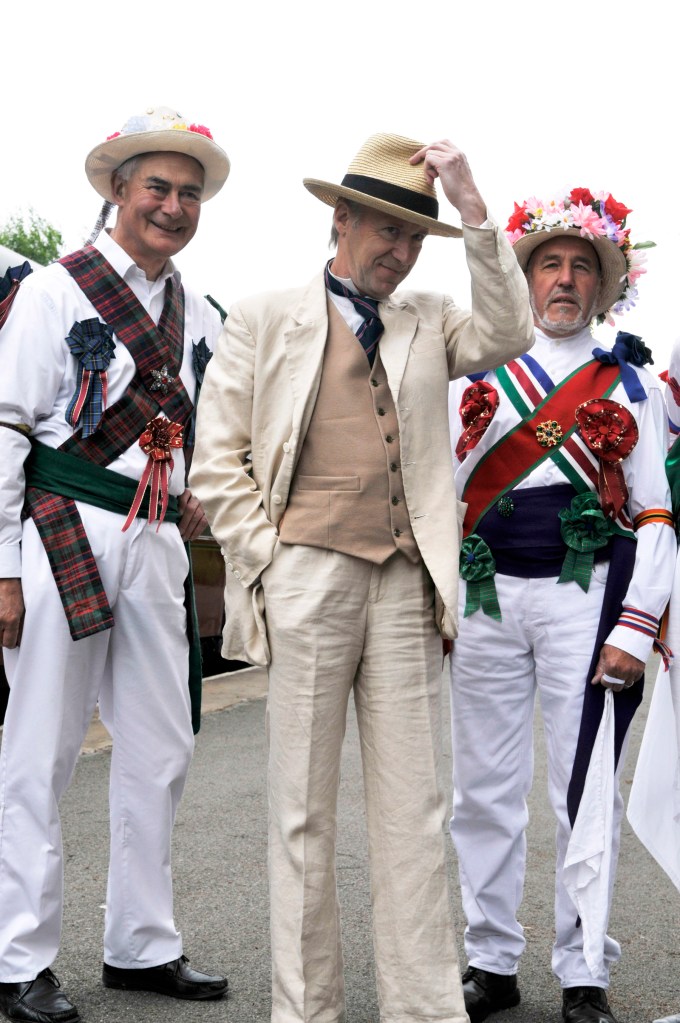
In 2008 I was employed to play the folk music and dance revivalist Cecil Sharp in a Heritage Lottery funded project in the village of Winster in the Derbyshire Dales. Sharp had travelled by train from his home in London in June of 1908 to research the Winster Gallop and other Morris tunes peculiar to the village and practised by the lead miners who made up most of the local dance team.
I was friends with fellow actor David Frederickson, a former resident of Winster. We’d met when working together on an ITV Docudrama about the 1984 IRA Brighton Bombing and he’d also performed as Polonius in my company’s production of Hamlet at Lancaster Castle. David thought me a perfect fit for Cecil Sharp so I joined him and another locally based colleague, Sue Daniels, to put on his play ‘A Nest of Singing Birds’ as part of Winster’s ‘Look Sharp’ weekend festival.
David’s play covered not only the great man’s visit to the village but the story of his interaction with those singers, dancers and fellow travellers who featured alongside in the revival of folk song and dance during the early years of the 20th century. Cecil Sharp (1859- 1924) collected some 5,000 songs and tunes over 20 years and despite the contradictions and personal conflicts over methods, attitudes and philosophy which typified the age he left a priceless musical legacy to the nation.
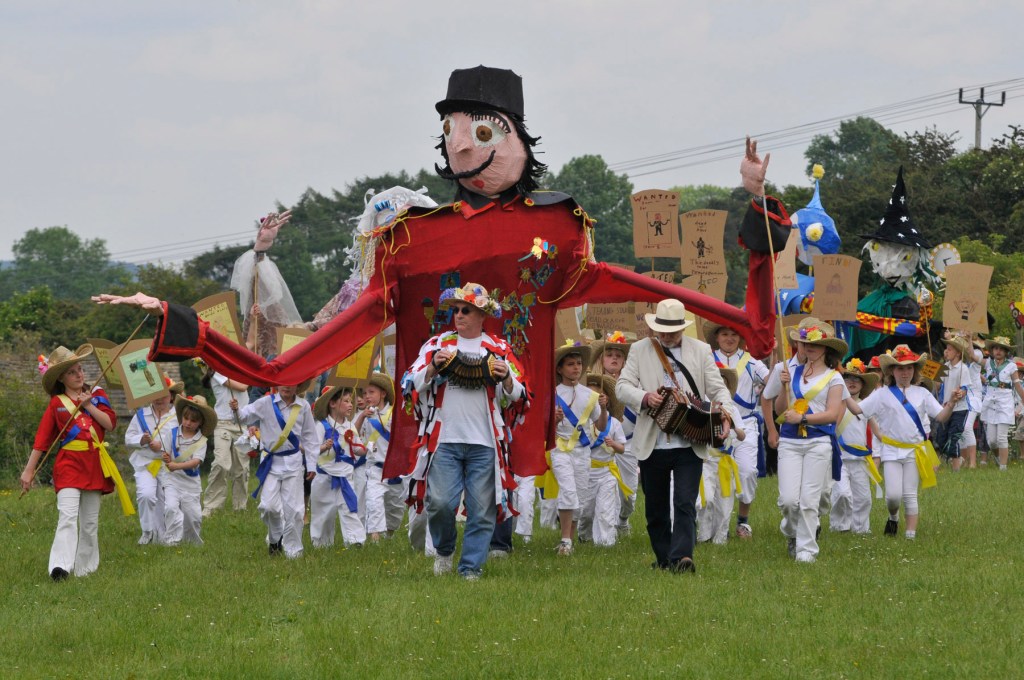
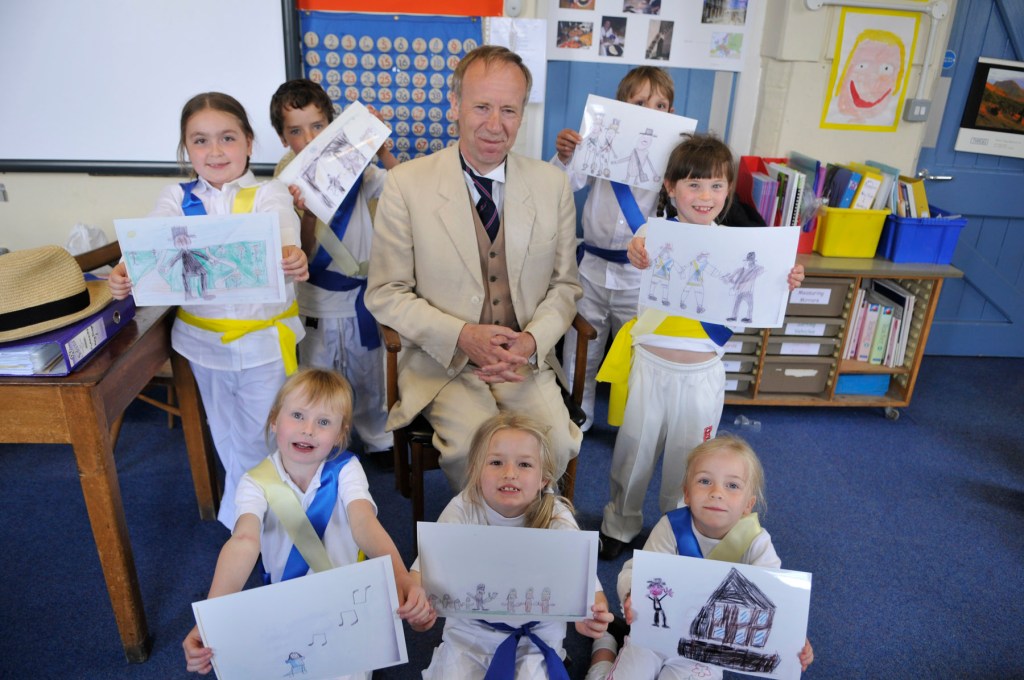
‘Look Sharp’ was a very successful community celebration in 2008 and our fully integrated participation as performers replicated most of what had happened a century previously, including a steam train arrival at nearby Darley Bridge station, Sharp’s introduction to lead mining history, a carriage ride up the hill and visit to the local school. The festival went one better in showcasing not only the village Morris side but five more from around the country who’d travelled to join us.
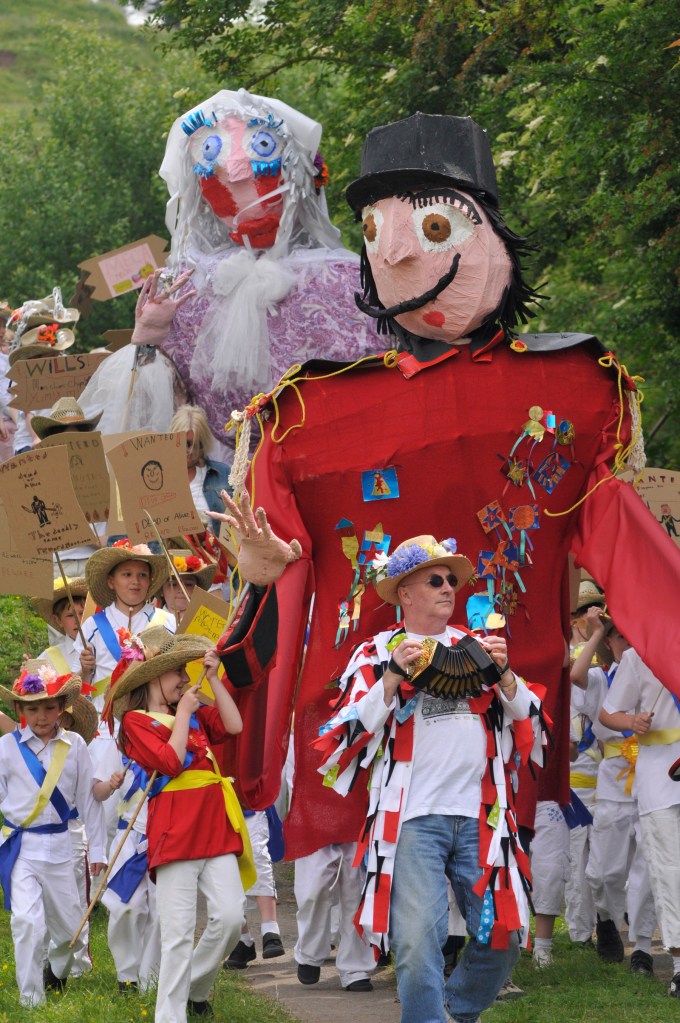
Our good friends and collaborators at Buxton based theatre company Babbling Vagabonds had fashioned the fabulous giant stick puppets, likenesses of traditional characters associated with the Morris, in association with local primary schools, and students from the local secondary school made a great short film documenting the event. The giant puppets headed the street procession to the playing fields where the entertainment, including our play, was performed in and around the big tent.
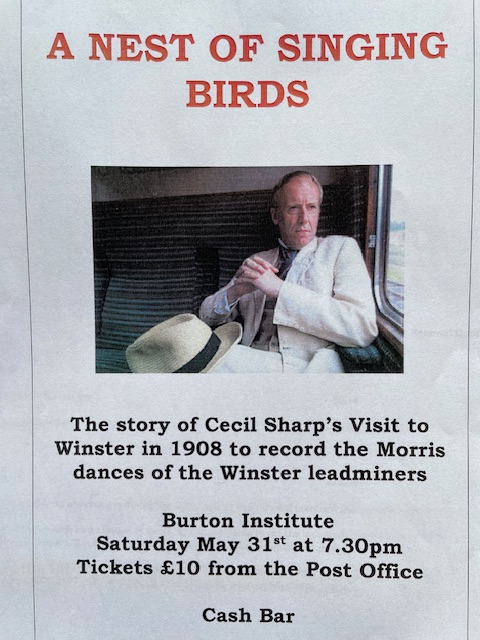
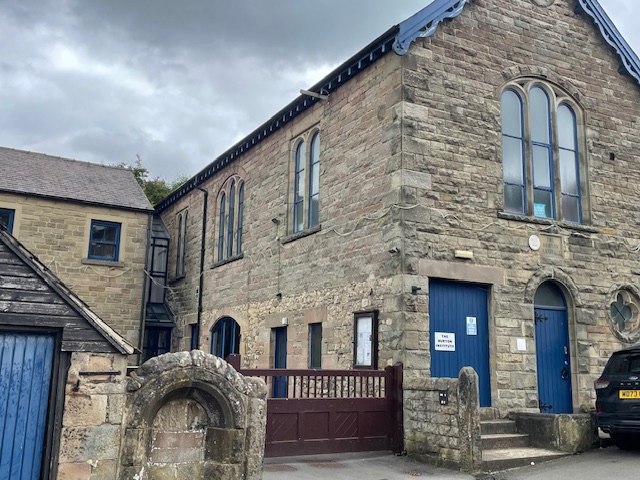
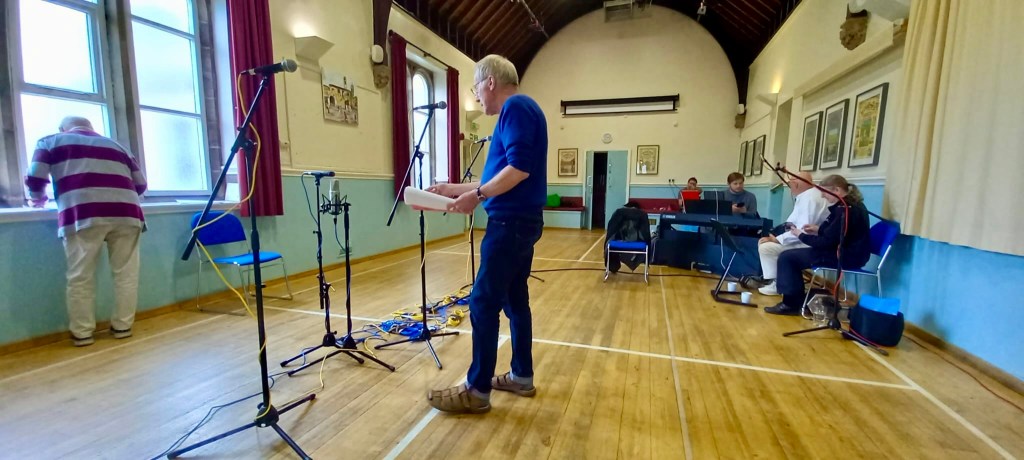
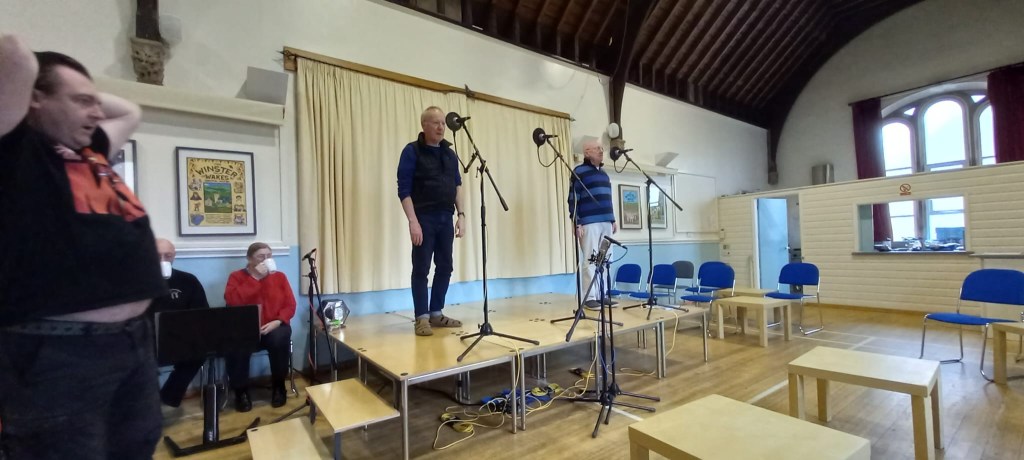
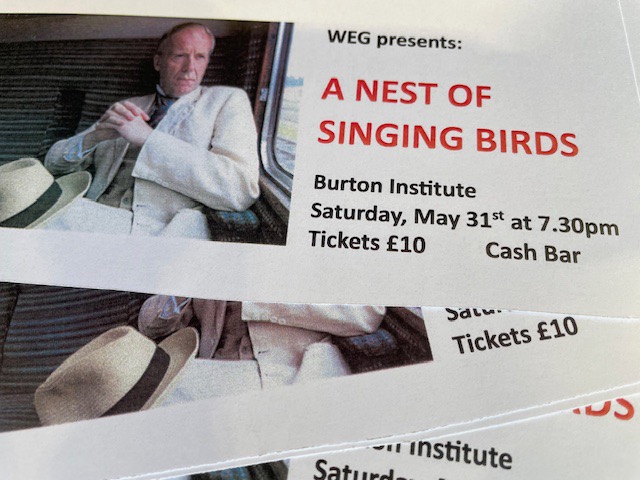
Seventeen years on from 2008 – in late May this year – our company was re-united to make a live recording of David’s wonderful entertainment in front of a live audience in the village hall, the Burton Institute.
The locals had secured extra Heritage lottery funding to ensure a permanent record of ‘A Nest of Singing Birds’, professionally staged and recorded, would be held in local archives available to all.
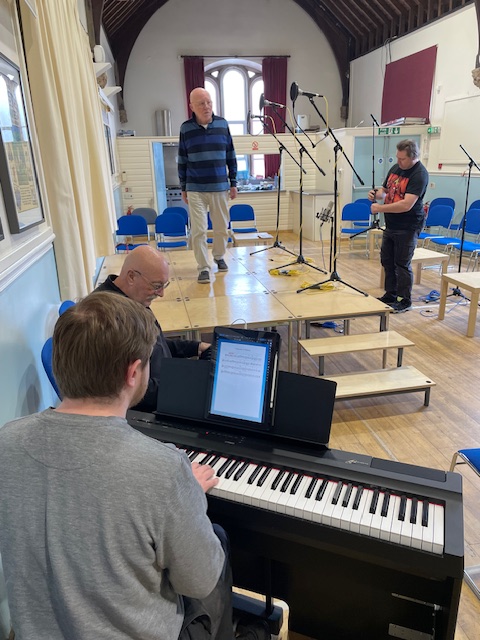
Our brilliant sound engineer, based at an arts centre in Derby, was Richard McKerron and his high spec recording equipment impressed us all, along with the skill he demonstrated as a musician himself rigging and recording our live event on the night of Saturday 31st May..
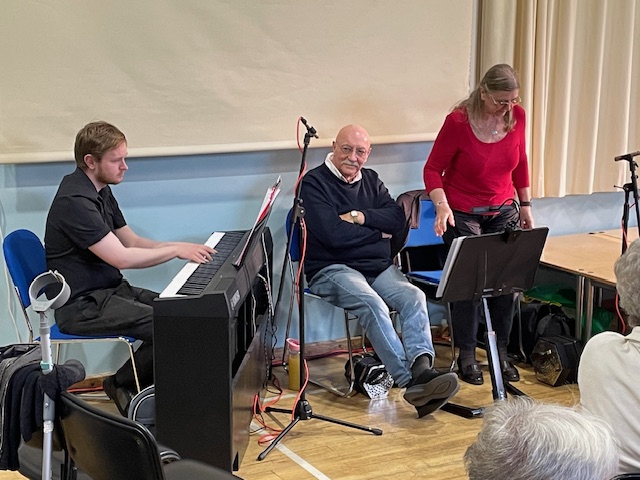
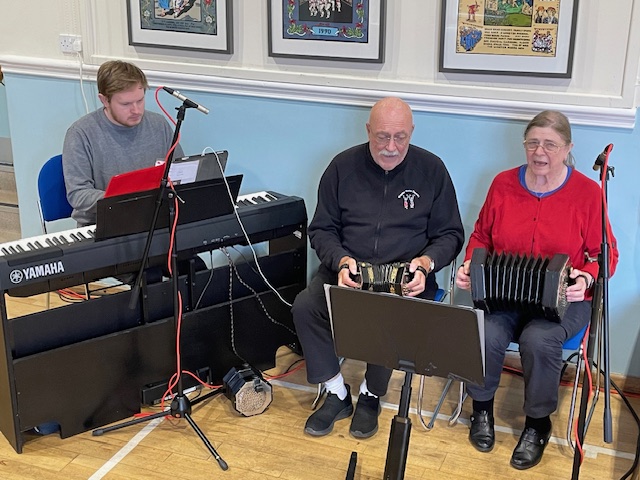
The musical element of our show was of course key. Re-joining David, Sue and myself to perform were our original musicians – folk concertina player Keith Kendrick and partner and co-singer Sylvia Needham. Funds allowed us on this occasion to be joined by Josh Wood. (He as it happens was one of the children involved at Winster school back in 2008).
Josh’s piano accompaniment was the perfect companion to Keith’s concertina. Sharp’s dilemma as collector and propagator lay in transposing the authentic folk music accompaniment -represented here by the concertina – to that of the drawing room or classroom, and the piano in our production would speak eloquently to that transition as well as providing underscoring of text at key moments.
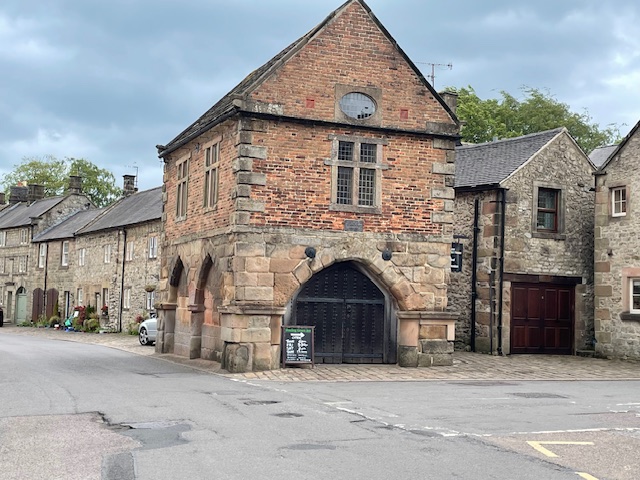
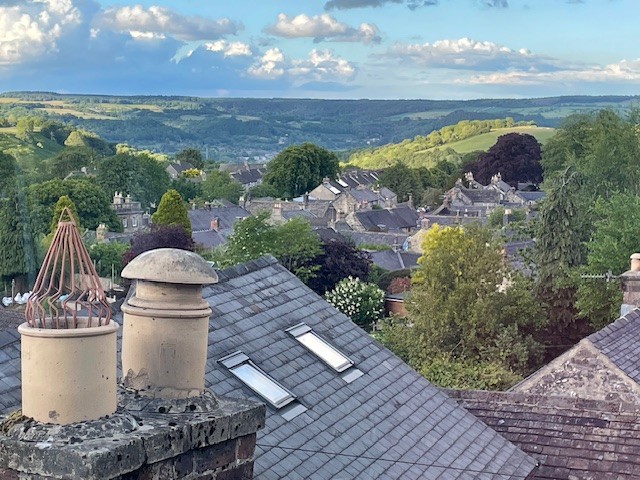
During breaks from rehearsal David – now back as a resident – showed me around Winster. Its attraction for me lies not just in the grander wide main street with its varied multi-storied older properties but in the three dimensional interlocking of domestic buildings on the steeply rising hillside behind.
The village has an integrated fabric of stone structures with a maze of lanes, paths & ginnels between them. Today’s restored cottages once housed extensive families of miners, quarrymen, labourers and artisans. The verdant valley location sets the whole off perfectly.
Like many other Derbyshire Dales settlements Winster has a remarkable community spirit. This is exemplified not just by our one off production but by the shop and post office, community run for the past two decades. Wakes Week and Secret Gardens open days were in the offing and David told me that the village used to feature regularly as location in the TV soap Peak Practice.
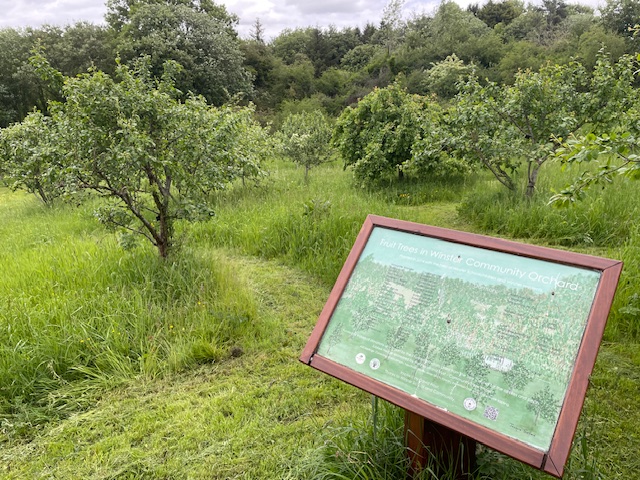
We ambled down a pretty lane lined with terraced cottages to the valley bottom and tried out the impressive outdoor gym equipment (perfect for pensioners like us) and admired the fine community orchard and pond beyond. The former boasts local varieties of fruit, the latter alive with tadpoles wriggling in the shallows while a family of moorhens were splashing over lilies or diving between stands of flag iris.
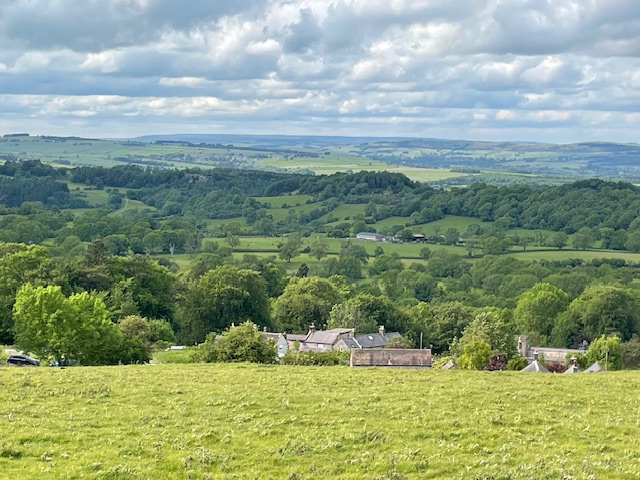
Another ramble of discovery led Sue, Richard & myself above the village to gain panoramic views over meadow rich grazing, tumbled stone walls and ruined barns. Our gradual descent brought us by rambling roses and dense bushy thickets. Nearby were remains of the lead workings which fuelled the 18th century industrial boom that made Winster the biggest, most prosperous town in the Dales at that time.
After three days of rehearsal and setting up we played to a fabulously receptive full house on the Saturday night there in the Burton Institute and despite a couple of technical hitches, which required some re-recording, it went with a swing. Words and music flowed and built beautifully, creating a great atmosphere that left everybody happy as could be, as the applause and sea of smiling faces at the end testified. A pint at the Bowling Green pub afterwards went down a treat as the performance had left us all with a fine thirst!
Bumped into more audience members the next day as we indulged in a leisurely breakfast in neighbouring Elton’s village hall. Local volunteers cooked and served a superb fry up in a bunting draped Victorian hall; visitors and locals alike full of laughter, chatter and general bonhomie.
Later, back in Winster, I joined Keith and Sylvia for tea and cakes outside the parish church. Both catering events are regular Sunday summer dates to raise funds for their respective heritage buildings.
I came home on the train from Chesterfield comforted and grateful for such a joyful and welcoming immersion in community culture, thankful for the rarest of treats as a performer in being re-united with colleagues to record a piece performed all those years earlier. It also amused me that for the first time ever a character I played would feature on the publicity poster and tickets…a career first!
We were in Toronto recently, where Kim’s niece Clare was getting married to her partner Adam in a 1930’s art deco former cinema, now an events venue. The hospitality and good companionship of immediate family – who had flown in from all over the country for the big event as well as that of the new in-laws – was incredibly generous and inclusive making this visit extra special and truly memorable.
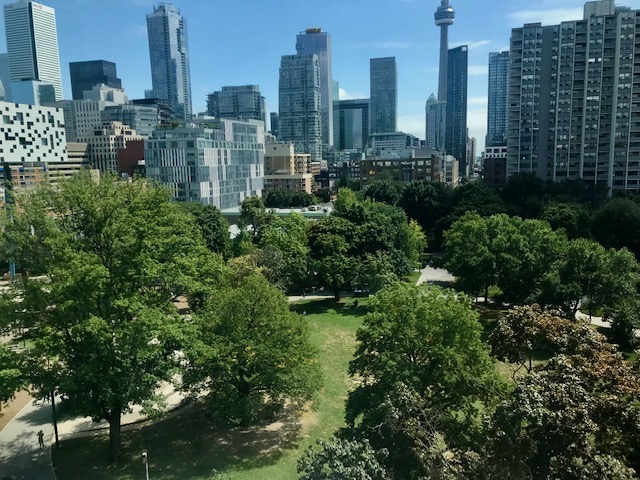
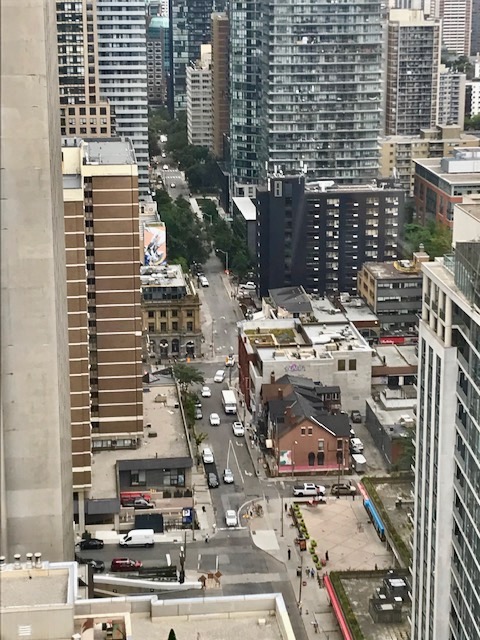
The city and its extensive suburbs is by far the biggest metropolitan area in Canada at 243 sq. miles/ 630 sq. km. and with a population of nearly six million people, is one of the most multicultural cosmopolitan cities in the world with hundreds of languages being spoken other than English. Arriving and departing from the city’s busy airport certainly reinforced that fact. Commanding the northern shores of Lake Ontario Toronto is the centre of Canada’s principal financial, media, commercial and logistical worlds, and its grid system of thoroughfares is bisected by rivers, ravines and urban forest.
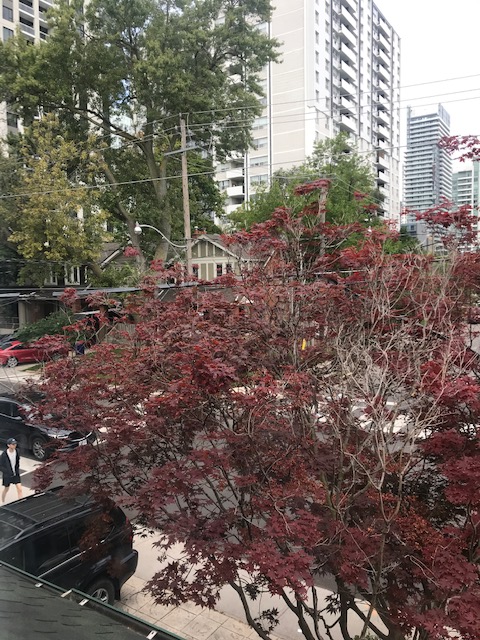
We were staying in an Air B&B in the inner suburb of Eglington. Strolling the residential area I clocked black squirrels, flocks of little finches and American Robins. Our clapboard house with its trees, porch & garden looked over – or rather, were overlooked by – new built blocks of apartments and condos.
There were the familiar street furniture of a north American cityscape, from fire hydrants to overhead traffic lights, yellow school buses and wide concrete sidewalks. More surprisingly were the first of a number of licensed outlets we’d see across Ontario legally selling marijuana products.
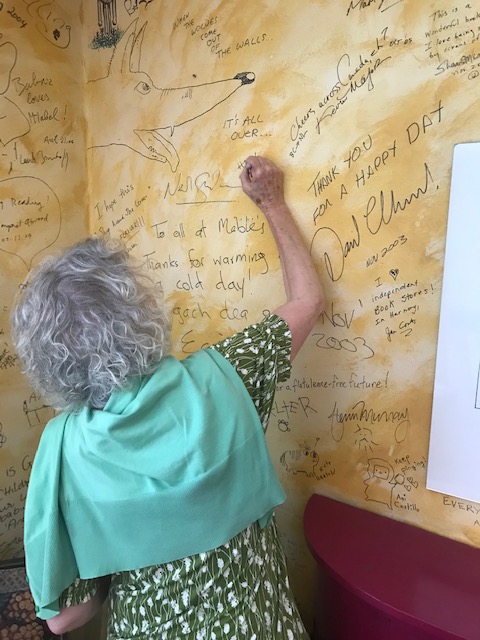
A stroll down the sun kissed boulevard took us by Mabel’s Fables, the city’s much loved children’s bookshop. The lady behind the desk got Kim to add her message & signature to the writers and illustrators wall in the room upstairs. She found a space between Neil Gaiman and David Almond to add her contribution of appreciation for this literary metropolitan oasis for the young.
My eye was caught by what I thought was a stuffed cat stretched leisurely over a pile of books on a display table. It turned out to be the shop’s real life mascot. Later I saw the laid back moggie skilfully catching flies in the shop window. Every bookshop should have one.
We enjoyed two special viewings of remarkable art collections during our four days in Toronto which allowed for a real insight and appreciation of Canadian culture. We were invited to a luxury apartment block downtown, to the penthouse home of one of the country’s foremost private arts patrons and philanthropists. Our genial host, a retired financier in his 80th year, had acquired and framed one of Kim’s drawings – Flea’s Hands (1979) – to add to his impressive collection of works by Canadian women artists. Our two hour personal guided tour of so many beautifully curated artworks, artifacts and rare manuscripts was an extraordinary privileged experience that will never be forgotten. That said, I’m glad I don’t reside in the sky as acrophobia would rob me of any enjoyment of immediate surroundings, however culturally awesome and life affirming.
The second artistic foray on the following day was a repeat visit to AGO – The Art Gallery of Ontario – a couple of blocks away. The Frank Gehry designed wing in particular made the perfect backdrop to this comprehensive collection of Canadian art over the centuries.
The vivid dynamic scenes of pioneer life from Montreal based Cornelius Krieghoff (1815-1872) contrast with contemporary paintings by leading First Nations artists like Kent Monkman. ‘The Deluge’ depicts the displacement of indigenous peoples by European settlers. Here the artist’s alter-ego rescues falling children and hands them back to their parents.
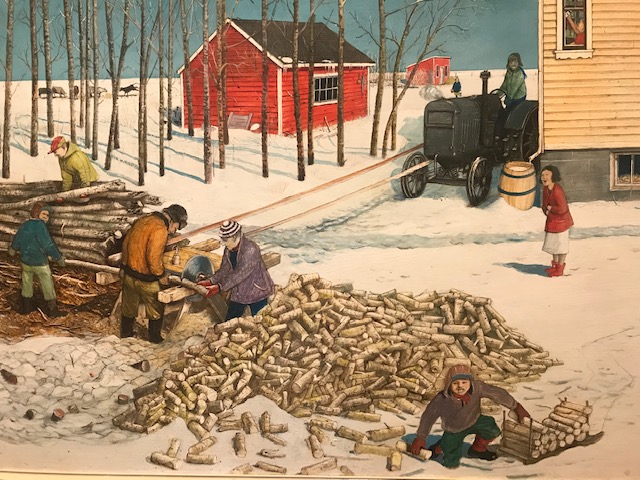
I was particularly drawn to the detailed paintings of country folk at work and play by an artist of Ukrainian heritage, William Kurelek (1927 – 1977). Loved the narrative qualities this self taught, spiritually motivated figure created in his fond depictions of rural life on the great plains.
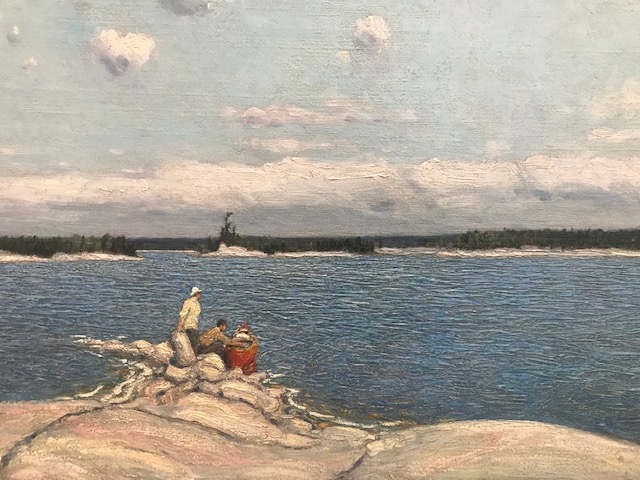
The Group of Seven is probably the most widely known school of Canadian art. These individuals explored and captured the rugged and remote landscapes of this vast country, putting them at the centre of their work, bringing their vision to international attention. Here’s one example, a view of Georgian Bay from 1913 by group co-founder JEH Macdonald (1873-1932) Born the son of a joiner in Durham, his family emigrated to Canada when he was fourteen. MacDonald founded a successful design firm and eventually became principal of the Ontario College of Art.
It was to the rural highlands in the east of Ontario we were heading, after the lovely wedding celebrations and art treats in Toronto, and further diaries will live up to their country titles.



























 STEPHEN TOMLIN