Fire and Ice

I can see all the country from Bolkow to Sheahan / And watch Lou go back in his flying machine/ Oh well its a job and I really feel great/ When reporting the ‘smokes’ Lou can’t see from his crate. From ‘A Towerman’s Lament’ by L Moreau

Dorset was another interesting historic lakeside spot to visit. Like Bobcaygeon it occupies a neck of flat land between lakes where once First Nations peoples lived and traded sustainably.
The settlement’s preserved centre boasts a canal side museum in the old schoolhouse, white clapboard church, craft shops, restaurants, a former lake pleasure steamer and a much loved well patronised traditional general store (est. 1921) full of essential items on different floors needed to sustain the scattered rural communities hereabouts.

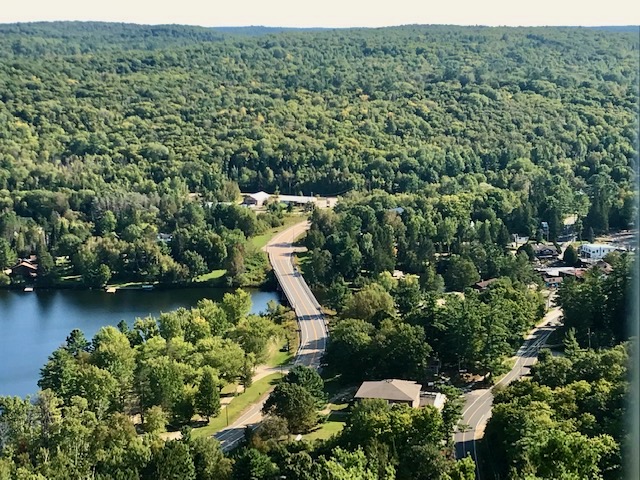
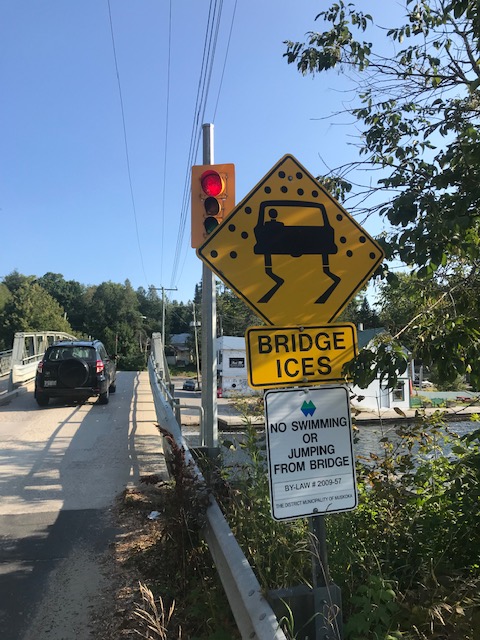
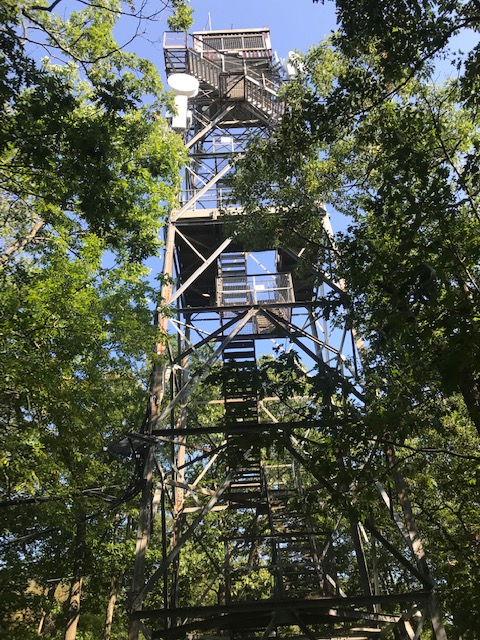
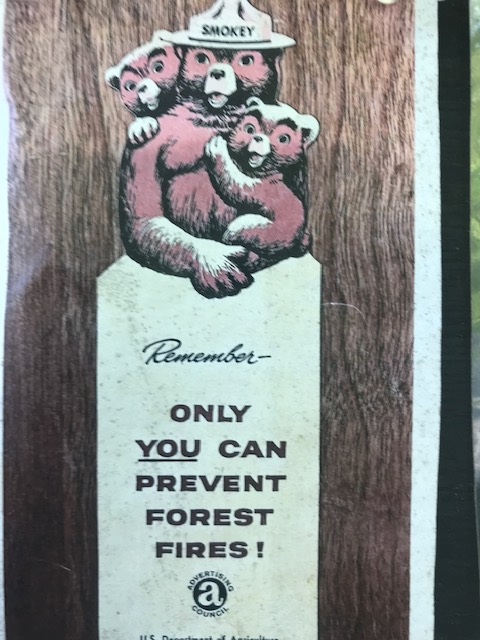
The bridge over the canal is a sturdy steel arched affair with lights to regulate traffic and warning signs of icy winter dangers. Dorset’s most famous engineering feature though is its preserved fire tower on the heights above the town.  A network of open sided metal watch towers, some 140 metres high were erected in the 1920’s, manned by fire wardens (Tower Jacks) from May to October to monitor the hundreds of square miles of forests for conflagrations. Use of spotter aeroplanes in the 1960’s made the towers redundant and they in turn were superseded by satellite cameras in the 1980’s.

This sole remaining tower on the Dorset heights is actually the second on site and of a different design, as it was originally intended to be an early warning structure on a military base during the cold war era.  Rescued and re-sited by a local community body it now doubles as telecoms tower and popular tourist attraction.

It’s easier to ascend the open structure’s 128 steps, eyes upwards, than to descend, which is more vertiginous and harder on the leg muscles. Apparently only 6 visitors in 10 feel able to make it to the top viewing platform. (It’s caged in to prevent anyone doing anything they shouldn’t). We met fellow Brits on the way who lived in Dorset and who just had to include it in their to do list.

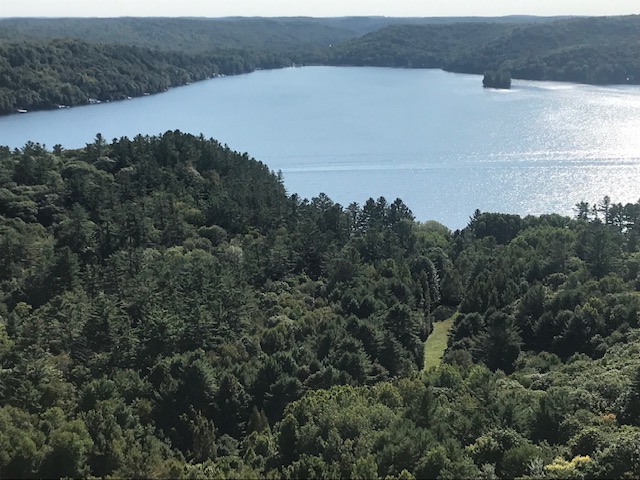
The views from the top are truly spectacular and gives a real feel for the distinctive landscape of forest and lakes stretching away to far horizons so I for one was glad I’d overcome a fear of heights to be rewarded with such an awesome 360 degree vista.

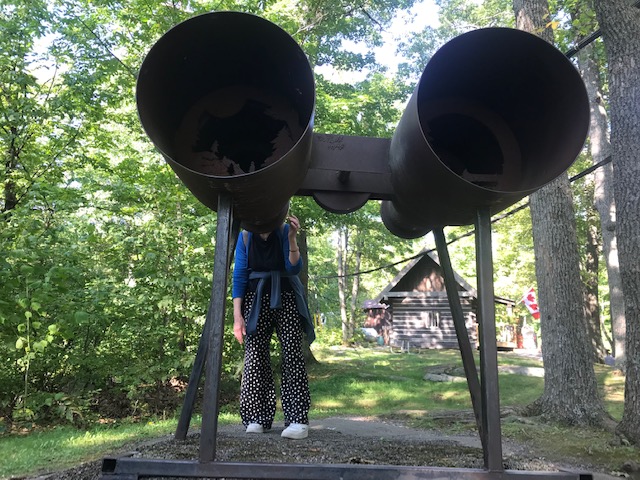
A giant metal sculpture at the base of the tower attracts visitors who may have left their own binoculars behind!

Log Chutes and Rock

Oh! wail for the forest – the proud stately forest/No more its dark depths shall the hunter explore; /For the bright golden grain/ Shall wave free o’er the plain/ Oh! wail for the forest – its glories are o’re! (Catherine Parr Traill, Peterborough Gazetteer, 1845)

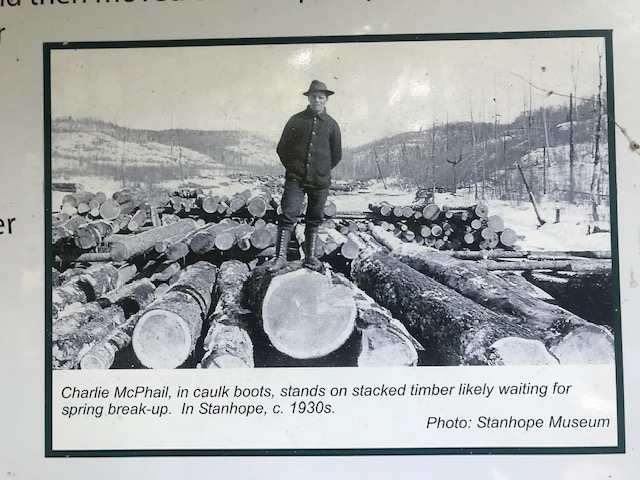
Some trees, like black walnut and western hemlock, dominate their spaces killing off competition from other arboreal species. Others, like the pines and conifers do it by height. It was the abundance of majestic white pine that first drew loggers here in force in the early 19th Century. Nearly all of the ancient big forest trees were felled then; initially to service Britain’s needs during the continental trade blockades of the Napoleonic wars and later more conveniently for the rapidly expanding American industrial market.

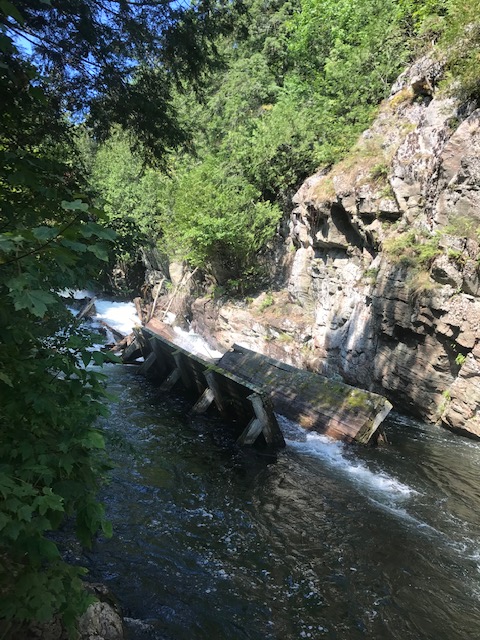
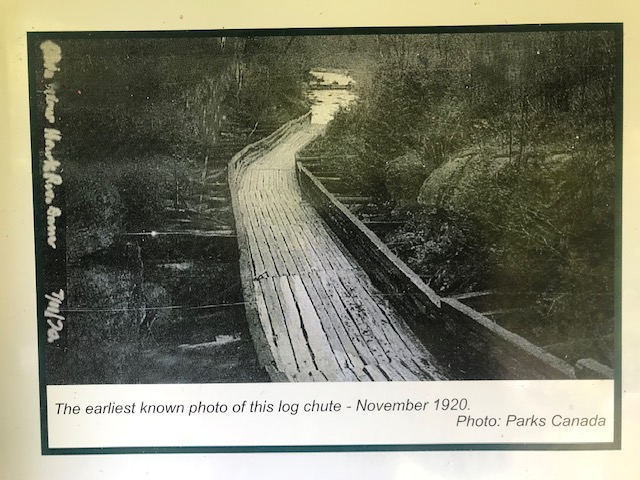
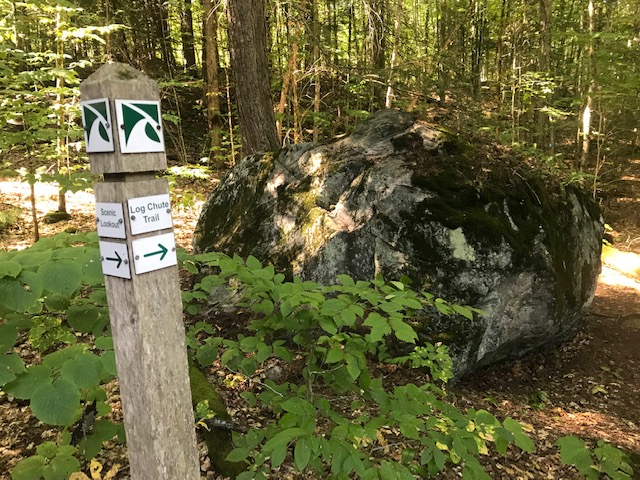
Our hosts hadn’t visited the heritage log chute before, and as we were keen to see it, a trip north towards the Algonquin National Park was eagerly anticipated. And we weren’t disappointed. The Kennisis river log chute, emerging from a dam on the Hawk lake, is the only one of its kind left, out of thousands that were once in action around the highlands. Built of secondary  timber and used to carry logs over rough river landscapes to sawmills, log chutes were first developed in 1829 to circumnavigate falls in neighbouring Quebec.

Built by the logging companies, they were always attached to a dam on a lake where the logs were massed after felling, ready to be shot downstream on the Spring meltwaters. This one dates from the 1920’s and was restored as a national monument in the 1970’s.

Great skill and daring were needed by those nimble footed workers afloat on the packed trunks wielding pikes resembling weapons of the medieval battlefields to deftly  manoeuvre and feed the mass of felled timber into the mouth of the chute.  

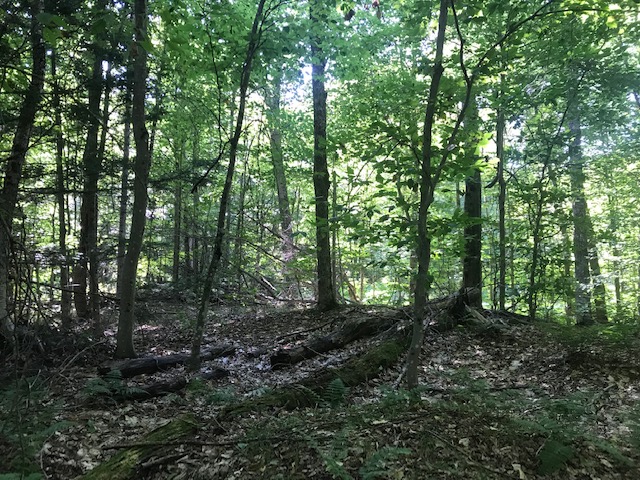
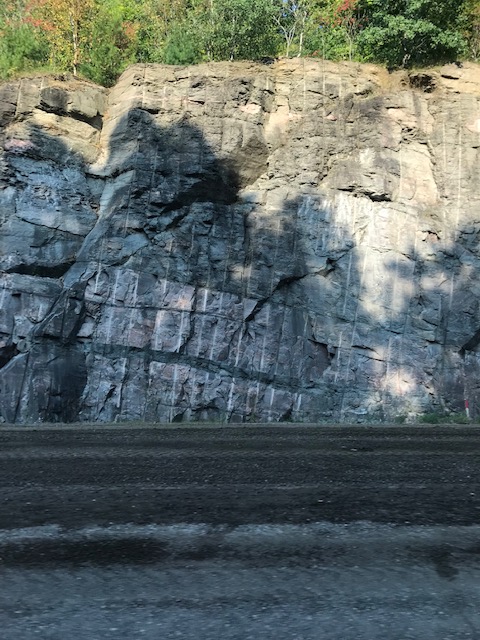
 A vast swathe of hard metamorphic rocks stretches from the great lakes and the border with the US all the way north to the Arctic, the ‘Canadian Shield’ as it is known. Cuttings, where the highways pass, bear witness to the deep drilling needed to split the bedrock. This land is littered with erratics, blocks of igneous rock generated by the vast grinding glaciers of the ice age. The soils over this dense mass of impervious bedrock are thinly spread, only enriched by annual leaf fall and wood decay. It holds water in countless depressions, small and shallow as well as big and deep. Deciduous trees dominate this landscape – spruce, beech, oak, maple and birch among them, as well as pines and firs.

The dense mixed woodlands are home to many animals. Chipmunks dashing about the place in a number of spots on our trave. We were told that in the old days, before rubbish at the municipal centre was separated into various types for recycling, brown bears would be in residence openly rifling through the piles of waste for food, oblivious to man.

Hikers using the extensive network of designated all seasons trails are officially warned to ‘wear blaze orange in the fall as hunting is a part of the Highlands heritage….Remember you use the trails at your own risk”.

Cottages Lakes and Canal

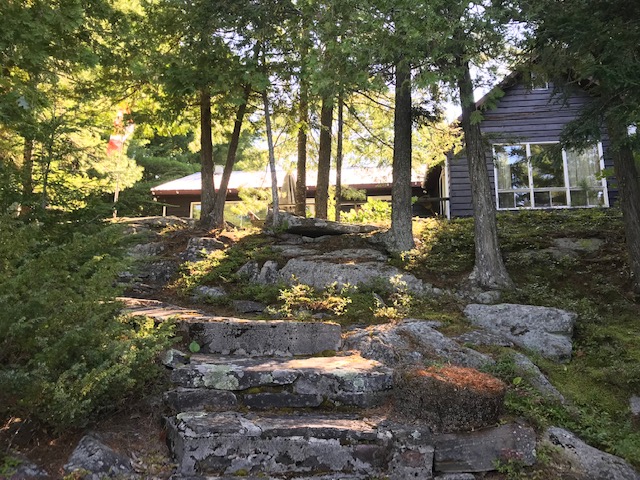
Our destination was the highland landscape of wooded lake lands, known to Ontarians as ‘Cottage Country’, and a popular rural retreat for city dwellers. Our stay was made possible by the great generosity of our hosts – the groom’s family – in whose traditional lakeside  holiday home we stayed for four wonderful days, enjoying their convivial company and delicious home cooking, unrivalled during our vacation!

Their more traditional wooden cottage had been gradually adapted and improved down the years but planning laws here allow for comprehensive redevelopment of plots so some of today’s ‘cottages’ present more like mansions now. Nearly all properties have launches or jetties on the water and the generous wraparound of natural tree cover preserves privacy.

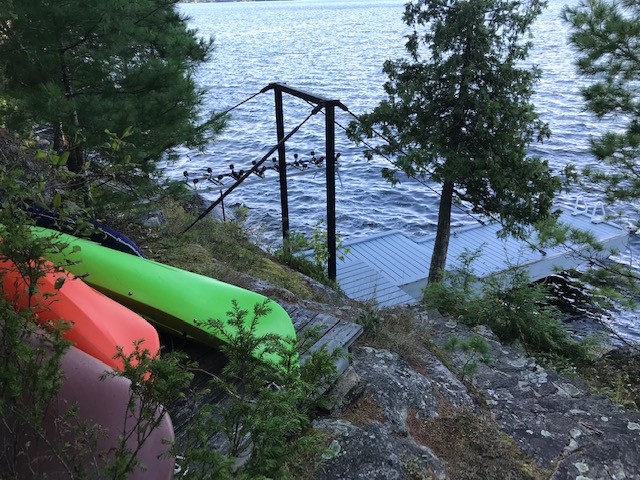
Like many others our host’s jetty was of the drawbridge type, and next to it there was a high boat rack. Autumn storage season sees all summer’s playthings put away for another year. In winter the lakes freeze solid, some three feet deep or more, so the ice would simply crush anything on its surface. Out come the snowmobiles to cross the frozen lakes and Ice hole fishing is very popular, extending seasonal vacationing for the hardy.

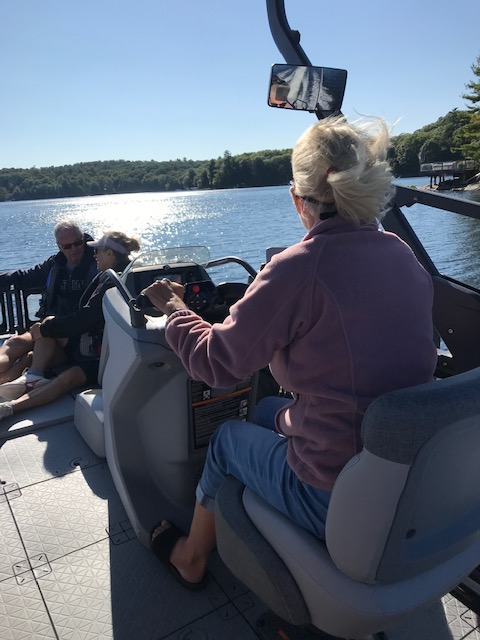
Thrills, but no spills, were had one fine afternoon on the neighbouring lake where our host’s sister had her own lovely property, south facing on a shallow inlet. We took our seats aboard her new speedboat. First time out was a fast and thrilling ride for me on the dickie seat up front towards the prow, pulling her brother on his water skis on a bracing circuit of the placid dark waters. The second trip had us all aboard at the back, at a more leisurely pace, for a fascinating sightseeing tour around the shoreline.

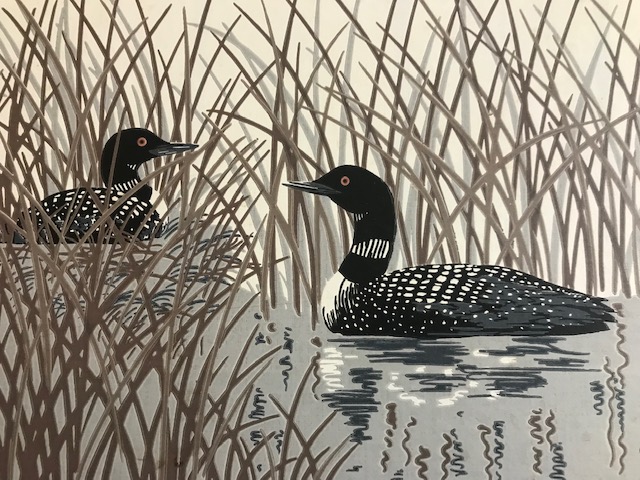
We saw a loon, one of north Americans most iconic water fowl on the lake, diving for fish. The birds distinctive calls at night haunt the air. Lake levels are some four foot lower at the end of summer because water is filtered off to top up the Trent-Severn canal system that links many of the major lakes in the region to the vastness of Lake Ontario to the south.

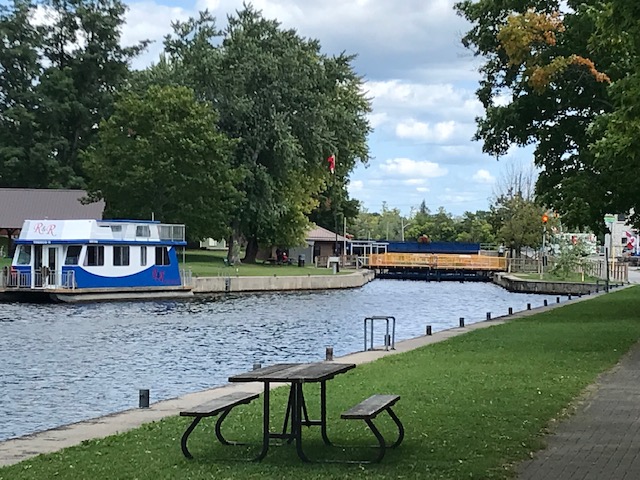
This impressive 386 KM long waterway took over ninety years to complete. It was begun in 1833 as a means to get British troops deployed rapidly should hostilities break out again with the US – The War of 1812 being still fresh in the collective memory.  Despite construction setbacks the waterway became an economic driver responsible for small towns springing up around saw mills and other industrial works. The coming of a railway followed by major highways in the last century saw decline and decay followed by a leisure boom of pleasure boating and cruising that defines the modern era.

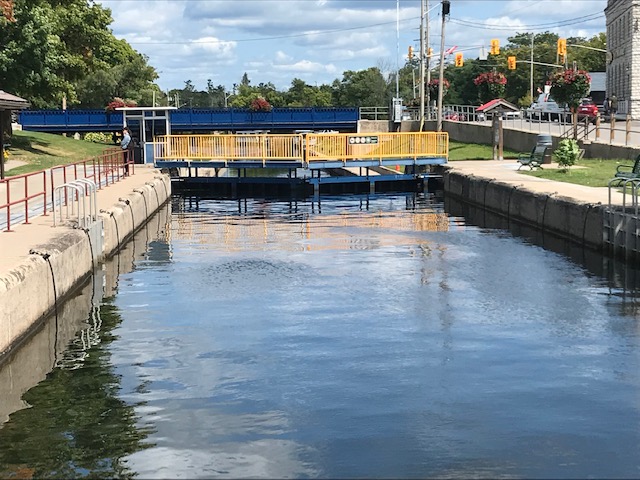
We took a trip to Bobcaygeon, an attractive small town whose historic centre is an island between river and canal and whose lock on the waterway links the two lakes it lies between. My companions discovered what the locally renowned Bigley’s shoes and clothing emporium and the Kawartha dairy had to offer. I meanwhile strolled around, witnessing the island’s access swing bridge in action and peeping in the windows of the preserved former watchkeeper’s lodge dating from a hundred years ago,

Insect Encounters

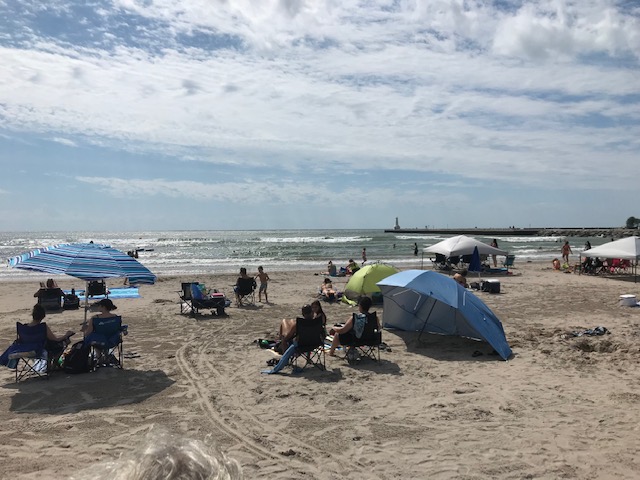
Our first stop out of Toronto was Cobourg, a town and beach resort further east on Lake Ontario in , of all places, Northumberland County. Still a matter of some fascination for a European to see a lake so big it powers breakers like the proper seaside!

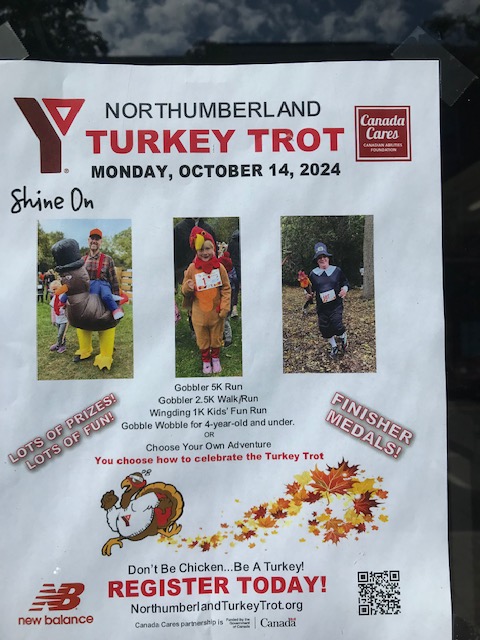
Not sure if Turkey trotting would ever catch on in our home county of Northumberland, but it certainly seems to be a popular entertainment hereabouts.

The old pleasure steamers are long gone although the marina was full of pleasure craft while the beach and adjacent playgrounds were buzzing with happy  family groups making the best of the Labour Day vacation weekend.

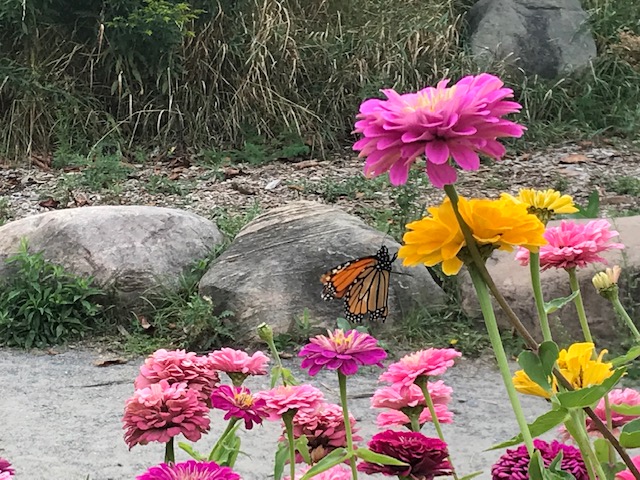
We stumbled upon a pocket park purpose built as a pitstop for migrant Monarch butterflies They are as big as a small bird big –  9-10 cms wingspan – and get their name for their main colour, after King William III of Great Britain,  the Dutch William of Orange. This handsome creature is notable for its mass migration from the northern US & Canada to Florida or Mexico. The larval stage feeds on a variety of milkweeds while the migrating adults – as we were excited to witness –  fill up on buddleia, goldenrod, chrysanthemums etc.

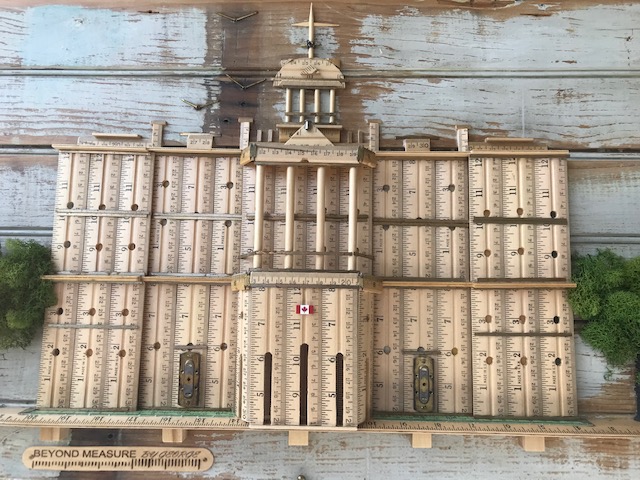
Later, having wandered down the main thoroughfare with its wide sidewalks spaced with shade giving trees and cheering swags of flowers on lamposts, we had lunch outdoors at a café. It stood opposite the Victorian town hall, and we’d earlier admired a local craftsman’s model of the grand building, fashioned from old rulers, displayed in a shop widow next to our café.

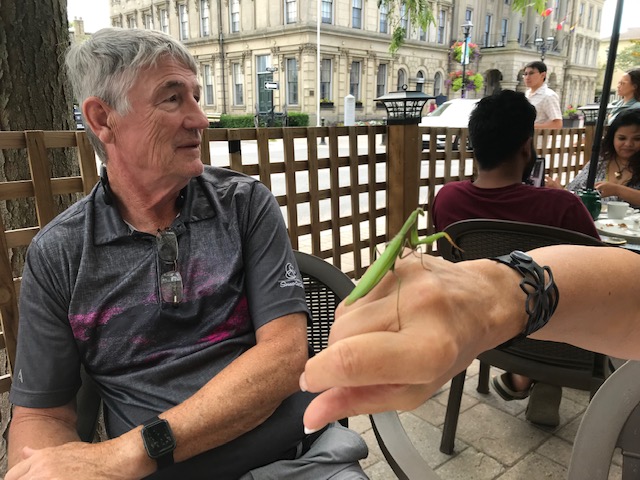
Everyone surprised and delighted when a male praying mantis alighted at each table in turn. Rather disconcertingly we observed Its green triangular  head turning right round. pity I couldn’t have used a ruler from next door but I reckon this chap was around 6-7 cms in length, with enlarged forelegs perfect for catching and gripping a wide variety of insect prey. The locals love them when they feast on mosquitos and blood sucking black flies that can plague the lakeland areas in Spring, we were told.

 Mantis are chiefly remembered though for the (larger and more sedentary) female’s habit of eating the male after mating. Introduced from Europe to the eastern seaboard in the 1890’s, in a rather misguided attempt at biological pest control, their population is now well established in North America.

Toronto Treats

We were in Toronto recently, where Kim’s niece Clare was getting married to her partner Adam in a 1930’s art deco former cinema, now an events venue. The hospitality and good companionship of  immediate family – who had flown in from all over the country for the big event as well as that of the new in-laws – was incredibly generous and inclusive making this visit extra special and truly memorable.

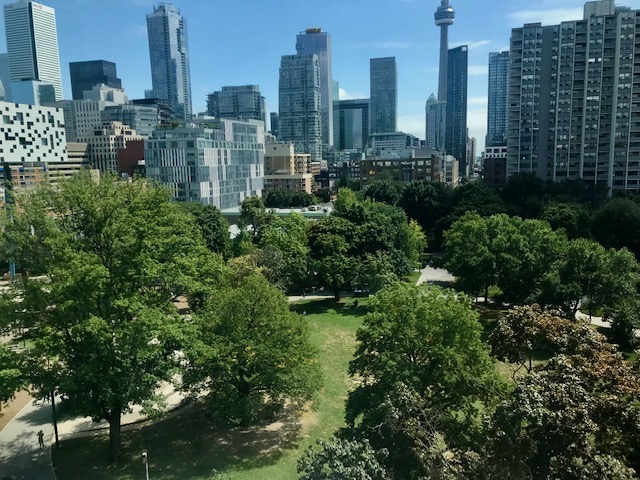
The city and its extensive suburbs is by far the biggest metropolitan area in Canada at 243 sq. miles/ 630 sq. km. and with a population of nearly six million people, is one of the most multicultural cosmopolitan cities in the world with hundreds of languages being spoken other than English. Arriving and departing from the city’s busy airport certainly reinforced that fact. Commanding the northern shores of Lake Ontario Toronto is the centre of Canada’s principal  financial, media, commercial and logistical worlds, and its grid system of thoroughfares is bisected by rivers, ravines and urban forest.

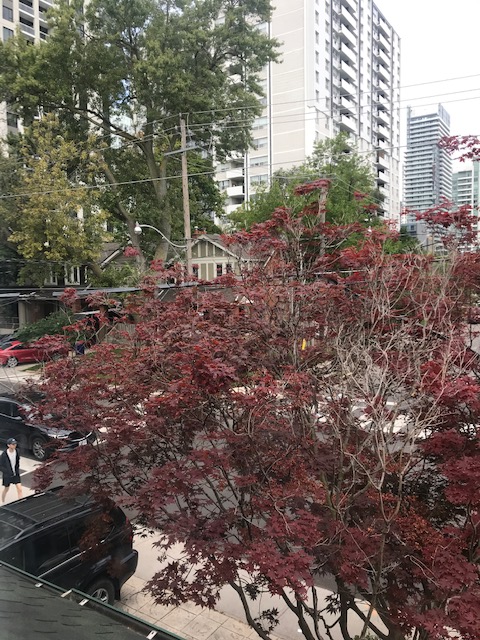
We were staying in an Air B&B in the inner suburb of Eglington. Strolling the residential area I clocked black squirrels, flocks of little finches and American Robins. Our clapboard house with its trees, porch & garden looked over – or rather, were overlooked by – new built blocks of apartments and condos.

There were the familiar street furniture of a north American cityscape, from fire hydrants to overhead traffic lights, yellow school buses and wide concrete sidewalks. More surprisingly were the first of a number of licensed outlets we’d see across Ontario legally selling marijuana products.

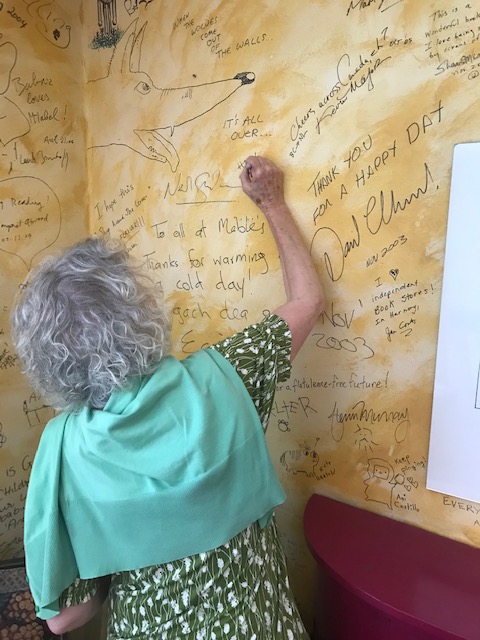
A stroll down the sun kissed boulevard took us by Mabel’s Fables, the city’s much loved children’s bookshop. The lady behind the desk got Kim to add her message & signature to the writers and illustrators wall in the room upstairs. She found a space between Neil Gaiman and David Almond to add her contribution of appreciation for this literary metropolitan oasis for the young.

My eye was caught by what I thought was a stuffed cat stretched leisurely over a pile of books on a display table. It turned out to be the shop’s real life mascot. Later I saw the laid back moggie skilfully catching flies in the shop window. Every bookshop should have one.

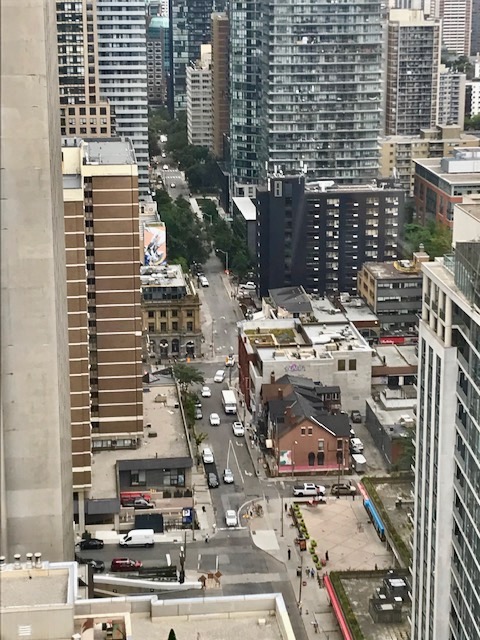
We enjoyed two special viewings of remarkable art collections during our four days in Toronto which allowed for a real insight and appreciation of Canadian culture. We were invited to a luxury apartment block downtown, to the penthouse home of one of the country’s foremost private arts patrons and philanthropists. Our genial host, a retired financier in his 80th year, had acquired and framed one of Kim’s drawings – Flea’s Hands (1979) – to add to his impressive collection of works by Canadian women artists. Our two hour personal guided tour of so many beautifully curated artworks, artifacts and rare manuscripts was an extraordinary privileged experience that will never be forgotten. That said, I’m glad I don’t reside in the sky as acrophobia would rob me of any enjoyment of immediate surroundings, however culturally awesome and life affirming.

The second artistic foray on the following day was a repeat visit to AGO – The Art Gallery of Ontario – a couple of blocks away. The Frank Gehry designed wing in particular made the perfect backdrop to this comprehensive collection of Canadian art over the centuries.

The vivid dynamic scenes of pioneer life from Montreal based Cornelius Krieghoff (1815-1872) contrast with contemporary paintings by leading First Nations artists like Kent Monkman. ‘The Deluge’ depicts the displacement of indigenous peoples by European settlers. Here the artist’s alter-ego rescues falling children and hands them back to their parents.

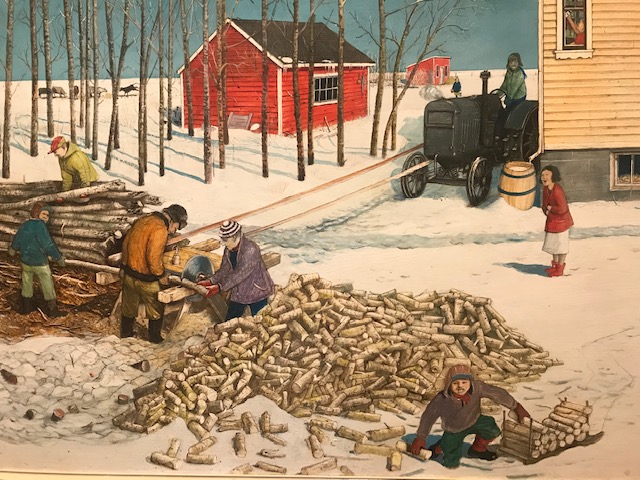
I was particularly drawn to the detailed paintings of country folk at work and play by an artist of Ukrainian heritage, William Kurelek (1927 – 1977). Loved the narrative qualities this self taught, spiritually motivated figure created in his fond depictions of rural life on the great plains.

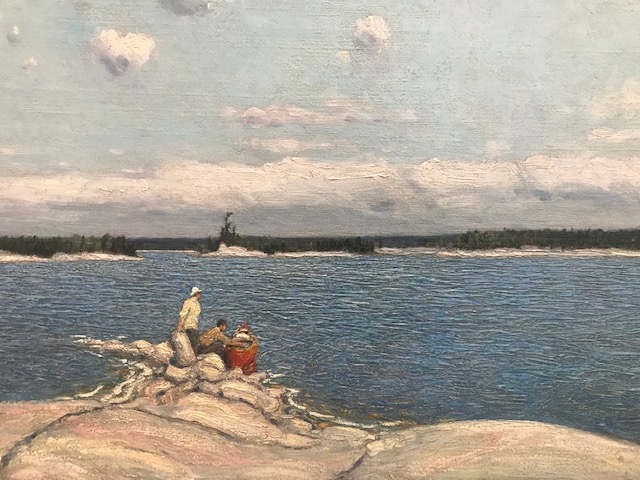
The Group of Seven is probably the most widely known school of Canadian art. These individuals explored and captured the rugged and remote landscapes of this vast country, putting them at the centre of their work, bringing their vision to international attention. Here’s one example, a view of Georgian Bay from 1913 by group co-founder JEH Macdonald (1873-1932) Born the son of a joiner in Durham, his family emigrated to Canada when he was fourteen. MacDonald founded a successful design firm and eventually became principal of the Ontario College of Art.

It was to the rural highlands in the east of Ontario we were heading, after the lovely wedding celebrations and art treats in Toronto, and further diaries will live up to their country titles.

Traquair Treat

Of all the historic properties visited as a tourist, as opposed to the ones worked in as an actor, Traquair remains a firm favourite. For centuries the home of the Stuart (now Maxwell-Stuart) family it exudes an authentic sense of history while still being accessible to the world. It draws  you in to its lively story as Scotland’s oldest inhabited house, with the colourful characters who inherited, extended and developed the place down the centuries.

The Stuart family, kinsmen to the Scottish monarchy have been resident at Traquair since 1461. The family rose to national prominence as their wealth and influence grew, as visits by twenty seven monarchs bear witness. The Catholic Mary Queen of Scots amongst them and her bedroom furnishings here are particularly striking. You see the oak cot her hosts had made to accommodate that tragic monarch’s infant son James, who would become king of both Scotland and England in 1603.

The family paid a protracted heavy price both as Catholic recusants after the reformation and for their later loyalty to the exiled Stuart cause after the revolution of 1688. How the family managed to hang on to remaining land and property given their fiscally challenged state and Jacobite sympathies was a wonder in itself. The most famous legend attached to the house is that of the elegant ‘Bear’ gates at the top of the long straight grassed over drive. Closed in 1745 after the departure of Bonnie Prince Charlie and his army, they are never to be reopened until a Stuart monarch is restored to the throne.

In the wake of one failed Jacobite rising Traquair was attacked and part looted by a mob of angry local protestants. The Priest’s room here on an upper floor has a secret passageway enabling the incumbent to flee to safety in the neighbouring woods. Liked the detail of the incumbent’s vestments, unique in being plain white and quickly convertible to bed covers when such an emergency disappearance arose.

The museum is worth the climb with guide rope up a steep winding stone staircase to the highest level of the original medieval former hunting lodge. The plaster walls with faded C16th frescoes of hunting scenes is the backdrop to well displayed family memorabilia and object d’art.

Curiosities range from Jacobite drinking glasses and miniature sets of C18th travel essentials to an intriguing set of ‘Napier’s Bones’ for calculating logarithms.

The organic nature of Traquair house adds greatly to the charm as you walk seamlessly from one century’s habitation to another, over different floors, through rooms adapted to time and place, marking the family fortunes. These rose and fell and would rise again through enterprising ways as the place opened up to the world in the modern era.

The title passes through both the female and male lines. In 1875  Lady Louisa Stuart died childless, aged 100, and the estate passed to the nearest relative who happened to be a Maxwell. The current, 21st Laird, Lady Catherine and her husband Mark, run the house and its 100 acres of grounds today through a charitable trust. Their programme of events has one unusual festival –  Beyond Borders  –  coinciding with the final week of the mega festival up the road in Edinburgh. The marquees for which were being delivered as we arrived.

In the 1950’s Lady Catherine’s father Peter re-discovered the abandoned C18th brewery and gradually renewed the craft on a commercial basis, a forerunner of today’s micro-breweries, that’s now  a thriving business exporting nationally and internationally. Naturally we stopped in the shop to buy a sample or two.

 A pleasant café in the former gardeners cottage, part of the extensive walled garden, now largely grassed over, complete with a pond and mature orchard. Particularly loved the sculpture of a life size heavy horse made up entirely of agricultural machinery and ploughs, painted black. Entitled ‘Epona’, it was made in 1999 by Rachael Long. We didn’t visit on this occasion but there’s also a beech tree maze created in modern times, with paths leading through the woods to the children’s playground and river beyond.

True to Type

In honour of the printers – past, present and to come…the multipliers of recorded thought, carrying down knowledge…the preservers of art, the promoters of culture. (Printers Association of Chicago, 1914)

Traquair House apart, Innerleithen in the Scottish Borders has an historic time capsule within its purlieu at R. Smail & Sons printing works on its high street, in the same premises it began business in 1866. Three generations of the family ran the firm up until 1986 when Cowan, the grandson of founder Robert, retired. By a stroke of great good fortune the whole premises, complete with all the original printing presses, equipment and archive came into the possession of the National Trust for Scotland (NTS) who moved to restore and reopen the business as a working museum. Staff and volunteers still print commercially for customers near and far using that original machinery, as well as operating daily tours and running courses out of season. This was our second visit, we enjoyed it so much when visiting for the first time years back with the grandchildren who live locally.

Guide Robin with some of the Guard Books

Our 90 minute guided tour, was led in turn by two experienced printers, Being engaged as apprentices, here to learn the trade, was a neat way of engaging our interest and involvement.

Dab, mallet, setting stick with newspaper front page set up

For most of its working life the premises were powered by a race off the burn that threads through this attractive Tweed valley settlement, formerly known as St Ronan’s Well. A mid Victorian boom town, water powered a host of mills in Innerleithen, and there was a lot of work out there for an enterprising printer. Between 1893 and 1916, when labour shortages due to wartime conscription ended circulation, Smail’s also produced the local newspaper. What a demanding job that must have been as a huge amount of rapid typesetting by hand was required to produce the weekly four page ‘St Ronan’s Standard and Effective Advertiser’ for up to 800 subscribers, while staff also doubled as reporters and salesmen.

Emigration to Canada, Australia, Africa and the U.S. was a common occurrence  in Scotland back in the day and Smail’s ran a booking agency for shipping lines up until WWI. The company office where we started the tour, illuminated by the acid etched shop front windows, has paperwork aplenty stacked in every nook and cranny. Keen fishermen, the Smail’s also stocked a range of flies for sale!

As we were to discover the family never threw anything away and their 52 hefty volumes of ‘Guard Books’ holds samples of every job produced between 1876 – 1956…advertising leaflets, posters, dance tickets, police reports, letterheads, concert notices, order forms, invoices, hymn sheets, menus, postcards and so on and so on. (After 1956 they kept job samples in files)

We were shown the original undershot water wheel in its casing as we entered the paper store. Quirky highlight here was the home engineered machine for dusting silver and gold leaf excess from finished print, utilising locally sourced fur and feathers from game.

Ascending the stairs we were inducted into the business that went on in the case room situated under sloping overhead windows, maximising the light. Here Robin, our guide, instructed us apprentices how to pick letters from the big wooden galley case. ‘Upper Case’ capital letters from the top, the rest from the ‘Lower Case’. We then compiled them, back to front, right way up, into our metal setting sticks, ready to hand over for individual framing and printing by our compositor in the great C19th Columbia eagle press.

Everyone – especially the children in our tour party – loved being handed back the souvenir bookmarks printed with our names. Task completed, we’d ‘made a good impression’. Other expressions born of the letterpress tradition started by Guttenberg in the 1450’s were explained here. Particularly liked to ‘Quoin a phrase’ which refers to the quoins, plain metal pieces of various thickness, that separate, frame and secure a phrase within the hand held stick. We saw the soft leather rounded stick or ‘dab’ used with practised skill to ink the set type thinly and evenly. Hence the reference to someone doing a job well as ‘a dab hand’.

The tour ended back down in the ground floor machine room. We were handed over to printer Colin who gave live demonstrations of the 19th & 20th century working printing presses still in their original positions. The oldest, biggest machine for the largest paper size runs was a cast iron Wharfedale Reliance roller press made by Fieldhouse, Elliott and Co in Otley. Watching and hearing it in motion printing a run of A3 posters, driven by belts that would originally been powered by water, was quite something.

Seeing the smaller but no less impressive pedal powered ‘clam-shell’ machine in action  proved fascinating too. Depending on the operative’s skill and concentration around 1,000 copies of small jobs – like bills, tickets or leaflets – could be printed every hour. Great hand eye co-ordination not to mention stamina required! Small wonder that a similar machine designed without guards, called The Cropper, caused many life altering accidents. Hence the expression ‘to come a cropper’.

Gift shops at heritage sites often fail to excite great interest but in this case our browsing produced a flush of sales, from a fabulous guide book with sample print pullout and wrap, to letterpress postcards, greetings cards, facsimile calendars and posters.

Smail’s has restricted opening days and tour numbers are limited so pre-booking essential. More at nts.org.uk

Seals and Parterres

North to Newburgh on the Aberdeenshire coast for a sight of seals at their ‘haul out’. Grey seals mainly, alongside smaller groups of harbour, or common, seals. They’ve been gathering here at the mouth of the River Ythan in increasing numbers over recent decades. With some 3,000 animals resident at peak times in the winter, it’s believed to be the largest concentration in Scotland.

Impressed at how much work had been done to provide sustainable access to what has since become a tourist attraction. Workmen were extending wooden walkways and some of the lower dunes we passed had been planted up with bunches of marram grass to help stabilise and secure them.

On the opposite side of the windswept estuary is Forvie, a 2,400 acre national nature reserve, consisting of dunes and coastal heath. The southern section is closed to human visitors in the spring and summer to help protect the seals sanctuary. A secure spot too for eider duck to settle, as we spied them now, sitting in a line facing seawards, their dark foliage contrasting with flusters of foraging gulls behind. We delighted to stand watching the seals dive and return, heads bobbing in the wavelets, sometimes turning on their backs to scratch. This safe haven of an estuary allows for the seasonal moulting of adults and  their pups to thrive, putting on the weight they will need to survive winter. Some of the seals appeared to follow our progress as we strolled the strand, as curious about us humans and canine companions as we were about them.

A curious landmark on the other shore. The squat concrete bulk of a wartime pill box tipped over, submerging into the beach. Traces of  what I assumed was its twin on our side of the water left as a scatter of pitted grey blocks, worn smooth by the waves. Much further south a line of wind turbines traced a line between sea and sky. Further out into the North Sea was a drilling rig  while above  helicopters plying back and forth from Dyce airport, reminded us of Aberdeen’s importance as a centre of the oil and gas industry and the wealth generated by it.

It was wealth of a different kind that enabled the great garden at nearby  Pitmedden, our next port of call, to be built three centuries ago. The vision of Sir Alexander Seton, a wealthy Edinburgh advocate, later a judge and MP, and his wife Dame Margaret Lauder in the 1670’s, and built to the designs of eminent Scottish architect Sir William Bruce.

As a Royalist in exile at the Stuart court at Versailles Bruce would have been greatly influenced by Andre Lenôtre’s famous designs for the gardens there. Pitmedden today consists of four great parterres (meaning ‘on the ground’) with another garden on the higher level where Pitmedden house stands. The two levels are linked by grand granite steps with parapets linking elegant stone gazebos at the corners. These square turrets allowed family and guests to congregate for conversation and musical entertainment while looking  over the formal gardens spread out below.

These architectural features, along with ancient yews in the further corners, are all that remains of the original garden structure completed in the 1670’s, while the horticultural gem we explored today is a bold modern recreation. When the National Trust for Scotland was gifted the estate in 1952 by its last owner, Major James Keith, it set about the huge task of recreating a formal 17th Century garden from scratch. The original plans for Pitmedden were lost in a house fire so drawings of the old Palace of Holyrood gardens in Edinburgh became the inspiration for the ambitious long term project.

Parterres and knot gardens developed over time to include different types of planting – like including annuals, different types of gravel or using herbs – and the different designs in the modern garden reflect that, alongside incorporating fountains and statuary.

Another contemporary feature is the continuation of installing sculptural forms. Stone pieces from the sculptor James Maine appear at key points around the gardens.

To maintain year long interest and take advantage of the sheltered setting, wide herbaceous borders were incorporated into the new design and most of these robust plants, artfully planted and well maintained, were in glorious full flower on our visit, swarming with bees, hoverflies and other insects.

Impressed by the upper south facing terrace where the stone wall was hardly visible, so thick and dense were the foliage and fruit of the espalier apple trees that have been growing  and spreading their boughs there for well over a century. In Major Keith’s day the garden as a whole was producing fruits and vegetables on a commercial scale for the local area’s markets.

The two parterres on the upper level – created in a much more free flowing form – date from the 1990’s and have since been modified in their planting regime with climate change in mind. In 2014 a one acre paddock adjacent to the walled garden was planted as an orchard and soft fruit garden with scores of traditional varieties. I liked the way some apples here are grown as fences, and that bee keepers and their hives are integral to the development.

There is also a museum of farming life in the barns, yards and outbuildings. This extensive collection of implements and machinery give one an idea of how labour intensive and demanding a business agriculture hereabouts was back  in the day. I particularly liked the recreated farm labourer’s family home in the cottage and the densely planted herb garden, full of fragrant aromas, situated beyond it.

Tale of Two Castles

Drum and Crathes castles are neighbouring estates on the north bank of the Dee between Banchory and Aberdeen. Both remarkable for the long unbroken history of occupation by their respective families. The Burnetts at Crathes, the Irvines at Drum. Both owe their early fortunes to Robert the Bruce, as each family had their fiefdoms in a vast hunting forest granted by that monarch. Their respective fortunes rose and fell in the turbulent centuries that followed, producing characters aplenty, amongst them rebels, gamblers and adventurers, fighters for crown and country, cultural benefactors and patrons. In one way or another playing their parts in regional and national events. In the late 20th Century both families called time on their ancestral piles and, along with hundreds of acres of estate acres, handed them over to the care  and management of the National Trust for Scotland.

At 70’ high with walls up to 12’ thick Drum Castle’s central tower  is one of the oldest in Scotland, an awesome construction dating from the 13th Century, which dominates the fine Jacobean mansion house and Victorian extension. The former common hall of the tower now a library with over 3,000 books, with many rare early editions, reflecting the family’s literary and cultural interests. The rooms throughout speak of a comfortable, comforting existence in more recent times, with elegant furniture and many beautifully crafted fittings.

Drum’s large walled garden is divorced from the castle at the edge of venerable woodland and rich pasture. A public appeal raised funds in the early 1990’s to turn it from its original function of kitchen garden into four garden rooms, divided by evergreen hedges, reflecting four centuries of rose growing and display.

One part of the garden surprises and delights with a human sundial where by standing on the edge of the current month marked the sun’s shadow will fall on the hour in the surrounding circle. Had the place to ourselves at afternoon’s end and its simple uncomplicated tranquillity conferred a sense of wellbeing.

I was surprised and willingly seduced by the presentation of Crathes, the showiest of the two castles. Garden and adjacent building combine to enchant visitors with contrasting colour, structure and texture. A series of way marked trails explores the woodlands and wider estate beyond.

The prize  topiary put me in mind of Levens Hall in Westmoreland and dates just a little later, around 1702. Despite the use of modern machinery – which we were lucky enough to see in action – the whole trimming process can take up to nine weeks to complete. There are eight individual gardens on two levels (including Victorian greenhouses) within its 3.75 acres of walled garden, divided by borders and hedges and graced by specimen trees.

A doocot (dovecot)  with steps and decorative stonework is an eye catching feature of one corner. The rose garden its most contemporary feature, where we lingered on benches to soak in the atmosphere by a bubbling fountain carved out of local hard black stone.

Crathes castle is a classic tower house that dates from the 16th/17th century. I loved the original stout wood door and iron gate behind it so typical of this sort of construction in uncertain and violent times. There were domestic comforts too by contrast. Only the Laird, his lady and VIP guests could expect a room of their own and a bed to lie on, so looking up from below at brightly decorated figures and lettered rafters on the ceiling was intended to entertain and distract by the light of candles and lamps.

Nearly all Crathes furnishings and contents were left to the trust by the 15th laird along with the house and estate in 1952, which adds authentic resonance to its domestic setting. Only the first floor is accessed by the addition of a wooden staircase in Victorian days, which means one must ascend the rest by the set of original granite steps spiralling upwards, linking one small room after another, floor after floor, until the wooden framed long gallery at the top is reached, which yields an overview of the gardens and wider estate.

Another set of spiral stairs then leads one down through more levels, bedrooms and private chambers. Dizzyingly wonderful stuff, especially when combined with ceiling art gazing.

Enjoyed good conversations with the warm and welcoming staff at both these properties. Find out more about Drum and Crathes and the stories of the individuals who lived there at www.nts.org.uk

Castle and Haven

From the Dee to Dunnottar Castle. Billed as one of Scotland’s major tourist attractions, we joined hundreds of other visitors – most of them from European countries – to take in the stunning view of the great ruined fortress sitting some 160’ above the north sea on a spur of land made up of boulders cemented in igneous rock millions of years old. Once an early Christian chapel it had previously been a fortress – Dun being  Pictish for ‘place of strength’.

Dunnottar’s deliberate pinch point of an entrance, half way up the great rock, is  little wider than a domestic doorway with narrow cobbled passage way and yet more stairs, opening out  at last onto a grassed plateau with an impressive  range of grey sandstone buildings, most of them now open to the elements; chapel, stables, smithy, great hall, bedrooms, barracks, great keep etc, many set over cellars, and vaults. Rocks and swirling waves are glimpsed below  the sheer cliffs . How did the builders of this bastion ever manage to get so much material and supplies from mainland behind to headland in front?

For centuries Dunnottar was the principal stronghold of Scotland’s Earl Marischal, one of the great officers of state, inherited through many generations by the aristocratic Keith dynasty. In that time it hosted Mary Queen of Scots and Charles II and saw attacks and sieges in both the War of Independence and Civil War. The 10th Earl’s active support of the 1715 Jacobite rebellion lost the family their lands and titles and Dunnottar was subsequently stripped of all fittings and re-usable building material.

Purchase of the castle by Lord and Lady Cowdray two centuries later saw it stabilised, repaired and re-opened to the public. Their descendants still own and manage the site. Even with lots of us visitors milling about and some testing climbs the castle ticks the necessary boxes of romantic ruin, superb viewpoint, historical atmosphere, preserved range of habitations, royal associations, fighting and conflict, immersion in the elements. …What more can one ask for?

We walked the high cliff path the 1.5 miles to Stonehaven. The town’s interlinking harbours spread out before us before the steep path descent to test your leg muscles. Our destination, appetites sharpened and senses primed, was the area’s most recommended and multi-awarded eateries, there on the beach promenade – The Bay. We sat outside to eat our haddock and chips after queuing for more than half an hour. It was well worth the wait. As the line shuffled forward we learnt the fish was fresh caught with the local boat named alongside the variety and farm in Norfolk the potatoes came from. One veggie offer the display board listed was chick pea fritters and n’are a deep fried Mars Bar anywhere!

On the return leg we stopped in admiration of a series of art works aside the beach boardwalk fashioned by an anonymous ex-seafarer dubbed ‘Stonehaven’s Banksy’. His humorous skilfully fashioned boat sculptures made of scrap metal first appeared anonymously about the place in 2006. In 2019 he told the local paper that “I’m nae an artist, I’m just a guy that bashes metal together” and that “The sea to me means freedom”. We’ll drink to that!