Dingle: Dun, Bee & Boat

The distinctive peninsulas that characterise this south west corner of Ireland present challenges to the modern day tourist, with cars and coaches traversing narrow twisting roads. Meanwhile the locals have to put up with peak season congestion as they go about their everyday business. It’s lucky then that nobody seems in a hurry to get anywhere fast.

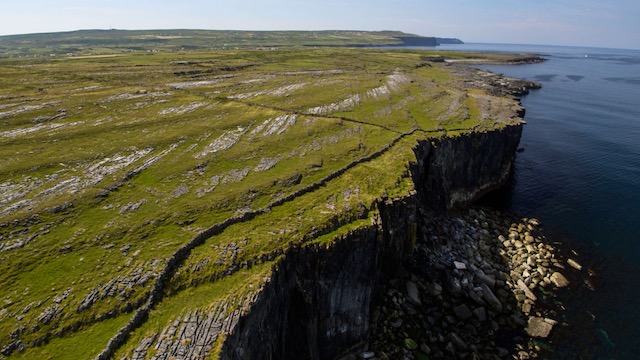
The Dingle peninsula boasts over 2,000 historical monuments and that reflects its remote location and farming way of life over thousands of years. Rocks cleared from patchworks of land built drystone field walls and farmhouses that distinguish this rugged landscape.

The ancient inhabitants of the peninsula were skilled in using the water as their sea roads. These would also have been trade routes and their culture and artefacts reflect that. We were lucky enough to get some sense of their world from the handful of sites visited on our traverse of the 38k/24 mile circular route marketed for tourist purposes as the Slea Head Drive. As advised we drove clockwise, with the traffic and not against it.

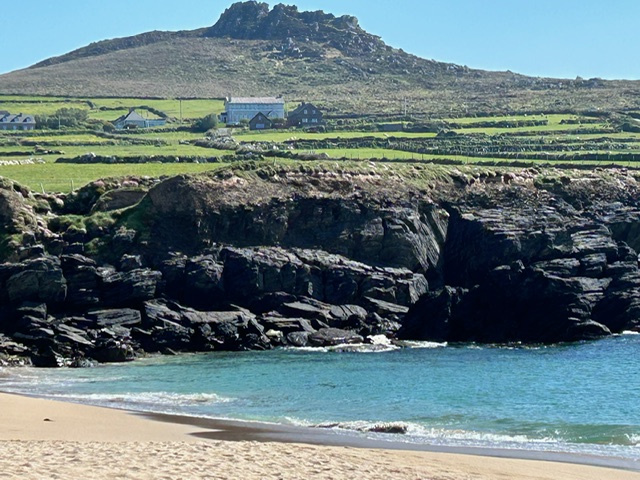
A Mountain range dominates the centre of the 48k/30m long peninsula, ending at the westernmost point in Ireland around Dunmore Head. It was here in 1588 that two of the remaining ships of the Spanish Armada’s failed invasion of England were tragically wrecked. The narrow road in and out of Dingle town, its busy main population centre, hugs the jagged coastline by cove cliff and beach.

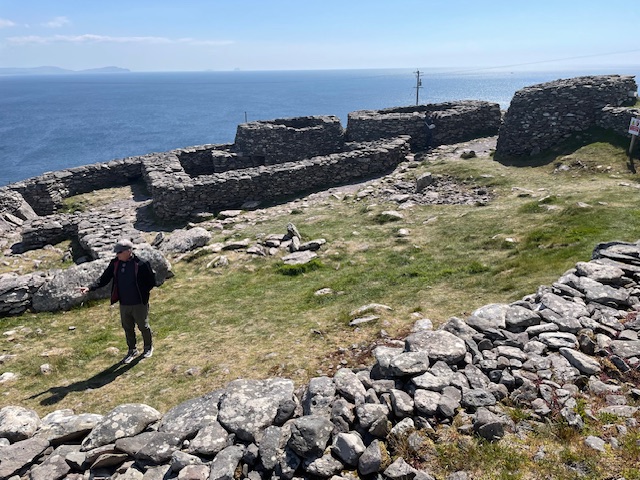
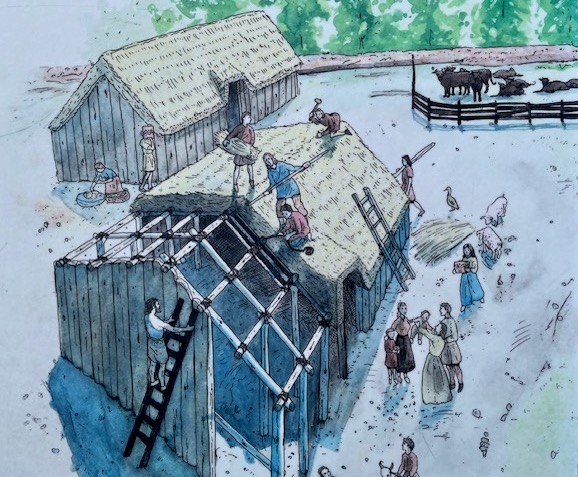
Dun Beag (‘small fort’) on the cliffs at Fahan has a beautifully created visitor centre inspired by traditional vernacular design. Here we watched an introductory film while sitting in the dark on animal hides in an intimate environment, suggesting the domestic interior of the 5,000 year old promontory fort below.
The streamside path leading to the fort with its massively wide dry stone walls is unexpectedly graced by lilies, while the bare sea cliffs below sport patches of thrift.

Storm damage this century has been extensive and fences now secure the site from over enthusiastic exploration but it still exudes a strong sense of its ancient role guarding the wild sea ways. This once formidable stronghold created was in the Iron Age, though archaeological evidence suggests Dun Beag remained in use between 8th – 11th centuries.

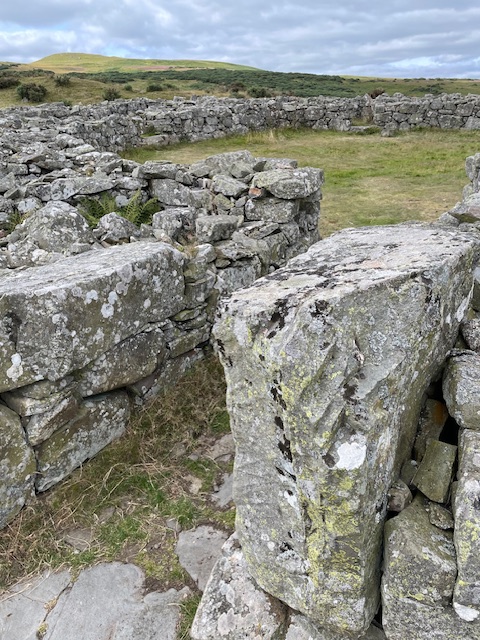
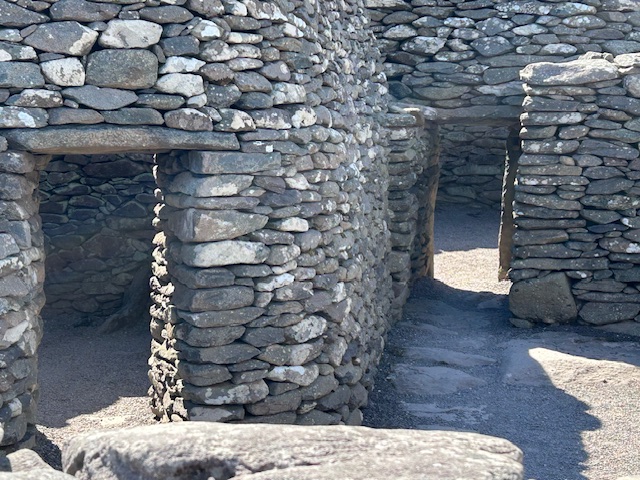
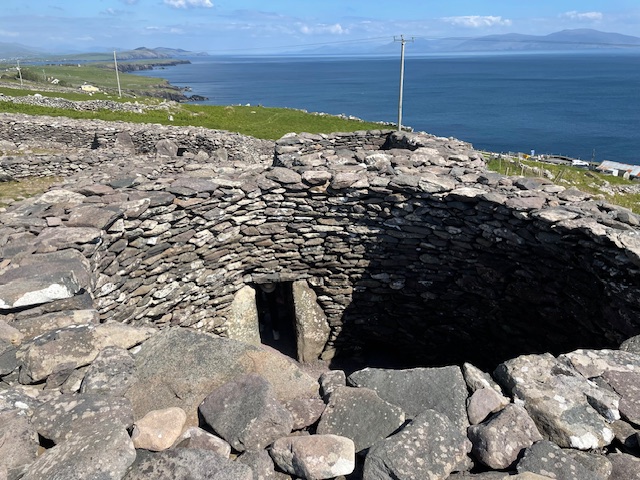
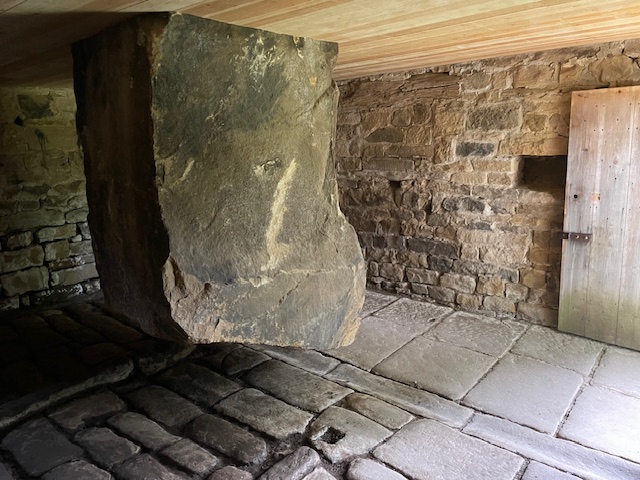
A short drive westwards brought us to the a group of Clochlans, better known because of their shape as beehive huts. Dating from the early medieval period they were home to Christian communities of farmers and fisherfolk and are remarkably well preserved. We learned that although significant historic monuments like these belong to the state, owners of the land have the right to grant paid access to the public.

Here the huts are part of a wider offer by Aiden, the occupying farmer and his family, to feed lambs and watch sheep dogs at work. A nice line in farming for tourism in the C21s. Good on them. 

Beyond this compact set of interlinked dwellings I glimpsed another cluster higher up the hill and the farmer’s dad (who it turned out had spent most of his working life in England as a labourer), told me access rights were in dispute and the owners were keeping it as was and unvisited. He felt those buildings were even more complete and whole than their own.
Our trio of antiquities was completed by a visit to the early Christian oratory at Gallarus. Dating from around 500 AD and fashioned in the shape of an upturned boat, the chapel is lit only at the far end by a simple window. An austere and striking symbol of the Celtic Church overlooking a harbour that has outlasted Viking raids, Norman conquests and everything the weather has thrown at it.
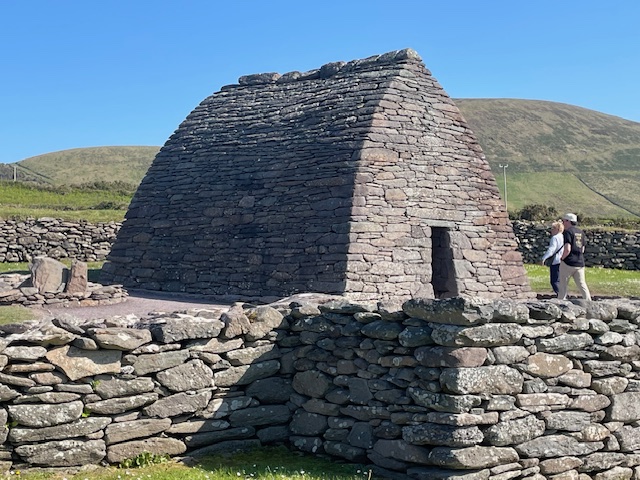
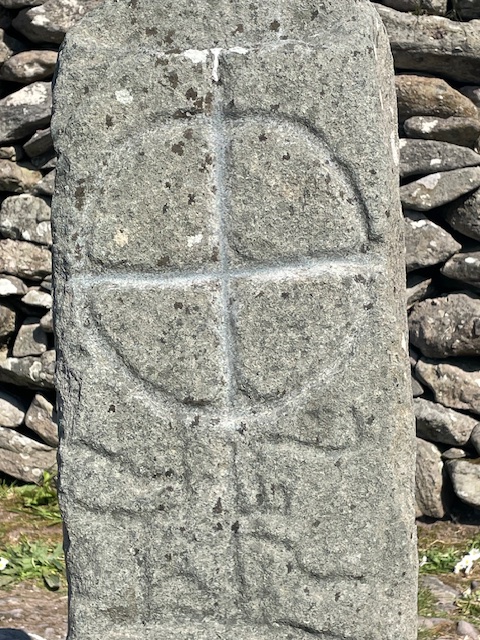
Made of gritstone the oratory measures 8m long x 5m wide and 5 m high. Some graveyard stones remain, like this simple cross inscribed in stone.

Thought of the skill seen in constructing beehive huts when viewing this little church, as the stones of various graded sizes meet to form the roof ridge. Also bore in mind that the central aisle of a church is called the nave because of that upturned boat shape, from Latin ‘navis’ for ship.  

We left Dingle entranced by the extraordinary sights, sorry not to have time to do more but glad to have sensed the life of the past through wonderfully well preserved examples of its fortifications, homes and churches.

The Burren

There is a world apart, / of elemental beauty carved by glacier, / where tiny wildflowers/ pierce through limestone. (From The Breathing Burren by Maureen Grady)

Living as I did for decades near the Silverdale & Arnside AONB on the Lancashire/Cumbria border I got to appreciate limestone pavements and the flora and fauna that thrive there. Coming to the Burren in County Clare for a day gave an even greater appreciation of such a landscape at scale and extremity. What at first looks like a barren and otherworldly landscape is in fact quite the opposite.

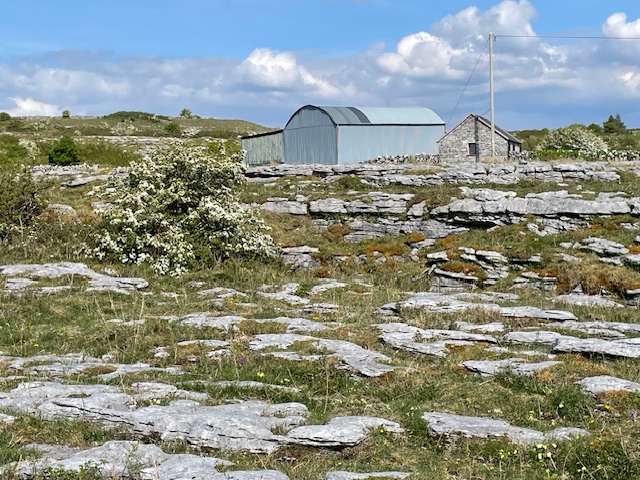
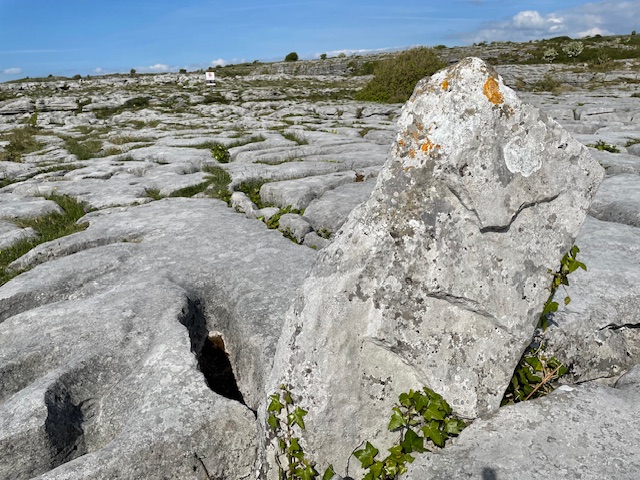
Much of the Burren (Irish Boireann for a rocky place) is a national park, part of the UNESCO Geo-park along with the Cliffs of Moher. 1500 hectares of karst limestone, calcareous grasses, hazel scrub, turloughs (lakes) petrifying springs, cliffs and fens. Limestone formed from sediments millions of years ago has been further ground and compressed into fractured state by glaciation. In those gaps or grikes  plants thrive in their mini eco chambers.

Some 70% of plant species found in the island of Ireland are represented here and 23 of the land’s 27 native orchids too. Most excitingly for botanists it’s party time for the world’s plants as flora from Arctic, Mediterranean and Alpine environments all thrive here and the grasses between rocks are species rich, providing quality grazing.

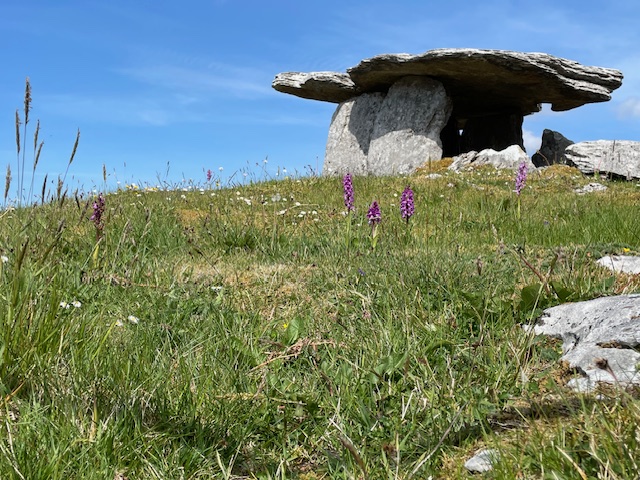
People have lived on this plateau for many thousands of years, and the wider area boasts some 3,000 registered ancient sites. We were fascinated to find out more when visiting the Burren’s best known dolmen, or burial chamber, at Poulnabrone. This striking structure is the oldest dated megalithic monument in Ireland. A portal tomb type it has two capstones, although at some point in the past the rear one had collapsed.

Archaeological excavations in the 1980’s revealed that 33 people had been buried here and that the tomb was in constant use between for 600 years between 5,200 and 5,800 years ago. This visit to Poulnabrone put me in mind of another dolmen of similar design and age I have visited often in the past; Pentre Ifan in Pembrokeshire.

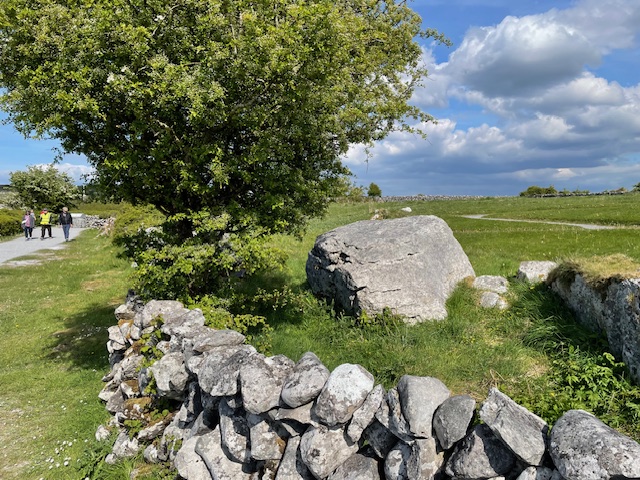
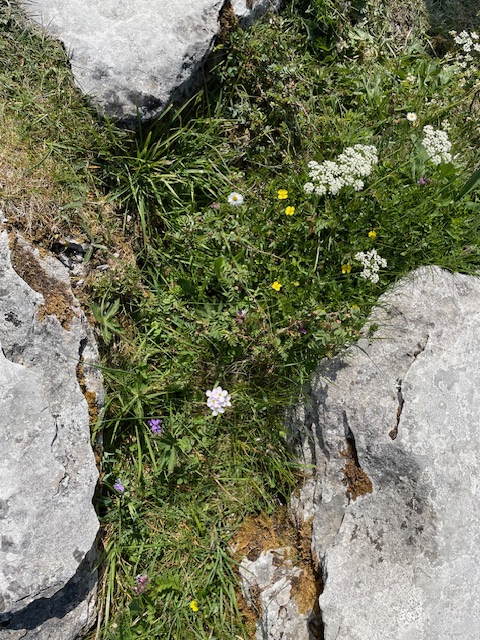
Early purple orchids were growing in abundance through the short wiry sward around the tomb and the grikes were full of ferns grasses and other calcareous loving plants. The land about was also dotted with erratics, large rocks left by glacial action. These are mostly limestone but some, being carried from a distance away, are of gritstone and granite.

A local we spoke to bemoaned the huge rise in tourism in the age of social media and the problems caused by it. Although the majority of the thousands of visitors here each year respect the place a significant minority do not, he said. They camp here, leave rubbish or worst of all attempt to make offerings or cremate remains in the tomb. One such misguided event a while ago caused cracks in the structure and visitors are urged to tread lightly, with care, less we damage the things we’ve come to admire.

Image: Kevin L Smith / Doolin Tourism

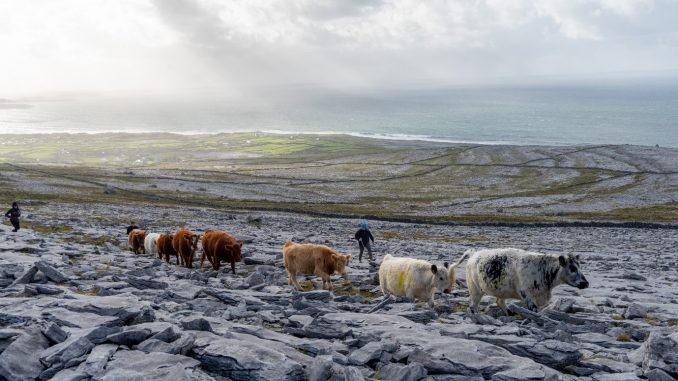
A Cromwellian officer in 1651 captured the paradoxical nature of the Burren when he reported ‘A country where there is not water enough to drown a man, wood enough to hang one nor earth enough to bury one… yet their cattle are very fat’.  I was fascinated to read up later about the ways that traditional agriculture and contemporary conservation have learned to partner here in the 21st century. Farming families on the Burren practice husbandry that runs counter to conventional cattle management in putting their beef herds – mainly shorthorns, but also Herefords, Dexter and other breeds – onto the exposed high land in winter as opposed to taking them off. In so doing they are key maintainers of an eco-system famous the world over.

Image Credit: Shane Casey/ARC

Winterage, as this practice is known, ensures dead herbage is grazed off and creeping  hazel scrub contained, thus preparing the ground for spring flora to flourish. The calcium and mineral rich grassland pockets between rocks provide healthy bite, with water from renewed springs and the well-drained stone ground, heated through the summer months, giving a dry lay for the beasts. The cattle have clearly learned to be nimble footed too, avoiding leg breaking crevices as they forage and roam.

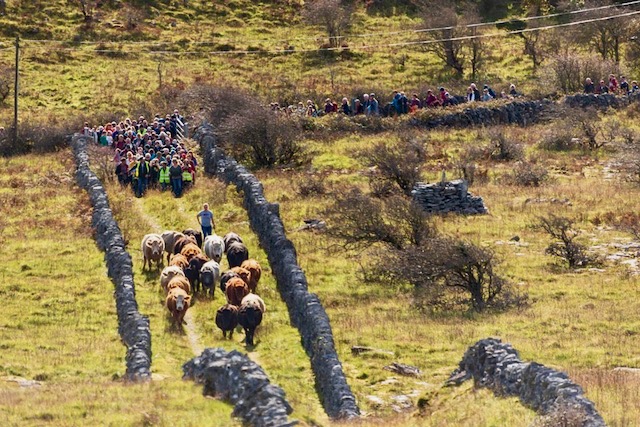
Image Credit: Burren Winterage Festival

Today this outstanding example of transhumance is increasingly appreciated by the wider public and acknowledged by the authorities through a custom made subsidy basis. Every October The Burren Winterage Weekend Countryside Festival culminates in the participating crowds following farmers as they herd their beasts up along the ancient drove roads to those winter pastures. What an unusual and heart-warming sight it is.

Cliffs of Moher

You know that Ireland’s road infrastructure has improved dramatically in the 21st century when you see day trips offered in Dublin to this tourist mecca in County Clare on the ‘Wild Atlantic Way’. That’s a 3.25 hour coach journey to cover the 268k (166m) trip, mostly by motorway, and the same back. One very long day out. And there are no shortage of takers.

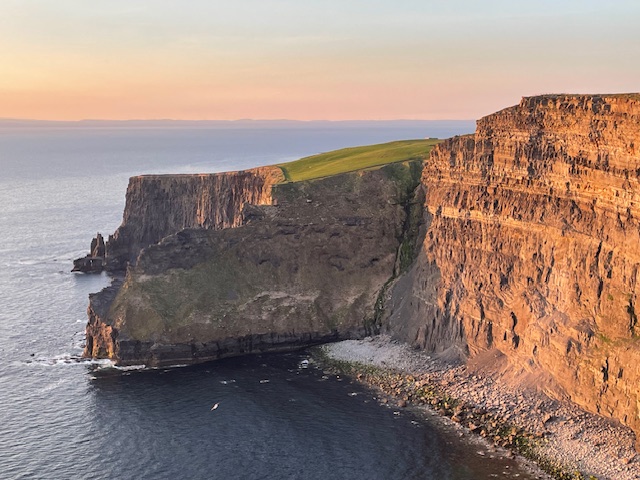
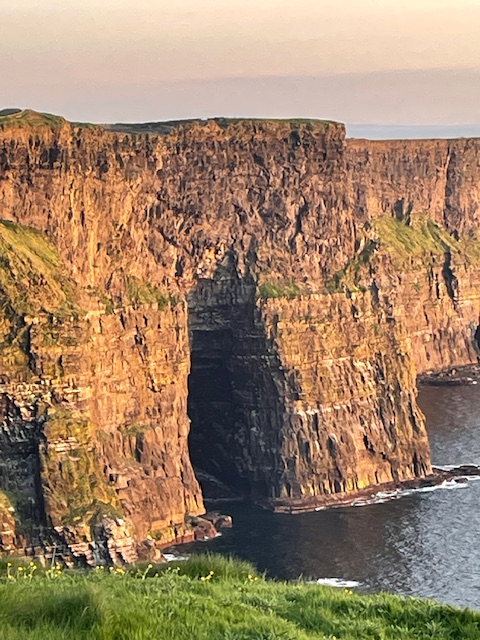
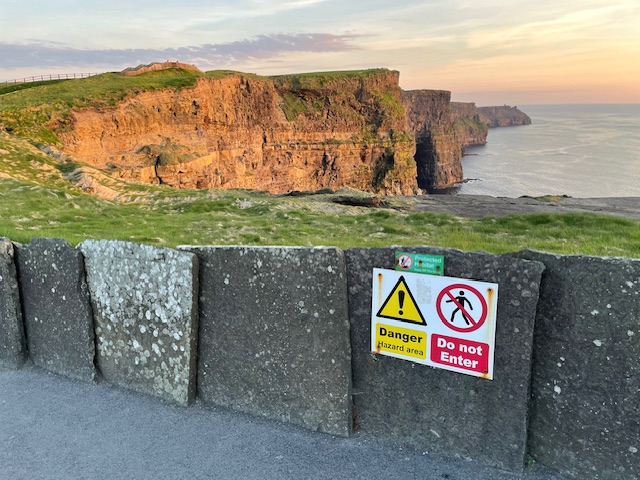
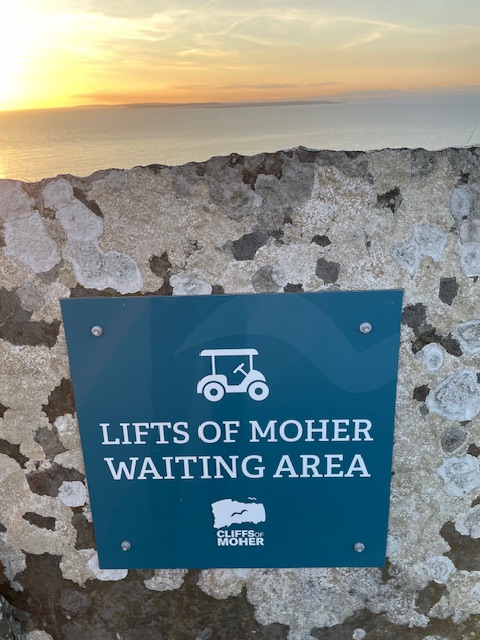
We visited on a weekday evening after the park had closed and crowds had left. To my mind this has to be the best time as the setting sun was starting to illuminate to great effect the 8 Km (5 miles) of high cliff faces, 214 m/700ft at their tallest, to dazzling effect. The place lives up to its hype, especially on yet another glorious blue sky day, offering sublime views over becalmed seas towards America way out west. The sheer cliff faces, eroded by wind and water into caves and stacks in places, providing a wealth of different breeding sites for over 20 species of sea bird and we watched some of them wheel about us in the golden light.

The cliffs consist of carboniferous rock, including shale and sandstone, and once formed part of a delta system 320 million years ago, carried up here from the equator on vast tectonic plates; broken, fractured and stratified on its snail’s pace journey north.

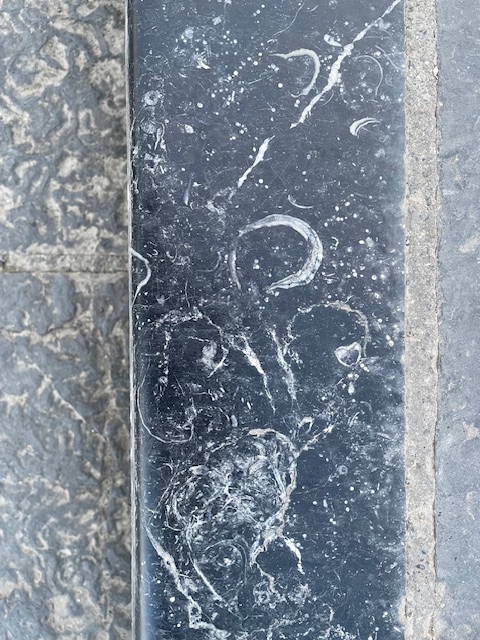
We climbed and descended the cliff tops on wide black marble like steps, tucked  in behind a protective barricade of grassed flagged bank, preserved to accommodate the thousands who pay to visit each day. These handsome steps are fashioned from locally quarried Liscannor stone and I loved looking closely at them as they contain a wealth of fossils: crinoids and ammonoids and other unidentified creatures whose trails are preserved for eternity.

The Cliffs of Moher are named for a deserted prehistoric fort on a headland that once stood here before being replaced by a look out during the Napoleonic wars, when national defence was key. In peace time the invasion has been internal and despite concerns about road congestion and overcrowding the locals we talked to welcomed the income tourism brings in its wake.  

Reflecting the intrinsic importance of music in the culture buskers have pitches set aside for them at key points along the walks and the nearby village of Doolin is acknowledged as a centre of traditional Irish music.

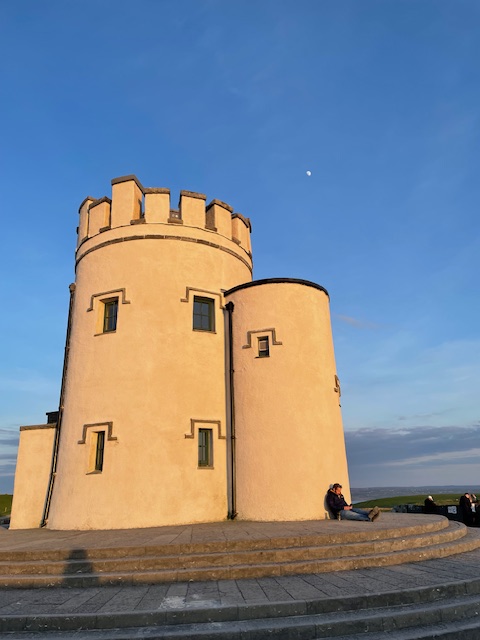
A far sighted local landowner built a viewing place in 1835, now named after him – O’Brien’s Tower – to help foster a  growing trend and provide local alternative employment for the remote rural community of the day. Since 2011 The Cliffs of Moher have been part of Ireland’s latest UNESCO Geo-park, along with that most remarkable of internationally renowned landscapes, The Burren….More of which in the next diary.

Thoor Ballylee and Coole

Our recent holiday with family in Ireland threw up the opportunity to visit two inter connected places in the Galway countryside associated with two of the country’s great cultural figures.

An ancient bridge, and a more ancient tower,
A farmhouse that is sheltered by its wall,
An acre of stony ground,
Where the symbolic rose can break in flower,
Old ragged elms, old thorns innumerable,
The sound of the rain or sound
Of every wind that blows;
The stilted water-hen
Crossing Stream again
Scared by the splashing of a dozen cows.

W.B.Yeats ‘My House’ (1928)

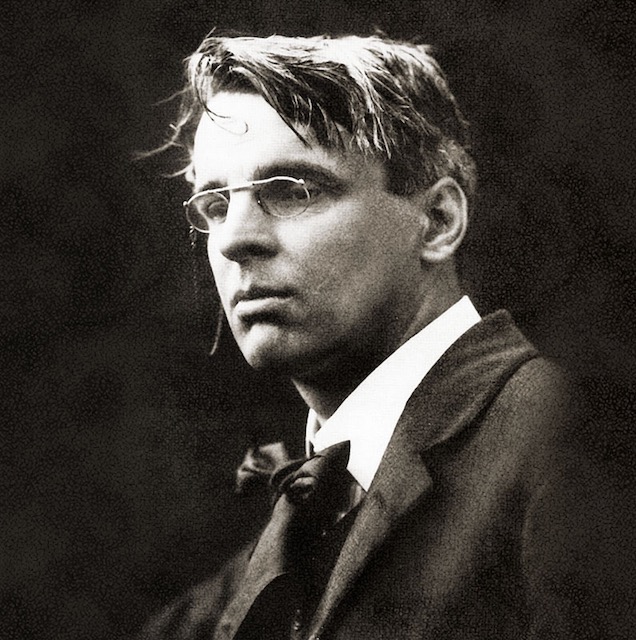
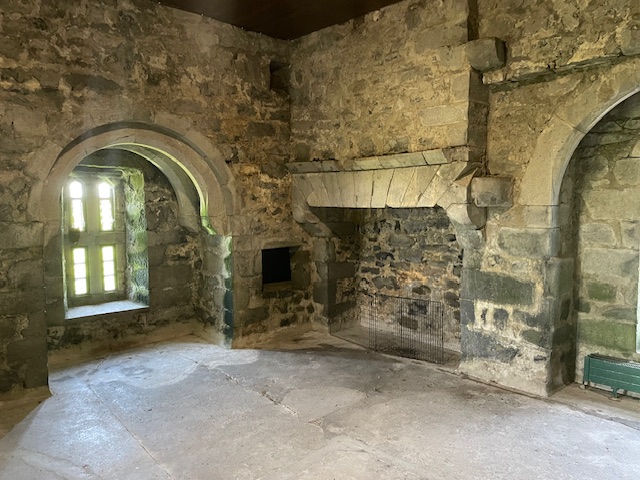
Thoor Ballylee is a C14th Hiberno-Norman defensive tower on the gentle banks of the Streamstown river in the west of Ireland built by the De Burgos, or Burkes, a Norman clan whose power base was in this area. It had fallen into a state of decay when the poet W B  Yeats first saw it in 1898 while staying with his friend and artistic collaborator Lady Augusta Gregory at neighbouring Coole Park.

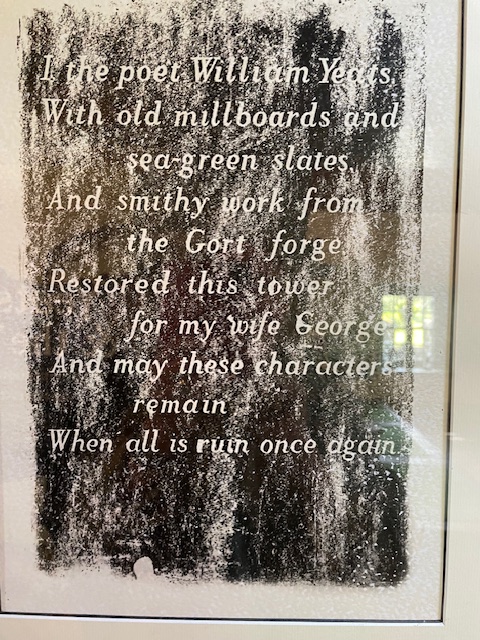
Eventually, as a newly married man with two children wanting a home away from Dublin in the west from where his own family originated, Yeats bought the romantic though ruinous structure for £35 in 1916. Working closely with local craftsmen he and his wife George carefully restored the structure to make it habitable as their summer residence through the 1920’s.

Interesting to note that neither he nor fellow protestant notable Lady Gregory were directly threatened by either of the feuding sides during the rebellion against British rule or the bitter civil war that followed. As respected cultural icons they were otherwise shielded from the violence and atrocities that marked the ‘Troubles’ across Ireland.

It’s not hard to see why the tower became the Yeats’s happy place, acting as both a refuge and an inspiration. George decorated and furnished rooms in the arts and crafts style while also developing the skill of fishing from the  windows! Friends visited regularly and everyone enjoyed the socialising. Yeats wrote some of his best poetry here; work that appears in the collections ‘The Tower’ (1928) and ‘The Winding Stair’ (1933).

Yeat’s deteriorating health, along with the damp and damage wrought by winter floods eventually caused the family to sell up and move away. Summers were increasingly spent abroad in France, with its kinder climate, better suited the ailing artist, but he never forgot this place or its importance in his life. Nor did admirers of his work forget him when in the summer of 2015, to mark the 150th anniversary of Yeats’s birth, the Yeats Thoor Bally Lee Society re-opened the tower to visitors and have continued to do so each season ever since. It is now a thriving cultural centre offering courses, talks and literary themed events.

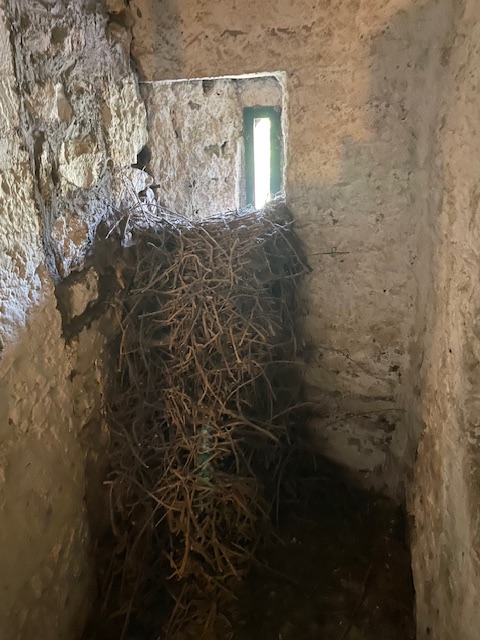
We loved chatting with the cheerful knowledgeable warden and exploring all four floors of the tower. Intrigued by the stack of crow’s nest below one of the slit windows and surprised by the alarmed cries of a returning parent just as I caught sight of the fledglings within.

From the top, I took in extensive views over surrounding pastoral landscape rich in hedging, banks, woods and fields. The white flood of flowering hawthorn everywhere. Curiously the gentle sparkling stream below literally disappears within these woods. This distinctive Karst limestone country is known for its turloughs – intermittent lakes that fill with water from streams like this one that drain back into the water table, having no surface outlet.

Under my window ledge the waters race,/Otters below and moor-hens on the top,
Run for a mile undimmed in Heaven’s face,/Then darkening through ‘dark’ Raftery’s ‘cellar’ drop,/Run underground, rise in a rocky place/ In Coole demesne, and there to finish up/
Spread to a lake and drop into a hole./What’s water but the generated soul?’

                                                                                              ( W.B. Yeats ‘Coole Park and Ballylee’, 1931)

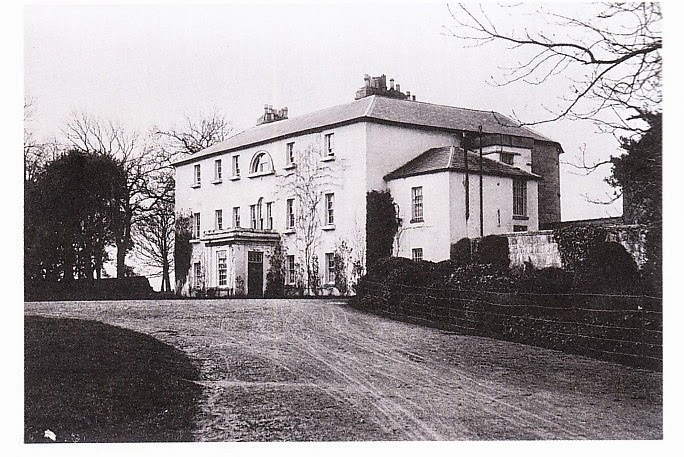
We followed the hidden line of flow on leaving Yeats Tower and within a few miles were at Coole Park, now a national nature reserve stretching over 1,000 acres (400 Hectares). The woods here have been attracting visitors from when they were first developed by the Gregory family in the late C18th. Coole Park was home to  Lady Augusta Gregory (1852-1932) and in her widowhood her genius for inspiration made it a centre for the movers and shakers involved in the Irish Literary renaissance, from Synge to Shaw, Casey to Yeats.

“These woods have been well loved, well-tended by some who came before me, and my affection has been no less than theirs. The generations of trees have been my care, my comforters. Their companionship has often brought me peace.” ( Lady Gregory, 1931)

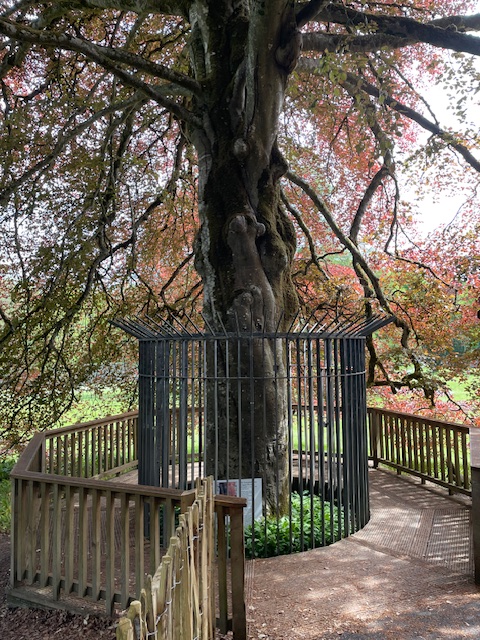
We were quickly enfolded into that peaceful, unhurried arboreal world and instantly appreciated the spell it must have cast on others. Although there was no time to discover the lakes with their swans or walk the woodland paths beyond the centre we did find the famous autograph tree – a venerable copper beech – where the great  men of letters carved their initials during their frequent visits. Their incisions now stretched and compacted by growth and stoutly defended from further additions by the public by railings.

‘Here poet, traveller, scholar take your stand / when all these rooms and passages are gone’ (Yeats)

The Georgian house was demolished in 1941, although the handsome restored stable block has a museum, facilities and excellent tea rooms serving imaginative good quality food, so a most enjoyable lunch was had here.

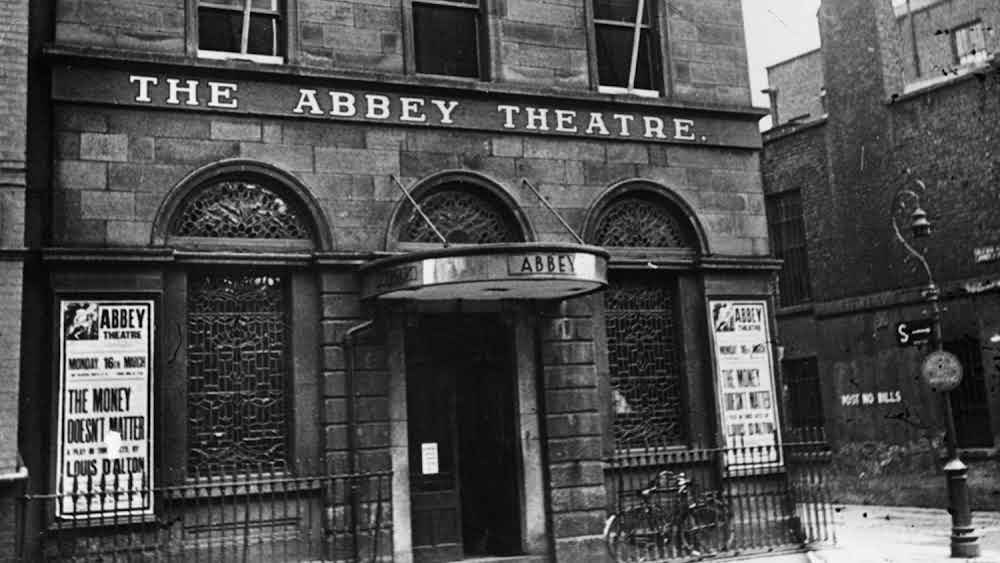
Yeats had first arrived at Coole in 1897, physically and psychologically exhausted and was nursed back to health and a more sustainable  lifestyle by Lady Gregory. As he described: “I found at last what I had been seeking always, a life of order and labour” Lady Gregory prescribed for him a balanced regimen of work and relaxation. It was the beginning of a lifelong friendship that saw them  in 1904 co-found with others the Abbey Theatre in Dublin. In so doing they were preparing the ground for independence by writing, producing and performing plays about Irish life for Irish people.

More here: www.yeatsthoorballylee.org and https://www.coolepark.ie

Towton Field

‘Recall the cold of Towton on Palm Sunday before dawn…fastidious trumpets shrilling into the ruck: some trampled acres, parched, sodden or blanched by sleet, stuck with strange postured dead. Recall the winds flurrying, darkness over the human mire.’ (Geoffrey Hill: King Log)

On 29th March 1461 two great armies met in battle outside the village of Towton, on the high wide limestone ridge country between Leeds and York. This was to prove a watershed event in the intermittent C15th civil conflict known as the ‘Wars of the Roses’. A dynastic power struggle between the aristocratic affinity who supported the pious Lancastrian King Henry V1, led by his fearsome warrior wife, Margaret of Anjou and the charismatic Yorkist claimant to the throne, Edward Earl of March, heir to the rival house of York

The Lancastrian forces were mainly northerners, the Yorkists drawn mostly from the south and midlands. The 19 year old Edward had lost both his father, Richard Duke of York and younger brother Edmund, Duke of Rutland at the Battle of Wakefield three months earlier. Edward’s revengeful victory at Towton lead to the deposition and imprisonment of Henry, the exile of Margaret and to him being crowned as Edward IV.

The weather played a key role in determining the battle’s outcome that fateful Palm Sunday. A snowstorm blinded the oncoming Lancastrian forces and the mass of Yorkist arrows borne on the bitter wind inflicted heavy losses on their tight battle formations. This pressurised the Lancastrian host to advance through the teeth of the storm, which in turn pushed the Yorkists backward. Only the last minute arrival of reinforcements from the south, led by the Duke of Norfolk, halted their slow retreat and raised the morale.  After yet more fierce hand to hand combat the Lancastrian army finally broke. Panic and hot pursuit ensued. The main line of retreat for the fleeing soldiery was on the old London road towards Tadcaster, over a narrow bridge crossing the Cock Beck below, to the west.

Some escaped that way while others, the mass of lightly protected infantry and archers, were not so lucky. No quarter would be asked or given. Jammed with the dead and dying, a desperate brute slaughter took place, the beck running red with the blood of butchered bodies that piled up, damming its course. Towton would go down in history as the biggest, longest and bloodiest of battles to be fought on British soil. 

The late April day we visited was clear skied, cool and fresh. After a good pub lunch at the Rockingham Arms in Towton village we drove down the B road to where the official ‘Battlefield Walk’ started, by a simple monument known as the Dacre Cross, named after a Lancastrian lord killed in the battle. A weathered wreath of red and white roses left at its base to mark the anniversary a couple of weeks earlier lent the exposed spot a melancholy air. The path sets out alongside fertile soil recently sown and banked, Toblerone like, for potatoes. One couldn’t help wondering if the blood and bone spilt here, albeit centuries since, makes for a good crop year on year.

The lie of the land proved crucial to the course and outcome of the fighting and the locally based volunteers of the Towton Battlefield Society have done a great job in establishing and maintaining  the 2.5 mile trail, complete with information boards at key points. 

On one side stretches the undulating main battlefield site, where thousands of soldiers fought in hand to hand combat. Recently unearthed archaeological evidence points to the use of small cannon on the field of battle, a first for any in England. Excavations on private land around the village property of Towton Hall thirty years ago also revealed 50 skeletons dated to this period, packed into a mass grave, all displaying signs of injury or violence.

Today this section of the former great field system has been sown for what we took for either barley or wheat, surrounded by headlands of some kind of green manure, then grass banks or wire, with hardly a hedge in sight to break or block the overview..

On the other side of the path the land falls suddenly and steeply down to the narrow winding Cock beck, a tributary of the River Wharfe.. Here we gazed over a typical pastoral scene of deciduous woodland within pastureland on which ewes and lambs were grazing, with willows, alder and poplars hiding the waterside at bottom.

I’m struck by the mass of white flowers we passed – dead nettle, stitchwort and crab apple blossom, combined with the presence of those Spring lambs, that somehow, unconsciously adds to the symbolism of the Yorkist victory here at the heart of the White Rose county.

The warfare these days is between landowners and poachers, as the vehicular concrete barriers we came across at roadside field entrances testify to. Whether poaching of gamebirds, deer or hares (or all) remains unknown.

Towton Battlefield walk is an engaging accessible circuit, rarely busy one suspects. We encountered only four people on our stroll, all dog walkers, and the way is clearly interpreted and cared for. It has a particular atmosphere and ably communicates the brute horror of medieval warfare, made more so when seen against an overlay of the modern day farmed countryside. Well worth a visit, especially at a time of year somewhere near the anniversary. Find out more at the Battlefield Society’s website: www.towton.org.uk

Cause for Celebration

John Dubbin’s painting is the basis for this animated panorama at Hopetown

Fifty years ago I was living and working on Teesside as an actor and drama workshops organiser for the Billingham Forum’s Young People’s Theatre Co. We enjoyed free outdoor events marking the 150th anniversary of the opening of the world’s first public passenger steam railway train between Stockton and Darlington. A souvenir from that time is this little China mug, now sadly minus its handle, but otherwise intact and very pretty.

The long train of 1st, 2nd and 3rd class passengers,  preceded by a rider on horseback for safety reasons, set off from Shildon in Co. Durham  on the 27th September 1825 travelling the 21.5 miles to Stockton, via Darlington, at an average speed of 9mph, cheered on by crowds of excited onlookers.

Friend Rob under Skerne bridge

Skerne Bridge, seen in the painting above, is still there today, part of the Hopetown site. The oldest railway bridge in the world still carrying a working rail route.

George Stephenson and his son Robert were the Tyneside engineers who gave us ‘Locomotion’, the engine that pulled those carriages on that triumphant day. Edward Pease, a leading Darlington Quaker (member of the Religious Society of Friends), was a retired wool merchant who had the time and capital to head the consortium of local businessmen were behind the scheme. The original plan was for a horse drawn tramway to transport coal from the mines in the Durham hills to the estuary port of Stockton-on-Tees where it could be shipped to the rest of the country. Stephenson Snr. persuaded the money men to opt for his newly invented coal fired steam engine instead. Adding passengers to commercial goods and loads of coal was something of an afterthought, but would have the greatest of consequences.

‘Locomotion’ replica on display at Hopetown

All this and much more my friend Rob and I learnt when we visited Hopetown in Darlington last week, in the year that sees the 200th anniversary of the Stockton & Darlington. Formerly known as ‘The Head of Steam’ museum at North Road railway station, the 7.5 acre heritage site has been transformed with a multi-million pound investment programme to make it a major regional tourist attraction and educational resource. Entry is free (donations welcomed) and the amount of digitalised interactive displays shows the ethos is about engaging with families and school parties to tell a spirited, many layered story. Exterior soft play areas and an adventure playground are other family attractions that help justify the public investment and draw the crowds.

We didn’t quite know what to expect but quickly became engrossed with what was on offer. The interactive stuff – being addressed by station master and engine driver holograms for instance and having our photos taken with them – sparked fun and laughter. Think the planners have got the mix of serious study material and simpler, bold displays about right, opening vistas for the curious and engaging visitors in the interplay of man and machinery.

Railway Pioneers exhibition

The Hopetown site, roughly triangular in size, consists of the original engine shed (1833) now the shop and café (above); station hall and offices (1842) now an exhibition area with locos and carriages, the Carriage Works (1853) with its huge open archive and large exhibition hall with awesome  replicas of early engines, part of the ‘Railway Pioneers’ exhibition currently showing.

Completing the building line up is the new, purpose built  Darlington Locomotive Works where 21st century steam locos are being made by a charitable trust and volunteers, the workshops overseen from a tower housing public viewing gallery.

Highlights? I think anyone who visits a heritage site is invariably fascinated by the unchanging necessities of everyday living and how each generation deals with them. That’s why the original station toilets were fascinating. Cast iron urinals, tiled walls and cubicles. Throw in the reputed ghost of a porter who committed suicide here in the 1840s that is believed to still haunt the place and you’ve got it made.

The simple elegant design of the original early Victorian station (above) entrance and its extension reflect the world view of those local Quaker company directors. The exuberant emerging Gothic style was not for them.

Britain being Britain the three original carriages on display remind us of rigid social and economic classification. First class enjoys padded seating and privacy while third class (above) is an array of hard benches and a hole in the roof to let out smoke and/or let in light. Second class a mix of both.

Lord Darlington

My favourite museum story happily fits the ‘Country Diary’ title for these occasional notes. We learned that it took three concerted attempts over many years to get the Stockton and Darlington railway up and running. At its heart was the struggle between the inherited wealth and influence of the landed gentry and the new money of the non-conformist urban business elite.

Henry Vane,  Earl of Darlington, resided at nearby Raby Castle, the centre of his great estate. A  fanatical fox hunter who maintained two packs of hounds, he was determined to stop ‘bankers, merchants and others wishing to employ money in the speculation’ from ruining his sport by running their rail road through his fox coverts. He and other country landowners successfully led the opposition in parliament to defeat the initial proposals. A contemporary petition, drawn up by a top London law firm for anonymous clients, makes fascinating reading. It objects to the railway proposal as being ‘harsh and injurious to the interests of the county through which it is intended to pass’ and will ‘spoil lucrative arable land’ splitting profitable holdings in two and be ‘detrimental to the profits of the turnpike road’ running parallel with it.

In March 1819 Quaker banker and line supporter, Jonathan Backhouse, got wind of a plot by the earl to bankrupt his business and so de-rail the financiers. Back then a bank’s promise to pay the bearer on demand the value of a note in gold inspired the disgruntled aristocrat to get his tenants and associates to turn up on a set day at the bank to demand just that. The resourceful Backhouse immediately took flight to London and had a whip round with other Friends in finance, loading the loaned bullion into his carriage and returning at fast as they could back up north on the new turnpike roads to Darlington.

He made it as far as the river crossing at Croft, three miles short of home, when the axle on the hard driven coach broke under the strain. The quick witted banker and his servants redistributed the heavy load and slowly hedged their way back into town, with time to spare, before the Earl’s steward came to call at the bank. Backhouse had raised £32,000 worth of precious metal, more than enough to meet the withdrawal threat. He reportedly saw off the Steward with the words ‘Now, tell thy master that if he will sell Raby, I will pay for it in the same metal’….A great story, which no doubt has improved with re-telling down the years. 

The Backhouse family bank prospered greatly thanks to the transformational economic prosperity the railway revolution engendered. Eventually, in the 1890’s, the business would merge with other Quaker founded financial institutions to form Barclays Bank. The bank branch (above) is still there, on its original site in the town centre and about to undergo a refurbishment. Ironically, given the simple design of the original North Road station, this  building is a fine example of imposing gothic architecture by Sir Alfred Waterhouse (1864).

Arriving and leaving Darlington via Bank Top – the mainline east coast station (1887) – we’re delighted to see that it too is getting a long deserved restoration. Looking up we take in the heraldic decoration and rhythmic flow of ironwork gracing the roof of this secular cathedral, fitting tribute to a wonderful railway history and the town’s proud role in it.

Linnell, John; Richard Trevithick (1771-1833); Science Museum, London ; http://www.artuk.org/artworks/richard-trevithick-17711833-179865

Footnotes: The current ‘Railway Pioneers’ exhibition at Hopetown features superb life size replicas of key early locomotives. One is the unnamed  engine (below) invented by Cornish mining engineer Richard Trevithick to transport iron from the Penderryn works in South Wales in 1804. In 2001 I had the pleasure of playing the obsessive charismatic inventor, in the BBC Radio 4 drama, ‘A Magnificent Prospect of the Works’ by Peter Roberts. The action was set in Coalbrookdale, the heartland of the industrial revolution on the river Severn, where Trevithick developed the prototype engine that would became the world’s first steam railway locomotive.

The Friends of the S & D Railway have produced an excellent illustrated introduction which you can download here: https://www.sdr1825.org.uk/wp-content/uploads/2021/10/stockton-and-darlington-railway-key-facts-booklet.pdf

Stitch in Time

In an hour and a quarter we are over the border into Scotland and our destination of Galashiels. Glad to sense the place looking brighter and more uplifted than on previous visits 15, 20 years ago. The textile industry was once the area’s biggest employer – as many as 20 mills, mostly water-powered, flourished here at its peak in the 1880’s. Those businesses that remain today have had to specialise to survive and the area remains famous worldwide for its tweed and tartan production. A fitting place then to give a home in 2013 to the peripatetic 21st century popular artwork known as The Great Tapestry of Scotland.

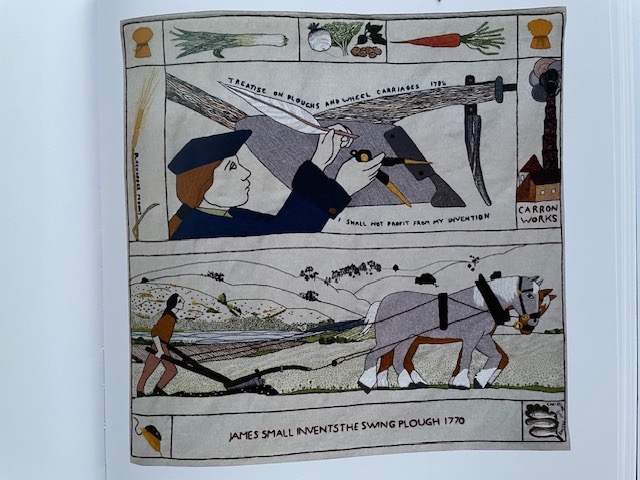
We didn’t quite know what to expect so were delighted to be immersed in what was on offer in the purpose built visitor centre standing proudly in the town centre, which opened in 2021. Having lunch at the friendly café broke down the hours so we could more realistically take in the 160 panel display. It splays across a spacious light filled first floor, depicting Scotland’s story from  prehistory to the opening of the new  parliament building in 1999.

Most panels are a metre/3’ 3” square and because they are not glassed over they appear even more immediate and fresh in their depictions of people, places and events, divided into seven triangular shaped time zones. The whole work stretches for 143 meters/ 469 ft. Informative brief text beneath each work with maker credits.

We are struck by how truly this is a people’s project, reflecting all that’s good in the character of the Scottish nation. A meritorious, interconnected, life affirming achievement. The combined work of a thousand volunteer stitchers in a range of community groups from Galloway to Shetland who put in some 50,000 hours of sewing using 300 miles of yarn. The movers and shakers of this national project were the author Alexander McCall Smith, artist Andrew Crummy, historian and broadcaster Alistair Moffat and head stitcher Dorie Wilkie. Between them they set framework for the stitchers to create and their formidable teamwork got the show on the road – literally!

Having the leisure to view the work in such a wonderful permanent setting opened new perspectives on our neighbouring land. This engaging way of presenting that narrative – of individuals, movements, beliefs through a unique synergy of history, culture and art – makes you wonder what an English, Welsh or Irish equivalent would look like. How would they define and reflect themselves through this form of craft based storytelling?

Scenes of conflict and warfare are vividly played out here. The sacking and pillaging of Holy Island in AD 793 in the Kingdom of Northumbria marked the arrival on these shores of the dreaded Vikings in their dreki – dragon ships. Subsequent colonisation along the Scottish coast saw these remarkably adaptable boats being hauled across narrow necks of land between inlets, giving rise to the place name ‘Tarbert’.

‘Is this a dig at the Bard I see before me?”…One particular panel reminds us how the genius of dramatic licence can run counter to historical truth. The real life Macbeth who ruled in the 11th Century and the character created by Shakespeare to flatter Scots King James 500 years later could not be more different. Macbeth was King of Moray, defeating and killing King Duncan of Alba in battle to become King of Scotland in 1040, ruling unchallenged for another fourteen years. A contemporary source tells of of ‘the red, tall, golden haired one…Scotland will be brimful west and east during the reign of the furious red one’  and that physical description gives character definition here.

Another tableau I liked was the one depicting the Invergarry ironworks. Here in the 1720’s the Englishman Thomas Rawlinson, a Quaker industrialist from Lancaster, encouraged his workforce to adopt a shorter kilt for work purposes. The body wrap style of traditional highlander wear being too encumbering otherwise for industrial labour. A new form of Scottish dress that would eventually become standard wear.

The Jacobite uprising of 1745-6 and Bonnie Prince Charlie’s role in it is a familiar narrative, poignantly and powerfully expressed here in a poignant bitter-sweet design as a ‘vine-line’ linking romanticised landing in Eriskay to final devastating defeat at Culloden.

There’s wit and humour running through the whole exhibition, and that gets more pronounced as the later 20th century chapters unfold with the increasing importance of the arts and popular culture in enriching the national picture, from major festivals to all forms of media .

The exhibition demands a return visit so we no doubt will be back. A great day out for us as borderers on the English side and essential viewing for anyone with an interest in Scots history, art and culture. If you’re planning a visit yourself there’s more info here: http://www.thegreattapestryofscotland.com

Winter Pass

Once again I see / These hedgerows, hardly hedgerows, little lines / Of sportive wood run wild… (Wordsworth)

Like many walkers who want to combat littering on their local patch I pick up rubbish – mainly drinks tins or bottles – from the verges of our lane. Lately I’ve taken to adding another duty –  voluntary hedge warden.

I was delighted by our neighbour’s efforts in bordering roadside boundaries with the planting of hedges last autumn (See previous diary). Recent bouts of snow followed by a severe storm took a toll of the stripling plants in their plastic covers, staked with bamboo. Reuniting all three elements  when taking daily constitutionals has been a satisfying thing to do. Stretching or leaping across roadside drainage ditches in places adding an extra fitness testing edge to the exercise.

Southridge will also be getting a new shelter belt planted soon by the steep farmhouse lane. Lime, oak, chestnut and hazel will be going in to replace Sitka and Norway spruce harvested over a year ago, complimenting the remaining line of handsome Scots pines at the field wall. It’s only a small block but having native hardwoods back on the scene is as encouraging as the planting of new hedgerows and shows genuine commitment to long term landscape recovery. Many such actions replicated around the country must give cause for cheer.

Clearing last year’s dead foliage round the garden ponds has spurred a bonus product. The brown leaves of Iris sibirica make for good material in soft textile basketry weaving so I cut and dried this bundle by the kitchen Aga to pass on to Sara, the family’s natural fabric worker of fine pieces.

Cleaned out all the old nest boxes and added a couple in strategic places about the garden. Always fascinated by the shapes of trunks and boughs so I rescued this one with its cavity from the log pile and slotted it into the side of the west end log store. Maybe a pied wagtail or robin will take advantage of it this year as both species like this quiet corner.

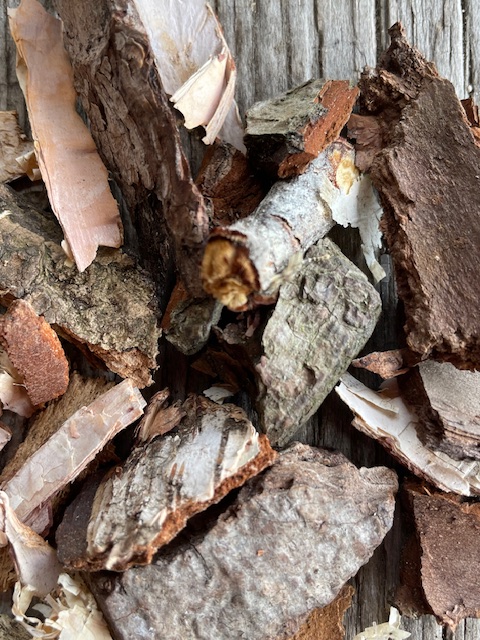
On bad weather days Kim has been turning her attention to sorting material for another quilt. (A long family tradition down the female line) When decent weather allows she’s been getting the kitchen garden ready to receive this year’s crop of seed potatoes and other bulbs and seeds. Also been clearing flower beds and drains before top dressing with mini-bark. I meanwhile continue to chip branches to add to the nourishing protective layer.

Who doesn’t love snowdrops?  Nothing cheers a drear February day more than the cheering sight of these freewheeling waves of white blossoms. We love it that they are so at home, spreading year on year to grace more corners of the garden with their welcome presence.

Planting out ‘in the green’

Some of the family took themselves off for a guided walk in the grounds of one of the county’s big houses and saw the gardens team plant flowering snowdrops ‘in the green’ as they have done for decades, so the vast swathes of them multiply year on year. Most are common snowdrops (galanthus novalis) but amongst them are a distinctive form of the common variety – the Sandersii Group’ – named after the man who discovered them at Chillingham, James Sanderson.

The Yellow Buttercup

Commonly known as ‘The yellow buttercup’ and sometimes ‘the Northumberland snowdrop’, Their leaves too often take on a paler colour due to differences in the levels of chlorophyll within the plant. Because these unusual plants are coveted by unscrupulous collectors their exact location must remain anonymous.

The moles have been active wherever one looks. The bare open landscape dotted with their prodigious eruptions of soil. Andy, our window cleaner, tells me that a straight line of molehills indicate the male’s subterranean course while isolated clumps are most likely to indicate the presence of females with their nests and stores close by. Not sure if that’s right or not bit I like the sound of it.

Passivhaus and Mule Maker

A few weeks back we retraced a short local walk. Signs en route warn the unwary and thank the thoughtful.

Highlights included a view along the side of a substantial former water mill which once ground barley oats and wheat for farms and businesses. The burn runs deep and fierce here in its narrow sandstone bed before meeting the big river a mile or so downstream.

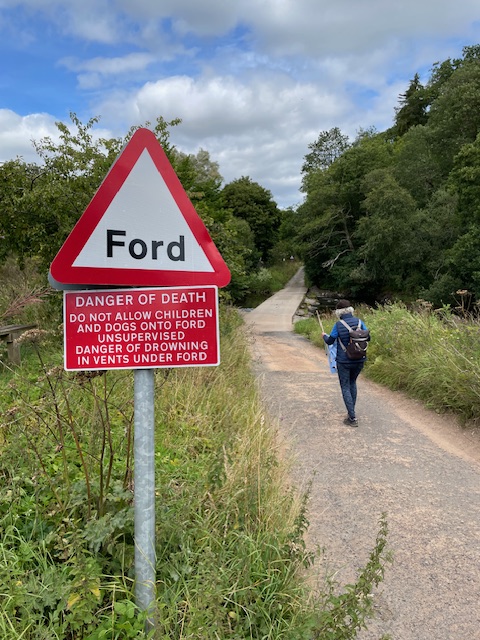
 Pulling slowly up the opposite bank, we passed through stands of old oak by stretches of a sunken lane. Gained the metalled lane by a farmhouse, seemingly uninhabited, though the extensive outbuildings were in use. From here a footpath sign beckoned. The weather fair and with no recent rain we thought, why not? The map showed it to be a short cut to the village via a ford of the burn we’d recently crossed. We rose to the bait.

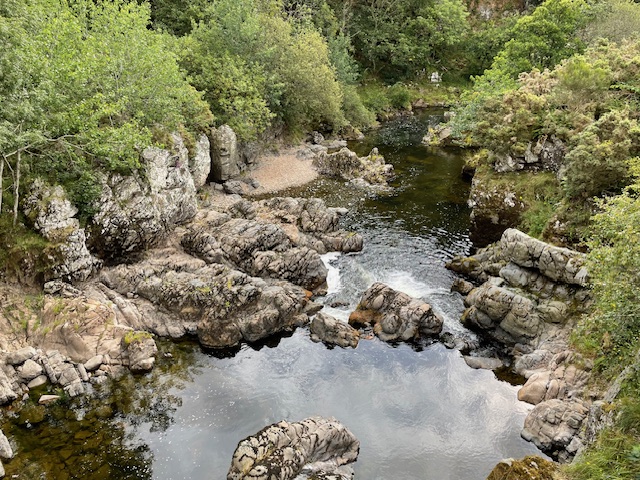
The broad field was easy enough to cross but the precipitous zig zagging stepped path through the raggedy wood proved hard to find and even harder to follow. Handholds of thin trunks and avoiding whipping branches. Eventually, having gained the wild valley bottom, we find what has to be the former ford in a river bed strewn with the evidence of flash floods and further erosion all around; boulders, trapped brash and ripped tree trunks.  

Flat bedrock and strands of barbed wire to duck under. Took walking shoes off before wading over to dry off and reboot on the grassy bank. We wondered when the ford was ever used and by who. Was there ever a track?  Easy walking up the field to a hillcrest to come into sight of the village and main valley once again. The most remarkable building in sight, at the settlement’s edge, might otherwise go unnoticed, until you read about it in the national press.

It’s the first church in the world to be certified to the international standard for energy efficient homes: – Passivhaus. The Victorian Congregational chapel, closed since 2019, has been converted by the couple who live in the former manse next door, using the services of one of our local builders, and is now available to rent for holidays. More at: www.warksburnoldchurch.com

My last diary mentioned the hired scarifier. I not only did a thorough job on the grass but also alas on my poor aging body. A literal pain in the bum, or right buttock to be precise, whether nerve or muscle related I don’t really know. But oh dear I do know it hurts and is only now diminishing after some two weeks of acute discomfort and disturbed sleep.  Trying not to overdo stuff, have gradually resumed daily exercises and in turn swept more leaves into the mould sack, turned compost in the bins and chipped willow wands. The latter we learn makes an excellent mulch for apple trees. Research is showing that the wonder substance present in willows – salic acid – acts as a natural protection against scab. We shall see in due course. This wet year saw an upsurge in the disease everywhere.

One of my regular perambulations takes me over the big permanent pasture field which borders our house (and gives it its name). Our neighbour currently has a flock of blackface ewes in there, all marked up. I’m followed home by a border Leicester tup. He’s perfectly fearless and very curious. I climb the style in the wall into our garden and he comes stepping up after, forelegs resting on the stones as I stroke his head and let him sniff my hand. I feel the cut stumps of horns once possessed and marvel at the bold bow nose and rectangular pupils. Thus acquainted he drops back down and goes off in search of another ewe to cover. The prodigy of these two breeds – the mule – is a popular flock choice for northern upland farmers. We’ll just be happy to see anything other than the ubiquitous Texel or Texel crosses which normally dominate the ovine scene.

Hedging Bets

Thrilled to see work starting along the lane, preparing for hedge planting. And autumn the time to do it. Two young guys busy with strimmers clearing herbage ready to receive the whips. The line they are patiently planting by hand makes its way wherever there’s room. Along drainage ditches in some places, banks in other, utilising the space between fence and tarmac on the single track roadway. Laybys are left open due to lack of space. I stop and chat to them. They tell me it’s a 75% hawthorn mix with  crab, blackthorn, hazel etc making up the rest. Order books are full and they’re working all over to meet demand from farmers and landowners taking advantage of current grants available.

Our farming  neighbour pays upfront and will eventually get his grant money from the ministry. In the yard when I’m up at Southridge on other business I stop to congratulate him. His biggest fear is that winter’s snow and compacted ice cleared from the road piling up on the infant trees in these first few years will destroy them. Given the alterations in weather patterns caused by climate change I think that’s less likely to happen, though excessive flooding might affect the ones in the ditch. The plants are from good stock, double spaced, warmed and protected from the elements and weed choke by their plastic guards and canes. We will be following their progress with keen interest, especially those planted by the fencing opposite us here on the corner.

Our friend the groundsman and his team turned up this week and were working for hours. The high sheltering hawthorn hedge on the east end boundary wall got its bi-annual trim. Still plenty of room left for nesting birds next spring. In our field his two friendly young employees strim the rampant soft rush and reeds all the  way back to the crags and beyond down the slope. What a difference it makes to our immediate view, opening up the ground and somehow lifting the land by restoring the primacy of grass, however rough the grazing. 

Best of all the boss, in a mini-digger hired for the purpose, skilfully tackles our big overgrown bonfire. He neatly separates and clears the wood and herbage, creating a pit in the process into which he packs the bulk of matter. He warns we’ll have even more stingers next year as a result, their seeds now well spread. Finally using the last of our store of diesel (safer to handle than petrol) he fires the remaining combustible material. A haunting sensation to have woodsmoke billow and merge with the deadening mist as a late sun starts to assert itself.

Our contractor is a big lad but a gentle one, with a keen eye for wildlife, and we always swop stories of encounters with the natural world. Three times while wielding the bucket he spies toads in the spill. Stopping work, he gathers them up to release by the  garden ponds. He’s tickled by my the story of the hare who I suspected gave birth to her leverets in the wild protective mess of the pile and my later encounter with them at dusk. (See ‘Hare Raising’ / July 14th 2024)

Our wonderful cheerful handyman and friend was also here a couple of weeks ago. He did a very neat job designing and building two adjoining wooden compost bins to replace the handsome but clapped out beehive style ones. Next to them a big black plastic bag receives the tons of leaves I’ve been raking up. The resulting leaf mould will make for good humus when mixed into the raised beds in the vegetable garden next year.

The ancient but effective petrol driven scarifier gives me a good workout as I trundle it round the grassed areas of the garden accumulating moss and leaves, which then get added to the compost. Gave the lower quadrant of the meadow a particularly thorough going over, this way and that.  Later I’ll work up those mini-patches of exposed earth where the molehills once were to sow a mix of yellow rattle and red bartsia – meadow plants that grow semi-parasitically on grass – in hope of making ingress against the couch which still predominate in that patch.  

Lest we forget….Post boxes around the country have been scene set in recent years with an increasing range of imaginative tableaux. Here’s the latest from the big village.