Wassail

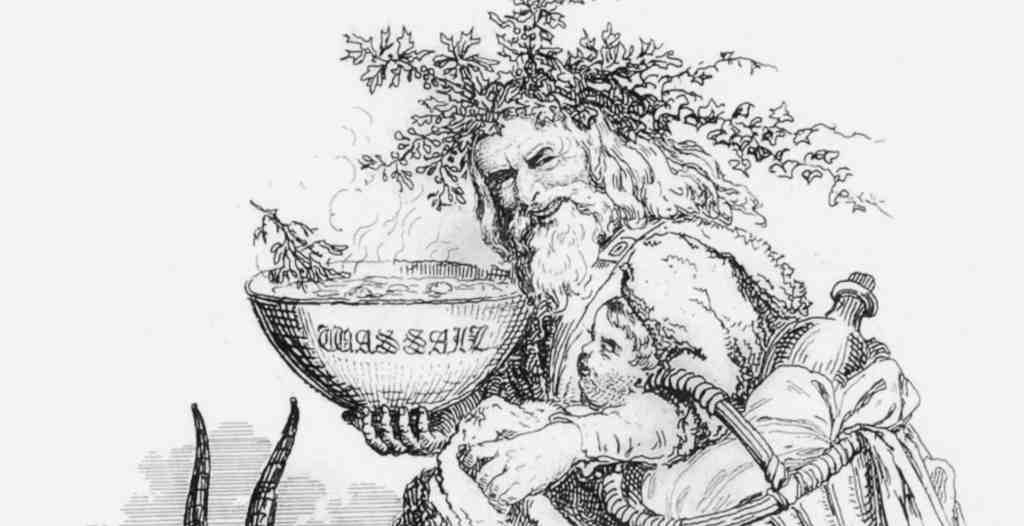
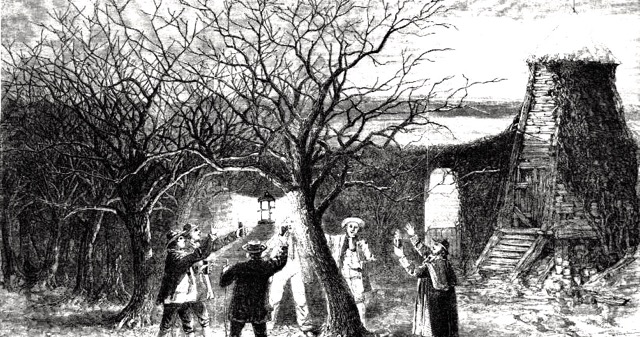
In this most curtailed of Christmas times we found a new way to make merry for a permitted day of family reunion….or rather, we rediscovered an old one. The Anglo Saxon term ‘wassail’ means ‘good health’ and in the cider producing areas of England at midwinter the country people would assemble to visit their dormant orchards to ritually see off bad spirits and invite in good ones. A frost and fire, essentially pagan community knees up, featuring libations of mulled cider, beer or punch and alcohol soaked bread, (literally, offering a toast) to the trees in hope of a bumper crop in the coming year.

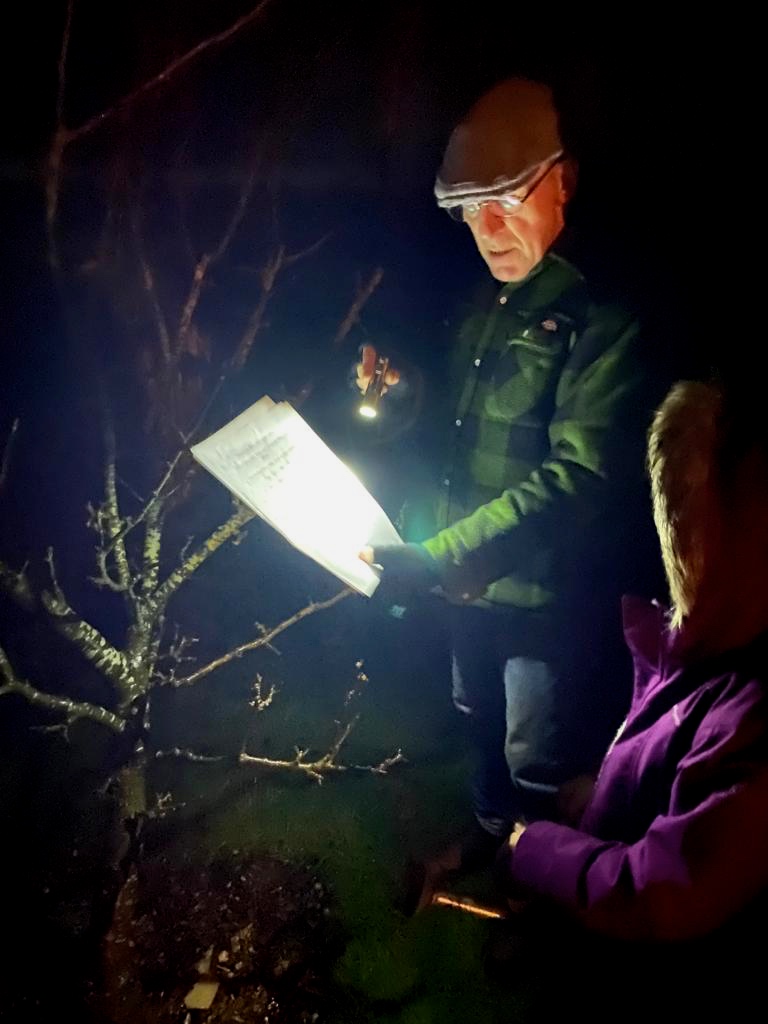
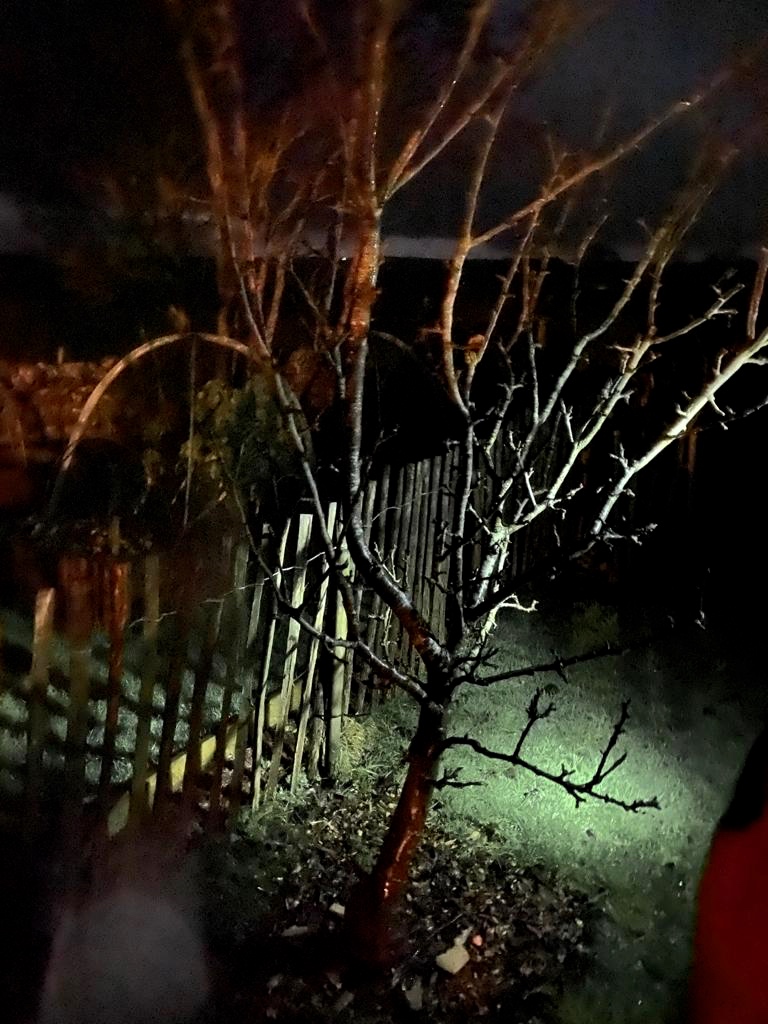
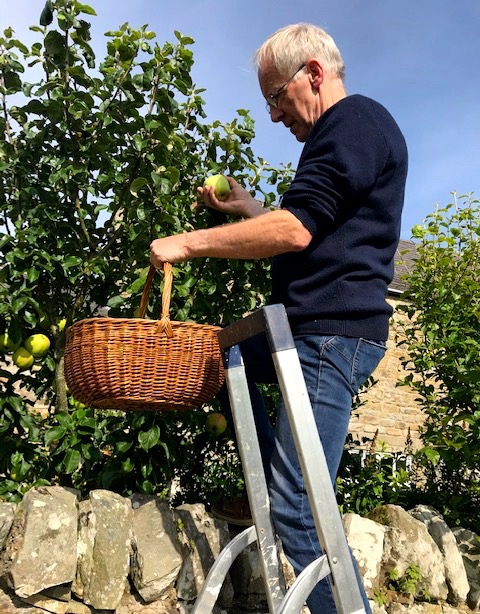
Our welcome visitors this precious day were family out from the city, an hours drive away. A great time to reintroduce some traditional festive fun with a (socially distanced) outdoor homage to the oldest tree in our young orchard – a slightly off beam Arthur Turner – the same age as the youngest grandchild, at 7 years. She and older brother, 10, loved the idea of bashing pots and ringing a bell, with licence to shout and scream to their hearts and throats capacity! Before that cacophonous climax I read an old wassailing verse, recorded as being sung by farmers and their labourers in Devon in the 1790’s

Here’s to thee, old apple-tree,
Whence thou mayest bud, and whence thou mayest blow
And when thou mayst bear apples enow
Hats full! Caps full!
Bushel-bushel-sacks full,
And my pockets full too!
Huzzah!

And then we all sang the first verse of one of the most popular of the old wassailing songs, with its chorus.

Here we come a-wassailing among the leaves so green
Here we come a-wassailing so fair to be seen

Love and joy come to you and to you your wassail too
And God bless you and send you a happy new year
And God send you a happy new year.

I was tempted to do what the chaps of old would have done and let off a round or two skywards through the branches, but somehow an air rifle soft ‘phut’ would never match a shotgun’s sharp blast! There are two wassailing traditions – the domestic and the horticultural. The former reflected the ancient tradition of rich households playing host to their humble tenants and dependents in the bleak midwinter, centred on the feast of christmas or new year’s eve, where begging was replaced by exchange of services – sing us a song and you’ll be rewarded with meat and drink. The song’s second verse catches that provision nicely:

We are not daily beggars that beg from door to door
but we are friendly neighbours who you have seen before

Today (2020 excepted) the domestic tradition has been largely overtaken and tamed by door to door carolling. In contrast the parallel ritual played out in orchards has enjoyed a healthy revival as more people immerse themselves in celebratory communal customs born of manual work practices and craft skills. Peak wassailing seems to take place mainly between Advent (Twelfth Night) up to mid month.

As for our impromptu rural homage, we found it one of the highlights of the holiday, Nicely apt for time and place; providing some family fun, a chance to revive jaded spirits and look forward to a time of fruitful renewal, in all senses of the term.

Wonderwall

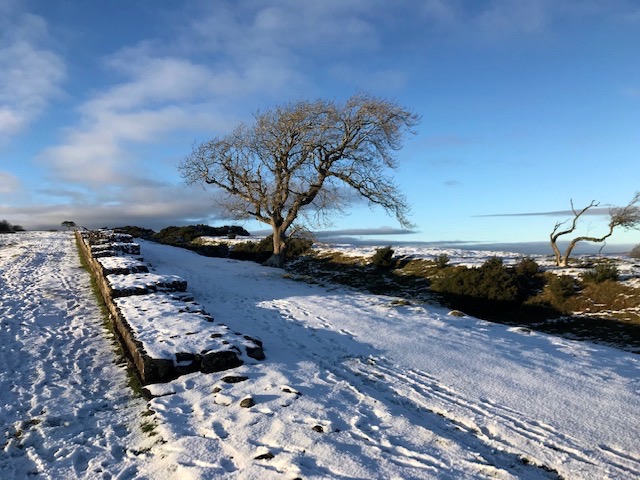
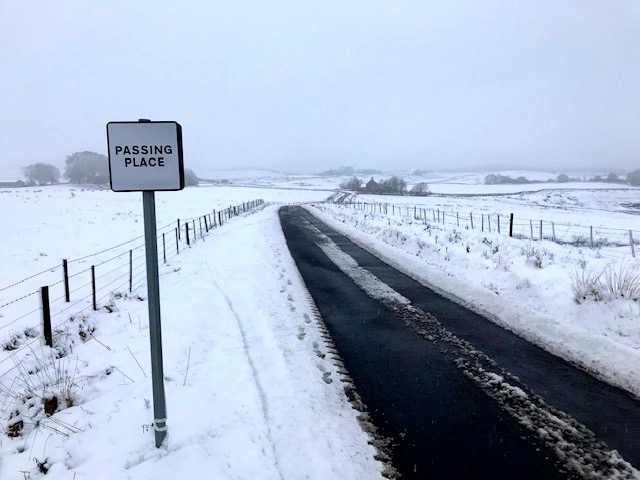
With the first real snow of winter comes that age old need to be out in it; making the best of the atmospheric high pressure that has brought us this gift of dry cold air and clear blue skies. The stretch of Hadrian’s Wall nearest our home is a short drive away at a junction off the B6318 (Military Road) where we pick up the official long distance path.

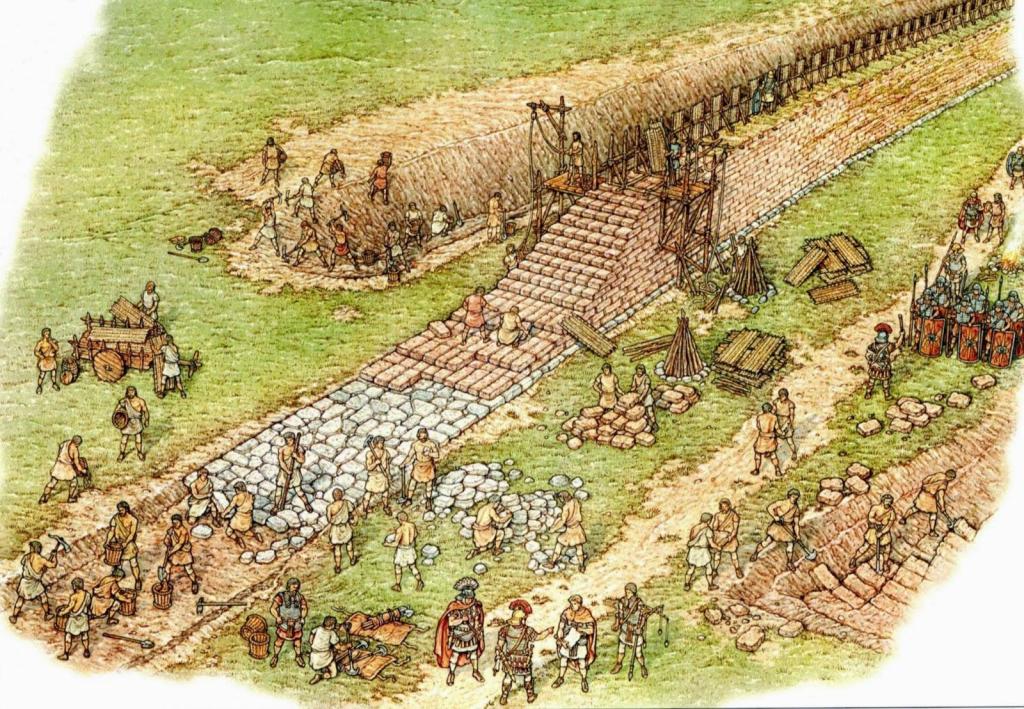
There is something particularly poignant about a winter visit to the wall. Snowfall adds emphasis to the remains and its setting in the rolling highland landscape. The Roman army built their definitive frontier structure in the course of just three years two millennia back, and though breeched and bereft it remained pretty much intact for centuries until 1746. It was then that another professional army deconstructed large swathes of it, in the wake of the Jacobite rebellion, in order to build a military road linking the garrison towns of Carlisle and Newcastle.

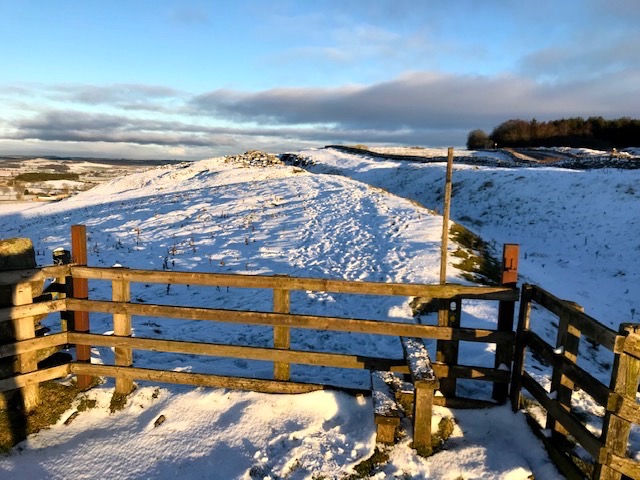
The path at this point skirts a wood and square legs it around some rectangular mounds in a field, the remains of one of the wall’s many milecastles. The narrow pathway is stiff and frozen, yet there are eruptions of soft black soil cast up by moles. How do they manage it in such conditions? After crossing a farm access lane the views open up as we gradually ascend. Here ‘thin’ wall (8 Roman feet wide) meets ‘fat’ (10 feet) conjoined at a turret, indicating a change of plan by the engineers of AD 122, perhaps driven by cost saving or construction deadlines. A couple we pass on the other side joke that the wall is proving ideal these days for enforcing social distancing.

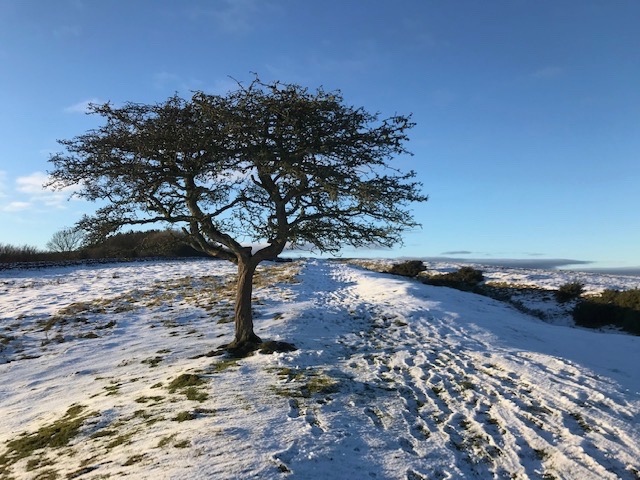
The low line of masonry vanishes again before attaining the summit. We pass a graceful hawthorn, unusually symmetrical, branches stark black against snow. The high bank along which the military road runs at this point is a reminder of just how much of the wall lies buried as foundation beneath its metalled skin. Local Georgian landowners too took advantage of the structure’s small blocks of dressed stone to build simple but elegant farmhouses that still grace the land hereabouts.

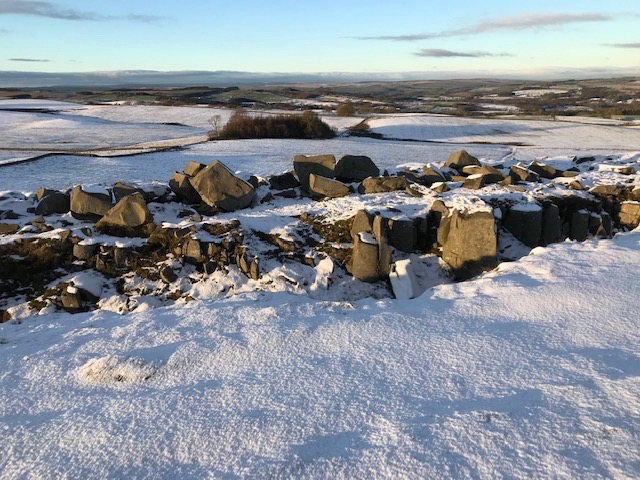
A trig point defines the heights and snow lies deep over uneven tricky ground. Continuing the line of the vallum (defensive ditch) here proved impossible even for the mighty Roman army, the hard dolerite rock being too hard to break down, so they gave up after 60 yards or so. This distinctive abutment, with its stone spoil, is the most northerly point on their 73 miles of coast-to-coast frontier.

Stop to take in the wide prospect before us. The broad valley’s fertile farmland features ploughed fields and permanent pasture, hedges, woods and blocks of conifer. These estate landscapes gradually give way to rough grazing and upland fells ending with the far blue prospect of the Cheviot range and Scottish border. Meanwhile, just below, a kestrel hovers then swoops, putting me in mind of the legion’s imperial eagles that once oversaw all activity on these ridged and rugged highlands. We leave content; returning downhill as the afternoon’s lengthening shadows add enriched tones to a mottled canvas of sharp and shaded whites.

This Other Eden

We shall not cease from exploration / And the end of all our exploring / Will be to arrive where we started / And know the place for the first time. (T. S. Eliot, from Little Gidding)

I met my partner Kim in 2010 and we spent the next seven years commuting between our respective homes in Northumberland and Lancaster. By 2016 I had produced the last shows under the Demi-paradise banner at Lancaster castle and the following May quit the city for the country. Having grown up in a market town and later a village on the western edges of Dartmoor, the son of working class parents, It felt absolutely right to be moving back into a truly rural community at this stage in my life.

I’d ‘retired’ soon after reaching 65 from a ‘day job’ I’d held for eighteen years, tour guiding at the castle. I was still in that working phase when the response of old friends to my Facebook posts on natural history topics encouraged me to take it on from there. Most posts are about about this corner of the north-east though Lancaster, the South-west, Wales, the South-east and other places also feature. Notes and accompanying images were posted on this website (before it crashed last year) or over on Facebook (Stephen Tomlin and previously on This Other Eden pages). Meeting further friend requests I will be publishing simultaneously here and on FB.

Actual place names are avoided when writing about the home patch in order to preserve my own and other people’s privacy or anonymity and to keep observations and commentaries as open as possible. To that end some place names have also been changed. All mistakes and oversights are mine and I’m happy to be corrected where I’ve got things wrong.

I have sought to re-balance a long and satisfying working life with rediscovering the things that first peaked my interests and passions when growing up in the Devon countryside. I hope you enjoy what you read hereafter. You’ll find little that’s original or revolutionary. There are wonderful professional writers out there who are brilliant at doing just that and I love to read their work. No, I remain a happy amateur scribbler who loves where he’s ended up and the people he’s ended up with and tries to pay to one and all the respect and understanding due to them. In short, a simple online diary attempting to capture something of the character and qualities of This Other Eden….

Red Alert

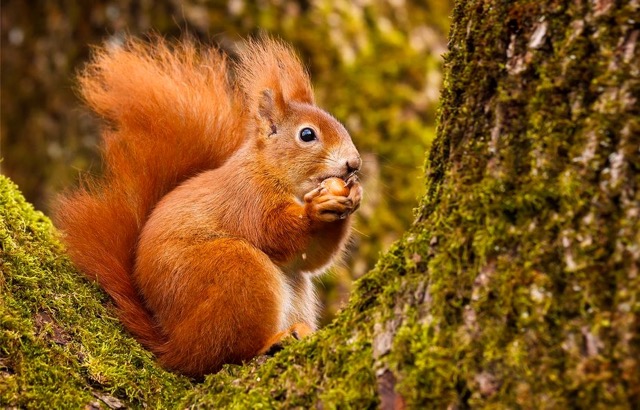
Maybe it was the two border collies that flushed the creature from forest floor to the upper canopy of a scots pine, but we came across their owner ahead of us on the trail, peering upwards and taking us into his confidence. ‘There, can you see it, up in the fork, it’s got its back to us?’. Well, we did, and rejoiced. A red squirrel, beautiful chestnut hues, tufted ears, and of course the fine feathery tail. ‘I’ve seen them in the forest when I was working but in the five years since it’s the first time I’ve spotted a single one around here’.

His comments put me in mind of an encounter I had with red squirrels back in the autumn of 1992, in Madrid of all places. I watched their antics from a bench in the Retiro, the capital’s former royal park. There they appeared as ubiquitous as the grey squirrels we are so familiar with in the UK. The story of the American greys escape from captivity at the Duke of Bedford’s Woburn estate in the late 19th century, and their subsequent nationwide colonisation, is a well known one. The bigger, bolder Greys carry ‘squirrel pox’ which has little effect on them but has devastated the population of native reds. They also compete for vital food sources. Squirrels as a species do not hibernate and survive by foraging and relying on their secreted autumn stores during winter. Greys have better memories apparently so can more reliably recall where they hid their nuts and other foodstuffs, so tend to fare better.

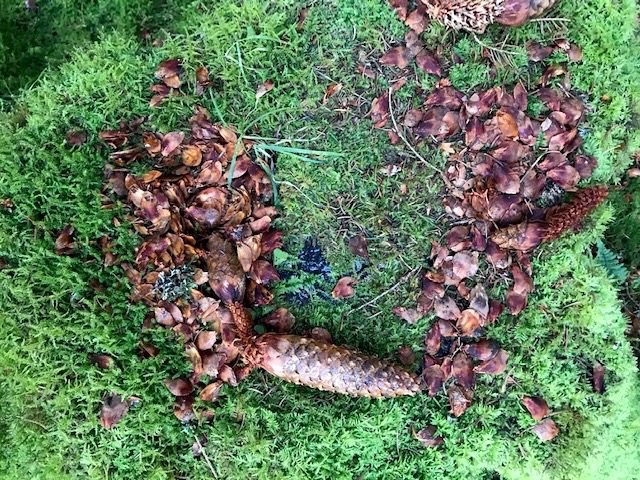
Today a population of between 120 – 140,000 reds are confined to the most remote parts of the UK countryside, with some three quarters of their number found in Scotland. The isolated strongholds in England are mainly in the north and range from the dunes and pinewoods around Formby on the Lancashire coast to the great forest on our doorstep. Kielder in fact is home to some 50% of England’s total. On previous walks here, at the forest’s edge of mixed woodlands & waterway, I’d sensed, if not seen, the illusive reds. Their ‘dinner tables’ of moss covered trees stumps (pictured) are often littered with the chewed remains of the pinecones they favour.

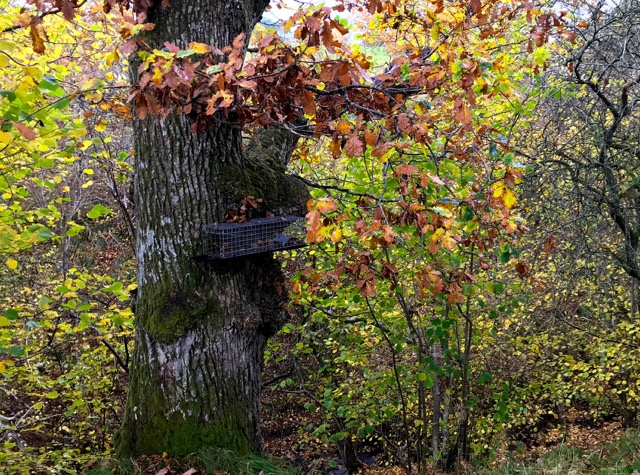
I remember a retired forester friend tells me that some years ago the Forestry Commission replanted with native deciduous trees after harvesting and clearing blocks of conifer. The wildlife corridors subsequently created worked only too well in speeding up ingress by greys into the territory of the conifer preferring reds! That may have been a battle lost but the war goes on. I know landowners who trap and dispose of greys on their patch. (pictured) A natural solution though to controlling their numbers may also lie in the spread south  from Scotland of the indigenous pine marten, which is known to predate them successfully.  

Our farming neighbours at Southridge tell me they spotted both species in late 2020 – a red running a stone wall to go feeding on apple windfalls, with a grey running into their shelter belt of pines a few weeks later. Reds also spotted by neighbours in the deciduous woods (mainly birch, oak and ash) in the valley of the burn flowing out of the forest a half mile north of us. At this time of year the male is seeking a partner so potentially a good time to see chasing pairs. I reported our sighting to Red Squirrel Northern England (RSNE), an umbrella conservation body led by the Wildlife Trusts. If you live in the north and spy a red squirrel why not visit the RSNE website and leave the simple few details they ask for? It only takes a couple of minutes and your arrow on the map will help the conservationists and scientists further their work: https://www.rsne.org.uk/