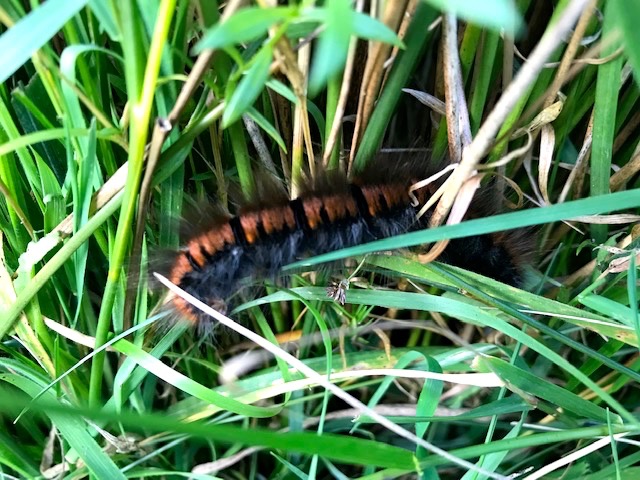
Spotted a couple of caterpillars on walks near the house recently. Here’s a picture of the first, found under some soft rush in our field. Looking it up I discover it to be the caterpillar of the fox moth, named for its colouration at this larval stage. Up to 7cm long and commonly found on variety of grassland habitats across the country from June to April.
The second caterpillar encountered was much smaller and a more uniform brown. It was sashaying across the tarmac when we came upon it. When it changed direction to go up, as opposed to across, the lane I attempted to chivvy it gently with my walking stick towards the verge, away from obliteration by passing vehicles. However, it would not be interfered with and promptly rolled into a ball; then the breeze lifted and wheeled the little creature rapidly off and away, depositing it in the verge further up. This amused me greatly and prompted speculation. Do caterpillars deliberately harness the power of the wind to travel distances, or was this just an instinctive emergency escape measure accidentally aided by air lift? The creature’s curled form and cushion of fine hairs make it remarkably light and aerodynamic, that’s for sure.
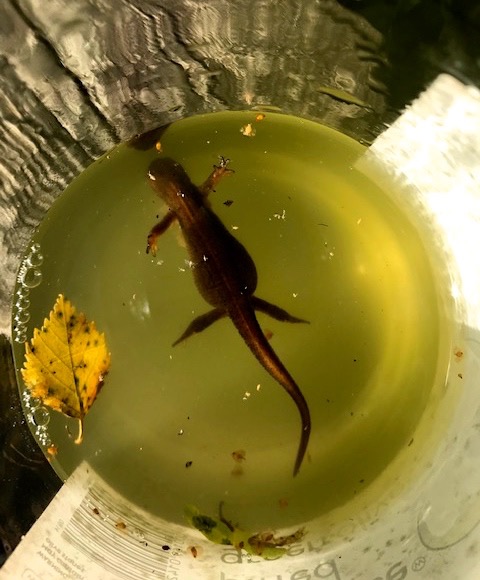
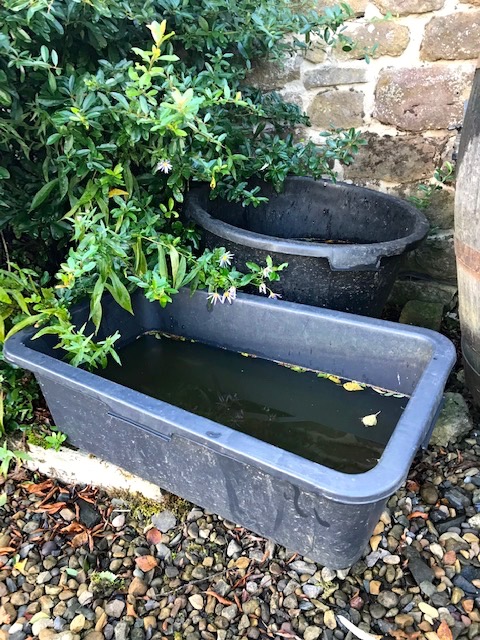
Another small wonder of the natural world that made me wonder in turn occurred this week. As I’ve mentioned in these columns before we have a number of closed and open rainwater containers about the garden, from old wooden whisky barrels to plastic plant troughs. My eye caught slight movements in one of these low troughs as I passed. It was an adult palmate newt, floating near the surface.
Closer examination in the net used to lift it out with indicated this was a pregnant female. Had it migrated from the pond at the other end of the garden to get to an alternative water world? And if so, how had it managed to get into this particular container? Given the trough was low lying yet sheer sided with an extruded top the only way must have been by climbing the dense berberis bush, whose prickly stems reach over one end, then dropping in. The lone amphibian would have eventually perished for lack of food and inability to ever extract itself. I returned the wanderer to the shallow beach of the pond, where its dark still form merged perfectly with pebbles and water. Try again. Returning 10 minutes later it had disappeared. Better luck next time, I thought.
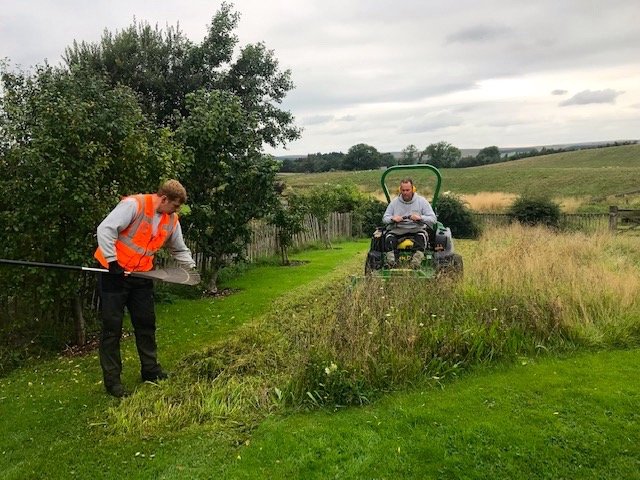
And finally…another small creature story to end with. Once a year in late August or early September Chris the landscape gardener comes to cut the mini-meadow, or Jungle as he calls it, being a no nonsense local man. Usually it’s just his trainee lads that turn up in the van to cut our garden sward with strimmers. This time around it was the boss himself who showed up to do the job, with just one helper to clear. They arrived with a ride on tractor to do the cut, as pictured.
At one point Chris stopped the engine, walked forward, leaned down and cupped his hands over the tall grasses. He then strolled across me on the sidelines with his catch – a small tortoiseshell butterfly. ‘You’re more of an old softy than I thought’ I said, as he smiled and released the delicate flutterby from his mighty hands.
On a small island, the feeble purchase that the land obtains between the sea and the sky, the drifting of mist and the intensity of light, unsettles the intellect and opens the imagination to larger and more liquid configurations.
(From the poem Riasg Buile by Thomas A Clarke)
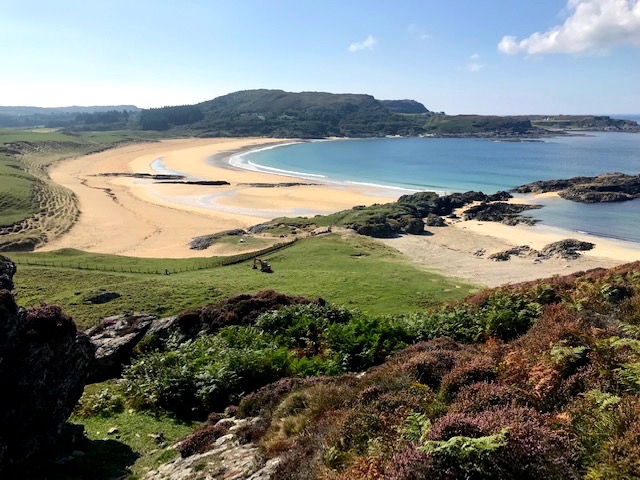
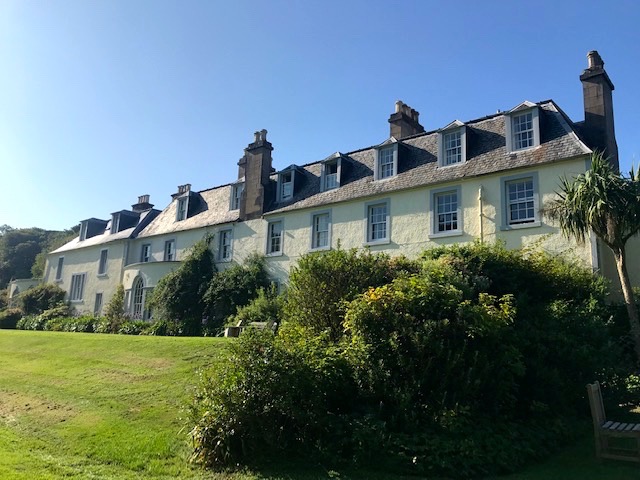
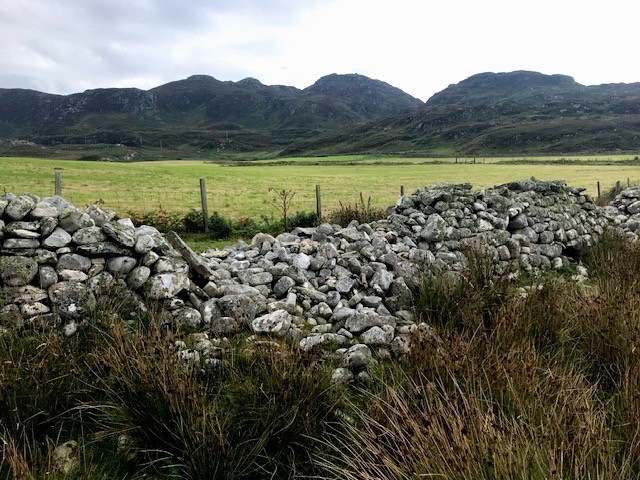
Our recent five day sojourn here was well spent. Lazing, walking the shores and hills, dining out at the hotel and pantry, swimming at Kiloran Bay (above), or exploring the environs surrounding Colonsay house where we were staying, in the former nursery, with a view over the extensive sheltered gardens & woods.
Colonsay is home to some 130 permanent residents, with we visitors coming mainly from Oban, a two hour ferry trip away. The elongated isle measures roughly 10 miles by two and lies west of mountainous Jura, out of the highland rain shadow and along with the island of Tiree it enjoys Scotland’s highest number of sunshine hours. An avian paradise, with more than 100 breeding species of birds and many more visiting. Its extended mild climate, non intensive agriculture and range of environments makes for interesting and diverse plantlife.
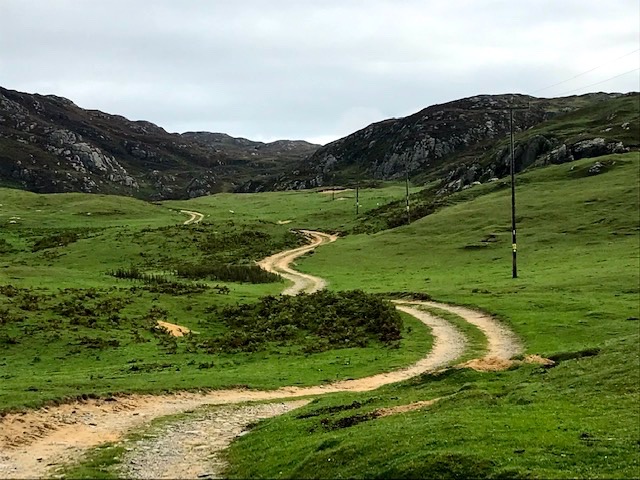
The winding high track from Kiloran over three miles to Balnahard Bay took in some distinct and thrilling sights. The wild goats we caught grazing on the mountain side above us are reputed to be descended from animals that came ashore from a wrecked Spanish vessel, part of the invading armada in 1588. Later we saw a golden eagle perched on the ridge, surveying the scene below before lifting off and circling, its massive wingspan not failing to impress.
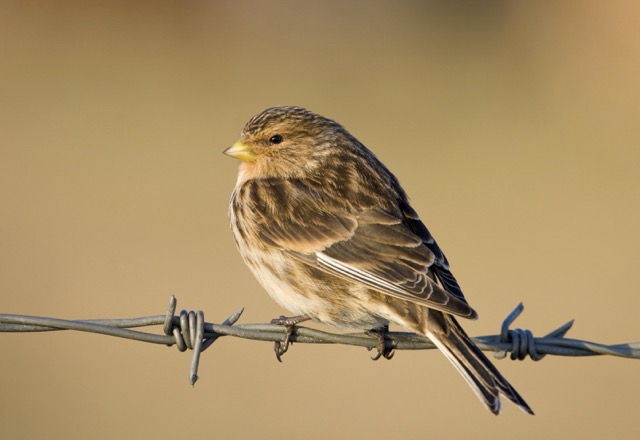
A lively flock of twites accompanied us along the approach through new mown meadows to Balnahard farm. Seed eating finches, often confused with linnets, they’re a bird of the Celtic fringes, little seen outside the north Wales and west of Scotland coasts where they live and breed all year round.
A section of the rough farm track we followed had ditches and rough grazing lined with bog myrtle. Common in the highlands, if rarer elsewhere, this dwarf deciduous shrub thrives in wet acid soils and supports many insects. More importantly its distinctive smell and antibacterial properties have seen it used traditionally to help deter midges! These days its essential oils are a key ingredient in skin conditioners and soaps. (An alternative name is sweet myrtle).
Machair is the Gaelic term for low lying coastal land. Formed from sand and shell fragments, it is the mainstay of traditional crofting agriculture in the Hebrides. A unique habitat and one of the rarest in Europe. A delight then for us to discover some less common flowers there, most of which we’ve had to look up in identifying. No bad thing of course in extending knowledge and awareness!
Bugloss. Half the size of, and with smaller flowers than, its more exotic sibling Viper’s Bugloss. Apparently packed with alkaloids too so rather poisonous. A member of the borage family and distinctly bristly the leaves resemble an ox’s tongue; hence its name origin, from the Greek. Love the pretty sky blue flowers nevertheless.
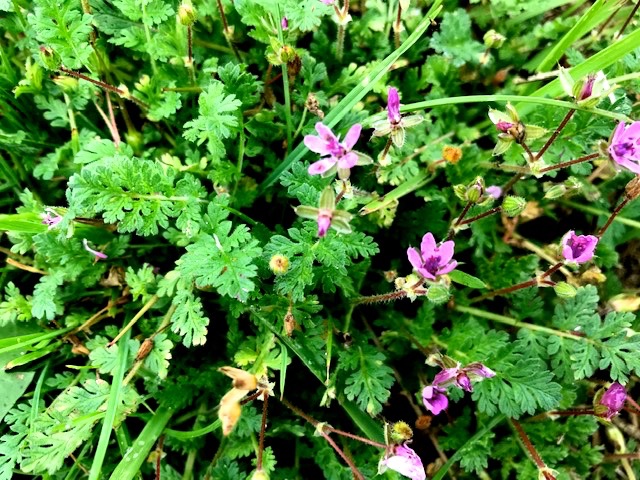
Common Storksbill. Attractive pink flowers and a typical member of the Geranium family with distinctively long pods like a crane or storks bill that will eventually explode, scattering the seeds within some distance. A sprawling, low lying plant with finely divided fern like leaves it is the main food plant of both common and brown argus butterflies.
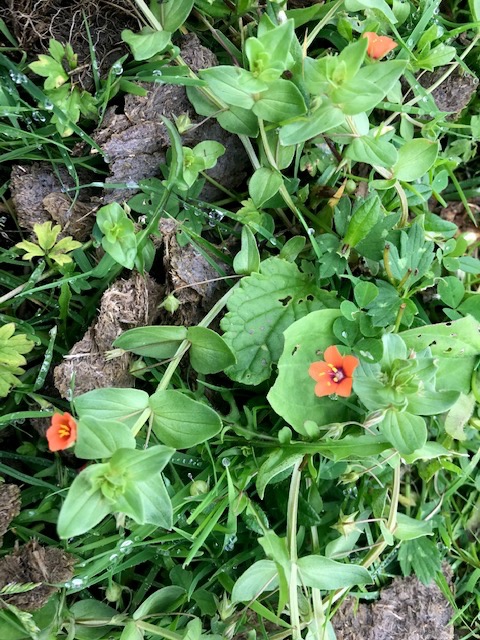
Scarlet Pimpernel. Once a common weed of arable land around the UK this member of the primrose family is now a rarer sight due to modern intensive agricultural practices. This one’s flowers are more salmon pink than the bright red seen elsewhere. The other common name I remember from childhood days is ‘shepherd’s weatherglass’ on account of the plant’s responding to atmospheric pressure in closing up its flowers on the approach of bad weather.
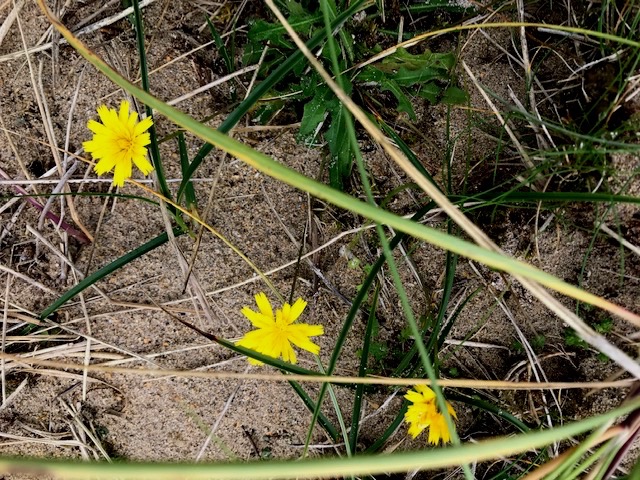
Hawkbit is a cheery ubiquitous presence in the grassland by the coast as well as inland.
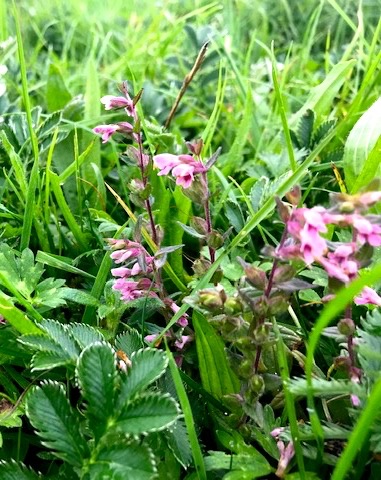
Red Bartsia, An attractive small plant suffused in redish pink which thrives in the well drained low fertility soils of the machair. Maybe even more so, as it is also semi-parasitic, feeding on the roots of grasses.
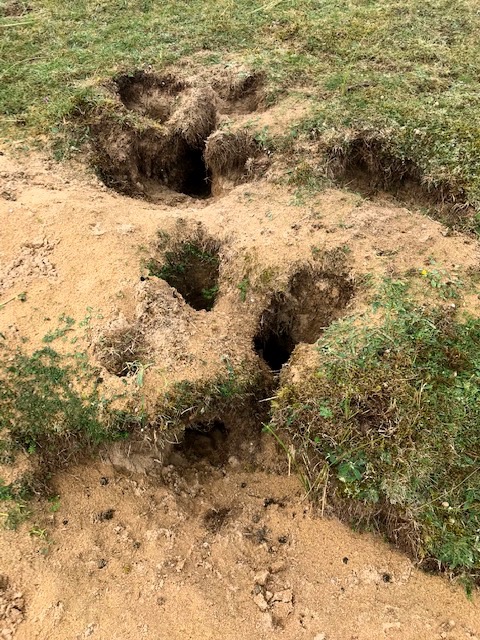
There are no snakes, moles, squirrels, hedgehogs, foxes, stoats, weasels, badgers, frogs, toads or deer…but there are lots of rabbits, with fewer predators to control them, and their presence in the sandy soils is obvious in many places.
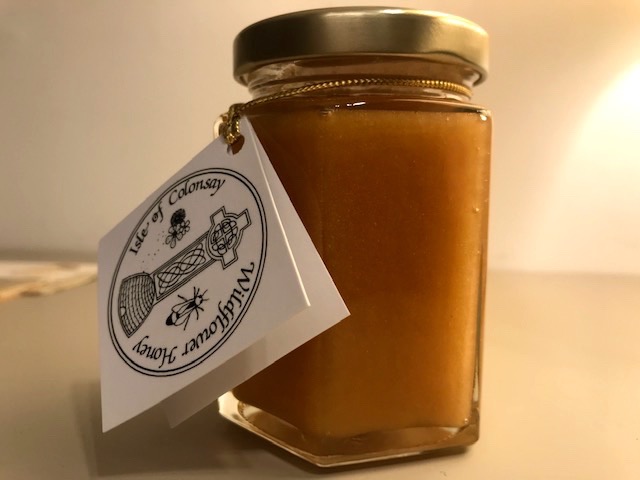
We came away with samples of Colonsay’s finest home produced products, along with gin, whiskey and honey. It’s perhaps no surprise that as this nature rich and temperate isle has over 50% of UK flower species present it makes for a fabulous diversity and range of nectar for bees over an extended period. Best of all the producers here have some 50 colonies of the native black bees, an officially protected species in Scotland. Hardier and more adaptable than the yellow or Italian species on the mainland these bees are perfectly adapted to and thrive on the conditions here. The rich produce of their labours speaks for itself, as we can testify!
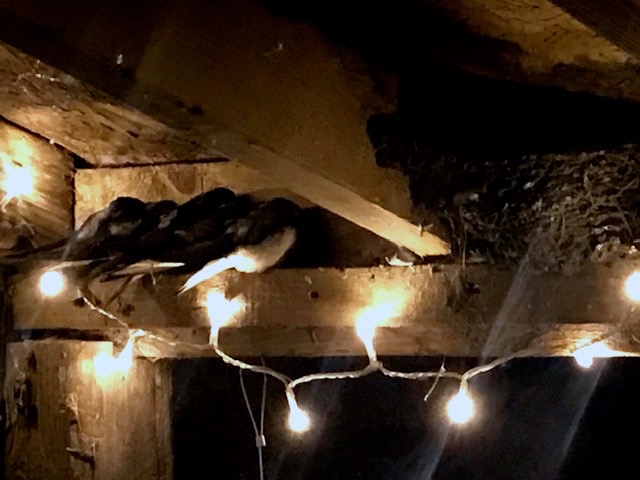
This season’s second swallow brood hatched earlier than last year’s and of course fledged sooner so chances of survival on the great migration begin to look better. Their departure from the nest under the eaves of the garden door deck took place the very Sunday morning we held a celebratory outdoor party, which saw some 60 – 70 family and friends in attendance. Perhaps some sixth sense told them that they better get flying now or else they’d be crowded out. Guests were later entertained to catch the parents feeding their young – beaks agape and wings fluttering – while perched on the rungs of the access ladder between roof and chimneystack. Some days, at certain times, the skies above and around us are filled with the frenetic activity of family flight schools, 30 birds or more.
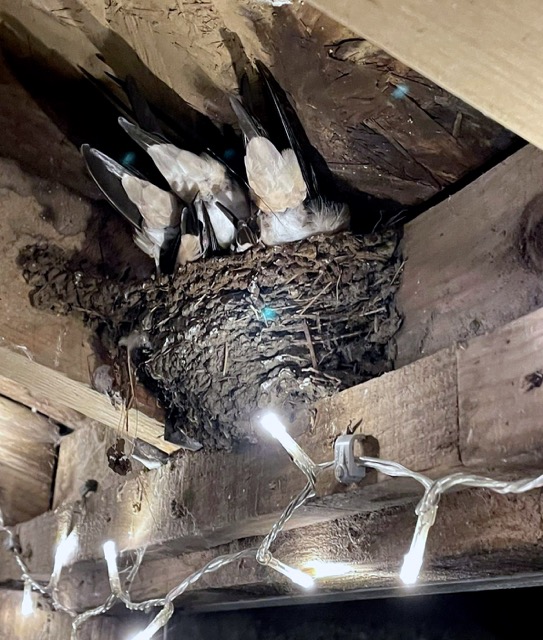
The fledglings return to their nest of an evening to roost. Initially heads in and tails out. (Something of a comedy turn it has to be said). Only three could be accommodated in this fashion and we witnessed a short scrap to see who of the four would lose out. Since then the quartet have given over trying to fit back in their mud and straw cup and currently snuggle up together in a row along the supporting beam.
For one reason or another our four acre field has had hardly a visit from either Kim or myself during the summer. Southridge’s Texel tups, shorn of their fleeces, are back in residence this past two weeks, which is welcome. I followed paths they and wild animals like hare and fox have made, by fences and through the verdant foliage, getting slowly and happily soaked in the soft rain.
My delight was in seeing oaks and willows in lush leaf at the foot and a widespread dusting of yellow flowers everywhere else. Starry ground hugging Tormentil, alongside two members of the pea family; meadow vetchling and birds foot trefoil, just falling to seed. Hundreds of weak flying crane flies on the wing clinging to the long grass stems.
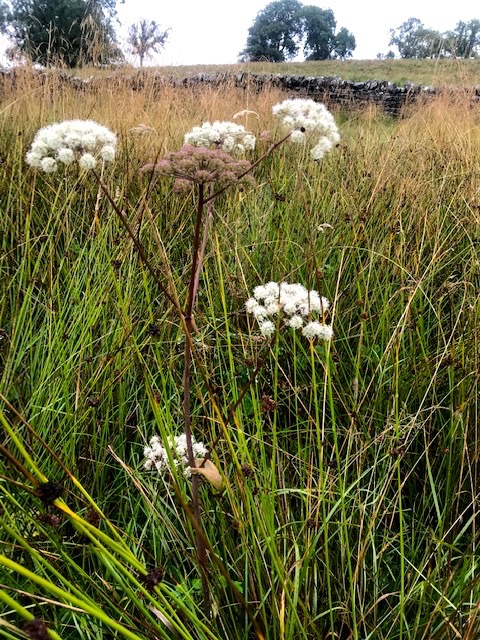
Some umbellifers too, standing proud in the marshy bottom among the swaying mass of bog grasses and meadowsweet. Not sure what variety these purple stemmed damp loving plants are, as seen here….Suggestions welcome!
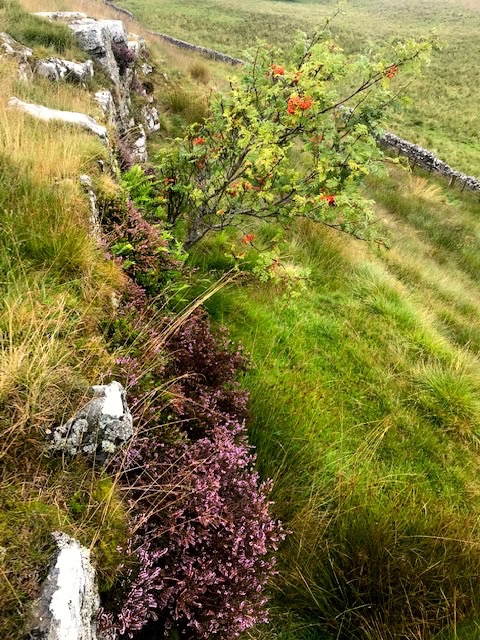
The crags at the high end give our rough grazing land its name. Here’s the defiant rowan, displaying like a banner and already in berry, rooted in a crevice of the rock face. This vertical surface is a safe haven for tree, fern and heather while the lesser grazed slopes nearby shelter the delicate looking but tough harebell flowers from ovine grazing.
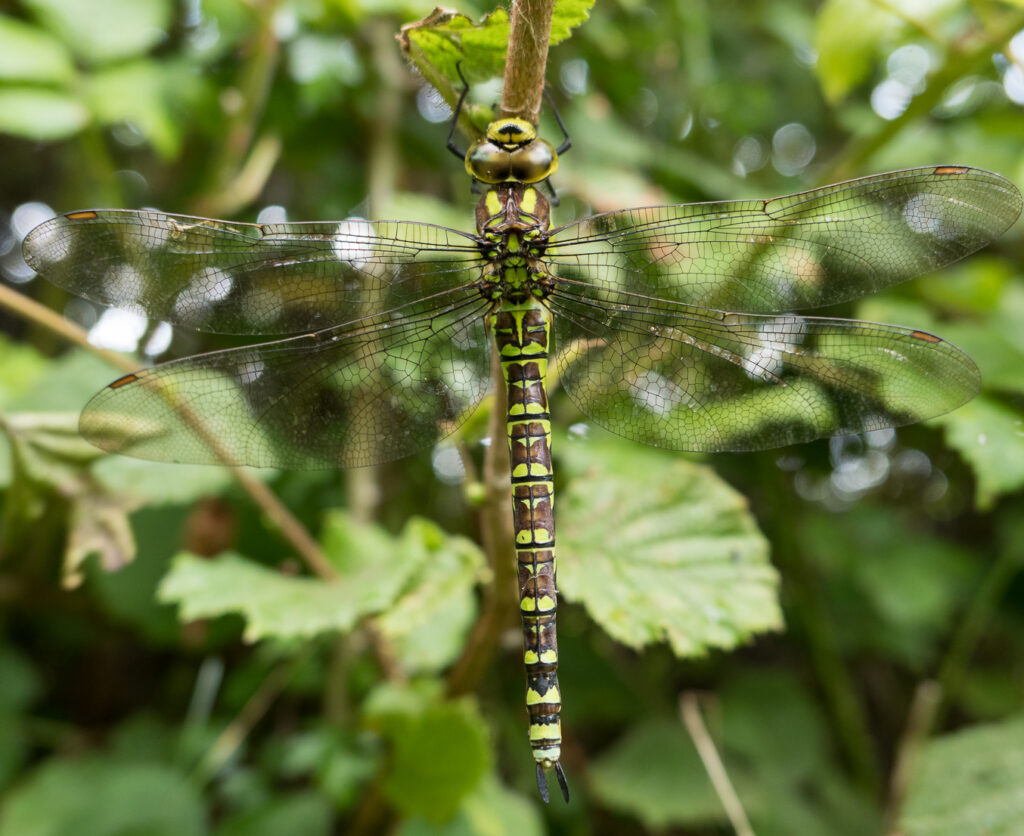
Casually lingering by the garden pond recently I got a big surprise. Came within a couple of feet of a large dragonfly, of a type I’d never seen before. Returned too late from the house with a camera as it had helicoptered off by then so here’s Ian Worsley’s fine image from the British Dragonfly and Damselfly Society’s website….A female Southern Hawker. Research tells me it prefers ponds to rivers, is particularly curious and will investigate at close quarters, is common down south (hence the name) but localised elsewhere. Using its powerful jaws to hunt prey on the wing gains this type of dragonfly the appellation of hawker. Knowing that dragonflies as a species have been around for at least 250 million years is a sobering thought. What beautiful finely engineered creatures they are with huge compound eyes, transparent two paired wings and multi directional high speed flight abilities. Awesome indeed.
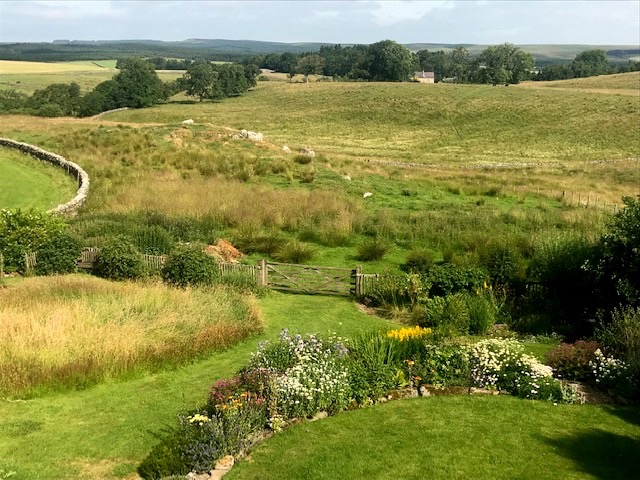
On my first visit to the Cornerhouse, fresh (or not so fresh) from camping at friends wedding in the Lake District, I was glad to take a shower upstairs before joining the company. The glorious view I took in from the bathroom that hot August day has not changed eleven years later, here once more at the height of Summer.
No, actually the garden is much improved since then in having two of us servicing its needs, seeing it (literally) bear fruit. Apple trees by the vegetable garden out of sight to the left, plus the improved mini-meadow and creation of a wildlife pond with complimentary planting off right. Delightful to see garden birds bathing here or coming to drink. Kim’s plantswoman’s skills have gradually extended the wonderful variety of flowers and shrubs in all the borders.
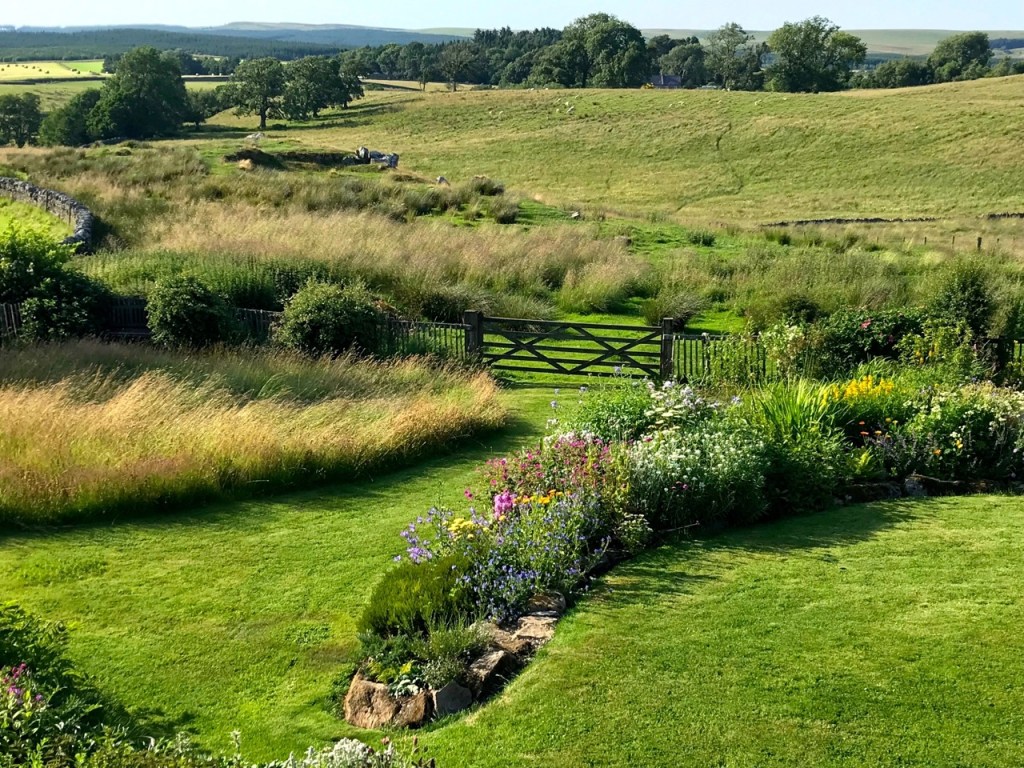
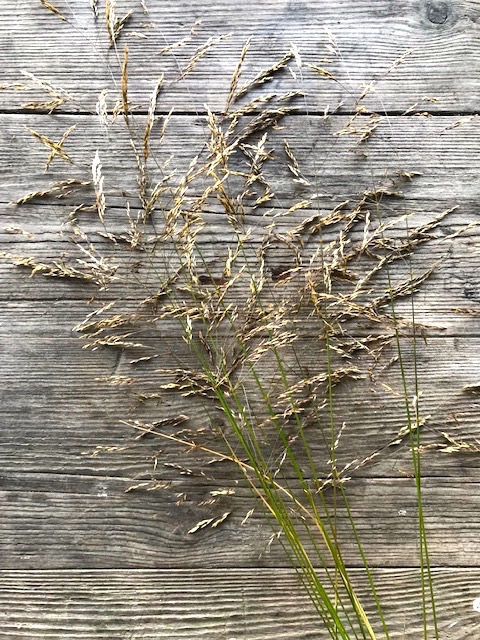
The five bar wooden gate gives onto our four acre field, the Crags. The remains of a small quarry are evident. I think it likely this house (a former shepherds cottage, barns and shippen) was built back in the 1870’s with stone extracted from there. Between garden and rocks do you see that patch of tall grass heads? That’s tufted hair grass aka tussock grass, which thrives on wet, poorly drained soil. Their dense clumps of basal leaves are deceptively rough. Handled the wrong way the aligned fibre of the upper leaf can deliver a nasty cut. Yet the long round stems and seed heads appear gossamer light and graceful as they wave in the cooling breeze.
Tussock Grass
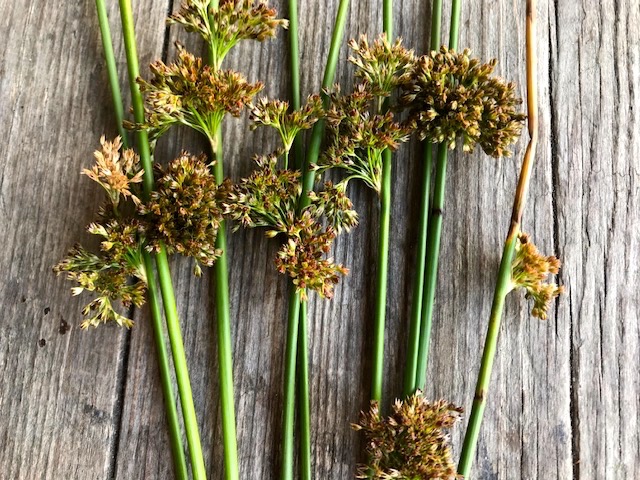
Clumps of soft rush are everywhere else. It spreads by rhizome and seed and does so very successfully, as do patches of creeping thistle. You also see stinging nettles claim space each summer ( a food plant for butterflies) colonising our garden rubbish heap, part hidden from view by roses and hawthorn. This raggedy pile usually gets put to the torch – or rather a very slow smoky incineration – when Chris the contractor comes to mow the garden meadow in August, when grasses, yellow rattle and other flowers have finally seeded.
Flowers of soft rush
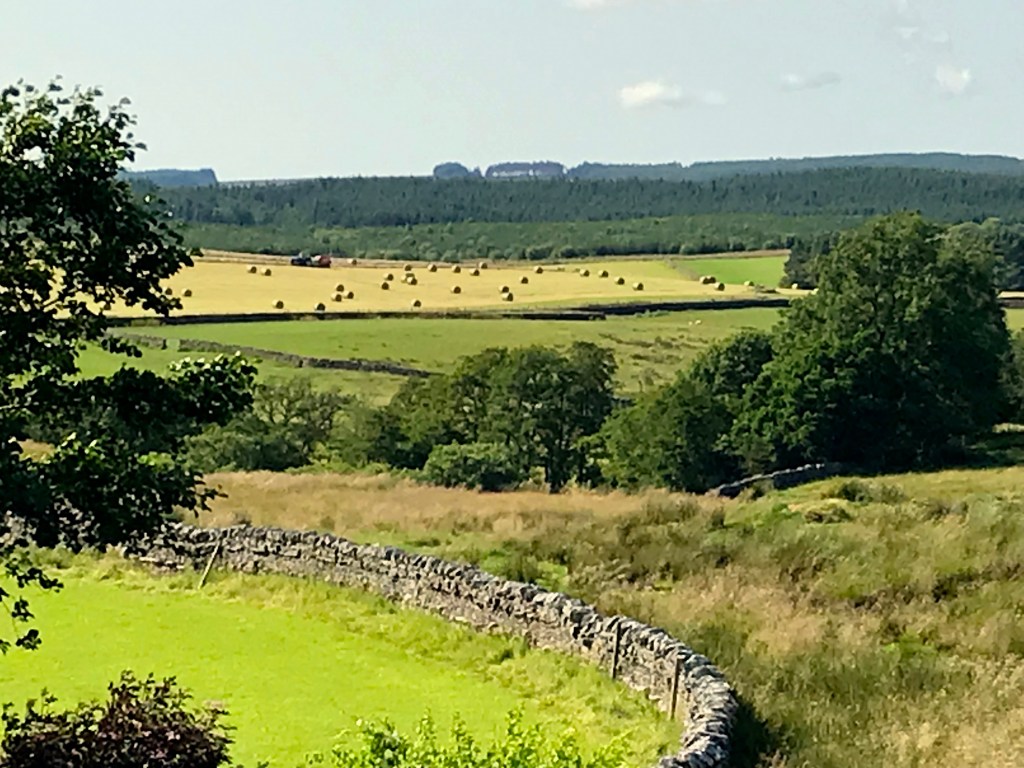
Where our stretch of rough grazing falls away towards the burn below we’ve secured walls and fences so Southridge’s sheep can graze, keeping it from reverting to scrub. That field stonewall curving away to the left is our responsibility to maintain, not our neighbour’s. I’ve recently walked it with Jason the waller, who’ll try to get the necessary patch & repair work in hand by back end. We saw and heard the ascending skylarks that have been nesting in the Crags. The field may be pretty poor agriculturally but it undoubtedly benefits wildlife.
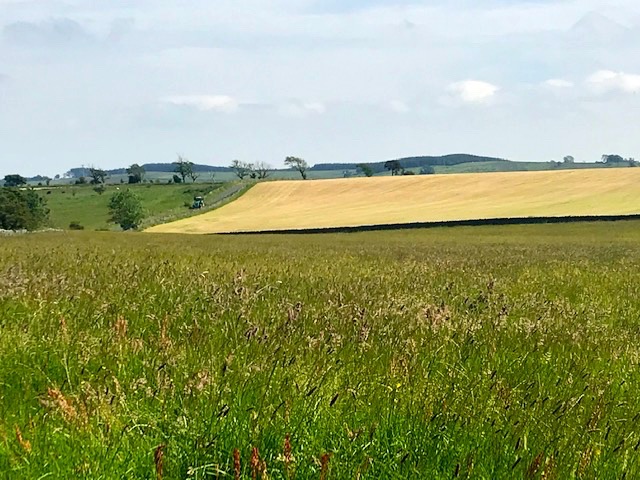
Beyond the valley and its sheltered wood of oak, ash, alder, willow and sycamore our northern neighbour has had perfect weather to cut then ted (turn) frequently before rowing up and baling for hay on his south facing meadow. He leaves the round bales to dry further, taking advantage of the long run of sun kissed days. Livery and the farmer’s own horses are kept in adjacent fields, grazing alongside recently shorn sheep. woodland shelters and hides the farmhouse and yard. Behind it all is an arm of the great commercial forest, England’s biggest. You see a margin of replanted conifer and broadleaf at front, some eight years in the growing, backed by the darker mass of mature trees.
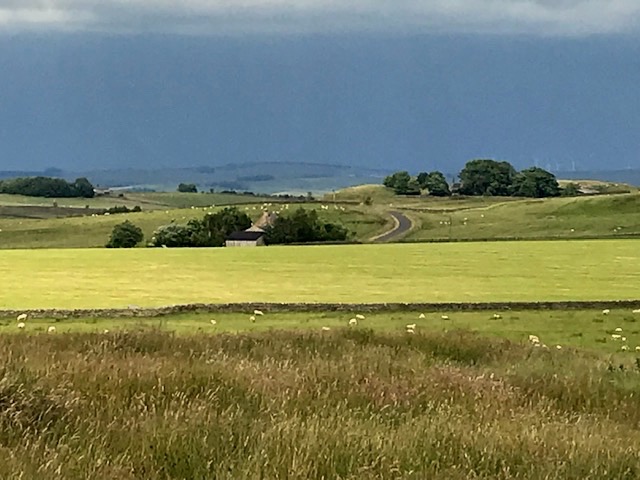
Straight ahead lies a rise of yet more rough grazing, with swathes of tall creamy meadowsweet flowering at its damp foot. In this big field the rushes are mechanically topped before they can seed and the eastern farmer’s herd of stabilizer bullocks put to graze and further slow their spread. Just discernable, threading through, is the long distance national trail. Occasional forays of walkers – short haulers and those committed to the full stretch – appear or disappear over the rise. Our neighbours in the house whose roof you see planted the deciduous wood to the right, which has added wonderfully to the picture. In contrast, those mature ash trees at the top of the slope are not in great shape, having fallen foul of die back. One has already been felled, the others, to greater and lesser degree, present as stag headed (bare branched) and will go the same way within the decade. The house and granary are of some antiquity with small windows and outside steps. At its core is a former 16th Century bastle (fortified farmhouse) and the buildings all perch above the burn in its steep sandstone gorge, curving a protective arm around.The view continues beyond; with more small farms, steep wooded valleys and rough pastureland, before being defined by the long stretch of open fell. Beyond that, unseen, the region’s big river flows from its source on the high Scottish border down to the great conurbation at its mouth.
Literature and butterflies are the two sweetest passions known to man. (Vladimir Nabokov)
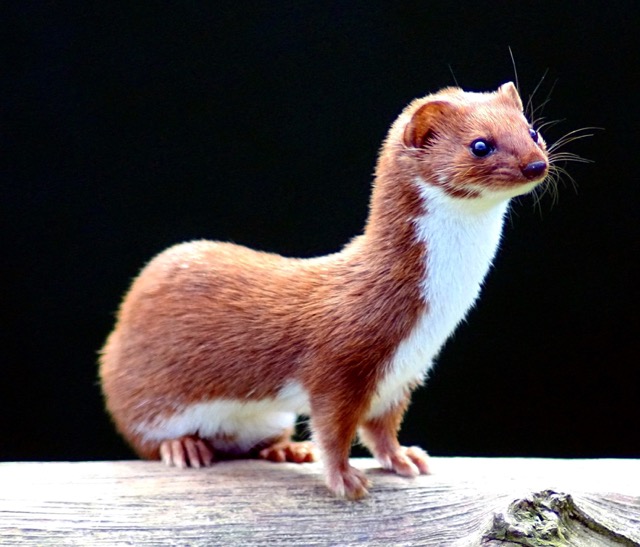
Weasel image c. British Wildlife Centre
Our postie, John, told me an amazing story the other day. Out on his deliveries driving along Stanegate – the old Roman road that linked Vindolanda and Corbridge – he encountered its martial spirit in an unexpected way. Surprised by an odd undulating movement ahead he brought his van to a halt. What he’d witnessed was a weasel escorting her young kits across the road. The fearless jill came up to the driver’s side and sat up on her back legs, stock still, watching him with a ‘don’t you dare open that door’ look. A few seconds more, turning to check her brood were all safely across, she turned tail and vanished into the hedgerow after them.
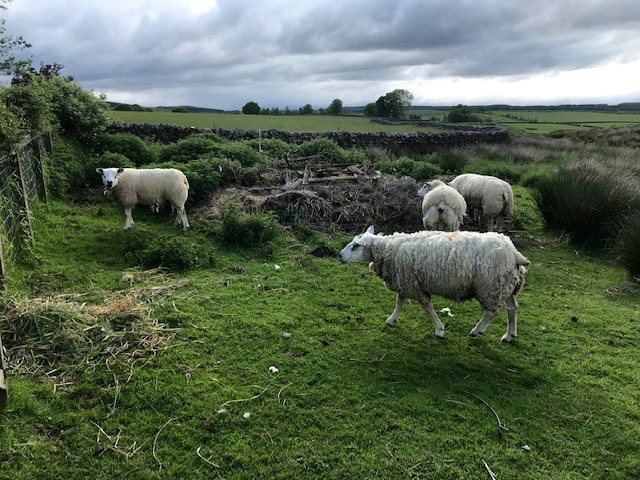
The Texel tups have been taken off our crags after a long residence and the ewes and their fat lambs let loose to graze and fertilize the newly mown emerald green meadow over the wall. I’ll miss the rams for their utility in consuming waste green material we’d no room to compost. They were such unfussy eaters and the ready meal packages of fresh grass cuttings in particular always appealed. As soon as I got the mower out they came up to the fence, ready to snack.
Early July 2021
Early July 2020
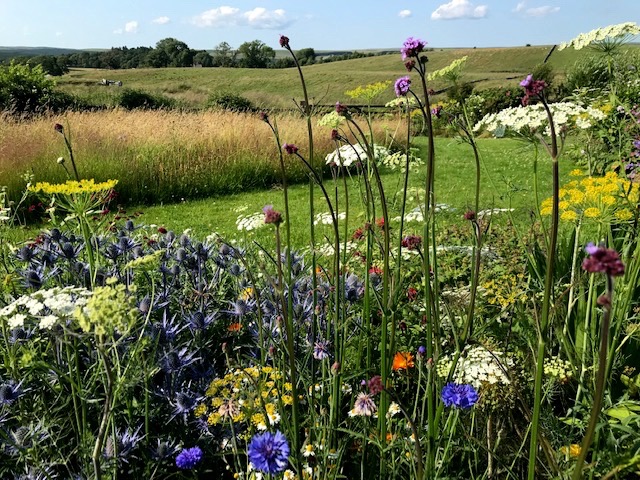
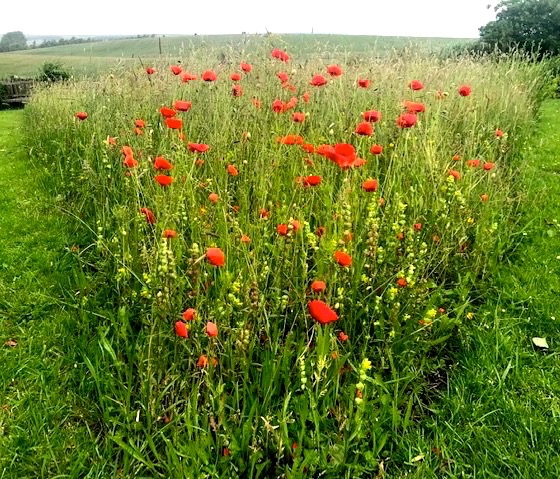
Exactly a year ago our garden meadow was radiant with red poppies. This year there’s ne’er a one but instead it’s bursting with marguerite daisies. Such unexpected succession planting, with different germination patterns playing out, makes for constant interest. What will dominate, or appear for the first time, next year? We’ve never had so many yellowrattle flowering before as we have this year and that should affect future grass fertility as they seed and spread.
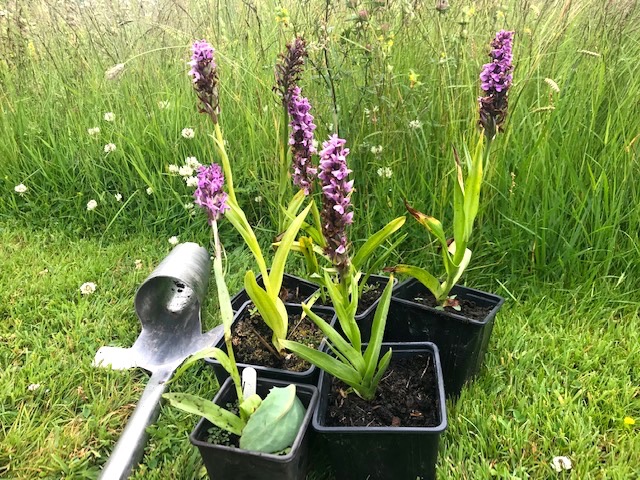
Our local plant nursery, operating seasonally from the old walled garden of an estate house, closed recently on the retirement of the nurseryman. We turned up to buy some interesting plants in the weekend sale. My choice was this handful of orchids which I’ve slotted into different parts of the meadow. I’ll be watching out next year to see how they have subsequently fared.
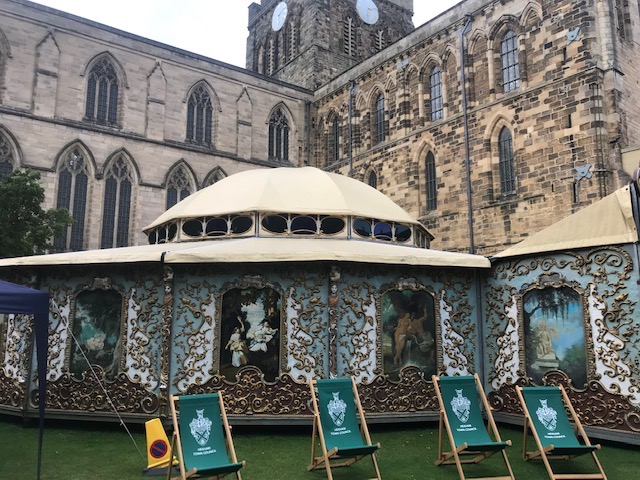
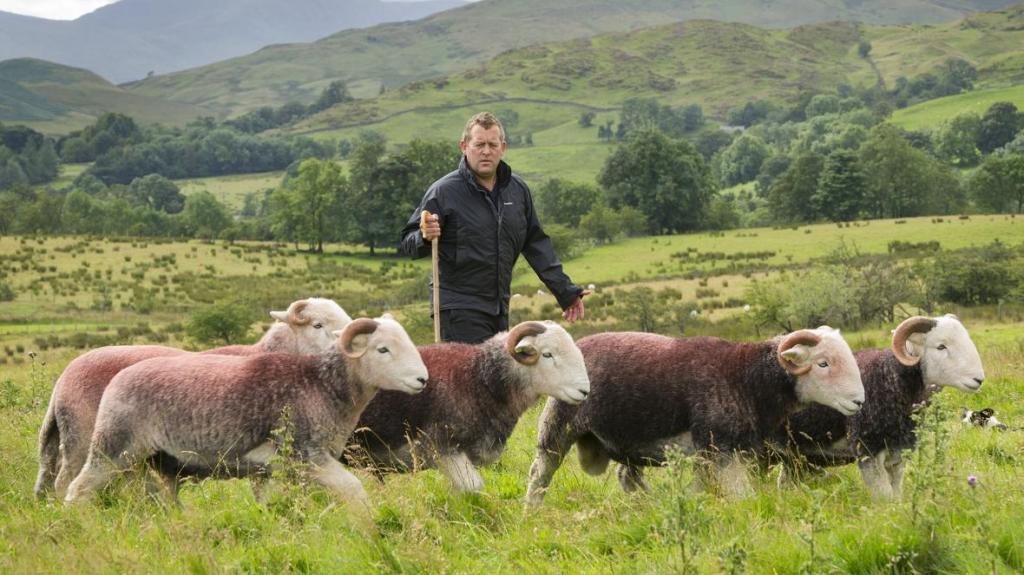
The market town’s annual book festival is always a treat. Kim & I spent an enjoyable hour listening to James Rebanks in conversation in the exuberant surroundings of the speigeltent, pitched outside the abbey. JB comes from a long line of Lakeland farmers and his home patch of Matterdale has in recent years been quietly transformed with the help of a small army of volunteers and advisers into a model environmentally sustainable hill farm. Former canalised water courses re-aligned and allowed to wander to help prevent flood prevention further downstream in towns and villages; hedges, woods and walls restored to boost nature and restore declining native species that were once common; favouring hay over silage to restore balance with nature. Restoring mixed rotational farming practice integrating (belted galloway) cattle, (herdwick) sheep and crops to underpin and develop soil health…Lots of small actions that add up to something big and meaningful. It’s subsidy driven, and profit margins remain low. Luckily for JB he has another income source to support his wife and family of four young children – writing.
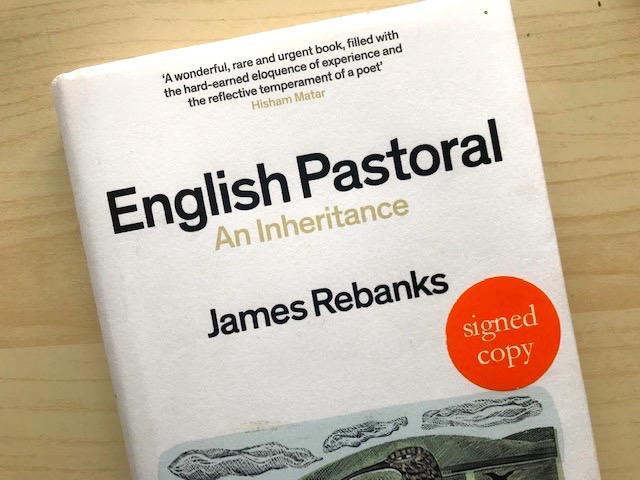
The Shepherds Life (2015) and English Pastoral (2020)have deservedly gained its author an impressive reputation. An authentic individual thinker, James Rebanks analytical insight and lived experience as husbandman and shepherd might come as a revelation to most of the 99% of the population who do not make their direct living from the land. He writes – as he spoke to us that evening – with terse lyricism, mixing anecdote with observation, recollection with revelation, disarmingly honest and prescient.
Rebanks with Herdwick Sheep in Matterdale. Image c. The Sunday Times
English Pastoral unfolds its powerful narrative in three parts, and in mood and tempo it’s something akin to a pastoral symphony. The first section (Nostalgia) reveals the rural world Rebanks grew up in from his birth in 1974, peppered with telling portraits of family, especially his grandfather, whose Lakeland farm he would eventually inherit. The second chapter (Progress) deals with the drastic changes brought about by the wholesale industrialisation of farming to secure a cheap food agenda, and the widespread consequences. The third section (Utopia) restores hope and explores interconnected ways back to true sustainability in food production and farming’s re-integration with nature and the wider landscape.
Another day and a late afternoon stroll up the lane to revisit sights I’d only but glimpsed from the bike earlier. Road works of recent years, resurfacing and clearing or putting in of drainage ditches has – as I suspected at the time – opened up the wayside to new plant possibilities. I stopped to admire the colour combinations of these three common grassland perenniels at the nearest passing place.
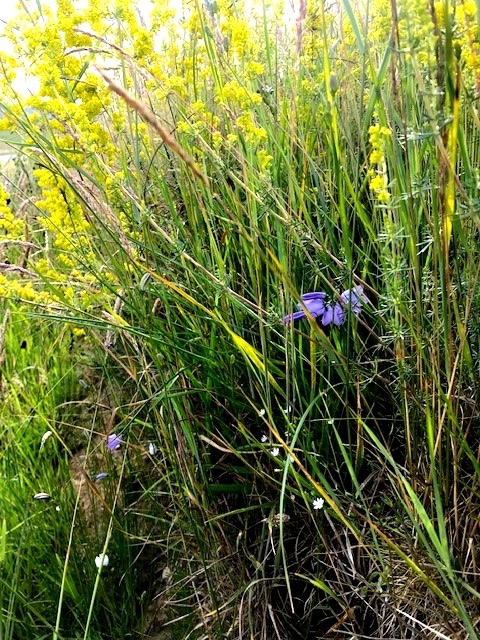
Particularly love the lavender blue flowers of the harebell. Their numbers have definitely increased along the dry poor soil margins where deep but narrow ditch meets lush grass verge. Likewise, there’s seems to be more lesser stitchwort about as they like dry meadows and grassy places too. As the name implies the folk medicine canon had a place for it as relief from the pain of a stitch. Surprised to learn that the pretty white flowers only last three days. Luckily, the plant is a prolific producer through the summer months. The delicate looking flowers (only five petals but heavily indented so appear as ten) float serenely above the ditch, reinforcing its star like imagery. Most obvious though is the frothy yellow presence of ladies bedstraw, which is another coloniser of the mini-cliff face here. A hardy perennial of grassland it gives off a subtle scent somewhere between honey and hay. Traditionally the plant was used to strew floors and stuff mattresses, as its astringent qualities deterred fleas and was thought to aid safe delivery for women in childbirth. The dense clusters of tiny yellow flowers were used in cheese making apparently as a coagulate of milk and that the original Double Gloucester owes its rich colouring to the plant!
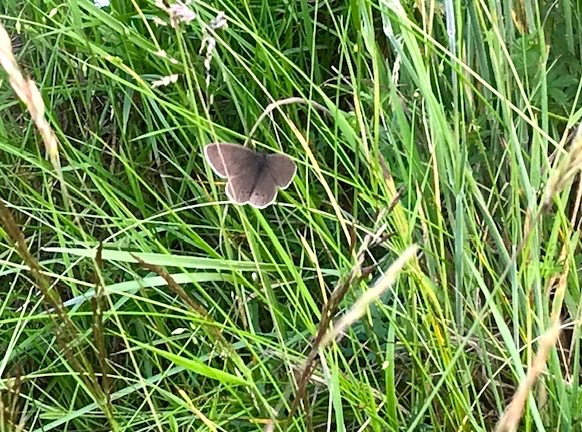
Returning home from photographing the flowers something caught in the corner of my vision…a moth? Turned and followed its tiny form along the wayside. The fluttering creature finally alighted briefly and I managed to snatch this image before it flew off again. A butterfly. But which one? A dive in a reference book provided the answer. I’d been privileged enough to encounter a small blue. It has widespread UK distribution but is very localised, and sad to say, in serious decline. The small blue is the country’s smallest resident butterfly, whose food plant is kidney vetch and its relatives found in unimproved pastures. Colonies are often only a few dozen in numbers although it can increase to a few hundred in favourable conditions. I thought I saw another on my walk before identifying this one so we may well have a small colony in the grassland and waste places hereabouts. Let’s hope so.
Correction. Having dropped a line to charity Butterfly Conservation.org today, accompanied by the butterfly image above, I was disappointed to learn it was not a Small Blue but rather a Ringlet butterfly I’d seen. Oh well, can’t win ’em all. Lovely creature to spot anyway, and a timely reminder to check more thoroughly before publishing in future!
This old stone ark / moored on the hump back / of the Whin Sill, is rock / is rainbow, is anchor / Buttressed against weather, / like hands arched in prayer… From ‘Throckrington Church’ by Linda France.
What do the following three outstanding individuals have in common?
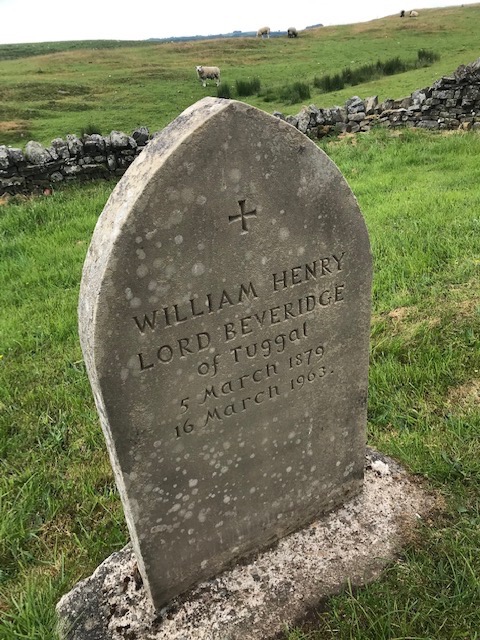
William, Lord Beveridge (1879 – 1963). Liberal politician, economist & social reformer whose 1942 report laid the foundations for the post war welfare state.
Tom Sharpe (1928 – 2013). Satirical novelist and anti-apartheid activist in 1950’s South Africa. Based on his teaching experience in Cambridge, Sharpe’s darkly comic romps – the Wilt series, Blott on the Landscape and Porterhouse Blue – becamebest selling novels in the 1970’s & 80’s, and were filmed for TV.
Constance Leathart (1903 – 1993) Daughter of a wealthy Tyneside industrialist, A pioneering inter-war aviatrix, aircraft repairer; later an officer in the Air Transport Auxillary, delivering planes from factories to airfields during WW2.
All three are buried in the churchyard at Throckrington, Northumberland.
Actually, that’s not quite true. Tom Sharpe died, aged 85, at Llafranc in north-east Spain, his home for the previous 20 years. Close friend and associate Dr Montserrat Verdaguer fulfilled the author’s wish for his ashes to be placed near his father’s grave at St Aiden’s. Unfortunately this was done without permission and a consistory (ecclesiastical) court held in Newcastle found against her. The ashes – along with the author’s favourite pen, a Cuban cigar and bottle of whisky – were removed. Unsurprisingly this bizarre saga got a lot of media attention.
Beveridge was briefly MP for Berwick-upon-Tweed and had family ties with the area, and his wife Janet is buried next to him. Connie Leathart, who became increasingly eccentric on retirement, moved to live at a nearby farm, where she ran a donkey sanctuary. Her grave is a simple stone, easily overlooked, with the letters CL engraved in it. The churchyard is graced on one side by a carpet of heath bedstraw which adds a glow to the ground. The church porch noticeboard displays a wonderfully worded missive from the vicar that made me smile…
‘This Church is open at all times for the curious or anyone in need of shelter, a breather, inspiration or reflection. Please close the door after you because the swallows haven’t worked out how to lift the latch to get out, and please close and bolt the gate as tups (male sheep) want to be with their mates, not stuck in the graveyard’.
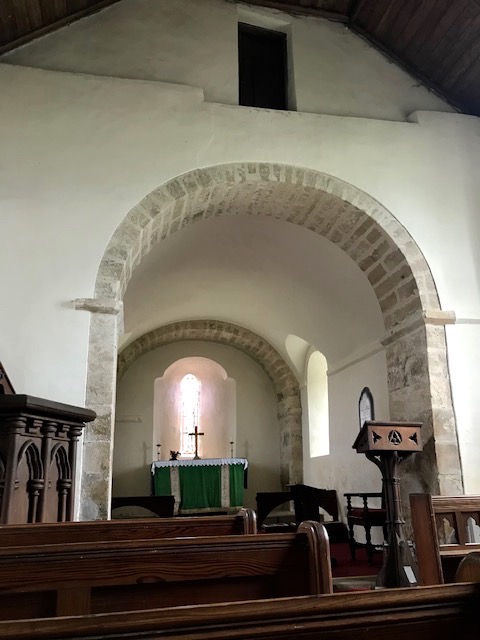
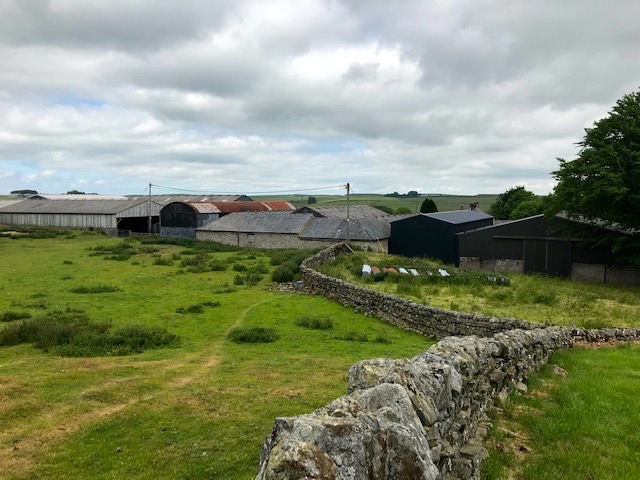
St Aiden’s is one of the oldest churches in the county, dating from 1100. Sitting proudly on an outcrop of the great whin sill, it overlooks wide swathes of open pasture and woods, as well as plantations and wind farms on the far ridges. The chancel walls and its impressive arch survive. Of the medieval settlement at its foot, where a farm and host of sheds now stand, there is no sign, having been long abandoned or simply built over. Legend has it that a sailor returning home in the mid 19th century brought typhus with him, and that eradicated the already declining population of Throckrington village. Today’s parishioners are drawn from the closest clusters of hamlets, farms and an old family run estate or two.
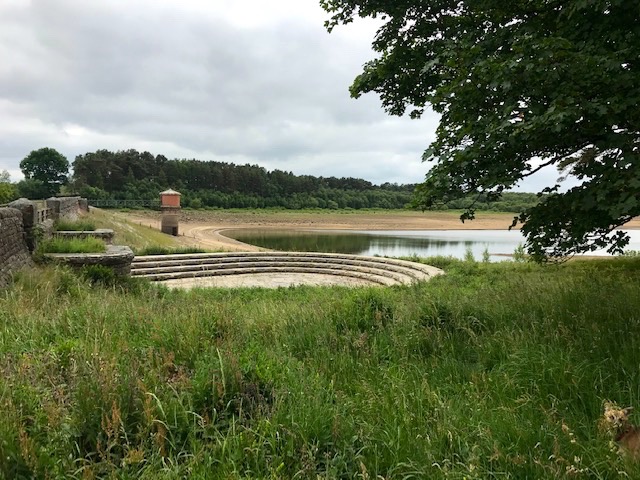
Our exploratory ramble took us (and a number of cyclists) along a little used metalled lane through big fields of rough grazing. After a mile or so we broke away to circumnavigate Colt Crag reservoir, one of a series of interconnecting Edwardian reservoirs supplying Newcastle/Gateshead starting at the headwaters of the River Rede, just below the Scottish border at Carter Bar.
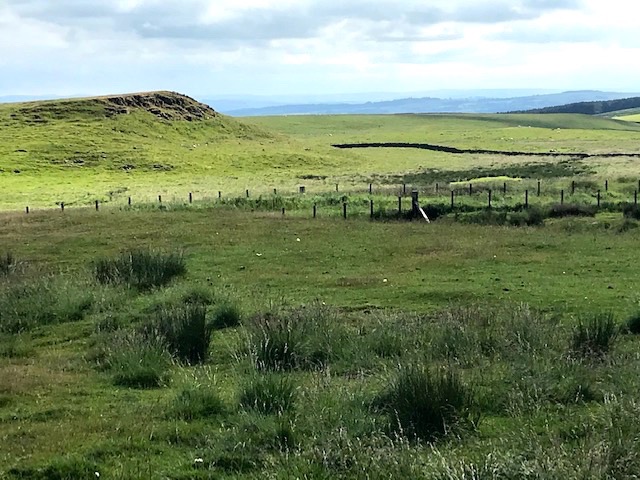
The water level at this remote and peaceful site, after a prolonged period of little rain, was decidedly low. Set in a hollow, the natural feed stream at its highest point snaked down through residual mud to the depleted still waters below. Scrub plants were establishing between stone slabs of its recently exposed apron. The stoic figure of a lone fisherman in waders, standing thigh deep in the shallow waters, was casting his line for trout.
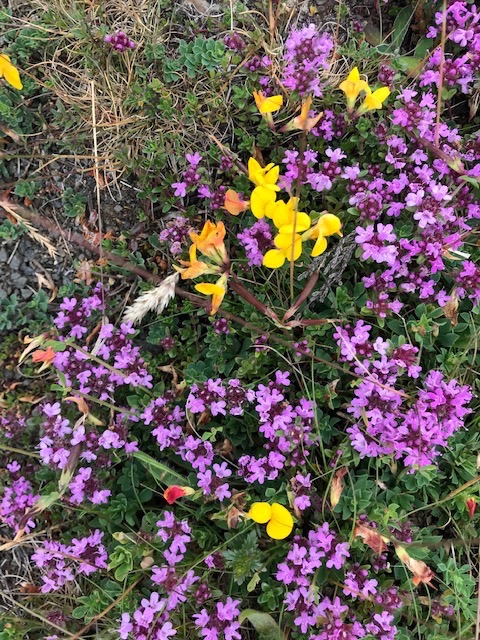
Sheltering woodland and the sandy soil perimeter vehicle access track allow a lively array of various meadow plants to thrive, like this mix of thyme and trefoil.
Returning on a gentle amble along the gated lane to Throckrington we had our picnic on the grass verge after exploring church and grounds. Further entertained in watching the farm’s shepherd co-ordinating quad and border collies to shift a flock of sheep with lambs off on to distant broad pastures.
Cut grass lies frail / Brief is the breath / Mown stalks exhale / Long, long the death / It dies in the white hours / Of young-leafed June…(From Philip Larkin’s poem ‘Cut Grass’)
The prolonged spell of good weather in the wake of midsummer is the trigger for a wave of farming activity. Next door neighbours but one run a contracting business from their farm over the ridge, which might explain why they were sorting their own patch first this past weekend. We witnessed them out and about with their kit cutting, spreading, rowing, baling, and carrying off grass as silage. Just prior to that the family also managed to have their flock of sheep shorn and muckspread some of those newly mown fields as well.
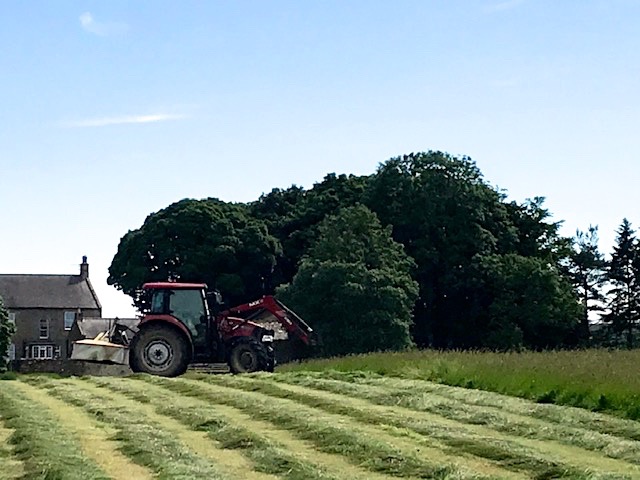
On Monday morning Southridge’s workhorse red tractor cut the big meadow that borders two sides of us here at the corner house. First the headlands (field boundaries) then, with turning room established, it steadily mowed the rest on a series of returning diagonals. Tuesday morning their contractor arrived in his big John Deere tractor drawing a combo tedder and rake. This machine is an unfolding wide winged setup of wheeling metal tines, drawn over the wilting sward to wuffle (spread dry) then windrow (line up) the cut grass.
The afternoon saw our man return with a round baler to draw and bind the drying grass into airtight rolls, not too loose and not too tight, before ejecting them. Southridge’s red tractor then spiked up each bale unto a flat bed trailer pulled by their other tractor that in turn hauled them off for stacking in the farmyard barn.Weather, the lie of the land dictate and ease of storage means that silage is favoured over hay in these parts as winter fodder for sheep and cattle.
I think the workers may have taken a break (along with the rest of the nation) to watch the Germany v England match live from Wembley stadium at 5pm, but they were back to finish the whole job before the light finally faded. Seeing the black & white team strips against the pristine Wembley turf put me in mind of the intermingling gulls and corvids on that far neighbours new mown fields, co-existing to feast on a bonus of worms and insects newly exposed to light.
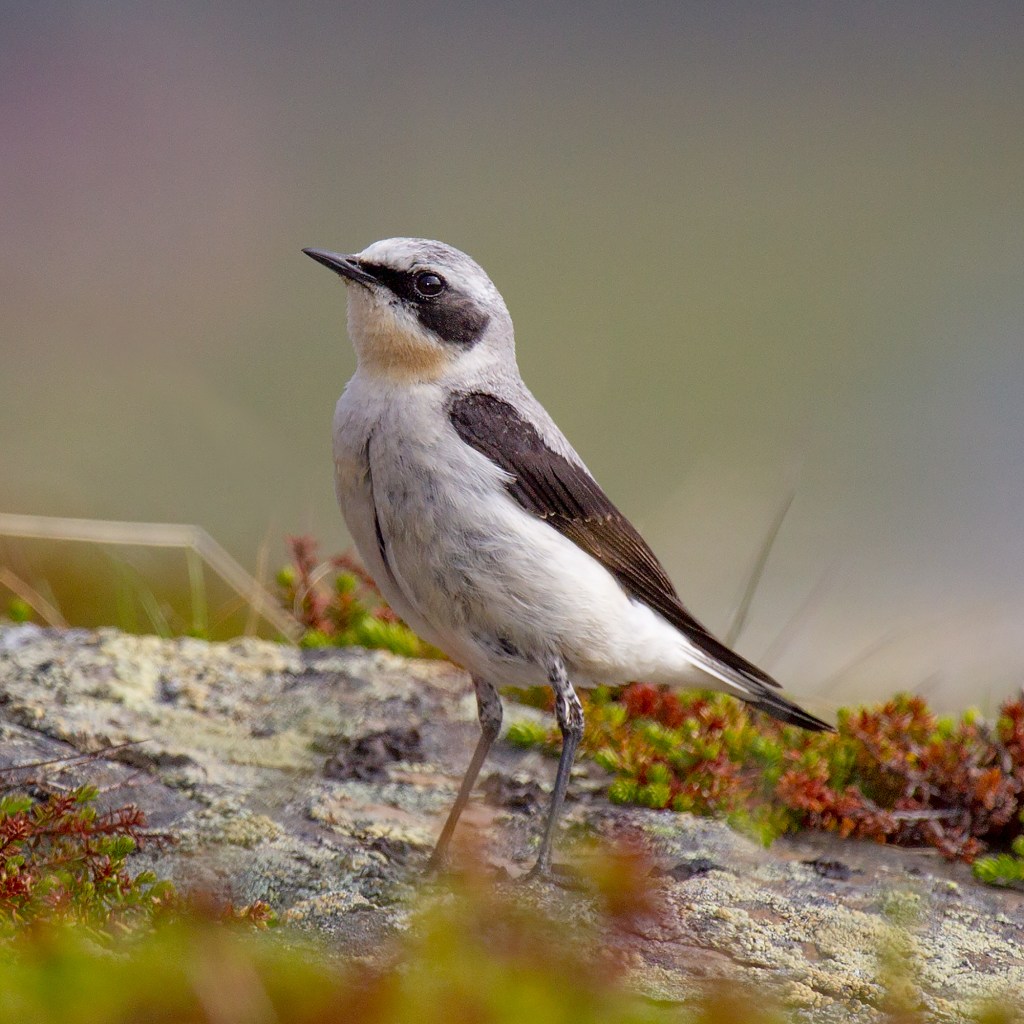
Back here on the big meadow our resident avian families took advantage of fallen seed and vulnerable worms too, albeit on a far less industrial scale. Wheatears spotted atop the curving dry stonewall before dropping in to forage. These welcome summer migrants from Africa normally keep their distance from habitation but clearly could not resist this temptation to come in by. I was afforded a sight of their handsome form and tell tale white rump. The bird’s original common name was ‘whitearse’ but Victorian sensibility put a stop to that.
I also hope that the Curlews who nest in the meadow have had their chicks hatched and fledged by now. These iconic birds return from the coast each spring to this traditional breeding spot so I can only assume they have. Nationally the picture looks bleak as the birds summer quarters away from the coastal winter coasts and estuaries are increasingly confined to remote upland hill country. The curlew breeding population has halved over the last 25 years. This distinctive wader, with its haunting liquid call, is celebrated by local Allendale brewery as one of its many fine bottled ales while the Northumberland National Park (in which the field sits) features the curlew as its logo.
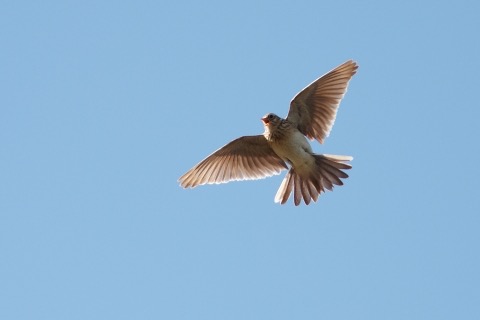
There is one bird perhaps above all others that says ‘summer in the country’ and that for me has to be the skylark. This year their presence has been more marked than usual, which is heartening. We suspect them of nesting somewhere on the ground within our four acres of rough grazing, as I’ve mentioned before, which makes us happy as skylarks are an endangered red list species. When out on the bike I’ve flushed them from wayside cover. How wonderful it is to hear the cock bird singing his heart out as he rises high above to hold as a vibrating fixed speck in a cloudless blue sky. Truly, a sublime enchantment.
Footnote: Clocked our neighbour going over the big field with his baler. The contractor’s wide winged machinery not able to deal with more uneven ground in non regular shaped fields. A closer shave needed. The seven round bales he managed to gather will join the rest to dry for a week before wrapping and storage. Alas, recent last couple of days rain will slow that process down.
‘That’s life, (that’s life), that’s what all the people say / You’re riding high in April, shot down in May / But I’m gonna change that tune / When I’m back on top, back on top in June’ (Frank Sinatra/That’s Life)
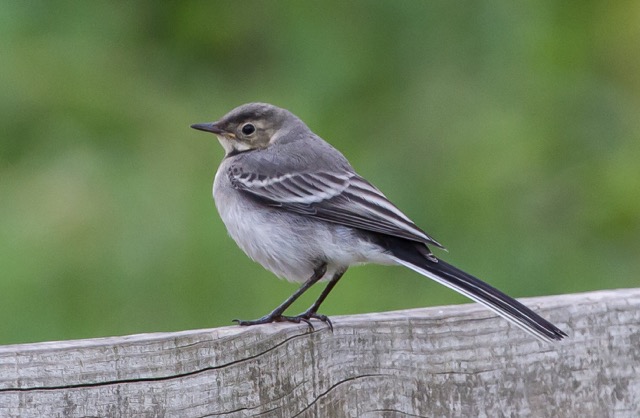
The open sided kitchen deck shelters a dense swag of ivy covering the wall top to bottom. Wrens normally favour it, living up to their cave dweller name (troglodytes) secretively feeding on the insects and grubs that shelter therein. This spring our green wall’s obvious inhabitants are nesters. Swallows up top and pied wagtails somewhere in the foliage below. They’ve proved the worst of neighbours. Patient and cautious wagtails with beaks full of insects have had to make carefully timed exits and entrances to avoid the ire of the swallows who screech and dive bomb them if spotted.
Juvenile Wagtail: RSPB Image
The swallows are seemingly still building while the wagtail chicks have already hatched and fledged. They make for a handsome sight, the avian equivalent of grey co-ordinated uniforms of traditional schools or law offices. The parents are simultaneously coaching and feeding their brood around the place. These juveniles behave more soberly than say young robins. I had to rescue one, twice, from inside the ‘poppa-dome’ netting protecting our brassicas from cabbage white butterflies.
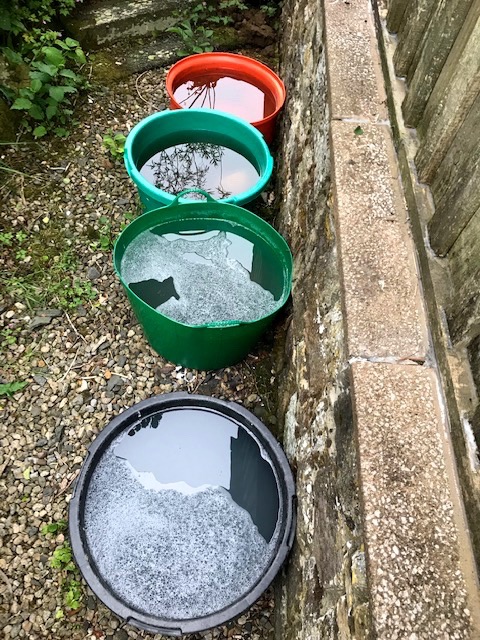
Top of the mishap ratings are blackbirds whose adolescent fledglings can be relied upon to find ways of meeting an early demise. Their favourite is drowning in the nearest open topped water trough or tub, although they are also partial to getting fatally tangled in garden netting. We consequently abandoned using large mesh plastic filament nets for bean and pea protection, though ‘needs must when the devil drives’ as my mother used to say, and we still use the current open top reserves of rain water.
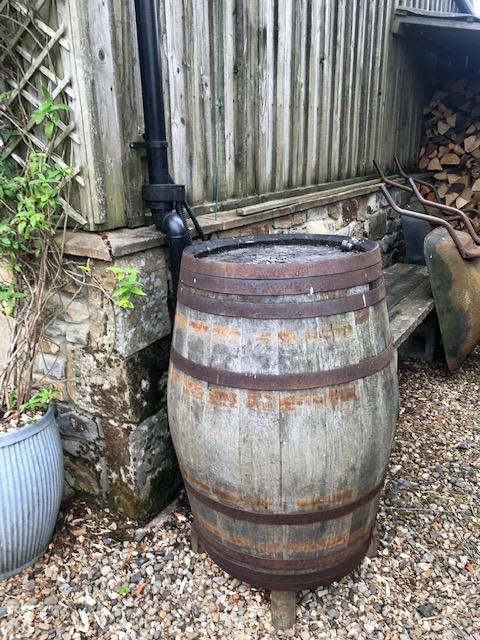
As previously noted in these columns the corner house is off grid for water. We share a spring with the two family households up at the farm. Their cows and sheep grazing in the big spring field are thirsty consumers at this time of year, putting extra demand on the resource. Summer days see us recycling the grey water from evening baths to service an array of garden pots, boxes and beds. We’ve other reservoirs too in the shape of old wooden whiskey storage barrels tapped into downspouts to catch precious (whiskey scented) rainwater as well as those open topped empty animal feed tubs, now tucked out of sight back of the garage.
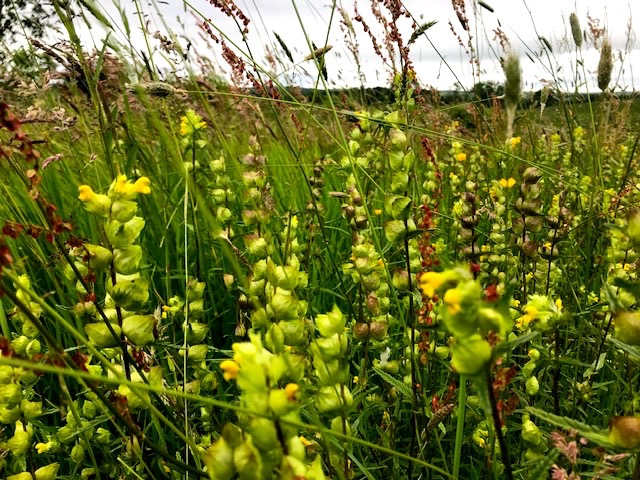
Yellow rattle & Sorrel
The meadow continues to develop through changing form and cast of characters. Broadcasting another tranche of yellow rattle last autumn round the perimeter has paid off handsomely in continuing to roll back the rampant grasses. As semi-parasitic plants these free seeding annuals feed off the roots of our tougher grasses and by weakening them allow other meadow species to break through.
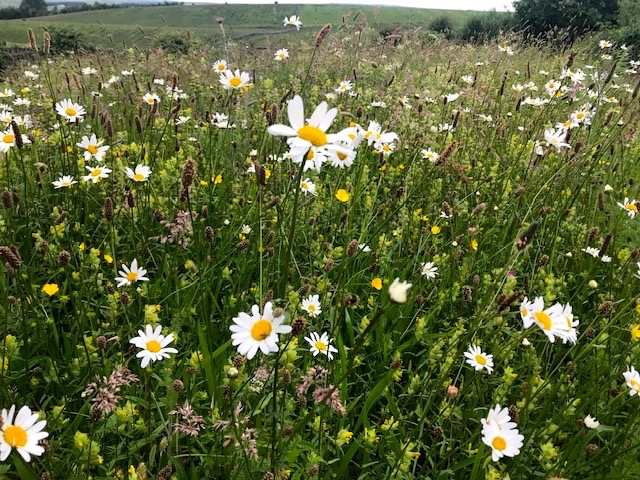
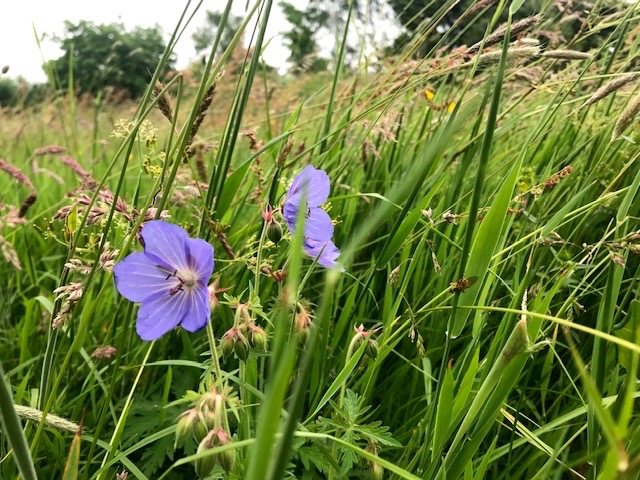
This year we’ve been happily surprised by two newcomers. Ox-eye daisies or marguerites, that most exuberant and cheerful of wayside flowers, are flourishing. There’s one dusky purple meadow cranesbill present too and I hope it will take and spread. I’ve chopped the cow parsley before it seeded. It’ll be great to have it back next year but not in such profusion to take the meadow over if allowed to propagate at will.
Meadow Cranesbill
In comparison It’s easy to overlook a humble plant with flowers so tiny they barely registers on the eye, registering as subtle pencil strokes of blue in the bigger picture. Changing forget-me-not has pretty five petal flowers when seen up close. The name comes from the flower’s ability to change colour from yellow to blue – not that you’d ever truly notice!
I’m intrigued that this creeping hairy perennial was not listed in the original seed mix for acid clay soils sown in the autumn of 2019. It may have been present in the original sward or has found its way in since the yellow rattle got to work. It loves disturbed ground so it could be that the perimeter harrowing I did in the previous two autumns has allowed it to establish and spread. Other bloomers in season include pink campion and the lookalike ragged robin, while sturdy dark headed plantain and tall rusty fronds of sorrel make for a lovely contrasting presence in the sea of swaying seedheads that top timothy, meadow, rye and couch grasses. It’s a joy to catch the flashing acrobatics of exuberant gold finches on their fluttering descent to bend and feast off them.
Irises & Monkey flowers
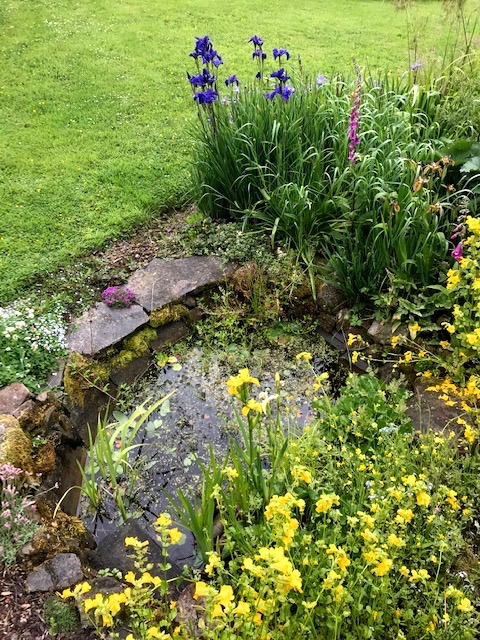
Friends have gifted irises in the past that we’ve planted in or around the pond. The deep blue ones are in danger of being choked by rogue grasses and will need weeding after they’ve finished flowering. Yellow brown streaked Holden Clough iris (bred at the nursery of the same name in the Forest of Bowland) and common yellow flag are good pond marginals, majestic in their aquatic baskets, and are looking particularly splendid this year. Their subtle shades of golden glory somewhat lost when set against a chorus line of common yellow monkey flowers behind them. These mat forming, damp loving plants originated in north America and are viewed as being an invasive species. The snapdragon like flowers, splattered with red dots, are now a common sight in gardens and the wild throughout the UK.
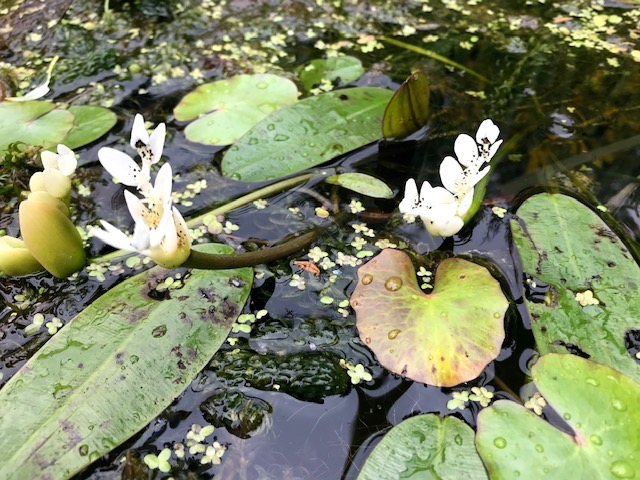
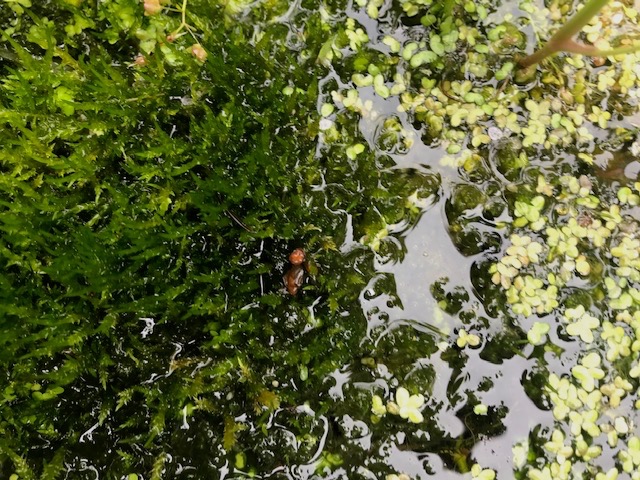
No sign of frogs so far but the resident adult palmate newts are breeding and the aquatic snails with their spiral shells are growing in size and number, alongside healthy population levels of various underwater insects and beetles. Distinctly shaped white flowers of water hawthorn present their faces to the sun and the miniature water lilies yellow flowers will soon be out.
The submerged mass of sheltering water weeds and oxygenators suspended below the floating plants are key to keeping these still waters cool, fresh and healthy as the days heat and their level falls. I top up with a watering can of an evening and reluctantly welcome a few grey windy days bearing waves of replenishing showers.
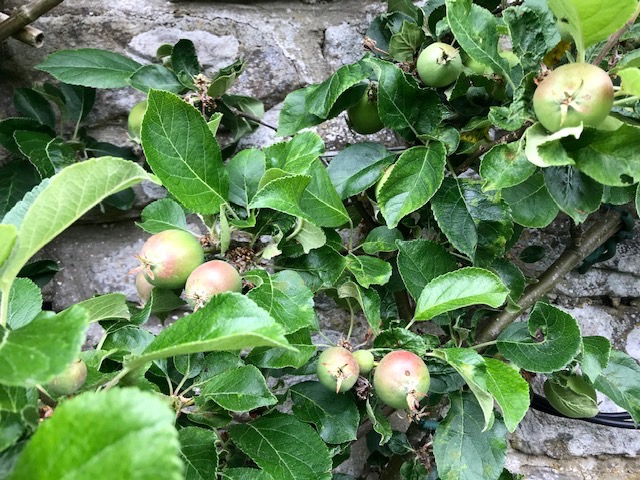
What a strange season for fruit trees everywhere. The generally cold wet May put paid to much glorious blossom and curtailed setting. Our espaliered trees on the south facing sheltered side of the house have come safely through, now bearing swelling fruit, while most of the free standing apple trees in the more exposed northern facing garden have no or few fruiting stems to show. Nevertheless their foliage is a healthy fresh green and growth is good so they’re likely to come back bearing fruit next year.
Her heart was light, her eyes were wild / As kneeling down with her little child / She christened her bairn in the Devilswater / The black eyed brat of the devil’s daughter. / Low she laughed as she hugged it tight / Clapped its hands at the golden light / That glanced and danced on the Devilswater / To think she was once a parson’s daughter. (From ‘Devilswater’ by WW Gibson)
Old friends who’d been this way but a little while since were kind enough to repeat their rural ramble in our company. Hexhamshire, or simply The Shire, was originally a generous gift of land (some 92 square miles of it) made by Queen Ethelreda to St Wilfred to support his foundation of a priory at Hexham in 674AD. During the medieval period it was the fiefdom of the Archbishop of York, separate from Northumberland as such. The smaller modern civil parish still retains that feel of a land apart due to its relative remoteness and definable boundaries. The Shire today is the rural hinterland south of Hexham, stretching from the green belt of the Tyne valley to Hexhamshire Commons (part of the North Pennines AONB). The main landowner here in the modern era is Lord Allendale’s estate. Pretty much in the centre of this sparsely populated, deeply rural landscape of sandstone gorges, woodland and rich pasture is the village of Whitley Chapel and that’s where we started and ended our four mile ramble.
Quakers Hollow, Devilswater Valley & Steelhall Wood
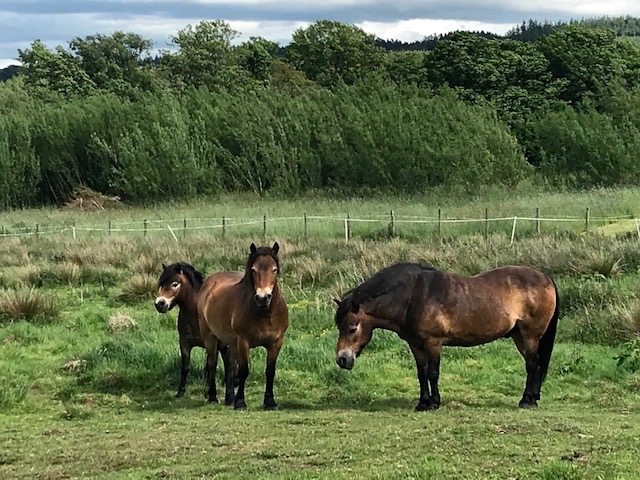
The footpath through Quakers Hollow nature reserve was a lovely surprise. Named after the late 17th century Friends meeting house that once stood on nearby chapel hill this 9 hectares of semi-natural wetland is composed of peat which acts as a giant sponge to retain permanent moisture and supports rare flora and fauna. We heard reed buntings calling and saw clumps of purple orchids in the bog. A bird hide overlooks the site and thousands of willow whips have been planted on its perimeter by a local basket weaving group for future harvesting. All credit to the enterprising community here for their sterling work since 2002 in investigating, enhancing and interpreting this precious moss and its adjacent meadows. We especially admired the three handsome Exmoor ponies, the most perfect of conservation grazers, happily fulfilling their brief.
Exmoor Ponies with Willow Plantation Behind
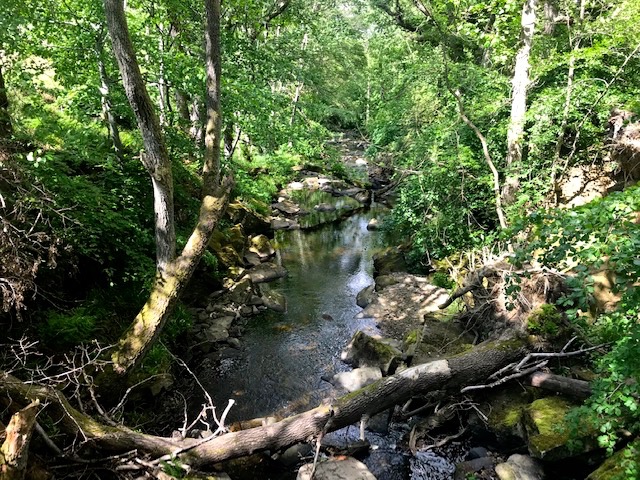
A short while later we dropped down to the Devilswater. This stream defines the Shire in a number of subtle interconnecting ways and runs for approximately six miles from its source in the high commons to confluence with the Tyne at Dilston below Corbridge. Although peaceful now fallen trees littering the steep banks below the footbridge reminded us of the power of a Pennine stream in spate – seemingly living up to its name! Rather more prosaically the word’s etymology defines it as a variant of Douglas, derived from Brittonic (Celtic) words Dub (black) and Gless (stream). Lancastrian Queen Margaret fleeing the battle of Hexham (1464) supposedly took shelter in a cave in the valley, while Anya Seaton’s historic novel of the same name tells the story of young Lord and Lady Derwentwater of Dilston Castle and their doomed involvement in the 1715 Jacobite rising. The Hexhamshire Brewery at Dilston Mill pub further dowstream boasts a Devilswater dark beer (‘black stream’ personified) while a local folk band also bears the name.
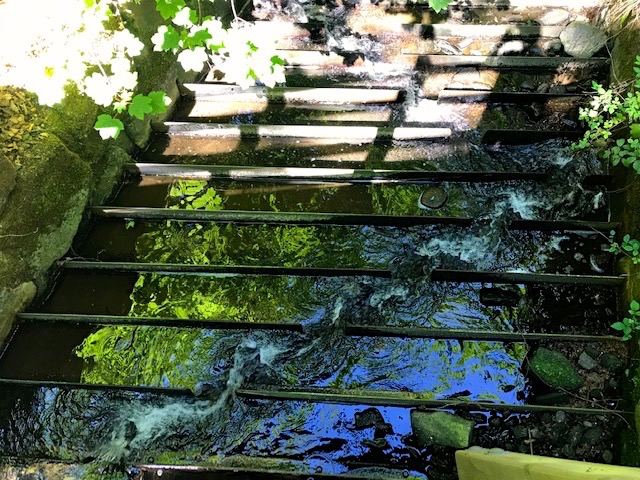
Soon we were trekking up through the airy mature pines of Steelhall wood before dropping down again to a confluence of well beaten track way leading to a deep set ford in an ancient wood by a footbridge, below which was an iron weir with a fish run zig-zagging through it!
A place to linger and speculate about those who had defined and worn those tracks down the centuries. Later I discovered this was one of the ancient packhorse routes where the area’s lead miners brought their precious hard won ores to be smelted at nearby Dukesfield Mill. These works were once, from the late 17th to the early 19th century, the largest smelting works in the land. The mill also extracted silver from the iron ore, making it even more lucrative.
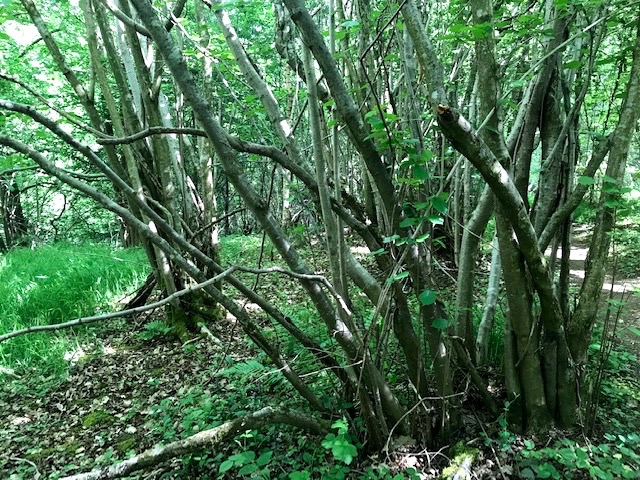
Walking on we passed through woodland rides (clearings) and stands of coppiced (harvested) hazel, reminding us how rich a resource mixed woodlands of native species would have been to our forefathers, providing tool handles, fuel, fencing, furniture, building materials and so on.
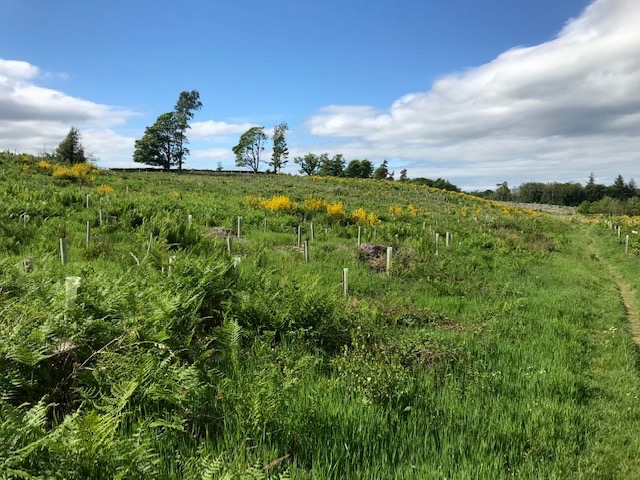
The return leg of our ramble had the rushing Devilswater in its tree lined bed to our right and a sweep of clear felled former conifer plantation to our left. These slopes are now replanted with deciduous varieties liberally interspersed with the bright yellow flowers of broom amid a flush of bracken, birch and other colonisers of ground recently exposed.
Arriving back at the village we enjoyed a picnic outside St Helen’s parish church (rebuilt 1742). The little hill yielded a fine view over the diverse landscapes we had walked. A step inside the cool of the chapel like building revealed some very interesting windows. The most recent was one designed by our friend Bridget Jones, inspired by the life of St Cuthbert, commissioned to mark the millennium.
The other 20th Century plain leaded glass windows there are particularly eye catching in their creative simplicity. These lights are the work of Leonard Evetts (1909-1997) and are lovely memorials to parish benefactors – priest, farmer, churchwarden, and a formerWW2 WRAF radio operative – with bold stylised images referencing flowers, tractor tyres, fields, radar screen etc.
All in all a nicely varied gentle country walk, gifted by and enjoyed with old friends, discovering yet another fascinating corner of rural Northumberland.
Drifting in moonlight / the dunes sing their songs. / Wings of old battles / fly all night long. / Cry of the seagulls, / curse of the ghosts; / aches of dead warriors / scar this old coast.From ‘Song for Northumberland’ by Keith Armstrong.
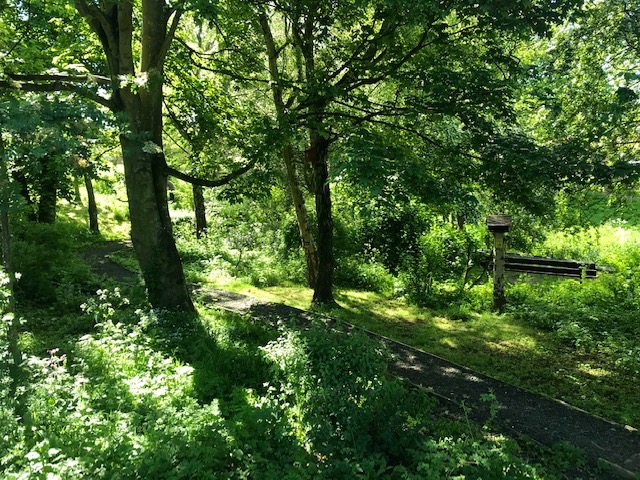
Returned home from a week away at the coast sharing a holiday house with the Newcastle branch of the family in the north Northumberland village of Belford, now by-passed by the A1, but once an important C18th coaching stop on the great north road. The Belford Community Group, a registered charity, is the key to lots of contemporary activity; setting up or running village shop, museum, gym, social clubs, playground and woodland gardens. The latter particularly impressed me as I fell into conversation with one of the volunteer gardeners in a work party tending their happy acres between a housing estate and the playground. He told me that this verdant and fully accessible patch either side of the Belford burn was once a neglected blackthorn scrubland hiding an accumulated under storey of weeds and rubbish.
The villagers wanted to mark the Queen’s Jubilee in 2002 by setting up a garden. People’s diggers and chainsaws were put to work on the initial clear out before installing infrastructure of paths and banking, then the selection & replanting, of native trees, shrubs & flowers, by which time they’d attracted development funding or help in kind from the Forestry Commission, Northumberland Wildlife Trust, the EU & others to help finish the job. An inspirational story.
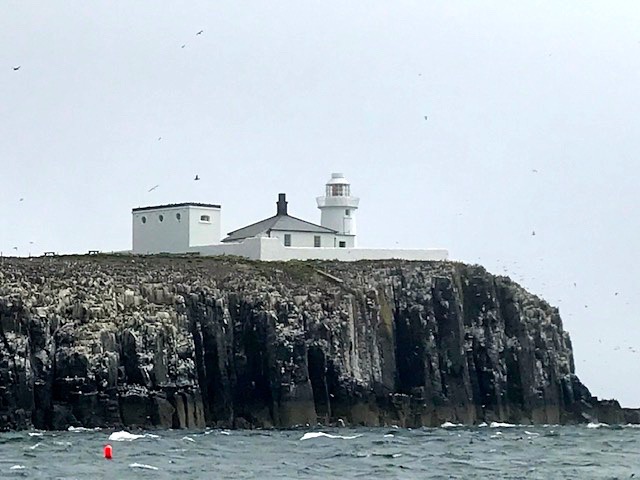
The Great Whin Sill is a belt of coarse dolerite igneous rock that runs across Northumberland, an undulating series of weathered ridges and hills millions of years old, largely defined for at least 2,000 years through use for defensive purposes. These heights carry the Roman Wall and Georgian military road in the south west and are topped by great fortresses on the north-east shores at Bamburgh and Dunstanburgh, before stepping out to sea as Holy Island and the Farnes, where monasteries and saints cells mix with peel towers, lighthouses and wildlife havens.
We sailed on one of Billy Shiel’s numbered vessels out of Seahouses for a two hour sightseeing trip round the Farne Islands. In this time of Covid landings by the public are not currently allowed. Partly as a result Puffin numbers for last year show that their population increased because the birds have more undisturbed holes in the ground to lay their eggs in and raise greater numbers of ‘pufflings,’ as their young are rather charmingly known.
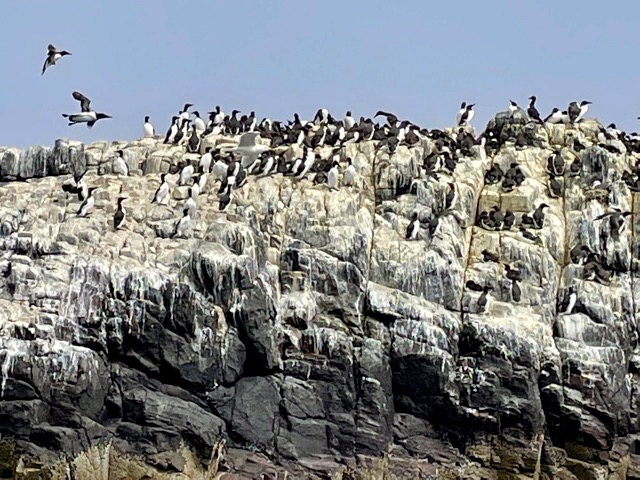
Our voyage round the island group took in (amongst other highlights) the UK’s largest colony of breeding Atlantic grey seals and close up views of the guano covered mini-cliff faces where vast numbers of guillemots outstrip the other seabirds who nest there. Along with razorbills, terns, puffins, eider they raise an acrid smell as pungent and impressive as the sight of them wheeling, slicing, diving and gliding all around us. It was disappointing this mist wrapped morning only gave limited visibility yet at the same time the restriction made for an experience as powerfully eerie and atmospheric as any ghost story.
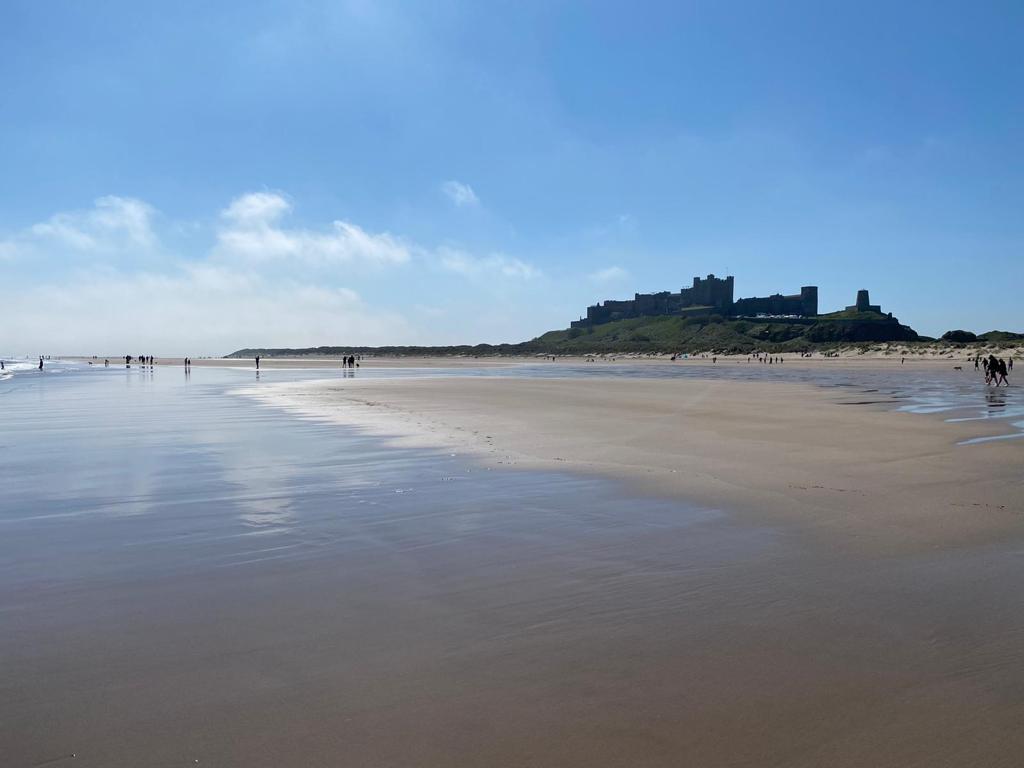
Another day, from Bamburgh Beach, the islands could be seen clear as a bell. It was here in 1786 that experiments by London coach builder Lionel Lukin, commissioned by dynamic local clergyman and social activist, the Rev. John Sharp, saw a coble (traditional coastal fishing boat) converted into a prototype ‘unimmmergible’ lifeboat. The view reminded me too of young Grace Darling, whose gallant efforts with her lighthouse keeper father to rescue by rowboat passengers and crew of the ‘SS Forfarshire’ wrecked off the Farnes one storm lashed night in 1838 made her a national heroine. The popular RNLI museum in Bamburgh is named for Grace Darling.
Emboldened by being clad in a wet suit I slid into the swell before diving into the North Sea’s cold embrace. I love this beach, all three wide open miles of it. Especially as I’m a weak swimmer, a late learner, wary not to get out of my depth, so happy to trust to the strand’s gentle sandy slope. Immersion in such a sea, however cold or relatively brief, makes me sublimely happy and unbounded.
The beach may be busy, but this one’s big enough to cater for all holiday hungry humans, our presence muted under a huge sky, at one with the constant rumble of the beating sea. We sunbathe in our settlement in the dunes ascending to the base of the massive rock formation on which the mighty castle keeps watch. A medieval stronghold rescued and restored by the Victorian armaments magnate Lord Armstrong, whose family still own and occupy it, Bamburgh Castle has been photographed countless millions of times.
This week and next the castle immerses itself in another venerable character role as the setting for the fifth movie in the Indiana Jones franchise, starring Harrison Ford and Phoebe Waller-Bridge. I watch fascinated, in a break between playing beach cricket, as a huge crane anchored this side of the castle extends its long hydraulic reach to lift and finally, after much adjustment, position another self contained lighting rig where required, above those already in place on the walls, in readiness for the eventual shoot.
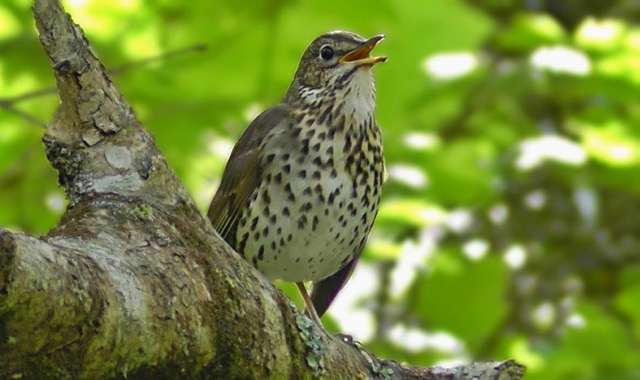
The entertainer that stole our hearts though was the busker we heard running through his versatile repertoire before we actually spotted him. A song thrush, perched on a fence at the castle’s foot, where sand dunes gave way to tarmac and the way back to the car park.
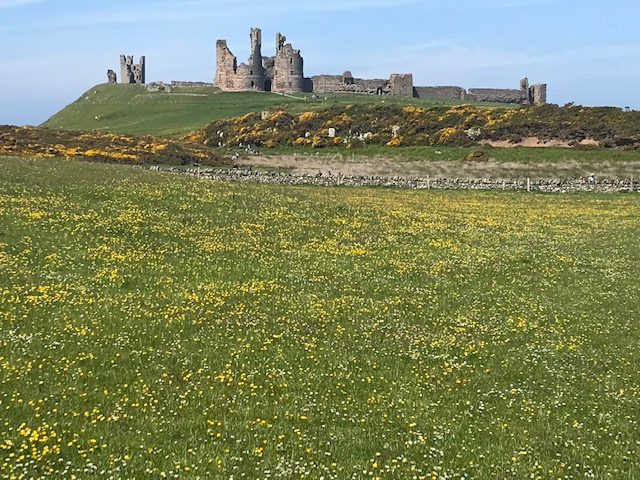
Bamburgh cannot fail to impress with that look-up-at-me and I’m-still-standing power. Dunstanburgh, by contrast, impresses with its distinctive ruined spread (at nearly 10 acres the biggest castle by area in the county). After a meal at the Jolly Fisherman pub in Craster we dutifully joined the procession of secular pilgrims following the trail over fields owned by the National Trust to the castle run by English Heritage. The trust’s tenant farmer had pastured a herd of bullocks in the big field we had to pass through which stirred things up a bit. Disorientated by so many dogs the beasts were scarily frisky for many of the visitors, who made wide berths.
The ruined fortress within its isolated enclave had an aesthetic attraction for late Georgian artists like Thomas Girtin and J M W Turner. The Victorians, more prosaically, fashioned a golf links on the opposite side. For me Dunstanburgh has a particular interest, as a former Lancaster Castle guide, because it was created by the age’s richest noble, Thomas, earl of Lancaster. Thomas was executed for rebellion in 1322 by Edward II after being captured at the battle of Boroughbridge, before reaching the safety of his newly created northern bolthole. The earl’s famous descendant, John of Gaunt, rebuilt and strengthened the castle. Interestingly it would have originally been surrounded on the landward side by three shallow lakes or meres which, apart from acting as a defensive moat, would have reflected and magnified its bulk, a signal to rival Bamburgh castle in sight up the coast that you might be higher but I’m bigger!




















 STEPHEN TOMLIN