Sugar and Snow

I’ve brought some snowdrops; only just a few/But quite enough to prove the world awake /Cheerful and hopeful in the frosty dew/ And for the pale sun’s sake. (From:’The Months – A Pageant’ by Christina Rossetti)

Recent triple whammy storm events meant we had to call off a weekend trip to the Derbyshire Dales to visit family and friends. In between those mighty gales a calm sunny Saturday gave us compensation by way of a cross county drive to Howick Hall gardens and its neighbouring stretch of coast.

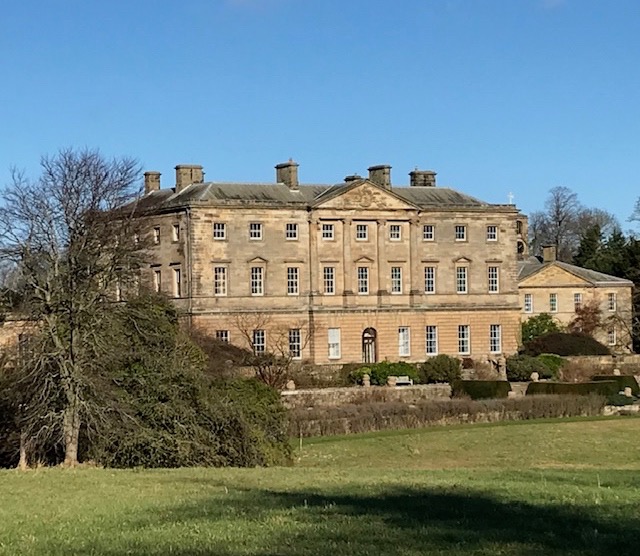
Howick is a horticultural treat at any time of the year. The Grey family have been in residence since the early 16th century and the present house dates from 1782. The dynasty were not great art collectors or connoisseurs; the line’s great legacy, shared all year round with the visiting public, are the many acres of gardens and woodlands that surround and shelter their late C18th Palladian mansion.

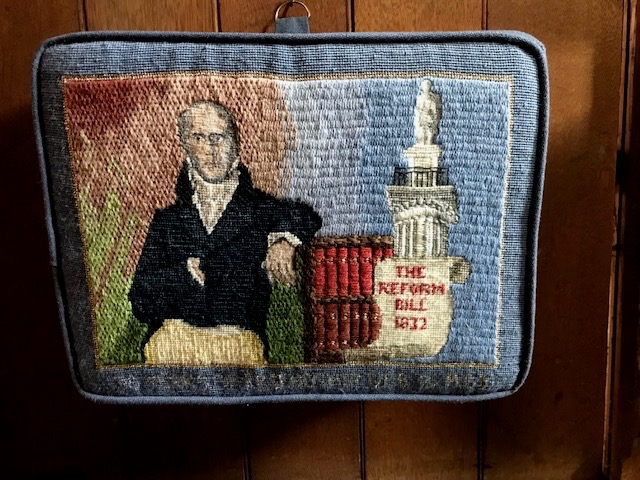
Earl Grey tea is named for the second earl, (1764-1845) leader of the Whigs who oversaw the passing of the Great Reform Act of 1832 and whose memorial statue atop a pillar famously dominates the centre of Newcastle. What more fitting drink to round off our afternoon visit than that particular beverage, part of a cream tea, enjoyed in the faded elegance of the spacious tearooms overlooking the extensive flower borders. Formerly the grand ballroom this part of the west wing later became a hospital for wounded soldiers during World War One.

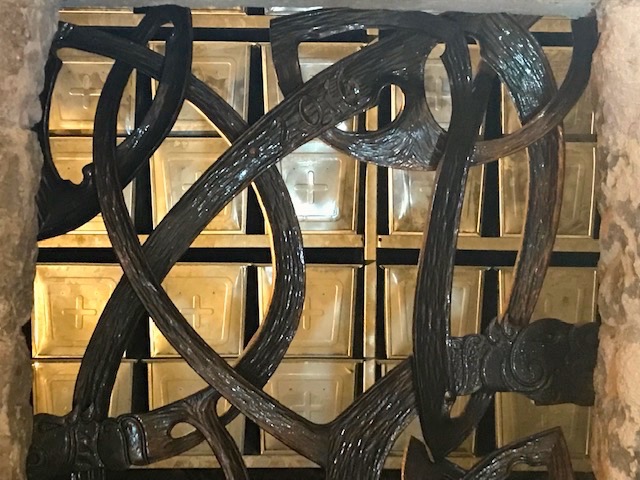
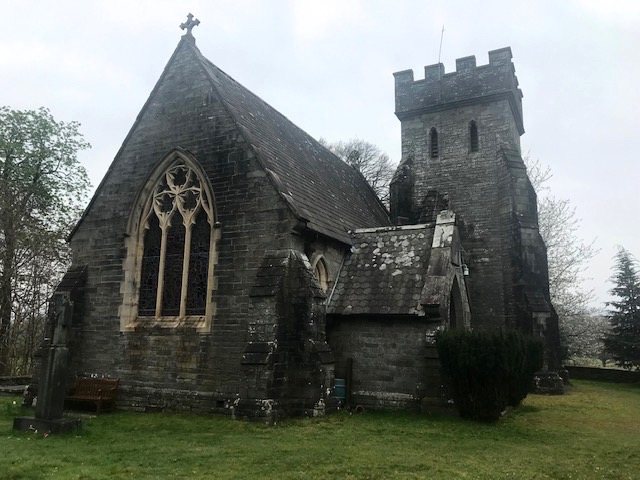
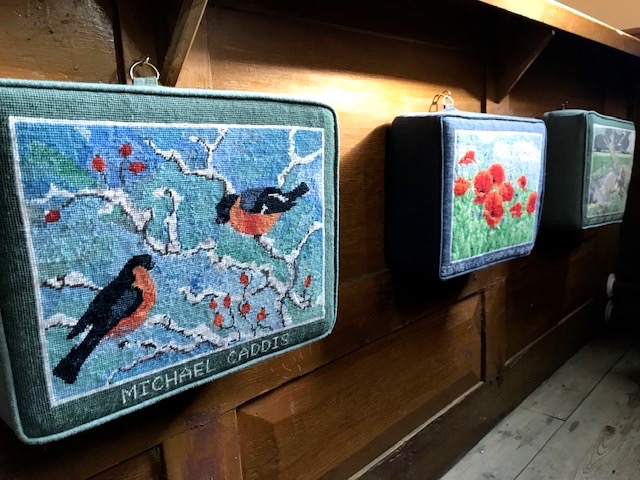
The Victorian church of St Michael & All Angels in the grounds houses the impressive marble tomb of the famous statesman. More unusually, as we discovered, works of art hang here too. Not paintings or drawings but a collection of 92 embroidered kneelers stitched by local craftspeople, inspired by images reflecting aspects of life and history on the estate, from family portraits and dramatic events to natural history, farming and horticulture. All skillfully rendered, with a tender touch, evoking the unique spirit of place and continuity.

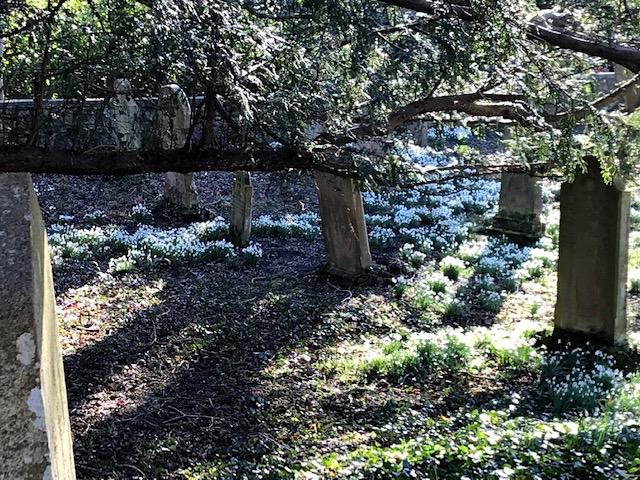
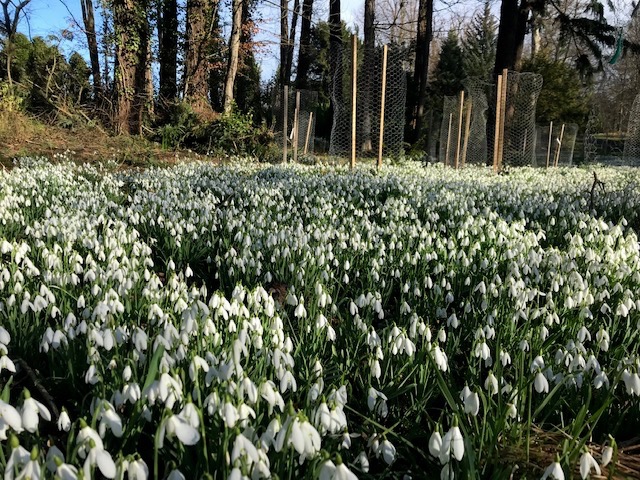
The extensive grounds rotate their star attractions with each season. The family tradition of gardening and tree planting has resulted in a fine arboretum and impressive woodland garden. The informal and natural style promoted by the 5th earl, his wife Mabel and daughter Mary from the early to mid 20th century is still maintained today and it’s a delightful legacy to explore. Great bulb enthusiasts, the drifts of snowdrops they planted have happily spread and hybridised and this was the draw for today’s visit. The little flower loves damp soil in broadleaved woods and everyone appreciates it, seen en masse, as a welcome harbinger of Spring. I love the fact that US soldiers stationed in the British countryside in WW2 were nicknamed ‘Snowdrops’ for their green uniforms and white caps or helmets.

Snowdrop (Galanthus Nivalis) is a bulbous perennial that owes its official name to the Greeks, meaning milkflower, and was also known to them as ‘white violet’. First referenced in England in the late C16th as a garden ornamental it’s not until the late C18th that it’s recorded as growing wild – having escaped its confines in the formal garden and finding the perfect conditions of our climate to its liking.  Early pollinators, like bees, love snowdrops but its main way to spread is by bulb division. The bulbs themselves are poisonous when eaten but have long been used medicinally to treat headaches and nervous system injuries. In our own age a compound extracted from the bulb, galantamine, is used to treat dementia.

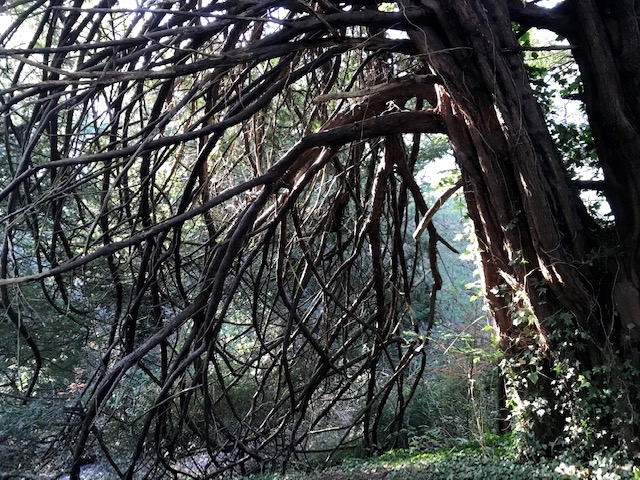
Sightings of yellow winter aconite and hellebores in amongst  the swathes of whiteness cheered the eye while the many types of trees imported from all round the world, soaring above us, were a graceful addition to the scene. Bare forms appreciated for their structure, with buds and emerging foliage in places hinting at glories to come. My favourite tree was a multi stemmed yew poised on crutch like branches above the steep slopes of the Howick burn, where yet more leggy snowdrops stretched skywards between dense ground cover of fern, bramble and bushes.

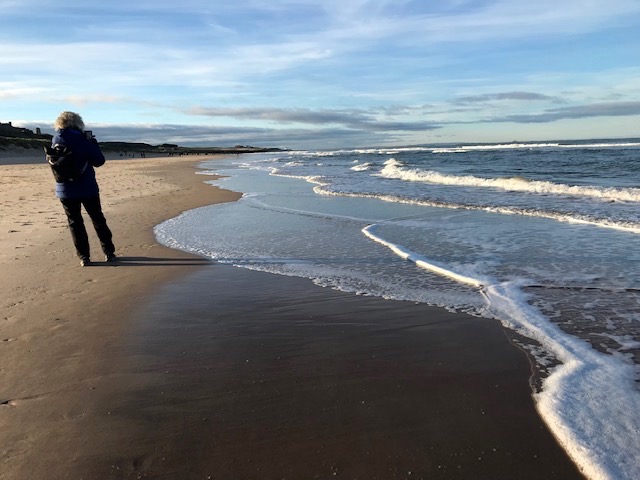
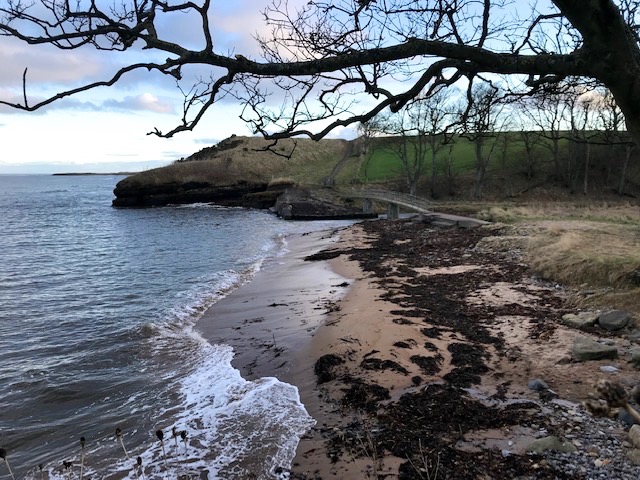
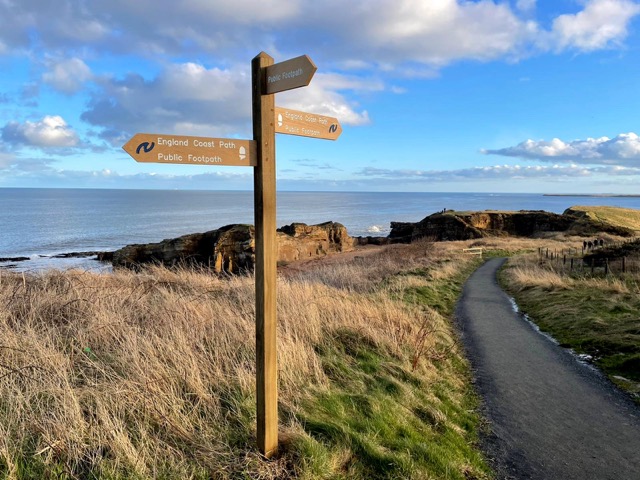
We drove on to the coast, an easy mile away through flat arable fields. Normally one can follow the burn through its wooded dene (valley) curving eastwards to meet the sea but the storms had brought down trees and that path has been temporarily closed. We followed the hard surfaced official English coast path instead, to eventually meet the stream where it debouches into the North sea, under an arched bridge carrying our path. Attention held by the rapid grey-green water of the burn below merging and losing identity within the brown choppy sea water, present here at high tide. Pressed on up the slope to look down towards Sugar Sands at sun set. Need to return another day to visit properly.

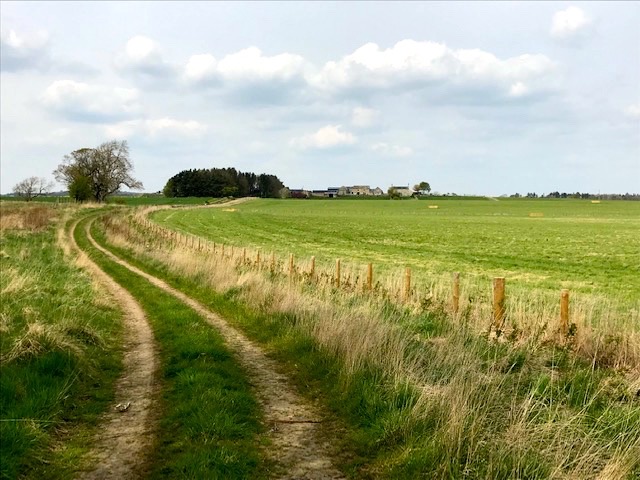
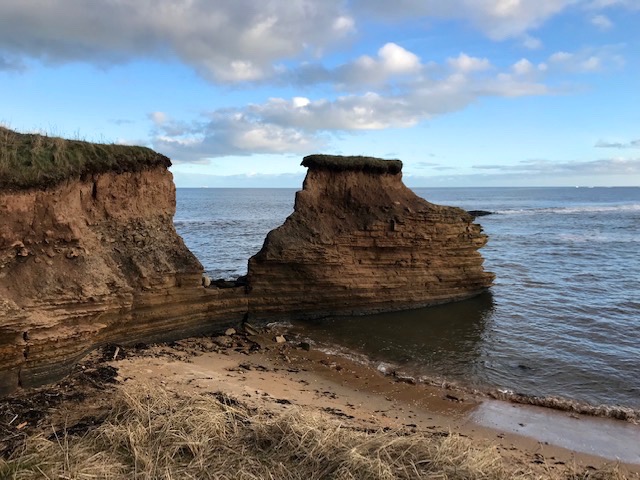
Our walk took us past photographers silhouetted on grassy headlands with serious looking kit, a variety of joggers and a clutch of well insulated fishermen by their tripods of resting rods and gear. Struck by stranded strata of eroding low cliffs, isolated from the main. We left the path to return higher up on a rutted field track, pausing as the light faded to take in the playful antics of a trio of hares over bare ploughed land by a low bank from whose cover they emerged and eventually disappeared back into. Another welcome sign of spring, which – we all agree – can’t come soon enough.

Blue in the Face

Took a short stroll between weekend storms in a near deserted countryside down the dale from our home. Simonburn is an ancient settlement whose parish, up until 1814, claimed to be the largest in England, stretching some 33 miles from the Roman wall right up to the Scottish border.

Photo Credit: Geograph.org.uk W F Millar 2010

A glimpse of the grand former rectory off the delightful village green underlines that former status. It was the rows of humble estate cottages that helped single it out in more recent times as a perfect location for a TV mini-series dramatizing the novels of Catherine Cookson. Simonburn has also featured in an episode of ITV’s police drama series, ‘Vera’. The dignified 13th century church of St Mungo overlooks the Crook burn, whose course we followed for much of our three mile ramble, mainly on single track lanes servicing scattered farms and hamlets.

I was amused by this accidental artwork at an elbow of lane where valley woodland had given way to open high pastureland. Hopefully it really does function well as a reflector in the mist or at night.

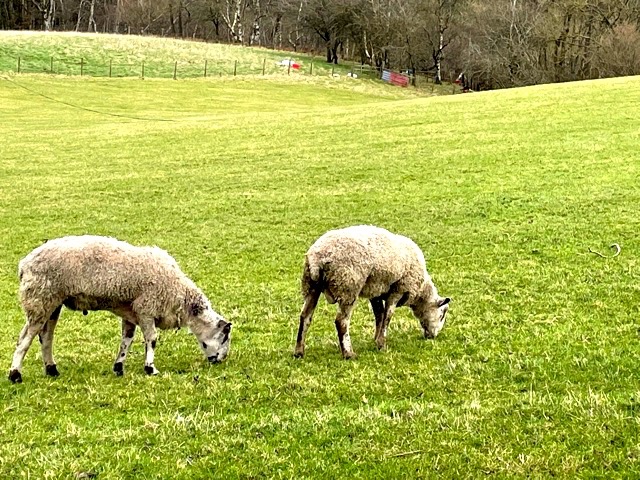
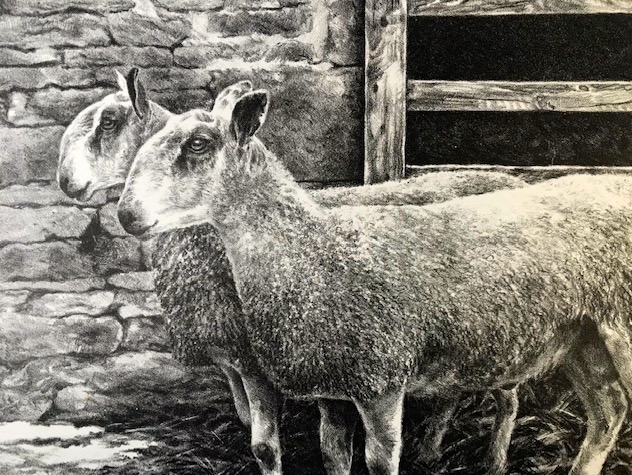
We pause to admire a gang of impressive rams with prominent ‘Roman’ noses. These are Bluefaced Leicesters and Kim knows the family who farm here. Their flock produces many fine exemplars of the breed and she was commissioned back in 1984 to record the distinctive profiles of a pair of their prize tups.

Kim Lewis pencil drawing on paper of Blue Faced Leicester tups

Blue faced Leicesters (BFL) originated in the 18th century near Dishley in Leicestershire, bred by agricultural innovator Robert Bakewell from traditional Leicester Longwool stock. So enthusiastically was this new ‘improved’ breed taken up in Northumberland they quickly became known as Hexham Blueface. Today, when interbred with hardy hill sheep, their prodigy are known as Mules, and remain a common sight on sheep farms across the north.  Although principally kept for meat the wool of BFLs is much sought after by hand spinners who value its curly, fine, soft and lustrous wool clip.

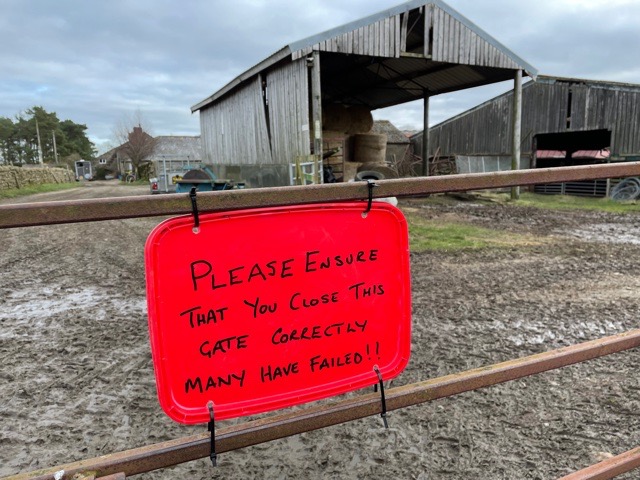
We leave the lane to continuing its way up to Hadrian’s wall at farm road’s end and follow the yellow public footpath signs through its yard, by barns and sheds. As the gate was already open we’d no need to meet the farmer’s challenge!

It proved much more challenging, on leaving that yard, not to tumble down the field’s precipitous slopes, with lateral sheep trods more obvious than the public footpath. This sort of landform is typical hereabouts with fast streams cutting through sandstone gorges where dense woodland survives on land too steep for sheep or cattle to graze. A valley topography with a mix of native broadleaf that’s infilled or supplemented with commercially grown conifer.

A wooden footbridge spans the Crook burn and we ascend the other side past great beeches, oaks and ash marking an ancient banked narrow track just below the delineated footpath we are following. Moss coated and grassed over, it would once have had packhorses and carts passing slowly along its gradient.

Back on the level, we take in fine views across the main river valley as we pass between a cluster of rather fine old farm buildings. Simple elegant farmhouse, old granary with exterior steps, cobbled yard with arched housing for carts etc. Glad to note too a low cut but exceptional wide field hedge, alive with small birds dashing back and forth, A spring runs off here as a rivulet run alongside the pleasant farm lane we follow back to the metalled single lane. A clutch of mature ash trees have been felled here in recent times, sad trunks remaining waist high in the roadside bank. Victims of die-back perhaps? Our little lane drops us back down to the start. We cross the Crook burn once again by a recently repointed stone bridge and banking. It’s solidly built to withstand and channel the most testing of floodwaters, both underneath the high arch as well as draining the steep roadway that descends and rises either side.

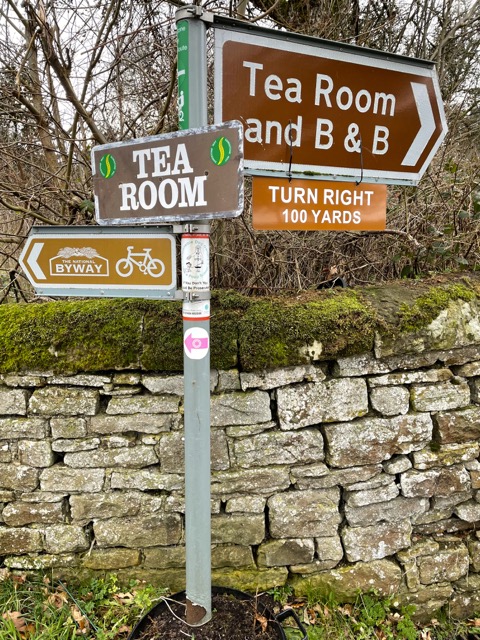
The tearoom is a popular stopping point for visitors & locals alike

On Watch Hill

Our last few walks have explored the north Tyne at its source and nearby where it enters Kielder Water. Last weekend we travelled some 30+ miles downstream to where the north Tyne meets the South Tyne, just outside Hexham, below Warden. There’s been a hill fort or lookout point on the great hill here for as long as warfare or armed incursion have been part of everyday life; from the Iron Age, if not before, up to the 17th Century. The name Warden comes from the old English ‘Weard-dun’ meaning watch hill and this broad rural peninsula between the two rivers, roughly triangulated on the north side by the Roman wall and road (Stanegate) is one steeped in history. Our 3.5 mile walk followed well trod paths and clearly marked bridleways. The latter is also part of the Sandstone Way – a long distance cross county cycle route between Berwick & Hexham.

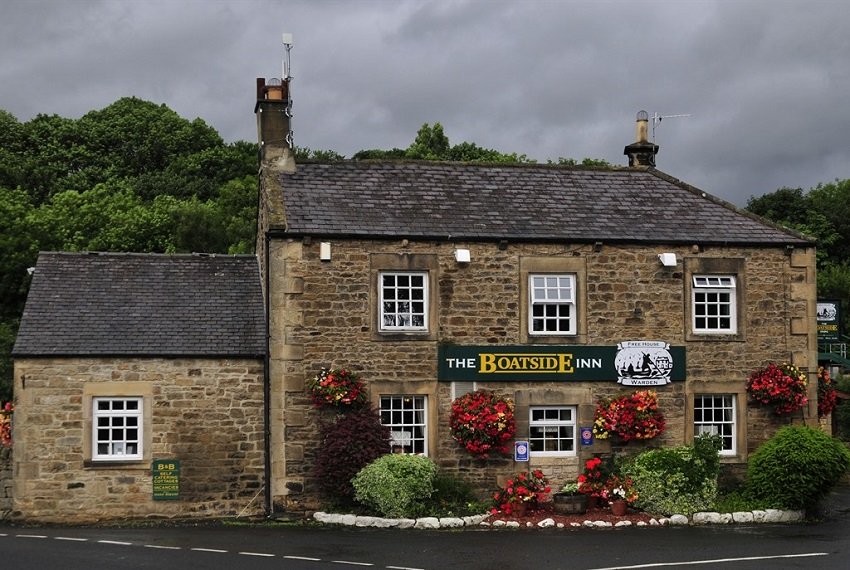
We started and finished at The Boatside Inn. The name a reminder that a ferry once plied its way across the South Tyne here, a half mile before its confluence with the north Tyne. The ferry was eventually superseded by a bridge in 1826, with the current road bridge dating from 1903.

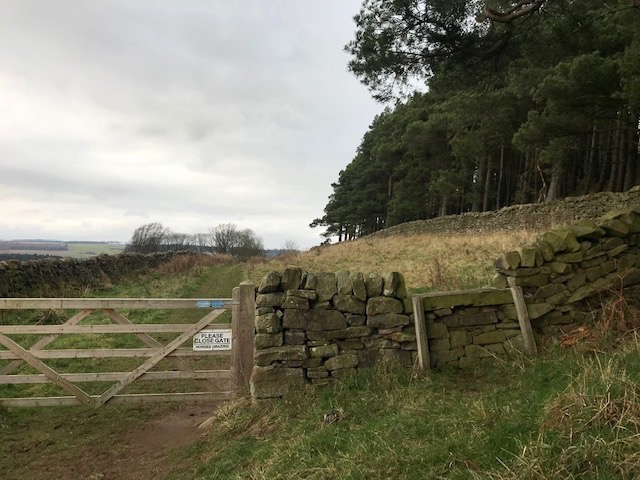
A narrow, fence lined path parallels the railway before joining a broad bridleway that crosses it by former railway workers cottages. With room to breathe again we made the first steep ascent of Warden hill, through stone walled pastureland and alongside mature woodland. The Newcastle-Carlisle was one of the first intercity lines built in England and revolutionised the economy hereabouts. The view up the broad south Tyne valley gives few hints of it today, but from the mid 19th to mid 20th century quarries and coal mines linked to the (now closed) Fourstones station and sidings would have dominated the scene.

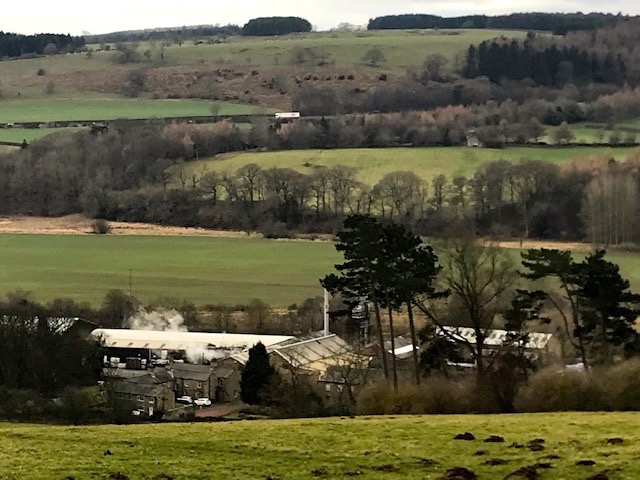
The only major industrial activity remaining today is one that predates the railway, by whose riverside embankment and level crossing it lies. The Fourstones Paper Mill Company, established as the Warden Paper Mill in 1763 by bookseller William Charnley, supplied handmade paper for the burgeoning Newcastle book trade. The old mill was not mechanised as such until the 1860’s and today produces a range of paper products from till rolls and toilet rolls to disposable pads and heavy duty wipes. I love the fact that during the Napoleonic wars the business was commissioned by HM government to produce counterfeit banknotes that would be used to undermine the French economy.

The view absorbed, we switch backed on upwards through the woodland. Being on the south side of the great hill and relatively sheltered the many scots pines here have remained unscathed by Storm Arwen. By contrast, we later witnessed on the northern flank of the hill extensive storm damage to mature beech, oak and pine.  

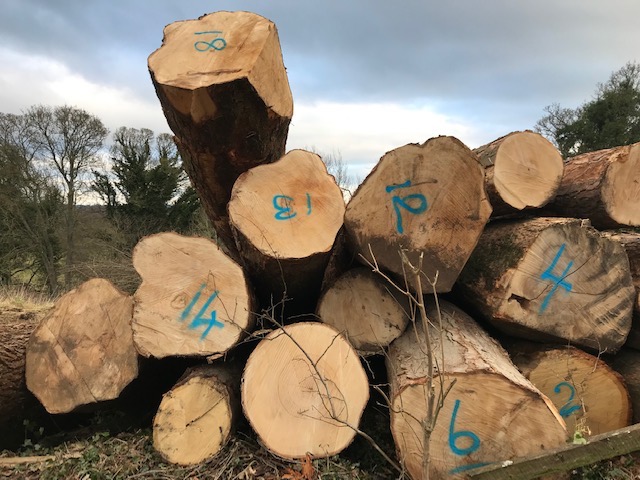
Did not divert to the summit on this occasion but instead continued with the gently descending track leading into the valley of the north Tyne, through the Warden estate and home farm with its outbuildings, paddocks, tied cottages, walled gardens and parkland. Lots of fallen trees in evidence and later, joining the valley road, saw more felled timber awaiting collection. A small yellow bulldozer and forwarder (trunk carrier) were parked in the ploughed up verges and field tracks. Later research revealed that, out of sight a few hundred yards up the steep slope, is the site of a motte and bailey castle. Just one of many ‘pop-up’ wooden forts built by colonising Normans in the late 11th Century. Like so many others it would eventually be abandoned, but the fact that it maintained the ‘watch hill’ function, here above the meeting of the waters, is significant in itself.

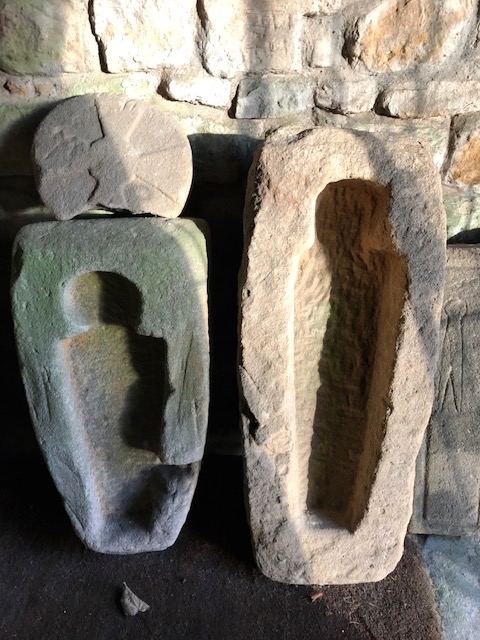
A welcome diversion, when back in the valley bottom, was a visit to the parish church. It has an unadorned interior lifted by fine Victorian leaded glass windows. An ancient holding of nearby Hexham Abbey, St. Michael’s was rebuilt in the mid 18th century on its original Saxon foundations. The building retains a distinctive late Saxon tower, the remains of a 7th century cross outside, while in side the porch are housed Roman stonework reused as Christian burial slabs.

An imposing stone and timber neo-gothic lych-gate from 1903, commands the entrance to the churchyard but the features that struck me most were the three graves next to it that still had their metal ‘mortsafes’ intact. In the 18th & 19th centuries exhuming freshly buried corpses for medical dissection was not uncommon. To prevent such illegal activity families could take extra precautions like this – usually as a rental from the sexton until the bodies were decomposed – to ensure their late kin really did rest in peace.

You can’t begin a walk from a pub without paying a visit at the end. As we were with friends and their dog we sat with our drinks and food in the big tepee the Boatside had had erected in the garden during lockdown. Another wonderful walk in good company and looking forward to more rambling discoveries.

Long Tails and Trails

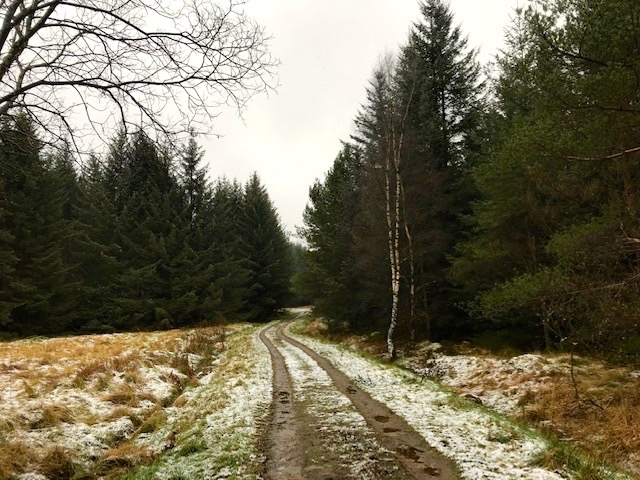
The new year brings every kind of winter weather. A new circular walk for us in a different part of the forest, on gravelled access roads through dense plantations of mature sitka spruce with clearings fringed by willow, birch, alder & oak. The tracks following the shallow vales of two sikes (streams) both on the way up and on the way back round.

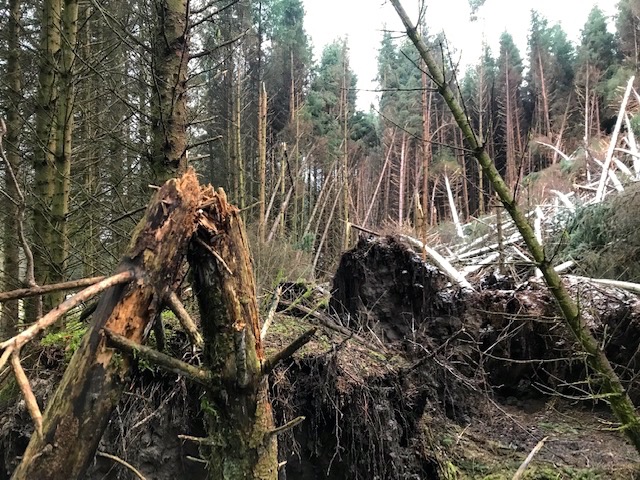
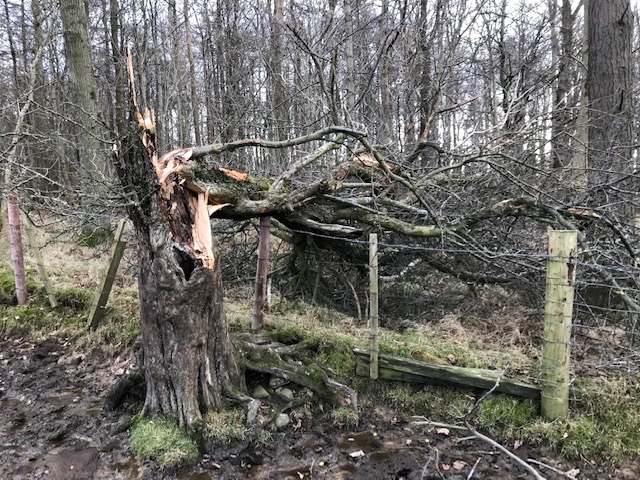
Damage caused by Storm Arwen very marked in places where the lie of the land caused funnelling of those fierce northerly winds. Pole straight conifers felled like skittles taking others down in their wake with some snapped like twigs. With bridleways blocked we’d no option but to stick to the roads.

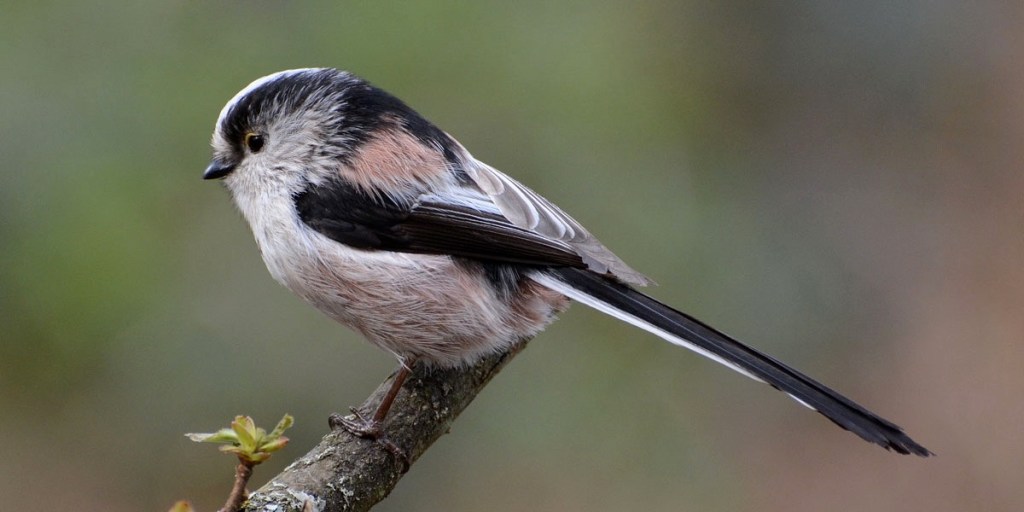
Attention caught one afternoon by the dot dash flitting passage of a flock of birds filtering through ash and aspen. Their silhouettes pronounce them to be long tailed tits. We rarely see them so close to the house, and if so only briefly in winter as they quarter trees in the garden copses for insects and grubs secreted away by buds, bark and joins. The following afternoon, late, they returned for another forage. I happened to be standing under one of the birch trees so froze as the flight came in to land just over my head, systematically working their tiny needle beaks over the lattice of branches communicating with high whistle calls I’d never normally hear. This glorious brief immersion made a dull day shine. Meanwhile…At the bird feeder a newly hung column of seeds attracts a charm of goldfinches, flashing dabs of yellow and red, to lord it over the rest of the avian gang. Eventually the regular tits, chaffinches and sparrows adjourn to a replenished column of fat balls set up on a nearby tree, and harmony is restored. 
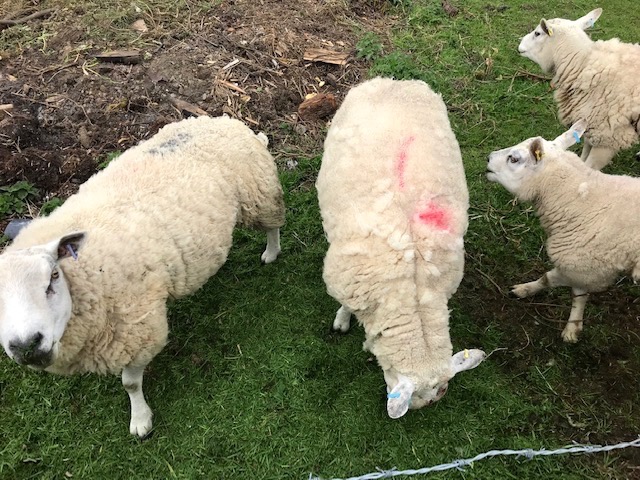
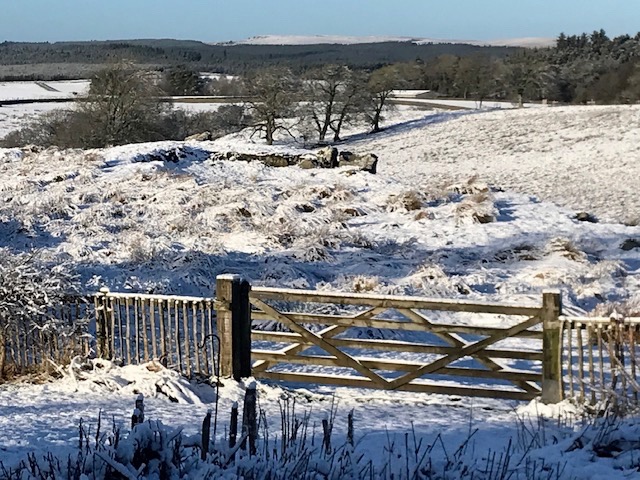
Just over a week into the new year we wake to a snow covered landscape. Southridge loads hay with ring feeder into the front field for their pregnant ewes. An early morning welcome tanker drop with oil for the Aga secures another 1000 + litres in the garden tank. A late afternoon walk in our field and Southridge’s adjoining pasture reveals a trail of a fox in the snow, who has easily scaled stone walls on the way up from the wood in the valley of the burn below. Also the long and short imprints of hare on the crags. The valley wood’s oaks drip where their trunks and branches reach over the field. Returning homeward on the road, the setting sun illumines snow as a sublime beautiful shade of pink.

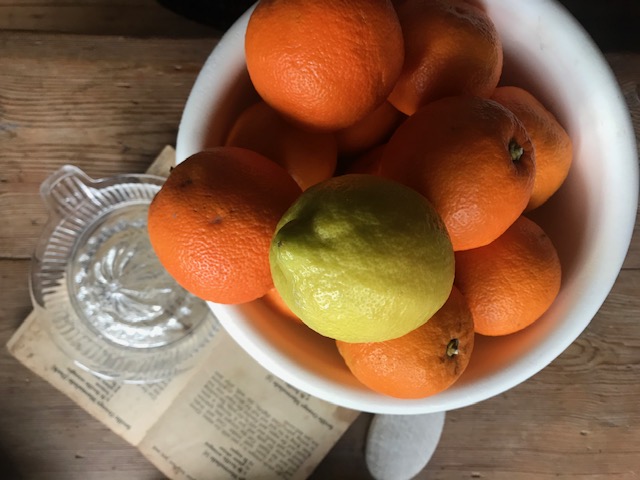
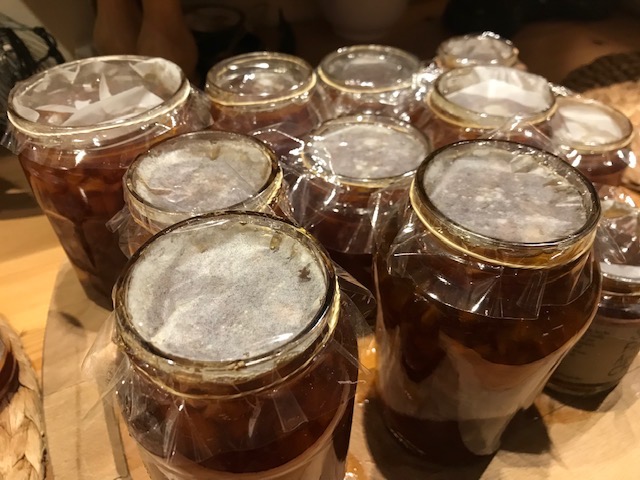
That time of year again. Seville oranges for marmalade making with a lemon and grapefruit thrown in for good measure. The glittering fall of white sugar added to the boiling mix. A big dollop of treacle changes the colour and adds to the taste. Thankfully setting point arrives early. Final bottling and labelling of the batch.

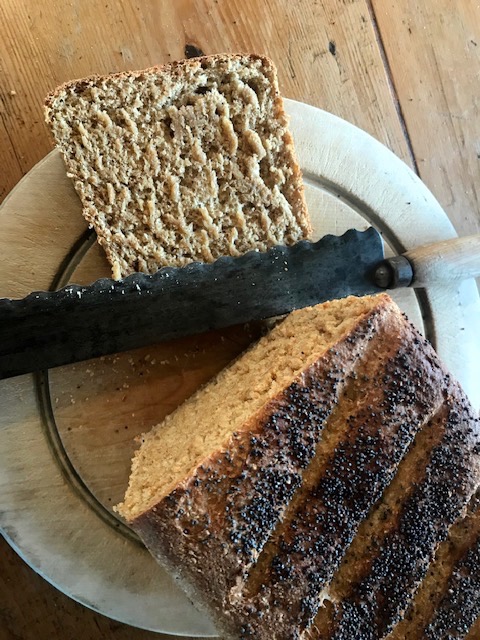
Always enjoy making bread at home. I favour a 50/50 very strong white, wholemeal mix with black treacle stirred into the yeast, sometimes also adding beer to the tepid water in which it rises.

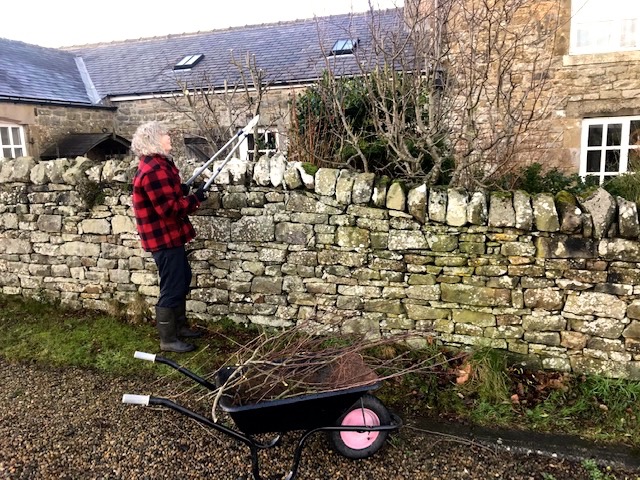
A clear dry windless day so we get to work pruning two of the hardest to get to apple trees out front. Kim more ruthless than I at this game while I’m left to do the highest branches using the stepladder. Beautiful apple wood cut branches will be used for plant support with lesser cuts fed to the chipper in due course.

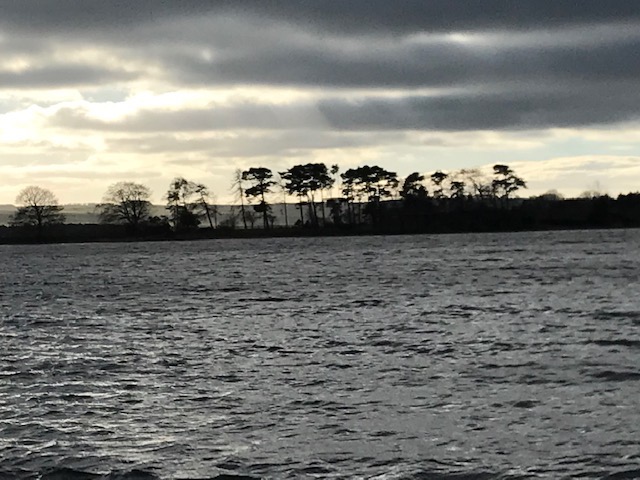
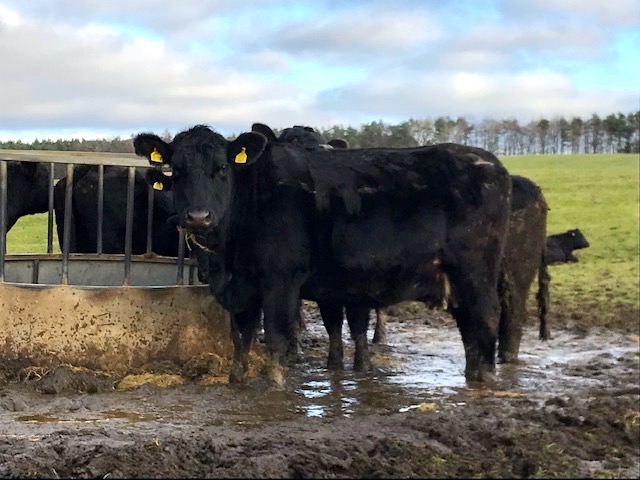
A walk in windy weather round a nearby reservoir reveals it at near full capacity; the exact opposite state we found it in on our last visit at the end of summer. To get there and back we pass through a field, poached by a placid herd of handsome black cows. Take in the sweet warm smell of silage drifting over the chill air from their ring feeder.

Dismayed to see the grand old crab apple tree snapped, its forlorn trunk drapped over the woodland fence and a handful of green apples on the bare bough. We’d picked a big basketful of fruit there on that last visit.

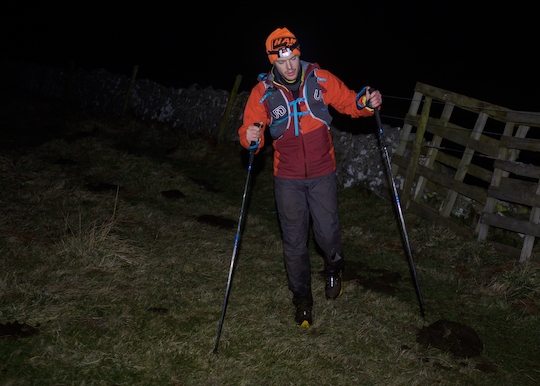
The effects of Storm Arwen are still being felt elsewhere too. The Montane Spine Race, now in its tenth year and billed as Britain’s toughest ultra marathon race, passes alongside our garden and field. This gruelling competition takes place over a week and attracts athletes from all over the world to run and walk 268 miles of the Pennine Way National Trail, by day and night, from Edale in the Derbyshire Dales to the Scottish Borders.

As we sit by the firepit on our deck chatting with friends white lights flicker through the undergrowth and another runner passes, headlight seeking out the well trod muddy path leading away into the enveloping night. Earlier, chatting to race marshals parked in the nearest layby I was told that the Forestry Commission had stopped competitors passing through the Kielder Forest leg of the race, due to the danger posed by fallen and unsafe trees. Instead participants were being bused 15 miles from the rest point at Bellingham up to Byrness where they could resume their solo expeditions into the high Cheviots and beyond, to the finish at Kirk Yetholm.. 

Down to the Waterline

Our latest walk took us back to Kielder village, where old friends who know the area well led a short walk full of variety, picking up on the themes of rail and river that dominated my last country diary entry.

The deliciously named Bakethin nature reserve was our start and finish point. Its immediate environs have taken a bit of a battering, post Storm Arwen, with lots of conifers down, blocking some public walks and rides. Perhaps the deciduous trees that have colonised the steep flanks of the former railway embankment here are more wind resistant and better anchored to avoid being dislodged. An avenue of them, their stark lengthy limbs encased with moss, flank the ruler straight old trackbed now reserved for pedestrians and cyclists.

The magnificent structure it leads to is the Kielder viaduct, that carried the former Border Counties Railway (completed 1862) over the north Tyne. By this point, some five miles from its source, the river has attained a wide girth as it merges seamlessly with its vast flooded valley, created in the 1970’s to become the country’s largest man made lake. The viaduct is stone built and graced with a battlemented top and arrow slits to match the architecture of nearby Kielder castle, a contemporary neo-gothic hunting lodge built for the duke of Northumberland which now serves as a visitor centre and café during the tourist season.

Because it crosses the river at an angle the viaduct was erected as a screw arch, which elevates its architectural status even more. Hard to think now that following the closure of the line in 1958 the Forestry Commission wanted to demolish it. A conservation battle ensued and the viaduct was eventually acquired by the Northumberland and Newcastle Society who repaired and renovated it. In recent times illustrative metal panels, inspired by wildlife and designed by local schoolchildren, have been fitted between the battlements, which in turn renders it more secure in the modern age for families to cross.

The way passes on through waterside pastureland. For the last fifteen years or so the commission have been utilising Exmoor ponies, those champion conservation grazers, to naturally manage their non-forested land hereabouts. The current two tenants of the field, out of curiosity or hunger, made their way up to us at the fence. With distinctive mealy coloured snouts and rugged chestnut coats these tenacious, well adapted animals live outdoors all year round in the most testing of conditions and can survive without supplementary feeding. That said, they are clearly used to garnishing titbits from passing pedestrians!

Binoculars reveal the nature reserve’s public bird hide half hidden in the trees on the opposite bank.

Further south are the concrete fixings of the massive movable weir that separates and regulates water flows between Bakethin reservoir and larger Kielder water beyond.

We’ve now reached the point where the descending trackbed slides gradually out of sight under the water’s surface. Like the river it parallels, the old line will not appear again for another ten miles or so, emerging in the shadow of the great dam down at Yarrowmoor. Drowned farms, cottages and the station at Plashetts lie somewhere out there under that grey expressionless expanse of water.

The return leg of our perambulation is made on a stretch of the round lake 26 mile long track constructed by the Forestry Commission in more recent times to give greater leisure options, from cycling to walking and running – the Kielder marathon being one of the most popular in the country. This rain bound hard core track has generous drainage ditches with numerous conduits and bridges to cope with the area’s high rainfall and subsequent run off – a quietly impressive modern day engineering achievement.

A short diversion on returning to our parking place was made to a nearby nature pond complete with wooden jetty and raised, touch friendly, metal markers that introduce visitors to the insect life living below. Children, bring your own dipping nets…who knows what you might discover here!

A short but revealing circular walk, mainly on level ground, with gradual inclines, perfect for families and just right for a dull January afternoon. Made us want to revisit another time, to witness seasonal contrasts. Hopefully those forest tracks will be cleared by then, to make a stroll to the reserve’s bird hide possible.

Rail and River

So walk with me, Aye and talk with me / Be a friend of mine/ And we’ll walk together hand in hand,/ By the banks of the bonny north Tyne [Chorus to ‘The Banks of the Bonny North Tyne’ by David McCracken]

Our new year’s day walk combined my love and interest in two things; railways and rivers. In search of this happy union we took a leisurely drive alongside the nation’s largest man made lake and forest at Kielder, feeling we might well be in north America or Canada, not the north of England.

We park beyond Kielder village, in a finger of forest between hills, relatively mature and open structured.  Strolled past resting machinery and harvested tree trunks waiting collection on what was turning out to be a busier than expected C road. We eventually broke free of the confine of conifers to take in views over bleakly beautiful fellside under skies weighed with scattered dark clouds.

A handsome cluster of grey stone farm buildings embedded in the shoulder of hillside to our right turned out to be Deadwater Farm. The monument marking the source of the north Tyne river lies on its land, and we need to walk a little further to the actual border with Scotland to pick up the permissive path that leads us to it, some 300 yards uphill.

Thanks to regional charity ‘Daft as a Brush’, founded by keen walkers to provide transport logistical support for cancer patients, the respective courses of south and north branches of the Tyne from source to sea are way marked as a long distance path…A total length of 135 miles.  

Sculptor Gilbert Ward’s work of 2013 is a simple modern menhir, fourteen solid feet of sandstone, donated by a local quarry and which had to be lifted in place by helicopter. Our river’s spring source could not get any nearer to being in Scotland, securing its emergence in England by a whisker. Unlike the mighty River Tweed which demarcates the border at the other end of Northumberland, this barely perceptible trickle would escape notice entirely by anybody driving over the culvert that marks the first of its many crossings.

I take an amused delight in straddling the rivulet as it emerges to gurgle down the gentle slope to the flat valley bottom. There we temporarily lose sight of it in the bog and tussocks either side the raised trackbed of a disused railway.

The 42 mile long Border Counties Railway opened in late 1850’s and closed a century later, pre-Beeching report. It had branched from the Newcastle/Carlisle line outside Hexham to weave its way through the whole length of the north Tyne valley before crossing both border and watershed at this point to join the former Waverley line, connecting Carlisle with Edinburgh, at Riccarton Junction, via Saughtree.

We passed Deadwater station, a single storey stone cottage on its lone platform; now a private house. There’s space for sidings and the lost spurs to two nearby former limestone quarries, the greened over spoil heaps of one obvious in the nearby hillside. No sign though of the well house for restorative bathing that once stood hereabouts in the 1820’s. How such an establishment could sustain itself in this remote and hard to reach setting, pre-railway, is a mystery.

The cinder dark trackbed, now a shared cycle & walk way, leads us straight as an arrow between forest and reed filled mires back towards Kielder. From here our peat coloured stream finally breaks cover, when conjoined with a first proper tributary, to assert its presence. At this point I begin to feel this other stream, the Deadwater Burn, might have a greater claim, by virtue of length and volume alone, to be the real source of the north Tyne. I also can’t help musing if ‘Deadwater’ had picked up a capital D and dropped an H at some point in its etymological history.

My eyes are drawn to a prominent monument as informative as the one marking the river’s origins – the military radar installation atop Deadwater Fell some 2,000 ft. up, from whence the burn of the same name springs. We are after all in Reiver country, the lawless borderlands of medieval and Tudor times crossed and re-crossed by clans of marauding cattle raiders and feuding national armies. The slow transition from hand to hand conflict into automated forms of national defence in our age – whether utilising installations like this or thousands of acres around nearby Otterburn for troop training – all evolve from a long history of accommodating armed engagement within the boundaries of these wild uplands.

As darkness began to fall, smoke was rising from the odd inhabited dwellings, including a pair of former railway workers cottages by a level crossing where we re-joined the road. We crossed to the opposite bank by the river’s first proper road bridge, a handsome stone arched structure spanning an enlarged and widening river after its confluence with the Bells Burn and other rivulets. Another piece of the geographical jigsaw in place, happily tired and suitably exercised, we drive contentedly back down the valley, thinking where the next outing alongside the home river might be….

Coals and Mummery

FATHER CHRISTMAS: Fill your hearts with Christmas cheer, /And all your quarrels cease./Lay down your swords, take up a glass/And let the toast go free: /May all men now as brothers stand/And drink health to the Company. (From a traditional mummers play script)

Delighted that two of our youngest grandchildren were able to get to their local theatre (in this case, The Orange Tree at Richmond) before the impending lockdown, to be entertained by a new version of ‘Pinocchio’ with puppets. I love it that they’re as enthralled by the setting up as much as they soon will be by the action!

Now winter is truly upon us I begin feeding the garden birds with sunflower hearts and peanuts. Love the way the smallest of the avian crew, the coal tits, flit in and fly off immediately with a single seed or nut to pick apart with their needle bills on a nearby branch. The chaffinches and sparrows by contrast spill the contents out and about as they feast, which it turn gives easy pick ups on the ground for dunnock, robin and blackbird.

In the wake of Storm Arwen the sound of the chainsaw is heard all over the land. Our good neighbour at Oldstead has completed clearing the section of the long distance path that skirts their lovely garden and orrchard. Being mature elder these limbs and logs will not be burnt indoors. Superstition forbids it. Rationality knows the wood gives off little heat and, most importantly, emits cyanide gas when burnt.

Always a pleasure in the run up to the holidays to deck our hall with boughs of holly… along with pine and fir and any other cheerful greenery the garden offers up. Recent windfalls and clearances from the field meanwhile get piled up in a dumpy bag in the yard for recycling.

The small electric driven shredder I use to digest surplus branches for chippings has distinct tastes. It can’t take anything over 35 mm in diameter and the straighter the offering the better. Willow wands slip down its throat like oysters while knotty twisted tough-as-old-boots hawthorn, that most resilient of upland trees, generates loud grating groans of severe mechanical indigestion.

The coalman calls and catches me by surprise with our order of smokeless ovoids. I’m suddenly put in mind by the sight of his striking figure of the traditional English mummer plays. (Mummer comes from the Greek for ‘mask’) The rustic entertainment’s sturdy plots are realised with relish by a cast of outlandish stock characters. These amateur troupes of (usually) all male ‘guisers’ (disguisers) act out ancient rituals of death and rebirth, with panache and broad humour. The short plays are usually performed outdoors (static or promenade) to see the old year out and the new year in, or occasionally at Easter to mark Christ’s crucifixion and resurrection.

The coal merchant’s appearance – skin engrained with coal dust and sporting the traditional leather jerkin and flat cap – has not changed since I was a lad. Slight of build but strong as an ox, our man cheerfully carries on his back hundred weight sacks from the open sided flat bed lorry (How do they get them stay put?) to tip into the battered old zinc bunker next where logs are slowly air drying.

Our urban born and bred grandchildren have not seen, and will most likely never now see, the coalman ply his trade down their respective streets. The Mumming tradition, like coal merchants, live on in many country areas, the former often revived and reworked to reflect the age they’re playing in. With two long established firms delivering coal products in our neck of the woods, trade must be holding up with a customer base still reliant on solid fuel.

Eggs is eggs. Our supply comes from just up the road, at Bastle farm, where our friends keep a flock of Rhode Island Reds, rescued from bondage in the battery, that range their yard and garden. We leave money in a bag hanging on our five bar gate, and recycle empty boxes. The eggs arrive in all sizes and are usually speckled, naturally enough, with farmyard muck and sometimes a straw or feather graces the line up. Years back I researched and wrote scripts for a friend whose business was making videos for corporate clients, including one of the UK’s biggest suppliers of battery chickens and eggs. They added a little feather to every box of uniformly sized and cleaned up eggs that left the plant to create that ‘fresh from the farm’ illusion.

Our much loved home made advent calendar (made by Kim’s mother in Montreal, early 1980’s, for daughter Sara) is softly opening its daily windows to decorate the tree as we approach Christmas Day.

A very happy Yuletide to you and yours!

A Wall Between Us

There are those who say the art can’t be taught;/you’re born with it or not, like second sight/or a twin clutching your heel….[From ‘Drystone Walling’ by Duncan Chambers]

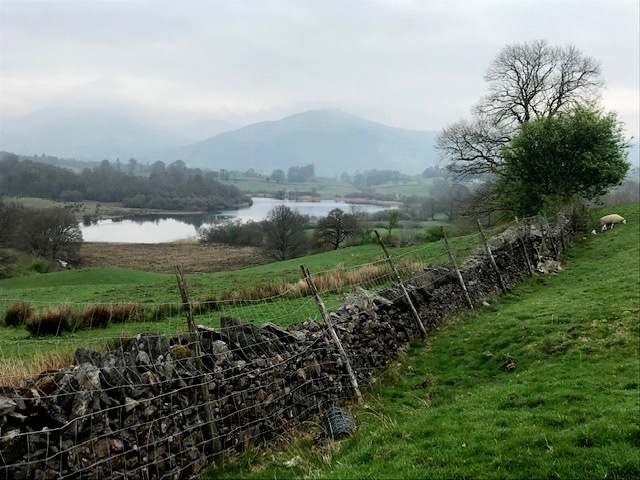
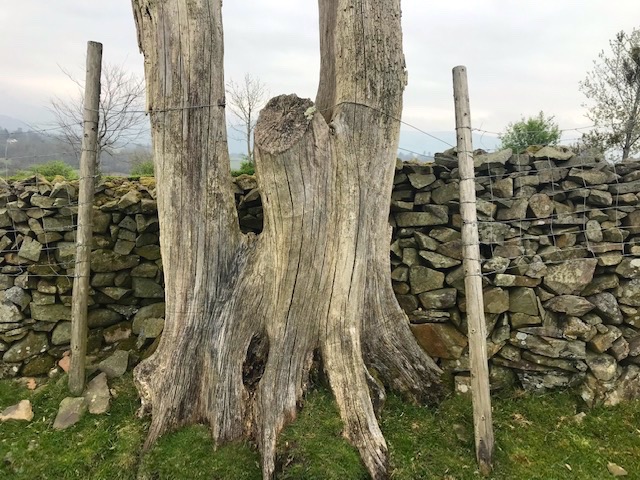
Our field has a boundary drystone wall, over a quarter mile long, which winds its way to the wooded valley of the north burn, and has been in place for at least 100 years. It’s one of an estimated 125,000 miles of such walling nationwide, and the Pennines are where most are situated. You probably see them as an iconic part of the upland landscape; extracted from the earth they stand on, fashioned by hand, home to invertebrates and amphibians, shelter in a storm, historical boundary markers…Who doesn’t warm to the the sight of a maintained well dressed wall?

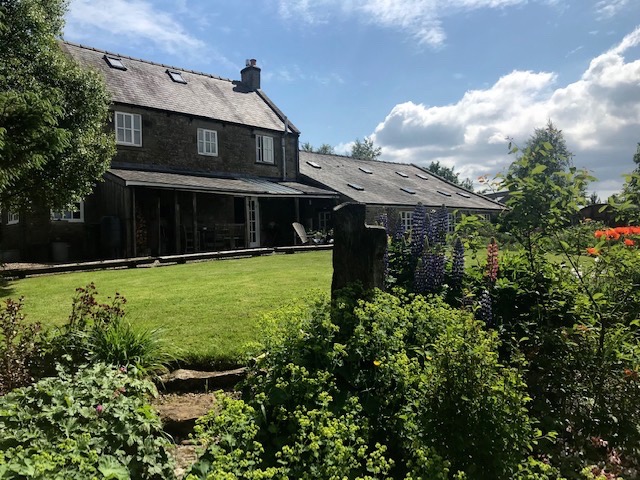
The deeds of the Corner House date from 1878 when the property was built as a shepherd’s cottage, along with two adjoining small barns and shippen, part of Southridge farm’s holdings. For the next century or so that’s what it continued to be, until sold and converted. Its large surrounding garden was created at the same time, parcelled up with an extra four acres of rough grazing. The owners would be responsible for maintaining that field’s boundary wall with the farm’s adjacent large meadow. And that’s why we’ve got the wallers in.

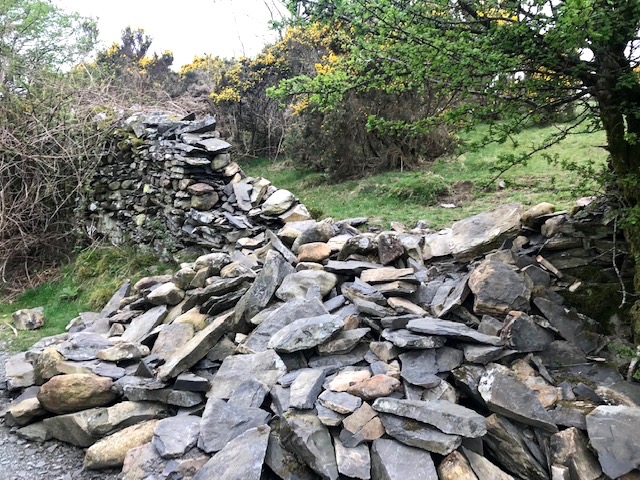
The middle section, which Jonny marks out at 50 strides, had worsened since I last walked it with him in the summer. He and younger brother Ben had a lot of work on in our region, and beyond, so we’ve had to patiently wait our turn. They finally rocked up in their 4X4 this back end, working solidly, dawn to dusk over a few weeks in testing weather before and after Storm Arwen. They methodically dismantled, sorted, laid out and reassembled the multi-sized grades of sandstone, supplemented with the odd lump of hard and heavy dolerite whinstone.

I wander across to talk to the brothers and admire their speed in hand and eye understanding what will fit, where and how. It’s a 3D jigsaw puzzle made solvable by the ingrained routine of a working filial relationship. They chat with me whilst carry on working, wielding chisel and lump hammers as they fit and place, with overlapping phrases, or sentences that one will start and the other finish, nuance and meaning enriched through the lilts and phrasing of the accent.

Both wear goggles and gloves. Jonny says he’d previously ended up in hospital A&E with flakes of stone chips in his eyes so sees the need to always wear PPE. They use a stash of plastic tubs that formerly held ovine mineral licks to store the smallest stones or ‘fill’. This they pack in between the outer facing stones that many wallers call ‘heart’ but which they term ‘middle’. The walls in our district are mostly constructed from locally quarried sandstone. Jonny points with some pride at a distant field wall – his first job when starting out as a lad some 25 years ago.

Over time dry stonewalls either move away from their foundations or – as in our case – the foundations move away from the wall. The task on this stretch is to reset the wall to where it was originally, securing it for another century or more. ‘What causes that shift to happen?’ I ask. The pressure of animal bodies (sheep or cattle) can hasten the natural attrition that a range of weather brings in its wake but in our case the main problem is the differing ground levels either side of the structure. Just a matter of inches, but on wet ground that’s enough difference to set the process in train.

On better weather days Ben had brought Daisy, his seven year old tricolour Jack Russell, a rescue dog of cheeky and determined character. (“Meet the Boss” Ben quips). After giving me a thorough bark and sniff going over she follows me as I walk on to cut an overhanging small tree threatening to topple fencing at our field’s end. On the way back, dragging branches for the chipper, she circles me with great excitement in fast flowing loops. Ben says Daisy ran a weasel down the other day when they were working away. He’s not happy about it but accepts that’s what terriers do and there’s not much he can do about it. The next morning  Daisy appears in the garden, barking long and loud at the kitchen door…loosely translated as ’Where are you – we’re waiting’. I emerge, togged up for work and weather, and am closely escorted to join her human companions. ‘I told you she’s the boss’ laughs Ben.

I’m curious too to find out what sort of things are uncovered when walls are deconstructed. Presence of animals apart – birds nests, spiders, hibernating toads and so on – they’ve found many bottles and other containers, in whole or part. These range from inter-war ‘Eiffel Tower’ brand lemonade and ‘Beef Oil’ bottles, (a one time popular tonic, extracted from boiled beef) to stout bottled by Collins & Co, Dublin. Lots of local brewers too, soft drink and chemist embossed glassware and the occasional mineral water bottle. (Jonny reckons that the latter, once consumed, was likely to be re-used for other liquids until broken when it would find a final purpose as filling). They’ve also found early 20th century coins, which they believe were most likely placed as date tokens, on completion or repair. In the same tradition the guys have brought in some hardcore rubble to add to the fill mix and will in turn be depositing a bright new penny to date their rebuild.

The lads remain convivial and chatty each time I walk over. They’re much amused by my experience of playing a stonewaller on the radio, contracted by the late Nigel Pargetter in an episode of The Archers back in 2008. The stage manager doing the requisite spot effects in studio as virtual work on the imaginary wall progressed under the dialogue.

I volunteered to help as apprentice, or rather, their goffer. We’re still short of material to finish the stretch so my task is to retrieve as many stones as possible from the remains of our field end wall, long since replaced with fencing, pole and barb. The grass covered mound is situated on the field’s steepest slope so I’m using the kids red plastic sledge to transport the recovered haul up to a gate where the boys can drive down later to load up. I labour slowly to flip any wide big slabs excavated up the grassy incline on to the flat. They’re invaluable as through stones, helping to stabilise and keep the structure tight.

When the work is finally completed and the lads packed and gone I stroll the renewed length and identify with quiet satisfaction the uncovered brown hued rocks I’d contributed set in amongst the existing stock of lichened grey stones.

The brothers are rewilders at heart and comprehend the bigger picture outside their own rural occupations. They’re part of the wider nature friendly generation working for a more coherent sustainable future for UK agriculture. Members of an extensive local farming family both boys grew up on a holding just to the north of Hadrian’s Wall, below the Great Whin Sill ridge on which it stands, at its most remote and highest point. We speculate that might have been a factor in their becoming professional wallers. I ask how they manage working together as brothers and Ben says ‘We get along fine….As long as there’s a wall between us.’

You might like to know that Ben features as a contributor to ‘The Wall,’ a 24 minute long BBC Radio 4 ‘Open Country’ programme first broadcast on Thurs 16th Dec. You can listen or download here: https://ww

Arwen and After

Most folk in the north have had a story to tell about Storm Arwen and its aftermath. Here’s ours. Power went off at the Corner House at suppertime on Friday 26th November. The vicious northerly winds howling and screaming around us, with ominous thuds and bangs outside. One of those knocks may‘ve been made by an Amazon driver because later I find the ‘Sorry I missed you’ card which said that a package was ‘In the bin’. Smart move. The big bin was empty of rubbish so able to retrieve the delivery safely. Next morning the same bin had been embedded by the wind into the big hawthorn hedge. The weather had calmed considerably by then but reports were coming in from our postie and over the battery powered radio of catastrophic damage on a vast scale across the north. Having experienced brief outages before we’ve lots of candles in store; plenty of logs for the living room burner, a bunker’s worth of smokeless coal, a recently serviced oil fired Aga to cook on and heat water so the heart of the house can keep on beating. Everything else for the moment has gone. No electricity, internet or mobile connectivity.

Wind speeds of up to 100mph had brought down a vast number of trees, blocking roads and trashing infrastructure. We live a mile from the country’s biggest man made forest. Commercially grown conifers being tall and shallow rooted are more vulnerable to toppling than most deciduous trees. The weekend slips by and nothing happens to reset the situation. Our spur of power, we learn, comes through forest rides (clear areas either side of power lines) where equipment will have been wrecked or sunk in a remote hinterland of peat bogs and dark mires. Reconstruction rather than repair seems to be the order of the day and, given difficulty of access, weather conditions and demands on the emergency crews brought in from all over the country to help out, this will account for the delay in restoring power.

A good quarter of Southridge’s shelterbelt has been bowled over. Three ash trees on their farm road, already earmarked for felling due to die-back, have been smashed by the storm with broken branches threatening to snap off and block access. Kim walked up there to see how our friends were faring. She reports that the menfolk had rigged up a palette on the tractor’s hydraulic forks, raised up and wobbling in the wind, with the younger farmer taking his saw to the offending tree limbs. Perilous but necessary, as there’s no other available mechanical help to hand.  

Water supply is the main domestic challenge for us (see previous posts). Having the electric powered pump out of action means the header tanks for hot and cold up in the loft cannot be refilled from the spring source, so the tedious process of water bearing begins. Most days I fill the plastic 15 litre holders with water from the sealed butts fed by our gutters and downspouts. Plastic ones have tops so one can lower a bucket in each time. The old whisky barrels only work when the weather stays mild as they freeze up at the tap otherwise. Bitterly cold days alternate with wet mild ones that quickly refill the containers. Baths take on extra significance as deeply pleasurable and refreshing experiences. The old bath water then doubles as grey water to flush the adjoining toilet, so nothing wasted. Fortunate that those water butts installed to sustain us through summer droughts are proving just as useful in meeting this winter crisis.

A walk along the long distance path & good chat with our neighbour taking a break from wielding the chainsaw. It takes him five days to clear the row of elders that had been brought down, blocking the path. Meanwhile we’re re-directed through their garden. The days add up to a week and still our postcode batch of properties have not been reconnected. The sympathy and support from family, friends and neighbours increases. AA batteries, LED camping lights, big candles & so on arrive and we make forays out for other supplies or to plug in devices at the local hotel while having a drink or reading. Some locals are having to lodge there (paid for by the power company) but we’ve not got to that stage yet.

Old Bastle Farm, Southridge and us – four households in all – are without power whilst other neighbours just a few fields in either direction were reconnected within a few days of the storm. To make matters worse on Day 5 a Northern Power Grid person rings to say we can expect to be back on the next day, but nothing happens. National news on day 7 tells us re-connection for the 1,500 or so remaining properties & businesses is not likely to be achieved until next week.

The two freezers are being gradually emptied as they thaw out. The one in the garage/workshop the slowest to unfreeze as the low temperature there helps. We get stuck in to making jam from last year’s fruit. There are also hams to be boiled, mince for chilli con carne for selves and neighbours, elderflower cordial to drink etc. Hate waste but become resigned to losing most of our frozen store.

Kim has retained an old analogue phone to replace the non operational digital one so we can receive and make landline calls, which is a real lifeline. Like other rural dwellers we dread the day when BT completes its national scheme to replace all copper wires with digital connectivity, leaving us with no alternative.

Enforced lockdown has incentivised us to make the best of daylight hours. Kim’s home made Christmas cards (already printed), are written, stamped and along with family presents get posted at the village sub PO. I’ve been quarrying for old wall stone at the field’s end to supplement the needs of the dry stone wallers’ rebuilding our field boundary (more in a future post) while Kim has started creating a series of illustrations for a literature and archeology commission, to be completed in a month’s time (Again, more about this project in a future blog).

By night 6, and sorely deprived of visual stimulation we head out to the bright lights of our market town, 15 miles distant, to marvel with childlike wonder at the myriad of snow white Christmas lights decorating the old streets. We then snuggle down in the warmth and comfort of the independently run art deco cinema to see Jane Campion’s latest feature ‘The Power of the Dog’, enhanced by surround-a-sound audio. A visually stunning, emotionally powerful film that took us, enraptured, to another place entirely. The following night we went to see the local amateur dramatics company production of ‘Whisky Galore’ in the big village’s fine town hall. Another triumph of technical excellence creating wonderful set, lighting and effects for the large acting ensemble, ranging in age from 10 to 80. Everyone contributed in creating a cracking night’s entertainment to lift our spirits.

Night 9 and another mighty storm from the north bearing snow. That evening a knock on the door and flashlight around the corner – It’s our friend and local county councillor Nick, calling on afflicted households to check that residents are coping, and bearing batteries, water cans, blankets etc. in his van. We have a catch up chat and he’s away back down the valley for a long delayed meal waiting in the slow oven at home. Later we learn it was a touch and go journey on treacherous roads with another tree down on the highway at one point.

Sunday morning and the usual drive down to the village to pick up papers. Pull over to watch the wheeling flock of fieldfares, recently arrived a few weeks back from the far north, alighting in a ghostly wave to join a score of lapwings quartering a neighbour’s boggy meadow for food. Back at the house, we catch fleeting glimpses most days of the garden’s resident winter birds – dunnock, robin, wren and blackbird. Winter’s onset reveals more previously hidden former nests; a dunnock’s secure in the spikey heart of a pyracantha bush and a pied wagtail’s atop the woody tangle of an old montana rubens clematis.

The 10th day of blackout (Sun 5th December). Driving back in the dark that early evening from friends – where we’d charged batteries and did a load of washing – arrived home to see lights on in the kitchen. Hurray! We’re back in the 21st century after our extended surprise vacation in the 19th. Still no internet but that can wait. (Posting this on a visit back to Lancaster). When we get that compensation from Northern Power it’ll go towards buying a small diesel powered generator and the necessary junction installation so we’ll be as ready as we can be to face future big weather events.

Of Mills and Men

And no bobbins and spindles and shuttles are left / Where weavers once tended the warp and the weft /To fettle to fabric with fine-spun thin threads /But axes have fallen and silenced the sheds /And only the bleat of the sheep on the hills /Gives a musical beat to the crumbling mills. From ‘Cotton Mills’ by C Richard Miles

The visit to Middleton-in-Wirksworth recorded as my last diary entry was enhanced by an immersive visit to the nearby village of Cromford and the historic mill complex that caused it to grow and flourish.

An excellent tour by one of the volunteer guides introduced us to a globally significant event in economic and social history wrought here in the 1770’s. An achievement so singular it has earned the Derwent Valley Mills UNESCO World Heritage Site status. Sir Richard Arkwright’s Cromford Mill became the model that effectively spearheaded Britain’s industrial revolution. This never- before-seen building design and its method of production was the achievement of a single minded personality who conceived and designed this novel industrial complex and oversaw its financing, construction and operation from start to finish. In the process he became a template for successive reincarnations of the self made, larger than life capitalist; from Josiah Bounderby in Dickens Hard Times to Gordon Gecko in Wall Street.

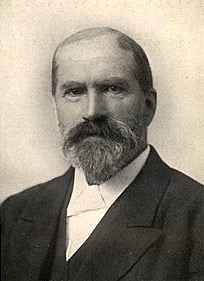
Richard Arkwright was born, the 13th child of a Lancashire tailor, in 1732. He became a wig-maker in Bolton and in the course of his travels buying up human hair from working people willing to part with their spare locks for cash got to know the rural hinterland of Derbyshire well. In partnership with clock-maker John Kay and technician Thomas Highs he developed and manufactured a roller spinning machine made from wood – the water frame – that could make mechanical cotton spinning possible. Once patented in his own name Arkwright ruthlessly dumped his inventor associates for business partners who could supply the venture capital needed to make his vision a reality. The key power element – water – came from drainage out of the area’s old lead mines, which Arkwright had dammed for a reservoir that is now the village pond. That allowed him to engineer and regulate the brace of millraces to power his nascent enterprise.

He advertised for and attracted a small army of willing workers (men, women and children) to operate, in continual shifts, the water frames installed in the newly built seven story stone mill, internally lined with imported brick.

So successful was this first mill that a second larger mill, together with extensive warehousing, were soon added. In design the works were now resembling a medieval castle, with a sheer cliff face topped by a wooded eminence – Scarthin Rock – completing the site’s fourth ‘wall’. Any resemblance was intentional. The great industrialist, keen to keep out unwanted attention from competitors, also maintained a cadre of apprentices housed in a barrack like communal building (since destroyed by fire), and they acted as a resident security and oversight force. Given that, in the years that followed, rioting handloom weavers would storm these new factories to destroy the hated machines that had left them jobless and destitute, Arkwright’s astuteness in adopting a defensive design was apt.

When its pioneering glory days had passed, Cromford Mill became just another old industrial building and gradually fell into decline. By the time it was rescued from neglect and decay parts of the fabric had been altered, destroyed or badly damaged. The Arkwright Society, a local charity, purchased the site in 1979 and started the process of restoration, interpretation and development. Though a huge amount has clearly been achieved the site is still a work in progress, and somehow all the more interesting for it.

I particularly appreciated the section of our guided tour where a hologram version of Arkwright, as played by a suitably portly be-wigged actor, took us through the original mill’s interior floors that no longer exist, but are here miraculously recreated through impressive audio-visual effects. Some of my family on dad’s side worked in the Lancashire cotton mills and I remember aunt Annie telling me about the noise and dust generated by machinery at full pelt, so hearing it recreated here informed me about conditions as much as any script. Annie had a loud clear voice too. She needed one (alongside sign language) to communicate at work with the other mill lasses back in the 1930’s.

Today small businesses, offices, shops and visitor facilities fill many of the remaining buildings and provide much of the necessary income to restore, maintain and develop Cromford Mills. Stepping outside its towering confines we took an easy walk beyond the wooded car park area to the riverside along paths with views of the distant grand ‘castle’, now a hotel, that Arkwright had built for himself (He died, in 1792, before it was finished) and the church of St Mary (yet another foundation) where Arkwright and other family members are interred.

The Arkwright Society have plans to harness the waters that still flow through the mill complex, this time to supply green electric power for the local community, which would be a fitting 21st century contribution to the revolutionary process that is constant history in perpetual motion.