
From the Dee to Dunnottar Castle. Billed as one of Scotland’s major tourist attractions, we joined hundreds of other visitors – most of them from European countries – to take in the stunning view of the great ruined fortress sitting some 160’ above the north sea on a spur of land made up of boulders cemented in igneous rock millions of years old. Once an early Christian chapel it had previously been a fortress – Dun being Pictish for ‘place of strength’.
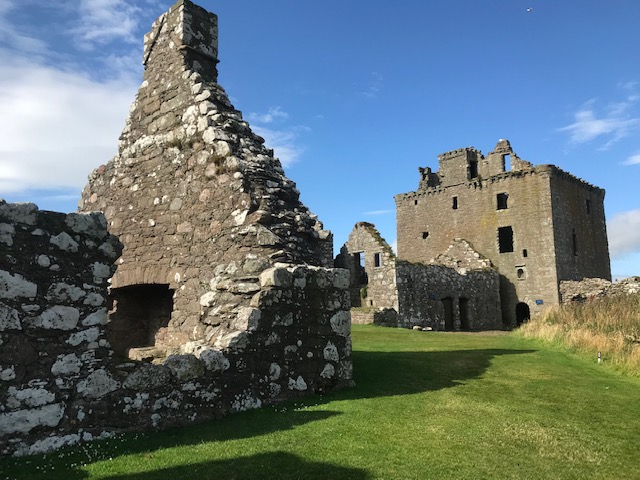
Dunnottar’s deliberate pinch point of an entrance, half way up the great rock, is little wider than a domestic doorway with narrow cobbled passage way and yet more stairs, opening out at last onto a grassed plateau with an impressive range of grey sandstone buildings, most of them now open to the elements; chapel, stables, smithy, great hall, bedrooms, barracks, great keep etc, many set over cellars, and vaults. Rocks and swirling waves are glimpsed below the sheer cliffs . How did the builders of this bastion ever manage to get so much material and supplies from mainland behind to headland in front?

For centuries Dunnottar was the principal stronghold of Scotland’s Earl Marischal, one of the great officers of state, inherited through many generations by the aristocratic Keith dynasty. In that time it hosted Mary Queen of Scots and Charles II and saw attacks and sieges in both the War of Independence and Civil War. The 10th Earl’s active support of the 1715 Jacobite rebellion lost the family their lands and titles and Dunnottar was subsequently stripped of all fittings and re-usable building material.
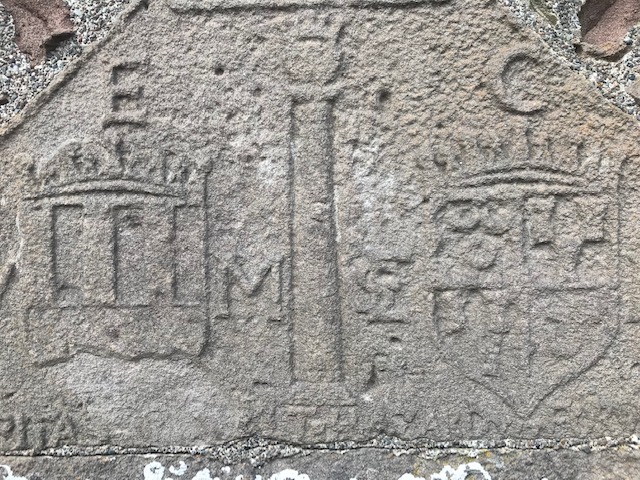
Purchase of the castle by Lord and Lady Cowdray two centuries later saw it stabilised, repaired and re-opened to the public. Their descendants still own and manage the site. Even with lots of us visitors milling about and some testing climbs the castle ticks the necessary boxes of romantic ruin, superb viewpoint, historical atmosphere, preserved range of habitations, royal associations, fighting and conflict, immersion in the elements. …What more can one ask for?

We walked the high cliff path the 1.5 miles to Stonehaven. The town’s interlinking harbours spread out before us before the steep path descent to test your leg muscles. Our destination, appetites sharpened and senses primed, was the area’s most recommended and multi-awarded eateries, there on the beach promenade – The Bay. We sat outside to eat our haddock and chips after queuing for more than half an hour. It was well worth the wait. As the line shuffled forward we learnt the fish was fresh caught with the local boat named alongside the variety and farm in Norfolk the potatoes came from. One veggie offer the display board listed was chick pea fritters and n’are a deep fried Mars Bar anywhere!
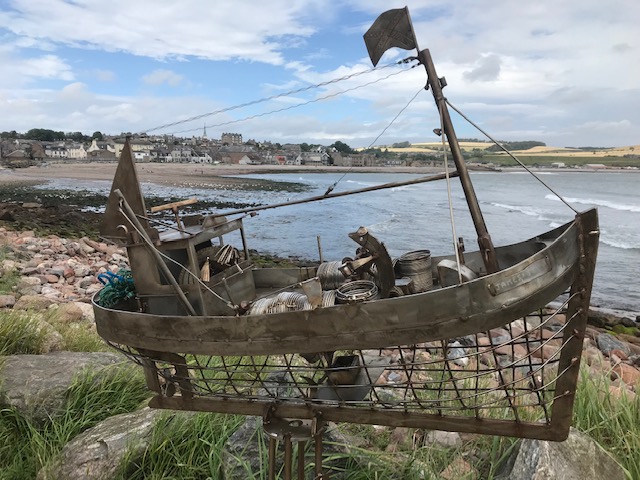
On the return leg we stopped in admiration of a series of art works aside the beach boardwalk fashioned by an anonymous ex-seafarer dubbed ‘Stonehaven’s Banksy’. His humorous skilfully fashioned boat sculptures made of scrap metal first appeared anonymously about the place in 2006. In 2019 he told the local paper that “I’m nae an artist, I’m just a guy that bashes metal together” and that “The sea to me means freedom”. We’ll drink to that!


 STEPHEN TOMLIN