NORTHUMBERLAND: I am a stranger here in Gloucestershire/ These high wild hills and rough uneven ways /Draws out our miles and makes them wearisome.
The Cotswolds is an AONB (Area of Outstanding Natural Beauty) graced with buildings using the locally quarried stone that gives even the humblest structure an added attractiveness. My old friend took me to a spot where this was amply demonstrated which I’d otherwise not have known about.
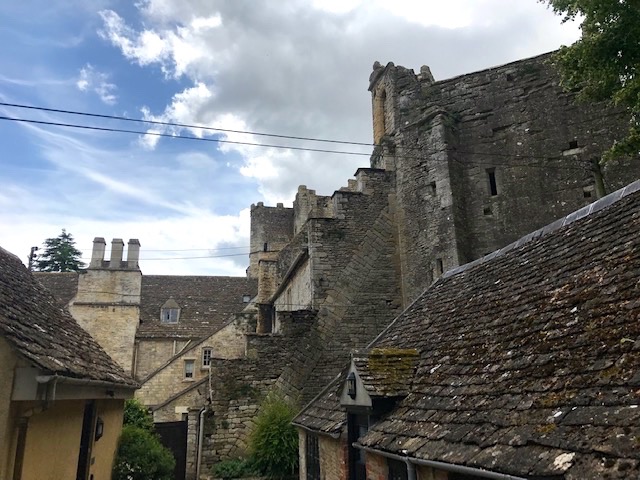
Driving through Beverston the clusters of uniform style cottages immediately tell you this is an estate village. Dating from the mid C19th, the quality of materials and vernacular design show the care that went into their creation. The big house and parish church were not so obvious, being shy of the road, cocooned by old walls and mature trees, now in full leaf. A short drive down a bumpy track brought us to a shady deserted square between the two historic fixtures. And what a pairing they have made over eight centuries of neighbourly companionship.
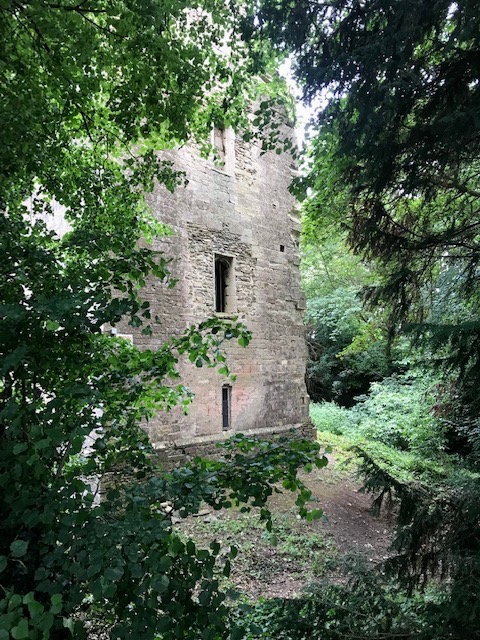
It was said of the Berkeley family that in riding to London from Berkeley Castle, down the road from here in the Vale of Severn, they never left their own land. Beverston would have been an initial stage of that cross country progress as a castle was erected here by one of their founding number in 1229 and further extended & reinforced by them in the C14th. As with many other castles it last saw serious action during the English Civil War and was subsequently ‘slighted’ by Parliamentary forces. In other words, made unusable by having walls and other defensive features demolished.
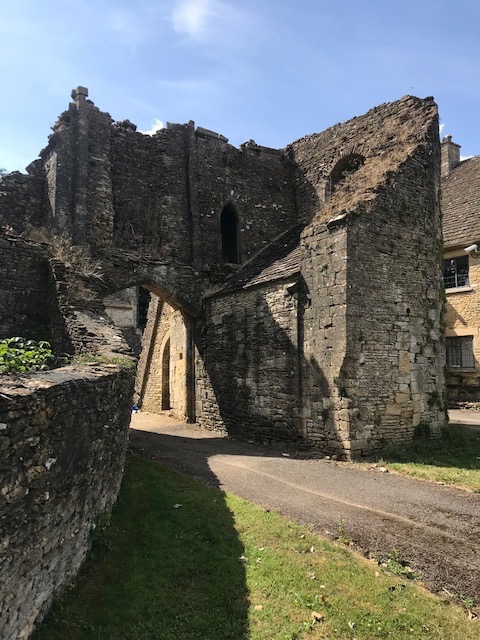
Fortunately Beverston castle’s substantial remains were not abandoned, as so many were elsewhere, but recycled over the following century to transform a military stronghold into a substantial manor house and ornamental gardens.
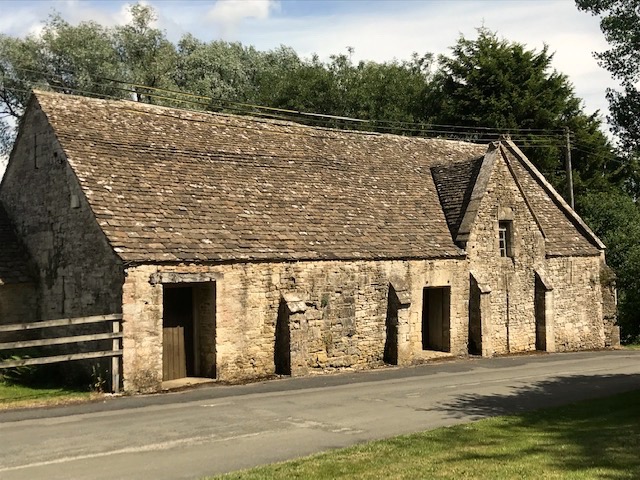
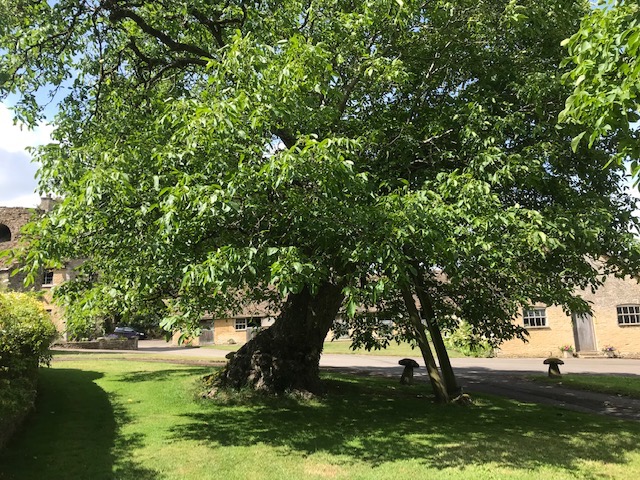
It remains at the centre of a 693 acre farm estate today, complete with venerable buttressed barn and more modern stables, grouped nearby around a green with specimen trees of some vintage, one propped up by timbers.
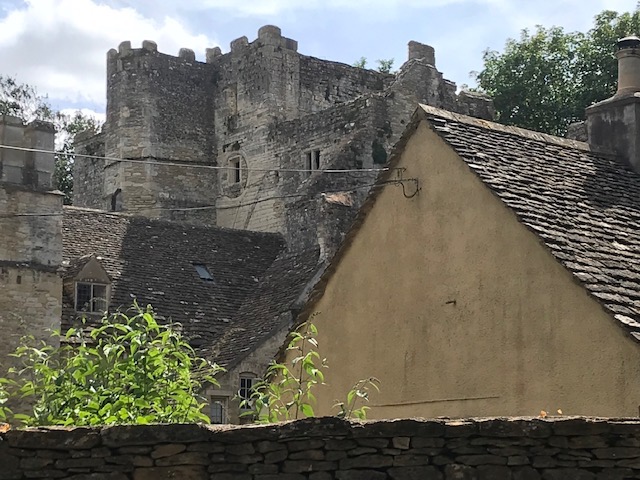
We marvelled at the architectural interaction of Cotswold stone on the different planes and levels. A Grade I listed building and scheduled ancient monument it remains a private residence, not open to the public.
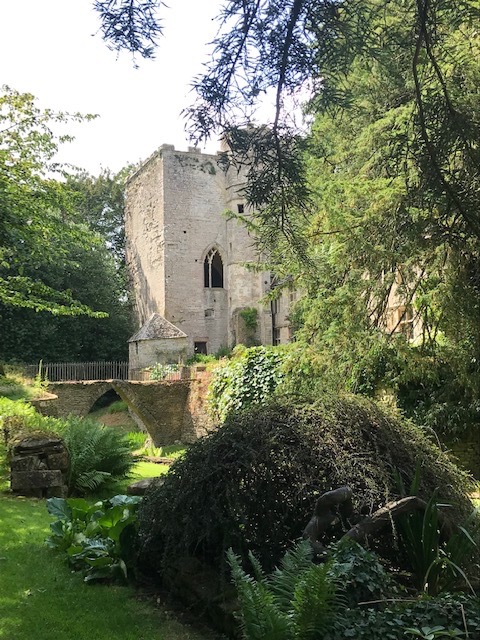
Glancing through a rusty iron bar gate in the wall we could see that the dry moat has been incorporated on the garden side of the house as a kind of ha-ha feature while the grassland beyond apparently boasts an array of orchids.
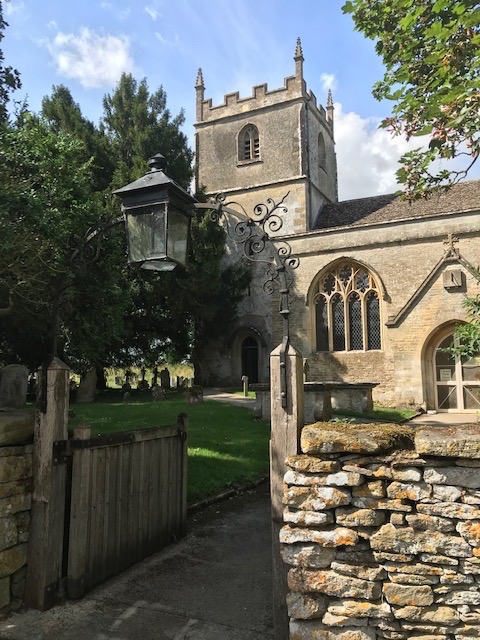
As in many other places once the feudal lord’s secular needs were met in the form of a castle a church would be built or improved to secure the eternal souls of himself and his kin. Here in Beverston, St Mary’s has an attractive stocky Norman tower, partly rebuilt in the C15th. The graceful metal lamp arch adds picturesque charm to the churchyard entrance.
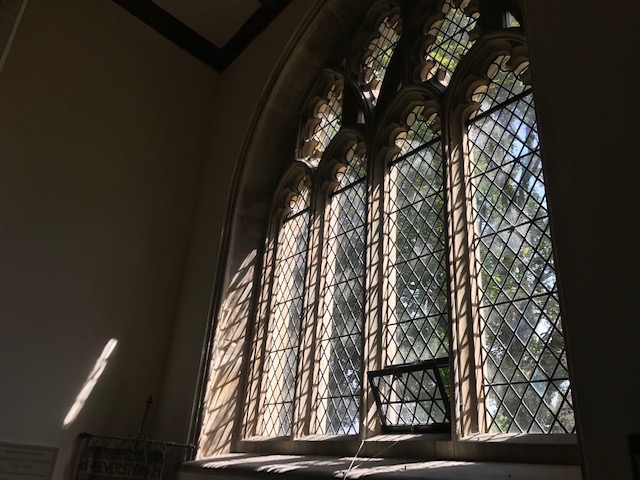
It didn’t always look so spruce. The dilapidated church was renovated, not just once but twice in the course of the C19th century. The end result is a pleasing and vibrant one and the parishioners are still fundraising to bring social facilities in line with C21st needs. The airy building we entered was flooded with soft summer light thanks to the large windows of plain glass, plain white washed walls and effect of the restful honey coloured stone.
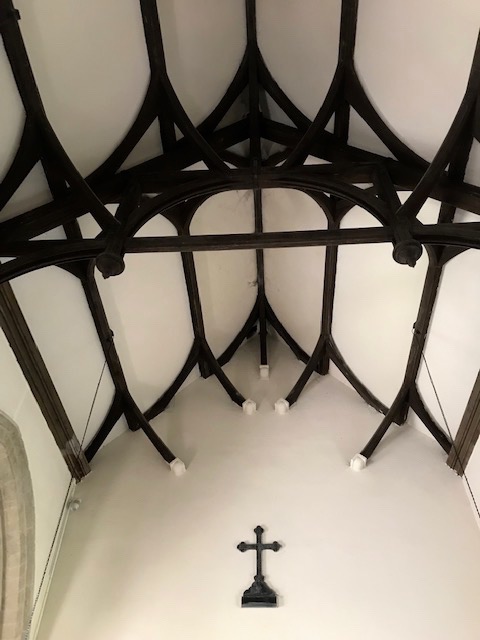
The church fabric boasts a number of fine medieval features but the one that impressed me most was the problem solving technique devised by the Victorian architect Lewis Vulliamy to secure the nave roof – a bespoke arrangement of trusses and corbels used sideways on the supporting walls. It struck me as an architectural version of that one time popular family fun game ‘Twister’.
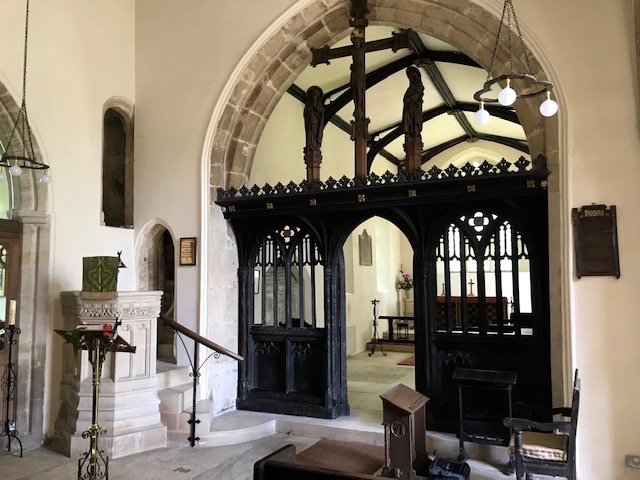
Loved the fact that the medieval rood screen, discarded in the first Victorian restoration, was rescued from the rectory garden where it’d been used as a pergola and put back in its original rightful place, between nave and choir.
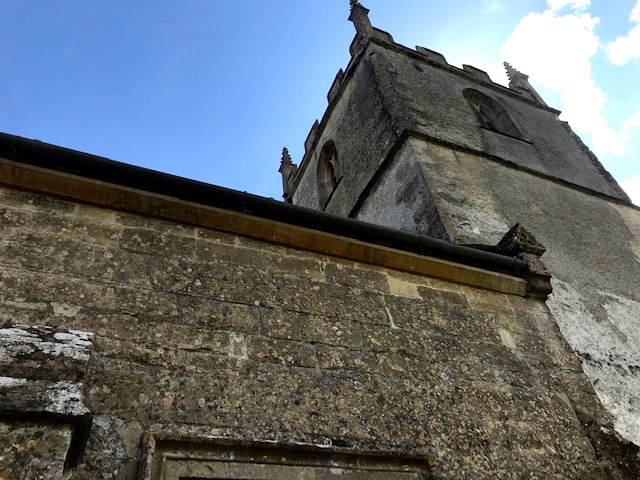
Alerted by the guide notes we went looking on the outside for four medieval stone grave covers with incised chamfered crosses and spotted them where they’d been incorporated into the masonry high above. Three of them in line to form a top course, the fourth on its own embedded into a lower section of wall.
Intrigued to learn that the parish registers contain references to the families of Shakespeare and Hathaway. William Shakespeare undoubtedly knew this part of the Cotswolds well and describes the district in Richard II, as quoted in part above. If you’re interested in knowing more the parish has a good website: https://www.beverstonparishcouncil.org.uk/

 STEPHEN TOMLIN