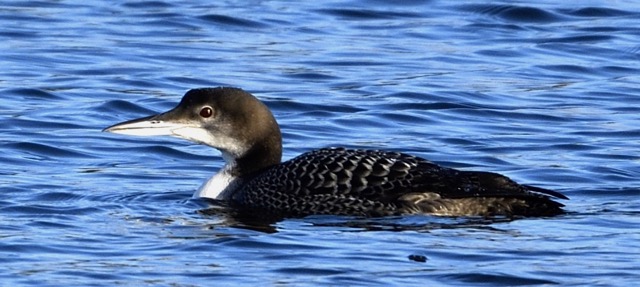
Headline acts apart, we had a great range of other natural history engagements round and about the Isle of Mull with our well informed local guide Andrew. He pointed out a large seabird with a heavy bill and stout neck, sitting low in the water, cormorant like, coasting along the shallow shores for food. Great Northern Divers, immigrants from the frozen north extending their winter break, sometimes stay on to breed here. Kim knows these birds from her upbringing in Canada where they’re populous and known there as Common Loons.
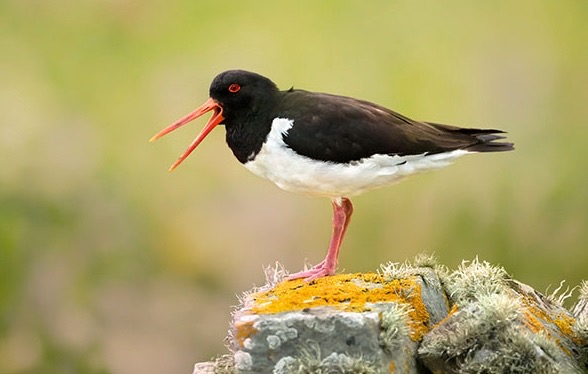
We stopped to watch the behaviour of a group of Oyster Catchers on a pebble beach and Andrew explained that they make a scrape in which to lay eggs and not a nest as that would draw unwelcome attention. The 2-3 mottled eggs laid are lost in the mass of pebbles to all but the parents and are more likely to be crushed by accident than taken deliberately. Both birds take it in turn to incubate and patrol, distracting attention when potential predators are watching – like us!
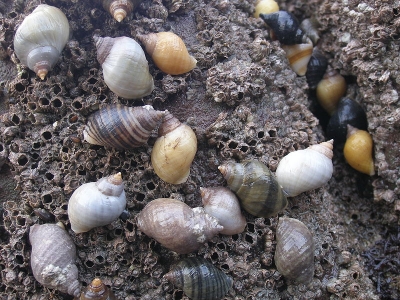
There aren’t enough oysters about to let those waders live up to their name. One creature that does predate oysters is the common whelk. These common sea snails (also known as periwinkles in Scotland) are carnivorous and like nothing better than applying their auger like tentacle to drill a tiny hole in the shells of mussels and oysters, allowing them to slowly extract and consume the occupants. Continuing on our motorised ramble we passed small encampments of traveller families, hired by landowners to harvest whelks along the shore. We saw by the caravans netted sacks of molluscs stacked ready for export to the mainland. Come back in a few weeks when the season’s over and you’d never know people had ever pitched there, Andrew pointed out. Whelking being a long tradition on Mull it has engendered a mutually respectful relationship, he added.
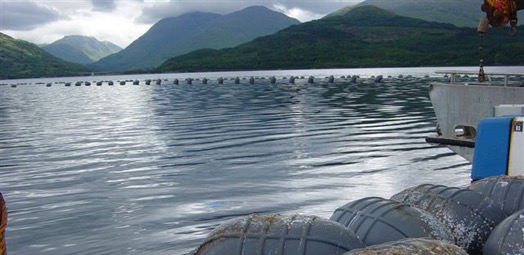
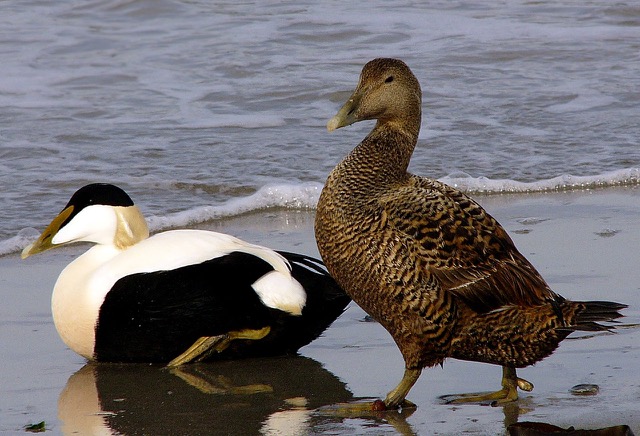
Earlier in the day we’d passed Inverlussa, a sheltered tree lined bay, its waters scored by parallel lines denoting the infrastructure securing vertical ropes on which cultivated mussels cluster and grow. This sustainable continuous farming system, originally pioneered in New Zealand, was successfully introduced here in 2006. Andrew informed us the greatest peril this family owned business faces is not predatory whelks but the insatiable attentions of eider ducks that have to be deflected every day from gorging on their harvest below the waves. Britain’s heaviest and fastest resident duck living in large flocks around our northern seacoasts, they can dive as far down as 30 metres in search of food.
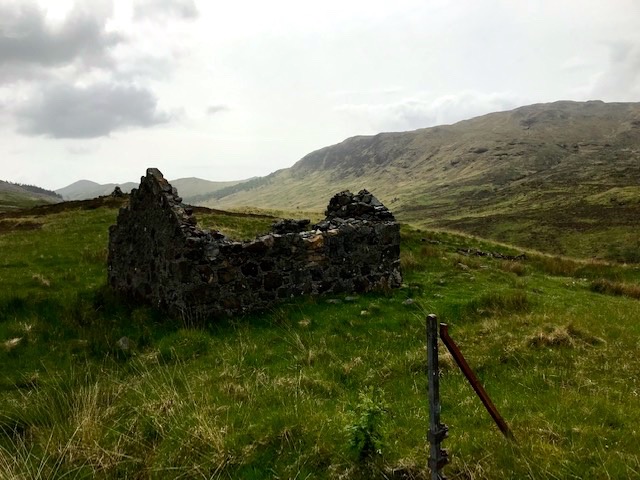
There was one endangered creature I wanted to see but had no luck in finding. Andrew pointed out fragments of a ‘ghost road’ running parallel to the current route (which opened 1967) connecting Craignure and Fionnophort. That ancient winding track, with remnants of bridges over burns and stretches of embankment, has been slowly absorbed by nature back into itself. We turned off by a ruined building to rest where the old road’s tattered tarmac peeped through a mosaic of turf and flowers.
This has become an adder breeding site said our guide, which piqued my interest. Though still widespread in the highlands the common European viper or adder (Vipera berus) is the UK ’s only venomous snake. Rarely found on the western Isles, with Mull proving a notable exception. The snake uses its venomous bite to kill rodents, lizards and nestlings while any hurt afforded humans is nearly always accidental, extremely infrequent and rarely fatal. ‘Nadder’ derives from the old English word for ‘Serpent’ but the ‘N’ eventually got dropped. Ironically it worked the other way round with newts when the ‘Ewt’ gained the ‘N’ the adder lost!
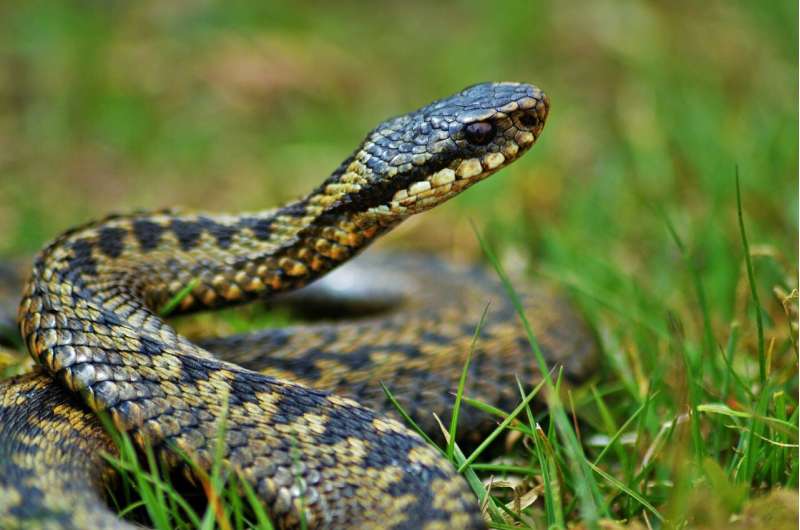
It’s been many years since I’ve seen that tell tale zig-zag pattern on the back of this reptile, a creature that loves to bask in the sun. As kids we used to frighten each other silly running through the summer bracken on Dartmoor, laughing and yelling the ‘vipee’ll get ee!’ The poor shy creatures would have vanished in an instant if they’d sensed our presence in any way, and there’s the rub. Recent scientific research has shown that vipera berus is in severe danger of being confined to just a few protected sites by 2032 if the present rate of decline continues. Crows and buzzards are the snake’s main predators while disturbance from dogs and people alongside mechanical mowing can severely disrupt their breeding processes. https://www.discoverwildlife.com/animal-facts/reptiles/facts-about-adders/

In looking out for any sign of an adder adder I got absorbed by the small flowers. Marsh Lousewort, also known as red rattle, is a semi-parasitic living off the roots of trees and grasses which allows it to thrive in poor soils like the ones here and is an important food source for bees. (Its cousin, yellow rattle is a keystone plant in establishing and maintaining a traditional meadow) Lousewort has been used for centuries as a medicinal herb. It contains several active compounds, including flavonoids, alkaloids, and essential oils, that have anti-inflammatory, analgesic, and antispasmodic properties.

Another plant found here by the old road, which I looked up later, was the Common Butterwort whose pretty blue flowers appear from May to July. Like Common Lousewort it is well adapted to survive in nutrient poor acidic soils, in this case by trapping insects in the sticky whorl of leaves at its base, which then curl shut allowing the plant to absorb them. The old rural knowledge had it that rubbing the juices of these leaves into the udders of cows would protect against evil and bad butter, hence the common name. As we reassembled and climbed back into the mini-bus to continue our tour I wondered if the former inhabitants of the nearby ruined steading had ever followed that practice.

 STEPHEN TOMLIN