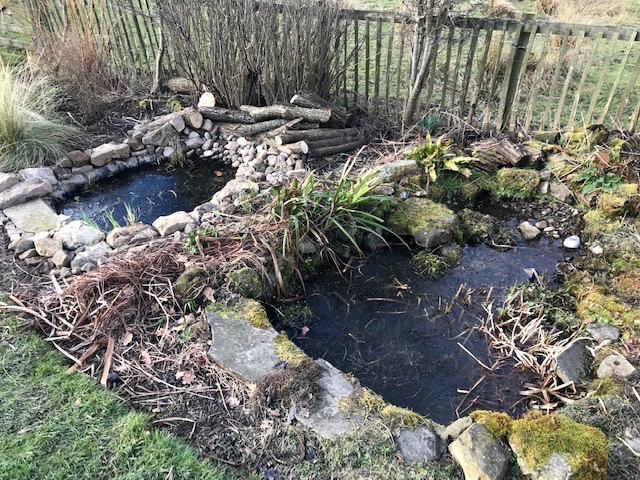
A long held ambition of mine has been to create a second wildlife pond in the garden, next to the original One I built in 2016. I’ve finally got round to doing as winter loosened its grip and spring is making its presence felt here in the hills.
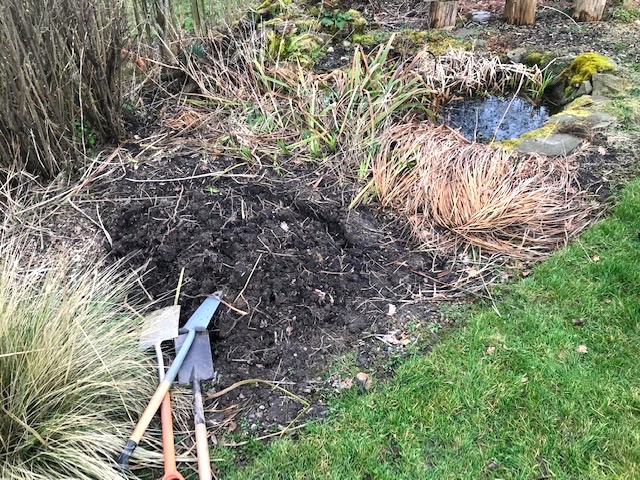
This new pond is a bit smaller and more compact than the old one. I’ve stepped it to house marginal plants all around the edges, with the deepest part reserved for lillies at the centre. Some existing iris and brooklime transplanted for a start.
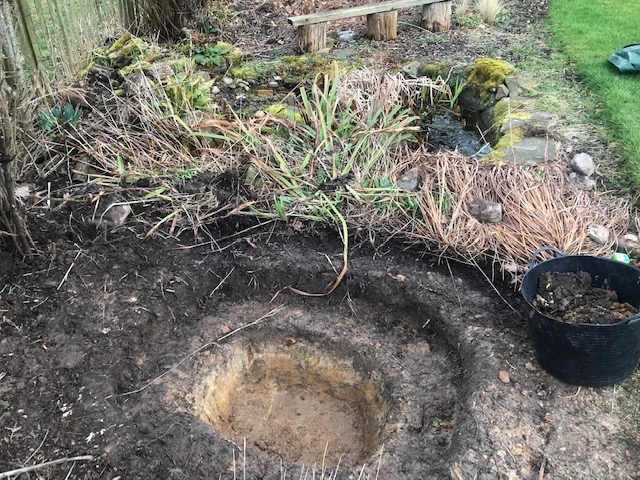
It’s hard work digging into thick impervious clay but that also means the excavation holds its shape well, unlike sandy or light soil which does not. Calculating how much liner’s required is never easy, but of course you need to have more, not less. Glad to say my generous length wise surplus is going to a family member to line a little pond she’s creating in her town garden.

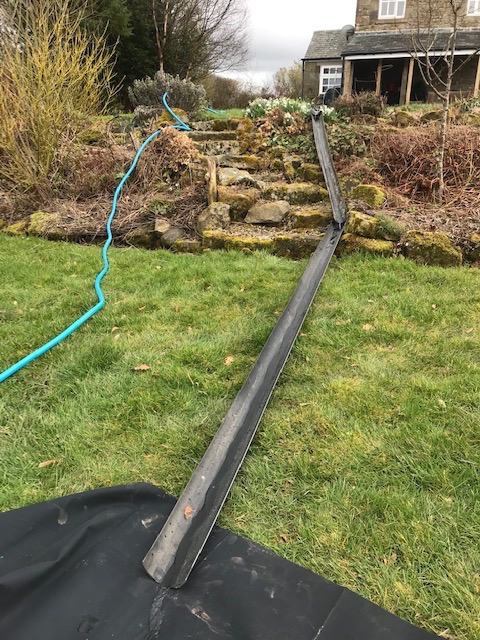
The plan was to run two interconnected garden hosepipes from the two nearest house water butts to fill the pond. Unfortunately, despite looking high and low, I could only lay hands on one pipe. Argh! What to do? Improvise of course!

Found lengths of spare plastic drain and guttering racked in the garage and detached a further short length from the west porch. This got me to the generous apron of spare EPDM pond lining material. Gravity did the rest. Bit more ingenuity needed to empty the second water butt which was further away from the pond but I managed it. Just.
I’d not properly checked levels with the spirit level prior to filling so some last minute bulking up of edges with excavated clay was called for. Last December’s excavations to replace our spring fed domestic supply (https://stephentomlin.co.uk/2022/12/06/waterworks/) meant there was a stock of unearthed stones about. These I collected in the wheelbarrow to weigh down the liner round the perimeter, thus stabilising as well as hiding it. A couple of nice flat stones made ideal kneeling points for anyone to deal with plants, see what’s going on in the water, net leaves or whatever.

Every wildlife pond needs a beach for amphibian access and for birds to drink and bathe. This pond’s beach is steeper than the former and I’ve pinched pebbles that could be spared from it to provide this essential feature. The lowest point on the pond edge is next to the beach and run off after rain is diverted away, under stones, towards the field beyond. Surrounding plants like the boggy ground here too. Another pond essential is an adjacent shelterbelt that logs and branches can provide. Last December’s diary entry (https://stephentomlin.co.uk/2022/12/03/wood-work/) recorded the felling of an alder and a willow by the kitchen garden. Tree limbs from this operation I’ve used to both secure the liner and provide hiding places for amphibians and other small beasts that use the pond. These logs and branches, as they slowly rot, have the potential to provide excellent over wintering quarters.
It’s just a matter now of restocking with more aquatic plants when they arrive next month in the nurseries. Meanwhile, to help raise oxygen levels and give shade I’ve borrowed generously from the original pool’s varied stock of submerged waterweeds.

 STEPHEN TOMLIN