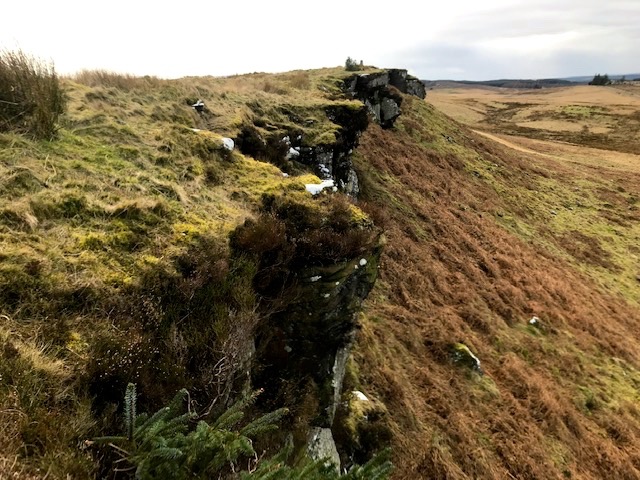
The view from the Corner House northwards is one bounded by the fell that separates us from the big village, while to the south the horizon is defined by a sandstone ridge. The highest and most dramatic part of that scar is Ravensheugh Crags. Easily accessible from a long straight lane that runs along its foot, the crags are popular with climbers. Its extensive face offers some 134 documented climbing routes, from 26 to 79 feet (8 to 24 m) high. Our interest though was not the rocks, quietly imposing as they are, but what lies half hidden beyond its ridge
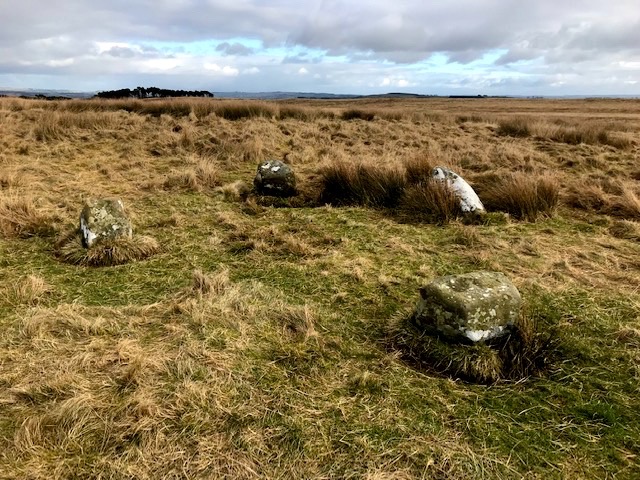
This was only the second time I’d set foot up there and we were keen to discover more about its important Bronze Age history (circa 2,000 – 600BC) by seeking out the Goat Stones. This name derives from the Saxon ‘gyet stanes’ or ‘wayside stones’. In former days cattle were driven to market along ridgeways so a track may indeed have once ran along here before the current public footpath. The Goatstones is a four-poster stone circle and the stones measure some 30 ins in height bedded approximately 13ft apart. What makes them significant are the numerous cup and ring markings, small depressions in the stone, and they’re the most southerly examples of prehistoric ‘rock art’ known in Britain. Most cup and ring markings on four-poster stone circles are found in Scotland, Perthshire in particular.
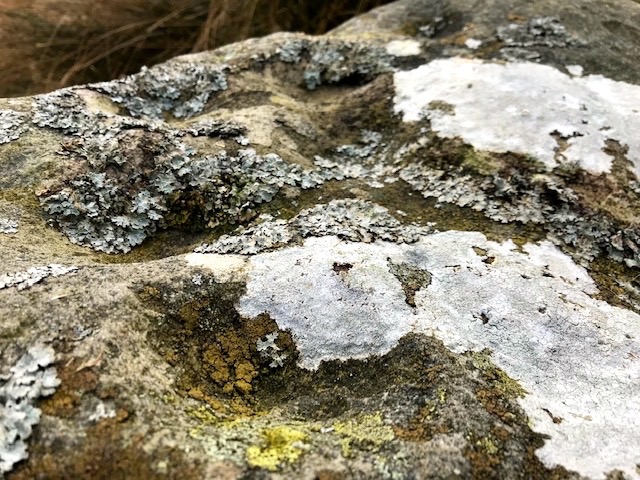
It’s a site crying out for further excavation and interpretation. Invaluable surveying work was undertaken by the Tynedale North of the Wall Archaeology Group a decade ago, which achieved a lot with limited resources. Reading about their findings and conclusions whets the appetite to know more. In the immediate area of rough grazing and peatbog around the Goatstones they recorded and mapped at least 16 scattered single stones with markings, evidence of both enclosed and unenclosed settlements, stone rows, cairns and remains of fired mounds from the Bronze Age. This high ground may well have had some special significance as a ceremonial site, and was possibly a sacred burial ground.
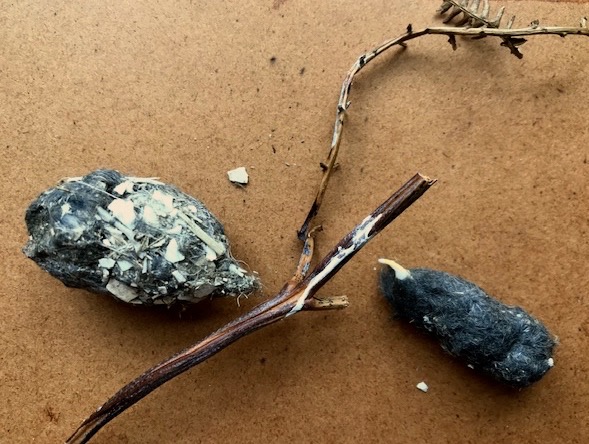
The land immediately behind the crags is bounded by a single strand of barbed wire fencing, a barrier to cattle but easily evaded by sheep and people. Scarred and fissured areas indicate the remains of quarrying in the not too distant past. At its far end the final fence post has provided the perfect look out for a raptor of some description. At foot white splashes of dung and dried droppings reveal crushed and compressed eggshells, fur, claws among other remains of prey.
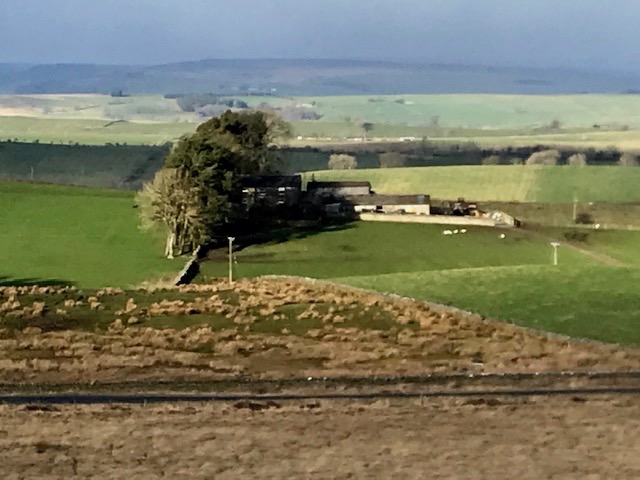
Vistas from the crags are impressive, whether south toward the (unseen) Roman Wall or north to the border with Scotland. Extra delight for us in being able to spy home amongst the scattered farms and dwellings. This is a distinctive landscape of rolling sandstone ridges and outcrops, with narrow valleys either side deepening into wooded gorges, through which peat laden burns rush out of the great conifer forests to join the big river in its arc of fertile valley to the east.
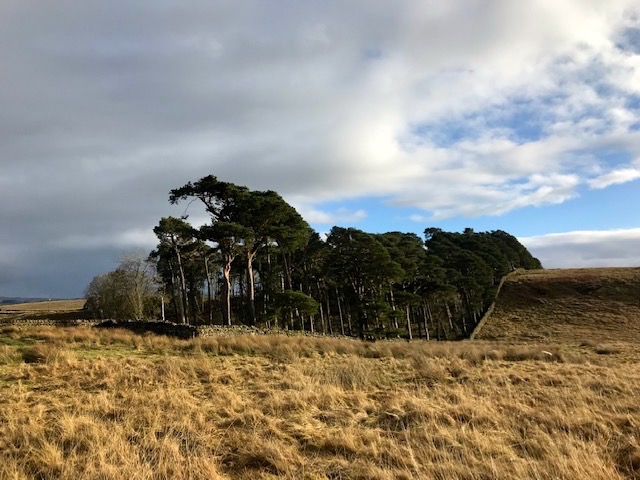
A banked plantation of mature Scots pines acts as windbreak for nearby Goatstones farm. We passed by it on a gentle descent to pick up the isolated steading’s access track which eventually led us back to the lane and our car.

In 2015 a 120 mile long mountain bike cycle path was created to traverse these successive waves of ridges, appropriately named The Sandstone Way. Running roughly parallel with the Scottish border it zig-zags a course through the heart of Northumberland, from Berwick in the north east to Hexham in the south west. Interestingly someone has pinned a note to the cycleway direction marker near where we’d parked. It’s a plea that must reflect a certain tension between some locals and cyclists. It reads ‘ PLEASE Do NOT vandalise this legal waymark. You are damaging rural tourism.’
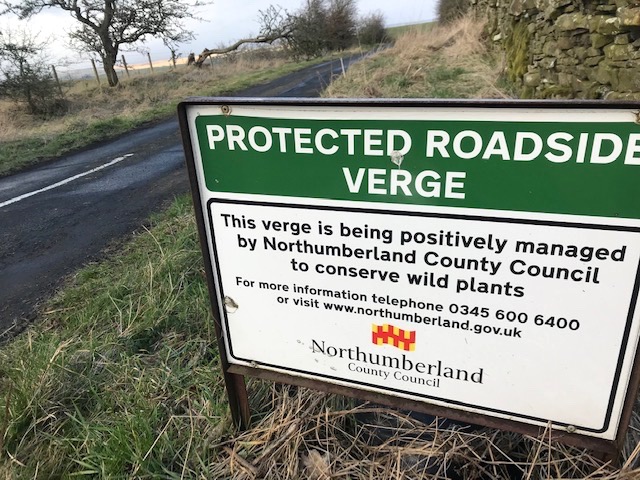
A little further, on a narrow side lane heading into the valley (‘Unsuitable for HGVs’) there’s this additional public notice…Be good to return later in the year to see what the verges look like then. I wish NCC luck as the sentiment is sound and that management will match aspiration. Bearing in mind the cyclists’ addendum I also hope that increased flowering on the roadside provides no extra cause for conflict!

 STEPHEN TOMLIN